1
5 Important Elements of
a Short Story
The 5 key elements that make up a short story are:
Characters
Setting
Conflict
Theme
Plot
Prer
2
Character
 A character is a person, or sometimes an animal, who ta
kes part in the action of a short story or other literary w
ork.
 Characters and how we get to know them:
 Through the author’s physical description of them
 Through their actions
 Through their words (dialogue)
 Through their inner thoughts
 Through what other characters say and think about them
3
Setting
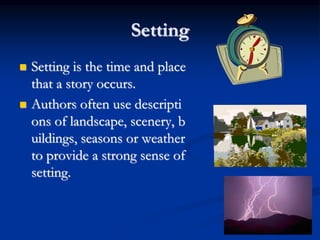
 Setting is the time and place
that a story occurs.
 Authors often use descripti
ons of landscape, scenery, b
uildings, seasons or weather
to provide a strong sense of
setting.
4
Theme
 Theme is the meaning behind events and charac
ters’ actions in a story.
 The theme is the central idea, message, or purpo
se in a short story.
 A theme can be expressed as a general statement
about people or life.
 It is NOT plot summary.
 It can be either directly or indirectly stated by th
e author. Most likely indirectly.
5
Conflict
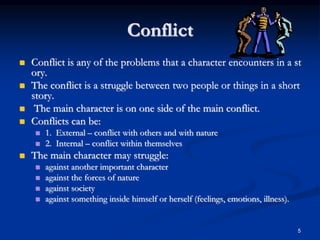
 Conflict is any of the problems that a character encounters in a st
ory.
 The conflict is a struggle between two people or things in a short
story.
 The main character is on one side of the main conflict.
 Conflicts can be:
 1. External – conflict with others and with nature
 2. Internal – conflict within themselves
 The main character may struggle:
 against another important character
 against the forces of nature
 against society
 against something inside himself or herself (feelings, emotions, illness).
6
Plot
 Plot is a pattern of events that develop from the interac
tions between characters.
 A plot is a series of events and character actions that rel
ate to the central conflict.
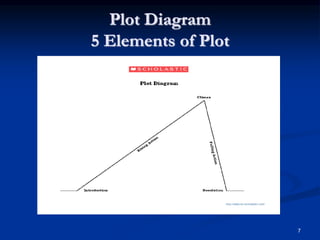
 There are 5 elements of plot:
 Exposition
 Rising Action
 Climax
 Falling Action
 Conclusion
7
Plot Diagram
5 Elements of Plot
8
Exposition
 The start or introduction of the story.
 The background information that the reader mu
st have in order to understand the story.
 This is where characters and setting are introduc
ed.
9
Rising Action
 All of the events that take place leading up to th
e climax.
 This is where the reader is introduced to the con
flict.
10
Climax
 The most exciting part of the story.
 The turning point in the story.
 Here the story is turned in a different direction, t
oward the conclusion.
11
Falling Action
 The immediate reaction to the climax.
 All the actions that occur after the climax and be
fore the conclusion of the story.
12
Resolution
 The conclusion of the plot.
 Loose ends are tied up.
 There might not be a clear res
olution. This is called a cliffha
nger ending.

ELEMENTS 101.pptx

  • 1.
    1 5 Important Elementsof a Short Story The 5 key elements that make up a short story are: Characters Setting Conflict Theme Plot Prer
  • 2.
    2 Character  A characteris a person, or sometimes an animal, who ta kes part in the action of a short story or other literary w ork.  Characters and how we get to know them:  Through the author’s physical description of them  Through their actions  Through their words (dialogue)  Through their inner thoughts  Through what other characters say and think about them
  • 3.
    3 Setting  Setting isthe time and place that a story occurs.  Authors often use descripti ons of landscape, scenery, b uildings, seasons or weather to provide a strong sense of setting.
  • 4.
    4 Theme  Theme isthe meaning behind events and charac ters’ actions in a story.  The theme is the central idea, message, or purpo se in a short story.  A theme can be expressed as a general statement about people or life.  It is NOT plot summary.  It can be either directly or indirectly stated by th e author. Most likely indirectly.
  • 5.
    5 Conflict  Conflict isany of the problems that a character encounters in a st ory.  The conflict is a struggle between two people or things in a short story.  The main character is on one side of the main conflict.  Conflicts can be:  1. External – conflict with others and with nature  2. Internal – conflict within themselves  The main character may struggle:  against another important character  against the forces of nature  against society  against something inside himself or herself (feelings, emotions, illness).
  • 6.
    6 Plot  Plot isa pattern of events that develop from the interac tions between characters.  A plot is a series of events and character actions that rel ate to the central conflict.  There are 5 elements of plot:  Exposition  Rising Action  Climax  Falling Action  Conclusion
  • 7.
  • 8.
    8 Exposition  The startor introduction of the story.  The background information that the reader mu st have in order to understand the story.  This is where characters and setting are introduc ed.
  • 9.
    9 Rising Action  Allof the events that take place leading up to th e climax.  This is where the reader is introduced to the con flict.
  • 10.
    10 Climax  The mostexciting part of the story.  The turning point in the story.  Here the story is turned in a different direction, t oward the conclusion.
  • 11.
    11 Falling Action  Theimmediate reaction to the climax.  All the actions that occur after the climax and be fore the conclusion of the story.
  • 12.
    12 Resolution  The conclusionof the plot.  Loose ends are tied up.  There might not be a clear res olution. This is called a cliffha nger ending.