Prof. N.M. Aher
Dept. Of Physics
Shree Ganesh Junior college Korhale
We know that the light has dual nature.
The Phenomena of interference & diffraction etc. can be
explained on the basis of wave theory of light.
Whereas the phenomena of Photoelectric Effect , compton
effect can be explained on the basis of particle theory of light.
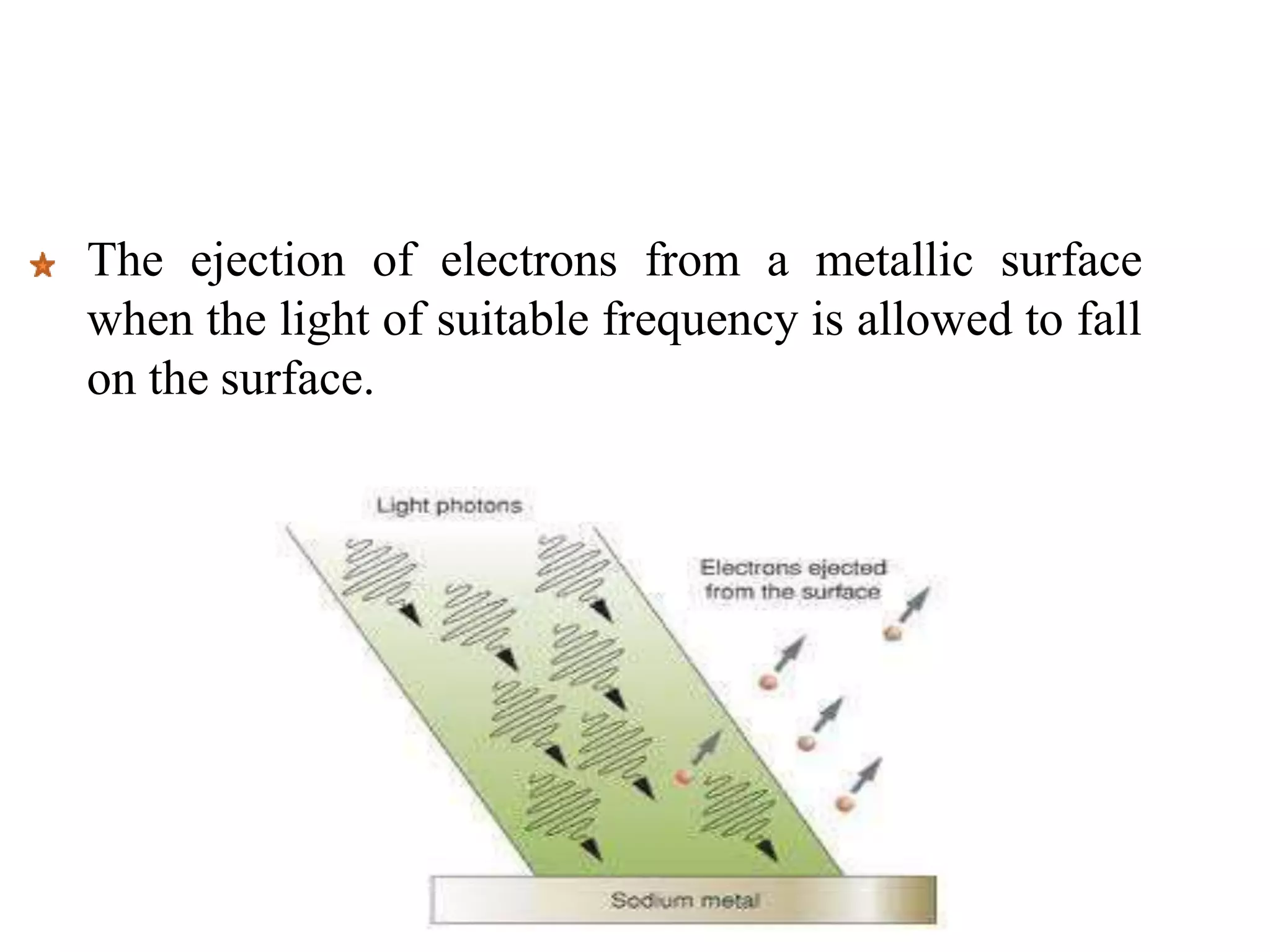
The ejection of electrons from a metallic surface
when the light of suitable frequency is allowed to fall
on the surface.
This suitable frequency is called Threshold
Frequency and the corresponding
wavelength is called threshold wavelength.
Work function: The work function is the
energy required to remove an electron from
the highest filled level.
•Incident light triggers the emission of (photo)electrons
from the cathode.
•Some of them travel toward the collector (anode) with an
initial kinetic energy.
•The applied voltage V either accelerates (if positive) or
decelerates (if negative) the incoming electrons.
•The intensity I of the current measured by the ammeter as
a function of the applied voltage V is a measurement of the
photoelectron properties, and therefore a measurement of
the properties of the photoelectric effect.
E
Km
W
Km :- maximum kinetic energy
of emitted electron
W :- work function
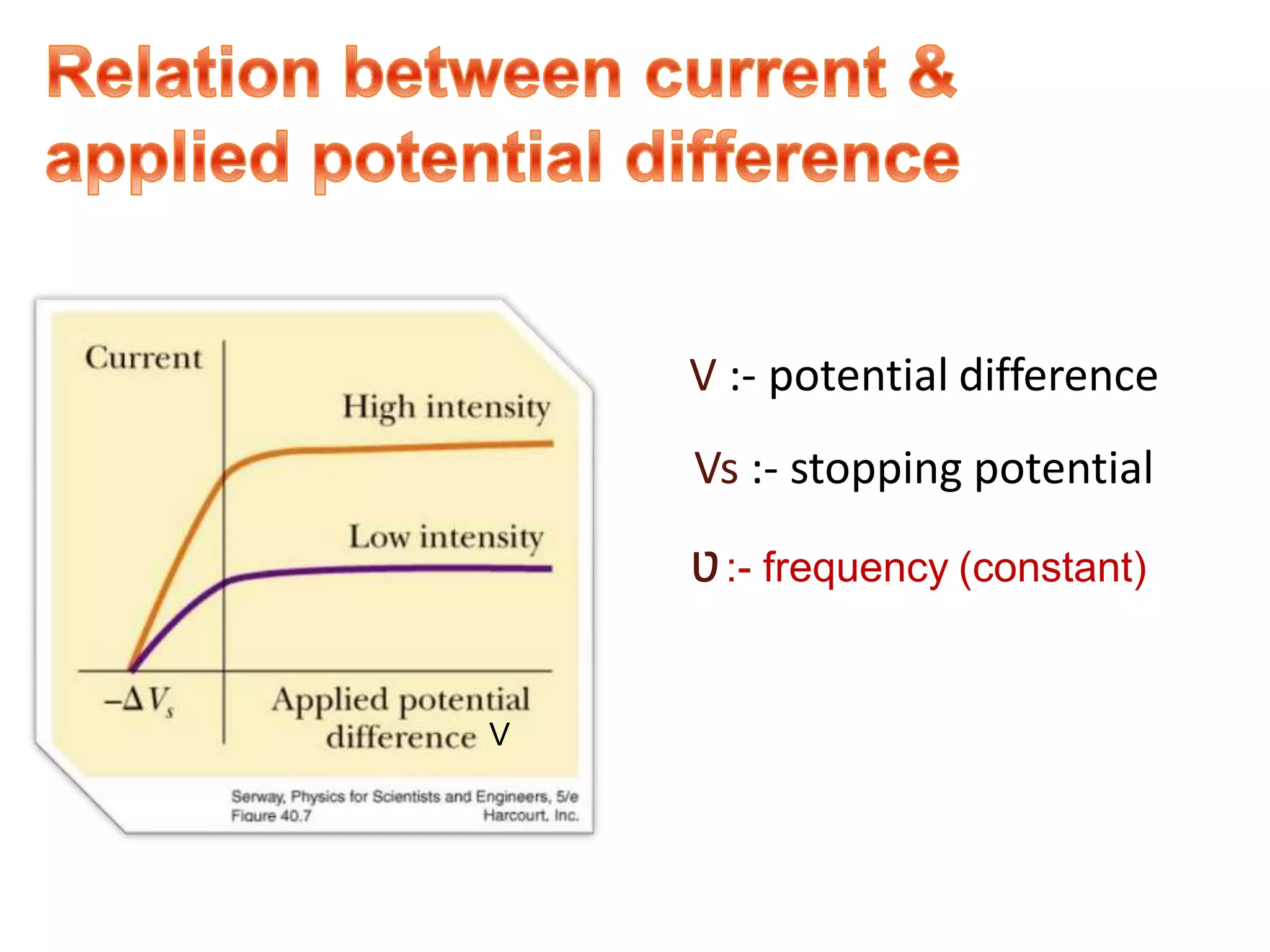
V
V :- potential difference
Vs :- stopping potential
ʋ:- frequency (constant)
Vs1 Vs2 Vs3
Ʋ1
Ʋ2
Ʋ3
The stopping potential depends on the frequency:-Higher
frequencies generates higher energy electrons.
Ʋ1 > Ʋ2 > Ʋ3
Photoelectric effect is directly proportional to intensity.
If the frequency of the incident light is less than the threshold frequency
then no electron ejected, no matter what the intensity.
The maximum kinetic energy of the electrons depend on the frequency of
the incident light.
The electrons were emitted immediately - no time lag.
Stopping potential is directly proportional to
frequency.
The process is instantaneous.
Characteristic of photoelectric effect
Einstein photoelectric equation
In 1905, on the basis of plank’s quantum theory ,
Albert Einstein derived the photoelectric equation
and explain all the characteristic of photoelectric
effect.
Einstein assumed that , When the radiation of
frequency υ is incident on the emitter surface,
collision occurs between the photons and the
electrons of the emitter atoms, during which the
electron completely absorbs the energy ‘hυ’ of
the photon.
Some part of the energy is used in liberating the electron from the
emitter surface and remaining part appears as kinetic energy (K.E) of
the liberated electron
The Photoelectric work function (W0) of the emitter is minimum
energy required to liberated an electron from the emitter surface.
Einstein photoelectric equation
Einstein Equations:
Photon Energy = Maximum K.E of electron + Work Function
h υ = K.E +W0 …………..(1)
But, W0= h υ0 and K.Emax = 2
_
MV2
1
Where , υ0 = threshold frequency,
m = mass of electron ,
Vmax = maximum velocity of electron
from equation (1)
h υ = M Vmax
2 + h υ0
1
2
_
_
2
1 M Vmax
2
= h (υ- υ0 )……. (2)
Also
1_
2
M Vmax
2 = e V0 Where e= charge of electron
V0 = Stopping Potential
e V0 = h (υ- υ0 )………..(3)
Equation (2 )and (3) both represents Einstein Photoelectric equation
Characteristics of photoelectric effect on the basis of Einstein Equation
The photoelectric work function W0 is constant for a given emitter.
By equation (2) its shows that,
a) if υ < υ0 , then K.E is negative which is not possible.
b) if υ > υ0 , then photoelectrons move with some velocity.
K.E > 0, which is possible. Hence photoelectron emitted.
c) if υ = υ0, the photoelectron are just emitted.
in this case, K.E =0
The maximum K.E with which photoelectron are emitted is independent of
intensity of radiation.
K.E of photoelectron is directly proportional to the frequency
According to quantum theory, when intensity of radiation is increase in
number of photons incident per second on the surface.
One photon can cause emission of one electron.
Photo electric cell
Photo electric cell
• Principle : a photoelectric cell is a device which
converts the light energy into an electrical energy.
Construction :
1. It consists of an evacuted glass tube or bulb in
which two electrode a cathode C and anode A are
fixed.
2. The cathode is semi cylindrical in shape and its
concave surface is coated with a photosensitive
material like sodium or cesium.
3. The anode is in form of platinum rod or wire
which is fixed along the axis of the cathode.
4. The cathode is connected to the negative
terminal and the anode to the positive terminal
of a strong d.c source.
Working :
1. When a suitable radiation falls on the
concave surface of the cathode, it
emits photoelectrons. These
photoelectron are attracted by the
anode which is at a positive potential
with respect to the cathode.
2. The electrons pass into the external
circuit causing an electric current
which can be measured from the
micro ammeter connected in series
with anode.
3. If the intensity of incident radiation is
increased, the rate of photoelectric
emission increases causing an
increase in the current.
4. Thus current is directly proportional
to the intensity of incident radiation.
APPLICATION OF PHOTOELECTRIC
EFFECT:- 1) photoelectric cell used in camera
for exposure meter.
3) Photoelectric cell are also used
for burglar alarm.
Particle nature of light : The Photon
What are Photon ?
when an atom absorbs or emits light, the energy transfer occurs in discrete packets of
energy. These packets of energy are called Photons.
Photon energy is given by ,
E= hc / λ
where, h= planks constant
h= 6.334x10^-34 J s
Properties of photon:
1. A photon does not have any mass.
2 . A photon does not have any charge and are not deflected in electric field or
magnetic field.
3 . All the quantum numbers are zero for a photon
4. In empty space, the photon moves at speed of light.
5. In the interaction of radiation with matter, radiation behaves as if it is made up of particles
called photons.
6. The energy and momentum of a photon are related as follows E= p.c where p- magnitude of
momentum and c is the speed of light.
7 . Photon is called as a virtualparticles.
8 . The energy of a photon is directly proportional to frequency and inversely proportional to
its wavelength.
Electron and photon

Electron and photon

  • 1.
    Prof. N.M. Aher Dept.Of Physics Shree Ganesh Junior college Korhale
  • 2.
    We know thatthe light has dual nature. The Phenomena of interference & diffraction etc. can be explained on the basis of wave theory of light. Whereas the phenomena of Photoelectric Effect , compton effect can be explained on the basis of particle theory of light.
  • 3.
    The ejection ofelectrons from a metallic surface when the light of suitable frequency is allowed to fall on the surface.
  • 4.
    This suitable frequencyis called Threshold Frequency and the corresponding wavelength is called threshold wavelength. Work function: The work function is the energy required to remove an electron from the highest filled level.
  • 6.
    •Incident light triggersthe emission of (photo)electrons from the cathode. •Some of them travel toward the collector (anode) with an initial kinetic energy. •The applied voltage V either accelerates (if positive) or decelerates (if negative) the incoming electrons. •The intensity I of the current measured by the ammeter as a function of the applied voltage V is a measurement of the photoelectron properties, and therefore a measurement of the properties of the photoelectric effect.
  • 7.
    E Km W Km :- maximumkinetic energy of emitted electron W :- work function
  • 8.
    V V :- potentialdifference Vs :- stopping potential ʋ:- frequency (constant)
  • 9.
    Vs1 Vs2 Vs3 Ʋ1 Ʋ2 Ʋ3 Thestopping potential depends on the frequency:-Higher frequencies generates higher energy electrons. Ʋ1 > Ʋ2 > Ʋ3
  • 10.
    Photoelectric effect isdirectly proportional to intensity. If the frequency of the incident light is less than the threshold frequency then no electron ejected, no matter what the intensity. The maximum kinetic energy of the electrons depend on the frequency of the incident light. The electrons were emitted immediately - no time lag. Stopping potential is directly proportional to frequency. The process is instantaneous. Characteristic of photoelectric effect
  • 11.
    Einstein photoelectric equation In1905, on the basis of plank’s quantum theory , Albert Einstein derived the photoelectric equation and explain all the characteristic of photoelectric effect. Einstein assumed that , When the radiation of frequency υ is incident on the emitter surface, collision occurs between the photons and the electrons of the emitter atoms, during which the electron completely absorbs the energy ‘hυ’ of the photon. Some part of the energy is used in liberating the electron from the emitter surface and remaining part appears as kinetic energy (K.E) of the liberated electron The Photoelectric work function (W0) of the emitter is minimum energy required to liberated an electron from the emitter surface.
  • 12.
    Einstein photoelectric equation EinsteinEquations: Photon Energy = Maximum K.E of electron + Work Function h υ = K.E +W0 …………..(1) But, W0= h υ0 and K.Emax = 2 _ MV2 1 Where , υ0 = threshold frequency, m = mass of electron , Vmax = maximum velocity of electron from equation (1) h υ = M Vmax 2 + h υ0 1 2 _ _ 2 1 M Vmax 2 = h (υ- υ0 )……. (2) Also 1_ 2 M Vmax 2 = e V0 Where e= charge of electron V0 = Stopping Potential e V0 = h (υ- υ0 )………..(3) Equation (2 )and (3) both represents Einstein Photoelectric equation
  • 13.
    Characteristics of photoelectriceffect on the basis of Einstein Equation The photoelectric work function W0 is constant for a given emitter. By equation (2) its shows that, a) if υ < υ0 , then K.E is negative which is not possible. b) if υ > υ0 , then photoelectrons move with some velocity. K.E > 0, which is possible. Hence photoelectron emitted. c) if υ = υ0, the photoelectron are just emitted. in this case, K.E =0 The maximum K.E with which photoelectron are emitted is independent of intensity of radiation. K.E of photoelectron is directly proportional to the frequency According to quantum theory, when intensity of radiation is increase in number of photons incident per second on the surface. One photon can cause emission of one electron.
  • 14.
    Photo electric cell Photoelectric cell • Principle : a photoelectric cell is a device which converts the light energy into an electrical energy. Construction : 1. It consists of an evacuted glass tube or bulb in which two electrode a cathode C and anode A are fixed. 2. The cathode is semi cylindrical in shape and its concave surface is coated with a photosensitive material like sodium or cesium. 3. The anode is in form of platinum rod or wire which is fixed along the axis of the cathode. 4. The cathode is connected to the negative terminal and the anode to the positive terminal of a strong d.c source.
  • 15.
    Working : 1. Whena suitable radiation falls on the concave surface of the cathode, it emits photoelectrons. These photoelectron are attracted by the anode which is at a positive potential with respect to the cathode. 2. The electrons pass into the external circuit causing an electric current which can be measured from the micro ammeter connected in series with anode. 3. If the intensity of incident radiation is increased, the rate of photoelectric emission increases causing an increase in the current. 4. Thus current is directly proportional to the intensity of incident radiation.
  • 16.
    APPLICATION OF PHOTOELECTRIC EFFECT:-1) photoelectric cell used in camera for exposure meter.
  • 18.
    3) Photoelectric cellare also used for burglar alarm.
  • 19.
    Particle nature oflight : The Photon What are Photon ? when an atom absorbs or emits light, the energy transfer occurs in discrete packets of energy. These packets of energy are called Photons. Photon energy is given by , E= hc / λ where, h= planks constant h= 6.334x10^-34 J s Properties of photon: 1. A photon does not have any mass. 2 . A photon does not have any charge and are not deflected in electric field or magnetic field. 3 . All the quantum numbers are zero for a photon 4. In empty space, the photon moves at speed of light. 5. In the interaction of radiation with matter, radiation behaves as if it is made up of particles called photons. 6. The energy and momentum of a photon are related as follows E= p.c where p- magnitude of momentum and c is the speed of light. 7 . Photon is called as a virtualparticles. 8 . The energy of a photon is directly proportional to frequency and inversely proportional to its wavelength.