ELECTRICAL LOCO TRIPSHED
SAWAI MADHOPUR (RAJASTHAN)
 Name – Akash karol
 2nd year (Electrical)
 Govt. Polytechnic college
• CONTENT
 INTRODUCTION
 HISTORY
 RAILWAY TRACK
 CLASSIFICATION OF LOCOMOTIVES IN INDIA BY TYPES
 OVERVIEW OF ELECTRIC LOCOMOTIVES
 ELECTRICAL PARTS OF ELECTRIC LOCOMOTIVES
 SOME IMPORTANT PARTS OF CAB
 LOCOMOTIVE BLOCK DIAGRAM
 CONCLUSION
• INTRODUCTION
 Locomotives in india cansist of Electrical and
Diesel locomotives. Locomotives are also called
locos and engine.
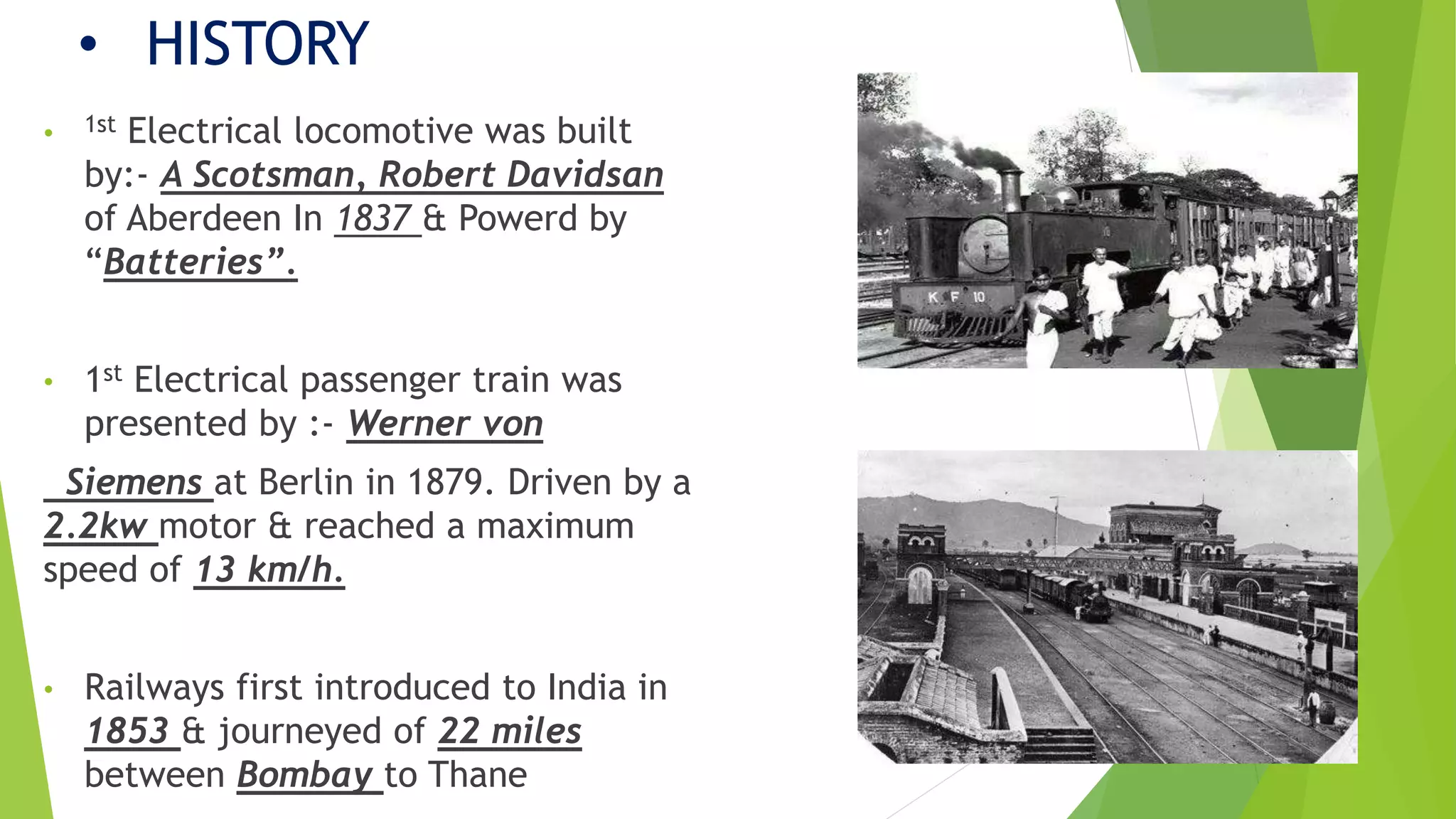
 An Electric Locomotives is a locomotive powered
by Electricity from overhead lines. An on board
energy chemical battery or fuel cell.
 Electricity is used to eliminate smoke and take
advantage of high efficiency of Electric motors.
• HISTORY
• 1st Electrical locomotive was built
by:- A Scotsman, Robert Davidsan
of Aberdeen In 1837 & Powerd by
“Batteries”.
• 1st Electrical passenger train was
presented by :- Werner von
Siemens at Berlin in 1879. Driven by a
2.2kw motor & reached a maximum
speed of 13 km/h.
• Railways first introduced to India in
1853 & journeyed of 22 miles
between Bombay to Thane
• Railway Track
Railways track gauge in india is complicated by historical usage Of multiple track
guages.
Indian railways uses four gauges:-
 1.676 mm (5 ft 6 in) - Broad Gauge (BG)
 1.000 mm (3 ft 3/8 in) - Metre Gauge(MG)
 762 mm (2 ft 6 in) - Narrow Gauge (NG)
 610 mm ( 2 ft) - Toy Gauge.
• Classification Of Locomotives In India By Type
Gauge Power Load Class Subtype
W A P 5 A
Service Gauge Traction Used Traffic Type Power/ version Arbitrary
W – Broad Gauge
Y – Meter Gauge
Z – Narrow Gauge
N – Toy Gauge
(Z = 2” 6’ N = 2”)
D – Diesel
A – Ac Electric
C – Dc Electric
CA – Ac+Dc Duel
B – Battery
P – Passenger
G – Goods
M – Mixed
S – Shunter
U –DMU/MEMU
Power Rating
Diesels (WDM2×)
Number×1000hp
Version Number
Electric+ WDM2×
Incremental
Power Rating
(Diesel Only)
Variant, Models
Variations
• OVERVIEW OF ELECTRIC LOCOMOTIVES
 Now a Days all locos are running
through Electricity with the help of OHE
lines.
 Pantograph is used to connect to loco
witj OHE Lines.
 Loco contains 2 Bgies. Each Bogie
consist of 6 wheels. So totally loco
consist of 12 wheels.
 Pantograph draws 25 KV of Electricity
from OHE Lines. Whkch is very high Ac
Voltage.
• ELECTRICAL PARTS OF LOCOMOTIVES
 TRANSFORMER
 RECTIFIER
 ARNO CONVERTOR
 TRACTION MOTORS
 AIR COMPRESSORS
 MOTOR - ALTERNATOR
• TRANSFORMER
 Transformer Oil circulation pump.
 Transformer oil cooling Radiator Blower
 Output voltage of the Traction converter Is
2180V
 Output current is 831A
 Output power is 2365 KW
• RECTIFIER
• ARNO CONVERTOR
 This is a rotary convertor which has a combined set of windings
and is used to convert the single phase supply from the Tertiary
winding of the Loco transformer to Three-Phase AC which is fit
for use by the various Auxiliary machines in the loco.
• TRACTION MOTOR
 A traction motor is an Electrical
motor used for propulsion of a
vehicle, such as an Electrical
Locomotives or electric roadway
vehicle.
 Traction motors are used in
electrically powered rail vehicles such
as Electric multiple unit and other
Electric vehicles such as Electric milk
flots, elevators, conayoers,
and trolleybuses, as well as vehicles
with electrical transmission systems
such as diesel-electric, electric hybrid
vehicles, and battery electric vehicles.
• AIR COMPRESSORS
 Electric locos need compressed at a pressure ranging from 6 kg/cm2 to 10
kg/cm2. Compressed air is used for the loco's own air brake system as
also for the train brakes, for raising the pantograph, for operating the
power switchgear inside the loco such as the power contactors, change-
over switches, windscreen wipers, sanders, etc.
 This compressed air is obtained by providing three air compressors, each
having a capacity to pump 1000 litres of air per minute. However
depending on the current requirement, more than two compressors are
rarely needed.
• MOTOR – ALTERNATER
 The MA set is used to generate power for
the Auxiliary machines in both the AC as
well as DC sections because the Arno
cannot run in DC line supply. The MA set
comprises of a DC motor coupled to an AC
alternator by a mechanical coupling. When
the loco is under AC line supply the DC
motor of the MA Set is fed by the tertiary
winding of the transformer via an auxiliary
rectifier known as RSI-3. While running in
DC line sections the DC motor of the MA
Set is supplied directly by the OHE line
supply. The switching between the AC and
DC modes is determined automatically by
the position of the Panto changeover
switch ZPT which in turn determines the
position of the Change-Over switches.
• SOME IMPORTANT PARTS OF CAB
 RHS Loco Control Desk
 LHS corner of The Cab
 Ammeters & voltmeters
 Implementation of modern vigilance contral Device
 DJ main contactor
 Sanding on Locomotives
• THE RHS CORNER OF THE LOCO CONTROL
 “A” – Horn valves
 “B” – Emergency brake flap
 “C” – Flasher light control unit
 “D” – Marker lamps control unit
• A VIEW OF THE LHS CORNER OF THE CAB
 "A": A9 , train brakes
 "B": SA 9, Loco brakes
 "C" Speedometer.
 "D": Air flow meter.
 "E": Ash tray.
 "F":Valves / switches to blow
horn
 "G": Gauges to indicate brake air
pressure.
• VOLTMETERS AMMETERS
•AM4 TM4: This ammeter indicates the current flowing through
Traction motor no. 4. A WAP 4 loco may draw a max current of
1000 Amps for a max duration of 10 minutes. Current of 900
Amps may be drawn continuously.
•U-5 TM-5: This volt meter indicates the voltage across Traction
motor no. five. The voltage at no time should exceed 750
voltage. When a quick acceleration is required and if the voltage
exceeds 750 volts due to rapid increase of notches, the
shunting notch (weak field lever or the "MPS") may be put into
position one after notch 20. This will lead to an increase in the
amps across the traction motors but a reduction in the voltage
across it. The notches may than be increased and again if the
voltage goes up the shunting notch may be put at position two.
•U-6 TM-6: This voltmeter indicates voltage across Traction
motor six. Old timers may wonder as to why there are two
voltmeters and only one ammeter, because there used to be two
ammeters and one volt meter in all loco upto now. The reason is
that now, higher than permissible voltage across the TM's for
burnt out of TM's.
• IMPLEMENTATION OF MORDERN VIGILANCE
CONTRAL DEVICE
In indian railways, Major accident have been caused
due to failure of Railway staff. Higher incidence of
human failure surface as technical safeguardAnd
backups
Don not always replace the human effort. Though an
accident occurs only when both fail but it usually gots
logged as human error with a tendency of glossing
over technical failure.
vigilance contral Device plays a major role to reduce
the accident that are caused by the pilot of the train
vigilance contral Device (VCD) is a microcontroller
based safety device which will automatically apply
penalty brakes in case the driver is incapacitated or
dead.
• WORKING OF VCD
 THe VCD monitors whether these controls
have been operated by the driver in a 60
second time period. In case the driver has
not operated light for 8 second. If
acknowledge is not received. An additional
alarm, a message is send ti guard and to
signal inspector thought GSM mordern as “
DRIVER IS NOT ALERT” here guard is
provided with break to control the VCD. If
guard is not apply break within 10 second
than message send to signal inspector as “
DRIVER AND GUARD NOT ALERT” and
VCD will initiate the automatic application
of break and it inform the position of the
train where it is stopped in the form of
latitude and longitude thought GSM by
using GPS module.
• DJ MAIN CONTACTOR
DJ Control circuit is provided
1. To give starting phase to arno
2. To protect the loco if any of eight auxiliary
motors is not working
3. To protect the loco if arno is not working
4. To protect RGR
5. To ensure that GR is on “0” while closing DJ
6. To protect feeding power circuit from over
current and short circuit
7. To protect auxiliary power circuit from over
current and earth fault.
8. To protect tracion power circuit from over
current and earth fault.
9. If trip DJ if GR is struck up on full notches
while doing quick registration with MP.
• Types Of DJ
 In DJ there are two types ABCB and VCB.
 In VCB there are three types
 In ABCB DJ control circuit there are six branches
{Q118, Q45, Q44, C118, EFDJ, MTDJ}
 In VCB DJ (Double Interrupter and single Interrupter
vertical) control circuit there are five branches.
{Q118, Q45, Q44, C118 AND MTDJ}
In these are two types closing coil and tripping coil is
MTDJ.
1. Double Interrupter VCB.
2. Single Interrupter horizontal VCB.
3. Sngle Interrupter vertical VCB.
• SANDING ON LOCOMOTIVE
 A SANDBOX is a container on most
Locomotives, multiple units and teams
that holds send, wbich is dropped on
the rail in front of the driving wheels in
wet and slippery conditions and on
steep grades in order to improve
traction.
• LOCOMOTIVE BLOCK DIAGRAM
• ADVANTAGES OF ELECTRIC LOCOMOTIVES
 Electric Locomotives do not produce much heat and noise.
 Electric Locomotives are therefore easier to maintain whereas the moving
parts of a diesel Locomotives require constant maintenance.
 The simple nature of the Electric Locomotives make tham efficient and
powerful.
 Electric Locomotives are light weight, constituting only motors and wheel
axides, and have almost no moving parts.
 Do not produce smoke.
 3- phase drive allows regeneration and unity power facto operation.
 It is improve operation efficiency besides reduction in maintenance efforts.
The energy saving due to regeneration and improved power factor sizeable.
• CONCLUSION
 Main Objective was to learn Electric Locomotives in
Indian railways.
 I am thankful to the supporting people of the
Electric locoshed sawai madhopur.
 Electricity is used to eliminate smoke and take
advantage of the high efficiency of Electric motors.
THANK
YOU

Electrical loco tripshed,sawai madhopur

  • 1.
    ELECTRICAL LOCO TRIPSHED SAWAIMADHOPUR (RAJASTHAN)  Name – Akash karol  2nd year (Electrical)  Govt. Polytechnic college
  • 2.
    • CONTENT  INTRODUCTION HISTORY  RAILWAY TRACK  CLASSIFICATION OF LOCOMOTIVES IN INDIA BY TYPES  OVERVIEW OF ELECTRIC LOCOMOTIVES  ELECTRICAL PARTS OF ELECTRIC LOCOMOTIVES  SOME IMPORTANT PARTS OF CAB  LOCOMOTIVE BLOCK DIAGRAM  CONCLUSION
  • 3.
    • INTRODUCTION  Locomotivesin india cansist of Electrical and Diesel locomotives. Locomotives are also called locos and engine.  An Electric Locomotives is a locomotive powered by Electricity from overhead lines. An on board energy chemical battery or fuel cell.  Electricity is used to eliminate smoke and take advantage of high efficiency of Electric motors.
  • 4.
    • HISTORY • 1stElectrical locomotive was built by:- A Scotsman, Robert Davidsan of Aberdeen In 1837 & Powerd by “Batteries”. • 1st Electrical passenger train was presented by :- Werner von Siemens at Berlin in 1879. Driven by a 2.2kw motor & reached a maximum speed of 13 km/h. • Railways first introduced to India in 1853 & journeyed of 22 miles between Bombay to Thane
  • 5.
    • Railway Track Railwaystrack gauge in india is complicated by historical usage Of multiple track guages. Indian railways uses four gauges:-  1.676 mm (5 ft 6 in) - Broad Gauge (BG)  1.000 mm (3 ft 3/8 in) - Metre Gauge(MG)  762 mm (2 ft 6 in) - Narrow Gauge (NG)  610 mm ( 2 ft) - Toy Gauge.
  • 6.
    • Classification OfLocomotives In India By Type Gauge Power Load Class Subtype W A P 5 A Service Gauge Traction Used Traffic Type Power/ version Arbitrary W – Broad Gauge Y – Meter Gauge Z – Narrow Gauge N – Toy Gauge (Z = 2” 6’ N = 2”) D – Diesel A – Ac Electric C – Dc Electric CA – Ac+Dc Duel B – Battery P – Passenger G – Goods M – Mixed S – Shunter U –DMU/MEMU Power Rating Diesels (WDM2×) Number×1000hp Version Number Electric+ WDM2× Incremental Power Rating (Diesel Only) Variant, Models Variations
  • 7.
    • OVERVIEW OFELECTRIC LOCOMOTIVES  Now a Days all locos are running through Electricity with the help of OHE lines.  Pantograph is used to connect to loco witj OHE Lines.  Loco contains 2 Bgies. Each Bogie consist of 6 wheels. So totally loco consist of 12 wheels.  Pantograph draws 25 KV of Electricity from OHE Lines. Whkch is very high Ac Voltage.
  • 8.
    • ELECTRICAL PARTSOF LOCOMOTIVES  TRANSFORMER  RECTIFIER  ARNO CONVERTOR  TRACTION MOTORS  AIR COMPRESSORS  MOTOR - ALTERNATOR
  • 9.
    • TRANSFORMER  TransformerOil circulation pump.  Transformer oil cooling Radiator Blower  Output voltage of the Traction converter Is 2180V  Output current is 831A  Output power is 2365 KW
  • 10.
  • 11.
    • ARNO CONVERTOR This is a rotary convertor which has a combined set of windings and is used to convert the single phase supply from the Tertiary winding of the Loco transformer to Three-Phase AC which is fit for use by the various Auxiliary machines in the loco.
  • 12.
    • TRACTION MOTOR A traction motor is an Electrical motor used for propulsion of a vehicle, such as an Electrical Locomotives or electric roadway vehicle.  Traction motors are used in electrically powered rail vehicles such as Electric multiple unit and other Electric vehicles such as Electric milk flots, elevators, conayoers, and trolleybuses, as well as vehicles with electrical transmission systems such as diesel-electric, electric hybrid vehicles, and battery electric vehicles.
  • 13.
    • AIR COMPRESSORS Electric locos need compressed at a pressure ranging from 6 kg/cm2 to 10 kg/cm2. Compressed air is used for the loco's own air brake system as also for the train brakes, for raising the pantograph, for operating the power switchgear inside the loco such as the power contactors, change- over switches, windscreen wipers, sanders, etc.  This compressed air is obtained by providing three air compressors, each having a capacity to pump 1000 litres of air per minute. However depending on the current requirement, more than two compressors are rarely needed.
  • 14.
    • MOTOR –ALTERNATER  The MA set is used to generate power for the Auxiliary machines in both the AC as well as DC sections because the Arno cannot run in DC line supply. The MA set comprises of a DC motor coupled to an AC alternator by a mechanical coupling. When the loco is under AC line supply the DC motor of the MA Set is fed by the tertiary winding of the transformer via an auxiliary rectifier known as RSI-3. While running in DC line sections the DC motor of the MA Set is supplied directly by the OHE line supply. The switching between the AC and DC modes is determined automatically by the position of the Panto changeover switch ZPT which in turn determines the position of the Change-Over switches.
  • 15.
    • SOME IMPORTANTPARTS OF CAB  RHS Loco Control Desk  LHS corner of The Cab  Ammeters & voltmeters  Implementation of modern vigilance contral Device  DJ main contactor  Sanding on Locomotives
  • 16.
    • THE RHSCORNER OF THE LOCO CONTROL  “A” – Horn valves  “B” – Emergency brake flap  “C” – Flasher light control unit  “D” – Marker lamps control unit
  • 17.
    • A VIEWOF THE LHS CORNER OF THE CAB  "A": A9 , train brakes  "B": SA 9, Loco brakes  "C" Speedometer.  "D": Air flow meter.  "E": Ash tray.  "F":Valves / switches to blow horn  "G": Gauges to indicate brake air pressure.
  • 18.
    • VOLTMETERS AMMETERS •AM4TM4: This ammeter indicates the current flowing through Traction motor no. 4. A WAP 4 loco may draw a max current of 1000 Amps for a max duration of 10 minutes. Current of 900 Amps may be drawn continuously. •U-5 TM-5: This volt meter indicates the voltage across Traction motor no. five. The voltage at no time should exceed 750 voltage. When a quick acceleration is required and if the voltage exceeds 750 volts due to rapid increase of notches, the shunting notch (weak field lever or the "MPS") may be put into position one after notch 20. This will lead to an increase in the amps across the traction motors but a reduction in the voltage across it. The notches may than be increased and again if the voltage goes up the shunting notch may be put at position two. •U-6 TM-6: This voltmeter indicates voltage across Traction motor six. Old timers may wonder as to why there are two voltmeters and only one ammeter, because there used to be two ammeters and one volt meter in all loco upto now. The reason is that now, higher than permissible voltage across the TM's for burnt out of TM's.
  • 19.
    • IMPLEMENTATION OFMORDERN VIGILANCE CONTRAL DEVICE In indian railways, Major accident have been caused due to failure of Railway staff. Higher incidence of human failure surface as technical safeguardAnd backups Don not always replace the human effort. Though an accident occurs only when both fail but it usually gots logged as human error with a tendency of glossing over technical failure. vigilance contral Device plays a major role to reduce the accident that are caused by the pilot of the train vigilance contral Device (VCD) is a microcontroller based safety device which will automatically apply penalty brakes in case the driver is incapacitated or dead.
  • 20.
    • WORKING OFVCD  THe VCD monitors whether these controls have been operated by the driver in a 60 second time period. In case the driver has not operated light for 8 second. If acknowledge is not received. An additional alarm, a message is send ti guard and to signal inspector thought GSM mordern as “ DRIVER IS NOT ALERT” here guard is provided with break to control the VCD. If guard is not apply break within 10 second than message send to signal inspector as “ DRIVER AND GUARD NOT ALERT” and VCD will initiate the automatic application of break and it inform the position of the train where it is stopped in the form of latitude and longitude thought GSM by using GPS module.
  • 21.
    • DJ MAINCONTACTOR DJ Control circuit is provided 1. To give starting phase to arno 2. To protect the loco if any of eight auxiliary motors is not working 3. To protect the loco if arno is not working 4. To protect RGR 5. To ensure that GR is on “0” while closing DJ 6. To protect feeding power circuit from over current and short circuit 7. To protect auxiliary power circuit from over current and earth fault. 8. To protect tracion power circuit from over current and earth fault. 9. If trip DJ if GR is struck up on full notches while doing quick registration with MP.
  • 22.
    • Types OfDJ  In DJ there are two types ABCB and VCB.  In VCB there are three types  In ABCB DJ control circuit there are six branches {Q118, Q45, Q44, C118, EFDJ, MTDJ}  In VCB DJ (Double Interrupter and single Interrupter vertical) control circuit there are five branches. {Q118, Q45, Q44, C118 AND MTDJ} In these are two types closing coil and tripping coil is MTDJ. 1. Double Interrupter VCB. 2. Single Interrupter horizontal VCB. 3. Sngle Interrupter vertical VCB.
  • 23.
    • SANDING ONLOCOMOTIVE  A SANDBOX is a container on most Locomotives, multiple units and teams that holds send, wbich is dropped on the rail in front of the driving wheels in wet and slippery conditions and on steep grades in order to improve traction.
  • 24.
  • 25.
    • ADVANTAGES OFELECTRIC LOCOMOTIVES  Electric Locomotives do not produce much heat and noise.  Electric Locomotives are therefore easier to maintain whereas the moving parts of a diesel Locomotives require constant maintenance.  The simple nature of the Electric Locomotives make tham efficient and powerful.  Electric Locomotives are light weight, constituting only motors and wheel axides, and have almost no moving parts.  Do not produce smoke.  3- phase drive allows regeneration and unity power facto operation.  It is improve operation efficiency besides reduction in maintenance efforts. The energy saving due to regeneration and improved power factor sizeable.
  • 26.
    • CONCLUSION  MainObjective was to learn Electric Locomotives in Indian railways.  I am thankful to the supporting people of the Electric locoshed sawai madhopur.  Electricity is used to eliminate smoke and take advantage of the high efficiency of Electric motors.
  • 27.