ELECTRIC SUBSTATION
SUBMITTED TO: GAGANDEEP SINGH WALLIA
SUBMITTED BY: ANNU KUMAR
REGISTRATION NO: 11711796
ROLL NO: B43
SECTION :1708
CASE STUDY
TABLE OF CONTANT
 INTRODUCTION
 TRANSFORMER
 CONDUCTORS , INSULATORS
 ISOLATORS
 BUSBARS
 LIGHTNING ARRESTERS
 CIRCUIT BREAKERS
 CONCLUSION
 REFERENCES
INTRODUCTION
 ELECRIC SUBSTATION : Part of an electrical, generation ,
transmission ,distribution system . Here voltage gets
transforms from low to high or high to low(generally).
 Between generation to consumption various sub station may
involve, at various level
 May be public or private owned
 May be of several types of substations ; transmission, pole,
switching , distribution e.t.c.
This case study is based on TRANSMISSION SUBSTATION
so important components used here are as follows,
 ELECTRICAL POWER TRANSFORMERS
 INSTRUMENTS TRANSFORMERS
 CONDUCTORS
 INSULATORS
 ISOLATORS
 BUS BARS
 LIGHTNING ARRESTERS
 CIRCUIT BREAKERS
 ELECTRICAL PANELS
SINGLE LINE CIRCUIT DIAGRAM
ELECTRICAL POWER TRANSFORMERS
• A STATIC ELECTRICAL MACHINE USED TO TRANSFORMS
LOW VOLTAGE TO HIGH OR VICE VERSA.
• WORKING PRINCIPLE BASED ON FARADAY LAW OF
ELECTROMAGNETIC INDUCTION ( a varying current in
one coil produces varying magnetic field which in turn
induces voltage in other coil)
FOUR COMBINATION IS POSSIBLE
DEPENDING UPON USE AND
LEVEL OF TRANSMISSION
INSTRUMENT TRANSFORMERS
CURRENT TRANSFORMERS
VOLTAGE TRANSFORMERS
 Instrument transformers scale the large values of voltage or current to
small, standardized values that are easy to handle for instruments
and protective relays.
 . This is because measuring meters or instruments and protective relays
are low voltage devices, thereby cannot be connected directly to high
voltage circuit for the purpose of measurement and protection of the
system.
 A current transformer provides a secondary current that is accurately
proportional to the current flowing in its primary.
 The current transformer presents a negligible load to the primary circuit.
 Current transformers are the current sensing units of the power system.
CONDUCTORS
 The material that allows the flow of electric charge is called conductor.
 Conductors permit free movement of the flow of electrons through them.
 These are used for the transmission of power or electrical energy.
 Conductors are of different types and mostly aluminum conductors are
preferred in practical power systems.
 Al 61% of conductivity than Cu.
 But has 30 % weight of copper.
 Bare wire of Al weighs half of Cu of same resistance.
 Types of Conductors:
 AAC - All Aluminum Conductor.
 AAAC - All Aluminum Alloy Conductor.
 ACSR - Aluminum Conductor Steel Reinforced.
 ACAR - Aluminum Conductor Aluminum-Alloy Reinforced
INSULATORS
 An electrical insulator is a material whose internal electric charges do not
flow freely
 Insulators used for high-voltage power transmission are made
from glass, porcelain or composite polymer materials.
 Strain insulator
 Suspension insulator
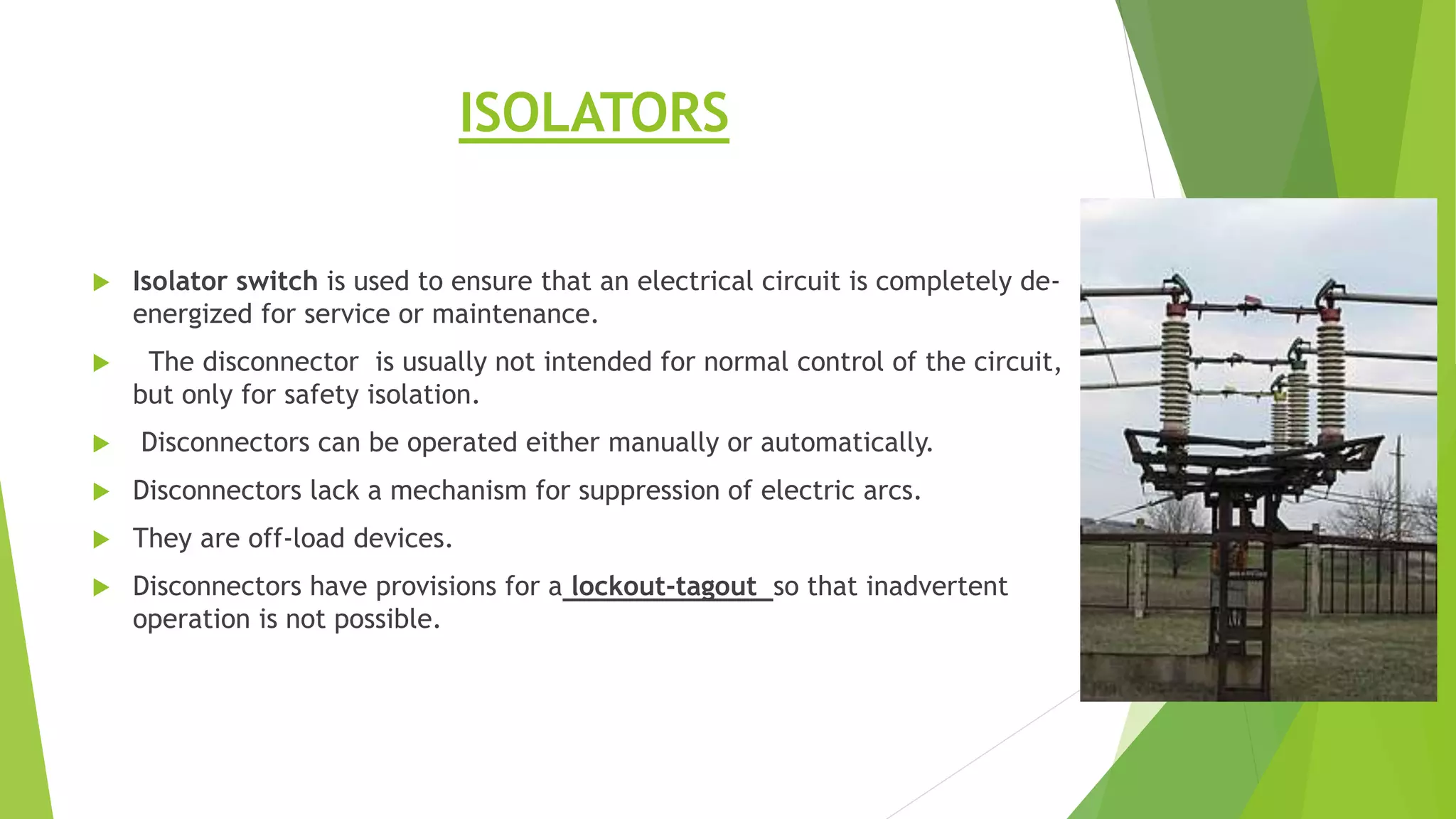
ISOLATORS
 Isolator switch is used to ensure that an electrical circuit is completely de-
energized for service or maintenance.
 The disconnector is usually not intended for normal control of the circuit,
but only for safety isolation.
 Disconnectors can be operated either manually or automatically.
 Disconnectors lack a mechanism for suppression of electric arcs.
 They are off-load devices.
 Disconnectors have provisions for a lockout-tagout so that inadvertent
operation is not possible.
LIGHTNING ARRESTER
 A lightning arrester is a device used on electrical power systems to protect
the insulation and conductors of the system from the damaging effects
of lightning.
 If protection fails or is absent, lightning that strikes the electrical system
introduces thousands of kilovolts that may damage the transmission lines, and
can also cause severe damage to transformers and other electrical or
electronic devices.
 USED BOTH SIDE OF TRANSFORMER
 These prevent the flow of the normal power or signal currents to ground, but
provide a path over which high-voltage lightning current flows bypasses to
earth.
 connected parallel to device to be protected
BUSBARS
 A busbar is a metallic strip or bar, typically housed inside switchgear, panel
boards, and busway enclosures for local high current power distribution.
 They are also used to connect high voltage equipment at electrical
switchyards, and low voltage equipment in battery banks.
 They are generally uninsulated, and have sufficient stiffness to be supported
in air by insulated pillars.
 These features allow sufficient cooling of the conductors, and the ability to
tap in at various points without creating a new joint.
 It can be used outside
CIRCUIT BREAKERS
 Vacuum interrupter is a switch which uses electrical contacts in a vacuum.
It is the core component of medium-voltage switches.
 Separation of the electrical contacts results in a vacuum arc, which is quickly
extinguished.
 The separation of contacts causes the release of vapour which is filled in the
contact space. It consists positive ions liberated from contact material.
 The vapour density depends on the current in the arc. When the current
decreases, the rate of vapour release decreases and after current zero.
 Medium regain its dielectric strength if the vapour density is reduced.
CONCLUSION
 VARIOUS ELECTRICTAL SYSTAMS ARE WONDERFULLY CONTRIBUTING TO
TRANSMISSION AND DISTRIBUTION SYSTEMS
 KNOWING THE SAFETY PRECAUTION TAKEN DURING WORKING
 MAINTAINING THE HEALTH OF EQUIPMENT IS VERY NECESSARY
REFERENCES
 WIKIPEDIA
 www.elprocus.com/vacuum-circuit-breaker-working-
applications
 www.edgefx.in/electrical-engineering-substation-
components-and-their-workings
 EE NPTEL PDF IIT KHARAGPUR
 WWW.QUORA.COM
 GOOGLE IMAGE
Electric substation

Electric substation

  • 1.
    ELECTRIC SUBSTATION SUBMITTED TO:GAGANDEEP SINGH WALLIA SUBMITTED BY: ANNU KUMAR REGISTRATION NO: 11711796 ROLL NO: B43 SECTION :1708 CASE STUDY
  • 2.
    TABLE OF CONTANT INTRODUCTION  TRANSFORMER  CONDUCTORS , INSULATORS  ISOLATORS  BUSBARS  LIGHTNING ARRESTERS  CIRCUIT BREAKERS  CONCLUSION  REFERENCES
  • 3.
    INTRODUCTION  ELECRIC SUBSTATION: Part of an electrical, generation , transmission ,distribution system . Here voltage gets transforms from low to high or high to low(generally).  Between generation to consumption various sub station may involve, at various level  May be public or private owned  May be of several types of substations ; transmission, pole, switching , distribution e.t.c.
  • 4.
    This case studyis based on TRANSMISSION SUBSTATION so important components used here are as follows,  ELECTRICAL POWER TRANSFORMERS  INSTRUMENTS TRANSFORMERS  CONDUCTORS  INSULATORS  ISOLATORS  BUS BARS  LIGHTNING ARRESTERS  CIRCUIT BREAKERS  ELECTRICAL PANELS
  • 5.
  • 6.
    ELECTRICAL POWER TRANSFORMERS •A STATIC ELECTRICAL MACHINE USED TO TRANSFORMS LOW VOLTAGE TO HIGH OR VICE VERSA. • WORKING PRINCIPLE BASED ON FARADAY LAW OF ELECTROMAGNETIC INDUCTION ( a varying current in one coil produces varying magnetic field which in turn induces voltage in other coil)
  • 10.
    FOUR COMBINATION ISPOSSIBLE DEPENDING UPON USE AND LEVEL OF TRANSMISSION
  • 13.
    INSTRUMENT TRANSFORMERS CURRENT TRANSFORMERS VOLTAGETRANSFORMERS  Instrument transformers scale the large values of voltage or current to small, standardized values that are easy to handle for instruments and protective relays.  . This is because measuring meters or instruments and protective relays are low voltage devices, thereby cannot be connected directly to high voltage circuit for the purpose of measurement and protection of the system.  A current transformer provides a secondary current that is accurately proportional to the current flowing in its primary.  The current transformer presents a negligible load to the primary circuit.  Current transformers are the current sensing units of the power system.
  • 16.
    CONDUCTORS  The materialthat allows the flow of electric charge is called conductor.  Conductors permit free movement of the flow of electrons through them.  These are used for the transmission of power or electrical energy.  Conductors are of different types and mostly aluminum conductors are preferred in practical power systems.  Al 61% of conductivity than Cu.  But has 30 % weight of copper.  Bare wire of Al weighs half of Cu of same resistance.
  • 17.
     Types ofConductors:  AAC - All Aluminum Conductor.  AAAC - All Aluminum Alloy Conductor.  ACSR - Aluminum Conductor Steel Reinforced.  ACAR - Aluminum Conductor Aluminum-Alloy Reinforced
  • 18.
    INSULATORS  An electricalinsulator is a material whose internal electric charges do not flow freely  Insulators used for high-voltage power transmission are made from glass, porcelain or composite polymer materials.  Strain insulator  Suspension insulator
  • 19.
    ISOLATORS  Isolator switchis used to ensure that an electrical circuit is completely de- energized for service or maintenance.  The disconnector is usually not intended for normal control of the circuit, but only for safety isolation.  Disconnectors can be operated either manually or automatically.  Disconnectors lack a mechanism for suppression of electric arcs.  They are off-load devices.  Disconnectors have provisions for a lockout-tagout so that inadvertent operation is not possible.
  • 20.
    LIGHTNING ARRESTER  Alightning arrester is a device used on electrical power systems to protect the insulation and conductors of the system from the damaging effects of lightning.  If protection fails or is absent, lightning that strikes the electrical system introduces thousands of kilovolts that may damage the transmission lines, and can also cause severe damage to transformers and other electrical or electronic devices.  USED BOTH SIDE OF TRANSFORMER  These prevent the flow of the normal power or signal currents to ground, but provide a path over which high-voltage lightning current flows bypasses to earth.  connected parallel to device to be protected
  • 25.
    BUSBARS  A busbaris a metallic strip or bar, typically housed inside switchgear, panel boards, and busway enclosures for local high current power distribution.  They are also used to connect high voltage equipment at electrical switchyards, and low voltage equipment in battery banks.  They are generally uninsulated, and have sufficient stiffness to be supported in air by insulated pillars.  These features allow sufficient cooling of the conductors, and the ability to tap in at various points without creating a new joint.  It can be used outside
  • 26.
    CIRCUIT BREAKERS  Vacuuminterrupter is a switch which uses electrical contacts in a vacuum. It is the core component of medium-voltage switches.  Separation of the electrical contacts results in a vacuum arc, which is quickly extinguished.  The separation of contacts causes the release of vapour which is filled in the contact space. It consists positive ions liberated from contact material.  The vapour density depends on the current in the arc. When the current decreases, the rate of vapour release decreases and after current zero.  Medium regain its dielectric strength if the vapour density is reduced.
  • 28.
    CONCLUSION  VARIOUS ELECTRICTALSYSTAMS ARE WONDERFULLY CONTRIBUTING TO TRANSMISSION AND DISTRIBUTION SYSTEMS  KNOWING THE SAFETY PRECAUTION TAKEN DURING WORKING  MAINTAINING THE HEALTH OF EQUIPMENT IS VERY NECESSARY
  • 29.
    REFERENCES  WIKIPEDIA  www.elprocus.com/vacuum-circuit-breaker-working- applications www.edgefx.in/electrical-engineering-substation- components-and-their-workings  EE NPTEL PDF IIT KHARAGPUR  WWW.QUORA.COM  GOOGLE IMAGE