Elasticity Price elasticity of demand
(PED)
Price elastic demand
Price inelastic demand Unitary inelastic demand Perfectly price elastic demand
Perfectly price inelastic
demand
Determinants of price elastic
demand
Cross elasticity of demand
(XED)
Income elasticity of demand
(YED)
Income elastic demand Income inelastic demand
Firm’s Revenue Elasticity
Key Terms
Government revenue
Primary sector / primary
commodities
Manufacturing sector Tertiary sector or service
sector
Price elasticity of supply (PES) Price elastic supply Price inelastic supply
Unitary elastic supply Perfectly price elastic supply Perfectly price inelastic supply
Determinants of price elastic
supply
Immediate time period Short run
Long run24-09-2018
Sachin Sachdeva, Dhirubhai Ambani International School,
Mumbai, India
Elasticity
Elasticity refers to responsiveness of one variable to proportionate
change in another variable.
24-09-2018
Sachin Sachdeva, Dhirubhai Ambani International School,
Mumbai, India
Price elasticity of demand (PED)
Price elasticity of demand is a measure of responsiveness of quantity
demanded of a product to proportionate change in the price of that
product.
24-09-2018
Sachin Sachdeva, Dhirubhai Ambani International School,
Mumbai, India
Price elastic demand
Demand is said to be price elastic if proportionate change in quantity
demanded of a product is greater than proportionate change in price
of that product. Here PED > 1. When the product experiences price
elastic demand then its demand curve is relatively flatter.
24-09-2018
Sachin Sachdeva, Dhirubhai Ambani International School,
Mumbai, India
Price inelastic demand
Demand is said to be price inelastic if proportionate change in quantity
demanded of a product is smaller than proportionate change in price
of a that product. Here PED < 1. When the product experiences price
inelastic demand its demand curve is relatively steeper.
24-09-2018
Sachin Sachdeva, Dhirubhai Ambani International School,
Mumbai, India
Unitary inelastic demand
Demand is said to be unitary elastic if proportionate change in
quantity demanded of a product is equal proportionate change in
price of a that product. Here PED = 1. When the product experiences
unitary elastic demand then its demand curve is like rectangular
hyperbola or arch.
24-09-2018
Sachin Sachdeva, Dhirubhai Ambani International School,
Mumbai, India
Perfectly price elastic demand
When quantity demanded of a product changes without any change in
the price of that product, then the demand of that product is said to
be perfectly price elastic. Here PED = ∞ or n.d.. When the product
experiences perfectly price elastic demand then its demand curve is
parallel to horizontal axis.
24-09-2018
Sachin Sachdeva, Dhirubhai Ambani International School,
Mumbai, India
Perfectly price inelastic demand
When quantity demanded of a product does not change at all in
response to any change in the price of that product, then the demand
of that product is said to be perfectly price inelastic. Here PED = 0.
When the product experiences perfectly price inelastic demand then
its demand curve is parallel to vertical axis.
24-09-2018
Sachin Sachdeva, Dhirubhai Ambani International School,
Mumbai, India
Determinants of price elastic demand
Factors affecting price elasticity of demand of a product are referred as
determinants of PED. For example if the product in question
represents necessity then demand of that product will be price
inelastic whereas if it represents luxury then demand of that product
will be price elastic.
24-09-2018
Sachin Sachdeva, Dhirubhai Ambani International School,
Mumbai, India
Cross elasticity of demand (XED)
Cross elasticity of demand measures the responsiveness of quantity
demanded of a product to proportionate change in the price of
another product. If the 2 goods in question are substitute, then their
XED will be positive where as if they are complementary then their
XED will be negative. XED of unrelated goods is equal to zero.
24-09-2018
Sachin Sachdeva, Dhirubhai Ambani International School,
Mumbai, India
Income elasticity of demand (YED)
Income elasticity of demand measures the responsive of quantity
demand of a product to proportionate change in the income of its
consumers. YED for normal goods is positive while YED for inferior
goods is negative.
24-09-2018
Sachin Sachdeva, Dhirubhai Ambani International School,
Mumbai, India
Income elastic demand
When the proportionate change in quantity demand of a product is
greater than proportionate change in the income of consumer of that
product , then the demand of that product is said to be income elastic.
24-09-2018
Sachin Sachdeva, Dhirubhai Ambani International School,
Mumbai, India
Income inelastic demand
When the proportionate change in quantity demand of a product is
smaller than proportionate change in the income of consumer of that
product , then the demand of that product is said to be income
inelastic.
24-09-2018
Sachin Sachdeva, Dhirubhai Ambani International School,
Mumbai, India
Firm’s Revenue
Firms’ revenue refers to the amount of sales proceeds of the firm. It is
calculated by multiplying the number of units of the product sold with
the price per unit of the product. (TR = P X Q)
24-09-2018
Sachin Sachdeva, Dhirubhai Ambani International School,
Mumbai, India
Government revenue
Government revenue refers to the amount received by the
government to meet its expenditure from various sources which
includes: direct and indirect tax collections, fines and penalties, profit
from public sector undertakings, sales proceeds from the transfer of
ownership national assets &/or public sector undertakings, interest on
loans, entry fee from visitors national monuments etc.
24-09-2018
Sachin Sachdeva, Dhirubhai Ambani International School,
Mumbai, India
Primary sector / primary commodities
Everything that is extracted from the land is considered as primary
goods or primary commodities or commodities. It includes
agricultural, fishing, oil, coal, mineral, forestry etc. Firms operating in
primary sector are involved with the extraction, harvesting &
conversion of natural resources.
24-09-2018
Sachin Sachdeva, Dhirubhai Ambani International School,
Mumbai, India
Manufacturing sector
It’s also referred as secondary sector. Manufactured goods are man-
made goods. They are produced by transforming primary goods into
finished goods. They include: electronics, automobiles, books and
stationery, processed food, clothing, buildings etc. Firms operating in
the secondary sector are involved in the manufacturing or
construction of products.
24-09-2018
Sachin Sachdeva, Dhirubhai Ambani International School,
Mumbai, India
Tertiary sector or service sector
Service sector includes non-tangible economic goods like banking,
insurance, transportation, education, hospitability, healthcare
entertainment etc whose consumption indicates improvement in
standard of living of the consumer. Firms operating in the tertiary
sector specialise in providing services to their customers.
24-09-2018
Sachin Sachdeva, Dhirubhai Ambani International School,
Mumbai, India
Price elasticity of supply (PES)
Price elasticity of supply is a measure of responsiveness of quantity
supplied of a product to proportionate change in the price of that
product.
24-09-2018
Sachin Sachdeva, Dhirubhai Ambani International School,
Mumbai, India
Price elastic supply
Supply is said to be price elastic if proportionate change in quantity
supplied of a product is greater than proportionate change in price of
that product. Here PES > 1. When the product experiences price elastic
supply then its supply curve starts from y-axis.
24-09-2018
Sachin Sachdeva, Dhirubhai Ambani International School,
Mumbai, India
Price inelastic supply
Supply is said to be price inelastic if proportionate change in quantity
supplied of a product is smaller than proportionate change in price of
a that product. Here PES < 1. When the product experiences price
inelastic demand its supply curve starts form x-axis.
24-09-2018
Sachin Sachdeva, Dhirubhai Ambani International School,
Mumbai, India
Unitary elastic supply
Supply is said to be unitary elastic if proportionate change in quantity
supplied of a product is equal proportionate change in price of a that
product. Here PES = 1. When the product experiences unitary elastic
supply its supply curve pass through from origin.
24-09-2018
Sachin Sachdeva, Dhirubhai Ambani International School,
Mumbai, India
Perfectly price elastic supply
When quantity supplied of a product changes without any change in
the price of that product, then the supply of that product is said to be
perfectly price elastic. Here PES = ∞ or n.d.. When the product
experiences perfectly price elastic supply then its supply curve is
parallel to horizontal axis.
24-09-2018
Sachin Sachdeva, Dhirubhai Ambani International School,
Mumbai, India
Perfectly price inelastic supply
When quantity supplied of a product does not change at all in
response to any change in the price of that product, then the supply of
that product is said to be perfectly price inelastic. Here PES = 0. When
the product experiences perfectly price inelastic supply then its supply
curve is parallel to vertical axis.
24-09-2018
Sachin Sachdeva, Dhirubhai Ambani International School,
Mumbai, India
Determinants of price elastic supply
Factors affecting price elasticity of supply of a product are referred as
determinants of PES. For example “Time Period”, supply of a product is
perfectly price inelastic in immediate time period, while in short-run
supply is price inelastic and in long-run supply is price elastic.
24-09-2018
Sachin Sachdeva, Dhirubhai Ambani International School,
Mumbai, India
Immediate time period
During immediate time period all the factors of production are fixed or
constant.
24-09-2018
Sachin Sachdeva, Dhirubhai Ambani International School,
Mumbai, India
Short run
Short-run is time period in which all the factors of production are
variable but one.
24-09-2018
Sachin Sachdeva, Dhirubhai Ambani International School,
Mumbai, India
Long run
Long-run is a time period in which all the factors of production are
variable.
24-09-2018
Sachin Sachdeva, Dhirubhai Ambani International School,
Mumbai, India

Elasticity-key term-Quiz

  • 1.
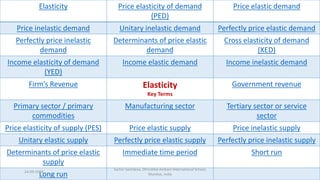
    Elasticity Price elasticityof demand (PED) Price elastic demand Price inelastic demand Unitary inelastic demand Perfectly price elastic demand Perfectly price inelastic demand Determinants of price elastic demand Cross elasticity of demand (XED) Income elasticity of demand (YED) Income elastic demand Income inelastic demand Firm’s Revenue Elasticity Key Terms Government revenue Primary sector / primary commodities Manufacturing sector Tertiary sector or service sector Price elasticity of supply (PES) Price elastic supply Price inelastic supply Unitary elastic supply Perfectly price elastic supply Perfectly price inelastic supply Determinants of price elastic supply Immediate time period Short run Long run24-09-2018 Sachin Sachdeva, Dhirubhai Ambani International School, Mumbai, India
  • 2.
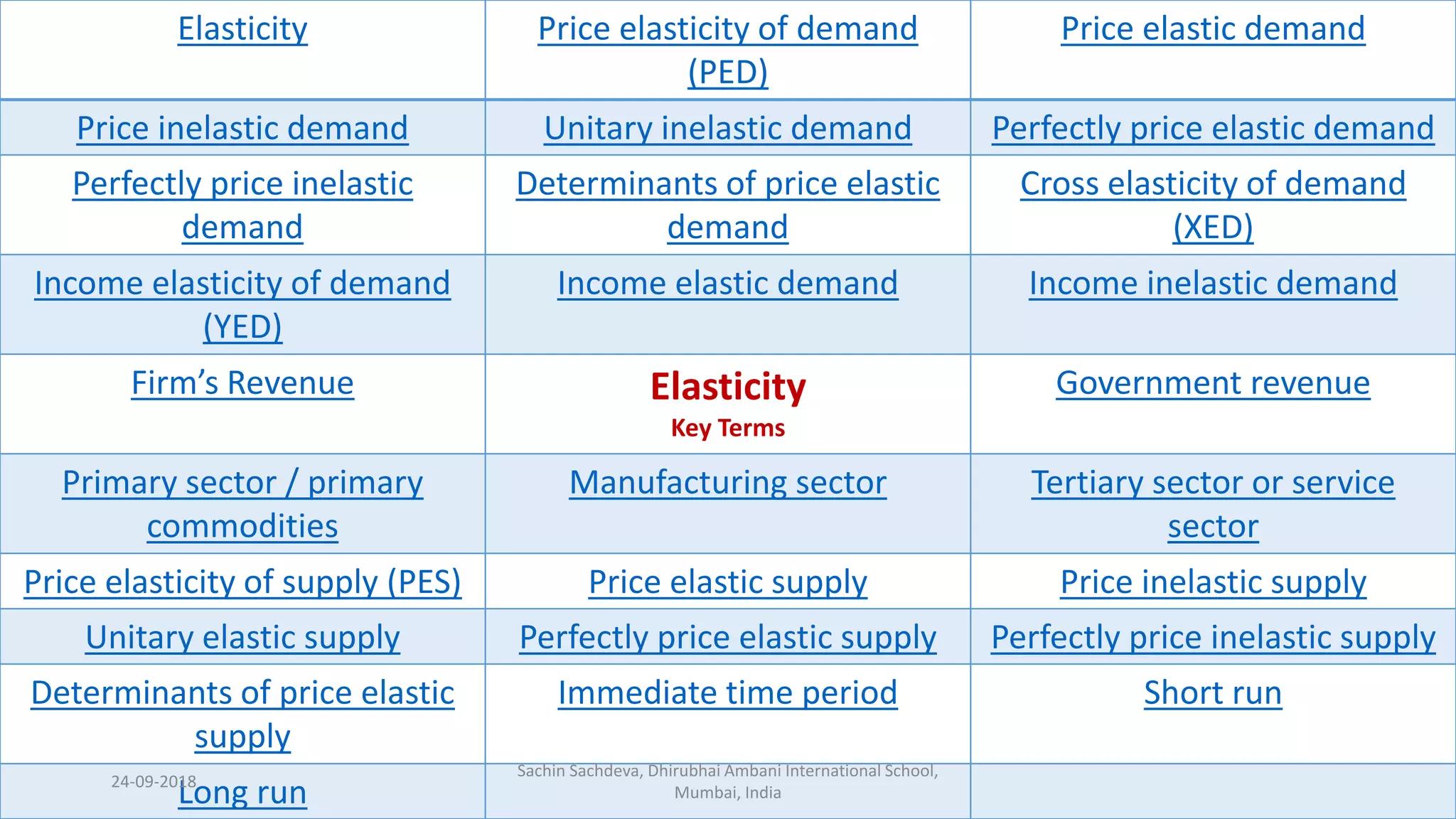
    Elasticity Elasticity refers toresponsiveness of one variable to proportionate change in another variable. 24-09-2018 Sachin Sachdeva, Dhirubhai Ambani International School, Mumbai, India
  • 3.
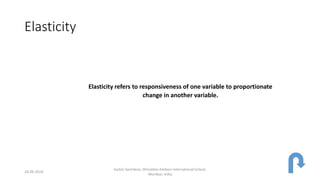
    Price elasticity ofdemand (PED) Price elasticity of demand is a measure of responsiveness of quantity demanded of a product to proportionate change in the price of that product. 24-09-2018 Sachin Sachdeva, Dhirubhai Ambani International School, Mumbai, India
  • 4.
    Price elastic demand Demandis said to be price elastic if proportionate change in quantity demanded of a product is greater than proportionate change in price of that product. Here PED > 1. When the product experiences price elastic demand then its demand curve is relatively flatter. 24-09-2018 Sachin Sachdeva, Dhirubhai Ambani International School, Mumbai, India
  • 5.
    Price inelastic demand Demandis said to be price inelastic if proportionate change in quantity demanded of a product is smaller than proportionate change in price of a that product. Here PED < 1. When the product experiences price inelastic demand its demand curve is relatively steeper. 24-09-2018 Sachin Sachdeva, Dhirubhai Ambani International School, Mumbai, India
  • 6.
    Unitary inelastic demand Demandis said to be unitary elastic if proportionate change in quantity demanded of a product is equal proportionate change in price of a that product. Here PED = 1. When the product experiences unitary elastic demand then its demand curve is like rectangular hyperbola or arch. 24-09-2018 Sachin Sachdeva, Dhirubhai Ambani International School, Mumbai, India
  • 7.
    Perfectly price elasticdemand When quantity demanded of a product changes without any change in the price of that product, then the demand of that product is said to be perfectly price elastic. Here PED = ∞ or n.d.. When the product experiences perfectly price elastic demand then its demand curve is parallel to horizontal axis. 24-09-2018 Sachin Sachdeva, Dhirubhai Ambani International School, Mumbai, India
  • 8.
    Perfectly price inelasticdemand When quantity demanded of a product does not change at all in response to any change in the price of that product, then the demand of that product is said to be perfectly price inelastic. Here PED = 0. When the product experiences perfectly price inelastic demand then its demand curve is parallel to vertical axis. 24-09-2018 Sachin Sachdeva, Dhirubhai Ambani International School, Mumbai, India
  • 9.
    Determinants of priceelastic demand Factors affecting price elasticity of demand of a product are referred as determinants of PED. For example if the product in question represents necessity then demand of that product will be price inelastic whereas if it represents luxury then demand of that product will be price elastic. 24-09-2018 Sachin Sachdeva, Dhirubhai Ambani International School, Mumbai, India
  • 10.
    Cross elasticity ofdemand (XED) Cross elasticity of demand measures the responsiveness of quantity demanded of a product to proportionate change in the price of another product. If the 2 goods in question are substitute, then their XED will be positive where as if they are complementary then their XED will be negative. XED of unrelated goods is equal to zero. 24-09-2018 Sachin Sachdeva, Dhirubhai Ambani International School, Mumbai, India
  • 11.
    Income elasticity ofdemand (YED) Income elasticity of demand measures the responsive of quantity demand of a product to proportionate change in the income of its consumers. YED for normal goods is positive while YED for inferior goods is negative. 24-09-2018 Sachin Sachdeva, Dhirubhai Ambani International School, Mumbai, India
  • 12.
    Income elastic demand Whenthe proportionate change in quantity demand of a product is greater than proportionate change in the income of consumer of that product , then the demand of that product is said to be income elastic. 24-09-2018 Sachin Sachdeva, Dhirubhai Ambani International School, Mumbai, India
  • 13.
    Income inelastic demand Whenthe proportionate change in quantity demand of a product is smaller than proportionate change in the income of consumer of that product , then the demand of that product is said to be income inelastic. 24-09-2018 Sachin Sachdeva, Dhirubhai Ambani International School, Mumbai, India
  • 14.
    Firm’s Revenue Firms’ revenuerefers to the amount of sales proceeds of the firm. It is calculated by multiplying the number of units of the product sold with the price per unit of the product. (TR = P X Q) 24-09-2018 Sachin Sachdeva, Dhirubhai Ambani International School, Mumbai, India
  • 15.
    Government revenue Government revenuerefers to the amount received by the government to meet its expenditure from various sources which includes: direct and indirect tax collections, fines and penalties, profit from public sector undertakings, sales proceeds from the transfer of ownership national assets &/or public sector undertakings, interest on loans, entry fee from visitors national monuments etc. 24-09-2018 Sachin Sachdeva, Dhirubhai Ambani International School, Mumbai, India
  • 16.
    Primary sector /primary commodities Everything that is extracted from the land is considered as primary goods or primary commodities or commodities. It includes agricultural, fishing, oil, coal, mineral, forestry etc. Firms operating in primary sector are involved with the extraction, harvesting & conversion of natural resources. 24-09-2018 Sachin Sachdeva, Dhirubhai Ambani International School, Mumbai, India
  • 17.
    Manufacturing sector It’s alsoreferred as secondary sector. Manufactured goods are man- made goods. They are produced by transforming primary goods into finished goods. They include: electronics, automobiles, books and stationery, processed food, clothing, buildings etc. Firms operating in the secondary sector are involved in the manufacturing or construction of products. 24-09-2018 Sachin Sachdeva, Dhirubhai Ambani International School, Mumbai, India
  • 18.
    Tertiary sector orservice sector Service sector includes non-tangible economic goods like banking, insurance, transportation, education, hospitability, healthcare entertainment etc whose consumption indicates improvement in standard of living of the consumer. Firms operating in the tertiary sector specialise in providing services to their customers. 24-09-2018 Sachin Sachdeva, Dhirubhai Ambani International School, Mumbai, India
  • 19.
    Price elasticity ofsupply (PES) Price elasticity of supply is a measure of responsiveness of quantity supplied of a product to proportionate change in the price of that product. 24-09-2018 Sachin Sachdeva, Dhirubhai Ambani International School, Mumbai, India
  • 20.
    Price elastic supply Supplyis said to be price elastic if proportionate change in quantity supplied of a product is greater than proportionate change in price of that product. Here PES > 1. When the product experiences price elastic supply then its supply curve starts from y-axis. 24-09-2018 Sachin Sachdeva, Dhirubhai Ambani International School, Mumbai, India
  • 21.
    Price inelastic supply Supplyis said to be price inelastic if proportionate change in quantity supplied of a product is smaller than proportionate change in price of a that product. Here PES < 1. When the product experiences price inelastic demand its supply curve starts form x-axis. 24-09-2018 Sachin Sachdeva, Dhirubhai Ambani International School, Mumbai, India
  • 22.
    Unitary elastic supply Supplyis said to be unitary elastic if proportionate change in quantity supplied of a product is equal proportionate change in price of a that product. Here PES = 1. When the product experiences unitary elastic supply its supply curve pass through from origin. 24-09-2018 Sachin Sachdeva, Dhirubhai Ambani International School, Mumbai, India
  • 23.
    Perfectly price elasticsupply When quantity supplied of a product changes without any change in the price of that product, then the supply of that product is said to be perfectly price elastic. Here PES = ∞ or n.d.. When the product experiences perfectly price elastic supply then its supply curve is parallel to horizontal axis. 24-09-2018 Sachin Sachdeva, Dhirubhai Ambani International School, Mumbai, India
  • 24.
    Perfectly price inelasticsupply When quantity supplied of a product does not change at all in response to any change in the price of that product, then the supply of that product is said to be perfectly price inelastic. Here PES = 0. When the product experiences perfectly price inelastic supply then its supply curve is parallel to vertical axis. 24-09-2018 Sachin Sachdeva, Dhirubhai Ambani International School, Mumbai, India
  • 25.
    Determinants of priceelastic supply Factors affecting price elasticity of supply of a product are referred as determinants of PES. For example “Time Period”, supply of a product is perfectly price inelastic in immediate time period, while in short-run supply is price inelastic and in long-run supply is price elastic. 24-09-2018 Sachin Sachdeva, Dhirubhai Ambani International School, Mumbai, India
  • 26.
    Immediate time period Duringimmediate time period all the factors of production are fixed or constant. 24-09-2018 Sachin Sachdeva, Dhirubhai Ambani International School, Mumbai, India
  • 27.
    Short run Short-run istime period in which all the factors of production are variable but one. 24-09-2018 Sachin Sachdeva, Dhirubhai Ambani International School, Mumbai, India
  • 28.
    Long run Long-run isa time period in which all the factors of production are variable. 24-09-2018 Sachin Sachdeva, Dhirubhai Ambani International School, Mumbai, India