El Gordo
Spain's Christmas Lottery - when "El Gordo" calls the tune, a fortune is going for a song. Text by Perrott Phillips.
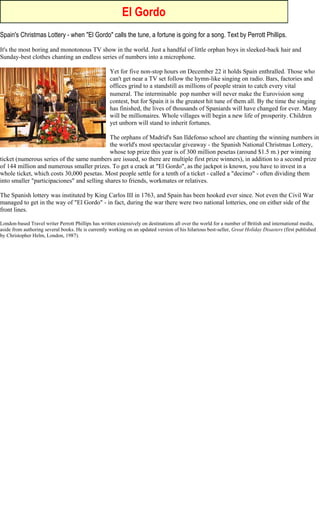
It's the most boring and monotonous TV show in the world. Just a handful of little orphan boys in sleeked-back hair and
Sunday-best clothes chanting an endless series of numbers into a microphone.
Yet for five non-stop hours on December 22 it holds Spain enthralled. Those who
can't get near a TV set follow the hymn-like singing on radio. Bars, factories and
offices grind to a standstill as millions of people strain to catch every vital
numeral. The interminable pop number will never make the Eurovision song
contest, but for Spain it is the greatest hit tune of them all. By the time the singing
has finished, the lives of thousands of Spaniards will have changed for ever. Many
will be millionaires. Whole villages will begin a new life of prosperity. Children
yet unborn will stand to inherit fortunes.
The orphans of Madrid's San Ildefonso school are chanting the winning numbers in
the world's most spectacular giveaway - the Spanish National Christmas Lottery,
whose top prize this year is of 300 million pesetas (around $1.5 m.) per winning
ticket (numerous series of the same numbers are issued, so there are multiple first prize winners), in addition to a second prize
of 144 million and numerous smaller prizes. To get a crack at "El Gordo", as the jackpot is known, you have to invest in a
whole ticket, which costs 30,000 pesetas. Most people settle for a tenth of a ticket - called a "decimo" - often dividing them
into smaller "participaciones" and selling shares to friends, workmates or relatives.
The Spanish lottery was instituted by King Carlos III in 1763, and Spain has been hooked ever since. Not even the Civil War
managed to get in the way of "El Gordo" - in fact, during the war there were two national lotteries, one on either side of the
front lines.
London-based Travel writer Perrott Phillips has written extensively on destinations all over the world for a number of British and international media,
aside from authoring several books. He is currently working on an updated version of his hilarious best-seller, Great Holiday Disasters (first published
by Christopher Helm, London, 1987).

El gordo

  • 1.
    El Gordo Spain's ChristmasLottery - when "El Gordo" calls the tune, a fortune is going for a song. Text by Perrott Phillips. It's the most boring and monotonous TV show in the world. Just a handful of little orphan boys in sleeked-back hair and Sunday-best clothes chanting an endless series of numbers into a microphone. Yet for five non-stop hours on December 22 it holds Spain enthralled. Those who can't get near a TV set follow the hymn-like singing on radio. Bars, factories and offices grind to a standstill as millions of people strain to catch every vital numeral. The interminable pop number will never make the Eurovision song contest, but for Spain it is the greatest hit tune of them all. By the time the singing has finished, the lives of thousands of Spaniards will have changed for ever. Many will be millionaires. Whole villages will begin a new life of prosperity. Children yet unborn will stand to inherit fortunes. The orphans of Madrid's San Ildefonso school are chanting the winning numbers in the world's most spectacular giveaway - the Spanish National Christmas Lottery, whose top prize this year is of 300 million pesetas (around $1.5 m.) per winning ticket (numerous series of the same numbers are issued, so there are multiple first prize winners), in addition to a second prize of 144 million and numerous smaller prizes. To get a crack at "El Gordo", as the jackpot is known, you have to invest in a whole ticket, which costs 30,000 pesetas. Most people settle for a tenth of a ticket - called a "decimo" - often dividing them into smaller "participaciones" and selling shares to friends, workmates or relatives. The Spanish lottery was instituted by King Carlos III in 1763, and Spain has been hooked ever since. Not even the Civil War managed to get in the way of "El Gordo" - in fact, during the war there were two national lotteries, one on either side of the front lines. London-based Travel writer Perrott Phillips has written extensively on destinations all over the world for a number of British and international media, aside from authoring several books. He is currently working on an updated version of his hilarious best-seller, Great Holiday Disasters (first published by Christopher Helm, London, 1987).