Exploring the movements of Atlantic Salmon
around Scottish coasts, using historical
tagging data and a simple agent-based
modelling approach
2nd International Conference on Environmental
Interactions of Marine Renewable Energy Technologies
Stornoway, 1st May 2014
Andrew J. Guerin, Angus C. Jackson and Alan F. Youngson
Environmental Research Institute
Centre for Energy and the Environment
Thurso, Scotland
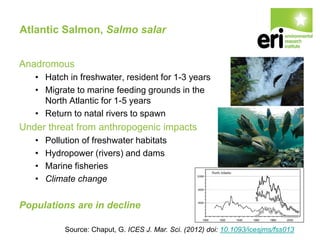
Atlantic Salmon, Salmo salar
Anadromous
• Hatch in freshwater, resident for 1-3 years
• Migrate to marine feeding grounds in the
North Atlantic for 1-5 years
• Return to natal rivers to spawn
Under threat from anthropogenic impacts
• Pollution of freshwater habitats
• Hydropower (rivers) and dams
• Marine fisheries
• Climate change
Populations are in decline
Source: Chaput, G. ICES J. Mar. Sci. (2012) doi: 10.1093/icesjms/fss013
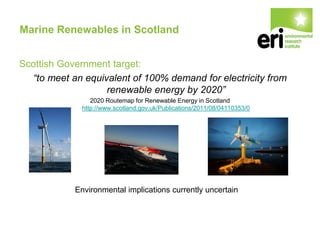
Marine Renewables in Scotland
Scottish Government target:
“to meet an equivalent of 100% demand for electricity from
renewable energy by 2020”
2020 Routemap for Renewable Energy in Scotland
http://www.scotland.gov.uk/Publications/2011/08/04110353/0
Environmental implications currently uncertain
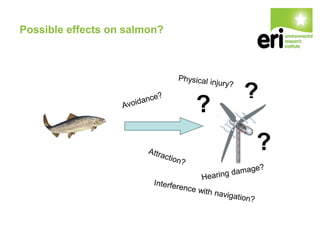
Possible effects on salmon?
?
?
?
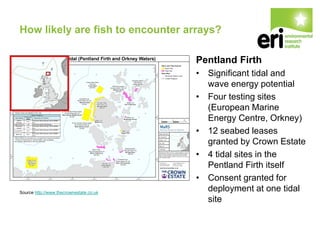
How likely are fish to encounter arrays?
Source http://www.thecrownestate.co.uk
Pentland Firth
• Significant tidal and
wave energy potential
• Four testing sites
(European Marine
Energy Centre, Orkney)
• 12 seabed leases
granted by Crown Estate
• 4 tidal sites in the
Pentland Firth itself
• Consent granted for
deployment at one tidal
site
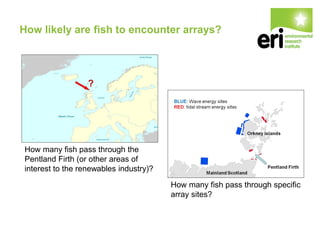
How likely are fish to encounter arrays?
How many fish pass through the
Pentland Firth (or other areas of
interest to the renewables industry)?
How many fish pass through specific
array sites?
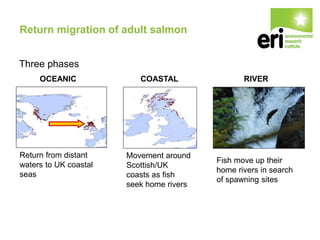
Return migration of adult salmon
Three phases
Return from distant
waters to UK coastal
seas
OCEANIC COASTAL RIVER
Movement around
Scottish/UK
coasts as fish
seek home rivers
Fish move up their
home rivers in search
of spawning sites
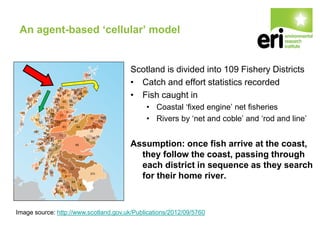
An agent-based ‘cellular’ model
Scotland is divided into 109 Fishery Districts
• Catch and effort statistics recorded
• Fish caught in
• Coastal ‘fixed engine’ net fisheries
• Rivers by ‘net and coble’ and ‘rod and line’
Assumption: once fish arrive at the coast,
they follow the coast, passing through
each district in sequence as they search
for their home river.
Image source: http://www.scotland.gov.uk/Publications/2012/09/5760
An agent-based ‘cellular’ model
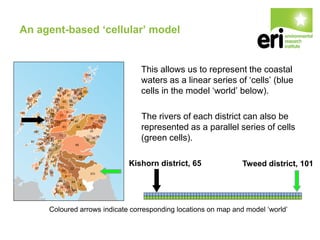
This allows us to represent the coastal
waters as a linear series of ‘cells’ (blue
cells in the model ‘world’ below).
The rivers of each district can also be
represented as a parallel series of cells
(green cells).
Kishorn district, 65 Tweed district, 101
Coloured arrows indicate corresponding locations on map and model ‘world’
An agent-based ‘cellular’ model
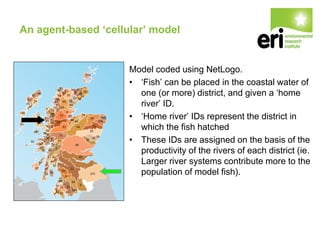
Model coded using NetLogo.
• ‘Fish’ can be placed in the coastal water of
one (or more) district, and given a ‘home
river’ ID.
• ‘Home river’ IDs represent the district in
which the fish hatched
• These IDs are assigned on the basis of the
productivity of the rivers of each district (ie.
Larger river systems contribute more to the
population of model fish).
An agent-based ‘cellular’ model
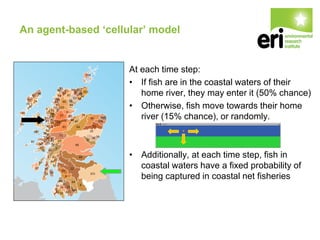
At each time step:
• If fish are in the coastal waters of their
home river, they may enter it (50% chance)
• Otherwise, fish move towards their home
river (15% chance), or randomly.
• Additionally, at each time step, fish in
coastal waters have a fixed probability of
being captured in coastal net fisheries
Initial model runs
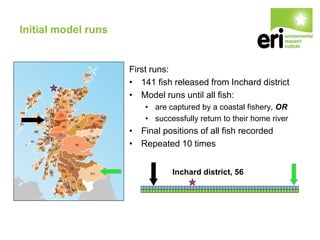
First runs:
• 141 fish released from Inchard district
• Model runs until all fish:
• are captured by a coastal fishery, OR
• successfully return to their home river
• Final positions of all fish recorded
• Repeated 10 times
Inchard district, 56
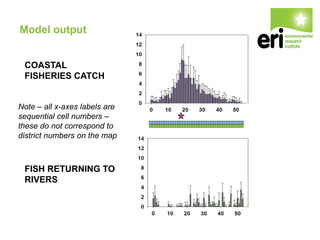
Model output
COASTAL
FISHERIES CATCH
FISH RETURNING TO
RIVERS
Note – all x-axes labels are
sequential cell numbers –
these do not correspond to
district numbers on the map
Real data: Historical fish tagging experiments
Fish tagging experiments in Scotland
• Early 20th Century (even late 19th century) up to 1970s
• Work initially conducted by Inspector of Salmon Fisheries for
Scotland
• W.L. Calderwood
• W. J. M. Menzies
• Tag-recapture exercise
• Fish caught in coastal netting stations
• Tagged, released
• Recaptured by coastal fisheries, river nets and anglers
• Couldn’t be repeated today (not enough coastal fishing effort)
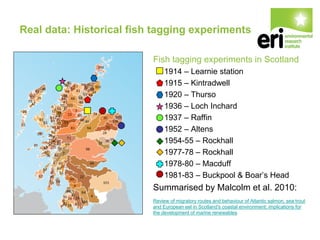
Real data: Historical fish tagging experiments
Fish tagging experiments in Scotland
1914 – Learnie station
1915 – Kintradwell
1920 – Thurso
1936 – Loch Inchard
1937 – Raffin
1952 – Altens
1954-55 – Rockhall
1977-78 – Rockhall
1978-80 – Macduff
1981-83 – Buckpool & Boar’s Head
Summarised by Malcolm et al. 2010:
Review of migratory routes and behaviour of Atlantic salmon, sea trout
and European eel in Scotland's coastal environment: implications for
the development of marine renewables
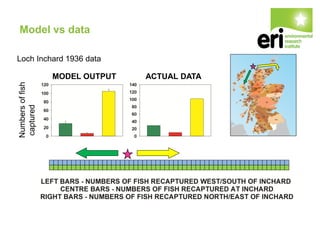
Model vs data
MODEL OUTPUT ACTUAL DATA
Numbersoffish
captured
Loch Inchard 1936 data
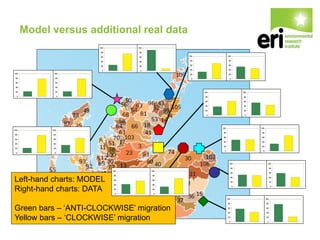
Model versus additional real data
Left-hand charts: MODEL
Right-hand charts: DATA
Green bars – ‘ANTI-CLOCKWISE’ migration
Yellow bars – ‘CLOCKWISE’ migration
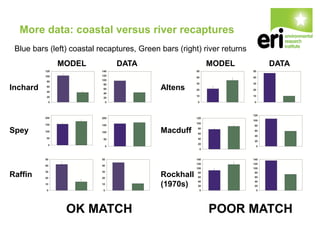
More data: coastal versus river recaptures
Inchard
MODEL DATA
Spey
Raffin
OK MATCH
MODEL DATA
Altens
Macduff
Rockhall
(1970s)
POOR MATCH
Blue bars (left) coastal recaptures, Green bars (right) river returns
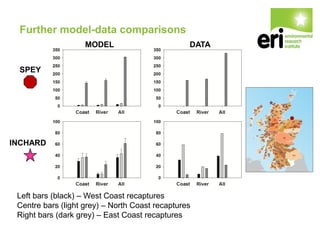
Further model-data comparisons
SPEY
INCHARD
MODEL DATA
Left bars (black) – West Coast recaptures
Centre bars (light grey) – North Coast recaptures
Right bars (dark grey) – East Coast recaptures
Conclusions
A simple ABM can represent some features of the coastal
migration of returning adult salmon in Scotland.
Other features are currently not well reproduced.
Problems with model assumptions?
• Composition of fish wrong at start?
• Simple linear passage too simple?
• Need alternate starting points?
Problems with underlying data?
• Uniform coastal fishing effort is not realistic
• Use of recent fishing data for river productivity
But the model can be modified to explore the alternatives!
Work supported by
The Crown Estate
Marine Renewable Energy and the Environment (MaREE) project
Thank you for your attention!
Presentation can be viewed and downloaded at
www.slideshare.net/andrewjguerin
Thanks to:
Marine Scotland Science (in particular, Jason Godfrey, Stuart
Middlemas, Julian MacLean and Gordon Smith) for helping us with
access to tagging data

EIMR 2014 Presentation slides

  • 1.
    Exploring the movementsof Atlantic Salmon around Scottish coasts, using historical tagging data and a simple agent-based modelling approach 2nd International Conference on Environmental Interactions of Marine Renewable Energy Technologies Stornoway, 1st May 2014 Andrew J. Guerin, Angus C. Jackson and Alan F. Youngson Environmental Research Institute Centre for Energy and the Environment Thurso, Scotland
  • 2.
    Atlantic Salmon, Salmosalar Anadromous • Hatch in freshwater, resident for 1-3 years • Migrate to marine feeding grounds in the North Atlantic for 1-5 years • Return to natal rivers to spawn Under threat from anthropogenic impacts • Pollution of freshwater habitats • Hydropower (rivers) and dams • Marine fisheries • Climate change Populations are in decline Source: Chaput, G. ICES J. Mar. Sci. (2012) doi: 10.1093/icesjms/fss013
  • 3.
    Marine Renewables inScotland Scottish Government target: “to meet an equivalent of 100% demand for electricity from renewable energy by 2020” 2020 Routemap for Renewable Energy in Scotland http://www.scotland.gov.uk/Publications/2011/08/04110353/0 Environmental implications currently uncertain
  • 4.
    Possible effects onsalmon? ? ? ?
  • 5.
    How likely arefish to encounter arrays? Source http://www.thecrownestate.co.uk Pentland Firth • Significant tidal and wave energy potential • Four testing sites (European Marine Energy Centre, Orkney) • 12 seabed leases granted by Crown Estate • 4 tidal sites in the Pentland Firth itself • Consent granted for deployment at one tidal site
  • 6.
    How likely arefish to encounter arrays? How many fish pass through the Pentland Firth (or other areas of interest to the renewables industry)? How many fish pass through specific array sites?
  • 7.
    Return migration ofadult salmon Three phases Return from distant waters to UK coastal seas OCEANIC COASTAL RIVER Movement around Scottish/UK coasts as fish seek home rivers Fish move up their home rivers in search of spawning sites
  • 8.
    An agent-based ‘cellular’model Scotland is divided into 109 Fishery Districts • Catch and effort statistics recorded • Fish caught in • Coastal ‘fixed engine’ net fisheries • Rivers by ‘net and coble’ and ‘rod and line’ Assumption: once fish arrive at the coast, they follow the coast, passing through each district in sequence as they search for their home river. Image source: http://www.scotland.gov.uk/Publications/2012/09/5760
  • 9.
    An agent-based ‘cellular’model This allows us to represent the coastal waters as a linear series of ‘cells’ (blue cells in the model ‘world’ below). The rivers of each district can also be represented as a parallel series of cells (green cells). Kishorn district, 65 Tweed district, 101 Coloured arrows indicate corresponding locations on map and model ‘world’
  • 10.
    An agent-based ‘cellular’model Model coded using NetLogo. • ‘Fish’ can be placed in the coastal water of one (or more) district, and given a ‘home river’ ID. • ‘Home river’ IDs represent the district in which the fish hatched • These IDs are assigned on the basis of the productivity of the rivers of each district (ie. Larger river systems contribute more to the population of model fish).
  • 11.
    An agent-based ‘cellular’model At each time step: • If fish are in the coastal waters of their home river, they may enter it (50% chance) • Otherwise, fish move towards their home river (15% chance), or randomly. • Additionally, at each time step, fish in coastal waters have a fixed probability of being captured in coastal net fisheries
  • 12.
    Initial model runs Firstruns: • 141 fish released from Inchard district • Model runs until all fish: • are captured by a coastal fishery, OR • successfully return to their home river • Final positions of all fish recorded • Repeated 10 times Inchard district, 56
  • 13.
    Model output COASTAL FISHERIES CATCH FISHRETURNING TO RIVERS Note – all x-axes labels are sequential cell numbers – these do not correspond to district numbers on the map
  • 14.
    Real data: Historicalfish tagging experiments Fish tagging experiments in Scotland • Early 20th Century (even late 19th century) up to 1970s • Work initially conducted by Inspector of Salmon Fisheries for Scotland • W.L. Calderwood • W. J. M. Menzies • Tag-recapture exercise • Fish caught in coastal netting stations • Tagged, released • Recaptured by coastal fisheries, river nets and anglers • Couldn’t be repeated today (not enough coastal fishing effort)
  • 15.
    Real data: Historicalfish tagging experiments Fish tagging experiments in Scotland 1914 – Learnie station 1915 – Kintradwell 1920 – Thurso 1936 – Loch Inchard 1937 – Raffin 1952 – Altens 1954-55 – Rockhall 1977-78 – Rockhall 1978-80 – Macduff 1981-83 – Buckpool & Boar’s Head Summarised by Malcolm et al. 2010: Review of migratory routes and behaviour of Atlantic salmon, sea trout and European eel in Scotland's coastal environment: implications for the development of marine renewables
  • 16.
    Model vs data MODELOUTPUT ACTUAL DATA Numbersoffish captured Loch Inchard 1936 data
  • 17.
    Model versus additionalreal data Left-hand charts: MODEL Right-hand charts: DATA Green bars – ‘ANTI-CLOCKWISE’ migration Yellow bars – ‘CLOCKWISE’ migration
  • 18.
    More data: coastalversus river recaptures Inchard MODEL DATA Spey Raffin OK MATCH MODEL DATA Altens Macduff Rockhall (1970s) POOR MATCH Blue bars (left) coastal recaptures, Green bars (right) river returns
  • 19.
    Further model-data comparisons SPEY INCHARD MODELDATA Left bars (black) – West Coast recaptures Centre bars (light grey) – North Coast recaptures Right bars (dark grey) – East Coast recaptures
  • 20.
    Conclusions A simple ABMcan represent some features of the coastal migration of returning adult salmon in Scotland. Other features are currently not well reproduced. Problems with model assumptions? • Composition of fish wrong at start? • Simple linear passage too simple? • Need alternate starting points? Problems with underlying data? • Uniform coastal fishing effort is not realistic • Use of recent fishing data for river productivity But the model can be modified to explore the alternatives!
  • 21.
    Work supported by TheCrown Estate Marine Renewable Energy and the Environment (MaREE) project Thank you for your attention! Presentation can be viewed and downloaded at www.slideshare.net/andrewjguerin Thanks to: Marine Scotland Science (in particular, Jason Godfrey, Stuart Middlemas, Julian MacLean and Gordon Smith) for helping us with access to tagging data