2
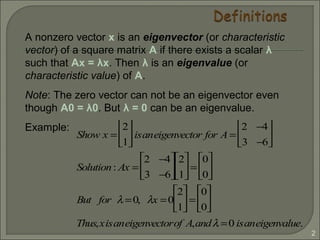
A nonzero vector x is an eigenvector (or characteristic
vector) of a square matrix A if there exists a scalar λ
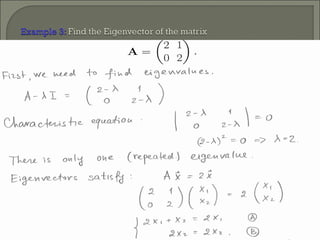
such that Ax = λx. Then λ is an eigenvalue (or
characteristic value) of A.
Note: The zero vector can not be an eigenvector even
though A0 = λ0. But λ = 0 can be an eigenvalue.
Example:
Show x =
2
1





 isaneigenvector for A =
2 −4
3 −6






Solution: Ax =
2 −4
3 −6






2
1





 =
0
0






But for λ =0, λx =0
2
1





 =
0
0






Thus,xisaneigenvectorof A,andλ =0 isaneigenvalue.
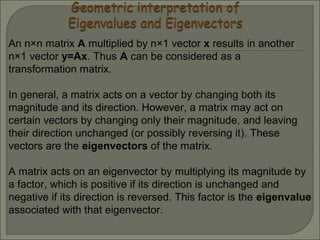
An n×n matrix A multiplied by n×1 vector x results in another
n×1 vector y=Ax. Thus A can be considered as a
transformation matrix.
In general, a matrix acts on a vector by changing both its
magnitude and its direction. However, a matrix may act on
certain vectors by changing only their magnitude, and leaving
their direction unchanged (or possibly reversing it). These
vectors are the eigenvectors of the matrix.
A matrix acts on an eigenvector by multiplying its magnitude by
a factor, which is positive if its direction is unchanged and
negative if its direction is reversed. This factor is the eigenvalue
associated with that eigenvector.
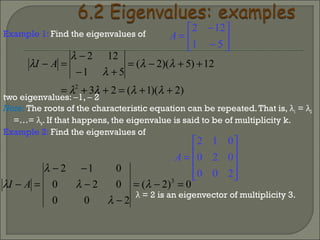
Example 1: Find the eigenvalues of
two eigenvalues: −1, − 2
Note: The roots of the characteristic equation can be repeated.That is, λ1 = λ2
=…= λk. If that happens, the eigenvalue is said to be of multiplicity k.
Example 2: Find the eigenvalues of
λ = 2 is an eigenvector of multiplicity 3.






−
−
=
51
122
A
)2)(1(23
12)5)(2(
51
122
2
++=++=
++−=
+−
−
=−
λλλλ
λλ
λ
λ
λ AI










=
200
020
012
A
0)2(
200
020
012
3
=−=
−
−
−−
=− λ
λ
λ
λ
λ AI
5
6
7
Example 1 (cont.):





 −
⇒





−
−
=−−−=
00
41
41
123
)1(:1 AIλ
0,
1
4
,404
2
1
1
2121
≠





=





=
==⇒=−
tt
x
x
txtxxx
x





 −
⇒





−
−
=−−−=
00
31
31
124
)2(:2 AIλ
0,
1
3
2
1
2 ≠





=





= ss
x
x
x
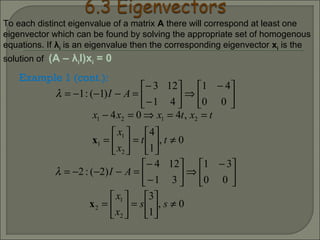
To each distinct eigenvalue of a matrix A there will correspond at least one
eigenvector which can be found by solving the appropriate set of homogenous
equations. If λi is an eigenvalue then the corresponding eigenvector xi is the
solution of (A – λiI)xi = 0
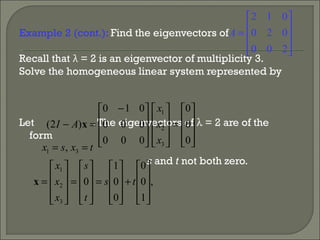
Example 2 (cont.): Find the eigenvectors of
Recall that λ = 2 is an eigenvector of multiplicity 3.
Solve the homogeneous linear system represented by
Let .The eigenvectors of λ = 2 are of the
form
s and t not both zero.










=



















 −
=−
0
0
0
000
000
010
)2(
3
2
1
x
x
x
AI x
txsx == 31 ,
,
1
0
0
0
0
1
0
3
2
1










+










=










=










= ts
t
s
x
x
x
x










=
200
020
012
A
10
11
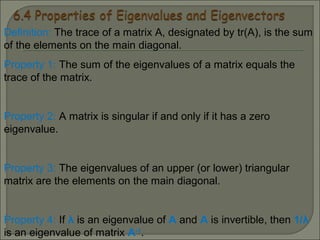
Definition: The trace of a matrix A, designated by tr(A), is the sum
of the elements on the main diagonal.
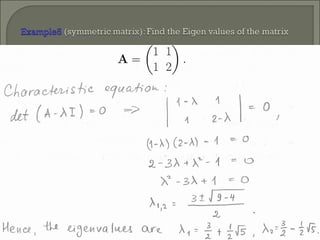
Property 1: The sum of the eigenvalues of a matrix equals the
trace of the matrix.
Property 2: A matrix is singular if and only if it has a zero
eigenvalue.
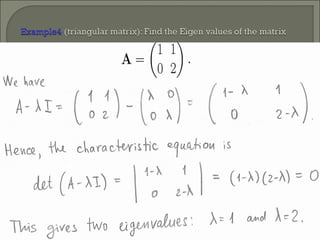
Property 3: The eigenvalues of an upper (or lower) triangular
matrix are the elements on the main diagonal.
Property 4: If λ is an eigenvalue of A and A is invertible, then 1/λ
is an eigenvalue of matrix A-1
.
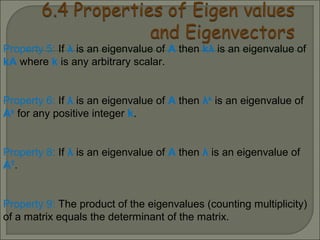
Property 5: If λ is an eigenvalue of A then kλ is an eigenvalue of
kA where k is any arbitrary scalar.
Property 6: If λ is an eigenvalue of A then λk
is an eigenvalue of
Ak
for any positive integer k.
Property 8: If λ is an eigenvalue of A then λ is an eigenvalue of
AT
.
Property 9: The product of the eigenvalues (counting multiplicity)
of a matrix equals the determinant of the matrix.
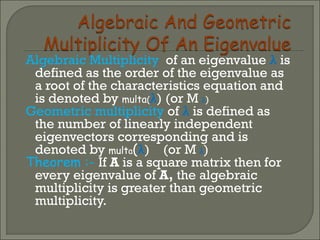
Algebraic Multiplicity of an eigenvalue λ is
defined as the order of the eigenvalue as
a root of the characteristics equation and
is denoted by multa(λ) (or M λ)
Geometric multiplicity of λ is defined as
the number of linearly independent
eigenvectors corresponding and is
denoted by multa(λ) (or M λ)
Theorem :- If A is a square matrix then for
every eigenvalue of A, the algebraic
multiplicity is greater than geometric
multiplicity.
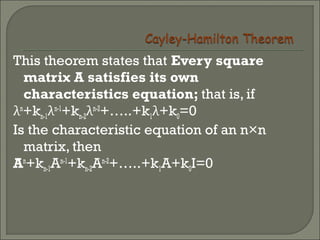
This theorem states that Every square
matrix A satisfies its own
characteristics equation; that is, if
λn
+kn-1λn-1
+kn-2λn-2
+…..+k1λ+k0=0
Is the characteristic equation of an n×n
matrix, then
An
+kn-1An-1
+kn-2An-2
+…..+k1A+k0I=0
16
If P = [ p1 p2 ], then AP = PD even if A is not diagonalizable.
Since AP =
1 −2
1 5






−3 −2
−5 0





 = A
r
p1
r
p2




= A
r
p1 A
r
p2




=
−5 −4
−5 10





 =
−5(1) 2(−2)
−5(1) 2(5)








= −5
1
1





 2
−2
5














= λ1
r
p1 λ2
r
p2




=
r
p1
r
p2




λ1 0
0 λ2








=
1
1






−2
5














−5 0
0 2





 =
1 −2
1 5






−5 0
0 2





 = PD.
17
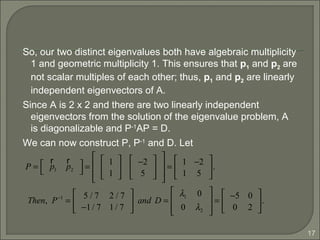
So, our two distinct eigenvalues both have algebraic multiplicity
1 and geometric multiplicity 1. This ensures that p1 and p2 are
not scalar multiples of each other; thus, p1 and p2 are linearly
independent eigenvectors of A.
Since A is 2 x 2 and there are two linearly independent
eigenvectors from the solution of the eigenvalue problem, A
is diagonalizable and P-1
AP = D.
We can now construct P, P-1
and D. Let
Then, P−1
=
5 / 7 2 / 7
−1/ 7 1/ 7





 and D =
λ1 0
0 λ2








=
−5 0
0 2





.
P =
r
p1
r
p2




=
1
1






−2
5














=
1 −2
1 5





.
18
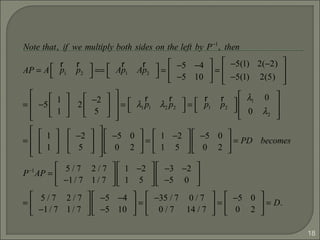
Note that, if we multiply both sides on the left by P−1
, then
AP = A
r
p1
r
p2




== A
r
p1 A
r
p2




=
−5 −4
−5 10





 =
−5(1) 2(−2)
−5(1) 2(5)








= −5
1
1





 2
−2
5














= λ1
r
p1 λ2
r
p2




=
r
p1
r
p2




λ1 0
0 λ2








=
1
1






−2
5














−5 0
0 2





 =
1 −2
1 5






−5 0
0 2





 = PD becomes
P−1
AP =
5 / 7 2 / 7
−1/ 7 1/ 7






1 −2
1 5






−3 −2
−5 0






=
5 / 7 2 / 7
−1/ 7 1/ 7






−5 −4
−5 10





 =
−35 / 7 0 / 7
0 / 7 14 / 7





 =
−5 0
0 2





 = D.
19
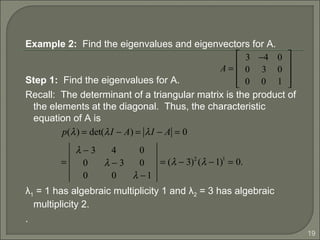
Example 2: Find the eigenvalues and eigenvectors for A.
Step 1: Find the eigenvalues for A.
Recall: The determinant of a triangular matrix is the product of
the elements at the diagonal. Thus, the characteristic
equation of A is
λ1 = 1 has algebraic multiplicity 1 and λ2 = 3 has algebraic
multiplicity 2.
.
A =
3 −4 0
0 3 0
0 0 1










p(λ) = det(λI − A) = λI − A = 0
=
λ − 3 4 0
0 λ − 3 0
0 0 λ −1
= (λ − 3)2
(λ −1)1
= 0.
20
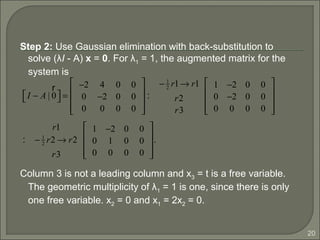
Step 2: Use Gaussian elimination with back-substitution to
solve (λI - A) x = 0. For λ1 = 1, the augmented matrix for the
system is
Column 3 is not a leading column and x3 = t is a free variable.
The geometric multiplicity of λ1 = 1 is one, since there is only
one free variable. x2 = 0 and x1 = 2x2 = 0.
I − A |
r
0  =
−2 4 0
0 −2 0
0 0 0
0
0
0










:
− 1
2 r1→ r1
r2
r3
1 −2 0
0 −2 0
0 0 0
0
0
0










:
r1
− 1
2 r2 → r2
r3
1 −2 0
0 1 0
0 0 0
0
0
0










.
21
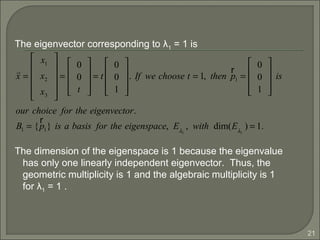
The eigenvector corresponding to λ1 = 1 is
The dimension of the eigenspace is 1 because the eigenvalue
has only one linearly independent eigenvector. Thus, the
geometric multiplicity is 1 and the algebraic multiplicity is 1
for λ1 = 1 .
r
x =
x1
x2
x3












=
0
0
t










= t
0
0
1










. If we choose t = 1, then
r
p1 =
0
0
1










is
our choice for the eigenvector.
B1 = {
r
p1} is a basis for the eigenspace, Eλ1
, with dim(Eλ1
) = 1.
22
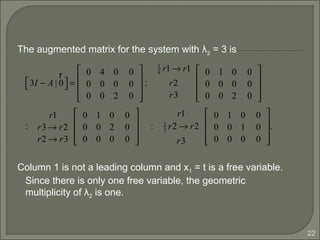
The augmented matrix for the system with λ2 = 3 is
Column 1 is not a leading column and x1 = t is a free variable.
Since there is only one free variable, the geometric
multiplicity of λ2 is one.
3I − A |
r
0  =
0 4 0
0 0 0
0 0 2
0
0
0










:
1
4 r1→ r1
r2
r3
0 1 0
0 0 0
0 0 2
0
0
0










:
r1
r3→ r2
r2 → r3
0 1 0
0 0 2
0 0 0
0
0
0










:
r1
1
2 r2 → r2
r3
0 1 0
0 0 1
0 0 0
0
0
0










.
23
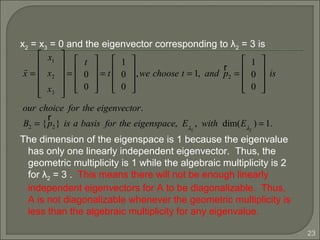
x2 = x3 = 0 and the eigenvector corresponding to λ2 = 3 is
The dimension of the eigenspace is 1 because the eigenvalue
has only one linearly independent eigenvector. Thus, the
geometric multiplicity is 1 while the algebraic multiplicity is 2
for λ2 = 3 . This means there will not be enough linearly
independent eigenvectors for A to be diagonalizable. Thus,
A is not diagonalizable whenever the geometric multiplicity is
less than the algebraic multiplicity for any eigenvalue.
r
x =
x1
x2
x3












=
t
0
0










= t
1
0
0










,we choose t = 1, and
r
p2 =
1
0
0










is
our choice for the eigenvector.
B2 = {
r
p2} is a basis for the eigenspace, Eλ2
, with dim(Eλ2
) = 1.
24
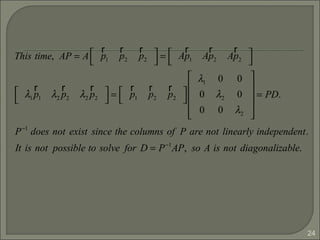
This time, AP = A
r
p1
r
p2
r
p2




= A
r
p1 A
r
p2 A
r
p2




λ1
r
p1 λ2
r
p2 λ2
r
p2




=
r
p1
r
p2
r
p2




λ1 0 0
0 λ2 0
0 0 λ2










= PD.
P−1
does not exist since the columns of P are not linearly independent.
It is not possible to solve for D = P−1
AP, so A is not diagonalizable.
25
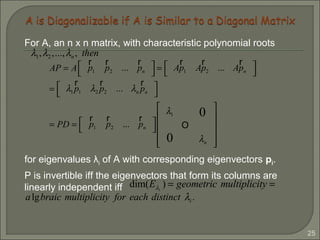
AP = A
r
p1
r
p2 ...
r
pn




= A
r
p1 A
r
p2 ... A
r
pn




= λ1
r
p1 λ2
r
p2 ... λn
r
pn




= PD =
r
p1
r
p2 ...
r
pn




λ1 0
O
0 λn












For A, an n x n matrix, with characteristic polynomial roots
for eigenvalues λi of A with corresponding eigenvectors pi.
P is invertible iff the eigenvectors that form its columns are
linearly independent iff
λ1,λ2,...,λn , then
algbraic multiplicity for each distinct λi .
dim(Eλi
) = geometric multiplicity =
26
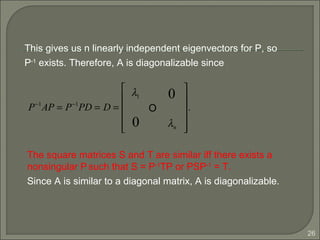
P−1
AP = P−1
PD = D =
λ1 0
O
0 λn












.
This gives us n linearly independent eigenvectors for P, so
P-1
exists. Therefore, A is diagonalizable since
The square matrices S and T are similar iff there exists a
nonsingular P such that S = P-1
TP or PSP-1
= T.
Since A is similar to a diagonal matrix, A is diagonalizable.
27
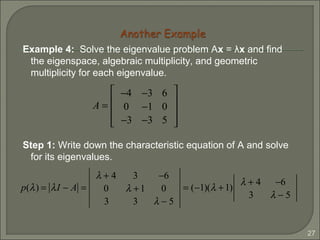
Example 4: Solve the eigenvalue problem Ax = λx and find
the eigenspace, algebraic multiplicity, and geometric
multiplicity for each eigenvalue.
Step 1: Write down the characteristic equation of A and solve
for its eigenvalues.
A =
−4 −3 6
0 −1 0
−3 −3 5










p(λ) = λI − A =
λ + 4 3 −6
0 λ +1 0
3 3 λ − 5
= (−1)(λ +1)
λ + 4 −6
3 λ − 5
28
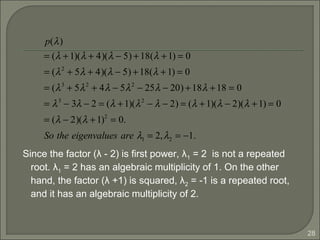
Since the factor (λ - 2) is first power, λ1 = 2 is not a repeated
root. λ1 = 2 has an algebraic multiplicity of 1. On the other
hand, the factor (λ +1) is squared, λ2 = -1 is a repeated root,
and it has an algebraic multiplicity of 2.
p(λ)
= (λ +1)(λ + 4)(λ − 5) +18(λ +1) = 0
= (λ2
+ 5λ + 4)(λ − 5) +18(λ +1) = 0
= (λ3
+ 5λ2
+ 4λ − 5λ2
− 25λ − 20) +18λ +18 = 0
= λ3
− 3λ − 2 = (λ +1)(λ2
− λ − 2) = (λ +1)(λ − 2)(λ +1) = 0
= (λ − 2)(λ +1)2
= 0.
So the eigenvalues are λ1 = 2,λ2 = −1.
29
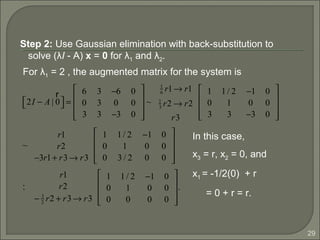
Step 2: Use Gaussian elimination with back-substitution to
solve (λI - A) x = 0 for λ1 and λ2.
For λ1 = 2 , the augmented matrix for the system is
2I − A |
r
0  =
6
0
3
3
3
3
−6
0
−3
0
0
0










~
1
6 r1→ r1
1
3 r2 → r2
r3
1
0
3
1/ 2
1
3
−1
0
−3
0
0
0










~
r1
r2
−3r1+ r3→ r3
1
0
0
1/ 2
1
3 / 2
−1
0
0
0
0
0










:
r1
r2
− 3
2 r2 + r3→ r3
1
0
0
1/ 2
1
0
−1
0
0
0
0
0










.
In this case,
x3 = r, x2 = 0, and
x1 = -1/2(0) + r
= 0 + r = r.
30
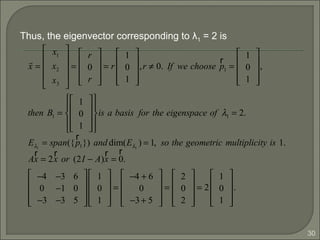
Thus, the eigenvector corresponding to λ1 = 2 is
r
x =
x1
x2
x3










=
r
0
r










= r
1
0
1










,r ≠ 0. If we choose
r
p1 =
1
0
1










,
then B1 =
1
0
1




















is a basis for the eigenspace of λ1 = 2.
Eλ1
= span({
r
p1}) and dim(Eλ1
) = 1, so the geometric multiplicity is 1.
A
r
x = 2
r
x or (2I − A)
r
x =
r
0.
−4 −3 6
0 −1 0
−3 −3 5










1
0
1










=
−4 + 6
0
−3+ 5










=
2
0
2










= 2
1
0
1










.
31
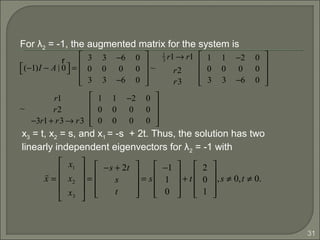
For λ2 = -1, the augmented matrix for the system is
(−1)I − A |
r
0  =
3
0
3
3
0
3
−6
0
−6
0
0
0










~
1
3 r1→ r1
r2
r3
1
0
3
1
0
3
−2
0
−6
0
0
0










~
r1
r2
−3r1+ r3→ r3
1
0
0
1
0
0
−2
0
0
0
0
0










x3 = t, x2 = s, and x1 = -s + 2t. Thus, the solution has two
linearly independent eigenvectors for λ2 = -1 with
r
x =
x1
x2
x3










=
−s + 2t
s
t










= s
−1
1
0










+ t
2
0
1










,s ≠ 0,t ≠ 0.
32
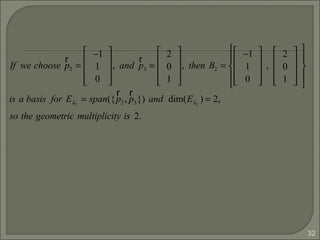
If we choose
r
p2 =
−1
1
0










, and
r
p3 =
2
0
1










, then B2 =
−1
1
0










,
2
0
1




















is a basis for Eλ2
= span({
r
p2 ,
r
p3}) and dim(Eλ2
) = 2,
so the geometric multiplicity is 2.
33
Thus, we have AP = PD as follows :
−4 −3 6
0 −1 0
−3 −3 5










1 −1 2
0 1 0
1 0 1










=
1 −1 2
0 1 0
1 0 1










2 0 0
0 −1 0
0 0 −1










2 1 −2
0 −1 0
2 0 −1










=
2 1 −2
0 −1 0
2 0 −1










.
Since the geometric multiplicity is equal to the algebraic
multiplicity for each distinct eigenvalue, we found three
linearly independent eigenvectors. The matrix A is
diagonalizable since P = [p1 p2 p3] is nonsingular.
34
P | I[ ]=
1 −1 2
0 1 0
1 0 1
1 0 0
0 1 0
0 0 1










:
1 −1 2
0 1 0
0 1 −1
1 0 0
0 1 0
−1 0 1










:
1 0 2
0 1 0
0 0 1
1 1 0
0 1 0
1 1 −1










:
1 0 0
0 1 0
0 0 1
−1 −1 2
0 1 0
1 1 −1










. So, P−1
=
−1 −1 2
0 1 0
1 1 −1










.
We can find P-1
as follows:
35
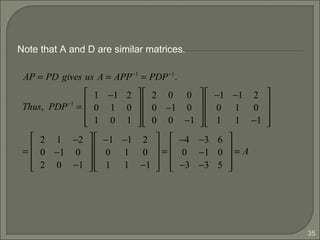
AP = PD gives us A = APP−1
= PDP−1
.
Thus, PDP−1
=
1 −1 2
0 1 0
1 0 1










2 0 0
0 −1 0
0 0 −1










−1 −1 2
0 1 0
1 1 −1










=
2 1 −2
0 −1 0
2 0 −1










−1 −1 2
0 1 0
1 1 −1










=
−4 −3 6
0 −1 0
−3 −3 5










= A
Note that A and D are similar matrices.
36
D =
−1 −1 2
0 1 0
1 1 −1










−4 −3 6
0 −1 0
−3 −3 5










1 −1 2
0 1 0
1 0 1










=
−2 −2 4
0 −1 0
−1 −1 1










1 −1 2
0 1 0
1 0 1










=
2 0 0
0 −1 0
0 0 −1










.
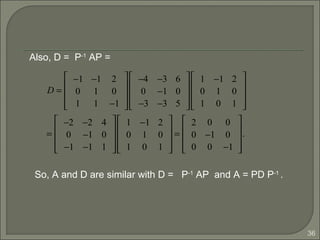
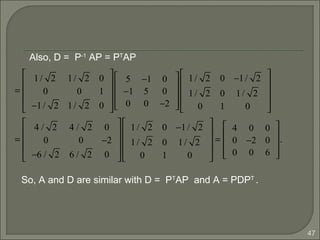
Also, D = P-1
AP =
So, A and D are similar with D = P-1
AP and A = PD P-1
.
37
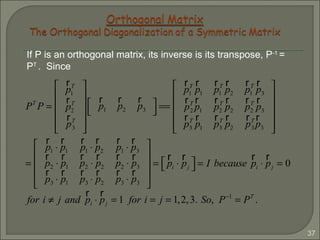
If P is an orthogonal matrix, its inverse is its transpose, P-1
=
PT
. Since
PT
P =
r
p1
T
r
p2
T
r
pT
3












r
p1
r
p2
r
p3




==
r
p1
T r
p1
r
p1
T r
p2
r
p1
T r
p3
r
pT
2
r
p1
r
p2
T r
p2
r
p2
T r
p3
r
p3
T r
p1
r
p3
T r
p2
r
pT
3
r
p3












=
r
p1 ⋅
r
p1
r
p1 ⋅
r
p2
r
p1 ⋅
r
p3
r
p2 ⋅
r
p1
r
p2 ⋅
r
p2
r
p2 ⋅
r
p3
r
p3 ⋅
r
p1
r
p3 ⋅
r
p2
r
p3 ⋅
r
p3










=
r
pi ⋅
r
pj
  = I because
r
pi ⋅
r
pj = 0
for i ≠ j and
r
pi ⋅
r
pj = 1 for i = j = 1,2,3. So, P−1
= PT
.
38
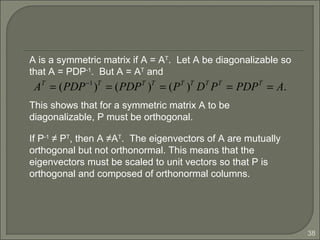
A is a symmetric matrix if A = AT
. Let A be diagonalizable so
that A = PDP-1
. But A = AT
and
AT
= (PDP−1
)T
= (PDPT
)T
= (PT
)T
DT
PT
= PDPT
= A.
This shows that for a symmetric matrix A to be
diagonalizable, P must be orthogonal.
If P-1
≠ PT
, then A ≠AT
. The eigenvectors of A are mutually
orthogonal but not orthonormal. This means that the
eigenvectors must be scaled to unit vectors so that P is
orthogonal and composed of orthonormal columns.
39
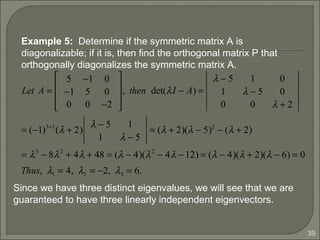
Example 5: Determine if the symmetric matrix A is
diagonalizable; if it is, then find the orthogonal matrix P that
orthogonally diagonalizes the symmetric matrix A.
Let A =
5 −1 0
−1 5 0
0 0 −2










, then det(λI − A) =
λ − 5 1 0
1 λ − 5 0
0 0 λ + 2
= (−1)3+1
(λ + 2)
λ − 5 1
1 λ − 5
= (λ + 2)(λ − 5)2
− (λ + 2)
= λ3
− 8λ2
+ 4λ + 48 = (λ − 4)(λ2
− 4λ −12) = (λ − 4)(λ + 2)(λ − 6) = 0
Thus, λ1 = 4, λ2 = −2, λ3 = 6.
Since we have three distinct eigenvalues, we will see that we are
guaranteed to have three linearly independent eigenvectors.
40
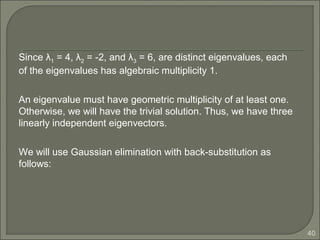
Since λ1 = 4, λ2 = -2, and λ3 = 6, are distinct eigenvalues, each
of the eigenvalues has algebraic multiplicity 1.
An eigenvalue must have geometric multiplicity of at least one.
Otherwise, we will have the trivial solution. Thus, we have three
linearly independent eigenvectors.
We will use Gaussian elimination with back-substitution as
follows:
41
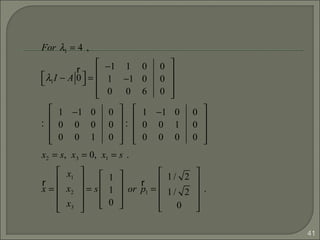
For λ1 = 4 ,
λ1I − A
r
0


 =
−1 1 0
1 −1 0
0 0 6
0
0
0










:
1 −1 0
0 0 0
0 0 1
0
0
0










:
1 −1 0
0 0 1
0 0 0
0
0
0










x2 = s, x3 = 0, x1 = s .
r
x =
x1
x2
x3










= s
1
1
0










or
r
p1 =
1/ 2
1/ 2
0










.
42
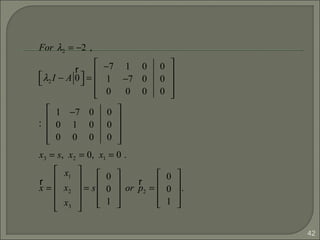
For λ2 = −2 ,
λ2 I − A
r
0


 =
−7 1 0
1 −7 0
0 0 0
0
0
0










:
1 −7 0
0 1 0
0 0 0
0
0
0










x3 = s, x2 = 0, x1 = 0 .
r
x =
x1
x2
x3










= s
0
0
1










or
r
p2 =
0
0
1










.
43
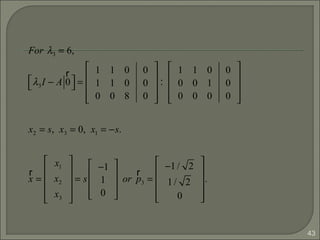
For λ3 = 6,
λ3I − A
r
0


 =
1 1 0
1 1 0
0 0 8
0
0
0










:
1 1 0
0 0 1
0 0 0
0
0
0










x2 = s, x3 = 0, x1 = −s.
r
x =
x1
x2
x3










= s
−1
1
0










or
r
p3 =
−1/ 2
1/ 2
0










.
44
As we can see the eigenvectors of A are distinct, so {p1, p2,
p3} is linearly independent, P-1
exists for P =[p1 p2 p3] and
Thus A is diagonalizable.
Since A = AT
(A is a symmetric matrix) and P is orthogonal
with approximate scaling of p1, p2, p3, P-1
= PT
.
AP = PD ⇔ PDP−1
.
PP−1
= PPT
=
1/ 2 0 −1/ 2
1/ 2 0 1/ 2
0 1 0










1/ 2 1/ 2 0
0 0 1
−1/ 2 1/ 2 0










=
1 0 0
0 1 0
0 0 1










= I.
45
As we can see the eigenvectors of A are distinct, so {p1, p2,
p3} is linearly independent, P-1
exists for P =[p1 p2 p3] and
Thus A is diagonalizable.
Since A = AT
(A is a symmetric matrix) and P is orthogonal
with approximate scaling of p1, p2, p3, P-1
= PT
.
AP = PD ⇔ PDP−1
.
PP−1
= PPT
=
1/ 2 0 −1/ 2
1/ 2 0 1/ 2
0 1 0










1/ 2 1/ 2 0
0 0 1
−1/ 2 1/ 2 0










=
1 0 0
0 1 0
0 0 1










= I.
46
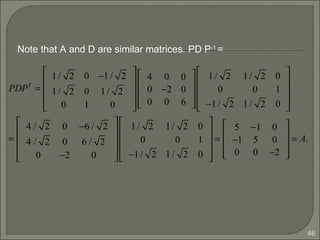
PDPT
=
1/ 2 0 −1/ 2
1/ 2 0 1/ 2
0 1 0










4 0 0
0 −2 0
0 0 6










1/ 2 1/ 2 0
0 0 1
−1/ 2 1/ 2 0










=
4 / 2 0 −6 / 2
4 / 2 0 6 / 2
0 −2 0










1/ 2 1/ 2 0
0 0 1
−1/ 2 1/ 2 0










=
5 −1 0
−1 5 0
0 0 −2










= A.
Note that A and D are similar matrices. PD P-1
=
47
=
1/ 2 1/ 2 0
0 0 1
−1/ 2 1/ 2 0










5 −1 0
−1 5 0
0 0 −2










1/ 2 0 −1/ 2
1/ 2 0 1/ 2
0 1 0










=
4 / 2 4 / 2 0
0 0 −2
−6 / 2 6 / 2 0










1/ 2 0 −1/ 2
1/ 2 0 1/ 2
0 1 0










=
4 0 0
0 −2 0
0 0 6










.
Also, D = P-1
AP = PT
AP
So, A and D are similar with D = PT
AP and A = PDPT
.
48
=
1/ 2 0 −1/ 2
1/ 2 0 1/ 2
0 1 0










4 0 0
0 −2 0
0 0 6










T
1/ 2 0 −1/ 2
1/ 2 0 1/ 2
0 1 0










T
=
1/ 2 0 −1/ 2
1/ 2 0 1/ 2
0 1 0










4 0 0
0 −2 0
0 0 6










1/ 2 1/ 2 0
0 0 1
−1/ 2 1/ 2 0










=
4 / 2 0 −6 / 2
4 / 2 0 6 / 2
0 −2 0










1/ 2 1/ 2 0
0 0 1
−1/ 2 1/ 2 0










=
5 −1 0
−1 5 0
0 0 −2










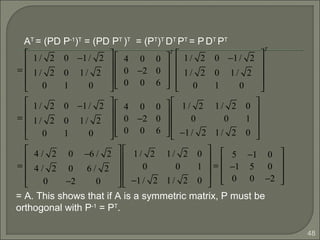
AT
= (PD P-1
)T
= (PD PT
)T
= (PT
)T
DT
PT
= P DT
PT
= A. This shows that if A is a symmetric matrix, P must be
orthogonal with P-1
= PT
.
49
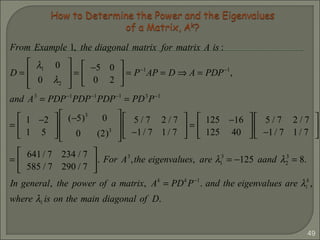
From Example 1, the diagonal matrix for matrix A is :
D =
λ1 0
0 λ2








=
−5 0
0 2





 = P−1
AP = D ⇒ A = PDP−1
,
and A3
= PDP−1
PDP−1
PDP−1
= PD3
P−1
=
1 −2
1 5






(−5)3
0
0 (2)3








5 / 7 2 / 7
−1/ 7 1/ 7





 =
125 −16
125 40






5 / 7 2 / 7
−1/ 7 1/ 7






=
641/ 7 234 / 7
585 / 7 290 / 7





. For A3
,the eigenvalues, are λ1
3
= −125 aand λ2
3
= 8.
In general, the power of a matrix, Ak
= PDk
P−1
. and the eigenvalues are λi
k
,
where λi is on the main diagonal of D.
50

Eigen values and eigenvectors

  • 2.
    2 A nonzero vectorx is an eigenvector (or characteristic vector) of a square matrix A if there exists a scalar λ such that Ax = λx. Then λ is an eigenvalue (or characteristic value) of A. Note: The zero vector can not be an eigenvector even though A0 = λ0. But λ = 0 can be an eigenvalue. Example: Show x = 2 1       isaneigenvector for A = 2 −4 3 −6       Solution: Ax = 2 −4 3 −6       2 1       = 0 0       But for λ =0, λx =0 2 1       = 0 0       Thus,xisaneigenvectorof A,andλ =0 isaneigenvalue.
  • 3.
    An n×n matrixA multiplied by n×1 vector x results in another n×1 vector y=Ax. Thus A can be considered as a transformation matrix. In general, a matrix acts on a vector by changing both its magnitude and its direction. However, a matrix may act on certain vectors by changing only their magnitude, and leaving their direction unchanged (or possibly reversing it). These vectors are the eigenvectors of the matrix. A matrix acts on an eigenvector by multiplying its magnitude by a factor, which is positive if its direction is unchanged and negative if its direction is reversed. This factor is the eigenvalue associated with that eigenvector.
  • 4.
    Example 1: Findthe eigenvalues of two eigenvalues: −1, − 2 Note: The roots of the characteristic equation can be repeated.That is, λ1 = λ2 =…= λk. If that happens, the eigenvalue is said to be of multiplicity k. Example 2: Find the eigenvalues of λ = 2 is an eigenvector of multiplicity 3.       − − = 51 122 A )2)(1(23 12)5)(2( 51 122 2 ++=++= ++−= +− − =− λλλλ λλ λ λ λ AI           = 200 020 012 A 0)2( 200 020 012 3 =−= − − −− =− λ λ λ λ λ AI
  • 5.
  • 6.
  • 7.
  • 8.
    Example 1 (cont.):      − ⇒      − − =−−−= 00 41 41 123 )1(:1 AIλ 0, 1 4 ,404 2 1 1 2121 ≠      =      = ==⇒=− tt x x txtxxx x       − ⇒      − − =−−−= 00 31 31 124 )2(:2 AIλ 0, 1 3 2 1 2 ≠      =      = ss x x x To each distinct eigenvalue of a matrix A there will correspond at least one eigenvector which can be found by solving the appropriate set of homogenous equations. If λi is an eigenvalue then the corresponding eigenvector xi is the solution of (A – λiI)xi = 0
  • 9.
    Example 2 (cont.):Find the eigenvectors of Recall that λ = 2 is an eigenvector of multiplicity 3. Solve the homogeneous linear system represented by Let .The eigenvectors of λ = 2 are of the form s and t not both zero.           =                     − =− 0 0 0 000 000 010 )2( 3 2 1 x x x AI x txsx == 31 , , 1 0 0 0 0 1 0 3 2 1           +           =           =           = ts t s x x x x           = 200 020 012 A
  • 10.
  • 11.
  • 12.
    Definition: The traceof a matrix A, designated by tr(A), is the sum of the elements on the main diagonal. Property 1: The sum of the eigenvalues of a matrix equals the trace of the matrix. Property 2: A matrix is singular if and only if it has a zero eigenvalue. Property 3: The eigenvalues of an upper (or lower) triangular matrix are the elements on the main diagonal. Property 4: If λ is an eigenvalue of A and A is invertible, then 1/λ is an eigenvalue of matrix A-1 .
  • 13.
    Property 5: Ifλ is an eigenvalue of A then kλ is an eigenvalue of kA where k is any arbitrary scalar. Property 6: If λ is an eigenvalue of A then λk is an eigenvalue of Ak for any positive integer k. Property 8: If λ is an eigenvalue of A then λ is an eigenvalue of AT . Property 9: The product of the eigenvalues (counting multiplicity) of a matrix equals the determinant of the matrix.
  • 14.
    Algebraic Multiplicity ofan eigenvalue λ is defined as the order of the eigenvalue as a root of the characteristics equation and is denoted by multa(λ) (or M λ) Geometric multiplicity of λ is defined as the number of linearly independent eigenvectors corresponding and is denoted by multa(λ) (or M λ) Theorem :- If A is a square matrix then for every eigenvalue of A, the algebraic multiplicity is greater than geometric multiplicity.
  • 15.
    This theorem statesthat Every square matrix A satisfies its own characteristics equation; that is, if λn +kn-1λn-1 +kn-2λn-2 +…..+k1λ+k0=0 Is the characteristic equation of an n×n matrix, then An +kn-1An-1 +kn-2An-2 +…..+k1A+k0I=0
  • 16.
    16 If P =[ p1 p2 ], then AP = PD even if A is not diagonalizable. Since AP = 1 −2 1 5       −3 −2 −5 0       = A r p1 r p2     = A r p1 A r p2     = −5 −4 −5 10       = −5(1) 2(−2) −5(1) 2(5)         = −5 1 1       2 −2 5               = λ1 r p1 λ2 r p2     = r p1 r p2     λ1 0 0 λ2         = 1 1       −2 5               −5 0 0 2       = 1 −2 1 5       −5 0 0 2       = PD.
  • 17.
    17 So, our twodistinct eigenvalues both have algebraic multiplicity 1 and geometric multiplicity 1. This ensures that p1 and p2 are not scalar multiples of each other; thus, p1 and p2 are linearly independent eigenvectors of A. Since A is 2 x 2 and there are two linearly independent eigenvectors from the solution of the eigenvalue problem, A is diagonalizable and P-1 AP = D. We can now construct P, P-1 and D. Let Then, P−1 = 5 / 7 2 / 7 −1/ 7 1/ 7       and D = λ1 0 0 λ2         = −5 0 0 2      . P = r p1 r p2     = 1 1       −2 5               = 1 −2 1 5      .
  • 18.
    18 Note that, ifwe multiply both sides on the left by P−1 , then AP = A r p1 r p2     == A r p1 A r p2     = −5 −4 −5 10       = −5(1) 2(−2) −5(1) 2(5)         = −5 1 1       2 −2 5               = λ1 r p1 λ2 r p2     = r p1 r p2     λ1 0 0 λ2         = 1 1       −2 5               −5 0 0 2       = 1 −2 1 5       −5 0 0 2       = PD becomes P−1 AP = 5 / 7 2 / 7 −1/ 7 1/ 7       1 −2 1 5       −3 −2 −5 0       = 5 / 7 2 / 7 −1/ 7 1/ 7       −5 −4 −5 10       = −35 / 7 0 / 7 0 / 7 14 / 7       = −5 0 0 2       = D.
  • 19.
    19 Example 2: Findthe eigenvalues and eigenvectors for A. Step 1: Find the eigenvalues for A. Recall: The determinant of a triangular matrix is the product of the elements at the diagonal. Thus, the characteristic equation of A is λ1 = 1 has algebraic multiplicity 1 and λ2 = 3 has algebraic multiplicity 2. . A = 3 −4 0 0 3 0 0 0 1           p(λ) = det(λI − A) = λI − A = 0 = λ − 3 4 0 0 λ − 3 0 0 0 λ −1 = (λ − 3)2 (λ −1)1 = 0.
  • 20.
    20 Step 2: UseGaussian elimination with back-substitution to solve (λI - A) x = 0. For λ1 = 1, the augmented matrix for the system is Column 3 is not a leading column and x3 = t is a free variable. The geometric multiplicity of λ1 = 1 is one, since there is only one free variable. x2 = 0 and x1 = 2x2 = 0. I − A | r 0  = −2 4 0 0 −2 0 0 0 0 0 0 0           : − 1 2 r1→ r1 r2 r3 1 −2 0 0 −2 0 0 0 0 0 0 0           : r1 − 1 2 r2 → r2 r3 1 −2 0 0 1 0 0 0 0 0 0 0           .
  • 21.
    21 The eigenvector correspondingto λ1 = 1 is The dimension of the eigenspace is 1 because the eigenvalue has only one linearly independent eigenvector. Thus, the geometric multiplicity is 1 and the algebraic multiplicity is 1 for λ1 = 1 . r x = x1 x2 x3             = 0 0 t           = t 0 0 1           . If we choose t = 1, then r p1 = 0 0 1           is our choice for the eigenvector. B1 = { r p1} is a basis for the eigenspace, Eλ1 , with dim(Eλ1 ) = 1.
  • 22.
    22 The augmented matrixfor the system with λ2 = 3 is Column 1 is not a leading column and x1 = t is a free variable. Since there is only one free variable, the geometric multiplicity of λ2 is one. 3I − A | r 0  = 0 4 0 0 0 0 0 0 2 0 0 0           : 1 4 r1→ r1 r2 r3 0 1 0 0 0 0 0 0 2 0 0 0           : r1 r3→ r2 r2 → r3 0 1 0 0 0 2 0 0 0 0 0 0           : r1 1 2 r2 → r2 r3 0 1 0 0 0 1 0 0 0 0 0 0           .
  • 23.
    23 x2 = x3= 0 and the eigenvector corresponding to λ2 = 3 is The dimension of the eigenspace is 1 because the eigenvalue has only one linearly independent eigenvector. Thus, the geometric multiplicity is 1 while the algebraic multiplicity is 2 for λ2 = 3 . This means there will not be enough linearly independent eigenvectors for A to be diagonalizable. Thus, A is not diagonalizable whenever the geometric multiplicity is less than the algebraic multiplicity for any eigenvalue. r x = x1 x2 x3             = t 0 0           = t 1 0 0           ,we choose t = 1, and r p2 = 1 0 0           is our choice for the eigenvector. B2 = { r p2} is a basis for the eigenspace, Eλ2 , with dim(Eλ2 ) = 1.
  • 24.
    24 This time, AP= A r p1 r p2 r p2     = A r p1 A r p2 A r p2     λ1 r p1 λ2 r p2 λ2 r p2     = r p1 r p2 r p2     λ1 0 0 0 λ2 0 0 0 λ2           = PD. P−1 does not exist since the columns of P are not linearly independent. It is not possible to solve for D = P−1 AP, so A is not diagonalizable.
  • 25.
    25 AP = A r p1 r p2... r pn     = A r p1 A r p2 ... A r pn     = λ1 r p1 λ2 r p2 ... λn r pn     = PD = r p1 r p2 ... r pn     λ1 0 O 0 λn             For A, an n x n matrix, with characteristic polynomial roots for eigenvalues λi of A with corresponding eigenvectors pi. P is invertible iff the eigenvectors that form its columns are linearly independent iff λ1,λ2,...,λn , then algbraic multiplicity for each distinct λi . dim(Eλi ) = geometric multiplicity =
  • 26.
    26 P−1 AP = P−1 PD= D = λ1 0 O 0 λn             . This gives us n linearly independent eigenvectors for P, so P-1 exists. Therefore, A is diagonalizable since The square matrices S and T are similar iff there exists a nonsingular P such that S = P-1 TP or PSP-1 = T. Since A is similar to a diagonal matrix, A is diagonalizable.
  • 27.
    27 Example 4: Solvethe eigenvalue problem Ax = λx and find the eigenspace, algebraic multiplicity, and geometric multiplicity for each eigenvalue. Step 1: Write down the characteristic equation of A and solve for its eigenvalues. A = −4 −3 6 0 −1 0 −3 −3 5           p(λ) = λI − A = λ + 4 3 −6 0 λ +1 0 3 3 λ − 5 = (−1)(λ +1) λ + 4 −6 3 λ − 5
  • 28.
    28 Since the factor(λ - 2) is first power, λ1 = 2 is not a repeated root. λ1 = 2 has an algebraic multiplicity of 1. On the other hand, the factor (λ +1) is squared, λ2 = -1 is a repeated root, and it has an algebraic multiplicity of 2. p(λ) = (λ +1)(λ + 4)(λ − 5) +18(λ +1) = 0 = (λ2 + 5λ + 4)(λ − 5) +18(λ +1) = 0 = (λ3 + 5λ2 + 4λ − 5λ2 − 25λ − 20) +18λ +18 = 0 = λ3 − 3λ − 2 = (λ +1)(λ2 − λ − 2) = (λ +1)(λ − 2)(λ +1) = 0 = (λ − 2)(λ +1)2 = 0. So the eigenvalues are λ1 = 2,λ2 = −1.
  • 29.
    29 Step 2: UseGaussian elimination with back-substitution to solve (λI - A) x = 0 for λ1 and λ2. For λ1 = 2 , the augmented matrix for the system is 2I − A | r 0  = 6 0 3 3 3 3 −6 0 −3 0 0 0           ~ 1 6 r1→ r1 1 3 r2 → r2 r3 1 0 3 1/ 2 1 3 −1 0 −3 0 0 0           ~ r1 r2 −3r1+ r3→ r3 1 0 0 1/ 2 1 3 / 2 −1 0 0 0 0 0           : r1 r2 − 3 2 r2 + r3→ r3 1 0 0 1/ 2 1 0 −1 0 0 0 0 0           . In this case, x3 = r, x2 = 0, and x1 = -1/2(0) + r = 0 + r = r.
  • 30.
    30 Thus, the eigenvectorcorresponding to λ1 = 2 is r x = x1 x2 x3           = r 0 r           = r 1 0 1           ,r ≠ 0. If we choose r p1 = 1 0 1           , then B1 = 1 0 1                     is a basis for the eigenspace of λ1 = 2. Eλ1 = span({ r p1}) and dim(Eλ1 ) = 1, so the geometric multiplicity is 1. A r x = 2 r x or (2I − A) r x = r 0. −4 −3 6 0 −1 0 −3 −3 5           1 0 1           = −4 + 6 0 −3+ 5           = 2 0 2           = 2 1 0 1           .
  • 31.
    31 For λ2 =-1, the augmented matrix for the system is (−1)I − A | r 0  = 3 0 3 3 0 3 −6 0 −6 0 0 0           ~ 1 3 r1→ r1 r2 r3 1 0 3 1 0 3 −2 0 −6 0 0 0           ~ r1 r2 −3r1+ r3→ r3 1 0 0 1 0 0 −2 0 0 0 0 0           x3 = t, x2 = s, and x1 = -s + 2t. Thus, the solution has two linearly independent eigenvectors for λ2 = -1 with r x = x1 x2 x3           = −s + 2t s t           = s −1 1 0           + t 2 0 1           ,s ≠ 0,t ≠ 0.
  • 32.
    32 If we choose r p2= −1 1 0           , and r p3 = 2 0 1           , then B2 = −1 1 0           , 2 0 1                     is a basis for Eλ2 = span({ r p2 , r p3}) and dim(Eλ2 ) = 2, so the geometric multiplicity is 2.
  • 33.
    33 Thus, we haveAP = PD as follows : −4 −3 6 0 −1 0 −3 −3 5           1 −1 2 0 1 0 1 0 1           = 1 −1 2 0 1 0 1 0 1           2 0 0 0 −1 0 0 0 −1           2 1 −2 0 −1 0 2 0 −1           = 2 1 −2 0 −1 0 2 0 −1           . Since the geometric multiplicity is equal to the algebraic multiplicity for each distinct eigenvalue, we found three linearly independent eigenvectors. The matrix A is diagonalizable since P = [p1 p2 p3] is nonsingular.
  • 34.
    34 P | I[]= 1 −1 2 0 1 0 1 0 1 1 0 0 0 1 0 0 0 1           : 1 −1 2 0 1 0 0 1 −1 1 0 0 0 1 0 −1 0 1           : 1 0 2 0 1 0 0 0 1 1 1 0 0 1 0 1 1 −1           : 1 0 0 0 1 0 0 0 1 −1 −1 2 0 1 0 1 1 −1           . So, P−1 = −1 −1 2 0 1 0 1 1 −1           . We can find P-1 as follows:
  • 35.
    35 AP = PDgives us A = APP−1 = PDP−1 . Thus, PDP−1 = 1 −1 2 0 1 0 1 0 1           2 0 0 0 −1 0 0 0 −1           −1 −1 2 0 1 0 1 1 −1           = 2 1 −2 0 −1 0 2 0 −1           −1 −1 2 0 1 0 1 1 −1           = −4 −3 6 0 −1 0 −3 −3 5           = A Note that A and D are similar matrices.
  • 36.
    36 D = −1 −12 0 1 0 1 1 −1           −4 −3 6 0 −1 0 −3 −3 5           1 −1 2 0 1 0 1 0 1           = −2 −2 4 0 −1 0 −1 −1 1           1 −1 2 0 1 0 1 0 1           = 2 0 0 0 −1 0 0 0 −1           . Also, D = P-1 AP = So, A and D are similar with D = P-1 AP and A = PD P-1 .
  • 37.
    37 If P isan orthogonal matrix, its inverse is its transpose, P-1 = PT . Since PT P = r p1 T r p2 T r pT 3             r p1 r p2 r p3     == r p1 T r p1 r p1 T r p2 r p1 T r p3 r pT 2 r p1 r p2 T r p2 r p2 T r p3 r p3 T r p1 r p3 T r p2 r pT 3 r p3             = r p1 ⋅ r p1 r p1 ⋅ r p2 r p1 ⋅ r p3 r p2 ⋅ r p1 r p2 ⋅ r p2 r p2 ⋅ r p3 r p3 ⋅ r p1 r p3 ⋅ r p2 r p3 ⋅ r p3           = r pi ⋅ r pj   = I because r pi ⋅ r pj = 0 for i ≠ j and r pi ⋅ r pj = 1 for i = j = 1,2,3. So, P−1 = PT .
  • 38.
    38 A is asymmetric matrix if A = AT . Let A be diagonalizable so that A = PDP-1 . But A = AT and AT = (PDP−1 )T = (PDPT )T = (PT )T DT PT = PDPT = A. This shows that for a symmetric matrix A to be diagonalizable, P must be orthogonal. If P-1 ≠ PT , then A ≠AT . The eigenvectors of A are mutually orthogonal but not orthonormal. This means that the eigenvectors must be scaled to unit vectors so that P is orthogonal and composed of orthonormal columns.
  • 39.
    39 Example 5: Determineif the symmetric matrix A is diagonalizable; if it is, then find the orthogonal matrix P that orthogonally diagonalizes the symmetric matrix A. Let A = 5 −1 0 −1 5 0 0 0 −2           , then det(λI − A) = λ − 5 1 0 1 λ − 5 0 0 0 λ + 2 = (−1)3+1 (λ + 2) λ − 5 1 1 λ − 5 = (λ + 2)(λ − 5)2 − (λ + 2) = λ3 − 8λ2 + 4λ + 48 = (λ − 4)(λ2 − 4λ −12) = (λ − 4)(λ + 2)(λ − 6) = 0 Thus, λ1 = 4, λ2 = −2, λ3 = 6. Since we have three distinct eigenvalues, we will see that we are guaranteed to have three linearly independent eigenvectors.
  • 40.
    40 Since λ1 =4, λ2 = -2, and λ3 = 6, are distinct eigenvalues, each of the eigenvalues has algebraic multiplicity 1. An eigenvalue must have geometric multiplicity of at least one. Otherwise, we will have the trivial solution. Thus, we have three linearly independent eigenvectors. We will use Gaussian elimination with back-substitution as follows:
  • 41.
    41 For λ1 =4 , λ1I − A r 0    = −1 1 0 1 −1 0 0 0 6 0 0 0           : 1 −1 0 0 0 0 0 0 1 0 0 0           : 1 −1 0 0 0 1 0 0 0 0 0 0           x2 = s, x3 = 0, x1 = s . r x = x1 x2 x3           = s 1 1 0           or r p1 = 1/ 2 1/ 2 0           .
  • 42.
    42 For λ2 =−2 , λ2 I − A r 0    = −7 1 0 1 −7 0 0 0 0 0 0 0           : 1 −7 0 0 1 0 0 0 0 0 0 0           x3 = s, x2 = 0, x1 = 0 . r x = x1 x2 x3           = s 0 0 1           or r p2 = 0 0 1           .
  • 43.
    43 For λ3 =6, λ3I − A r 0    = 1 1 0 1 1 0 0 0 8 0 0 0           : 1 1 0 0 0 1 0 0 0 0 0 0           x2 = s, x3 = 0, x1 = −s. r x = x1 x2 x3           = s −1 1 0           or r p3 = −1/ 2 1/ 2 0           .
  • 44.
    44 As we cansee the eigenvectors of A are distinct, so {p1, p2, p3} is linearly independent, P-1 exists for P =[p1 p2 p3] and Thus A is diagonalizable. Since A = AT (A is a symmetric matrix) and P is orthogonal with approximate scaling of p1, p2, p3, P-1 = PT . AP = PD ⇔ PDP−1 . PP−1 = PPT = 1/ 2 0 −1/ 2 1/ 2 0 1/ 2 0 1 0           1/ 2 1/ 2 0 0 0 1 −1/ 2 1/ 2 0           = 1 0 0 0 1 0 0 0 1           = I.
  • 45.
    45 As we cansee the eigenvectors of A are distinct, so {p1, p2, p3} is linearly independent, P-1 exists for P =[p1 p2 p3] and Thus A is diagonalizable. Since A = AT (A is a symmetric matrix) and P is orthogonal with approximate scaling of p1, p2, p3, P-1 = PT . AP = PD ⇔ PDP−1 . PP−1 = PPT = 1/ 2 0 −1/ 2 1/ 2 0 1/ 2 0 1 0           1/ 2 1/ 2 0 0 0 1 −1/ 2 1/ 2 0           = 1 0 0 0 1 0 0 0 1           = I.
  • 46.
    46 PDPT = 1/ 2 0−1/ 2 1/ 2 0 1/ 2 0 1 0           4 0 0 0 −2 0 0 0 6           1/ 2 1/ 2 0 0 0 1 −1/ 2 1/ 2 0           = 4 / 2 0 −6 / 2 4 / 2 0 6 / 2 0 −2 0           1/ 2 1/ 2 0 0 0 1 −1/ 2 1/ 2 0           = 5 −1 0 −1 5 0 0 0 −2           = A. Note that A and D are similar matrices. PD P-1 =
  • 47.
    47 = 1/ 2 1/2 0 0 0 1 −1/ 2 1/ 2 0           5 −1 0 −1 5 0 0 0 −2           1/ 2 0 −1/ 2 1/ 2 0 1/ 2 0 1 0           = 4 / 2 4 / 2 0 0 0 −2 −6 / 2 6 / 2 0           1/ 2 0 −1/ 2 1/ 2 0 1/ 2 0 1 0           = 4 0 0 0 −2 0 0 0 6           . Also, D = P-1 AP = PT AP So, A and D are similar with D = PT AP and A = PDPT .
  • 48.
    48 = 1/ 2 0−1/ 2 1/ 2 0 1/ 2 0 1 0           4 0 0 0 −2 0 0 0 6           T 1/ 2 0 −1/ 2 1/ 2 0 1/ 2 0 1 0           T = 1/ 2 0 −1/ 2 1/ 2 0 1/ 2 0 1 0           4 0 0 0 −2 0 0 0 6           1/ 2 1/ 2 0 0 0 1 −1/ 2 1/ 2 0           = 4 / 2 0 −6 / 2 4 / 2 0 6 / 2 0 −2 0           1/ 2 1/ 2 0 0 0 1 −1/ 2 1/ 2 0           = 5 −1 0 −1 5 0 0 0 −2           AT = (PD P-1 )T = (PD PT )T = (PT )T DT PT = P DT PT = A. This shows that if A is a symmetric matrix, P must be orthogonal with P-1 = PT .
  • 49.
    49 From Example 1,the diagonal matrix for matrix A is : D = λ1 0 0 λ2         = −5 0 0 2       = P−1 AP = D ⇒ A = PDP−1 , and A3 = PDP−1 PDP−1 PDP−1 = PD3 P−1 = 1 −2 1 5       (−5)3 0 0 (2)3         5 / 7 2 / 7 −1/ 7 1/ 7       = 125 −16 125 40       5 / 7 2 / 7 −1/ 7 1/ 7       = 641/ 7 234 / 7 585 / 7 290 / 7      . For A3 ,the eigenvalues, are λ1 3 = −125 aand λ2 3 = 8. In general, the power of a matrix, Ak = PDk P−1 . and the eigenvalues are λi k , where λi is on the main diagonal of D.
  • 50.