3. Aim, Principles and Rules of First Aid
SEMESTER-III
ENVIRONMENT, HEALTH
AND
SAFETY MANAGEMENT
DSC301
Col. (Prof.) Rajive Kohli, Ph.D.
17, 21 & 23 September 2020
First
Aid?
Immediate assistance
or treatment given to
someone before the
arrival of medical staff/
ambulance
the first and immediate assistance
given to any person suffering from
either a minor or serious illness or
injury, with care provided to
preserve life, prevent the condition
from worsening, or to promote
recovery.
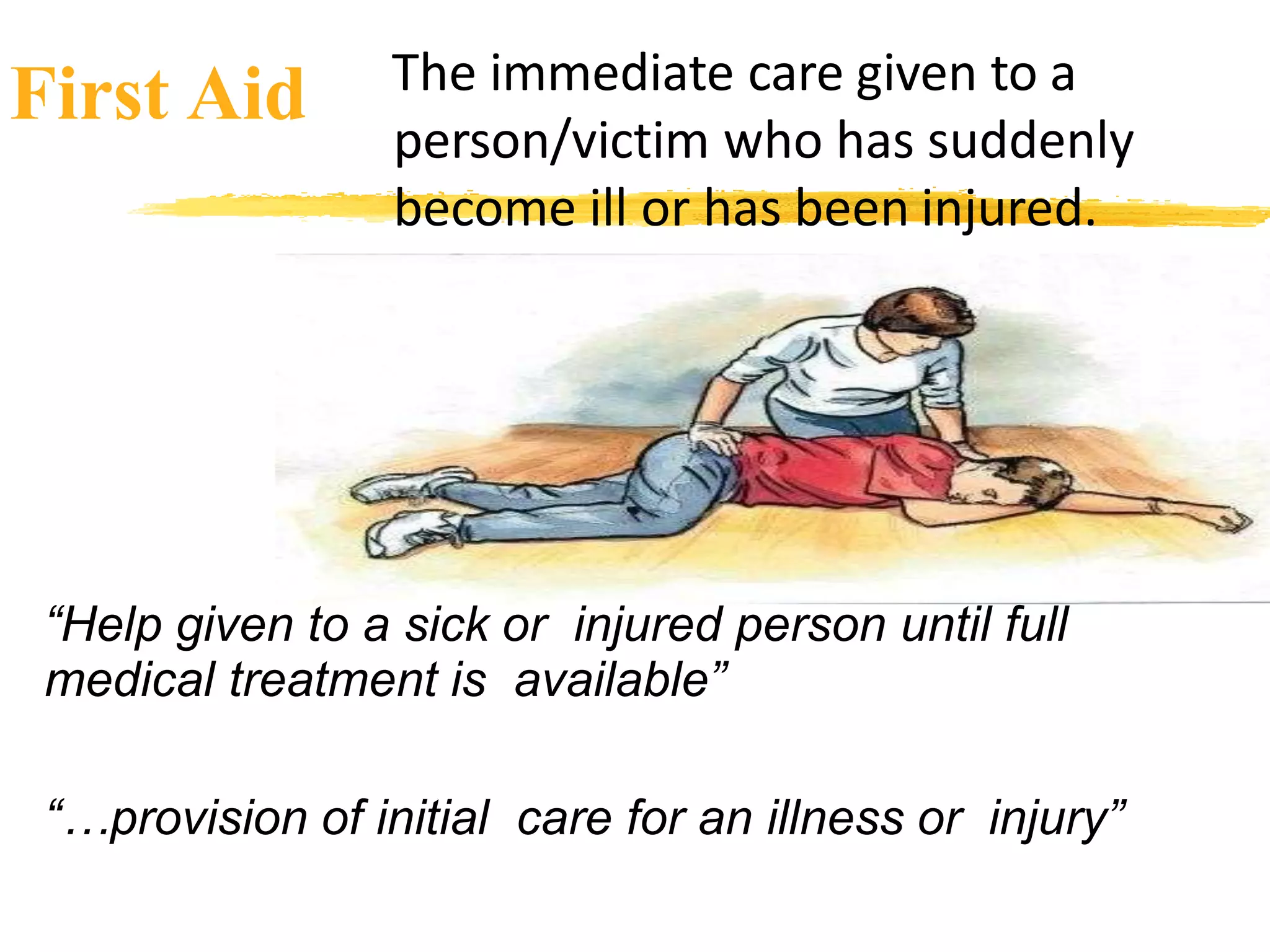
First Aid The immediate care given to a
person/victim who has suddenly
become ill or has been injured.
“Help given to a sick or injured person until full
medical treatment is available”
“…provision of initial care for an illness or injury”
"measures to be taken immediately after an
accident not with an idea to cure but in order
to prevent further harm being done". It uses
the available human and material resources at
the site of accident to provide initial care to
the victim of injury or sudden illness until
more advance care is provided.
First Aid (Encyclopaedia Britannica)
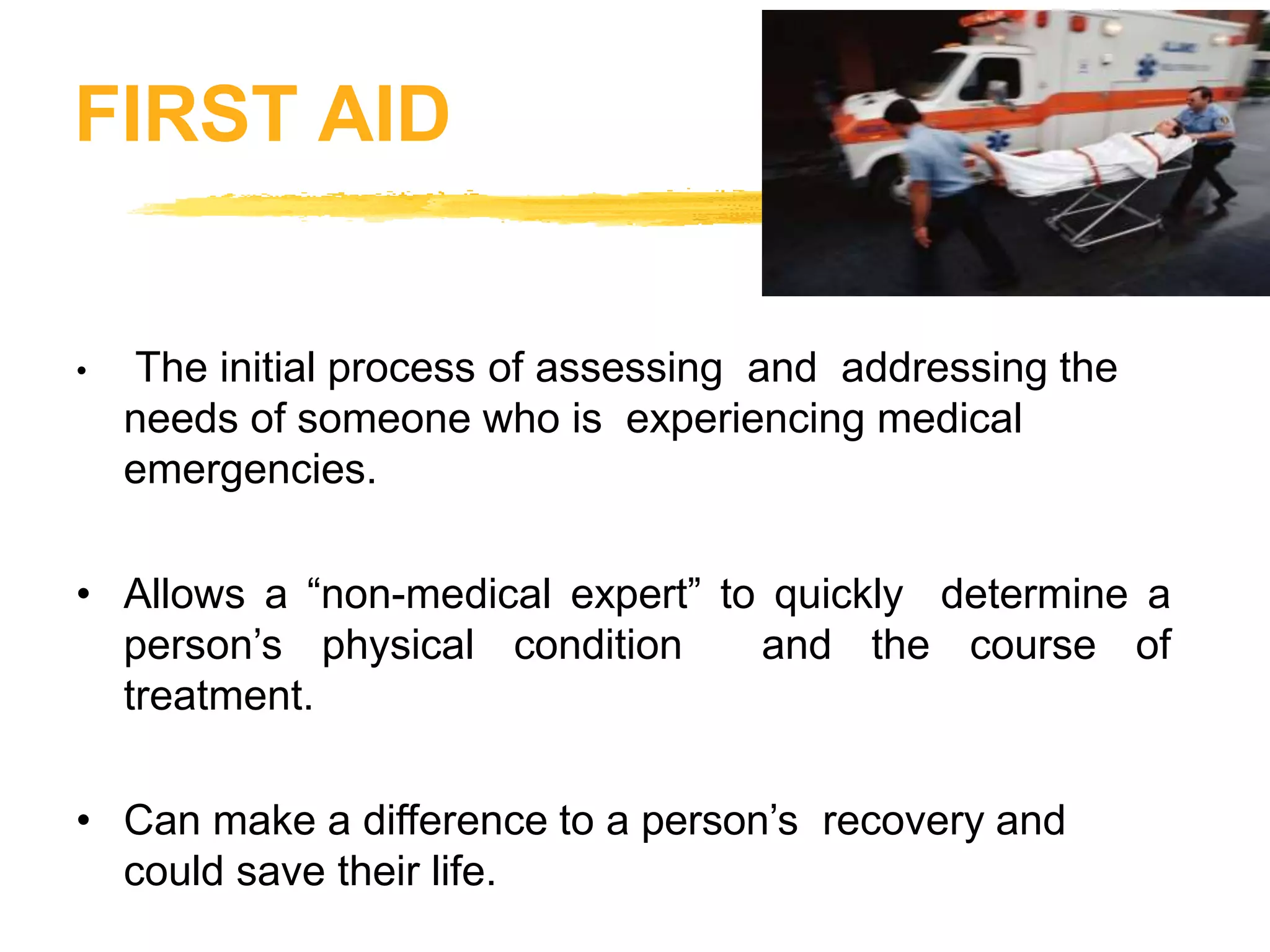
FIRST AID
• The initial process of assessing and addressing the
needs of someone who is experiencing medical
emergencies.
• Allows a “non-medical expert” to quickly determine a
person’s physical condition and the course of
treatment.
• Can make a difference to a person’s recovery and
could save their life.
Purpose of First Aid
• To Sustain the life
• To Prevent suffering
• To Prevent secondary complications
• To Promote speedy recovery
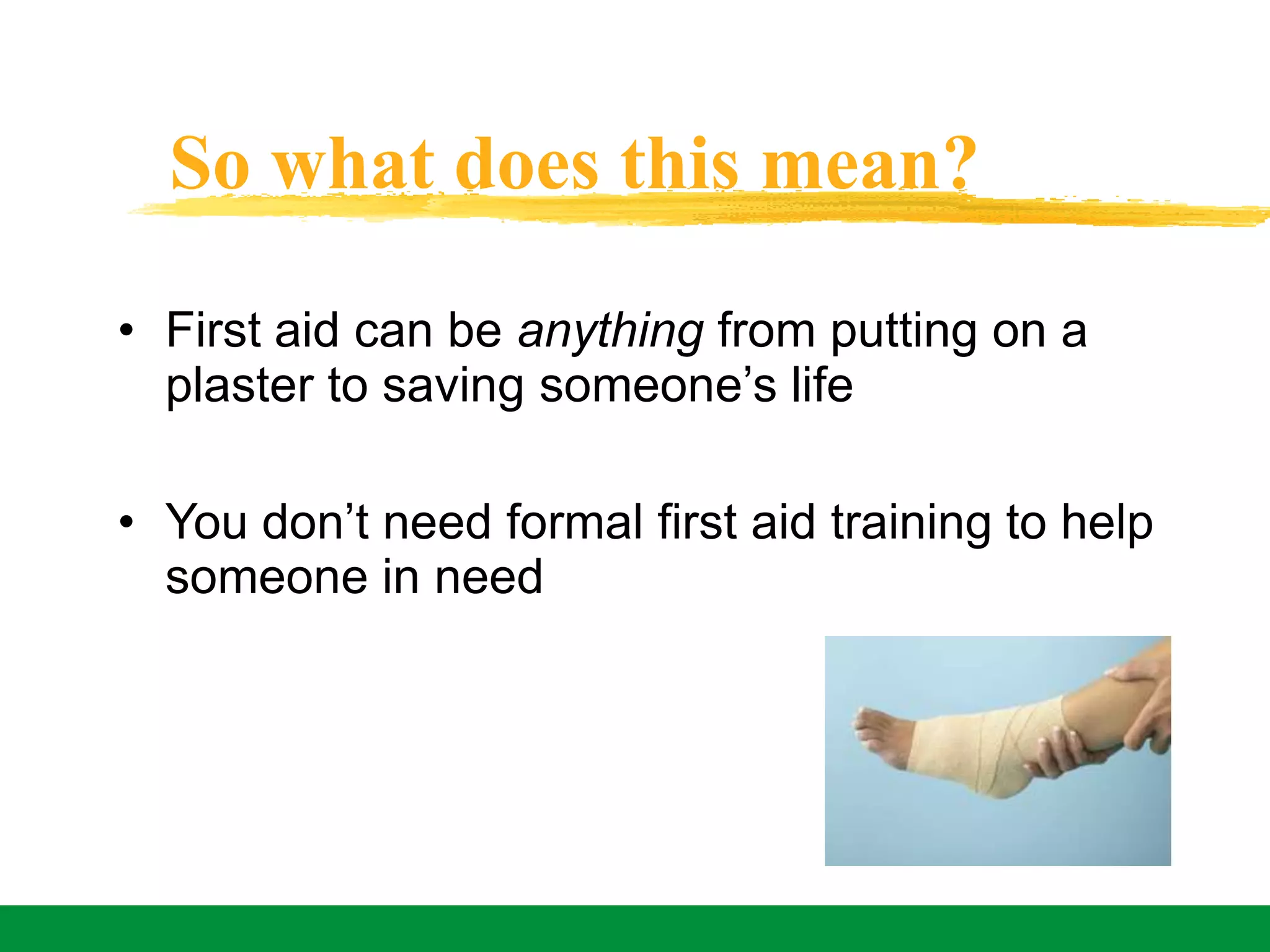
So what does this mean?
• First aid can be anything from putting on a
plaster to saving someone’s life
• You don’t need formal first aid training to help
someone in need
Objectives of first aid
For example, applying a plaster is preventing the
condition (a cut) from worsening by stopping
infection!
(i)Topreserve & prolong life
(ii)Toalleviate suffering & prevent the victim's
condition from worsening
(iii)To prevent further or added injury &
promote recovery
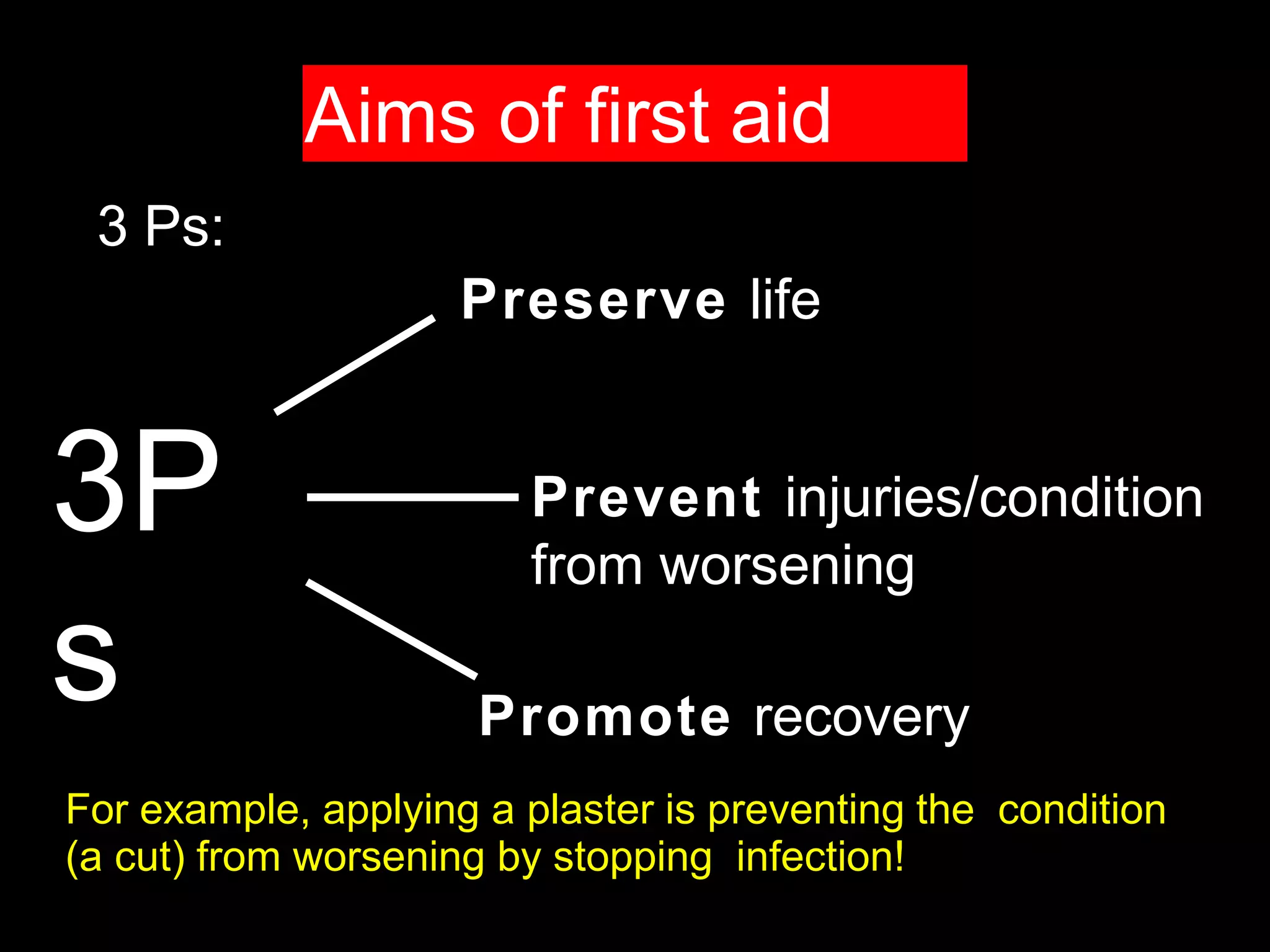
Aims of first aid
3P
s
3 Ps:
Preserve life
Prevent injuries/condition
from worsening
Promote recovery
For example, applying a plaster is preventing the condition
(a cut) from worsening by stopping infection!
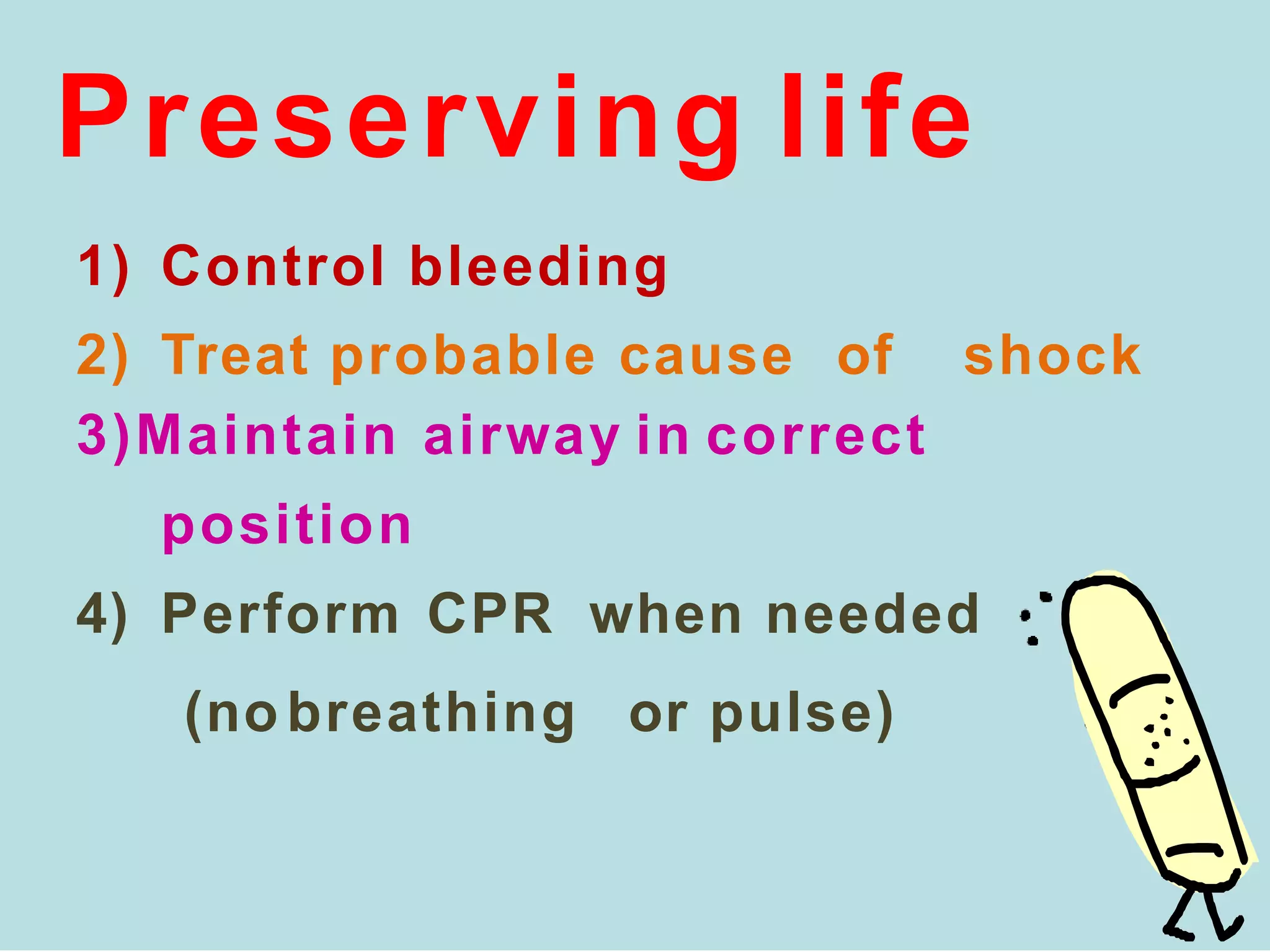
Preserving life
1) Control bleeding
2) Treat probable cause of shock
3)Maintain airway in correct
position
4) Perform CPR when needed
(no breathing or pulse)
Ps:
1) Dress woundto prevent
infection
2) Provide comfort to casualty
3) Place casualty in a comfortable
position
Prevent condition from
worsening:
1) Relieve casualty from anxiety
2) Encourage confidence and trust
3)Attempt to relieve pain and
discomfort
4) Handle casualty gently
5) Protect casualty from cold
and wet
Promote recovery:
PRINCIPLES OF FIRST AID (4 C’s)
• Call for Help
• Calmly Take Charge
• Check the scene & the casualty
• Carefully apply FIRST AID
PRINCIPLES of FIRST AID
DOs in giving First Aid
DO stay calm
DO reassure & comfort the victim
DO check for a medical bracelet
indicating a condition
DO loosen any tight clothing
DO keep the victim covered to
reduce shock
PRINCIPLES of FIRST AID
DON’Ts in giving First Aid
DON’T give food & drink to an
unconscious person
DON’T move an injured person
unless you need to place him/her in
the recovery position
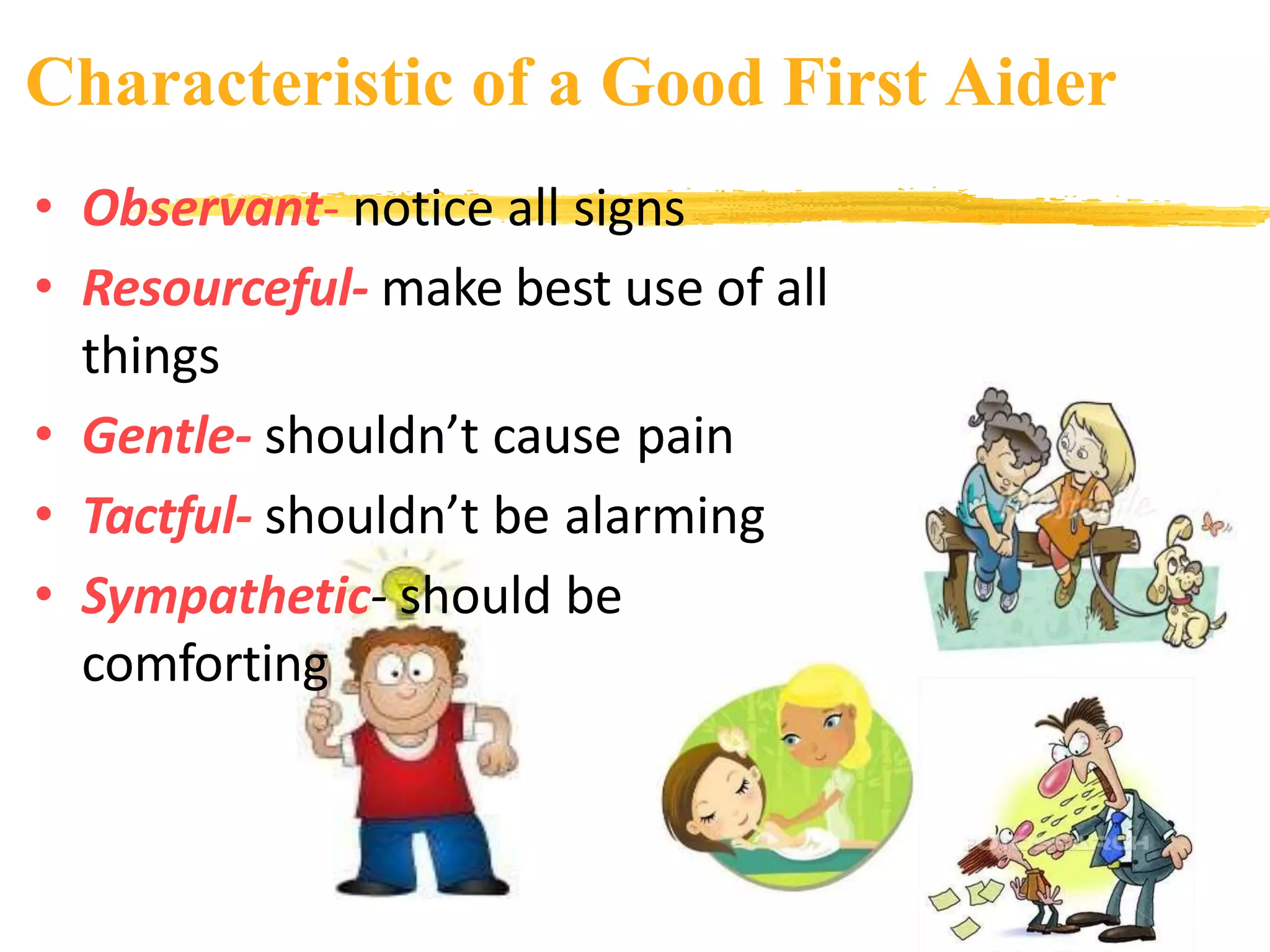
Characteristic of a Good First Aider
• Observant- notice all signs
• Resourceful- make best use of all
things
• Gentle- shouldn’t cause pain
• Tactful- shouldn’t be alarming
• Sympathetic- should be
comforting
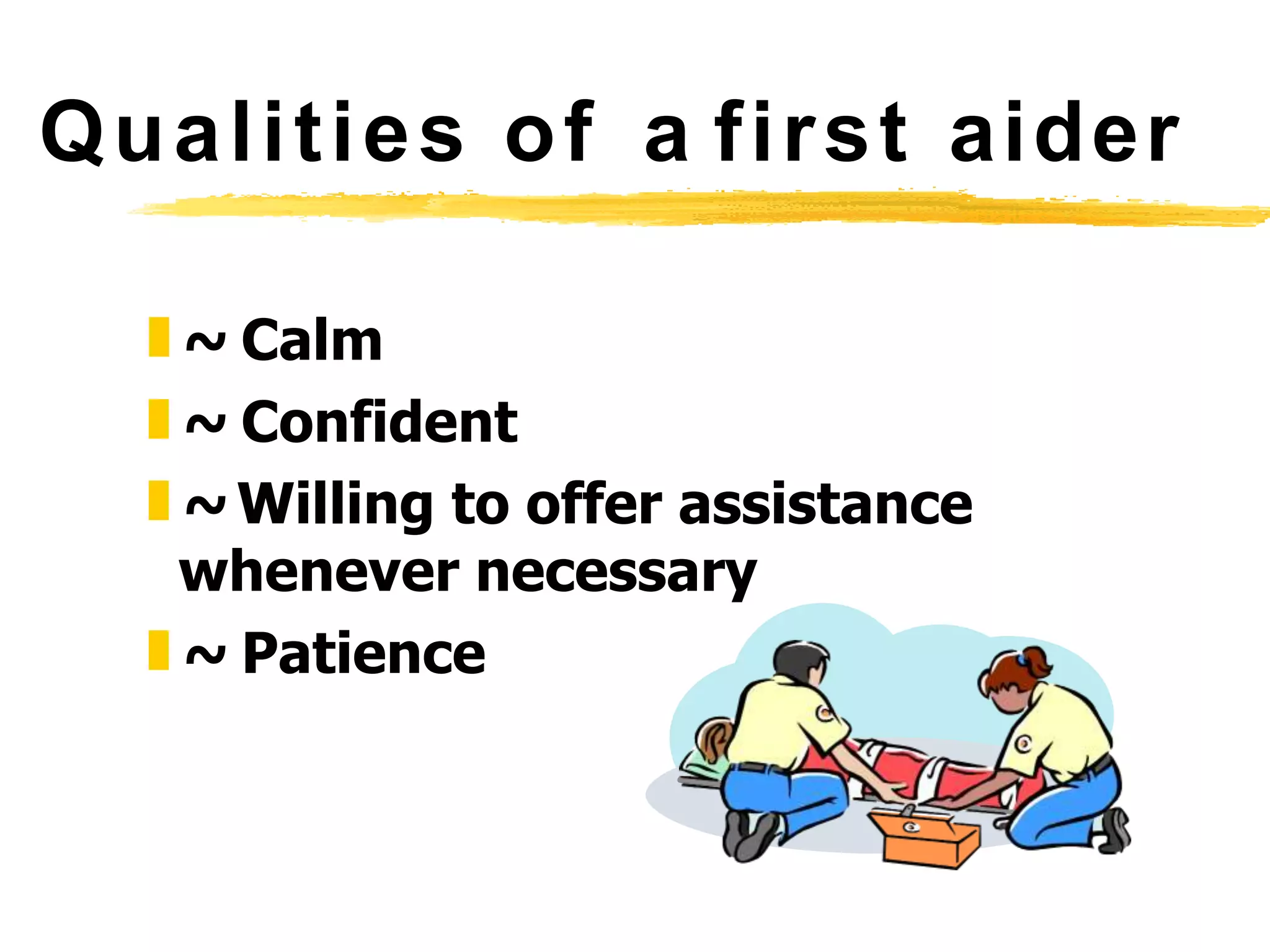
Qualities of a first aider
❚~ Calm
❚~ Confident
❚~Willing to offer assistance
whenever necessary
❚~ Patience
Role of First Aider
• Bridge the gap between the time of the accident
and the arrival of the physician.
• Ends when medical assistance begins.
• Doesn’t intend to compete with or take place of
the physician.
Responsibility of a First Aider
• To assess the situation quickly and safely and call for
appropriate help.
• To identify the level of injury or the nature of illness affecting
the casualty / victim.
• To give early and appropriate treatment in a sensible order of
priority.
• To make and pass on a report, give a further help if its
required.
DO AND DON’Ts
casualty use:
Mask
Gloves
Head Cover
Apron
DO DON’Ts
• Before handling the • First Aider can
never
 Prescribe Medicine
 Declare DEATH
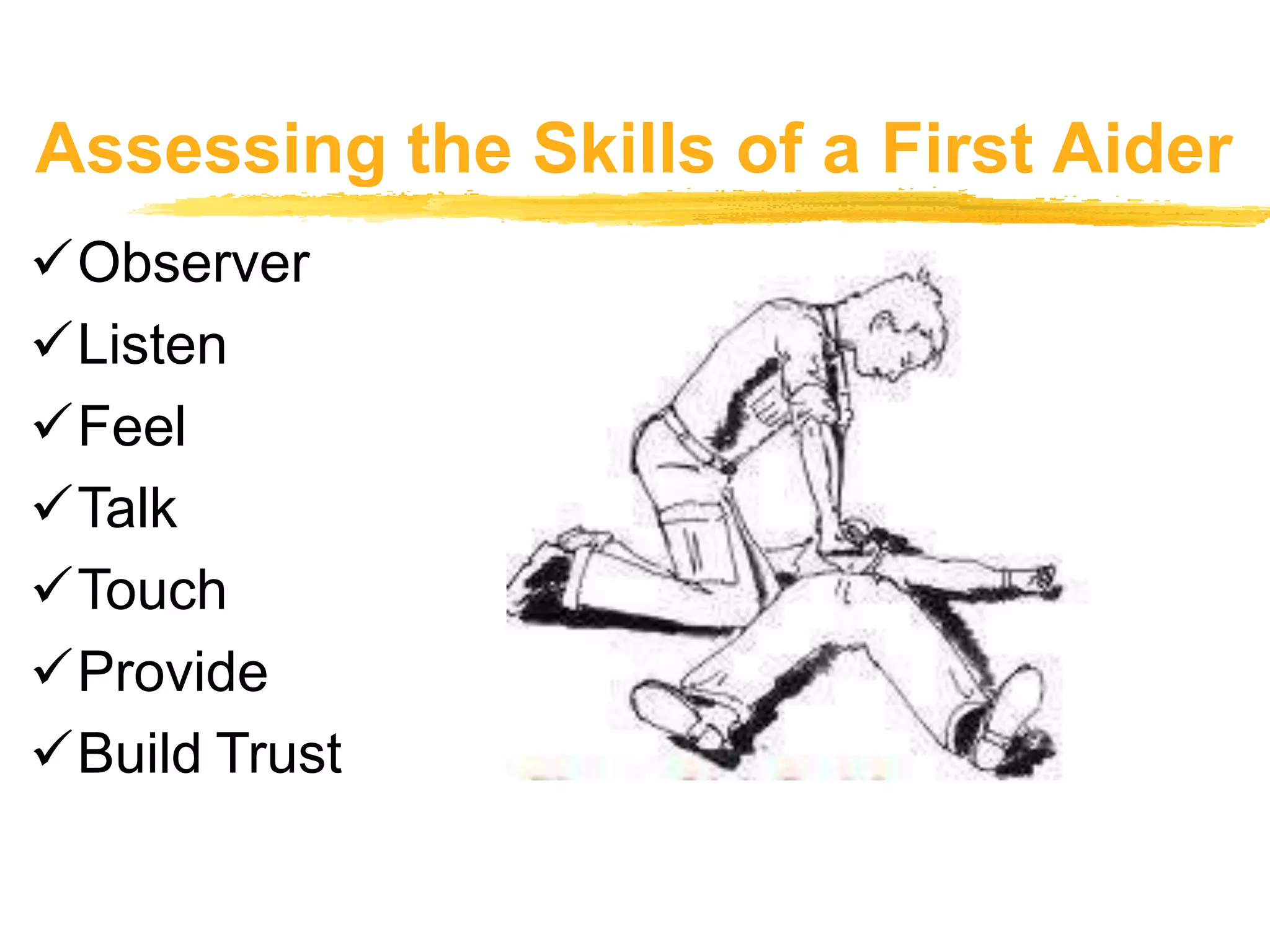
Assessing the Skills of a First Aider
Observer
Listen
Feel
Talk
Touch
Provide
Build Trust
 Essential to protect yourself from injury and
infection
 Ensure surroundings are safe
 Protection from infection to prevent “cross
infection” (transmitting germs to a casualty or
contracting an infection yourself)
wear gloves or wash hands before doing a dressing
Protecting yourself as a first
aider
EMERGENCY FIRST AID
 If you are the first on the scene of accident
that results in an injury or serious illness, you
may be the only link between a victim and
emergency medical care.
 Your role is to take action, whether by
providing first aid, seeking medical help or
calling emergency.
 Your actions may improve the victims chance
of recovery.
Calling for emergency help
1. In many first aid situations, help from the emergency
services may be required.
2. Ensure you know which number to call!
3. If the area is remote/difficult to access, consider
sending someone to meet the emergency services in a
known location
4. Give clear, precise information about
– The location of the incident
– The number of casualties / people involved
– The nature of their injuries
– In some cases, their age
– Any hazards at the incident (e.g: spilt fuel, fire,
electricity)
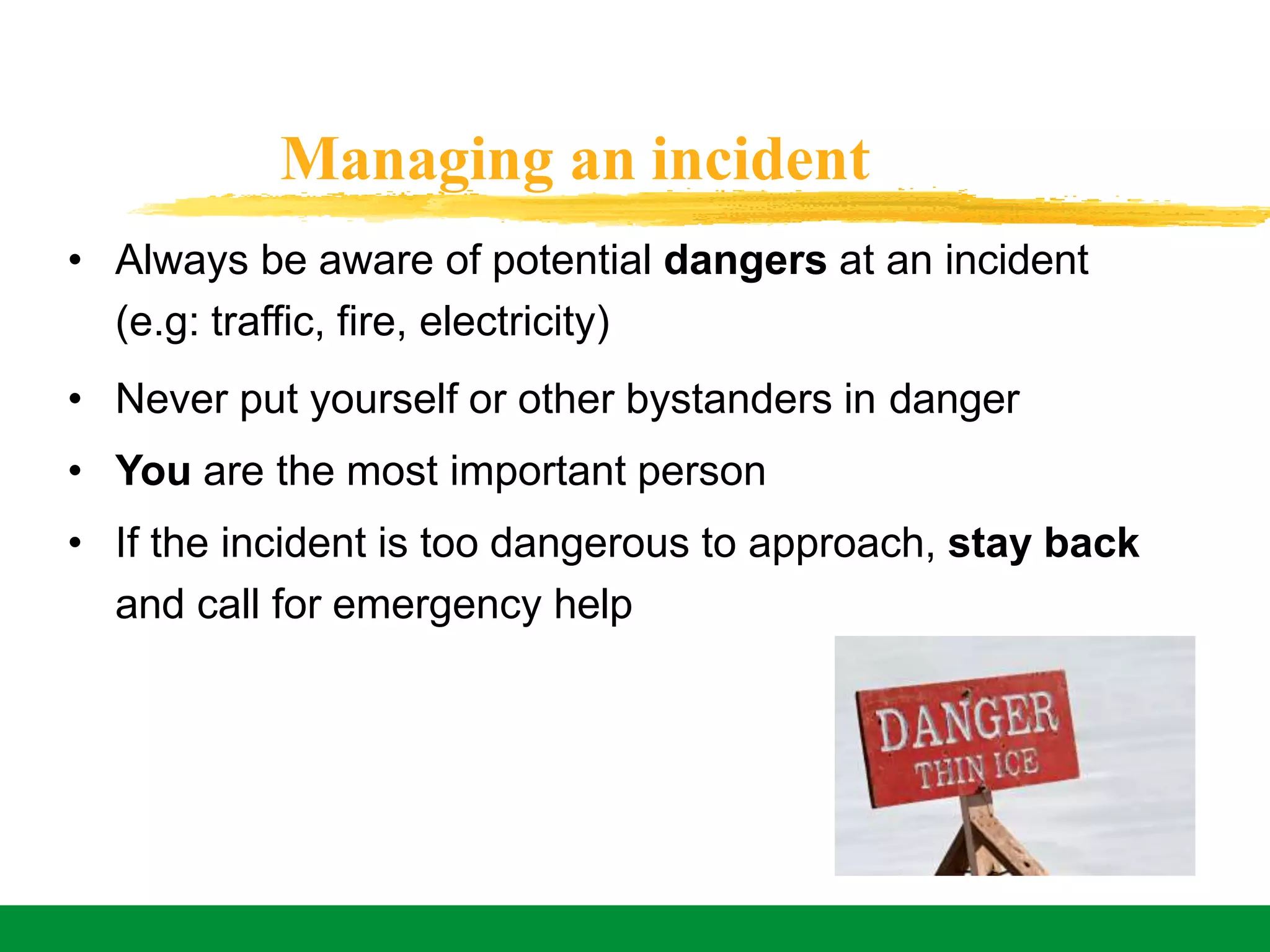
Managing an incident
• Always be aware of potential dangers at an incident
(e.g: traffic, fire, electricity)
• Never put yourself or other bystanders in danger
• You are the most important person
• If the incident is too dangerous to approach, stay back
and call for emergency help
❚Ambulance:
❚Police number:
❚Fire Brigade:
Emergency Hotlines
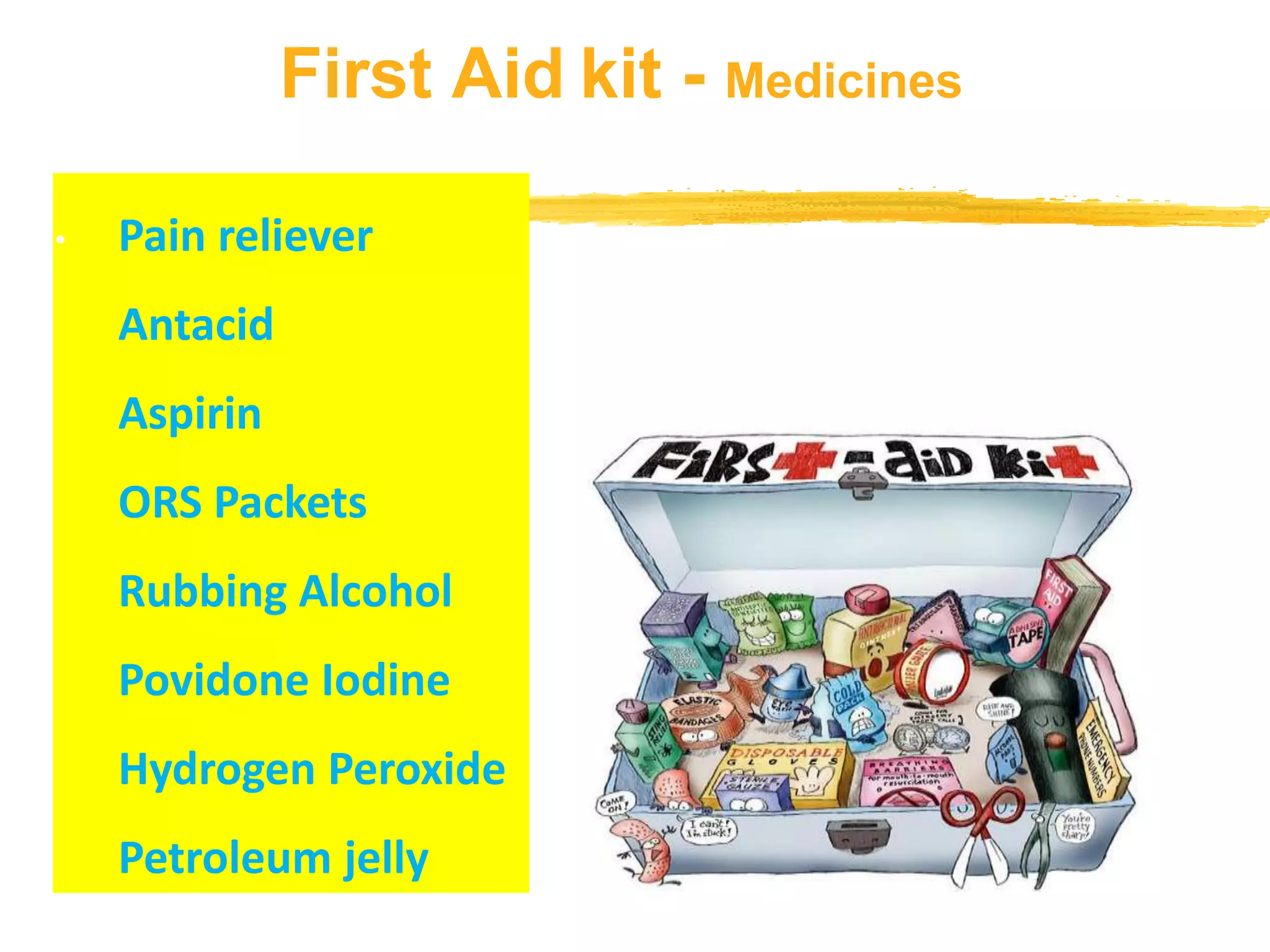
First Aid kit - Medicines
• Pain reliever
Antacid
Aspirin
ORS Packets
Rubbing Alcohol
Povidone Iodine
Hydrogen Peroxide
Petroleum jelly
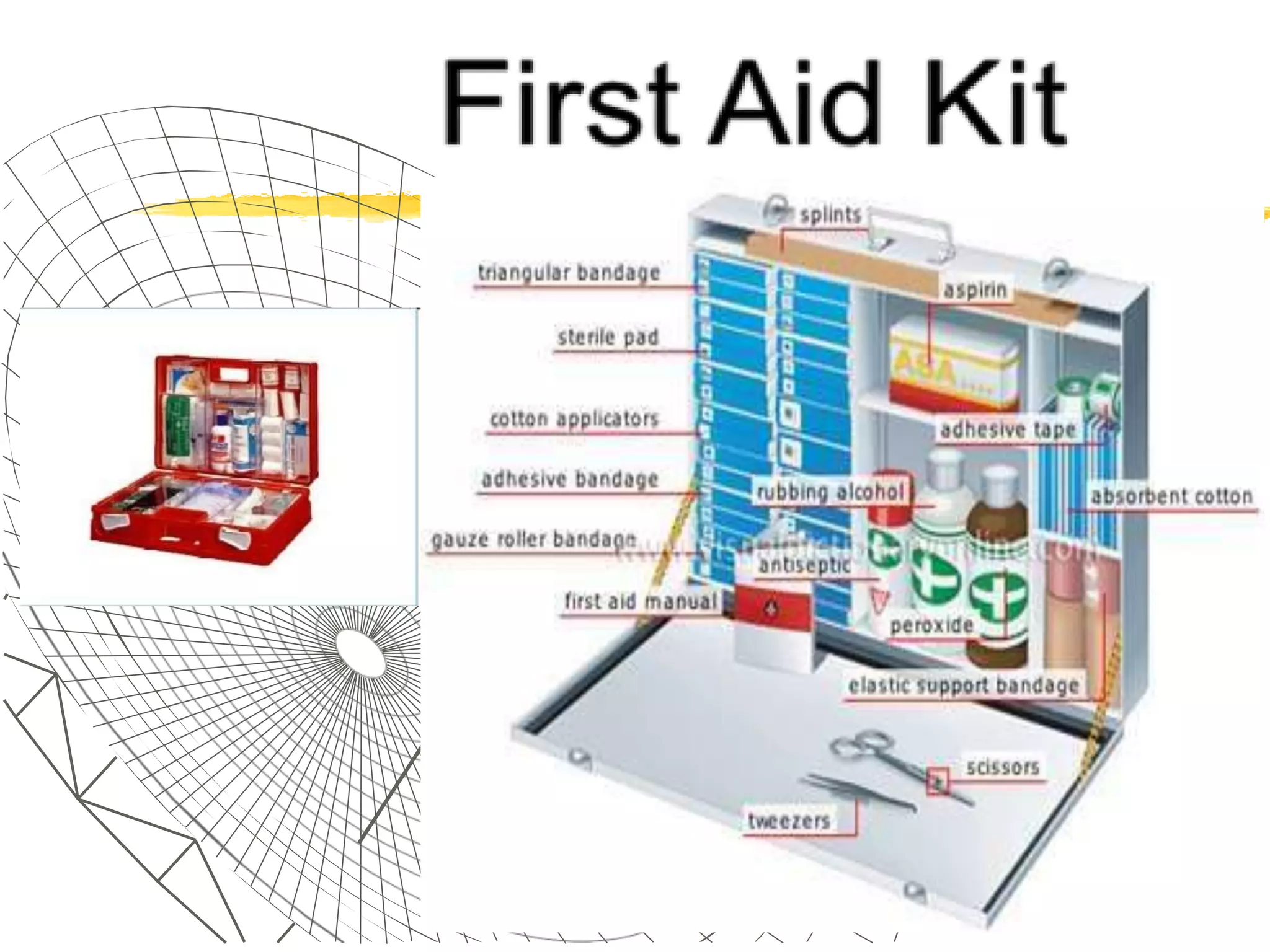
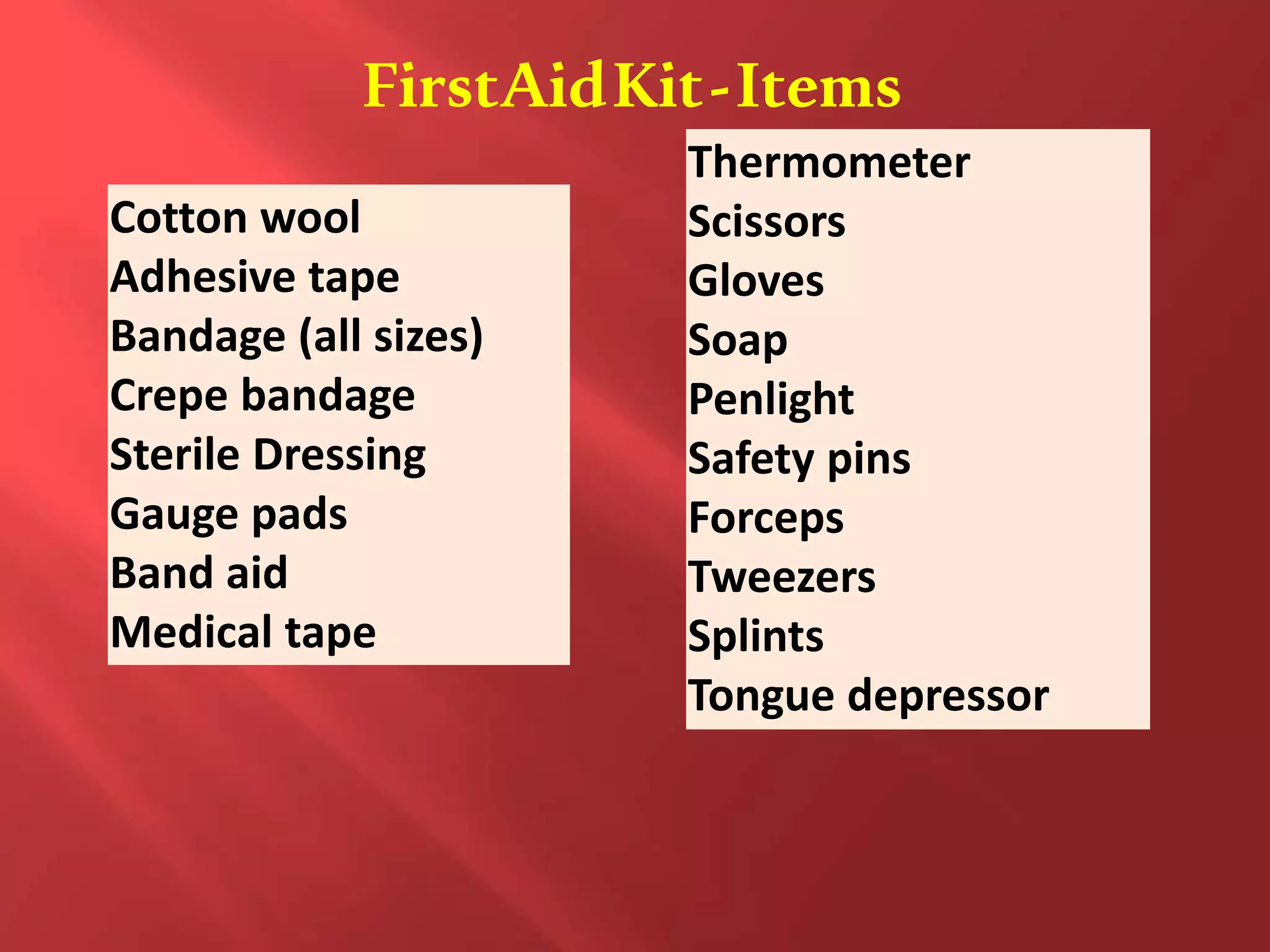
FirstAidKit-Items
Cotton wool
Adhesive tape
Bandage (all sizes)
Crepe bandage
Sterile Dressing
Gauge pads
Band aid
Medical tape
Thermometer
Scissors
Gloves
Soap
Penlight
Safety pins
Forceps
Tweezers
Splints
Tongue depressor
ACTION PLAN
 Assess the Situation
 Safety of yourself and the casualty
 Assess the casualty
 Treat the casualty
 Arrange the removal of the casualty to hospital or safe area
 Write a report / Communicate the status
This Action Plan is a vital aid to the first aider in assessing
whether the victim has any life-threatening conditions and
if any immediate first aid is necessary. They are DRABC .
D - Check for DANGER
 To you
 To others
 To victim
R - Check RESPONSE
 Is victim conscious?
 Is victim unconscious?
A - Check AIRWAY
 Is airway clear of objects?
 Is airway open?
B - Check for BREATHING
 Is chest rising and falling?
 Can you hear victim's breathing?
 Can you feel the breath on your cheek?
C - Check for CIRCULATION
 Can you feel a pulse?
 Can you see any obvious signs of life?
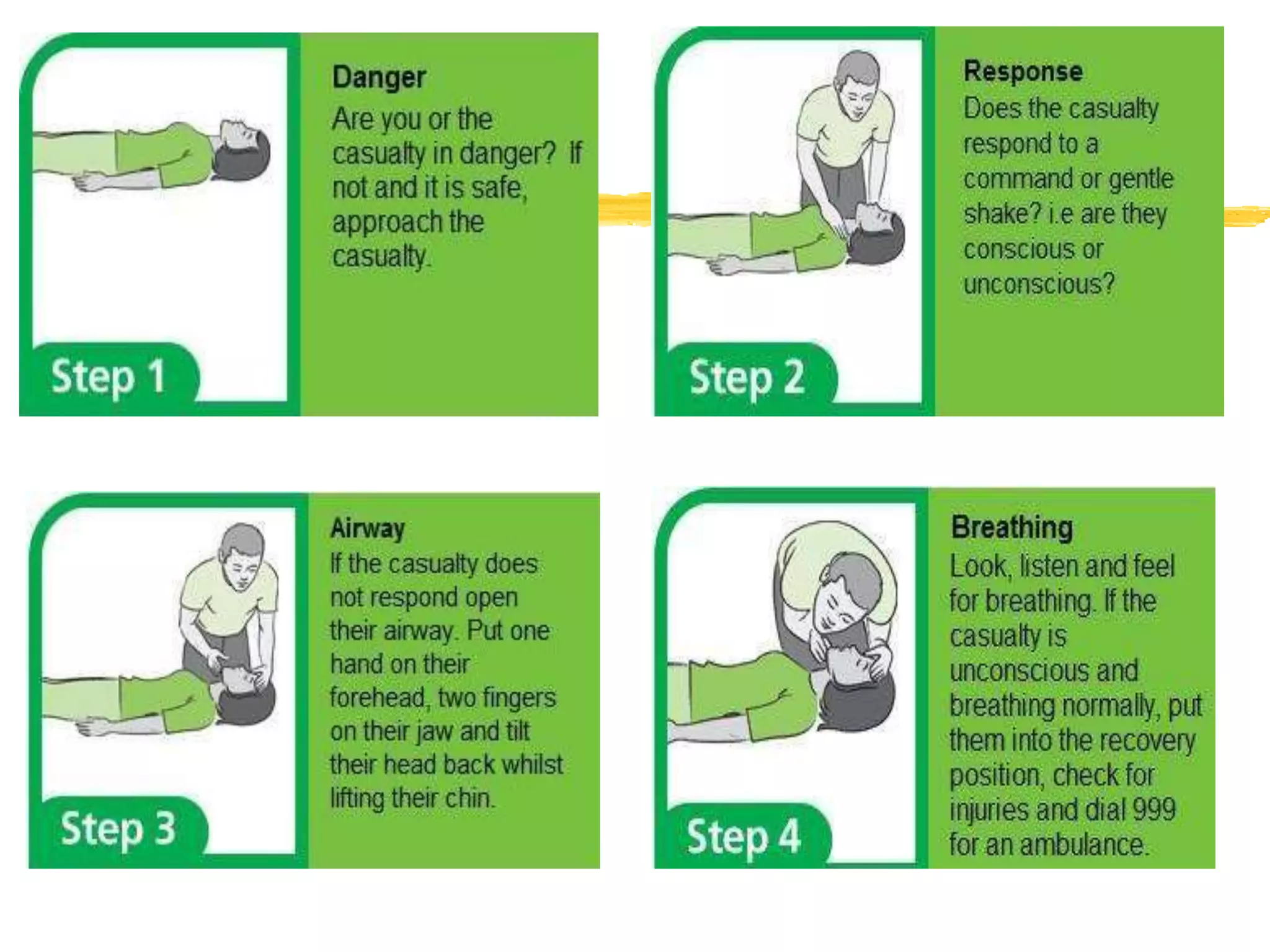
DRABC
Danger
Response
Airway
Breathing
Circulation
D - DANGER
To
yourself
To others
To
casualty
R - RESPONSE
• Gently “Shake and Shout” at the casualty
• Is the casualty is conscious?
• Is the casualty drowsy or confused?
• Is the casualty unconscious, but reacting?
• Is the casualty unconscious with no reaction?
• If unconscious, place the casualty in the stable side
position.
A - AIRWAY
• Is the airway is open and clear?
• Is there noisy in breathing?
• Are there Potential obstruction such as blood etc?
• If so, open and clear the airway!
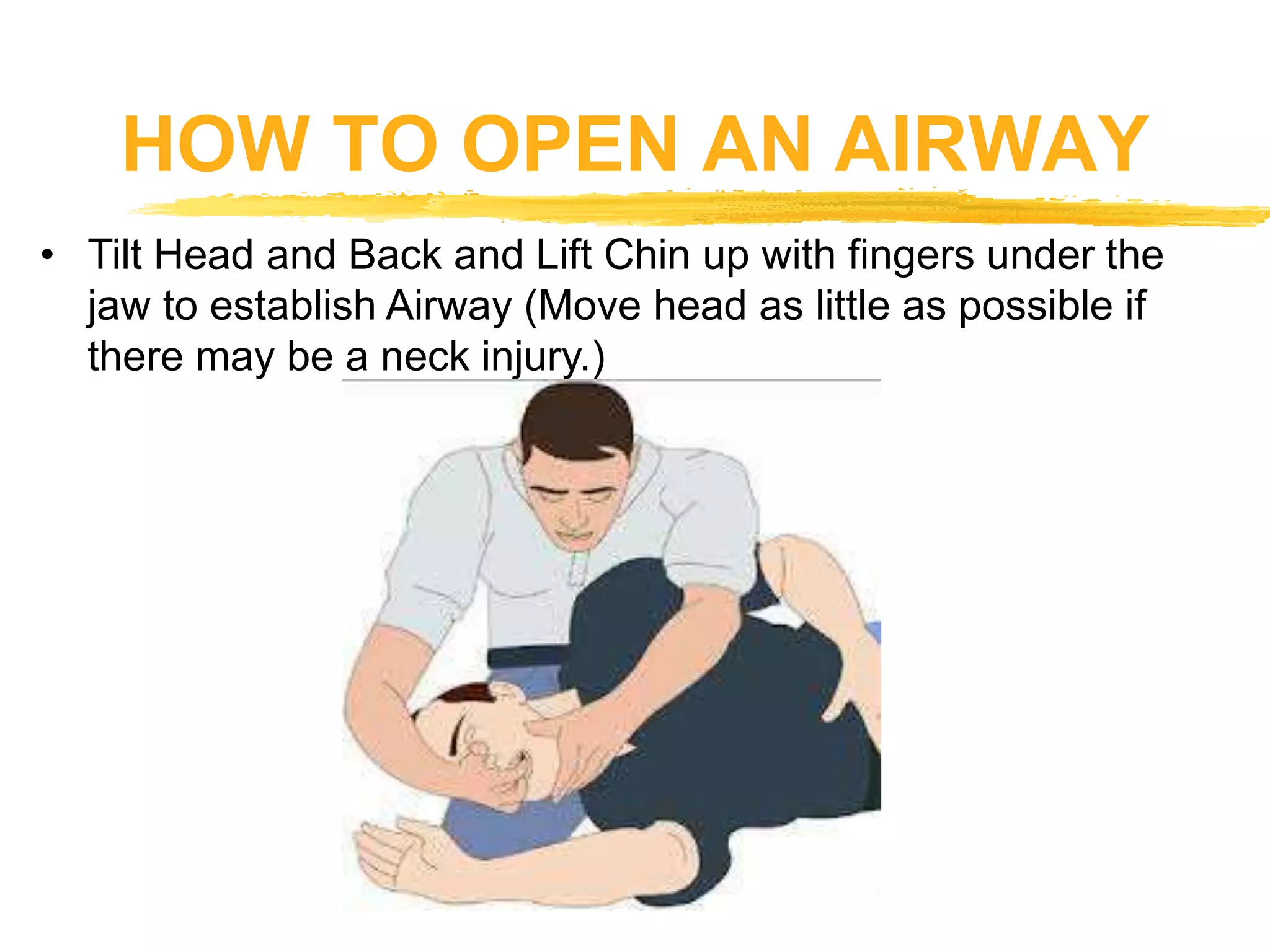
HOW TO OPEN AN AIRWAY
• Tilt Head and Back and Lift Chin up with fingers under the
jaw to establish Airway (Move head as little as possible if
there may be a neck injury.)
B - BREATHING
• Look for chest movements
• Listen for sounds for breathing
• Feel for breathes on your cheek
• If not breathing give 2 rescue breathes
C - CIRCULATION
• Is there a carotid pulse?
• Is it strong?
• Is it regular”
• Is there a major blood loss?
• IF NO PULSE PRESENT THEN START CPR
( CIRCULATION PULSE RESPIRATION)

Ehs3. aim, principles and rules of first aid

  • 1.
    3. Aim, Principlesand Rules of First Aid SEMESTER-III ENVIRONMENT, HEALTH AND SAFETY MANAGEMENT DSC301 Col. (Prof.) Rajive Kohli, Ph.D. 17, 21 & 23 September 2020
  • 2.
    First Aid? Immediate assistance or treatmentgiven to someone before the arrival of medical staff/ ambulance the first and immediate assistance given to any person suffering from either a minor or serious illness or injury, with care provided to preserve life, prevent the condition from worsening, or to promote recovery.
  • 3.
    First Aid Theimmediate care given to a person/victim who has suddenly become ill or has been injured. “Help given to a sick or injured person until full medical treatment is available” “…provision of initial care for an illness or injury”
  • 4.
    "measures to betaken immediately after an accident not with an idea to cure but in order to prevent further harm being done". It uses the available human and material resources at the site of accident to provide initial care to the victim of injury or sudden illness until more advance care is provided. First Aid (Encyclopaedia Britannica)
  • 5.
    FIRST AID • Theinitial process of assessing and addressing the needs of someone who is experiencing medical emergencies. • Allows a “non-medical expert” to quickly determine a person’s physical condition and the course of treatment. • Can make a difference to a person’s recovery and could save their life.
  • 6.
    Purpose of FirstAid • To Sustain the life • To Prevent suffering • To Prevent secondary complications • To Promote speedy recovery
  • 7.
    So what doesthis mean? • First aid can be anything from putting on a plaster to saving someone’s life • You don’t need formal first aid training to help someone in need
  • 8.
    Objectives of firstaid For example, applying a plaster is preventing the condition (a cut) from worsening by stopping infection! (i)Topreserve & prolong life (ii)Toalleviate suffering & prevent the victim's condition from worsening (iii)To prevent further or added injury & promote recovery
  • 9.
    Aims of firstaid 3P s 3 Ps: Preserve life Prevent injuries/condition from worsening Promote recovery For example, applying a plaster is preventing the condition (a cut) from worsening by stopping infection!
  • 10.
    Preserving life 1) Controlbleeding 2) Treat probable cause of shock 3)Maintain airway in correct position 4) Perform CPR when needed (no breathing or pulse)
  • 11.
    Ps: 1) Dress woundtoprevent infection 2) Provide comfort to casualty 3) Place casualty in a comfortable position Prevent condition from worsening:
  • 12.
    1) Relieve casualtyfrom anxiety 2) Encourage confidence and trust 3)Attempt to relieve pain and discomfort 4) Handle casualty gently 5) Protect casualty from cold and wet Promote recovery:
  • 13.
    PRINCIPLES OF FIRSTAID (4 C’s) • Call for Help • Calmly Take Charge • Check the scene & the casualty • Carefully apply FIRST AID
  • 14.
    PRINCIPLES of FIRSTAID DOs in giving First Aid DO stay calm DO reassure & comfort the victim DO check for a medical bracelet indicating a condition DO loosen any tight clothing DO keep the victim covered to reduce shock
  • 15.
    PRINCIPLES of FIRSTAID DON’Ts in giving First Aid DON’T give food & drink to an unconscious person DON’T move an injured person unless you need to place him/her in the recovery position
  • 16.
    Characteristic of aGood First Aider • Observant- notice all signs • Resourceful- make best use of all things • Gentle- shouldn’t cause pain • Tactful- shouldn’t be alarming • Sympathetic- should be comforting
  • 17.
    Qualities of afirst aider ❚~ Calm ❚~ Confident ❚~Willing to offer assistance whenever necessary ❚~ Patience
  • 18.
    Role of FirstAider • Bridge the gap between the time of the accident and the arrival of the physician. • Ends when medical assistance begins. • Doesn’t intend to compete with or take place of the physician.
  • 19.
    Responsibility of aFirst Aider • To assess the situation quickly and safely and call for appropriate help. • To identify the level of injury or the nature of illness affecting the casualty / victim. • To give early and appropriate treatment in a sensible order of priority. • To make and pass on a report, give a further help if its required.
  • 20.
    DO AND DON’Ts casualtyuse: Mask Gloves Head Cover Apron DO DON’Ts • Before handling the • First Aider can never  Prescribe Medicine  Declare DEATH
  • 21.
    Assessing the Skillsof a First Aider Observer Listen Feel Talk Touch Provide Build Trust
  • 22.
     Essential toprotect yourself from injury and infection  Ensure surroundings are safe  Protection from infection to prevent “cross infection” (transmitting germs to a casualty or contracting an infection yourself) wear gloves or wash hands before doing a dressing Protecting yourself as a first aider
  • 23.
    EMERGENCY FIRST AID If you are the first on the scene of accident that results in an injury or serious illness, you may be the only link between a victim and emergency medical care.  Your role is to take action, whether by providing first aid, seeking medical help or calling emergency.  Your actions may improve the victims chance of recovery.
  • 24.
    Calling for emergencyhelp 1. In many first aid situations, help from the emergency services may be required. 2. Ensure you know which number to call! 3. If the area is remote/difficult to access, consider sending someone to meet the emergency services in a known location 4. Give clear, precise information about – The location of the incident – The number of casualties / people involved – The nature of their injuries – In some cases, their age – Any hazards at the incident (e.g: spilt fuel, fire, electricity)
  • 25.
    Managing an incident •Always be aware of potential dangers at an incident (e.g: traffic, fire, electricity) • Never put yourself or other bystanders in danger • You are the most important person • If the incident is too dangerous to approach, stay back and call for emergency help
  • 26.
  • 28.
    First Aid kit- Medicines • Pain reliever Antacid Aspirin ORS Packets Rubbing Alcohol Povidone Iodine Hydrogen Peroxide Petroleum jelly
  • 29.
    FirstAidKit-Items Cotton wool Adhesive tape Bandage(all sizes) Crepe bandage Sterile Dressing Gauge pads Band aid Medical tape Thermometer Scissors Gloves Soap Penlight Safety pins Forceps Tweezers Splints Tongue depressor
  • 30.
    ACTION PLAN  Assessthe Situation  Safety of yourself and the casualty  Assess the casualty  Treat the casualty  Arrange the removal of the casualty to hospital or safe area  Write a report / Communicate the status
  • 31.
    This Action Planis a vital aid to the first aider in assessing whether the victim has any life-threatening conditions and if any immediate first aid is necessary. They are DRABC . D - Check for DANGER  To you  To others  To victim R - Check RESPONSE  Is victim conscious?  Is victim unconscious?
  • 32.
    A - CheckAIRWAY  Is airway clear of objects?  Is airway open? B - Check for BREATHING  Is chest rising and falling?  Can you hear victim's breathing?  Can you feel the breath on your cheek? C - Check for CIRCULATION  Can you feel a pulse?  Can you see any obvious signs of life?
  • 34.
  • 35.
    D - DANGER To yourself Toothers To casualty
  • 36.
    R - RESPONSE •Gently “Shake and Shout” at the casualty • Is the casualty is conscious? • Is the casualty drowsy or confused? • Is the casualty unconscious, but reacting? • Is the casualty unconscious with no reaction? • If unconscious, place the casualty in the stable side position.
  • 37.
    A - AIRWAY •Is the airway is open and clear? • Is there noisy in breathing? • Are there Potential obstruction such as blood etc? • If so, open and clear the airway!
  • 38.
    HOW TO OPENAN AIRWAY • Tilt Head and Back and Lift Chin up with fingers under the jaw to establish Airway (Move head as little as possible if there may be a neck injury.)
  • 39.
    B - BREATHING •Look for chest movements • Listen for sounds for breathing • Feel for breathes on your cheek • If not breathing give 2 rescue breathes
  • 40.
    C - CIRCULATION •Is there a carotid pulse? • Is it strong? • Is it regular” • Is there a major blood loss? • IF NO PULSE PRESENT THEN START CPR ( CIRCULATION PULSE RESPIRATION)