EFFICIENT LIGHTING
INTRODUCTION
 Energy utilization is increasing day by day, but still we require more
buildings for business and homes with our expanding population.
Efficient lighting in building can be done in two ways:
1. Renewable energy, in order to reduce our carbon footprint.
2. By using Efficient artificial lighting System.
 Starting to invest in eco-friendly buildings now might be
expensive, but with the amount you save on electricity and
other utilities with these buildings we will start to make this
money back over time.
 We’re investing in our children’s future, and the health of
our earth in the future.
ECO-FRIENDLY BUILDING ON EARTH
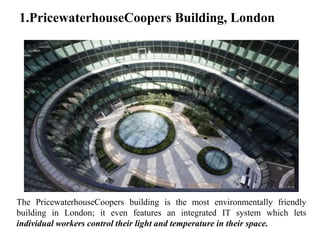
1.PricewaterhouseCoopers Building, London
The PricewaterhouseCoopers building is the most environmentally friendly
building in London; it even features an integrated IT system which lets
individual workers control their light and temperature in their space.
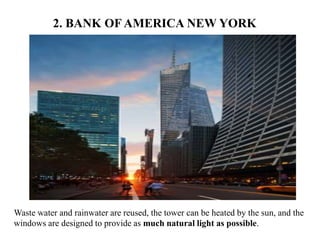
2. BANK OF AMERICA NEW YORK
Waste water and rainwater are reused, the tower can be heated by the sun, and the
windows are designed to provide as much natural light as possible.
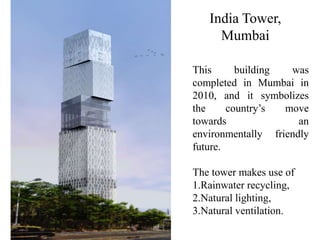
India Tower,
Mumbai
This building was
completed in Mumbai in
2010, and it symbolizes
the country’s move
towards an
environmentally friendly
future.
The tower makes use of
1.Rainwater recycling,
2.Natural lighting,
3.Natural ventilation.
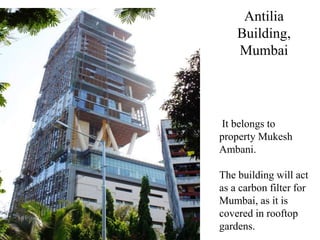
Antilia
Building,
Mumbai
It belongs to
property Mukesh
Ambani.
The building will act
as a carbon filter for
Mumbai, as it is
covered in rooftop
gardens.
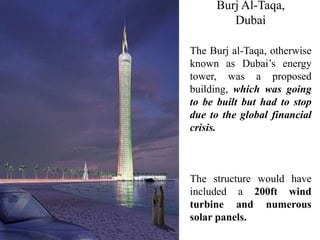
Burj Al-Taqa,
Dubai
The Burj al-Taqa, otherwise
known as Dubai’s energy
tower, was a proposed
building, which was going
to be built but had to stop
due to the global financial
crisis.
The structure would have
included a 200ft wind
turbine and numerous
solar panels.
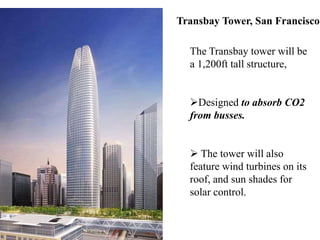
Transbay Tower, San Francisco
The Transbay tower will be
a 1,200ft tall structure,
Designed to absorb CO2
from busses.
 The tower will also
feature wind turbines on its
roof, and sun shades for
solar control.
Energy Management Cell, WBSEB
How to achieve energy savings in
lighting System
Make maximum use of natural light (more windows and
openings).
Switch off when not required.
Modify lighting layout to meet the need.
Select light colours for interiors
Use of PV panels.
Provide lighting Transformer to operate at reduced voltage.
Install energy efficient lamps such as CFL and LED.
Clean North roof glass, translucent sheet and luminaries
regularly.
TYPES OF LIGHTING
1. Incandescent lamps
2. Discharge lamps
3. Compact fluorescent lamps (CFLs)
4. Metal halide lamp
5. LED
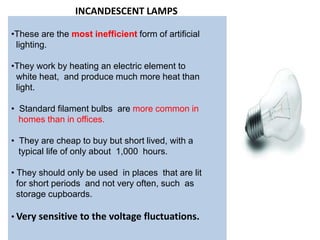
INCANDESCENT LAMPS
•These are the most inefficient form of artificial
lighting.
•They work by heating an electric element to
white heat, and produce much more heat than
light.
• Standard filament bulbs are more common in
homes than in offices.
• They are cheap to buy but short lived, with a
typical life of only about 1,000 hours.
• They should only be used in places that are lit
for short periods and not very often, such as
storage cupboards.
• Very sensitive to the voltage fluctuations.
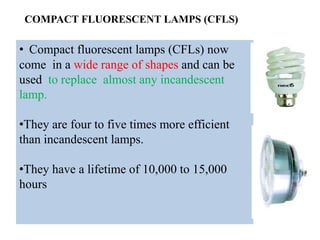
COMPACT FLUORESCENT LAMPS (CFLS)
• Compact fluorescent lamps (CFLs) now
come in a wide range of shapes and can be
used to replace almost any incandescent
lamp.
•They are four to five times more efficient
than incandescent lamps.
•They have a lifetime of 10,000 to 15,000
hours
What precaution should take when using CFLs
in home?
What precaution should take when using CFLs
in home?
 CFLs are made of glass and can break if dropped or roughly
handled.
 Be careful when removing the bulb from packaging,
installing it, or replacing it.
 Always screw or unscrew the light bulb by its base (not the
glass ) and never forcefully twist the CFL into light socket .If a
CFL breaks in your home follow the clean up
recommendations given by Bureau of Energy Efficiency.
What is LED?
• LED is a light emitting semiconductor diode that emits light in
forward direction or in the direction it is pointed towards.
• The color of the light produced by LED depends on the
composition of the semiconductor material used out of which
producing a blue color light is the most difficult process.
LED
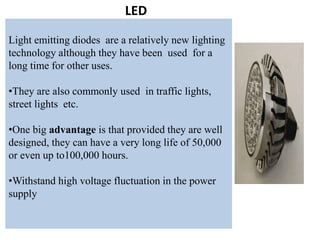
Light emitting diodes are a relatively new lighting
technology although they have been used for a
long time for other uses.
•They are also commonly used in traffic lights,
street lights etc.
•One big advantage is that provided they are well
designed, they can have a very long life of 50,000
or even up to100,000 hours.
•Withstand high voltage fluctuation in the power
supply
Disadvantage of a LED light bulb
• Some LED light bulbs show sign of age after a couple
of years of use and may produce only 50% of the
light output when compared to what it used to
produce when it was new.
• However new technologies are in process to enhance
its performance over its life span.
Power consumption of LED light bulbs
• Most modern LED operate in a range of 2 to 4 volts and
consume anywhere between 350mA and 1500mA.
• The power consumption varies from manufacturer to
manufacturer and also because of the purpose for which the
LED was designed.
• Now a days using latest of the LED manufacturing technology,
manufacturers are able to produce LEDs that are not only
super bright but also consume less power while producing
light of higher intensity.
Benefits of using LED light bulbs over standard
light bulbs
• Power consumption of LED light bulb is only 10% of
the standard light bulb.
• LED light bulbs withstand great amount of vibration,
shock and temperature variations.
• LED light bulbs are 10-60 times more energy
efficient than incandescent light bulbs.
• Incandescent light bulbs produce light that flickers
where as LED light bulbs produce flicker free light.
• LED bulbs can produce many rich and vibrant colors
when compared to incandescent light bulbs.

Efficient lighting

  • 1.
  • 2.
    INTRODUCTION  Energy utilizationis increasing day by day, but still we require more buildings for business and homes with our expanding population. Efficient lighting in building can be done in two ways: 1. Renewable energy, in order to reduce our carbon footprint. 2. By using Efficient artificial lighting System.  Starting to invest in eco-friendly buildings now might be expensive, but with the amount you save on electricity and other utilities with these buildings we will start to make this money back over time.  We’re investing in our children’s future, and the health of our earth in the future.
  • 3.
  • 4.
    1.PricewaterhouseCoopers Building, London ThePricewaterhouseCoopers building is the most environmentally friendly building in London; it even features an integrated IT system which lets individual workers control their light and temperature in their space.
  • 5.
    2. BANK OFAMERICA NEW YORK Waste water and rainwater are reused, the tower can be heated by the sun, and the windows are designed to provide as much natural light as possible.
  • 6.
    India Tower, Mumbai This buildingwas completed in Mumbai in 2010, and it symbolizes the country’s move towards an environmentally friendly future. The tower makes use of 1.Rainwater recycling, 2.Natural lighting, 3.Natural ventilation.
  • 7.
    Antilia Building, Mumbai It belongs to propertyMukesh Ambani. The building will act as a carbon filter for Mumbai, as it is covered in rooftop gardens.
  • 8.
    Burj Al-Taqa, Dubai The Burjal-Taqa, otherwise known as Dubai’s energy tower, was a proposed building, which was going to be built but had to stop due to the global financial crisis. The structure would have included a 200ft wind turbine and numerous solar panels.
  • 9.
    Transbay Tower, SanFrancisco The Transbay tower will be a 1,200ft tall structure, Designed to absorb CO2 from busses.  The tower will also feature wind turbines on its roof, and sun shades for solar control.
  • 10.
    Energy Management Cell,WBSEB How to achieve energy savings in lighting System Make maximum use of natural light (more windows and openings). Switch off when not required. Modify lighting layout to meet the need. Select light colours for interiors Use of PV panels. Provide lighting Transformer to operate at reduced voltage. Install energy efficient lamps such as CFL and LED. Clean North roof glass, translucent sheet and luminaries regularly.
  • 11.
    TYPES OF LIGHTING 1.Incandescent lamps 2. Discharge lamps 3. Compact fluorescent lamps (CFLs) 4. Metal halide lamp 5. LED
  • 12.
    INCANDESCENT LAMPS •These arethe most inefficient form of artificial lighting. •They work by heating an electric element to white heat, and produce much more heat than light. • Standard filament bulbs are more common in homes than in offices. • They are cheap to buy but short lived, with a typical life of only about 1,000 hours. • They should only be used in places that are lit for short periods and not very often, such as storage cupboards. • Very sensitive to the voltage fluctuations.
  • 13.
    COMPACT FLUORESCENT LAMPS(CFLS) • Compact fluorescent lamps (CFLs) now come in a wide range of shapes and can be used to replace almost any incandescent lamp. •They are four to five times more efficient than incandescent lamps. •They have a lifetime of 10,000 to 15,000 hours
  • 14.
    What precaution shouldtake when using CFLs in home?
  • 15.
    What precaution shouldtake when using CFLs in home?  CFLs are made of glass and can break if dropped or roughly handled.  Be careful when removing the bulb from packaging, installing it, or replacing it.  Always screw or unscrew the light bulb by its base (not the glass ) and never forcefully twist the CFL into light socket .If a CFL breaks in your home follow the clean up recommendations given by Bureau of Energy Efficiency.
  • 16.
    What is LED? •LED is a light emitting semiconductor diode that emits light in forward direction or in the direction it is pointed towards. • The color of the light produced by LED depends on the composition of the semiconductor material used out of which producing a blue color light is the most difficult process.
  • 17.
    LED Light emitting diodesare a relatively new lighting technology although they have been used for a long time for other uses. •They are also commonly used in traffic lights, street lights etc. •One big advantage is that provided they are well designed, they can have a very long life of 50,000 or even up to100,000 hours. •Withstand high voltage fluctuation in the power supply
  • 18.
    Disadvantage of aLED light bulb
  • 19.
    Disadvantage of aLED light bulb • Some LED light bulbs show sign of age after a couple of years of use and may produce only 50% of the light output when compared to what it used to produce when it was new. • However new technologies are in process to enhance its performance over its life span.
  • 20.
    Power consumption ofLED light bulbs • Most modern LED operate in a range of 2 to 4 volts and consume anywhere between 350mA and 1500mA. • The power consumption varies from manufacturer to manufacturer and also because of the purpose for which the LED was designed. • Now a days using latest of the LED manufacturing technology, manufacturers are able to produce LEDs that are not only super bright but also consume less power while producing light of higher intensity.
  • 21.
    Benefits of usingLED light bulbs over standard light bulbs • Power consumption of LED light bulb is only 10% of the standard light bulb. • LED light bulbs withstand great amount of vibration, shock and temperature variations. • LED light bulbs are 10-60 times more energy efficient than incandescent light bulbs. • Incandescent light bulbs produce light that flickers where as LED light bulbs produce flicker free light. • LED bulbs can produce many rich and vibrant colors when compared to incandescent light bulbs.