NADEEM UDDIN
ASSOCIATE PROFESSOR
OF STATISTICS
https://www.slideshare.net/NadeemUddin17
https://nadeemstats.wordpress.com/listofbooks/
Effective Rate of Interest:
The Effective Rate of interest is the rate of interest actually
earned on an investment or paid on a loan as a result of
compounding the interest over a given period of time. It is
usually higher than the nominal rate and is used to compare
different financial products that calculate annual interest
with different compounding periods – weekly, monthly,
quarterly, semi annually, and yearly. Increasing the number
of compounding periods makes the effective interest rate
increase as time goes by.
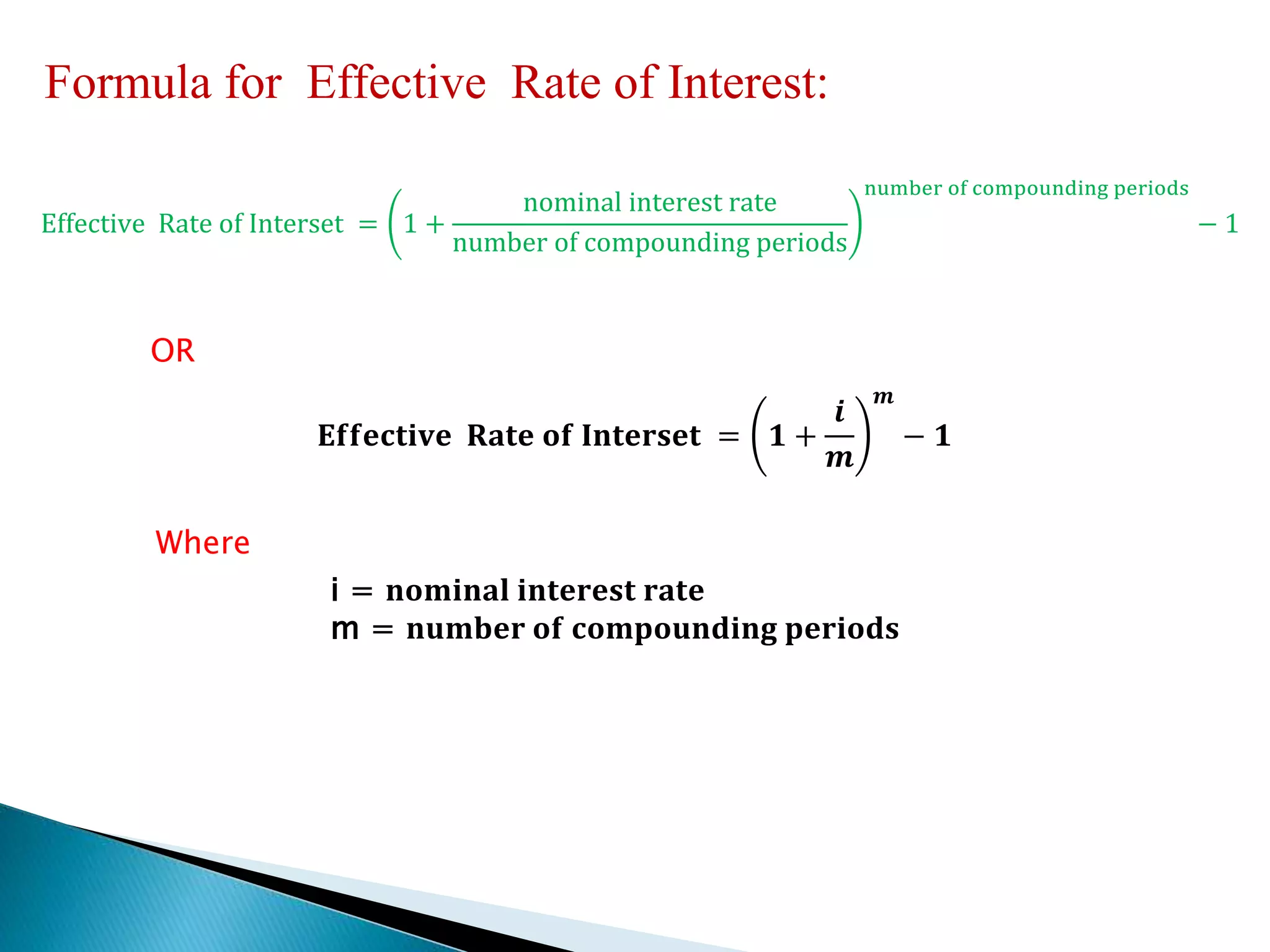
Formula for Effective Rate of Interest:
Effective Rate of Interset = 1 +
nominal interest rate
number of compounding periods
− 1
𝐄𝐟𝐟𝐞𝐜𝐭𝐢𝐯𝐞 𝐑𝐚𝐭𝐞 𝐨𝐟 𝐈𝐧𝐭𝐞𝐫𝐬𝐞𝐭 = 𝟏 +
𝒊
𝒎
𝒎
− 𝟏
OR
i = 𝐧𝐨𝐦𝐢𝐧𝐚𝐥 𝐢𝐧𝐭𝐞𝐫𝐞𝐬𝐭 𝐫𝐚𝐭𝐞
m = 𝐧𝐮𝐦𝐛𝐞𝐫 𝐨𝐟 𝐜𝐨𝐦𝐩𝐨𝐮𝐧𝐝𝐢𝐧𝐠 𝐩𝐞𝐫𝐢𝐨𝐝𝐬
Where
Nominal Rate of Interest:
A nominal rate interest is a stated rate indicated by a
financial instrument that is issued by a lender or guarantor.
This rate is the basis for computation to derive the interest
amount resulting from compounding the principal plus
interest over a period of time. This is the actual monetary
price that borrowers pay to lenders or that investors receive
from issuers.
Compounding Period:
A compounding period is the time period after which the
outstanding loan or investment’s interest is added to the
principal amount of said loan or investment. The period can
be daily, weekly, monthly, quarterly, or semi-annually,
depending on the terms agreed upon by the parties
involved. As the number of compounding periods increases
so does the amount of interest earned or paid on the money
used. Quarterly compounding produces higher returns than
semi-annual compounding, while monthly compounding
generates more than quarterly, and daily compounding
generates more than monthly.
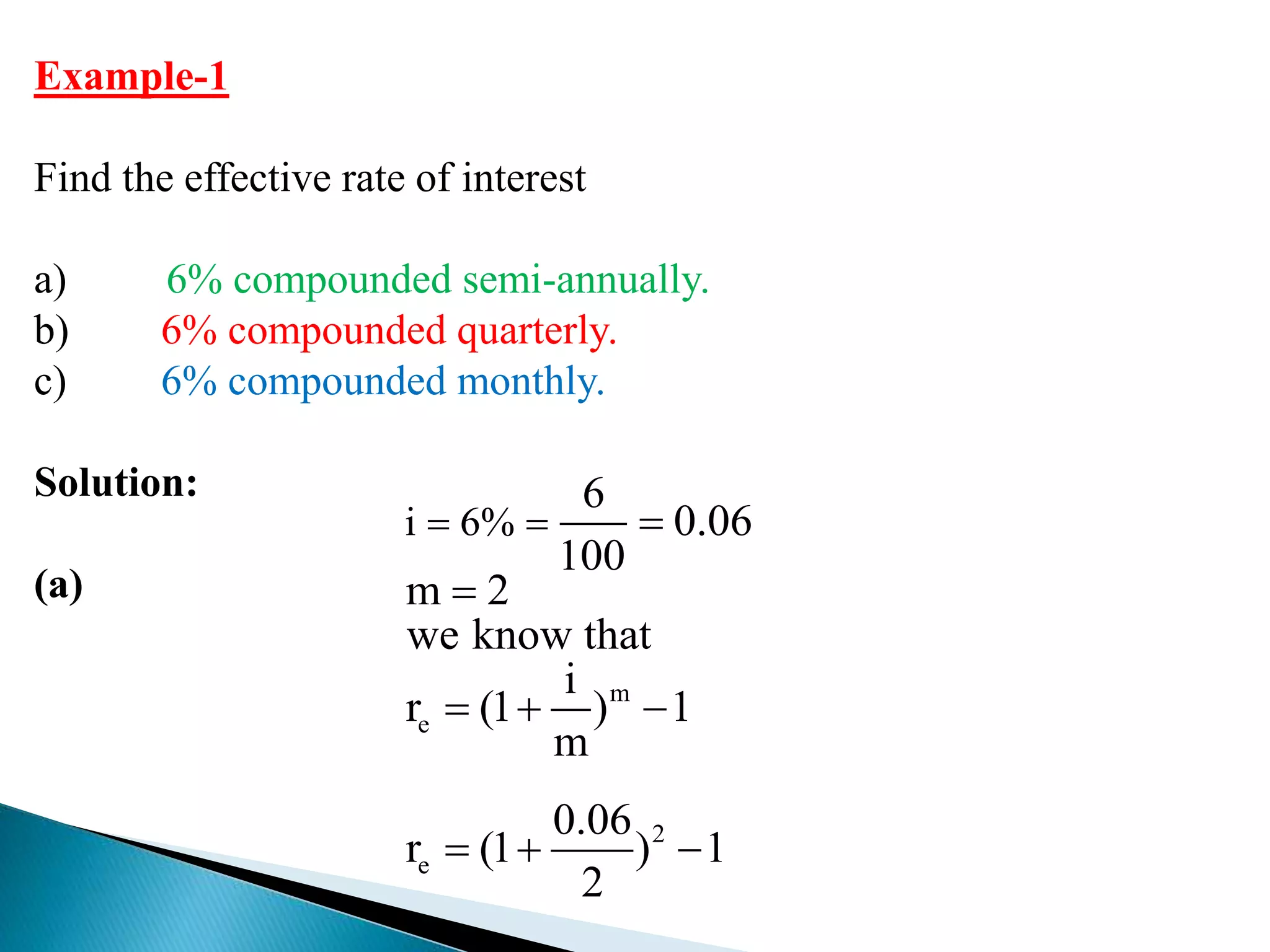
Example-1
Find the effective rate of interest
a) 6% compounded semi-annually.
b) 6% compounded quarterly.
c) 6% compounded monthly.
Solution:
(a)
m
e
2
e
i 6%
6
0.06
100
m 2
we know that
i
r (1 ) 1
m
0.06
r (1 ) 1
2
  

  
  
2
e
e
e
e
r (1 0.03) 1
r 1.0609 1
r 0.609
r 6.09%
  
 


(b)
m 4
e
4 4
e
e
i 6%
6
0.06
100
m 4
we know that
i 0.06
r (1 ) 1 (1 ) 1
m 4
r (1 0.015) 1 (1.015) 1
r 1.0614 1 0.0614 6.14%
  

     
    
   
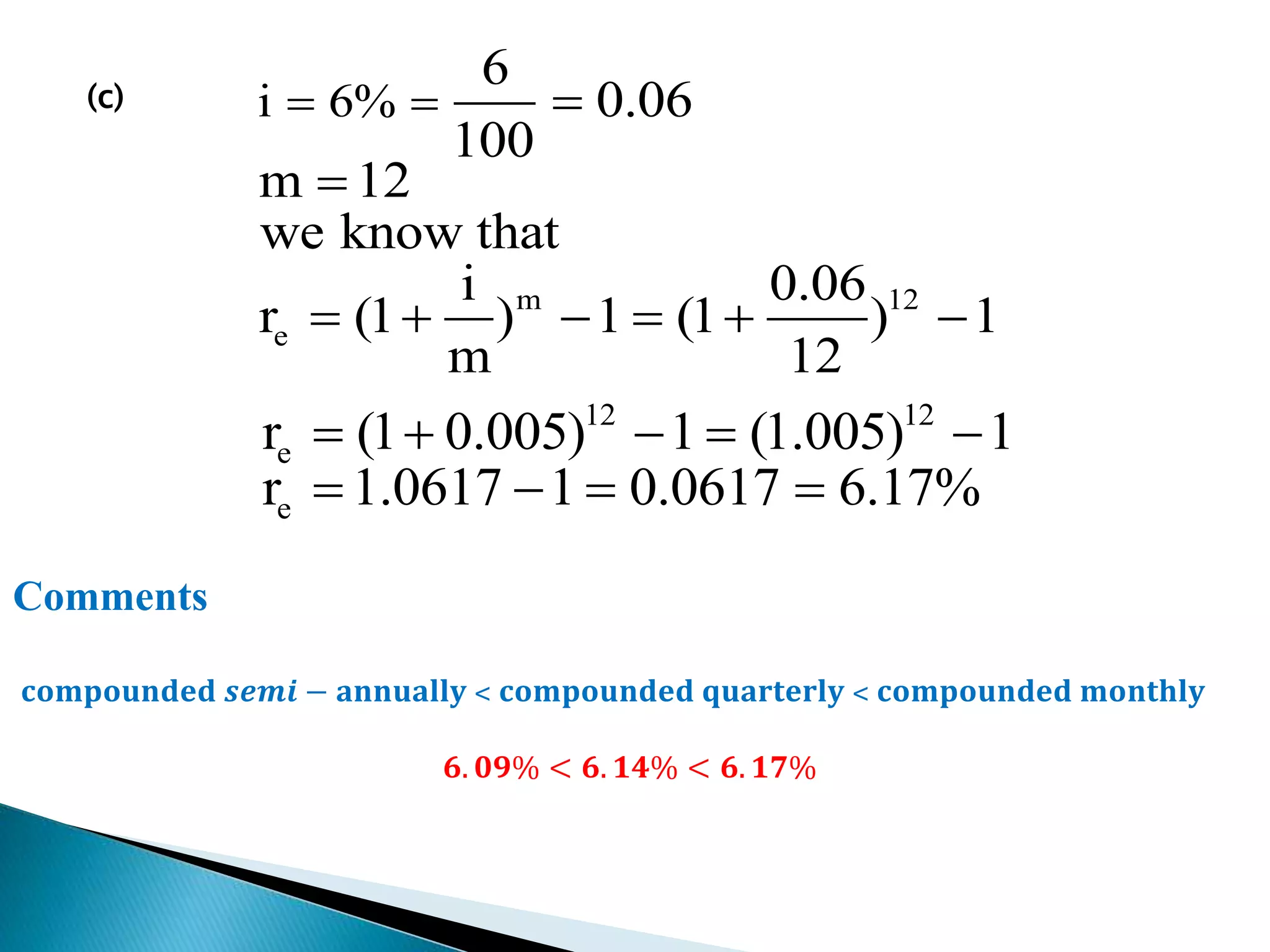
(c)
m 12
e
i 6%
6
0.06
100
m 12
we know that
i 0.06
r (1 ) 1 (1 ) 1
m 12
  

     
12 12
e
e
r (1 0.005) 1 (1.005) 1
r 1.0617 1 0.0617 6.17%
    
   
Comments
𝐜𝐨𝐦𝐩𝐨𝐮𝐧𝐝𝐞𝐝 𝒔𝒆𝒎𝒊 − 𝐚𝐧𝐧𝐮𝐚𝐥𝐥𝐲 ˂ 𝐜𝐨𝐦𝐩𝐨𝐮𝐧𝐝𝐞𝐝 𝐪𝐮𝐚𝐫𝐭𝐞𝐫𝐥𝐲 ˂ 𝐜𝐨𝐦𝐩𝐨𝐮𝐧𝐝𝐞𝐝 𝐦𝐨𝐧𝐭𝐡𝐥𝐲
𝟔. 𝟎𝟗% < 𝟔. 𝟏𝟒% < 𝟔. 𝟏𝟕%

Effective rate of interest

  • 1.
    NADEEM UDDIN ASSOCIATE PROFESSOR OFSTATISTICS https://www.slideshare.net/NadeemUddin17 https://nadeemstats.wordpress.com/listofbooks/
  • 2.
    Effective Rate ofInterest: The Effective Rate of interest is the rate of interest actually earned on an investment or paid on a loan as a result of compounding the interest over a given period of time. It is usually higher than the nominal rate and is used to compare different financial products that calculate annual interest with different compounding periods – weekly, monthly, quarterly, semi annually, and yearly. Increasing the number of compounding periods makes the effective interest rate increase as time goes by.
  • 3.
    Formula for EffectiveRate of Interest: Effective Rate of Interset = 1 + nominal interest rate number of compounding periods number of compounding periods − 1 𝐄𝐟𝐟𝐞𝐜𝐭𝐢𝐯𝐞 𝐑𝐚𝐭𝐞 𝐨𝐟 𝐈𝐧𝐭𝐞𝐫𝐬𝐞𝐭 = 𝟏 + 𝒊 𝒎 𝒎 − 𝟏 OR i = 𝐧𝐨𝐦𝐢𝐧𝐚𝐥 𝐢𝐧𝐭𝐞𝐫𝐞𝐬𝐭 𝐫𝐚𝐭𝐞 m = 𝐧𝐮𝐦𝐛𝐞𝐫 𝐨𝐟 𝐜𝐨𝐦𝐩𝐨𝐮𝐧𝐝𝐢𝐧𝐠 𝐩𝐞𝐫𝐢𝐨𝐝𝐬 Where
  • 4.
    Nominal Rate ofInterest: A nominal rate interest is a stated rate indicated by a financial instrument that is issued by a lender or guarantor. This rate is the basis for computation to derive the interest amount resulting from compounding the principal plus interest over a period of time. This is the actual monetary price that borrowers pay to lenders or that investors receive from issuers.
  • 5.
    Compounding Period: A compoundingperiod is the time period after which the outstanding loan or investment’s interest is added to the principal amount of said loan or investment. The period can be daily, weekly, monthly, quarterly, or semi-annually, depending on the terms agreed upon by the parties involved. As the number of compounding periods increases so does the amount of interest earned or paid on the money used. Quarterly compounding produces higher returns than semi-annual compounding, while monthly compounding generates more than quarterly, and daily compounding generates more than monthly.
  • 6.
    Example-1 Find the effectiverate of interest a) 6% compounded semi-annually. b) 6% compounded quarterly. c) 6% compounded monthly. Solution: (a) m e 2 e i 6% 6 0.06 100 m 2 we know that i r (1 ) 1 m 0.06 r (1 ) 1 2          
  • 7.
    2 e e e e r (1 0.03)1 r 1.0609 1 r 0.609 r 6.09%        (b) m 4 e 4 4 e e i 6% 6 0.06 100 m 4 we know that i 0.06 r (1 ) 1 (1 ) 1 m 4 r (1 0.015) 1 (1.015) 1 r 1.0614 1 0.0614 6.14%                   
  • 8.
    (c) m 12 e i 6% 6 0.06 100 m12 we know that i 0.06 r (1 ) 1 (1 ) 1 m 12           12 12 e e r (1 0.005) 1 (1.005) 1 r 1.0617 1 0.0617 6.17%          Comments 𝐜𝐨𝐦𝐩𝐨𝐮𝐧𝐝𝐞𝐝 𝒔𝒆𝒎𝒊 − 𝐚𝐧𝐧𝐮𝐚𝐥𝐥𝐲 ˂ 𝐜𝐨𝐦𝐩𝐨𝐮𝐧𝐝𝐞𝐝 𝐪𝐮𝐚𝐫𝐭𝐞𝐫𝐥𝐲 ˂ 𝐜𝐨𝐦𝐩𝐨𝐮𝐧𝐝𝐞𝐝 𝐦𝐨𝐧𝐭𝐡𝐥𝐲 𝟔. 𝟎𝟗% < 𝟔. 𝟏𝟒% < 𝟔. 𝟏𝟕%