Effective Non-Verbal
Communication Development
Abhishek Chhilwar
Vipul Maheshwari
Aditya Dayal
Vini Pargain
Kapil Sharma
Surbhi Arora
Shashank Kashyap
Presented by ~
The Non Verbal Communication
In Business Communication
Messages expressed by
Non-Linguistic means-
Silence
Environment
Artifacts
Vocal Intonation
A Powerful mode
of Communication
Is It Possible to
communicate
without words?
Studies have showed
Over half of the messages are
Communicated though
non-verbal elements:
• Appearance
• Body Language
• Tone and Pace of voice
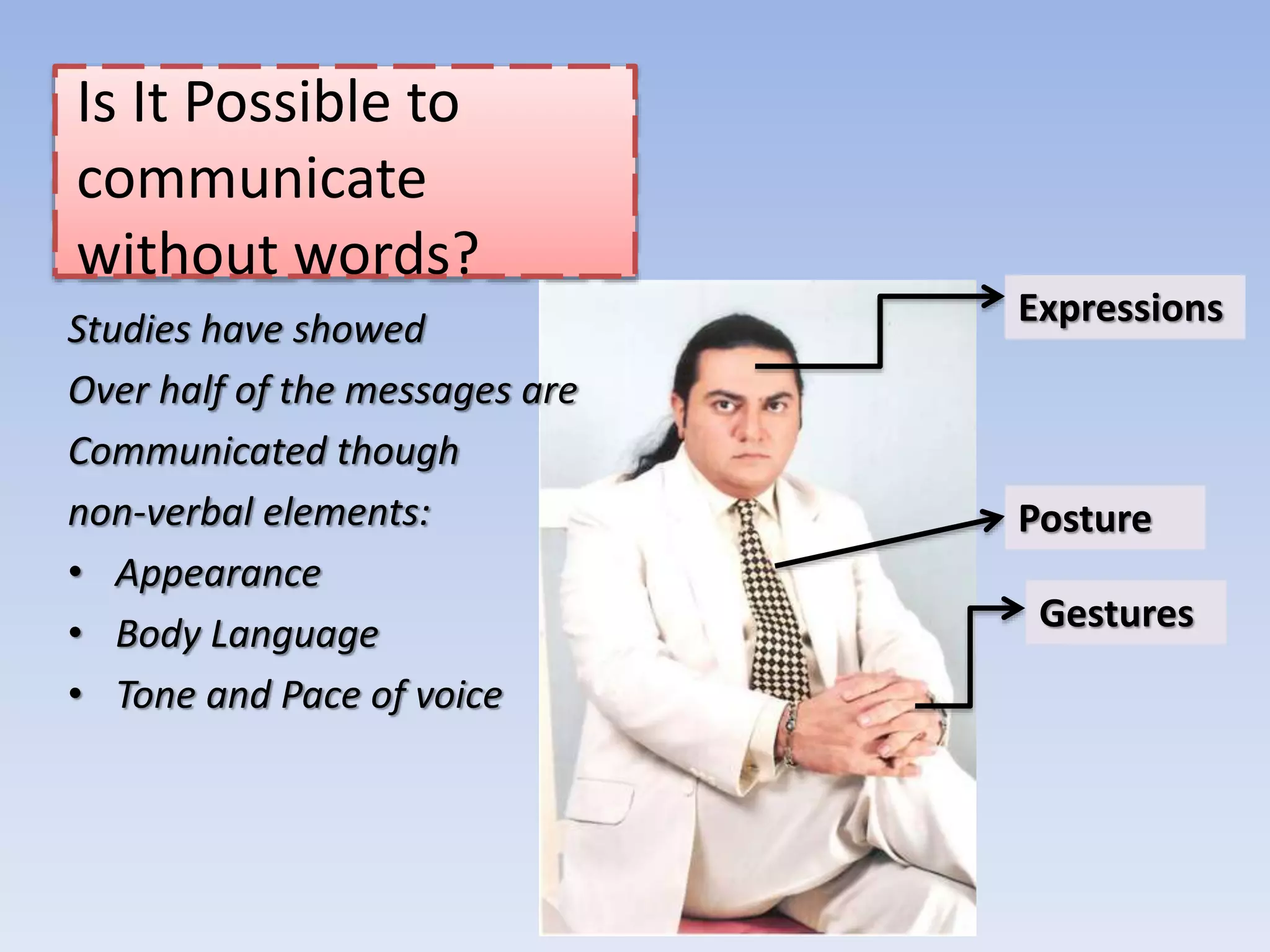
Expressions
Posture
Gestures
Principles of Non-Verbal
Communication
All behavior has communication
value because:
‘WE CANNOT NOT COMMUNICATE’
Principles of Non-Verbal
Communication
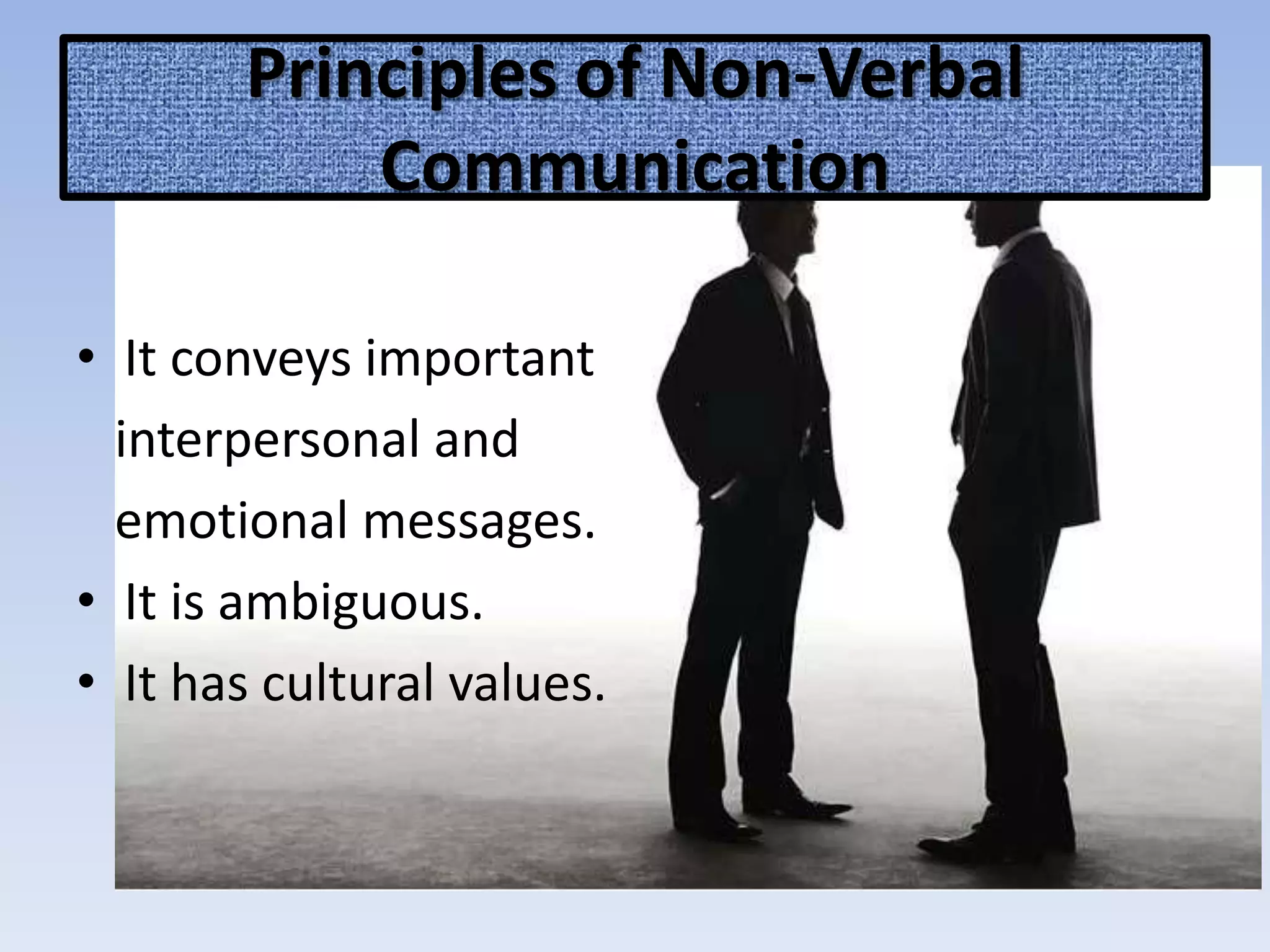
• It conveys important
interpersonal and
emotional messages.
• It is ambiguous.
• It has cultural values.
Interpersonal and emotional
messages
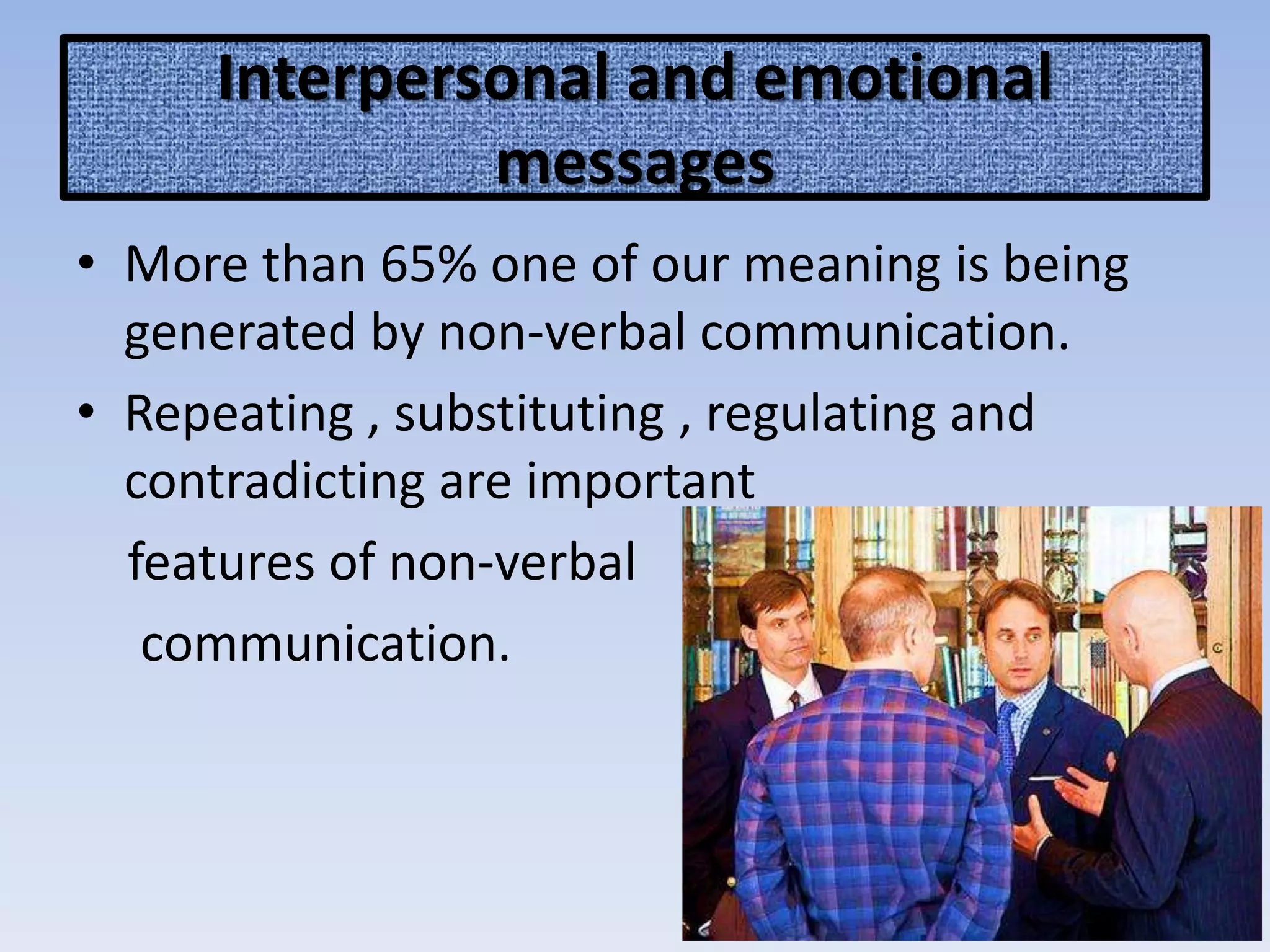
• More than 65% one of our meaning is being
generated by non-verbal communication.
• Repeating , substituting , regulating and
contradicting are important
features of non-verbal
communication.
Ambiguousness
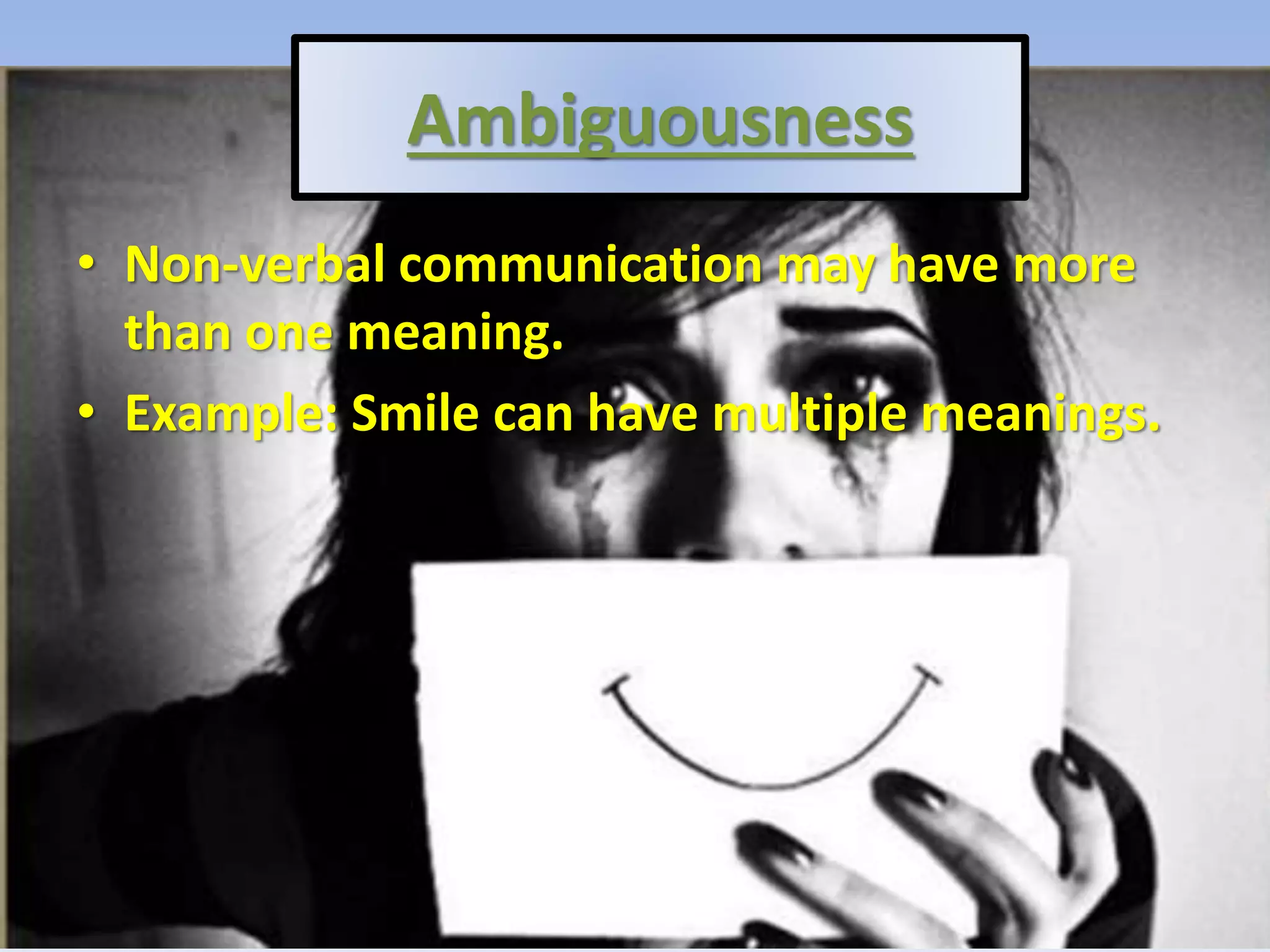
• Non-verbal communication may have more
than one meaning.
• Example: Smile can have multiple meanings.
Cultural Values
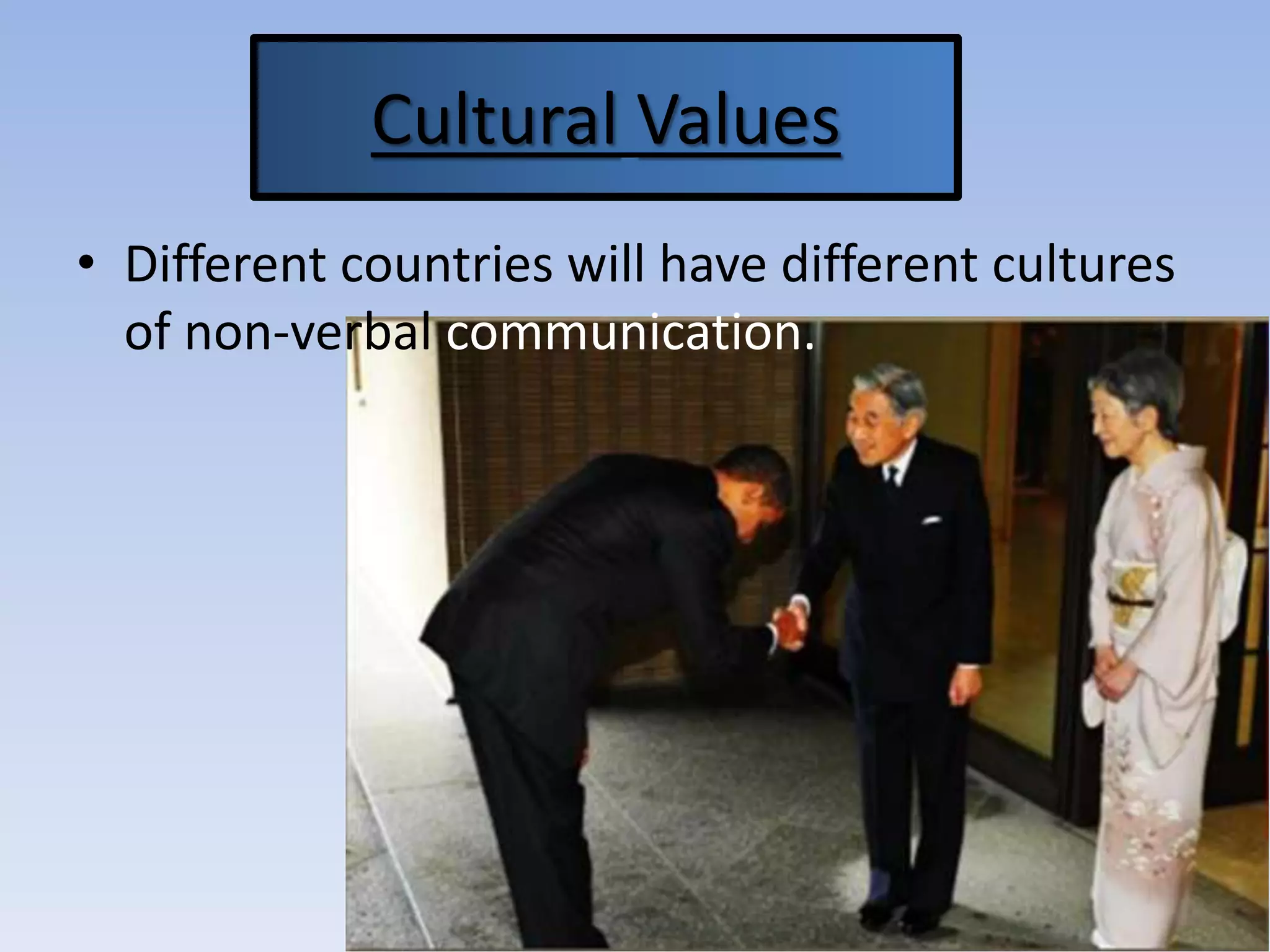
• Different countries will have different cultures
of non-verbal communication.
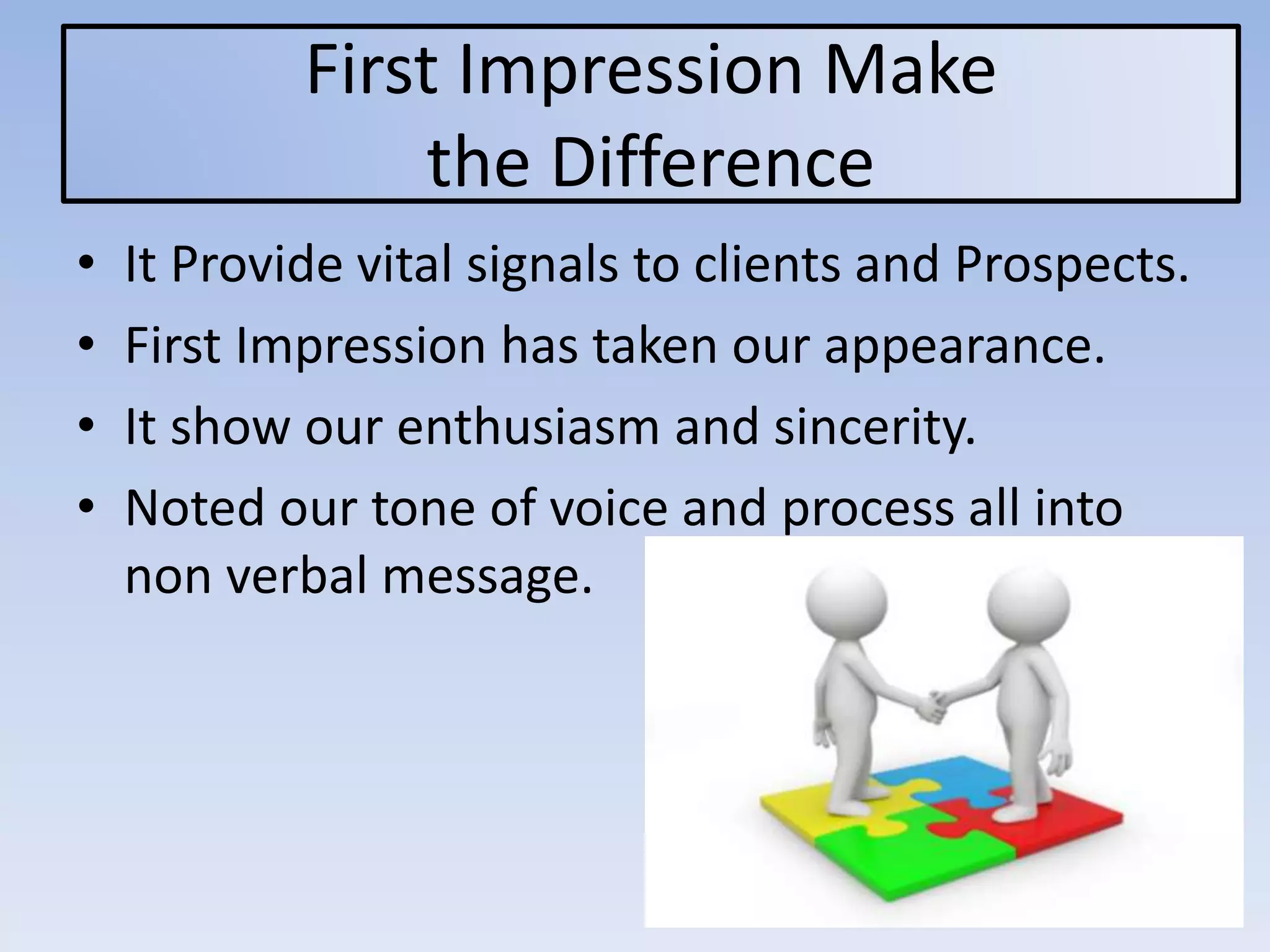
First Impression Make
the Difference
• It Provide vital signals to clients and Prospects.
• First Impression has taken our appearance.
• It show our enthusiasm and sincerity.
• Noted our tone of voice and process all into
non verbal message.
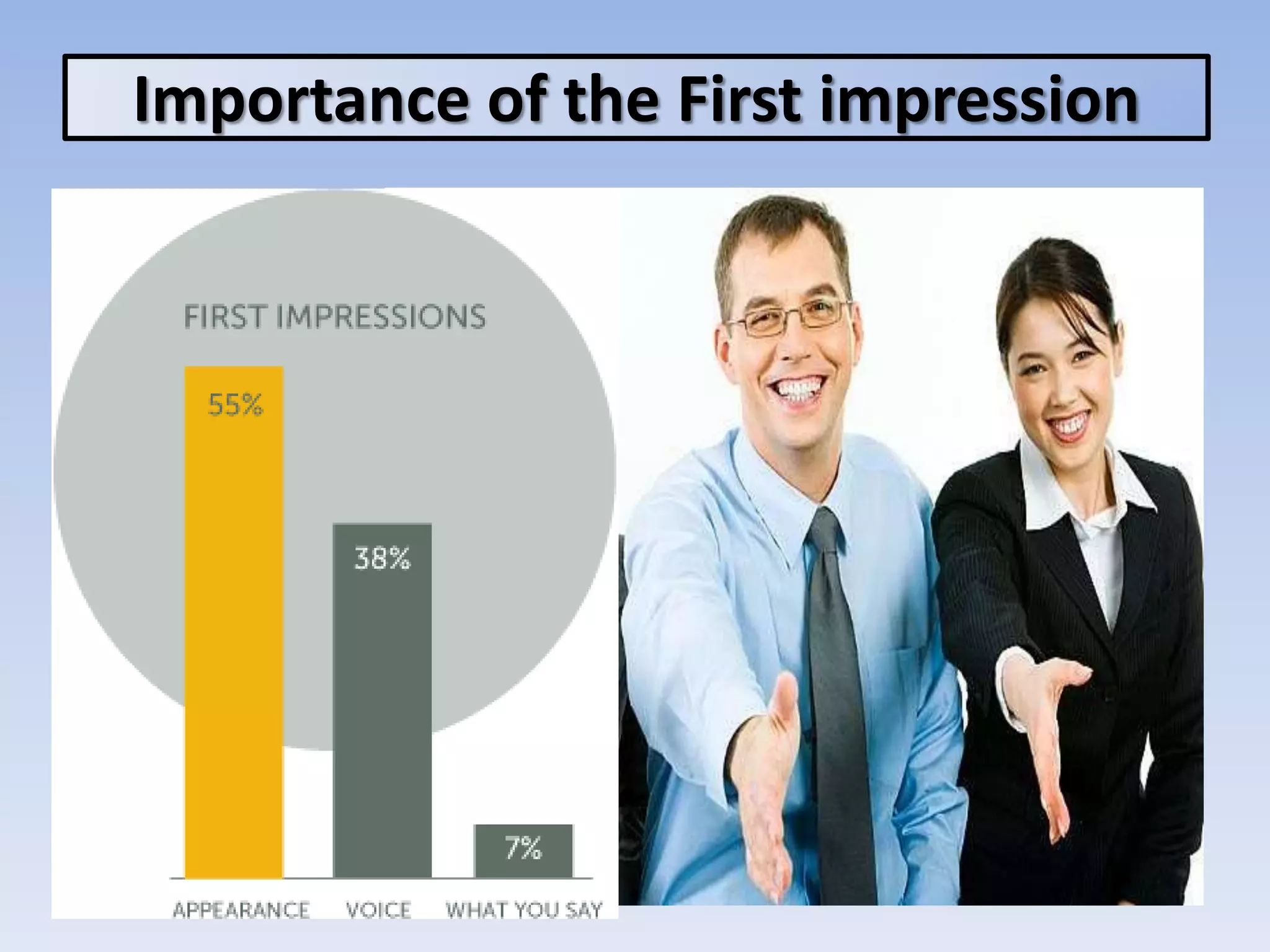
Importance of the First impression
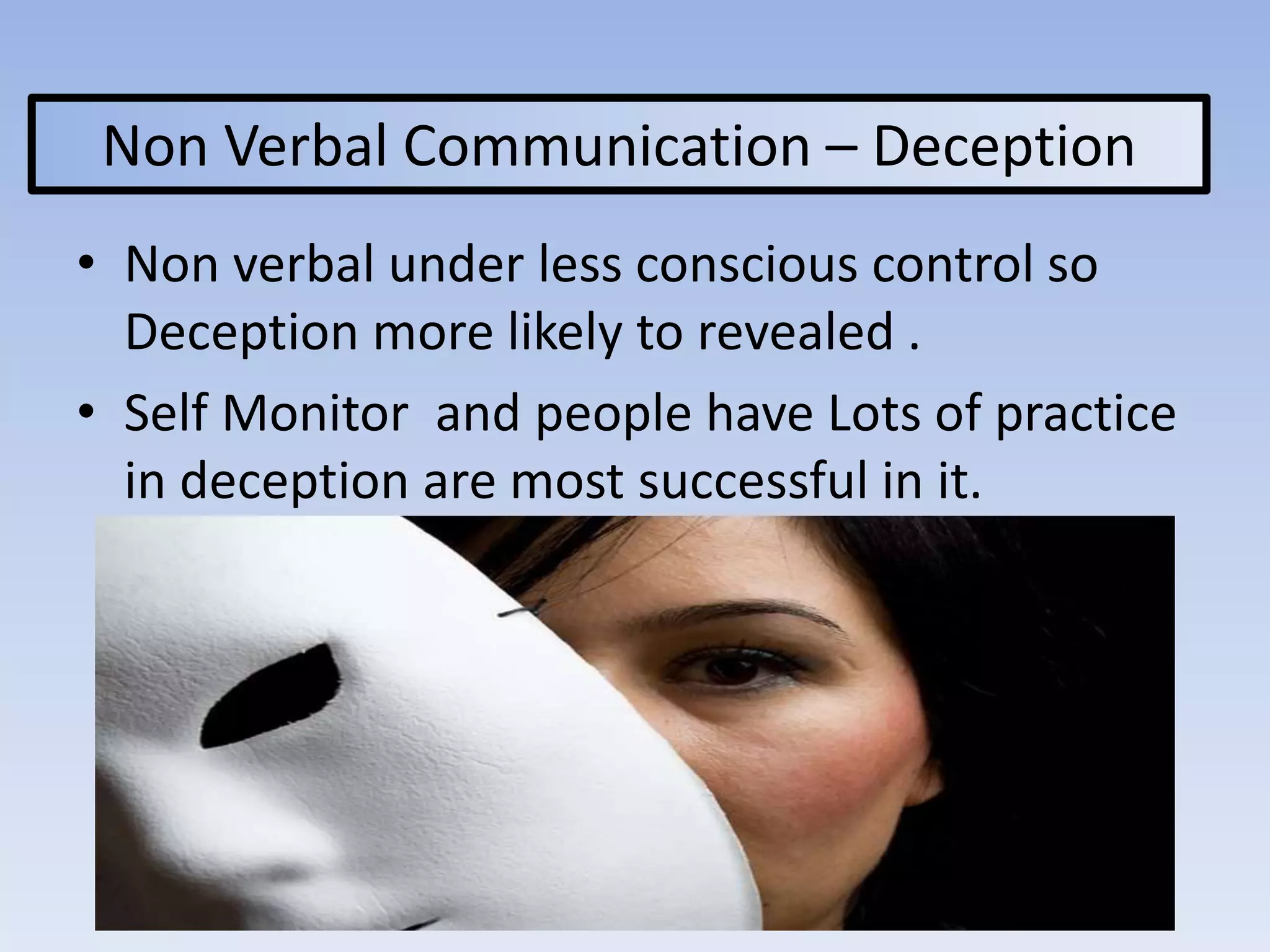
Non Verbal Communication – Deception
• Non verbal under less conscious control so
Deception more likely to revealed .
• Self Monitor and people have Lots of practice
in deception are most successful in it.
Hesitate
Higher Vocal Pitch
Fidget
Shift there posture more
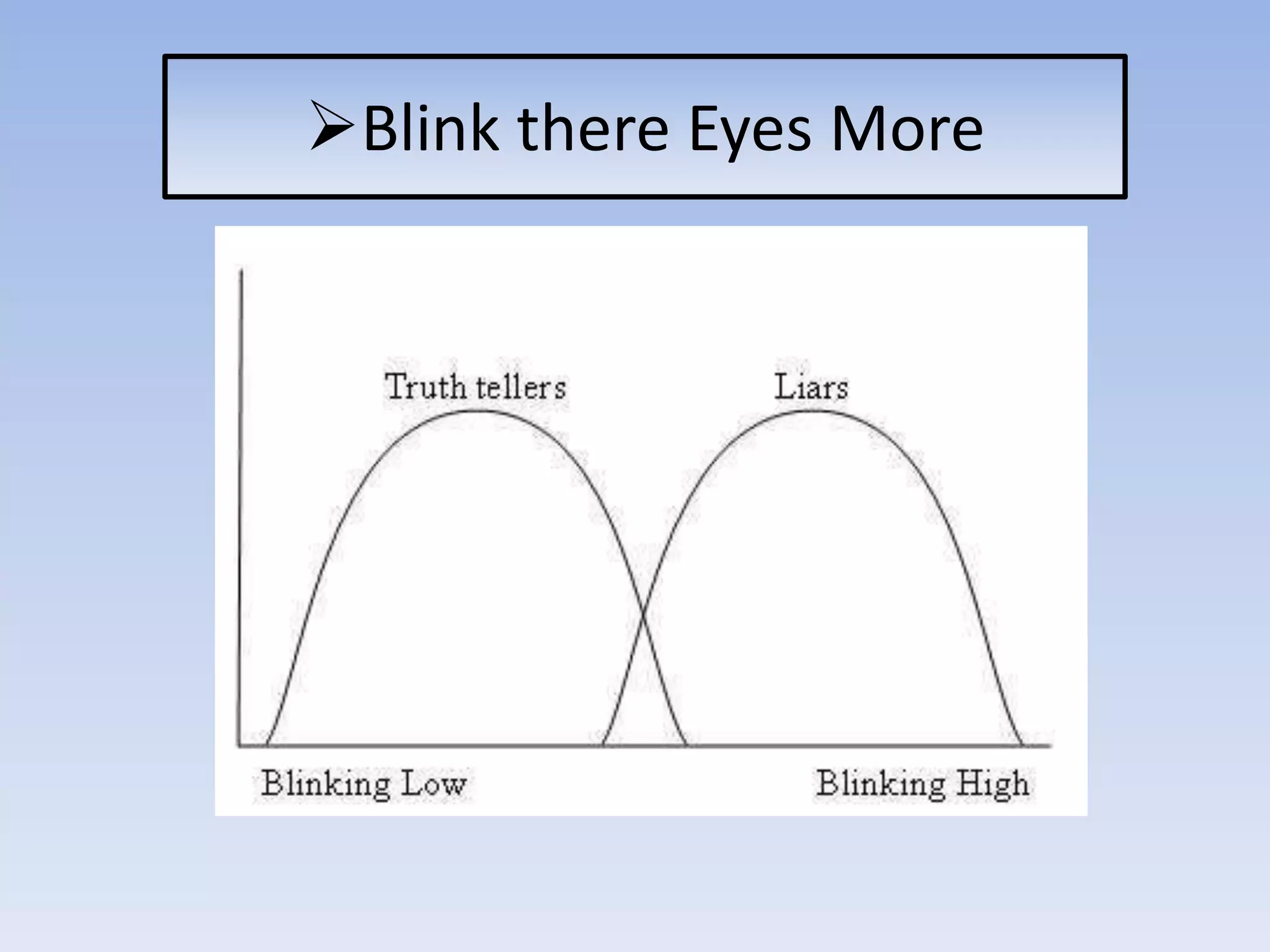
Blink there Eyes More
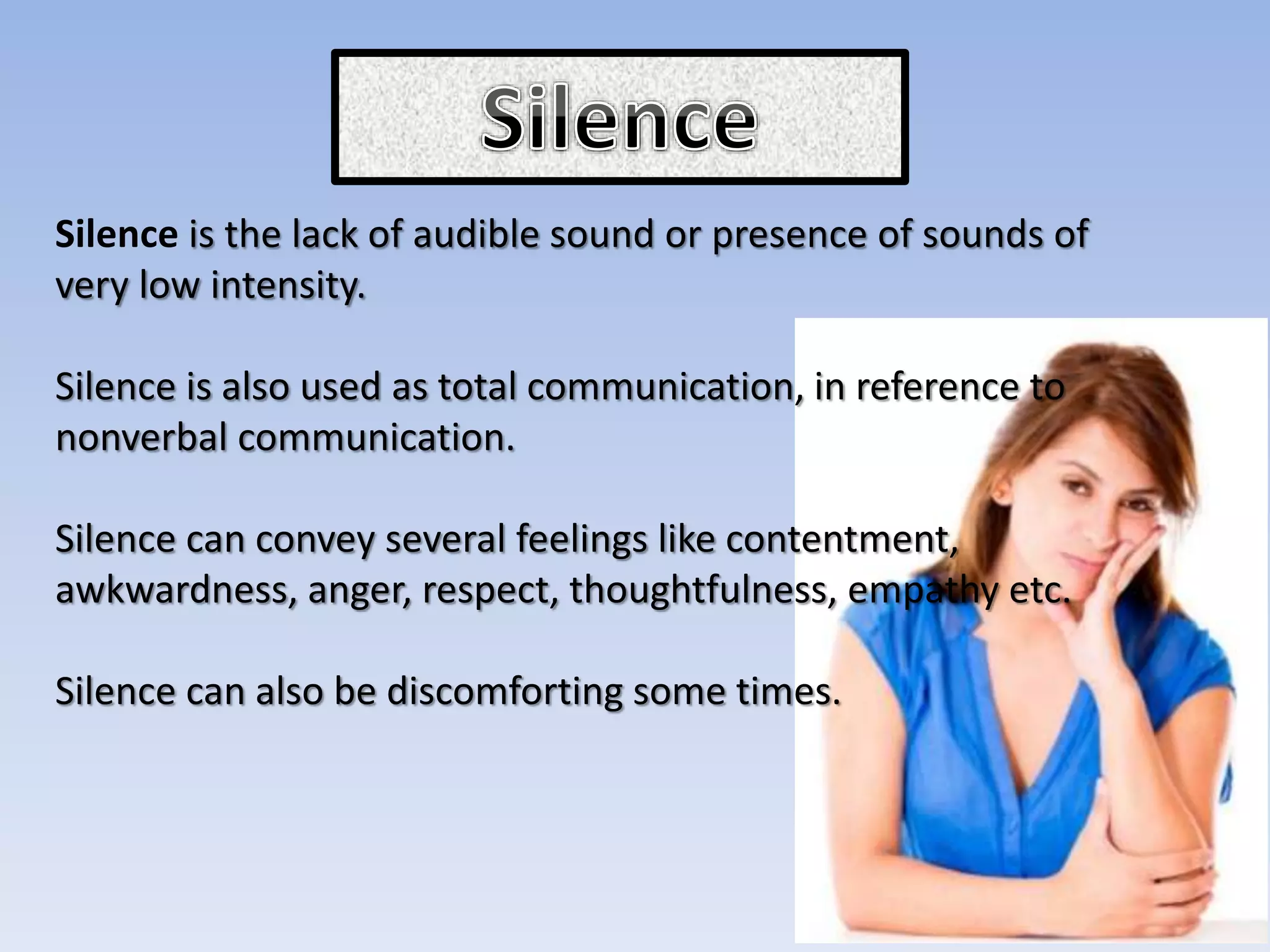
Silence is the lack of audible sound or presence of sounds of
very low intensity.
Silence is also used as total communication, in reference to
nonverbal communication.
Silence can convey several feelings like contentment,
awkwardness, anger, respect, thoughtfulness, empathy etc.
Silence can also be discomforting some times.
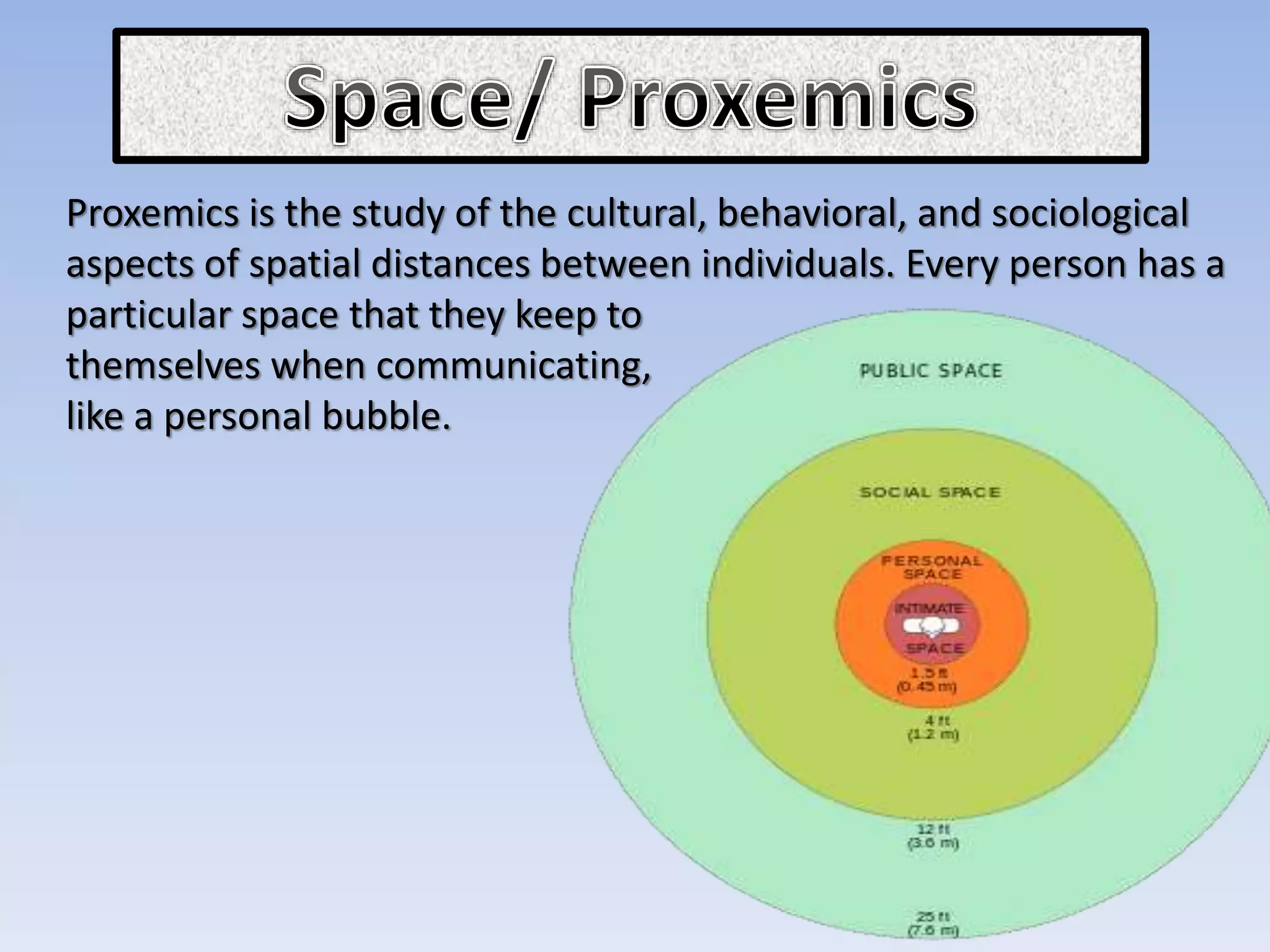
Proxemics is the study of the cultural, behavioral, and sociological
aspects of spatial distances between individuals. Every person has a
particular space that they keep to
themselves when communicating,
like a personal bubble.
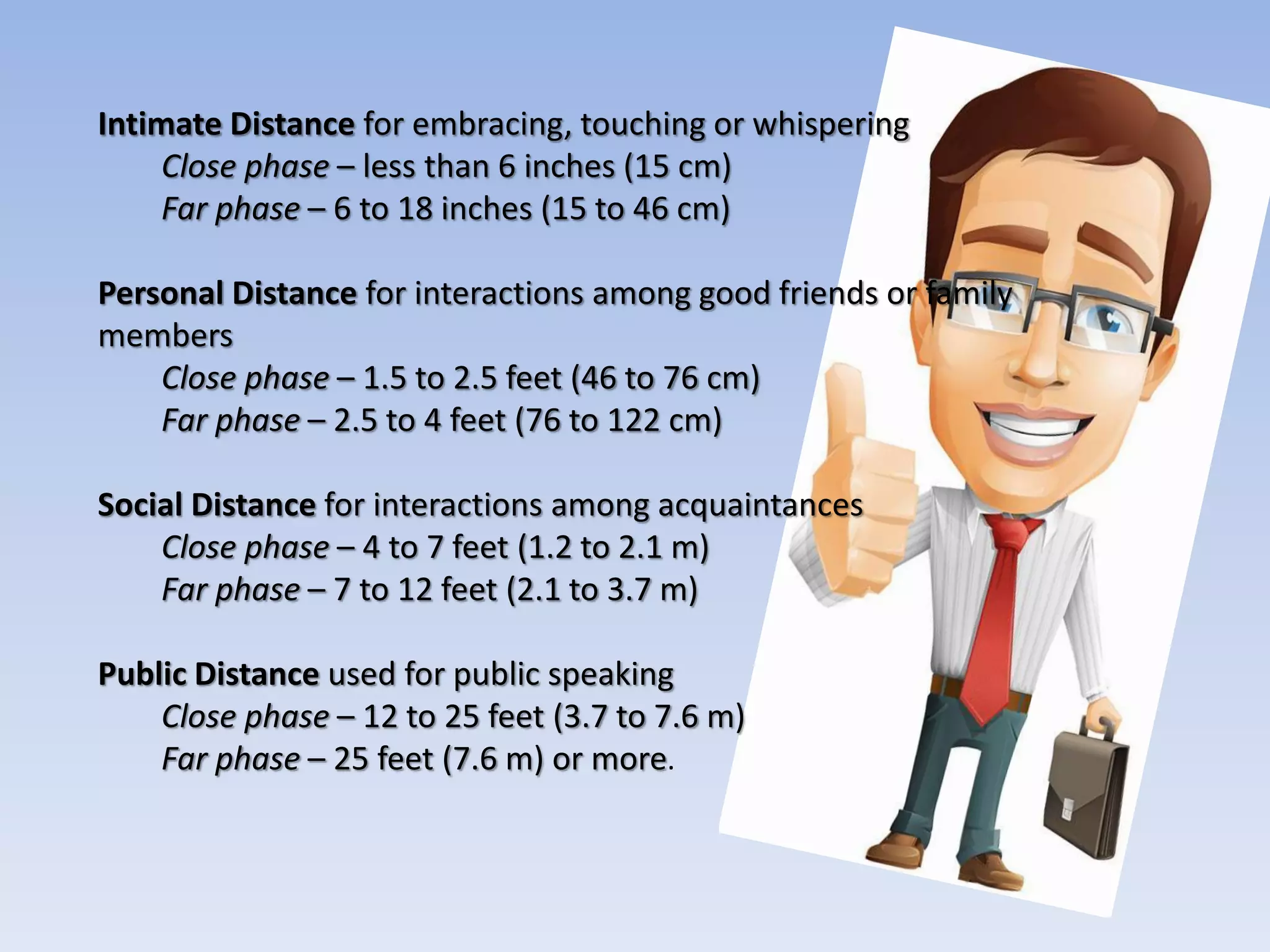
Intimate Distance for embracing, touching or whispering
Close phase – less than 6 inches (15 cm)
Far phase – 6 to 18 inches (15 to 46 cm)
Personal Distance for interactions among good friends or family
members
Close phase – 1.5 to 2.5 feet (46 to 76 cm)
Far phase – 2.5 to 4 feet (76 to 122 cm)
Social Distance for interactions among acquaintances
Close phase – 4 to 7 feet (1.2 to 2.1 m)
Far phase – 7 to 12 feet (2.1 to 3.7 m)
Public Distance used for public speaking
Close phase – 12 to 25 feet (3.7 to 7.6 m)
Far phase – 25 feet (7.6 m) or more.
Chronemics is the study of the use of time in nonverbal communication. The
way that one perceives and values time, structures time and reacts to time
frames communication.
Time perceptions include punctuality, willingness to wait, interactions and
status.
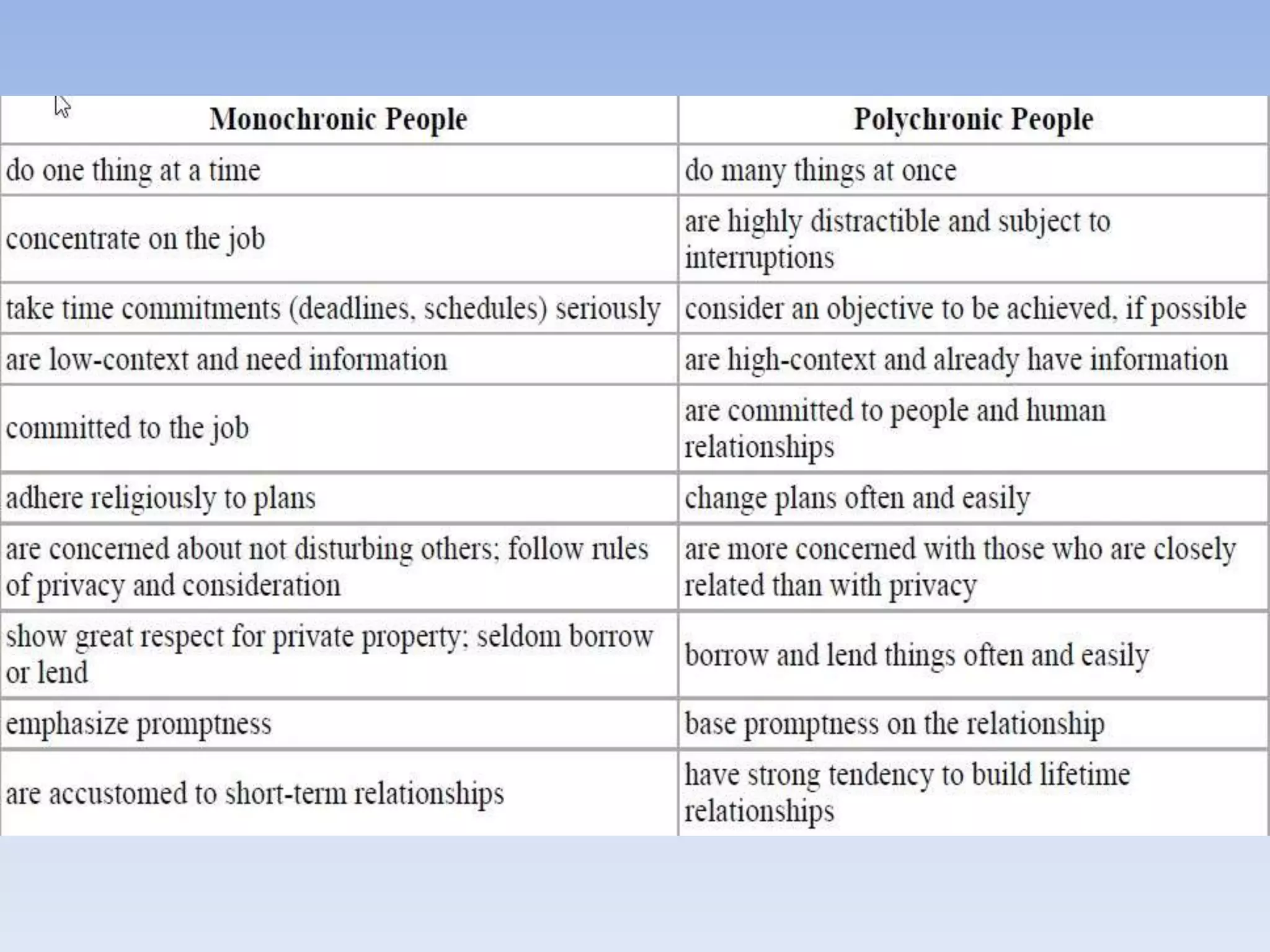
Cultures are sometimes considered monochronic or polychronic.
A monochronic time system means that things are done one at a time and
time is segmented into precise, small units. Under this system time is
scheduled, arranged and managed.
A polychronic time system is a system where several things can be done at
once, and a more fluid approach is taken to scheduling time.
Our choice of color, clothing, hairstyles, and other factors affecting
appearance are also considered a means of nonverbal
communication. According to what people see when they first set
their eyes on you, judgments about your personality and abilities
are going to be concluded.
We tend to notice obvious things first ( gender), then note
attractiveness.
Physically attractive people are generally perceived better.
Though importance based on physical appearance can be very
damaging as it is what we do is most important not how we look.
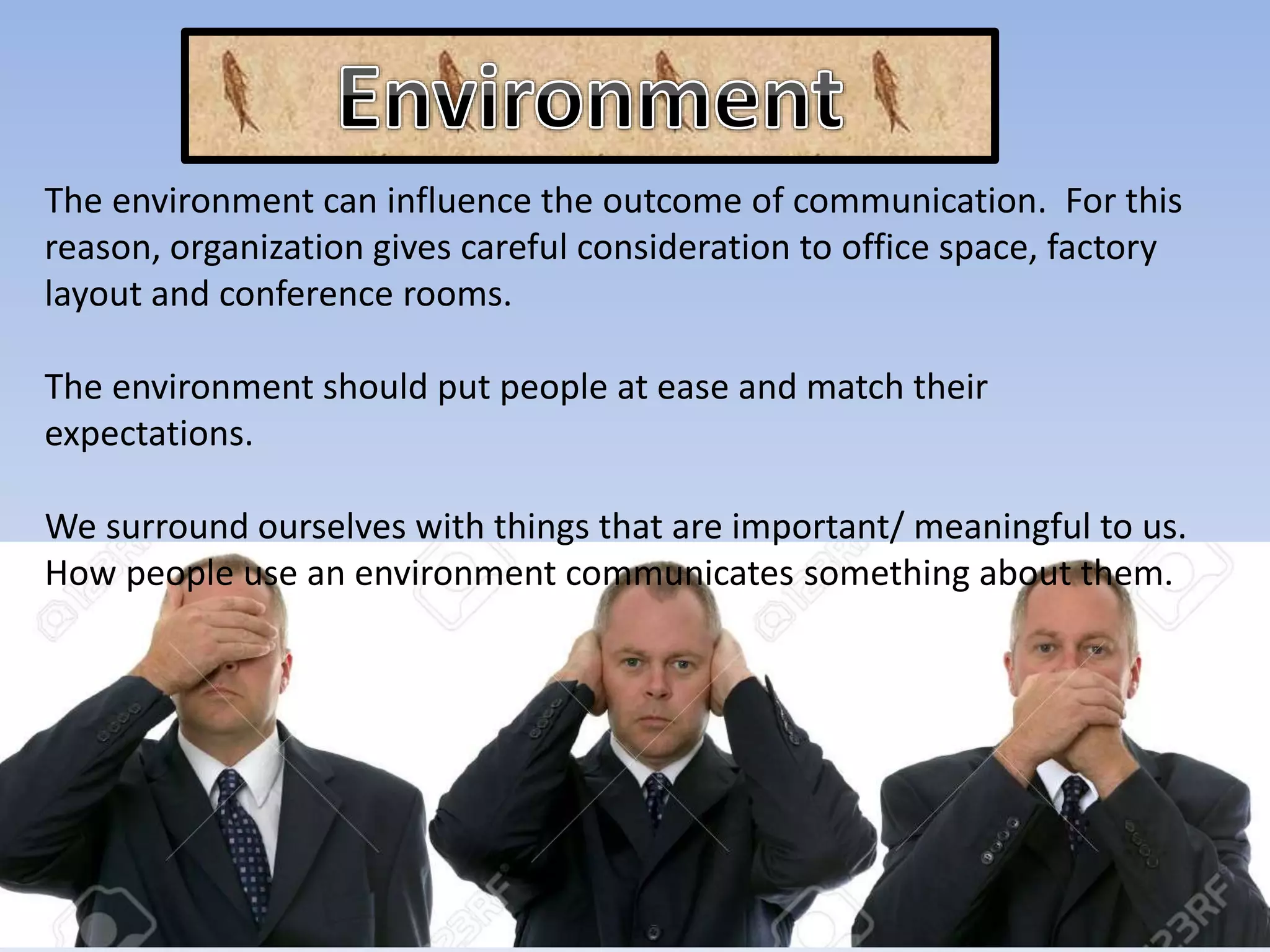
The environment can influence the outcome of communication. For this
reason, organization gives careful consideration to office space, factory
layout and conference rooms.
The environment should put people at ease and match their
expectations.
We surround ourselves with things that are important/ meaningful to us.
How people use an environment communicates something about them.
Projecting
Powerful
Image
Projecting Powerful Image
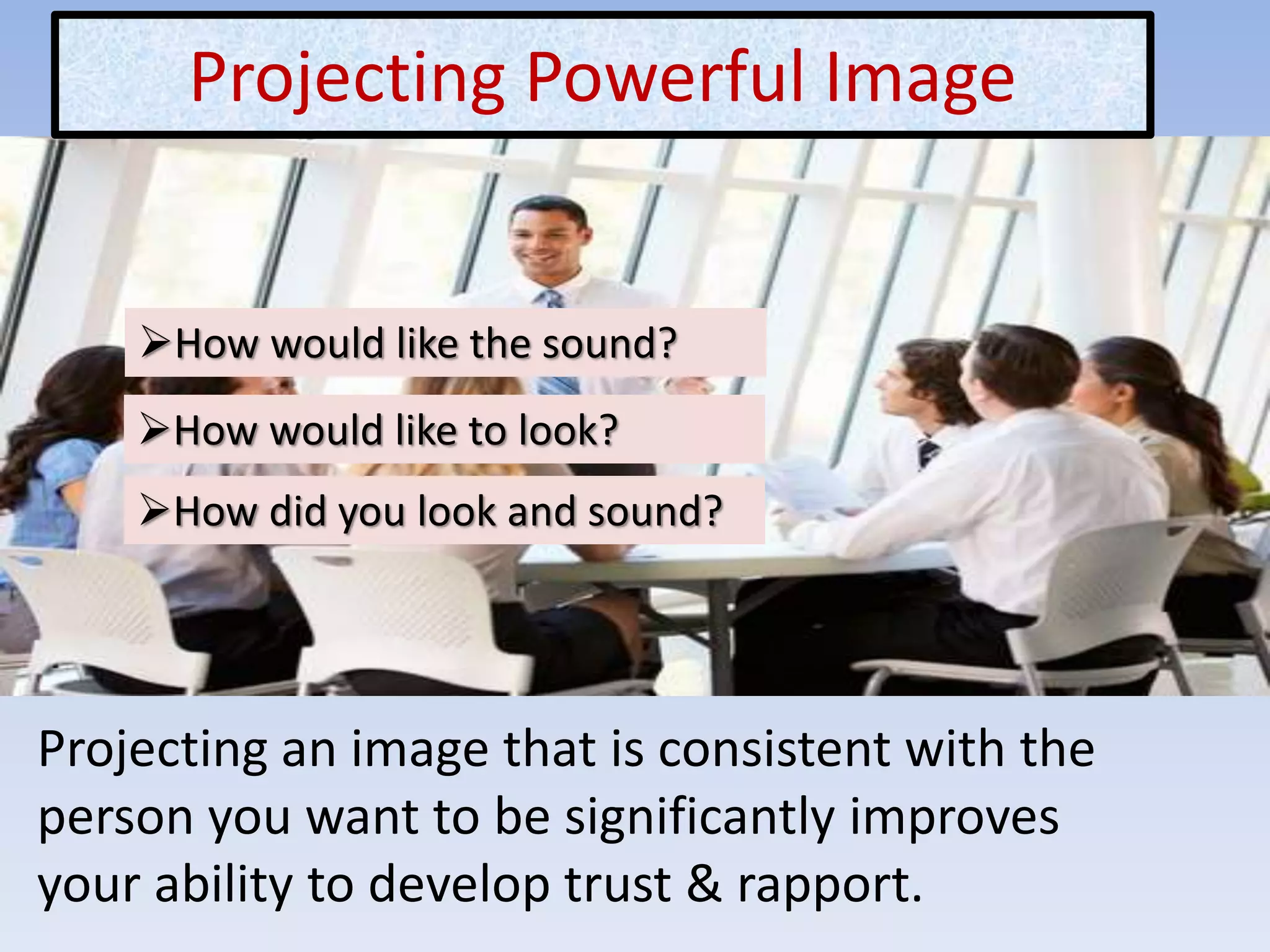
Projecting an image that is consistent with the
person you want to be significantly improves
your ability to develop trust & rapport.
How would like the sound?
How would like to look?
How did you look and sound?
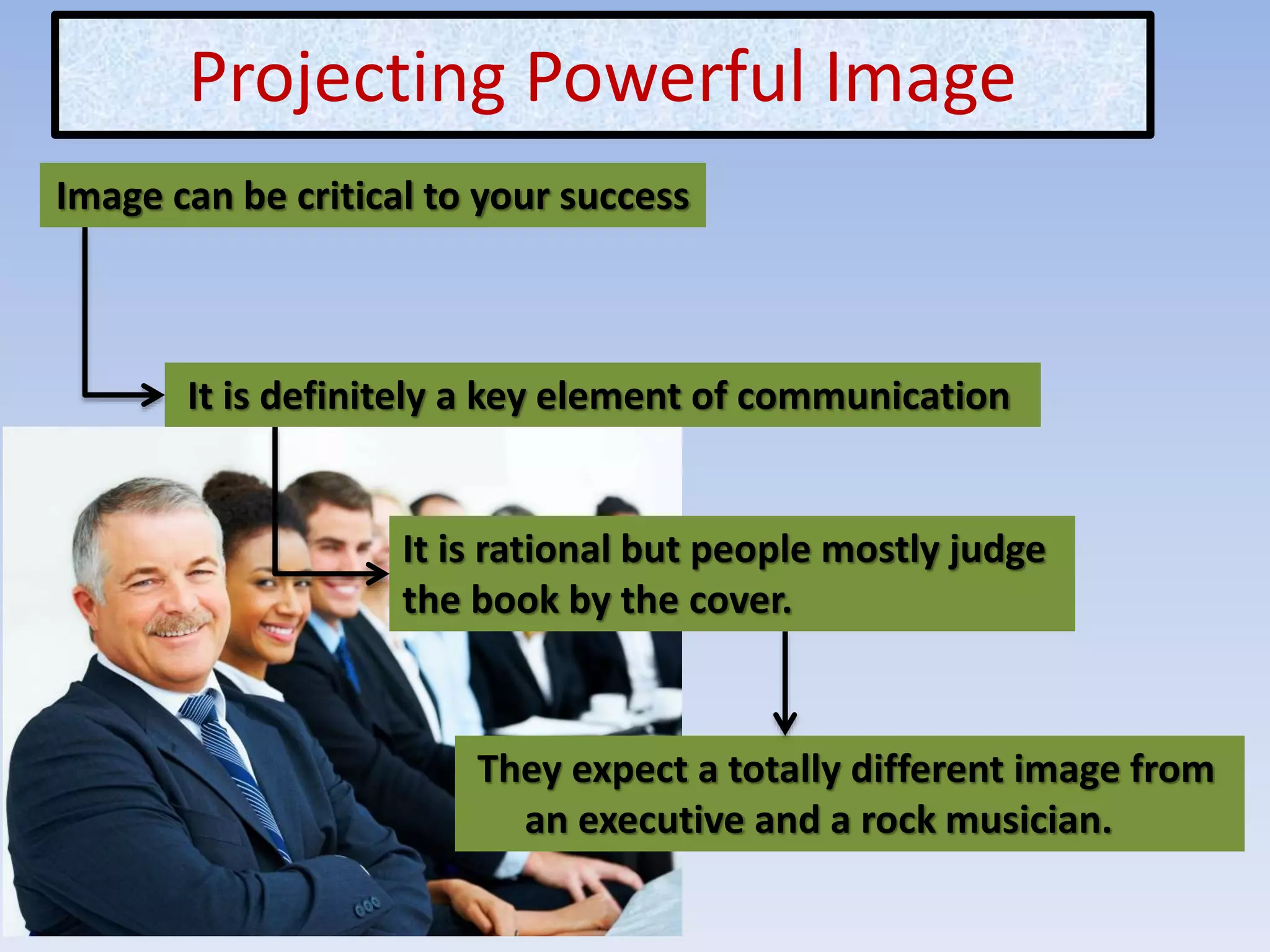
Image can be critical to your success
It is definitely a key element of communication
It is rational but people mostly judge
the book by the cover.
They expect a totally different image from
an executive and a rock musician.
Projecting Powerful Image
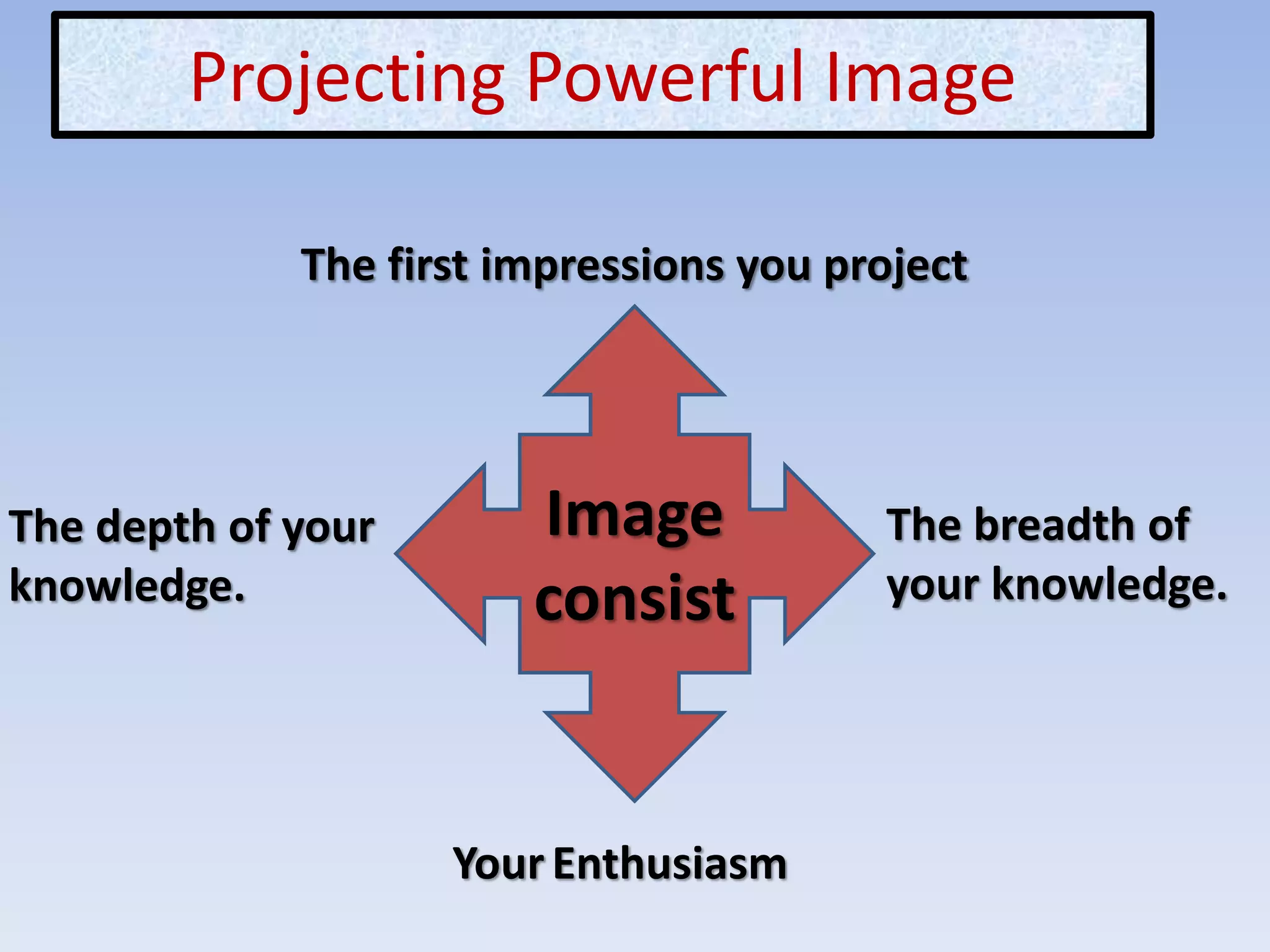
Image
consist
Projecting Powerful Image
The first impressions you project
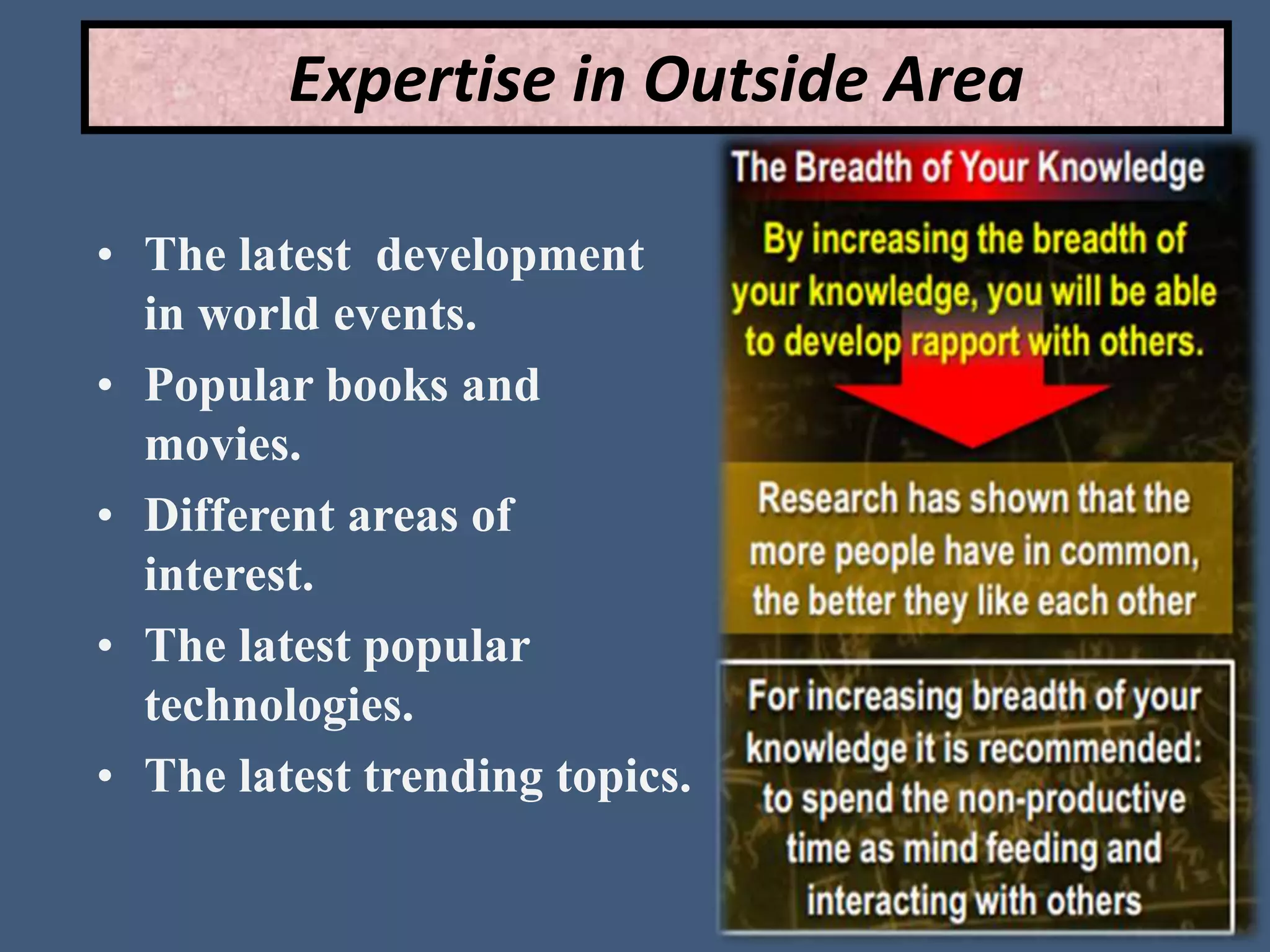
The breadth of
your knowledge.
YourEnthusiasm
The depth of your
knowledge.
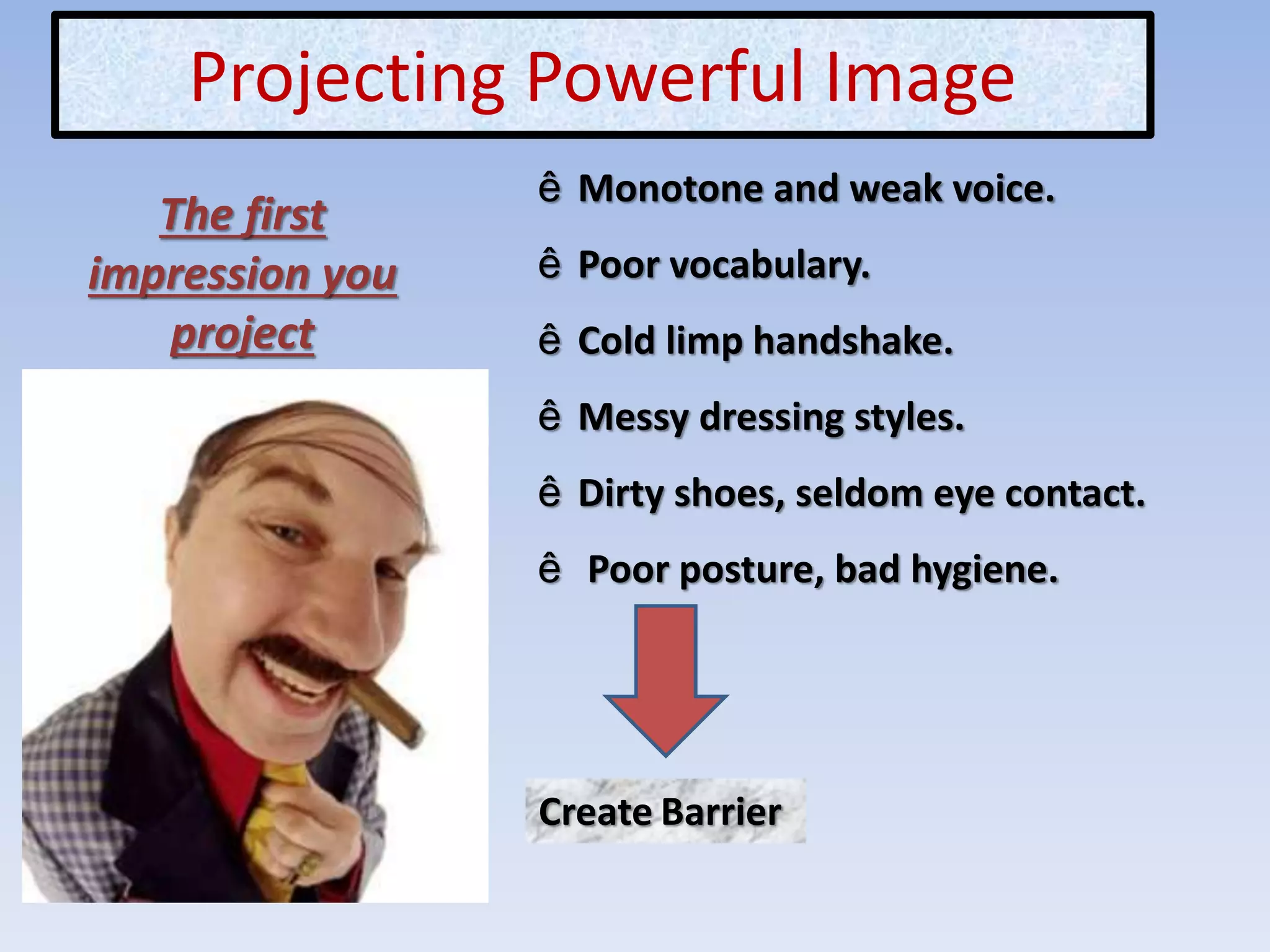
ê Monotone and weak voice.
ê Poor vocabulary.
ê Cold limp handshake.
ê Messy dressing styles.
ê Dirty shoes, seldom eye contact.
ê Poor posture, bad hygiene.
Create Barrier
The first
impression you
project
Projecting Powerful Image
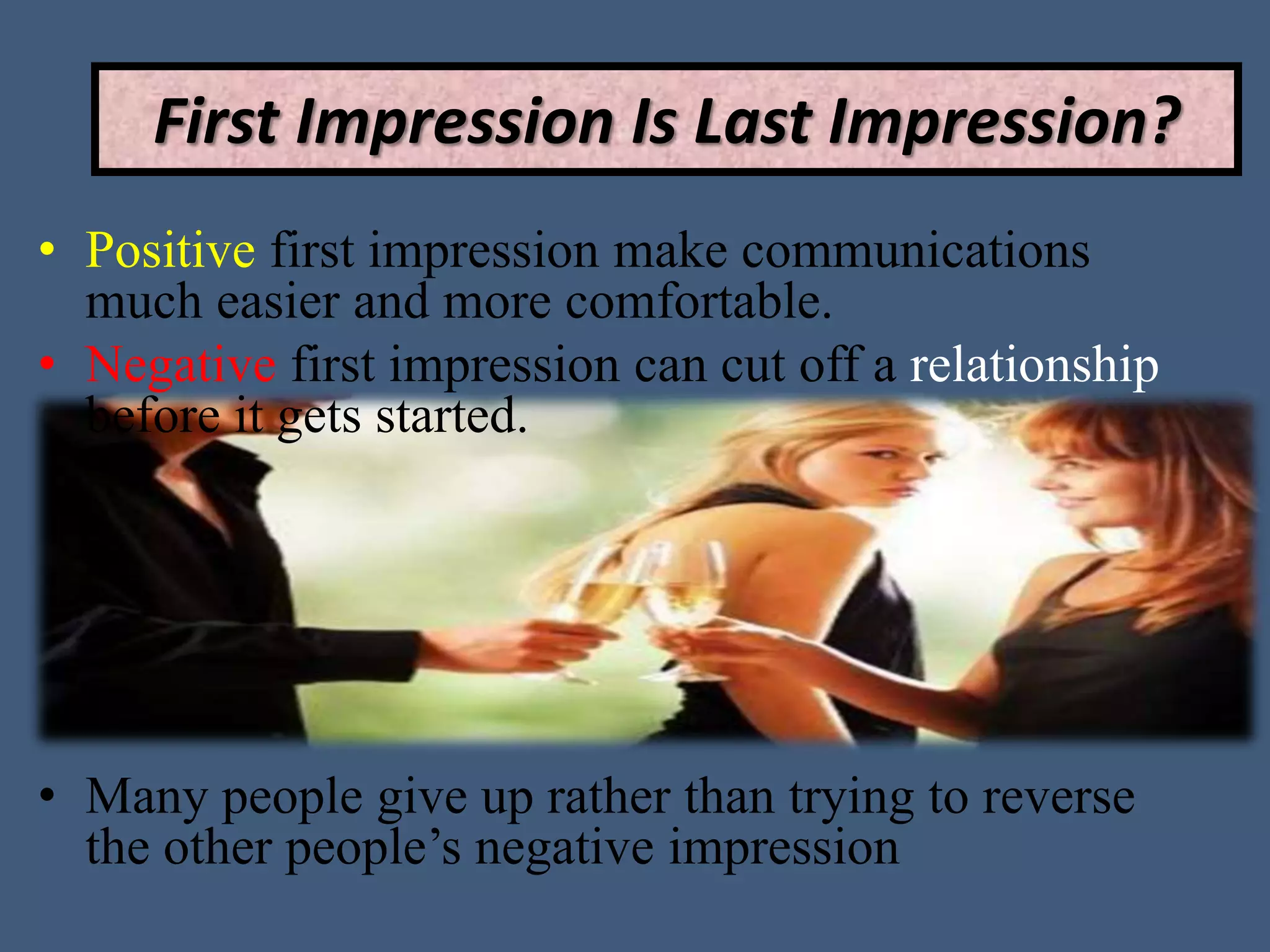
• Positive first impression make communications
much easier and more comfortable.
• Negative first impression can cut off a relationship
before it gets started.
• Many people give up rather than trying to reverse
the other people’s negative impression
First Impression Is Last Impression?
Expertise in Outside Area
• The latest development
in world events.
• Popular books and
movies.
• Different areas of
interest.
• The latest popular
technologies.
• The latest trending topics.
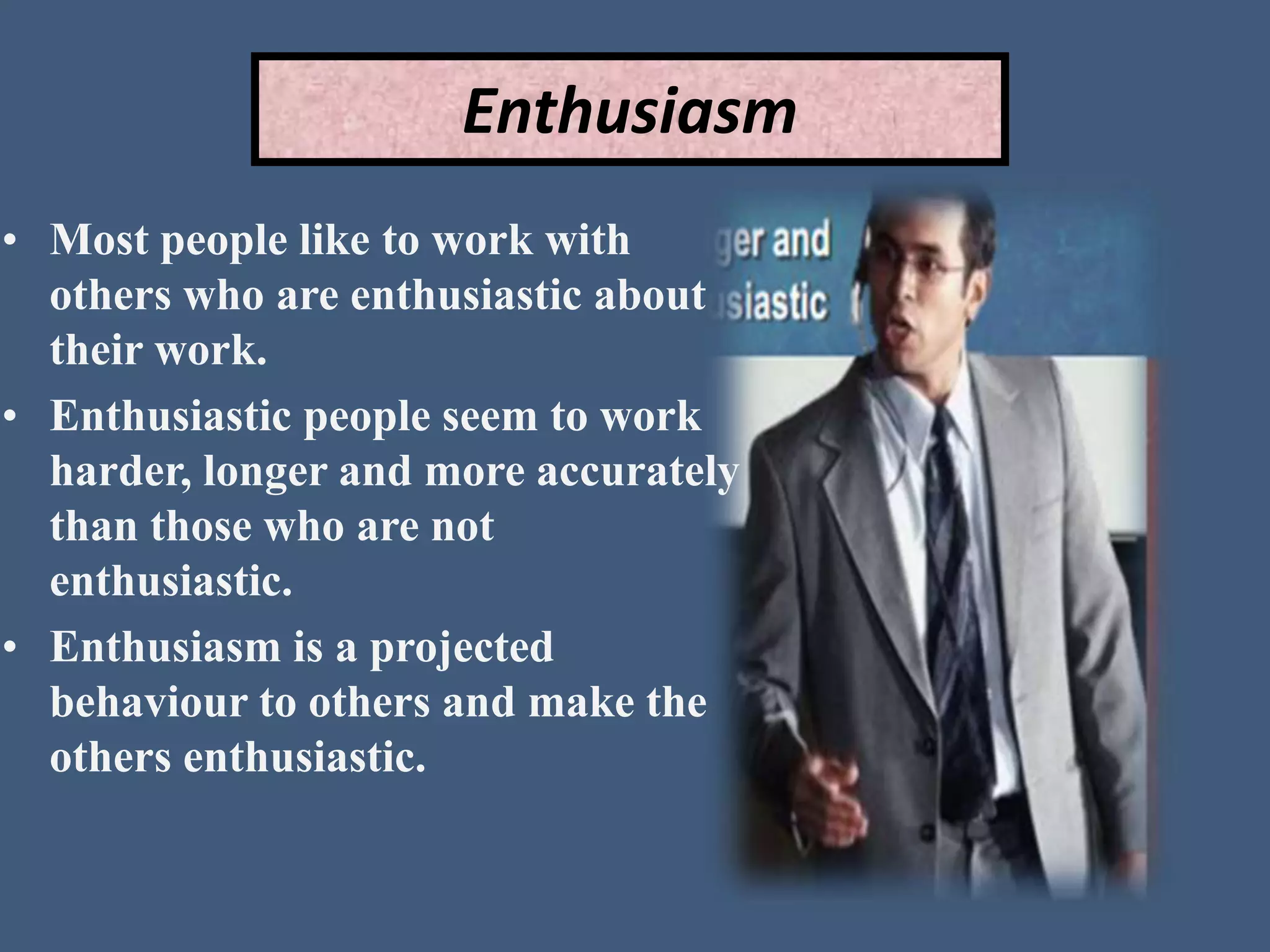
Enthusiasm
• Most people like to work with
others who are enthusiastic about
their work.
• Enthusiastic people seem to work
harder, longer and more accurately
than those who are not
enthusiastic.
• Enthusiasm is a projected
behaviour to others and make the
others enthusiastic.
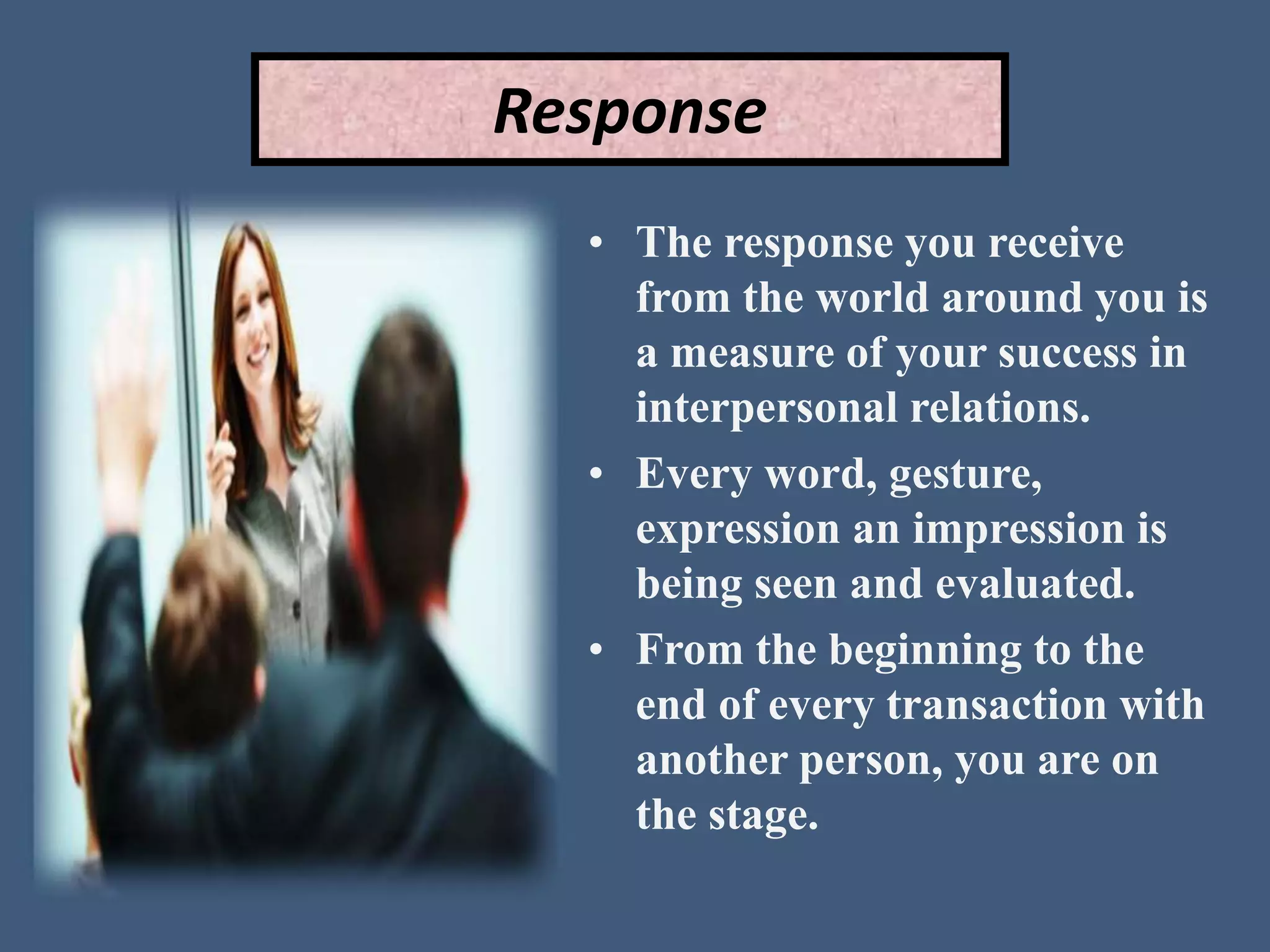
Response
• The response you receive
from the world around you is
a measure of your success in
interpersonal relations.
• Every word, gesture,
expression an impression is
being seen and evaluated.
• From the beginning to the
end of every transaction with
another person, you are on
the stage.
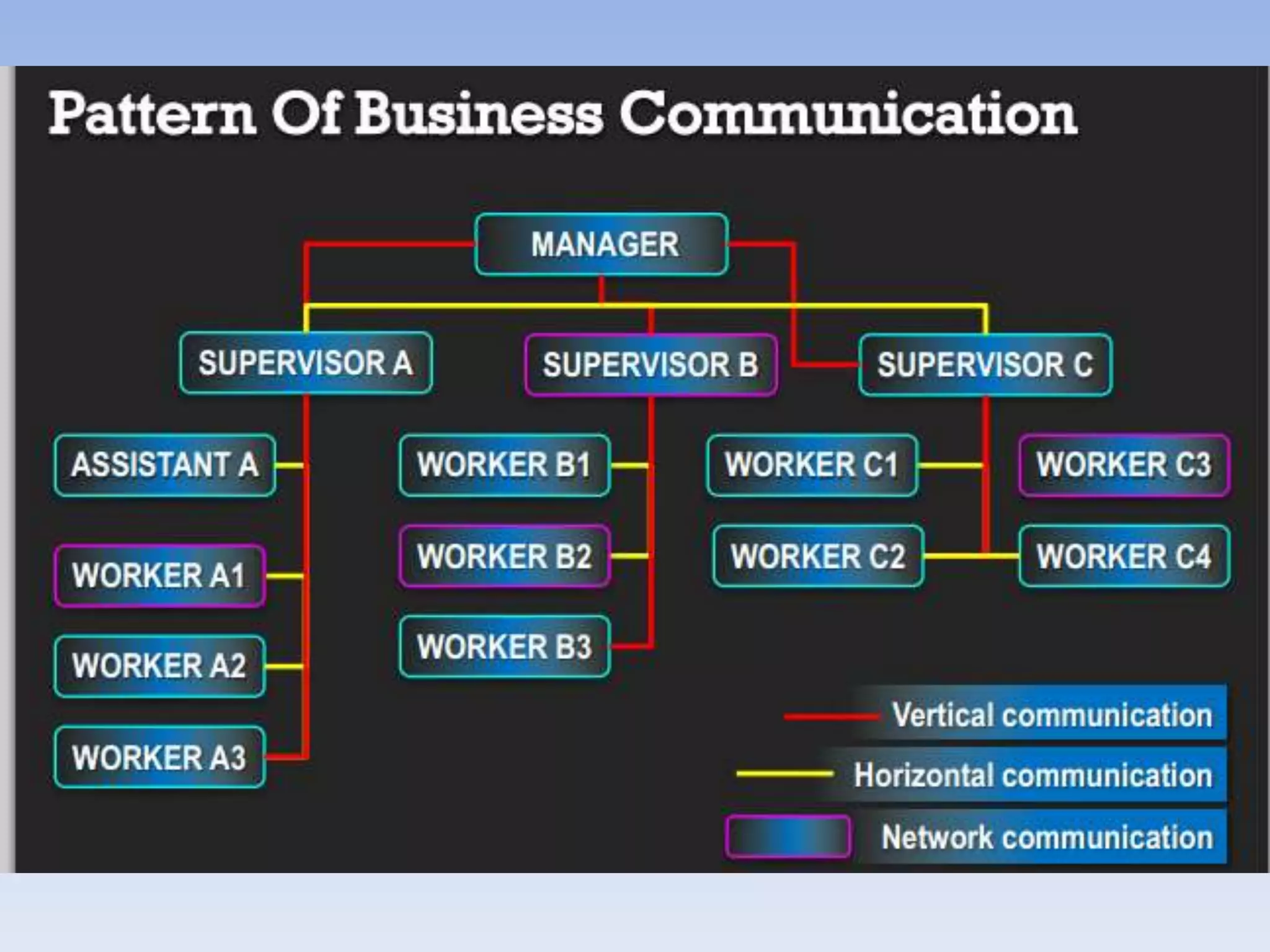
Patterns of Business
Communications
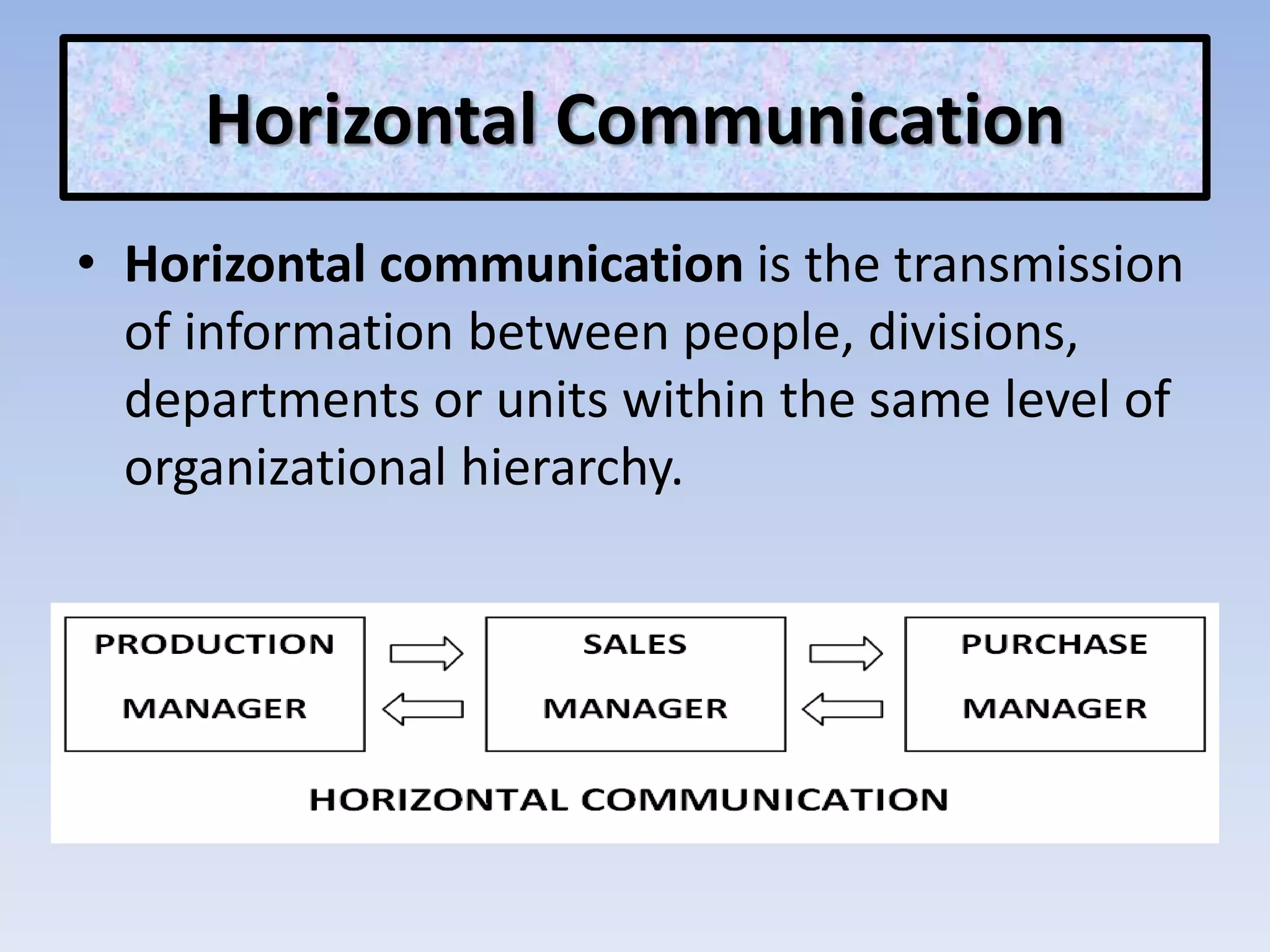
Horizontal Communication
• Horizontal communication is the transmission
of information between people, divisions,
departments or units within the same level of
organizational hierarchy.
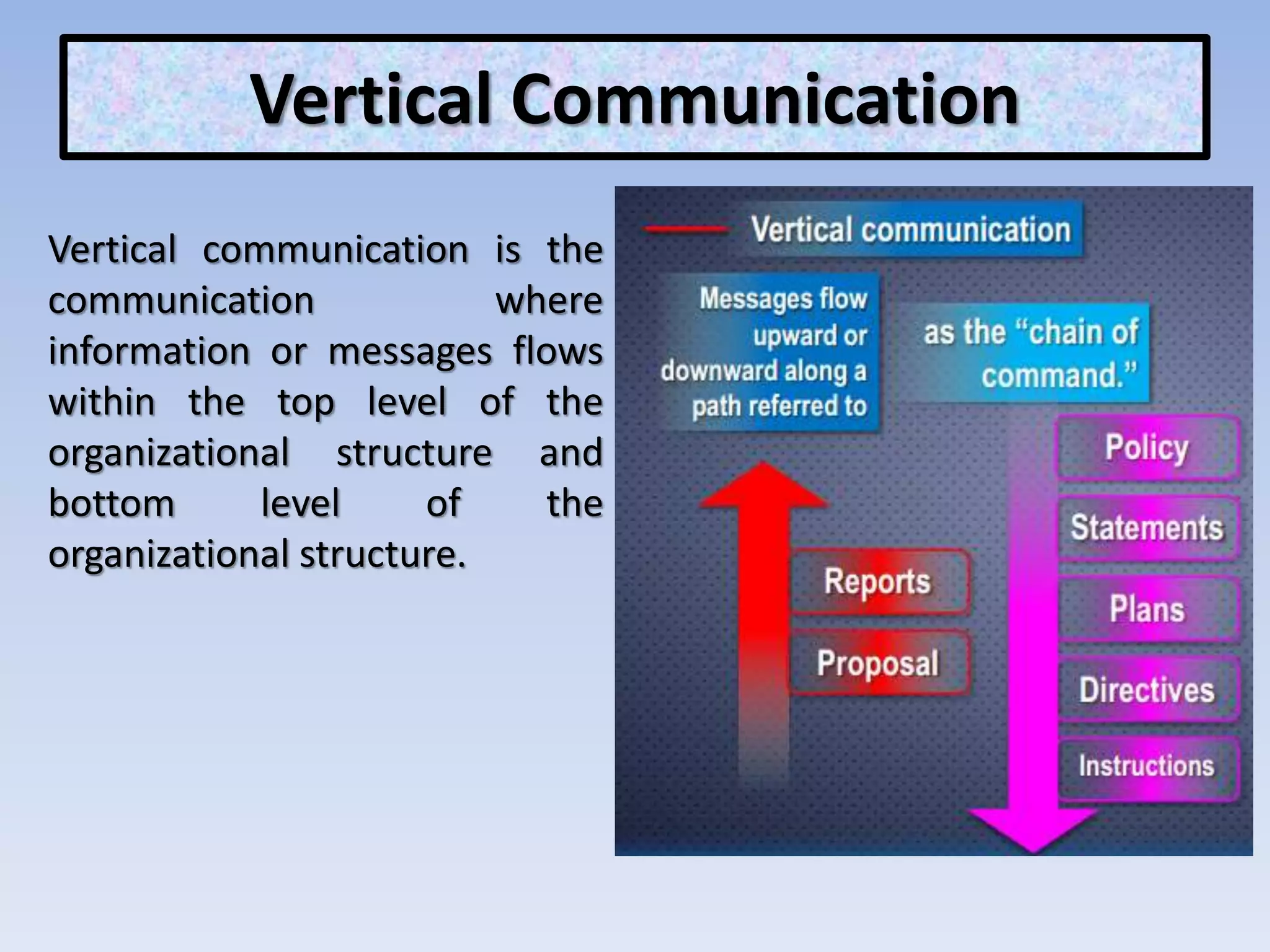
Vertical Communication
Vertical communication is the
communication where
information or messages flows
within the top level of the
organizational structure and
bottom level of the
organizational structure.
Patterns in Group Communication
Communication means transferring messages from one
to another and it has several forms such as intrapersonal,
interpersonal, group and mass communication. When it
comes to group communication it has a certain patterns
in its own. Few patterns are popular in mainstream
communication studies. Such as
• Circle
• Chain
• Y
• Wheel
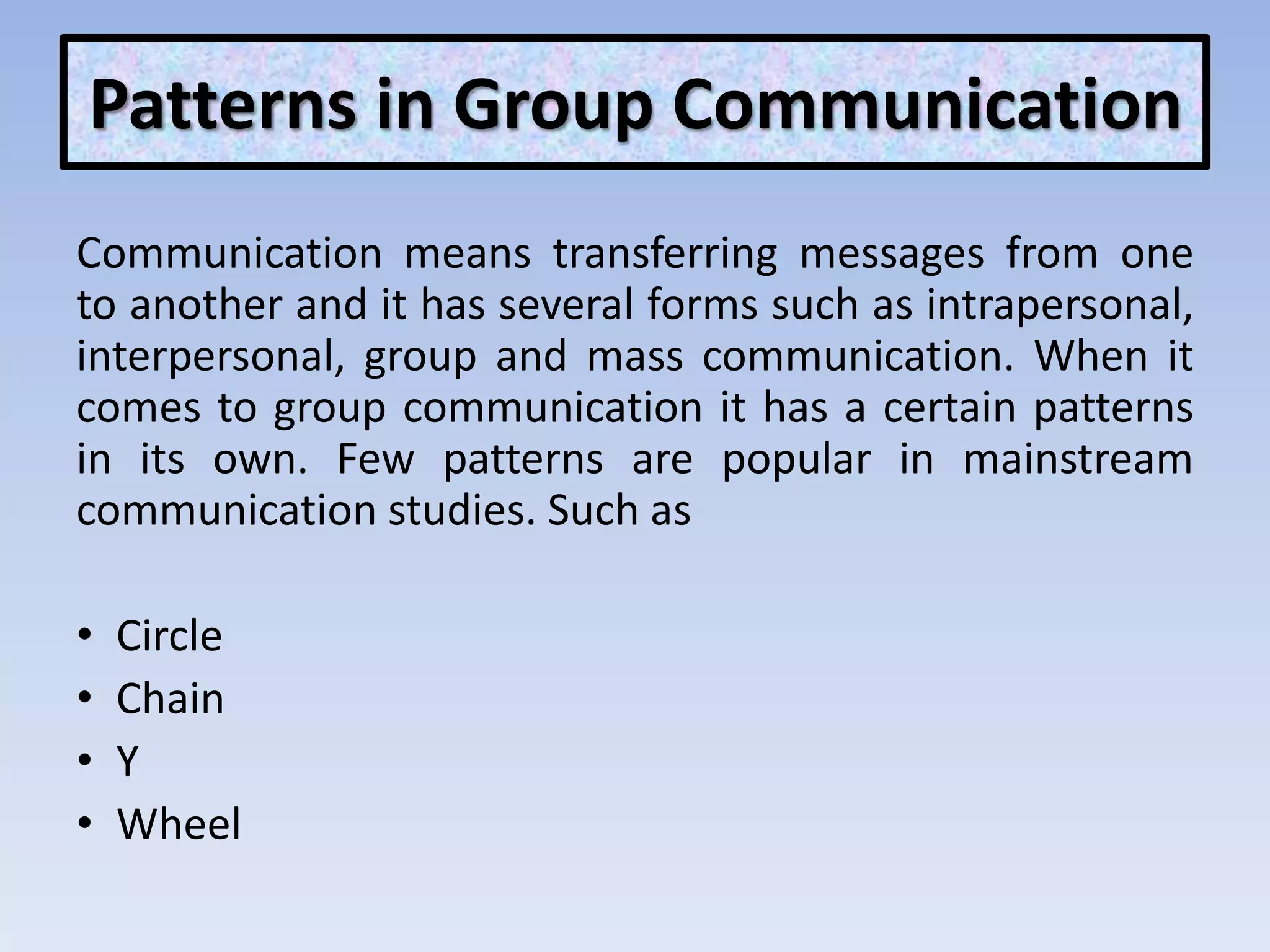
Circle Pattern
• In Circle pattern, the sender (Group Leader) can communicate with the
receivers (group members) who presents next to him/her.
• No others group members can’t receive the sender’s message directly and
they receive messages from the other group members who sharing the
message from the sender.
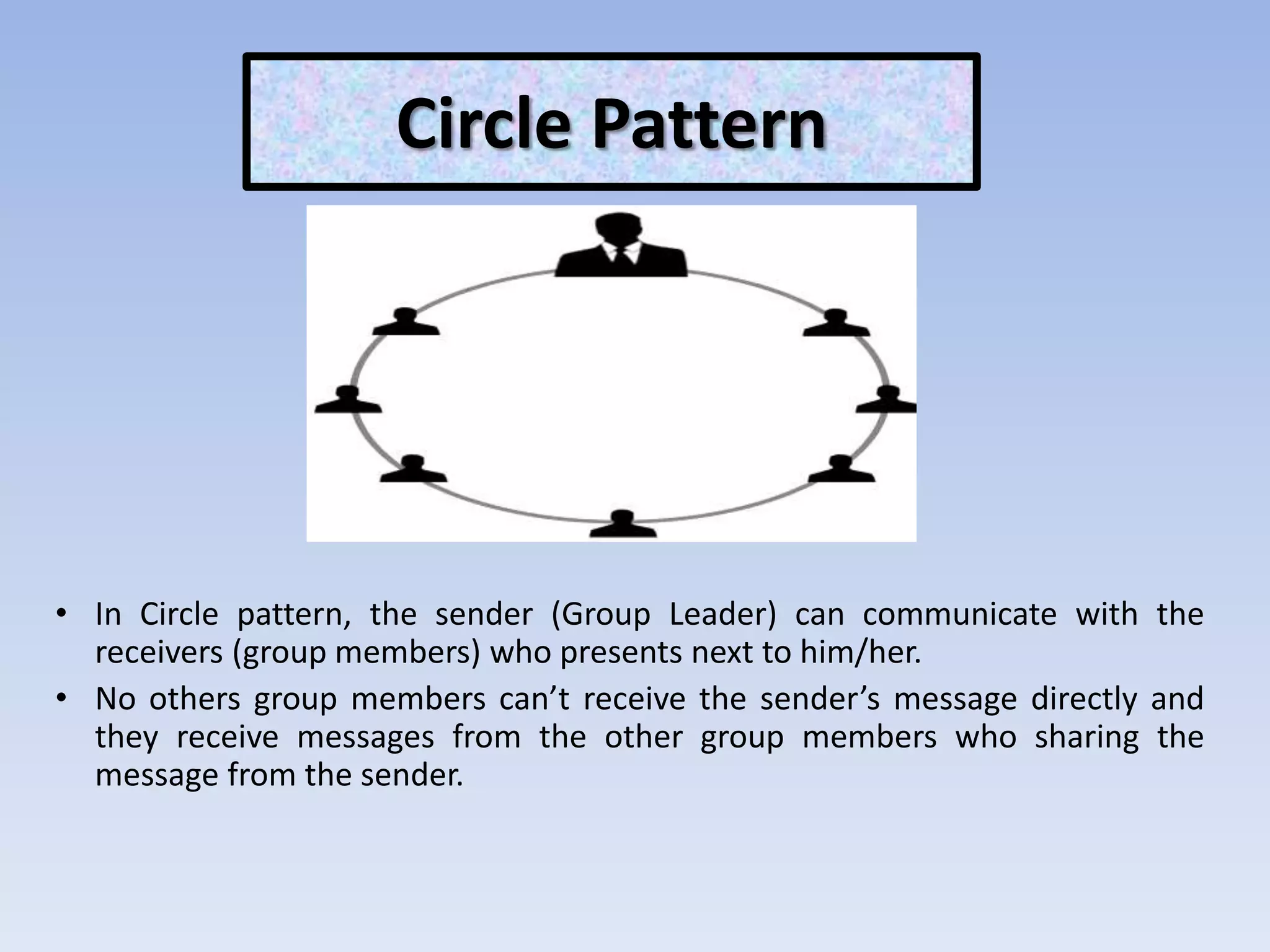
Chain Pattern
• In this pattern the last member might receive modified
messages from the leader.
• In this case the leader can’t find whether the last member
receives the correct information or not because there is no
feedback to identify the message distortion.
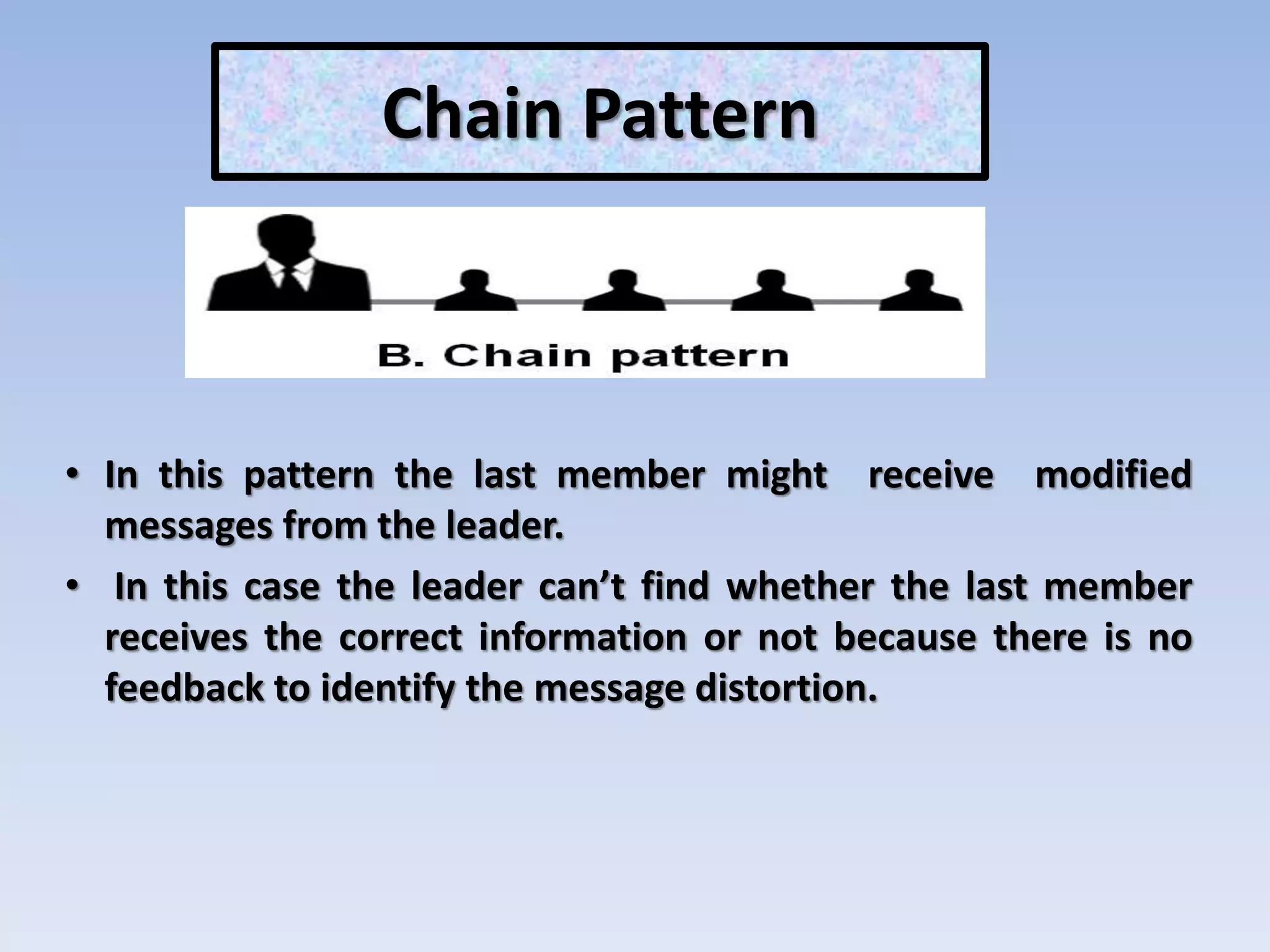
Y Pattern
• The group is separated into three.
• The group members can communicate with the other
members group through leader only
Y Pattern
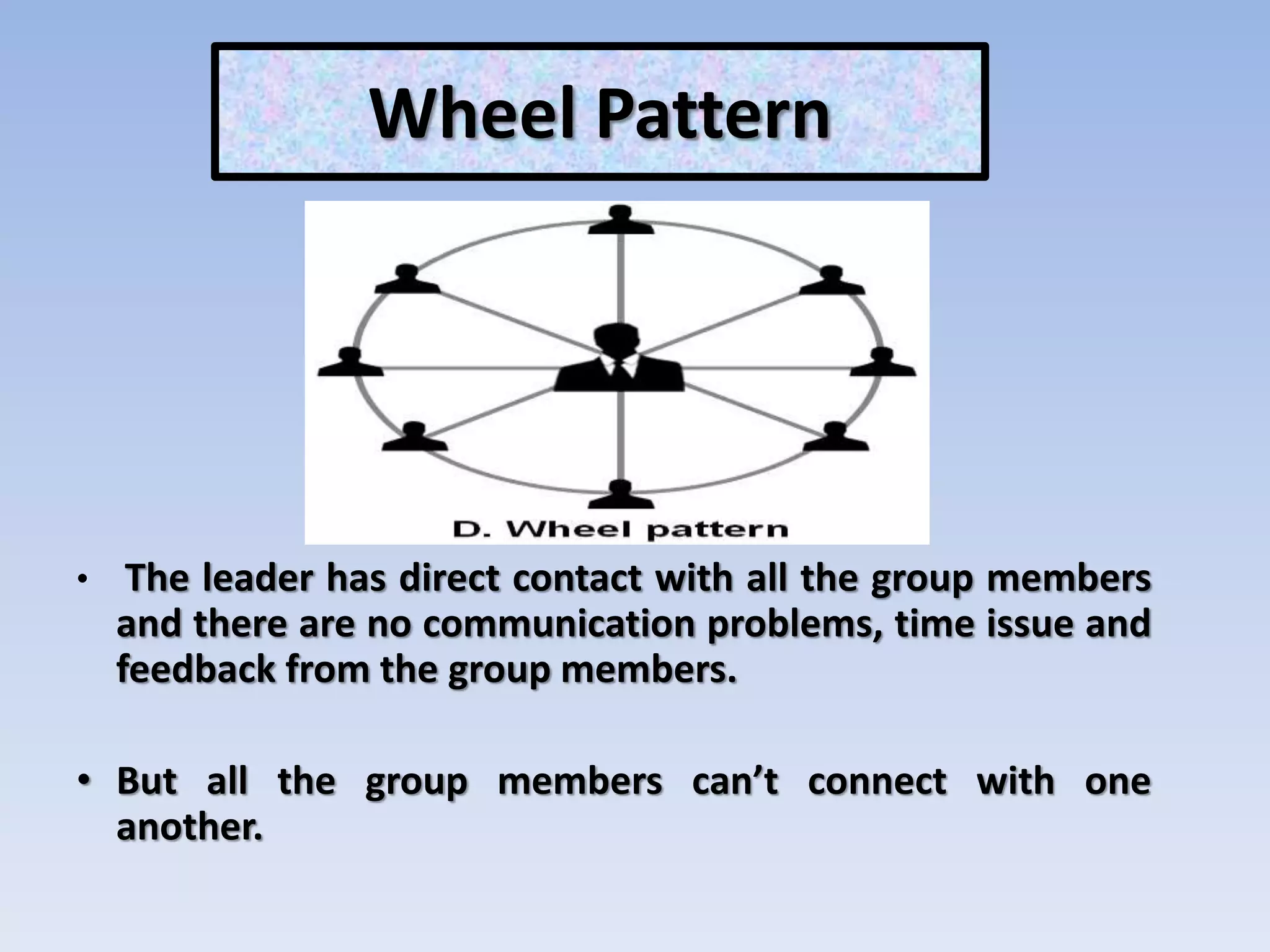
Wheel Pattern
• The leader has direct contact with all the group members
and there are no communication problems, time issue and
feedback from the group members.
• But all the group members can’t connect with one
another.
Wheel Pattern
Effective non verbal Communication  Development

Effective non verbal Communication Development

  • 1.
    Effective Non-Verbal Communication Development AbhishekChhilwar Vipul Maheshwari Aditya Dayal Vini Pargain Kapil Sharma Surbhi Arora Shashank Kashyap Presented by ~
  • 2.
    The Non VerbalCommunication In Business Communication Messages expressed by Non-Linguistic means- Silence Environment Artifacts Vocal Intonation A Powerful mode of Communication
  • 3.
    Is It Possibleto communicate without words? Studies have showed Over half of the messages are Communicated though non-verbal elements: • Appearance • Body Language • Tone and Pace of voice Expressions Posture Gestures
  • 4.
    Principles of Non-Verbal Communication Allbehavior has communication value because: ‘WE CANNOT NOT COMMUNICATE’
  • 5.
    Principles of Non-Verbal Communication •It conveys important interpersonal and emotional messages. • It is ambiguous. • It has cultural values.
  • 6.
    Interpersonal and emotional messages •More than 65% one of our meaning is being generated by non-verbal communication. • Repeating , substituting , regulating and contradicting are important features of non-verbal communication.
  • 7.
    Ambiguousness • Non-verbal communicationmay have more than one meaning. • Example: Smile can have multiple meanings.
  • 8.
    Cultural Values • Differentcountries will have different cultures of non-verbal communication.
  • 9.
    First Impression Make theDifference • It Provide vital signals to clients and Prospects. • First Impression has taken our appearance. • It show our enthusiasm and sincerity. • Noted our tone of voice and process all into non verbal message.
  • 10.
    Importance of theFirst impression
  • 11.
    Non Verbal Communication– Deception • Non verbal under less conscious control so Deception more likely to revealed . • Self Monitor and people have Lots of practice in deception are most successful in it.
  • 12.
  • 13.
  • 15.
    Silence is thelack of audible sound or presence of sounds of very low intensity. Silence is also used as total communication, in reference to nonverbal communication. Silence can convey several feelings like contentment, awkwardness, anger, respect, thoughtfulness, empathy etc. Silence can also be discomforting some times.
  • 16.
    Proxemics is thestudy of the cultural, behavioral, and sociological aspects of spatial distances between individuals. Every person has a particular space that they keep to themselves when communicating, like a personal bubble.
  • 17.
    Intimate Distance forembracing, touching or whispering Close phase – less than 6 inches (15 cm) Far phase – 6 to 18 inches (15 to 46 cm) Personal Distance for interactions among good friends or family members Close phase – 1.5 to 2.5 feet (46 to 76 cm) Far phase – 2.5 to 4 feet (76 to 122 cm) Social Distance for interactions among acquaintances Close phase – 4 to 7 feet (1.2 to 2.1 m) Far phase – 7 to 12 feet (2.1 to 3.7 m) Public Distance used for public speaking Close phase – 12 to 25 feet (3.7 to 7.6 m) Far phase – 25 feet (7.6 m) or more.
  • 18.
    Chronemics is thestudy of the use of time in nonverbal communication. The way that one perceives and values time, structures time and reacts to time frames communication. Time perceptions include punctuality, willingness to wait, interactions and status. Cultures are sometimes considered monochronic or polychronic. A monochronic time system means that things are done one at a time and time is segmented into precise, small units. Under this system time is scheduled, arranged and managed. A polychronic time system is a system where several things can be done at once, and a more fluid approach is taken to scheduling time.
  • 20.
    Our choice ofcolor, clothing, hairstyles, and other factors affecting appearance are also considered a means of nonverbal communication. According to what people see when they first set their eyes on you, judgments about your personality and abilities are going to be concluded. We tend to notice obvious things first ( gender), then note attractiveness. Physically attractive people are generally perceived better. Though importance based on physical appearance can be very damaging as it is what we do is most important not how we look.
  • 21.
    The environment caninfluence the outcome of communication. For this reason, organization gives careful consideration to office space, factory layout and conference rooms. The environment should put people at ease and match their expectations. We surround ourselves with things that are important/ meaningful to us. How people use an environment communicates something about them.
  • 22.
  • 23.
    Projecting Powerful Image Projectingan image that is consistent with the person you want to be significantly improves your ability to develop trust & rapport. How would like the sound? How would like to look? How did you look and sound?
  • 24.
    Image can becritical to your success It is definitely a key element of communication It is rational but people mostly judge the book by the cover. They expect a totally different image from an executive and a rock musician. Projecting Powerful Image
  • 25.
    Image consist Projecting Powerful Image Thefirst impressions you project The breadth of your knowledge. YourEnthusiasm The depth of your knowledge.
  • 26.
    ê Monotone andweak voice. ê Poor vocabulary. ê Cold limp handshake. ê Messy dressing styles. ê Dirty shoes, seldom eye contact. ê Poor posture, bad hygiene. Create Barrier The first impression you project Projecting Powerful Image
  • 27.
    • Positive firstimpression make communications much easier and more comfortable. • Negative first impression can cut off a relationship before it gets started. • Many people give up rather than trying to reverse the other people’s negative impression First Impression Is Last Impression?
  • 28.
    Expertise in OutsideArea • The latest development in world events. • Popular books and movies. • Different areas of interest. • The latest popular technologies. • The latest trending topics.
  • 29.
    Enthusiasm • Most peoplelike to work with others who are enthusiastic about their work. • Enthusiastic people seem to work harder, longer and more accurately than those who are not enthusiastic. • Enthusiasm is a projected behaviour to others and make the others enthusiastic.
  • 30.
    Response • The responseyou receive from the world around you is a measure of your success in interpersonal relations. • Every word, gesture, expression an impression is being seen and evaluated. • From the beginning to the end of every transaction with another person, you are on the stage.
  • 31.
  • 33.
    Horizontal Communication • Horizontalcommunication is the transmission of information between people, divisions, departments or units within the same level of organizational hierarchy.
  • 34.
    Vertical Communication Vertical communicationis the communication where information or messages flows within the top level of the organizational structure and bottom level of the organizational structure.
  • 35.
    Patterns in GroupCommunication Communication means transferring messages from one to another and it has several forms such as intrapersonal, interpersonal, group and mass communication. When it comes to group communication it has a certain patterns in its own. Few patterns are popular in mainstream communication studies. Such as • Circle • Chain • Y • Wheel
  • 36.
    Circle Pattern • InCircle pattern, the sender (Group Leader) can communicate with the receivers (group members) who presents next to him/her. • No others group members can’t receive the sender’s message directly and they receive messages from the other group members who sharing the message from the sender.
  • 37.
    Chain Pattern • Inthis pattern the last member might receive modified messages from the leader. • In this case the leader can’t find whether the last member receives the correct information or not because there is no feedback to identify the message distortion.
  • 38.
    Y Pattern • Thegroup is separated into three. • The group members can communicate with the other members group through leader only Y Pattern
  • 39.
    Wheel Pattern • Theleader has direct contact with all the group members and there are no communication problems, time issue and feedback from the group members. • But all the group members can’t connect with one another. Wheel Pattern