EFFECTIVE
JAVA
Roshan Deniyage
Axiohelix Co. Ltd, Japan
15/11/2010
Enums and Annotations
Use enums instead of int constants
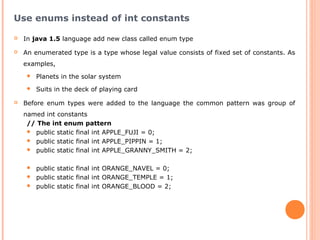
 In java 1.5 language add new class called enum type
 An enumerated type is a type whose legal value consists of fixed set of constants. As
examples,
 Planets in the solar system
 Suits in the deck of playing card
 Before enum types were added to the language the common pattern was group of
named int constants
// The int enum pattern
 public static final int APPLE_FUJI = 0;
 public static final int APPLE_PIPPIN = 1;
 public static final int APPLE_GRANNY_SMITH = 2;
 public static final int ORANGE_NAVEL = 0;
 public static final int ORANGE_TEMPLE = 1;
 public static final int ORANGE_BLOOD = 2;
Use enums instead of int constants
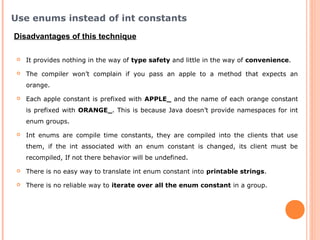
Disadvantages of this technique
 It provides nothing in the way of type safety and little in the way of convenience.
 The compiler won’t complain if you pass an apple to a method that expects an
orange.
 Each apple constant is prefixed with APPLE_ and the name of each orange constant
is prefixed with ORANGE_. This is because Java doesn’t provide namespaces for int
enum groups.
 Int enums are compile time constants, they are compiled into the clients that use
them, if the int associated with an enum constant is changed, its client must be
recompiled, If not there behavior will be undefined.
 There is no easy way to translate int enum constant into printable strings.
 There is no reliable way to iterate over all the enum constant in a group.
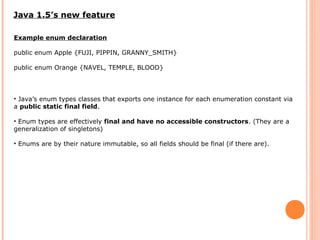
Java 1.5’s new feature
Example enum declaration
public enum Apple {FUJI, PIPPIN, GRANNY_SMITH}
public enum Orange {NAVEL, TEMPLE, BLOOD}
• Java’s enum types classes that exports one instance for each enumeration constant via
a public static final field.
• Enum types are effectively final and have no accessible constructors. (They are a
generalization of singletons)
• Enums are by their nature immutable, so all fields should be final (if there are).
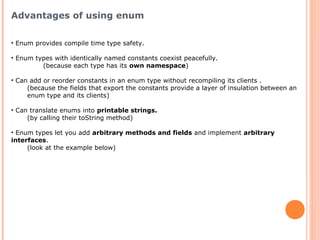
Advantages of using enum
• Enum provides compile time type safety.
• Enum types with identically named constants coexist peacefully.
(because each type has its own namespace)
• Can add or reorder constants in an enum type without recompiling its clients .
(because the fields that export the constants provide a layer of insulation between an
enum type and its clients)
• Can translate enums into printable strings.
(by calling their toString method)
• Enum types let you add arbitrary methods and fields and implement arbitrary
interfaces.
(look at the example below)
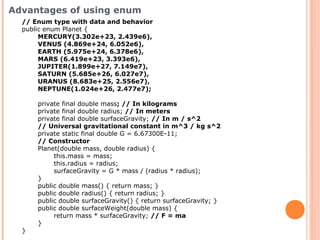
Advantages of using enum
// Enum type with data and behavior
public enum Planet {
MERCURY(3.302e+23, 2.439e6),
VENUS (4.869e+24, 6.052e6),
EARTH (5.975e+24, 6.378e6),
MARS (6.419e+23, 3.393e6),
JUPITER(1.899e+27, 7.149e7),
SATURN (5.685e+26, 6.027e7),
URANUS (8.683e+25, 2.556e7),
NEPTUNE(1.024e+26, 2.477e7);
private final double mass; // In kilograms
private final double radius; // In meters
private final double surfaceGravity; // In m / s^2
// Universal gravitational constant in m^3 / kg s^2
private static final double G = 6.67300E-11;
// Constructor
Planet(double mass, double radius) {
this.mass = mass;
this.radius = radius;
surfaceGravity = G * mass / (radius * radius);
}
public double mass() { return mass; }
public double radius() { return radius; }
public double surfaceGravity() { return surfaceGravity; }
public double surfaceWeight(double mass) {
return mass * surfaceGravity; // F = ma
}
}
public class WeightTable {
public static void main(String[] args) {
double earthWeight = Double.parseDouble(args[0]);
double mass = earthWeight / Planet.EARTH.surfaceGravity();
for (Planet p : Planet.values())
System.out.printf("Weight on %s is %f%n",
p, p.surfaceWeight(mass));
}
}
Client program that uses the above enum
Weight on MERCURY is 66.133672
Weight on VENUS is 158.383926
Weight on EARTH is 175.000000
Weight on MARS is 66.430699
Weight on JUPITER is 442.693902
Weight on SATURN is 186.464970
Weight on URANUS is 158.349709
Weight on NEPTUNE is 198.846116
Program output
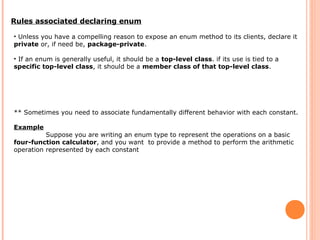
Rules associated declaring enum
• Unless you have a compelling reason to expose an enum method to its clients, declare it
private or, if need be, package-private.
• If an enum is generally useful, it should be a top-level class. if its use is tied to a
specific top-level class, it should be a member class of that top-level class.
** Sometimes you need to associate fundamentally different behavior with each constant.
Example
Suppose you are writing an enum type to represent the operations on a basic
four-function calculator, and you want to provide a method to perform the arithmetic
operation represented by each constant
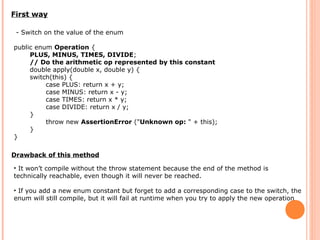
First way
- Switch on the value of the enum
public enum Operation {
PLUS, MINUS, TIMES, DIVIDE;
// Do the arithmetic op represented by this constant
double apply(double x, double y) {
switch(this) {
case PLUS: return x + y;
case MINUS: return x - y;
case TIMES: return x * y;
case DIVIDE: return x / y;
}
throw new AssertionError ("Unknown op: " + this);
}
}
Drawback of this method
• It won’t compile without the throw statement because the end of the method is
technically reachable, even though it will never be reached.
• If you add a new enum constant but forget to add a corresponding case to the switch, the
enum will still compile, but it will fail at runtime when you try to apply the new operation
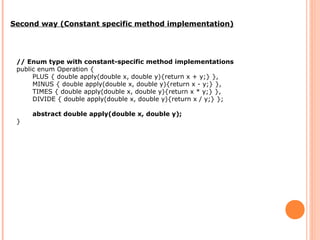
Second way (Constant specific method implementation)
// Enum type with constant-specific method implementations
public enum Operation {
PLUS { double apply(double x, double y){return x + y;} },
MINUS { double apply(double x, double y){return x - y;} },
TIMES { double apply(double x, double y){return x * y;} },
DIVIDE { double apply(double x, double y){return x / y;} };
abstract double apply(double x, double y);
}
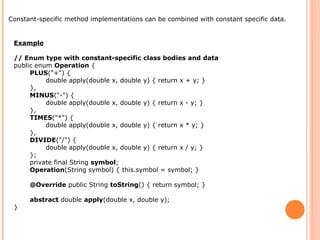
Example
// Enum type with constant-specific class bodies and data
public enum Operation {
PLUS("+") {
double apply(double x, double y) { return x + y; }
},
MINUS("-") {
double apply(double x, double y) { return x - y; }
},
TIMES("*") {
double apply(double x, double y) { return x * y; }
},
DIVIDE("/") {
double apply(double x, double y) { return x / y; }
};
private final String symbol;
Operation(String symbol) { this.symbol = symbol; }
@Override public String toString() { return symbol; }
abstract double apply(double x, double y);
}
Constant-specific method implementations can be combined with constant specific data.
In some cases, overriding toString in an enum is very useful
Demonstration Program
public static void main(String[] args) {
double x = Double.parseDouble(args[0]);
double y = Double.parseDouble(args[1]);
for (Operation op : Operation.values()) {
System.out.printf("%f %s %f = %f%n“, x, op, y, op.apply(x, y));
}
}
Output
2.000000 + 4.000000 = 6.000000
2.000000 - 4.000000 = -2.000000
2.000000 * 4.000000 = 8.000000
2.000000 / 4.000000 = 0.500000
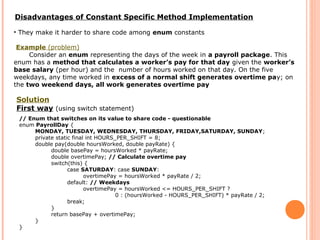
Disadvantages of Constant Specific Method Implementation
• They make it harder to share code among enum constants
Example (problem)
Consider an enum representing the days of the week in a payroll package. This
enum has a method that calculates a worker’s pay for that day given the worker’s
base salary (per hour) and the number of hours worked on that day. On the five
weekdays, any time worked in excess of a normal shift generates overtime pay; on
the two weekend days, all work generates overtime pay
Solution
First way (using switch statement)
// Enum that switches on its value to share code - questionable
enum PayrollDay {
MONDAY, TUESDAY, WEDNESDAY, THURSDAY, FRIDAY,SATURDAY, SUNDAY;
private static final int HOURS_PER_SHIFT = 8;
double pay(double hoursWorked, double payRate) {
double basePay = hoursWorked * payRate;
double overtimePay; // Calculate overtime pay
switch(this) {
case SATURDAY: case SUNDAY:
overtimePay = hoursWorked * payRate / 2;
default: // Weekdays
overtimePay = hoursWorked <= HOURS_PER_SHIFT ?
0 : (hoursWorked - HOURS_PER_SHIFT) * payRate / 2;
break;
}
return basePay + overtimePay;
}
}
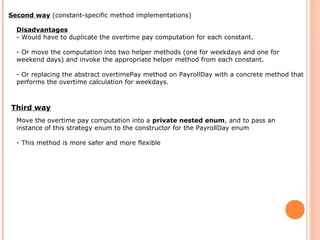
Second way (constant-specific method implementations)
Disadvantages
- Would have to duplicate the overtime pay computation for each constant.
- Or move the computation into two helper methods (one for weekdays and one for
weekend days) and invoke the appropriate helper method from each constant.
- Or replacing the abstract overtimePay method on PayrollDay with a concrete method that
performs the overtime calculation for weekdays.
Third way
Move the overtime pay computation into a private nested enum, and to pass an
instance of this strategy enum to the constructor for the PayrollDay enum
- This method is more safer and more flexible
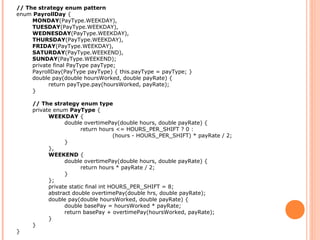
// The strategy enum pattern
enum PayrollDay {
MONDAY(PayType.WEEKDAY),
TUESDAY(PayType.WEEKDAY),
WEDNESDAY(PayType.WEEKDAY),
THURSDAY(PayType.WEEKDAY),
FRIDAY(PayType.WEEKDAY),
SATURDAY(PayType.WEEKEND),
SUNDAY(PayType.WEEKEND);
private final PayType payType;
PayrollDay(PayType payType) { this.payType = payType; }
double pay(double hoursWorked, double payRate) {
return payType.pay(hoursWorked, payRate);
}
// The strategy enum type
private enum PayType {
WEEKDAY {
double overtimePay(double hours, double payRate) {
return hours <= HOURS_PER_SHIFT ? 0 :
(hours - HOURS_PER_SHIFT) * payRate / 2;
}
},
WEEKEND {
double overtimePay(double hours, double payRate) {
return hours * payRate / 2;
}
};
private static final int HOURS_PER_SHIFT = 8;
abstract double overtimePay(double hrs, double payRate);
double pay(double hoursWorked, double payRate) {
double basePay = hoursWorked * payRate;
return basePay + overtimePay(hoursWorked, payRate);
}
}
}
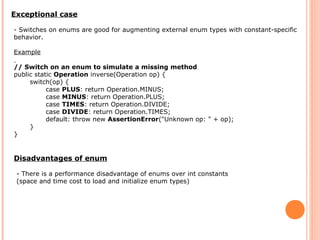
Exceptional case
- Switches on enums are good for augmenting external enum types with constant-specific
behavior.
Example
// Switch on an enum to simulate a missing method
public static Operation inverse(Operation op) {
switch(op) {
case PLUS: return Operation.MINUS;
case MINUS: return Operation.PLUS;
case TIMES: return Operation.DIVIDE;
case DIVIDE: return Operation.TIMES;
default: throw new AssertionError("Unknown op: " + op);
}
}
- There is a performance disadvantage of enums over int constants
(space and time cost to load and initialize enum types)
Disadvantages of enum

Effective Java - Enum and Annotations

  • 1.
    EFFECTIVE JAVA Roshan Deniyage Axiohelix Co.Ltd, Japan 15/11/2010 Enums and Annotations Use enums instead of int constants
  • 2.
     In java1.5 language add new class called enum type  An enumerated type is a type whose legal value consists of fixed set of constants. As examples,  Planets in the solar system  Suits in the deck of playing card  Before enum types were added to the language the common pattern was group of named int constants // The int enum pattern  public static final int APPLE_FUJI = 0;  public static final int APPLE_PIPPIN = 1;  public static final int APPLE_GRANNY_SMITH = 2;  public static final int ORANGE_NAVEL = 0;  public static final int ORANGE_TEMPLE = 1;  public static final int ORANGE_BLOOD = 2; Use enums instead of int constants
  • 3.
    Use enums insteadof int constants Disadvantages of this technique  It provides nothing in the way of type safety and little in the way of convenience.  The compiler won’t complain if you pass an apple to a method that expects an orange.  Each apple constant is prefixed with APPLE_ and the name of each orange constant is prefixed with ORANGE_. This is because Java doesn’t provide namespaces for int enum groups.  Int enums are compile time constants, they are compiled into the clients that use them, if the int associated with an enum constant is changed, its client must be recompiled, If not there behavior will be undefined.  There is no easy way to translate int enum constant into printable strings.  There is no reliable way to iterate over all the enum constant in a group.
  • 4.
    Java 1.5’s newfeature Example enum declaration public enum Apple {FUJI, PIPPIN, GRANNY_SMITH} public enum Orange {NAVEL, TEMPLE, BLOOD} • Java’s enum types classes that exports one instance for each enumeration constant via a public static final field. • Enum types are effectively final and have no accessible constructors. (They are a generalization of singletons) • Enums are by their nature immutable, so all fields should be final (if there are).
  • 5.
    Advantages of usingenum • Enum provides compile time type safety. • Enum types with identically named constants coexist peacefully. (because each type has its own namespace) • Can add or reorder constants in an enum type without recompiling its clients . (because the fields that export the constants provide a layer of insulation between an enum type and its clients) • Can translate enums into printable strings. (by calling their toString method) • Enum types let you add arbitrary methods and fields and implement arbitrary interfaces. (look at the example below)
  • 6.
    Advantages of usingenum // Enum type with data and behavior public enum Planet { MERCURY(3.302e+23, 2.439e6), VENUS (4.869e+24, 6.052e6), EARTH (5.975e+24, 6.378e6), MARS (6.419e+23, 3.393e6), JUPITER(1.899e+27, 7.149e7), SATURN (5.685e+26, 6.027e7), URANUS (8.683e+25, 2.556e7), NEPTUNE(1.024e+26, 2.477e7); private final double mass; // In kilograms private final double radius; // In meters private final double surfaceGravity; // In m / s^2 // Universal gravitational constant in m^3 / kg s^2 private static final double G = 6.67300E-11; // Constructor Planet(double mass, double radius) { this.mass = mass; this.radius = radius; surfaceGravity = G * mass / (radius * radius); } public double mass() { return mass; } public double radius() { return radius; } public double surfaceGravity() { return surfaceGravity; } public double surfaceWeight(double mass) { return mass * surfaceGravity; // F = ma } }
  • 7.
    public class WeightTable{ public static void main(String[] args) { double earthWeight = Double.parseDouble(args[0]); double mass = earthWeight / Planet.EARTH.surfaceGravity(); for (Planet p : Planet.values()) System.out.printf("Weight on %s is %f%n", p, p.surfaceWeight(mass)); } } Client program that uses the above enum Weight on MERCURY is 66.133672 Weight on VENUS is 158.383926 Weight on EARTH is 175.000000 Weight on MARS is 66.430699 Weight on JUPITER is 442.693902 Weight on SATURN is 186.464970 Weight on URANUS is 158.349709 Weight on NEPTUNE is 198.846116 Program output
  • 8.
    Rules associated declaringenum • Unless you have a compelling reason to expose an enum method to its clients, declare it private or, if need be, package-private. • If an enum is generally useful, it should be a top-level class. if its use is tied to a specific top-level class, it should be a member class of that top-level class. ** Sometimes you need to associate fundamentally different behavior with each constant. Example Suppose you are writing an enum type to represent the operations on a basic four-function calculator, and you want to provide a method to perform the arithmetic operation represented by each constant
  • 9.
    First way - Switchon the value of the enum public enum Operation { PLUS, MINUS, TIMES, DIVIDE; // Do the arithmetic op represented by this constant double apply(double x, double y) { switch(this) { case PLUS: return x + y; case MINUS: return x - y; case TIMES: return x * y; case DIVIDE: return x / y; } throw new AssertionError ("Unknown op: " + this); } } Drawback of this method • It won’t compile without the throw statement because the end of the method is technically reachable, even though it will never be reached. • If you add a new enum constant but forget to add a corresponding case to the switch, the enum will still compile, but it will fail at runtime when you try to apply the new operation
  • 10.
    Second way (Constantspecific method implementation) // Enum type with constant-specific method implementations public enum Operation { PLUS { double apply(double x, double y){return x + y;} }, MINUS { double apply(double x, double y){return x - y;} }, TIMES { double apply(double x, double y){return x * y;} }, DIVIDE { double apply(double x, double y){return x / y;} }; abstract double apply(double x, double y); }
  • 11.
    Example // Enum typewith constant-specific class bodies and data public enum Operation { PLUS("+") { double apply(double x, double y) { return x + y; } }, MINUS("-") { double apply(double x, double y) { return x - y; } }, TIMES("*") { double apply(double x, double y) { return x * y; } }, DIVIDE("/") { double apply(double x, double y) { return x / y; } }; private final String symbol; Operation(String symbol) { this.symbol = symbol; } @Override public String toString() { return symbol; } abstract double apply(double x, double y); } Constant-specific method implementations can be combined with constant specific data.
  • 12.
    In some cases,overriding toString in an enum is very useful Demonstration Program public static void main(String[] args) { double x = Double.parseDouble(args[0]); double y = Double.parseDouble(args[1]); for (Operation op : Operation.values()) { System.out.printf("%f %s %f = %f%n“, x, op, y, op.apply(x, y)); } } Output 2.000000 + 4.000000 = 6.000000 2.000000 - 4.000000 = -2.000000 2.000000 * 4.000000 = 8.000000 2.000000 / 4.000000 = 0.500000
  • 13.
    Disadvantages of ConstantSpecific Method Implementation • They make it harder to share code among enum constants Example (problem) Consider an enum representing the days of the week in a payroll package. This enum has a method that calculates a worker’s pay for that day given the worker’s base salary (per hour) and the number of hours worked on that day. On the five weekdays, any time worked in excess of a normal shift generates overtime pay; on the two weekend days, all work generates overtime pay Solution First way (using switch statement) // Enum that switches on its value to share code - questionable enum PayrollDay { MONDAY, TUESDAY, WEDNESDAY, THURSDAY, FRIDAY,SATURDAY, SUNDAY; private static final int HOURS_PER_SHIFT = 8; double pay(double hoursWorked, double payRate) { double basePay = hoursWorked * payRate; double overtimePay; // Calculate overtime pay switch(this) { case SATURDAY: case SUNDAY: overtimePay = hoursWorked * payRate / 2; default: // Weekdays overtimePay = hoursWorked <= HOURS_PER_SHIFT ? 0 : (hoursWorked - HOURS_PER_SHIFT) * payRate / 2; break; } return basePay + overtimePay; } }
  • 14.
    Second way (constant-specificmethod implementations) Disadvantages - Would have to duplicate the overtime pay computation for each constant. - Or move the computation into two helper methods (one for weekdays and one for weekend days) and invoke the appropriate helper method from each constant. - Or replacing the abstract overtimePay method on PayrollDay with a concrete method that performs the overtime calculation for weekdays. Third way Move the overtime pay computation into a private nested enum, and to pass an instance of this strategy enum to the constructor for the PayrollDay enum - This method is more safer and more flexible
  • 15.
    // The strategyenum pattern enum PayrollDay { MONDAY(PayType.WEEKDAY), TUESDAY(PayType.WEEKDAY), WEDNESDAY(PayType.WEEKDAY), THURSDAY(PayType.WEEKDAY), FRIDAY(PayType.WEEKDAY), SATURDAY(PayType.WEEKEND), SUNDAY(PayType.WEEKEND); private final PayType payType; PayrollDay(PayType payType) { this.payType = payType; } double pay(double hoursWorked, double payRate) { return payType.pay(hoursWorked, payRate); } // The strategy enum type private enum PayType { WEEKDAY { double overtimePay(double hours, double payRate) { return hours <= HOURS_PER_SHIFT ? 0 : (hours - HOURS_PER_SHIFT) * payRate / 2; } }, WEEKEND { double overtimePay(double hours, double payRate) { return hours * payRate / 2; } }; private static final int HOURS_PER_SHIFT = 8; abstract double overtimePay(double hrs, double payRate); double pay(double hoursWorked, double payRate) { double basePay = hoursWorked * payRate; return basePay + overtimePay(hoursWorked, payRate); } } }
  • 16.
    Exceptional case - Switcheson enums are good for augmenting external enum types with constant-specific behavior. Example // Switch on an enum to simulate a missing method public static Operation inverse(Operation op) { switch(op) { case PLUS: return Operation.MINUS; case MINUS: return Operation.PLUS; case TIMES: return Operation.DIVIDE; case DIVIDE: return Operation.TIMES; default: throw new AssertionError("Unknown op: " + op); } } - There is a performance disadvantage of enums over int constants (space and time cost to load and initialize enum types) Disadvantages of enum