Electrical Machines-II
6th Semester, EE and EEE
By
Dr. Binod Kumar Sahu
Associate Professor, Electrical Engg.
Siksha ‘O’ Anusandhan, Deemed to be University,
Bhubaneswar, Odisha, India
Lecture-30
2
Learning Outcomes: - (Previous Lecture_29)
 To understand the basics of Synchronous Motor.
 To understand the working principle of Synchronous Motor.
 To know the various methods of starting a Synchronous Motor.
3
Learning Outcomes: - (Today’s Lecture_30)
 To know the advantages and disadvantages Synchronous Motor.
 To understand the no-load and on-load operation of Synchronous Motor.
 To Analyse the voltage equation of a cylindrical pole Synchronous Motor
from its equivalent circuit.
 To solve numerical on voltage equation and calculation of load angle for
cylindrical pole Synchronous Motor .
4
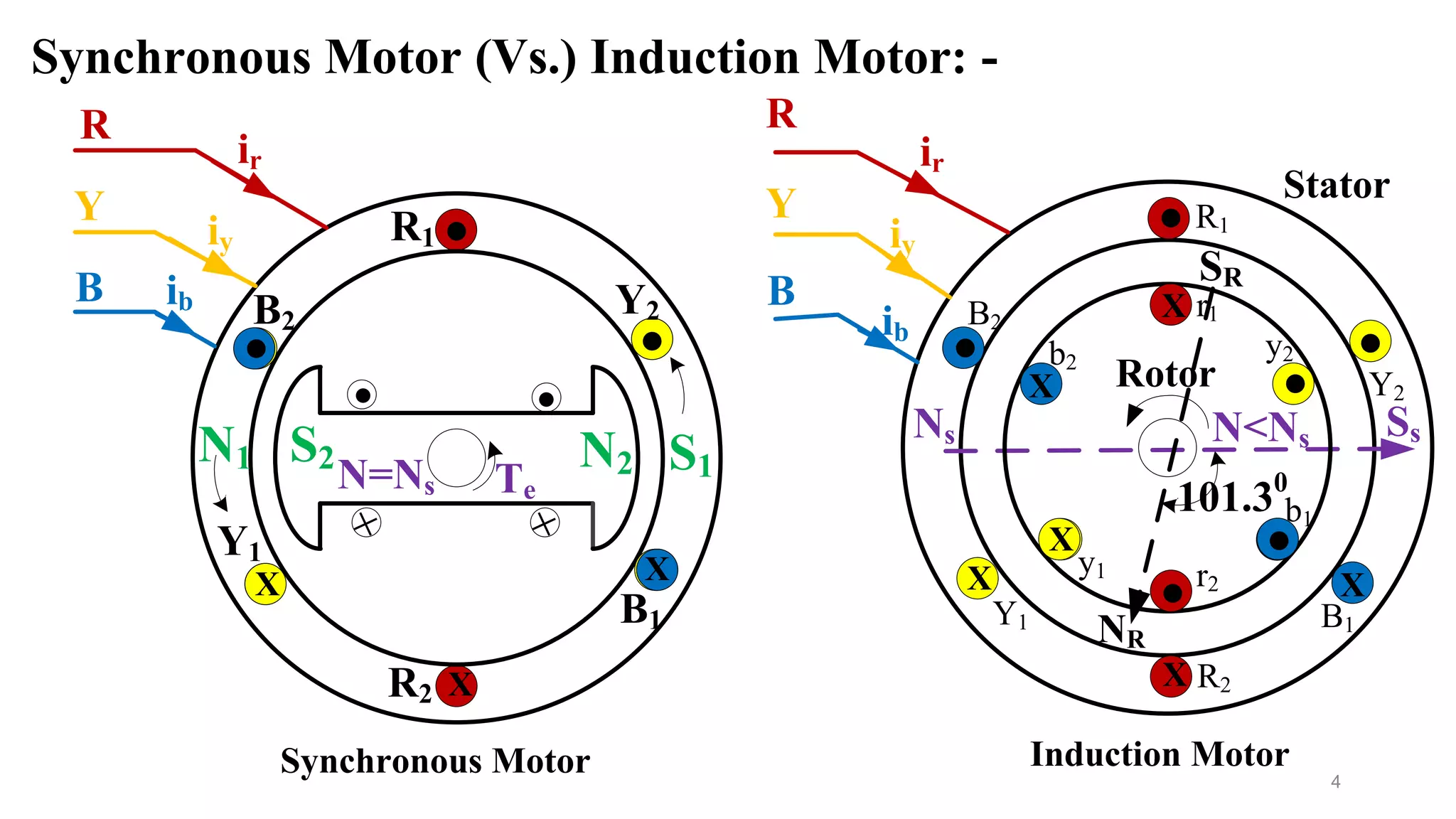
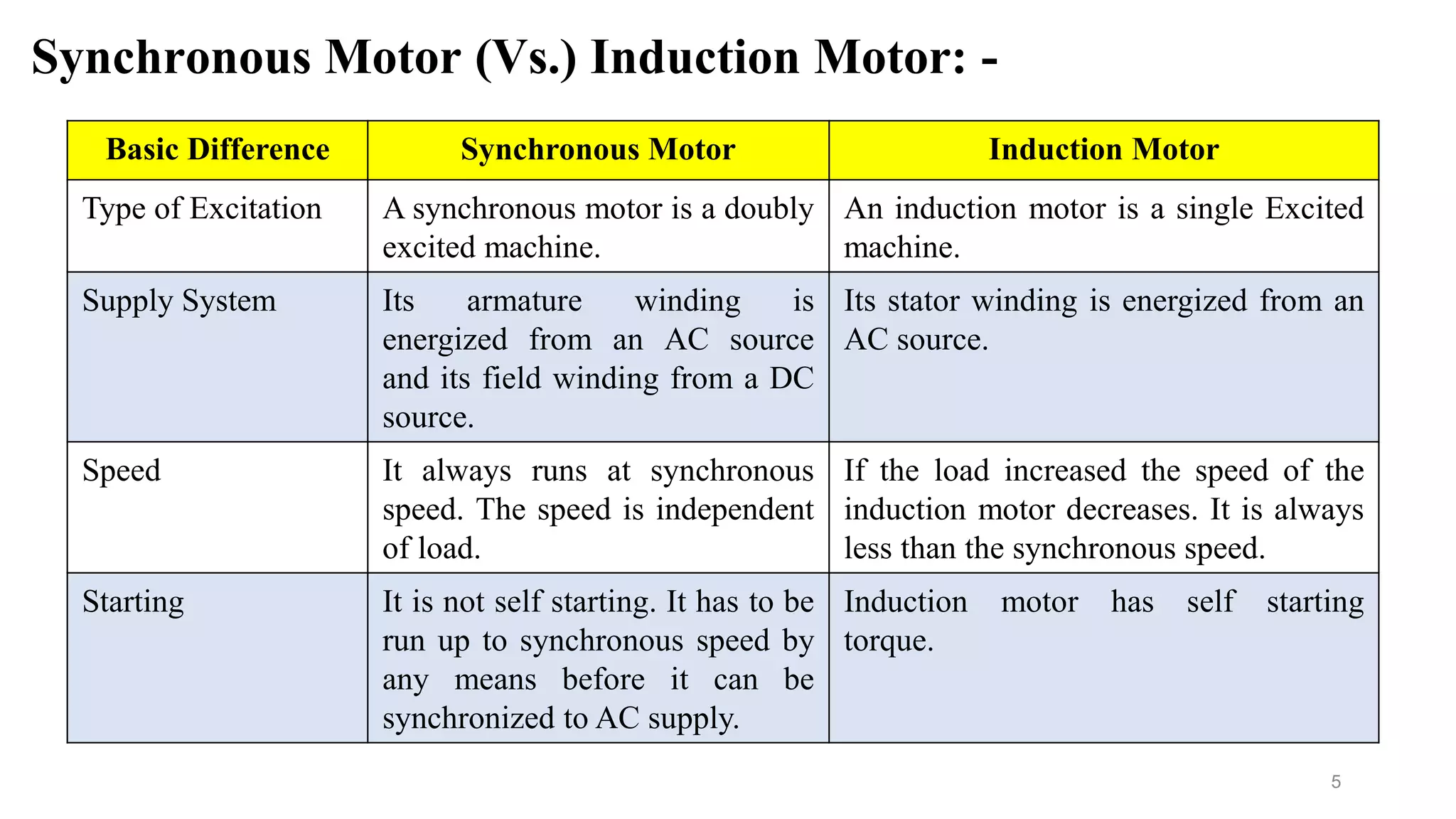
Synchronous Motor (Vs.) Induction Motor: -
Synchronous Motor Induction Motor
X
.
X
.
XXX
...
 
 
X
R1
Y2B2
Y1
B1
R2
R
Y
B
ir
iy
ib
Te
N1 S2 S1N2N=Ns
X
.
.
X
.
X
Ns Ss
R1
R2
B2
Y1 B1
Y2
Stator
Rotor
r1
r2
y1
y2
b1
b2
NR
SR
.
X
101.30
.
X .
X
B
ir
iy
ib
R
Y
N<Ns
5
Synchronous Motor (Vs.) Induction Motor: -
Basic Difference Synchronous Motor Induction Motor
Type of Excitation A synchronous motor is a doubly
excited machine.
An induction motor is a single Excited
machine.
Supply System Its armature winding is
energized from an AC source
and its field winding from a DC
source.
Its stator winding is energized from an
AC source.
Speed It always runs at synchronous
speed. The speed is independent
of load.
If the load increased the speed of the
induction motor decreases. It is always
less than the synchronous speed.
Starting It is not self starting. It has to be
run up to synchronous speed by
any means before it can be
synchronized to AC supply.
Induction motor has self starting
torque.
6
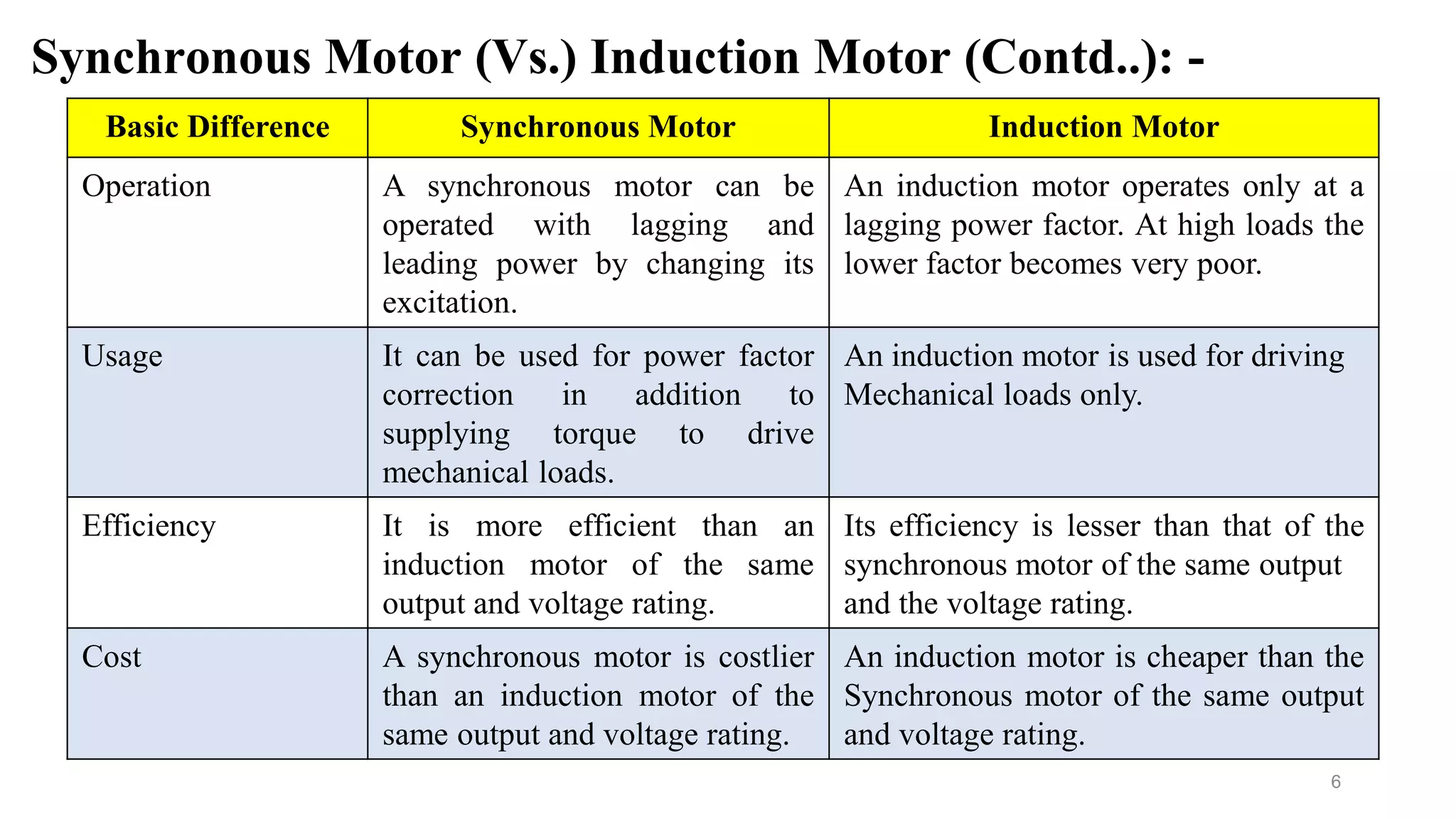
Basic Difference Synchronous Motor Induction Motor
Operation A synchronous motor can be
operated with lagging and
leading power by changing its
excitation.
An induction motor operates only at a
lagging power factor. At high loads the
lower factor becomes very poor.
Usage It can be used for power factor
correction in addition to
supplying torque to drive
mechanical loads.
An induction motor is used for driving
Mechanical loads only.
Efficiency It is more efficient than an
induction motor of the same
output and voltage rating.
Its efficiency is lesser than that of the
synchronous motor of the same output
and the voltage rating.
Cost A synchronous motor is costlier
than an induction motor of the
same output and voltage rating.
An induction motor is cheaper than the
Synchronous motor of the same output
and voltage rating.
Synchronous Motor (Vs.) Induction Motor (Contd..): -
7
Note: -
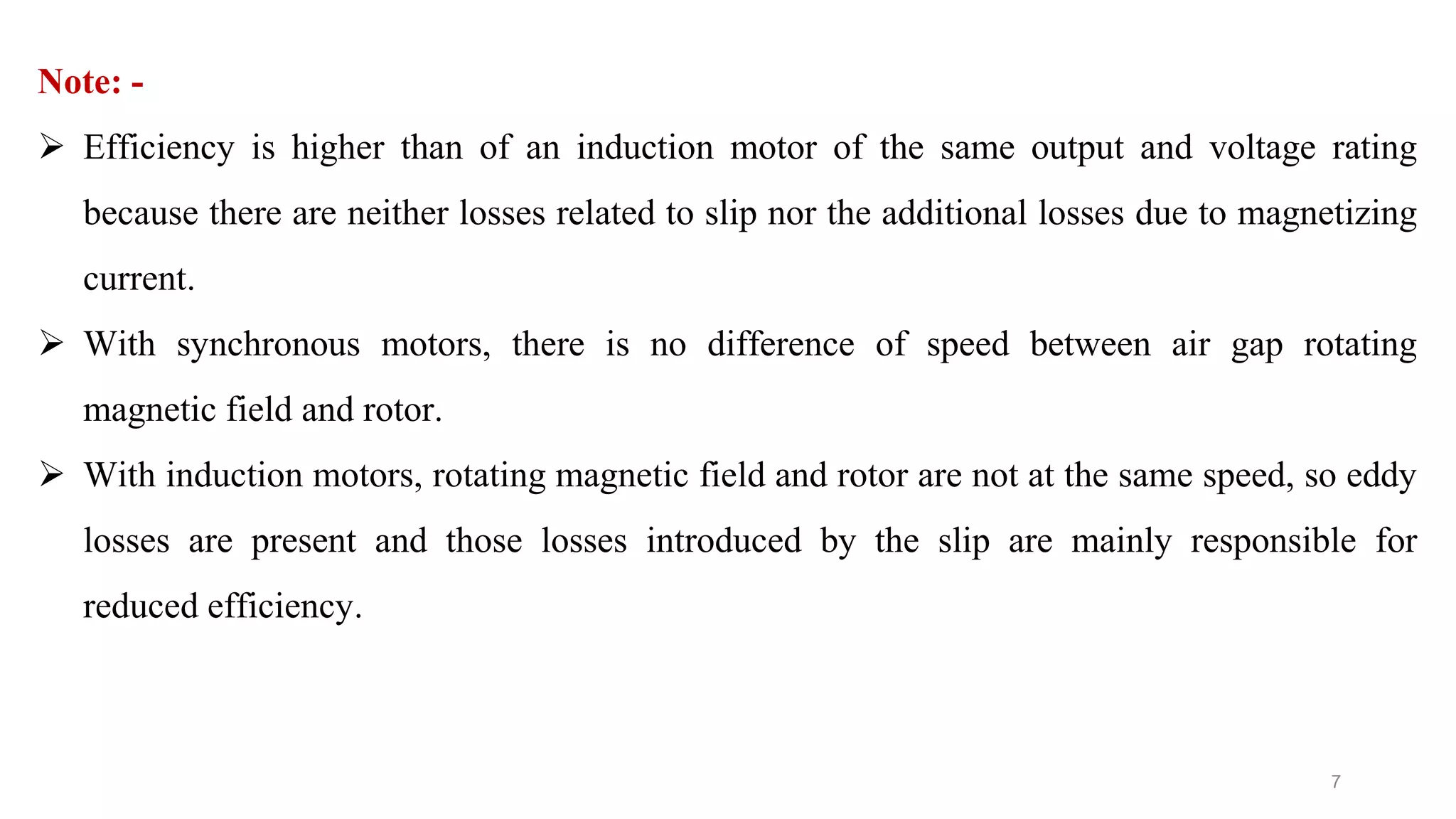
 Efficiency is higher than of an induction motor of the same output and voltage rating
because there are neither losses related to slip nor the additional losses due to magnetizing
current.
 With synchronous motors, there is no difference of speed between air gap rotating
magnetic field and rotor.
 With induction motors, rotating magnetic field and rotor are not at the same speed, so eddy
losses are present and those losses introduced by the slip are mainly responsible for
reduced efficiency.
8
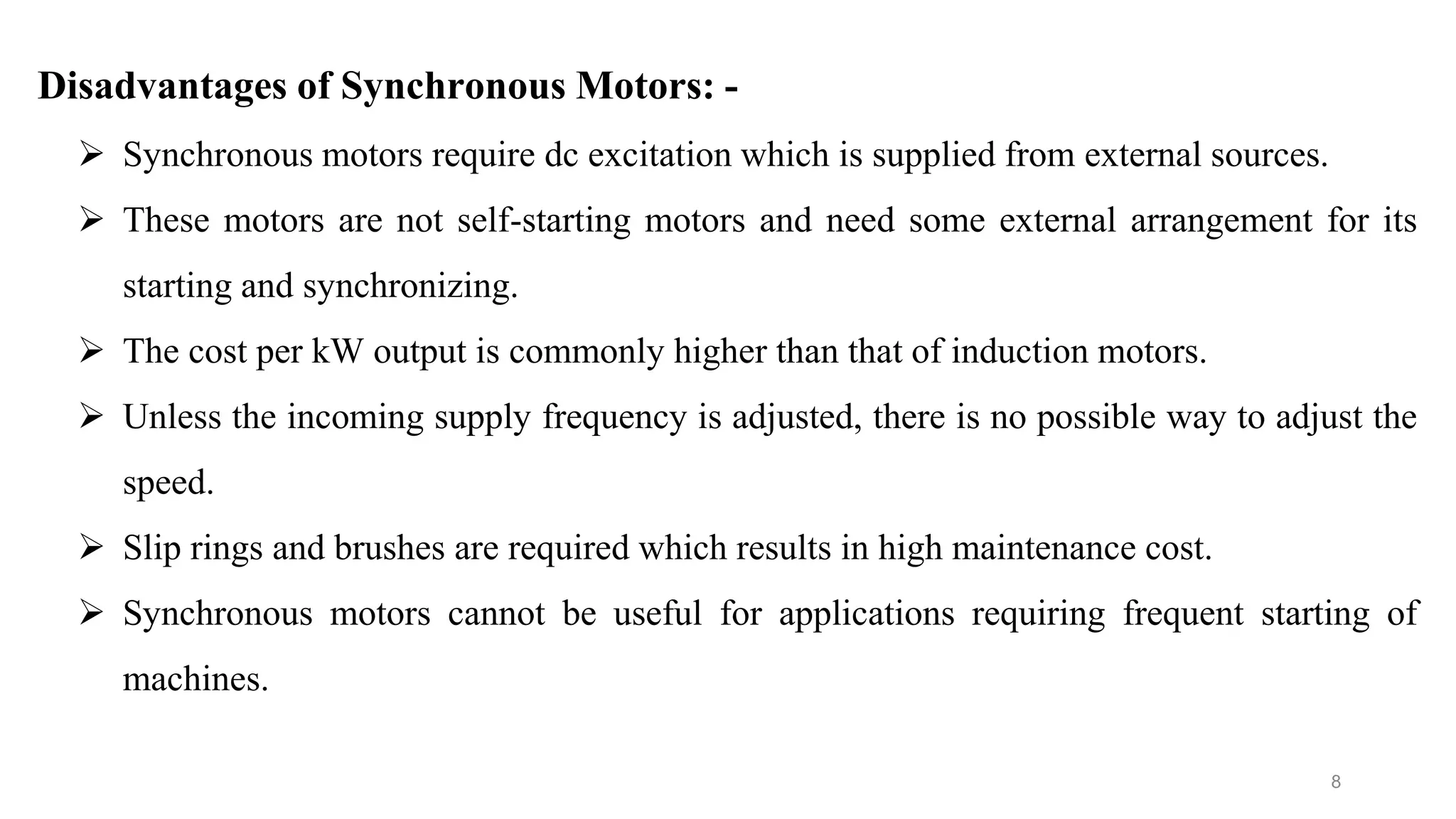
Disadvantages of Synchronous Motors: -
 Synchronous motors require dc excitation which is supplied from external sources.
 These motors are not self-starting motors and need some external arrangement for its
starting and synchronizing.
 The cost per kW output is commonly higher than that of induction motors.
 Unless the incoming supply frequency is adjusted, there is no possible way to adjust the
speed.
 Slip rings and brushes are required which results in high maintenance cost.
 Synchronous motors cannot be useful for applications requiring frequent starting of
machines.
9
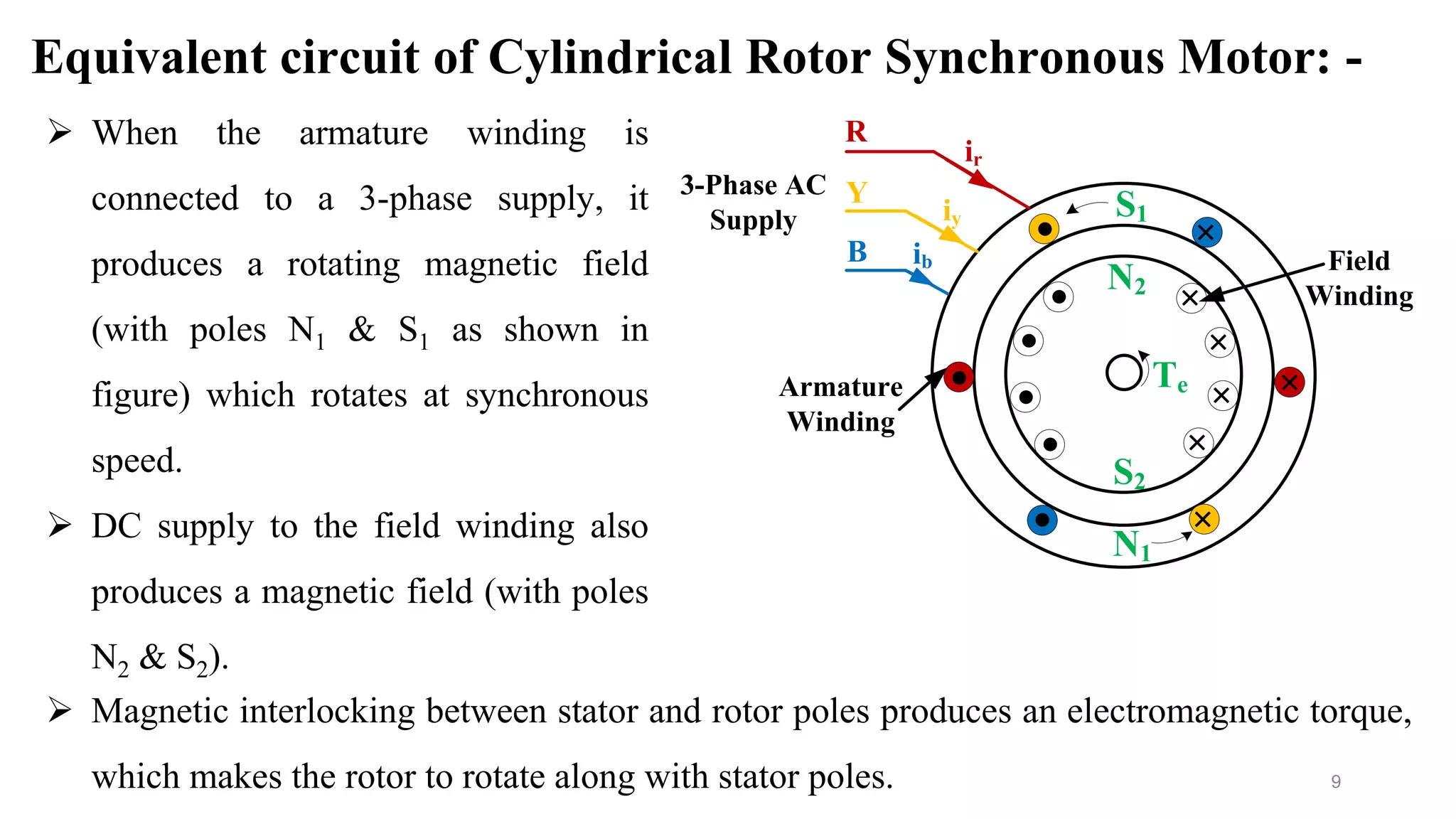
Equivalent circuit of Cylindrical Rotor Synchronous Motor: -
 When the armature winding is
connected to a 3-phase supply, it
produces a rotating magnetic field
(with poles N1 & S1 as shown in
figure) which rotates at synchronous
speed.
 DC supply to the field winding also
produces a magnetic field (with poles
N2 & S2).
 Magnetic interlocking between stator and rotor poles produces an electromagnetic torque,
which makes the rotor to rotate along with stator poles.
3-Phase AC
Supply
Y
B
ir
iy
ib
N1
S1
Armature
Winding
. 
.


.
S2
N2

.
.
.
.



Te
Field
Winding
R
10
 So, at steady state, stator poles and rotor poles are stationary with respect to each other.
So, the stator magnetic field can not induce an emf in the rotor/field winding.
 A part of the stator magnetic field takes part in armature reaction and the other part is the
leakage flux. So, the effect of armature magnetic field is accounted for by considering two
reactances namely, armature reaction reactance (xar) and leakage reactance (xl).
Synchronous reactance xs = xar + xl. In addition to ‘xs’ the armature winding has a
resistance of ‘ra’.
 But the synchronously rotating rotor magnetic field cuts the stator conductor (PNs times
per minute) there by, induces an emf in the stator winding (in the same manner as in an
alternator). This induced emf in the stator winding is called back emf (Eb) as it opposes
the stator voltage.
11
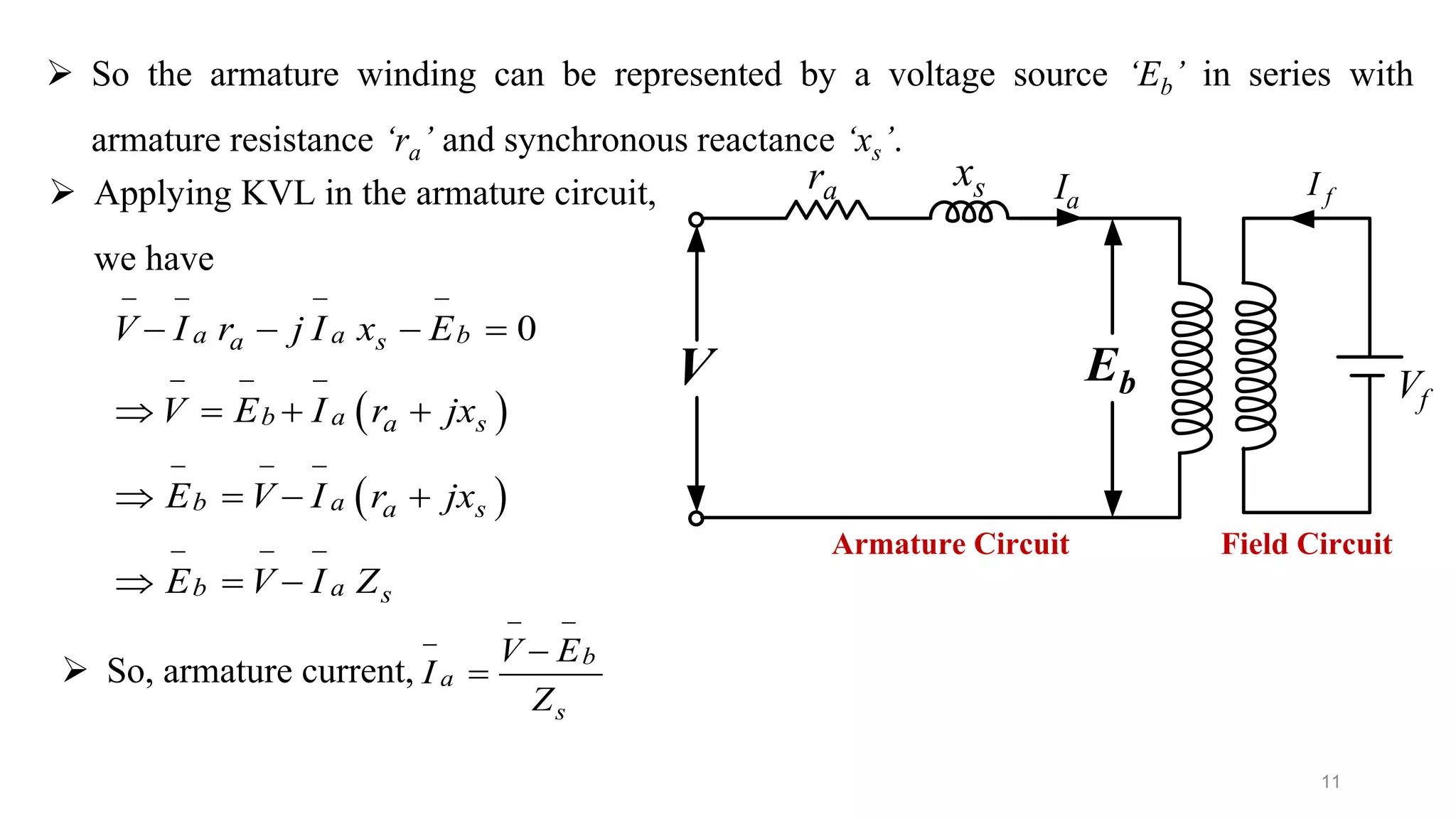
 So the armature winding can be represented by a voltage source ‘Eb’ in series with
armature resistance ‘ra’ and synchronous reactance ‘xs’.
fV
fI
Field CircuitArmature Circuit
bE
aIar sx
V
 
 
0a a ba s
b a a s
b a a s
b a s
V I r j I x E
V E I r jx
E V I r jx
E V I Z
   
  
  
  
   
   
   
  
 Applying KVL in the armature circuit,
we have
 So, armature current,
b
a
s
V E
I
Z
 
 

12
Synchronous Motor at no-load: -
 A DC motor running under no load condition, draws a small current (power) from the
supply to meet the no load losses.
 When the mechanical load on the DC motor increases, its speed decreases. The decrease in
speed reduces the back emf so that additional current is drawn by the motor from the source
to carry the increased load. So, increased mechanical load is met because of reduction in
speed.
 In induction motor, increase in mechanical load reduces the rotor speed. Reduction in rotor
speed increases the relative velocity between the rotating magnetic field and rotor
conductor.
 Increase in relative velocity increases the rotor induced emf and therefore the rotor current.
 Increase in rotor current, increases the current drawn by the motor from the 3-phase supply.
13
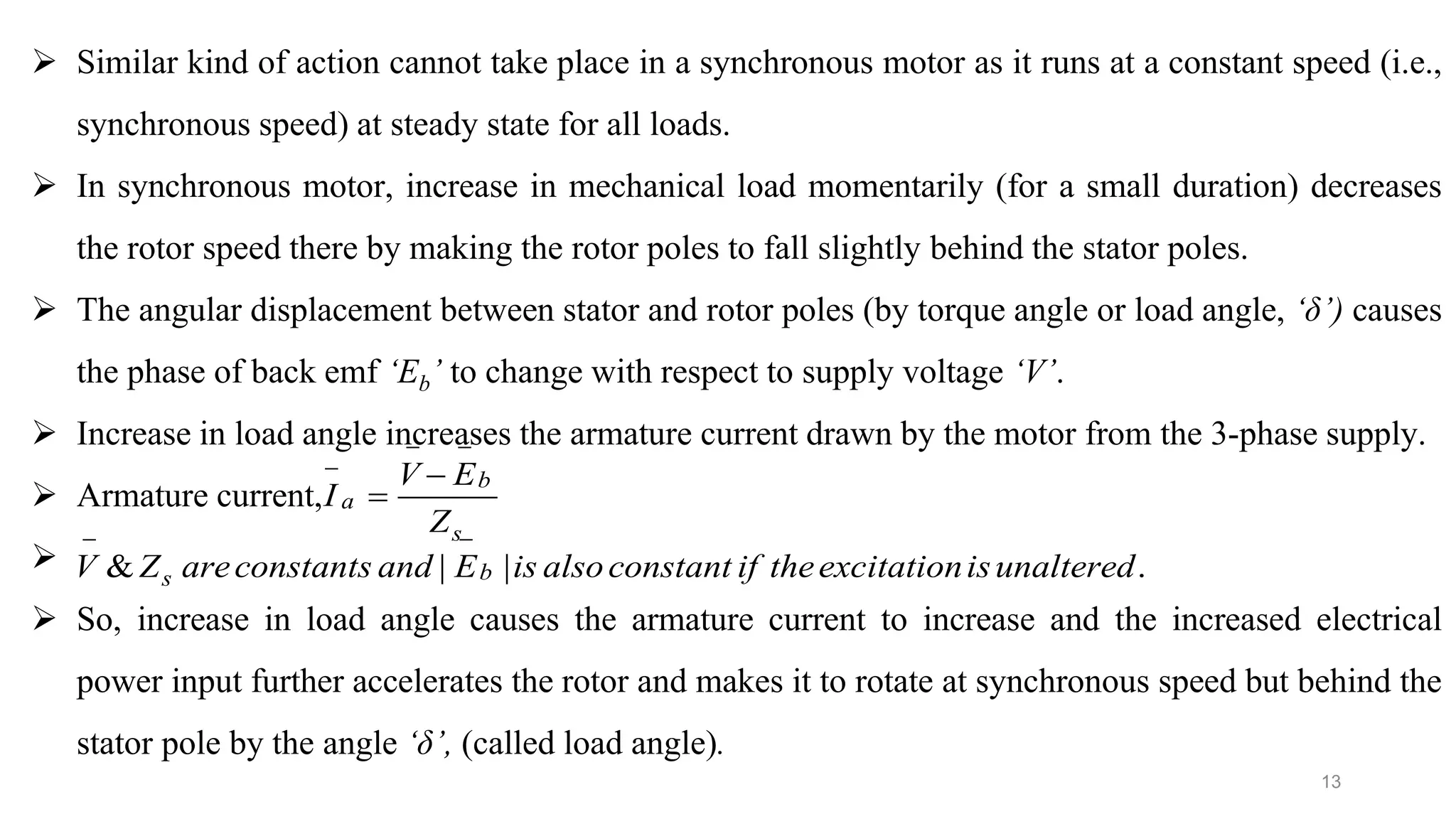
 Similar kind of action cannot take place in a synchronous motor as it runs at a constant speed (i.e.,
synchronous speed) at steady state for all loads.
 In synchronous motor, increase in mechanical load momentarily (for a small duration) decreases
the rotor speed there by making the rotor poles to fall slightly behind the stator poles.
 The angular displacement between stator and rotor poles (by torque angle or load angle, ‘δ’) causes
the phase of back emf ‘Eb’ to change with respect to supply voltage ‘V’.
 Increase in load angle increases the armature current drawn by the motor from the 3-phase supply.
 Armature current,

 So, increase in load angle causes the armature current to increase and the increased electrical
power input further accelerates the rotor and makes it to rotate at synchronous speed but behind the
stator pole by the angle ‘δ’, (called load angle).
b
a
s
V E
I
Z
 
 

& | | .bsV Z areconstants and E is alsoconstant if theexcitationisunaltered
 
14
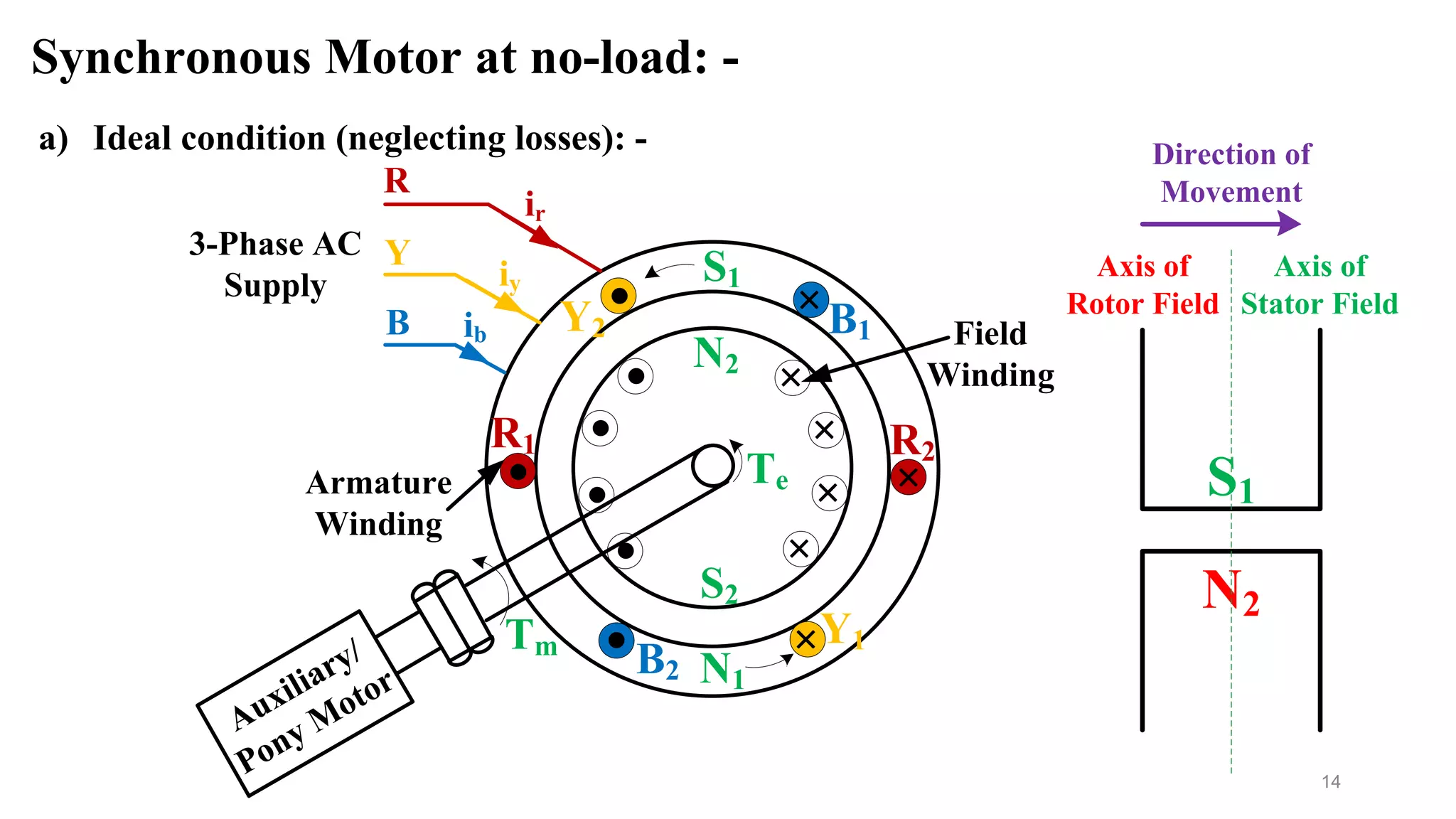
Synchronous Motor at no-load: -
a) Ideal condition (neglecting losses): -
3-Phase AC
Supply
Y
B
ir
iy
ib
N1
S1
Armature
Winding
. 
.


.
S2
N2

.
.
.
.



Te
Field
Winding
Auxiliary/
Pony Motor
Tm
R
R1 R2
Y1
Y2
B2
B1
S1
N2
Axis of
Rotor Field
Axis of
Stator Field
Direction of
Movement
15
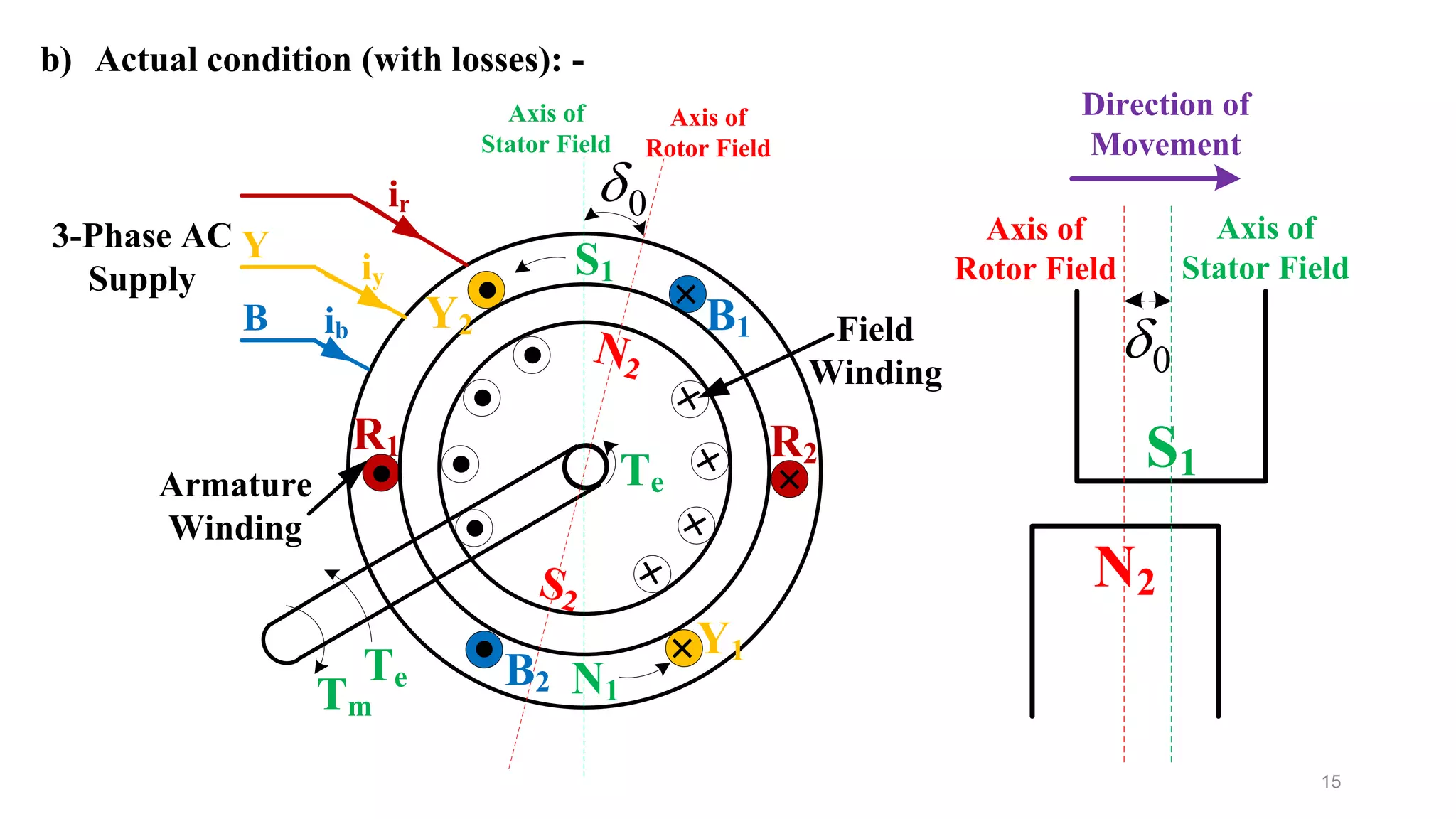
b) Actual condition (with losses): -
3-Phase AC
Supply
Y
B
ir
iy
ib
N1
S1
Armature
Winding
. 
.


.
Te
Field
Winding
Tm
S2
N2

.
.
.
.



0
Axis of
Stator Field
Axis of
Rotor Field
R1 R2
Y1
Y2
B2
B1
Te
S1
Axis of
Rotor Field
Axis of
Stator Field
N2
Direction of
Movement
0
16
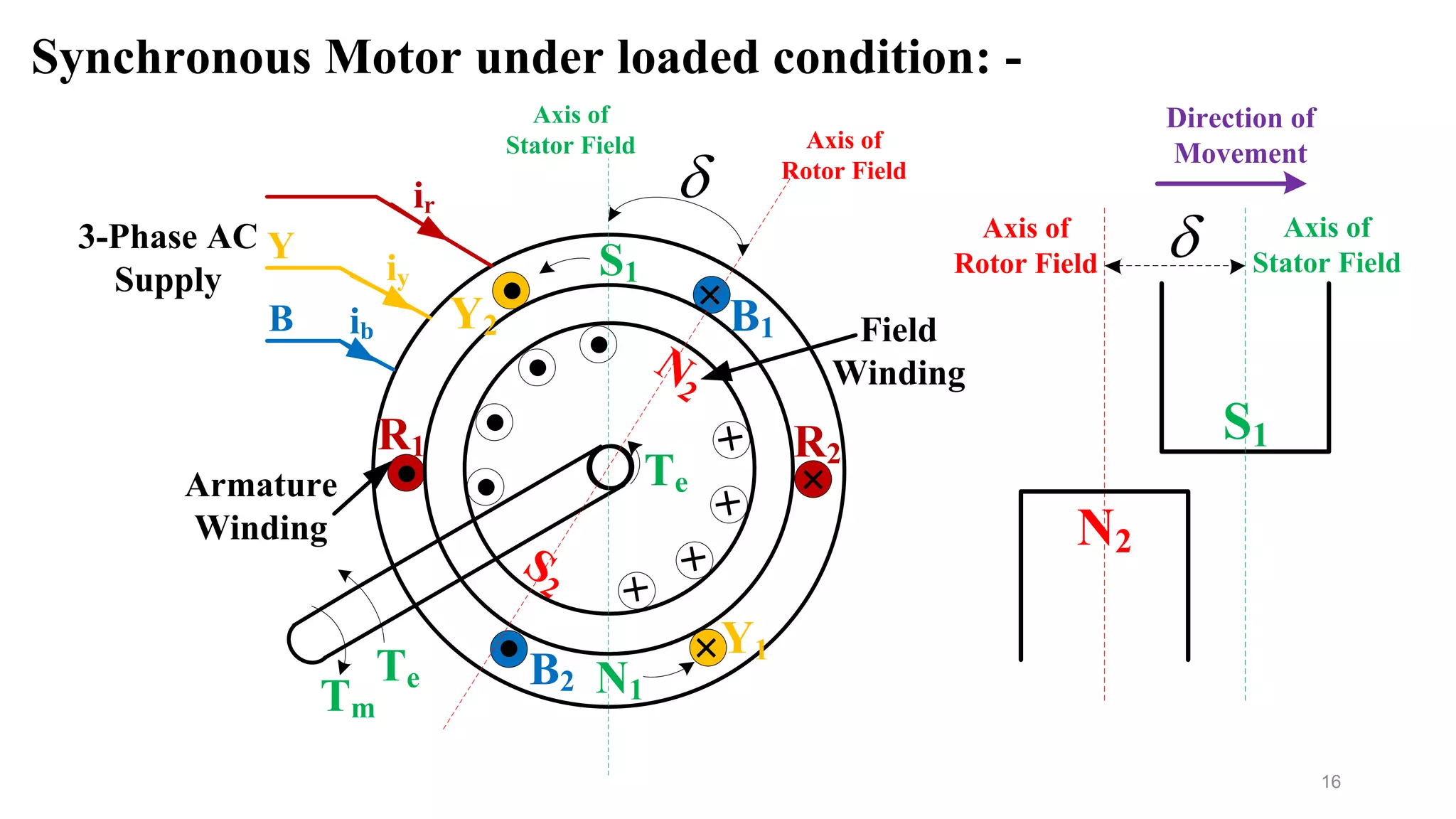
Synchronous Motor under loaded condition: -
3-Phase AC
Supply
Y
B
ir
iy
ib
N1
S1
Armature
Winding
. 
.


.
Te
Field
Winding
Tm
S2
N
2

.
.
.
. 



Axis of
Stator Field Axis of
Rotor Field
R1 R2
Y1
Y2
B2
B1
Te
S1
Axis of
Rotor Field
Axis of
Stator Field
N2
Direction of
Movement

17
Note: -
 For a lossless synchronous motor with
a. At no-load, load angle ‘δ = 0’, so neither the mechanical power is delivered by nor
the electrical power is received by the synchronous motor i.e. it is in floating
condition.
b. If the mechanical load on the shaft of the motor is increased, speed of the rotor
decreases momentarily and therefore the rotor poles lags behind the stator poles by
an angle called load angle ‘δ’.
c. So, the lagging of back emf behind the supply voltage, increases the armature
current, and therefore the electrical power input from the 3-phase supply.
| | | |bV E
 

18
Phasor Diagrams
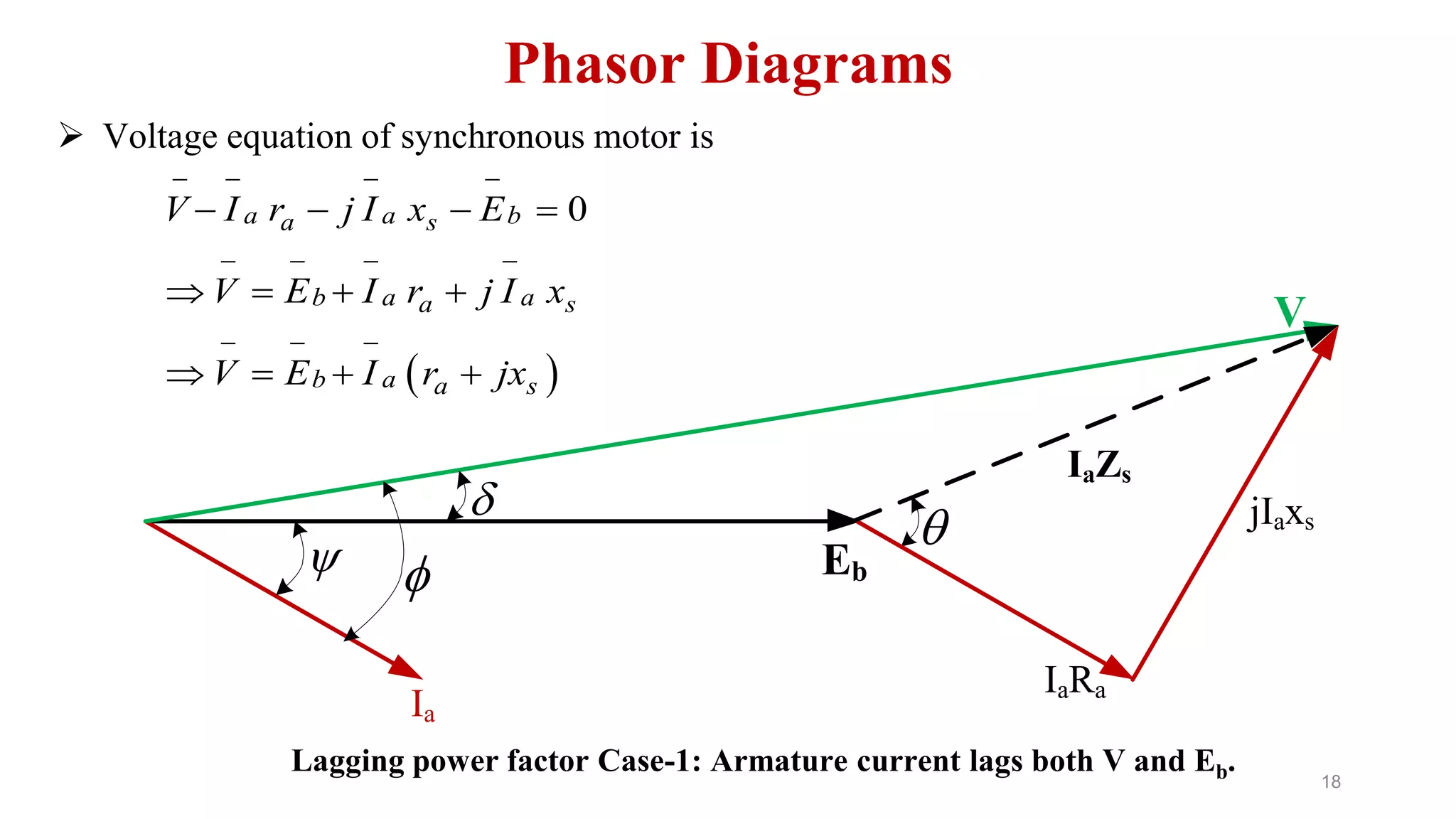
 Voltage equation of synchronous motor is
 
0a a ba s
b a aa s
b a a s
V I r j I x E
V E I r j I x
V E I r jx
   
   
  
   
   
   
Lagging power factor Case-1: Armature current lags both V and Eb.
Ia
IaRa
jIaxs

  Eb
V

IaZs
19
Ia
IaRa
jIaxs
 

Eb
V
IaZs

 b a a sV E I r jx
  
  
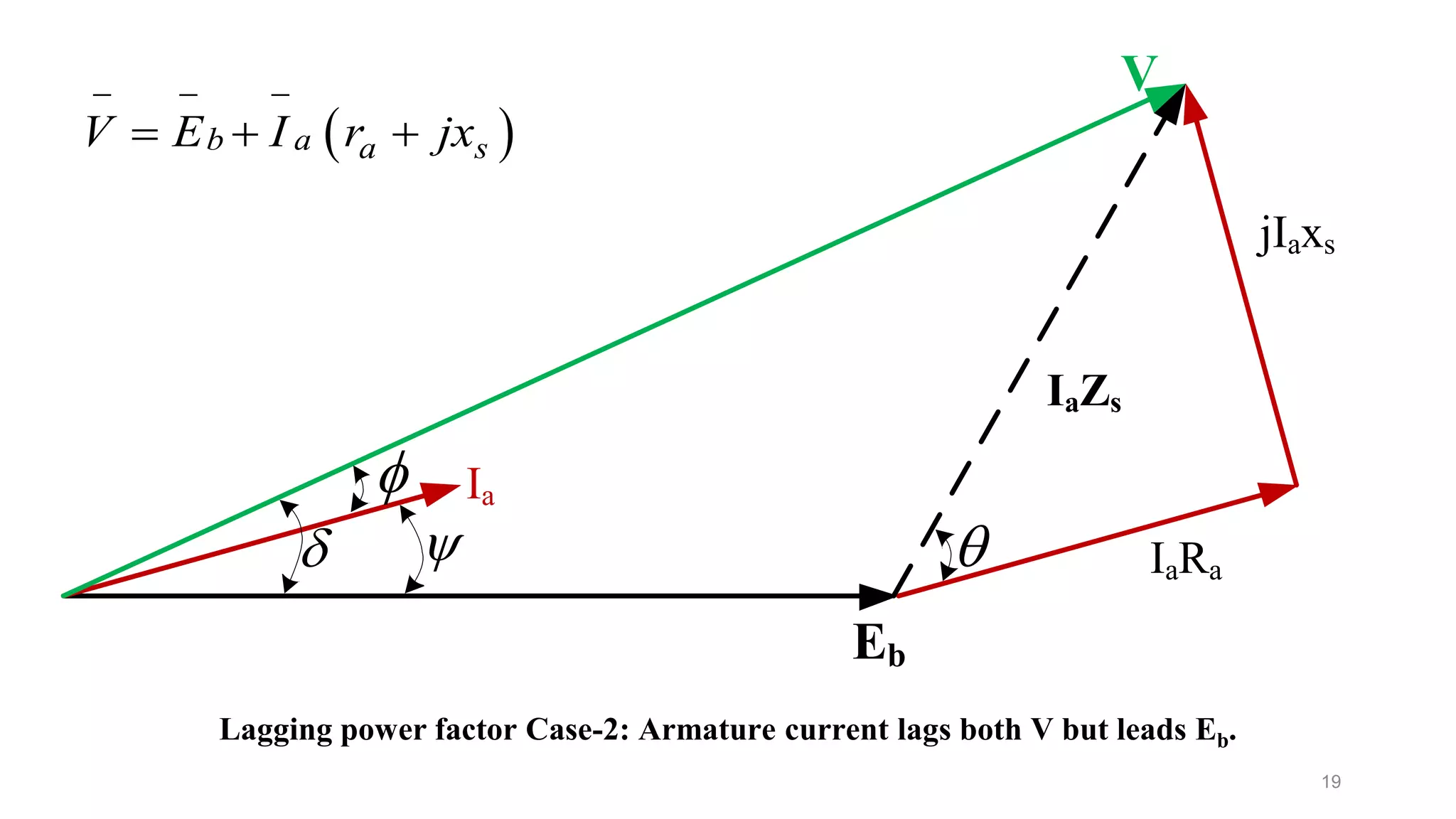
Lagging power factor Case-2: Armature current lags both V but leads Eb.
20
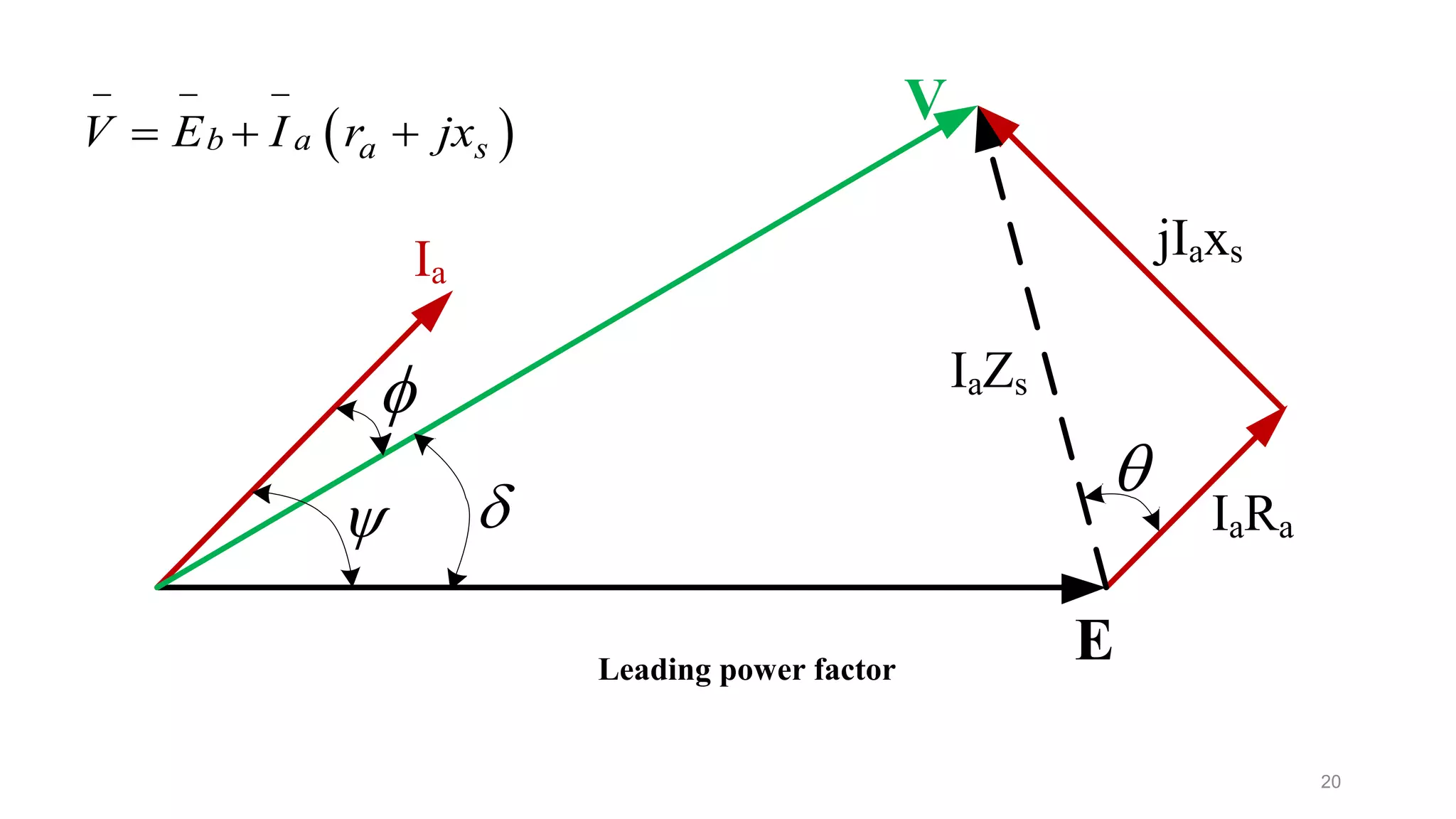
Leading power factor
V
Ia


E
IaRa

jIaxs
IaZs
 b a a sV E I r jx
  
  
21
Numerical
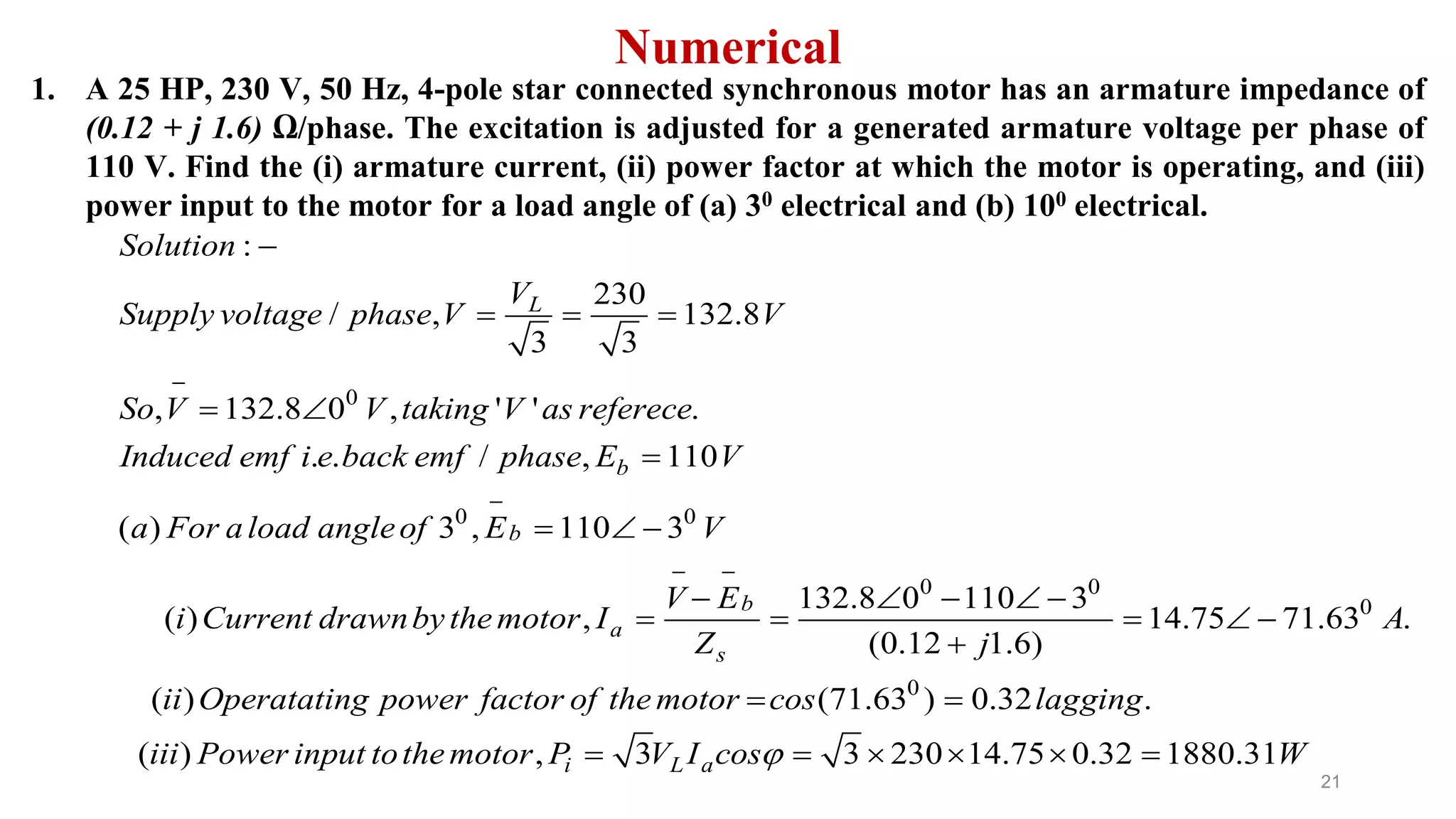
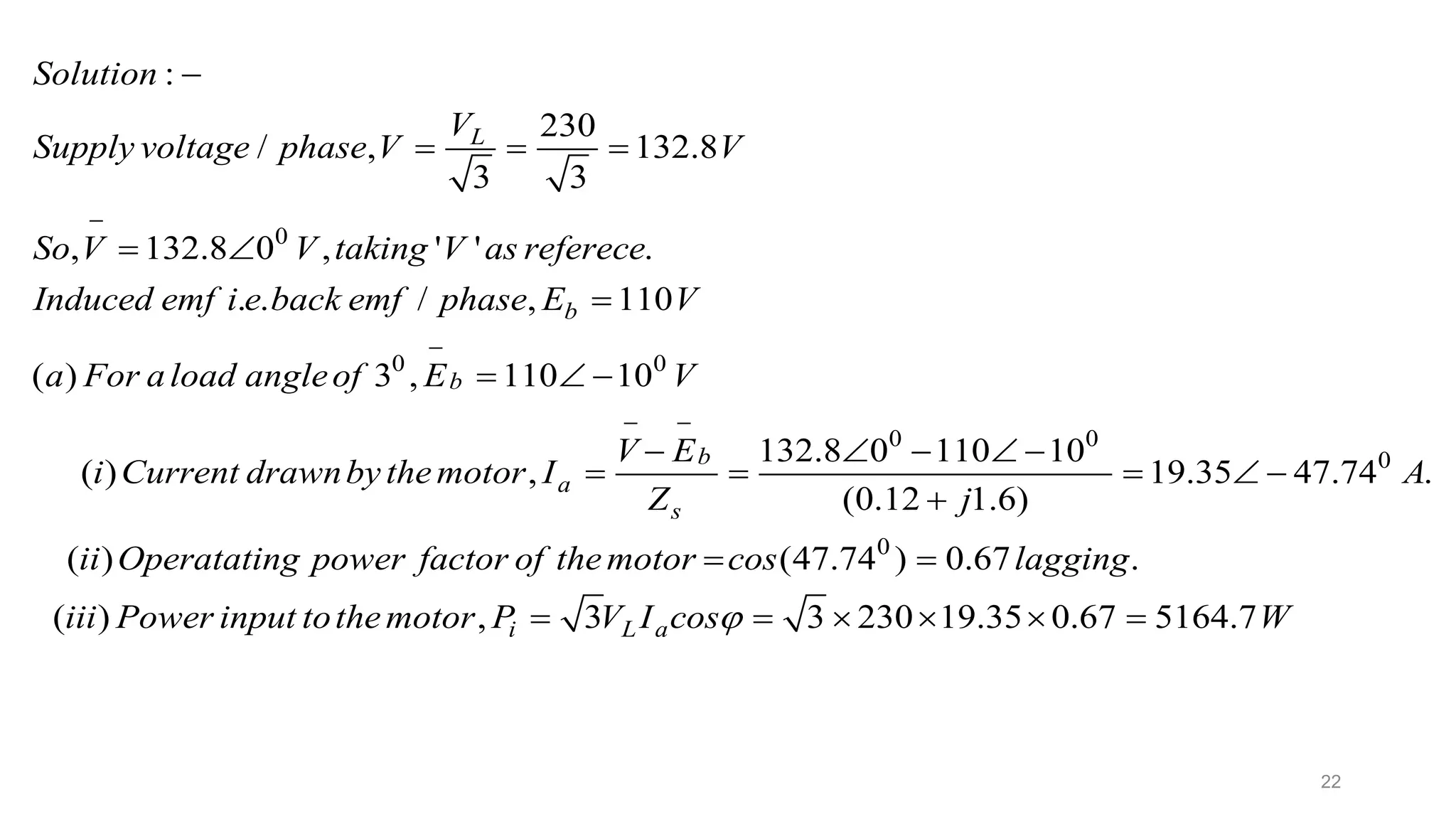
1. A 25 HP, 230 V, 50 Hz, 4-pole star connected synchronous motor has an armature impedance of
(0.12 + j 1.6) Ω/phase. The excitation is adjusted for a generated armature voltage per phase of
110 V. Find the (i) armature current, (ii) power factor at which the motor is operating, and (iii)
power input to the motor for a load angle of (a) 30 electrical and (b) 100 electrical.
0
0 0
0
:
230
/ , 132.8
3 3
, 132.8 0 , ' ' .
. . / , 110
( ) 3 , 110 3
132.8 0 11
( ) ,
L
b
b
b
a
s
Solution
V
Supply voltage phase V V
So V V taking V as referece
Induced emf i e back emf phase E V
a For aload angleof E V
V E
i Current drawnbythemotor I
Z


 

  
 

  
  
 
0
0
0
0 3
14.75 71.63 .
(0.12 1.6)
( ) (71.63 ) 0.32 .
( ) , 3 3 230 14.75 0.32 1880.31i L a
A
j
ii Operatating power factor of themotor cos lagging
iii Power input tothemotor P V I cos W
 
  

 
     
22
0
0 0
0
:
230
/ , 132.8
3 3
, 132.8 0 , ' ' .
. . / , 110
( ) 3 , 110 10
132.8 0 1
( ) ,
L
b
b
b
a
s
Solution
V
Supply voltage phase V V
So V V taking V as referece
Induced emf i e back emf phase E V
a For aload angleof E V
V E
i Current drawnbythemotor I
Z


 

  
 

  
  
 
0
0
0
10 10
19.35 47.74 .
(0.12 1.6)
( ) (47.74 ) 0.67 .
( ) , 3 3 230 19.35 0.67 5164.7i L a
A
j
ii Operatating power factor of themotor cos lagging
iii Power input tothemotor P V I cos W
 
  

 
     
23
Thank you

Eet3082 binod kumar sahu lecture_30

  • 1.
    Electrical Machines-II 6th Semester,EE and EEE By Dr. Binod Kumar Sahu Associate Professor, Electrical Engg. Siksha ‘O’ Anusandhan, Deemed to be University, Bhubaneswar, Odisha, India Lecture-30
  • 2.
    2 Learning Outcomes: -(Previous Lecture_29)  To understand the basics of Synchronous Motor.  To understand the working principle of Synchronous Motor.  To know the various methods of starting a Synchronous Motor.
  • 3.
    3 Learning Outcomes: -(Today’s Lecture_30)  To know the advantages and disadvantages Synchronous Motor.  To understand the no-load and on-load operation of Synchronous Motor.  To Analyse the voltage equation of a cylindrical pole Synchronous Motor from its equivalent circuit.  To solve numerical on voltage equation and calculation of load angle for cylindrical pole Synchronous Motor .
  • 4.
    4 Synchronous Motor (Vs.)Induction Motor: - Synchronous Motor Induction Motor X . X . XXX ...     X R1 Y2B2 Y1 B1 R2 R Y B ir iy ib Te N1 S2 S1N2N=Ns X . . X . X Ns Ss R1 R2 B2 Y1 B1 Y2 Stator Rotor r1 r2 y1 y2 b1 b2 NR SR . X 101.30 . X . X B ir iy ib R Y N<Ns
  • 5.
    5 Synchronous Motor (Vs.)Induction Motor: - Basic Difference Synchronous Motor Induction Motor Type of Excitation A synchronous motor is a doubly excited machine. An induction motor is a single Excited machine. Supply System Its armature winding is energized from an AC source and its field winding from a DC source. Its stator winding is energized from an AC source. Speed It always runs at synchronous speed. The speed is independent of load. If the load increased the speed of the induction motor decreases. It is always less than the synchronous speed. Starting It is not self starting. It has to be run up to synchronous speed by any means before it can be synchronized to AC supply. Induction motor has self starting torque.
  • 6.
    6 Basic Difference SynchronousMotor Induction Motor Operation A synchronous motor can be operated with lagging and leading power by changing its excitation. An induction motor operates only at a lagging power factor. At high loads the lower factor becomes very poor. Usage It can be used for power factor correction in addition to supplying torque to drive mechanical loads. An induction motor is used for driving Mechanical loads only. Efficiency It is more efficient than an induction motor of the same output and voltage rating. Its efficiency is lesser than that of the synchronous motor of the same output and the voltage rating. Cost A synchronous motor is costlier than an induction motor of the same output and voltage rating. An induction motor is cheaper than the Synchronous motor of the same output and voltage rating. Synchronous Motor (Vs.) Induction Motor (Contd..): -
  • 7.
    7 Note: -  Efficiencyis higher than of an induction motor of the same output and voltage rating because there are neither losses related to slip nor the additional losses due to magnetizing current.  With synchronous motors, there is no difference of speed between air gap rotating magnetic field and rotor.  With induction motors, rotating magnetic field and rotor are not at the same speed, so eddy losses are present and those losses introduced by the slip are mainly responsible for reduced efficiency.
  • 8.
    8 Disadvantages of SynchronousMotors: -  Synchronous motors require dc excitation which is supplied from external sources.  These motors are not self-starting motors and need some external arrangement for its starting and synchronizing.  The cost per kW output is commonly higher than that of induction motors.  Unless the incoming supply frequency is adjusted, there is no possible way to adjust the speed.  Slip rings and brushes are required which results in high maintenance cost.  Synchronous motors cannot be useful for applications requiring frequent starting of machines.
  • 9.
    9 Equivalent circuit ofCylindrical Rotor Synchronous Motor: -  When the armature winding is connected to a 3-phase supply, it produces a rotating magnetic field (with poles N1 & S1 as shown in figure) which rotates at synchronous speed.  DC supply to the field winding also produces a magnetic field (with poles N2 & S2).  Magnetic interlocking between stator and rotor poles produces an electromagnetic torque, which makes the rotor to rotate along with stator poles. 3-Phase AC Supply Y B ir iy ib N1 S1 Armature Winding .  .   . S2 N2  . . . .    Te Field Winding R
  • 10.
    10  So, atsteady state, stator poles and rotor poles are stationary with respect to each other. So, the stator magnetic field can not induce an emf in the rotor/field winding.  A part of the stator magnetic field takes part in armature reaction and the other part is the leakage flux. So, the effect of armature magnetic field is accounted for by considering two reactances namely, armature reaction reactance (xar) and leakage reactance (xl). Synchronous reactance xs = xar + xl. In addition to ‘xs’ the armature winding has a resistance of ‘ra’.  But the synchronously rotating rotor magnetic field cuts the stator conductor (PNs times per minute) there by, induces an emf in the stator winding (in the same manner as in an alternator). This induced emf in the stator winding is called back emf (Eb) as it opposes the stator voltage.
  • 11.
    11  So thearmature winding can be represented by a voltage source ‘Eb’ in series with armature resistance ‘ra’ and synchronous reactance ‘xs’. fV fI Field CircuitArmature Circuit bE aIar sx V     0a a ba s b a a s b a a s b a s V I r j I x E V E I r jx E V I r jx E V I Z                              Applying KVL in the armature circuit, we have  So, armature current, b a s V E I Z     
  • 12.
    12 Synchronous Motor atno-load: -  A DC motor running under no load condition, draws a small current (power) from the supply to meet the no load losses.  When the mechanical load on the DC motor increases, its speed decreases. The decrease in speed reduces the back emf so that additional current is drawn by the motor from the source to carry the increased load. So, increased mechanical load is met because of reduction in speed.  In induction motor, increase in mechanical load reduces the rotor speed. Reduction in rotor speed increases the relative velocity between the rotating magnetic field and rotor conductor.  Increase in relative velocity increases the rotor induced emf and therefore the rotor current.  Increase in rotor current, increases the current drawn by the motor from the 3-phase supply.
  • 13.
    13  Similar kindof action cannot take place in a synchronous motor as it runs at a constant speed (i.e., synchronous speed) at steady state for all loads.  In synchronous motor, increase in mechanical load momentarily (for a small duration) decreases the rotor speed there by making the rotor poles to fall slightly behind the stator poles.  The angular displacement between stator and rotor poles (by torque angle or load angle, ‘δ’) causes the phase of back emf ‘Eb’ to change with respect to supply voltage ‘V’.  Increase in load angle increases the armature current drawn by the motor from the 3-phase supply.  Armature current,   So, increase in load angle causes the armature current to increase and the increased electrical power input further accelerates the rotor and makes it to rotate at synchronous speed but behind the stator pole by the angle ‘δ’, (called load angle). b a s V E I Z      & | | .bsV Z areconstants and E is alsoconstant if theexcitationisunaltered  
  • 14.
    14 Synchronous Motor atno-load: - a) Ideal condition (neglecting losses): - 3-Phase AC Supply Y B ir iy ib N1 S1 Armature Winding .  .   . S2 N2  . . . .    Te Field Winding Auxiliary/ Pony Motor Tm R R1 R2 Y1 Y2 B2 B1 S1 N2 Axis of Rotor Field Axis of Stator Field Direction of Movement
  • 15.
    15 b) Actual condition(with losses): - 3-Phase AC Supply Y B ir iy ib N1 S1 Armature Winding .  .   . Te Field Winding Tm S2 N2  . . . .    0 Axis of Stator Field Axis of Rotor Field R1 R2 Y1 Y2 B2 B1 Te S1 Axis of Rotor Field Axis of Stator Field N2 Direction of Movement 0
  • 16.
    16 Synchronous Motor underloaded condition: - 3-Phase AC Supply Y B ir iy ib N1 S1 Armature Winding .  .   . Te Field Winding Tm S2 N 2  . . . .     Axis of Stator Field Axis of Rotor Field R1 R2 Y1 Y2 B2 B1 Te S1 Axis of Rotor Field Axis of Stator Field N2 Direction of Movement 
  • 17.
    17 Note: -  Fora lossless synchronous motor with a. At no-load, load angle ‘δ = 0’, so neither the mechanical power is delivered by nor the electrical power is received by the synchronous motor i.e. it is in floating condition. b. If the mechanical load on the shaft of the motor is increased, speed of the rotor decreases momentarily and therefore the rotor poles lags behind the stator poles by an angle called load angle ‘δ’. c. So, the lagging of back emf behind the supply voltage, increases the armature current, and therefore the electrical power input from the 3-phase supply. | | | |bV E   
  • 18.
    18 Phasor Diagrams  Voltageequation of synchronous motor is   0a a ba s b a aa s b a a s V I r j I x E V E I r j I x V E I r jx                        Lagging power factor Case-1: Armature current lags both V and Eb. Ia IaRa jIaxs    Eb V  IaZs
  • 19.
    19 Ia IaRa jIaxs    Eb V IaZs   ba a sV E I r jx       Lagging power factor Case-2: Armature current lags both V but leads Eb.
  • 20.
    20 Leading power factor V Ia   E IaRa  jIaxs IaZs b a a sV E I r jx      
  • 21.
    21 Numerical 1. A 25HP, 230 V, 50 Hz, 4-pole star connected synchronous motor has an armature impedance of (0.12 + j 1.6) Ω/phase. The excitation is adjusted for a generated armature voltage per phase of 110 V. Find the (i) armature current, (ii) power factor at which the motor is operating, and (iii) power input to the motor for a load angle of (a) 30 electrical and (b) 100 electrical. 0 0 0 0 : 230 / , 132.8 3 3 , 132.8 0 , ' ' . . . / , 110 ( ) 3 , 110 3 132.8 0 11 ( ) , L b b b a s Solution V Supply voltage phase V V So V V taking V as referece Induced emf i e back emf phase E V a For aload angleof E V V E i Current drawnbythemotor I Z                    0 0 0 0 3 14.75 71.63 . (0.12 1.6) ( ) (71.63 ) 0.32 . ( ) , 3 3 230 14.75 0.32 1880.31i L a A j ii Operatating power factor of themotor cos lagging iii Power input tothemotor P V I cos W              
  • 22.
    22 0 0 0 0 : 230 / ,132.8 3 3 , 132.8 0 , ' ' . . . / , 110 ( ) 3 , 110 10 132.8 0 1 ( ) , L b b b a s Solution V Supply voltage phase V V So V V taking V as referece Induced emf i e back emf phase E V a For aload angleof E V V E i Current drawnbythemotor I Z                    0 0 0 10 10 19.35 47.74 . (0.12 1.6) ( ) (47.74 ) 0.67 . ( ) , 3 3 230 19.35 0.67 5164.7i L a A j ii Operatating power factor of themotor cos lagging iii Power input tothemotor P V I cos W              
  • 23.