EDUCATIONAL
PLANNING
MODELS
EdM 405 – Educational Planning
Reporter: Chinly Ruth T. Alberto
What is a process?
series of steps followed in
doing an activity
can be illustrated in
graphical or symbolic terms
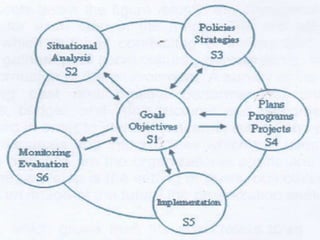
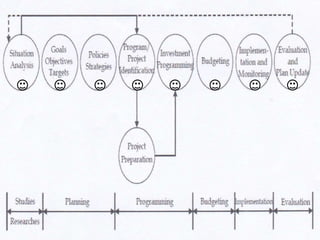
Planning Process Model
supplies guidance in what
ought to be done in practice
dictates explicitly what people
ought to do (act accordingly,
behave rationally & ascertain
successful completion of
process of activities)
Situational Analysis
• requires conducting of survey and research
studies
• survey calls for gathering of socio-cultural,
demographic, economic, physical, and natural
data and information in the environment
• survey indicating past and present
performances, programs and project,
manpower resources, budget, infrastructures
and equipment
• Data (analyzed and used as input for planning)
Setting of Goals, Objectives, & Targets
• Goal –a broad statement of an image of
the future the organization seeks to
achieve
• Objective –medium-range expectation
which is pursued to satisfy the goal
• Target –most specific statement of
purpose which is simple, measurable,
time bound, and achievable
Policy Statements & Strategies
• once goals, objectives, and targets are
crafted, more specific policy statements
and strategies are framed for each of the
areas of concern (social, economic,
physical, political, and administration)
• integration of these to a framework plan
for a particular period serves as guide to
the organization
Programs & Projects
• identified to effectively channel
resources to development programs
and projects considered strategic in
the overall attainment of goals
Prioritization of Programs &
Projects
• determined & done through
the conduct of feasibility
studies
Budgeting
• the costing of priority
programs and projects
Implementation & Monitoring
• Implementation –actual carrying out of
funded programs and projects by
concerned offices and individuals of the
organization
• Programs and projects are monitored to
find out if they are implemented
according to the plan. Otherwise,
corrective measures should be readily
instituted to put back the project on
track
Evaluation & Plan Update
• Results, in terms of outputs, after a year
of implementation, and outcomes after
about 4-5 years of implementation, in
terms of effects and impacts, are
evaluated
• These outputs and outcomes discussed
with managers and planners for decision-
making and updating the plan
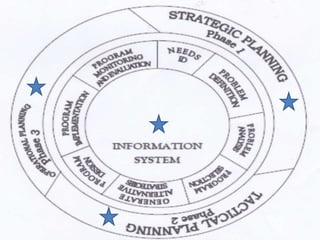
Bell’s Strategic Planning Model
• developed by Northwest Regional
Education Laboratory in
cooperation with Oregon
Education Coordinating Council
• purpose: to increase both intra-
system and inter-system planning
effectiveness
Strategic Planning
• identification of problems
• definition of policy objectives
• assignment of institutional
roles and resources
Tactical Planning
• transforms policy objectives and
general allocation of resources
into selection of programs
• identification of alternative
strategies
• developing specific program
designs for action
Operational Planning
• control or action ensures that
performance proceeds
according to plans, as well as
monitors and evaluate results
• Program implementation,
monitoring, and evaluation
Information System
• takes care of all data and
information gathered and used
as feedback in decision-making
and planning process
Herman’s Strategic
Planning Model
• focuses on a school as the frame
of planning reference
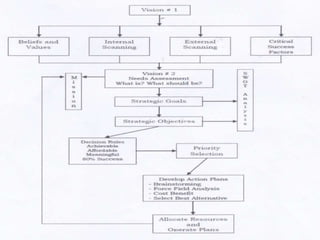
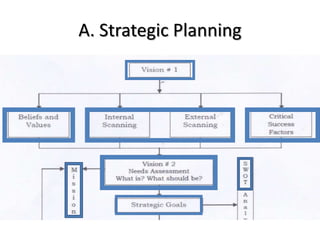
A. Strategic Planning
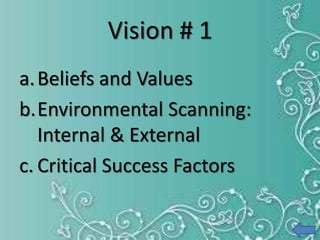
Vision # 1
a.Beliefs and Values
b.Environmental Scanning:
Internal & External
c. Critical Success Factors
Beliefs and Values
• creation & consensus of vision by
school leaders and stakeholders
• role of school is considered in mega,
macro, & micro environments
• the planners are able to situate where
they are and core values and beliefs
of school leaders & stakeholders are
identified for incorporation into vision
Environmental Scanning
• internal & external
• generated data and information
would provide the present state of
school and obtaining conditions, the
environment would dictate which are
facilitative and impediments in the
attainment of the preferred ideal
vision
Critical Success Factors
• if it enhance the attainment of
the desired future vision, it will
be retained
• if it hinder it, it will be
eliminated
Vision # 2
• Mission Statement
• Strategic Goals
• SWOT Analysis
(because of so much data &
information)
Mission Statement
• consider the major role of the
school in the mega, macro,
and micro environments
Strategic Goals
• consider the major role of the
school in the mega, macro,
and micro environments
SWOT Analysis
• data gathered laid out in 2x2 table to
analytically determine which enhance
or impede the attainment of the
preferred ideal vision
• Strengths & Opportunities (further
built upon and capitalized on)
• Weaknesses & Threats (remedied or
eliminated)
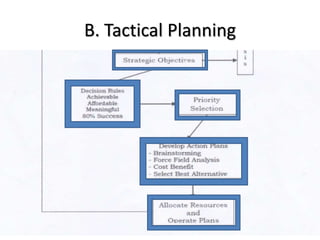
B. Tactical Planning
Strategic Objectives
• formulation of specific
objectives for every goal that
has been framed
Decision Rules
• prioritization of objectives
undertaken with the use of a
commonly-agreed upon set of
decision rules
Priority Selection
• objectives are prioritized
Develop Action Plans
• plans are subjected to testing or
analysis to determine the best
alternative strategies
• testing involves the use of
brainstorming, force field
analysis, cost-benefit & cost-
effective analyses
Allocate Resources &
Operate Plans
• allocation of resources to the
best alternative plans and
strategies
• implementing & monitoring
them and finally evaluating the
results
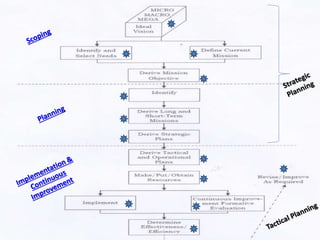
Kaufman’s Strategic Planning Model
• systems framework model by Kaufman
• model has undergone extensive
improvements during the last 2 decades
• initially presented in systems analysis of 6
steps
• Organization Elements Model (OEM) –
systems framework of 4 major clusters of
13 steps & improved into 3 major clusters
of 12 steps
A. Scoping
• Ideal Vision
• Identify and Select Needs
• Define Current Mission
• Derive Mission Objective
Ideal Vision
• Identification of preferred
ideal vision in the mega,
macro, and micro perspectives
Identify & Select Needs
• Identification of values & beliefs and data
gathering on the internal organization and
external environment
• Inputted in the continuous improvement of
formulating the ideal vision
• Critical success factors are determined to
guide educational partners in planning and
thinking process of the strategic planning
phase
Define Current Mission
• Framed ideal vision dictates the
elements of the mission of the
organization which commits to
deliver and contribute to that
vision
• Mission –broad description of
purpose
Derive Mission Objective
• Should be based on the mission,
and mission on the vision
• State both where the
organization is headed and the
precise criteria for determining
accomplishments
B. Planning
• Identify SWOT
• Derive long and short-term
Mission
• Derive Strategic Plan
Identify SWOT
• Analysis of identified Strengths,
Weaknesses, Opportunities, and
Threats (SWOT) becomes the
organizational barometer
indicating the organizational &
environmental factors that
enhance or impede the attainment
of the specific objectives
Derive long & short-term
mission
• Based on the SWOT, long and
short-term missions (targets)
are derived
Derive Strategic Plan
• Developed through the
conduct of function and
system analysis
• Results are in the form of
products designed to attain
the objectives
C. Implementation & Continuous
Improvement
• Derive tactical & operational plans
• Make/buy/obtain resources
• Implement
• Continuous improvement/ formative
evaluation
• Determine effectiveness & efficiency
• Revise/improve as required
Derive Tactical &
Operational Plans
• Method-means analysis
• Analysis identifies possible
ways and means for the for
doing and undertaking
products, tasks, and outputs
Make/ buy/ obtain
resources
• Once products and different
means are completed, funds
and resources are allocated
Implement
• Tasks and products are
implemented
• Ascertainment of successful plan
implementation requires
developing of structures within
the organization, installing a
Management Information System
(MIS), and a monitoring system
Continuous Improvement/
Formative Evaluation
• After a short period of time,
formative evaluation is
undertaken to determine
whether or not outputs
approximated the stated
objectives and mission
Determine Effectiveness &
Efficiency
• Conduct of summative
evaluation determines the
levels of efficiency &
effectiveness of the outputs
maturing into outcomes
Revise/ Improve as
Required
• Outputs & outcomes serve as
inputs to revise if not improve
the strategic & tactical
planning process
Franco Planning Model
• Florencio Arica Jr., who has worked
with Dr. Franco notes that this model
has been the subject of countless
variations in many educational
planning exercises in schools,
universities, educational agencies &
foundations, both public & private.
1. Analysis of the external
environment
• Students or learners
• Forces for change in the working
environment of the school
• Opportunities for consortia with
other institutions
Result: What programs/ services we
might do, expand, try or drop
2. Clarity of vision, mission &
values analysis for change
• Legal mandate
• Vision & Philosophy
• Mission/ Values System
• Organizational culture & lifestyle
Result: What we want to do
3. Analysis of the internal
organization
• Human & non-human resources
• Programs, services & projects
• Accomplishments & outputs over
the years
Result: What we can do & cannot
do
4. Long-term decisions on strategic
issues & strategies for institution
• Addressing the main issues
• Clarity of vision, mission statement, strategy,
and goals & objectives
• Formulation of programs, projects & activities
• Preparation of detailed work plans, schedules &
budgets
• Targeting of outputs & results and their proper
monitoring & evaluation
Result: What we should do
Arica points out that it doesn’t mean
that everything must fit –sometimes
stretching & flexibility are needed to
make sure the university can do
what it wants to do or it might do
something about, resulting hopefully
in the best things it should do.
“Stretch, flexibility, adjustments, not
exactly all fit.” –Franco’s continuing
reminder

Educational planning models

  • 1.
    EDUCATIONAL PLANNING MODELS EdM 405 –Educational Planning Reporter: Chinly Ruth T. Alberto
  • 2.
    What is aprocess? series of steps followed in doing an activity can be illustrated in graphical or symbolic terms
  • 3.
    Planning Process Model suppliesguidance in what ought to be done in practice dictates explicitly what people ought to do (act accordingly, behave rationally & ascertain successful completion of process of activities)
  • 6.
    Situational Analysis • requiresconducting of survey and research studies • survey calls for gathering of socio-cultural, demographic, economic, physical, and natural data and information in the environment • survey indicating past and present performances, programs and project, manpower resources, budget, infrastructures and equipment • Data (analyzed and used as input for planning)
  • 7.
    Setting of Goals,Objectives, & Targets • Goal –a broad statement of an image of the future the organization seeks to achieve • Objective –medium-range expectation which is pursued to satisfy the goal • Target –most specific statement of purpose which is simple, measurable, time bound, and achievable
  • 8.
    Policy Statements &Strategies • once goals, objectives, and targets are crafted, more specific policy statements and strategies are framed for each of the areas of concern (social, economic, physical, political, and administration) • integration of these to a framework plan for a particular period serves as guide to the organization
  • 9.
    Programs & Projects •identified to effectively channel resources to development programs and projects considered strategic in the overall attainment of goals
  • 10.
    Prioritization of Programs& Projects • determined & done through the conduct of feasibility studies
  • 11.
    Budgeting • the costingof priority programs and projects
  • 12.
    Implementation & Monitoring •Implementation –actual carrying out of funded programs and projects by concerned offices and individuals of the organization • Programs and projects are monitored to find out if they are implemented according to the plan. Otherwise, corrective measures should be readily instituted to put back the project on track
  • 13.
    Evaluation & PlanUpdate • Results, in terms of outputs, after a year of implementation, and outcomes after about 4-5 years of implementation, in terms of effects and impacts, are evaluated • These outputs and outcomes discussed with managers and planners for decision- making and updating the plan
  • 14.
    Bell’s Strategic PlanningModel • developed by Northwest Regional Education Laboratory in cooperation with Oregon Education Coordinating Council • purpose: to increase both intra- system and inter-system planning effectiveness
  • 16.
    Strategic Planning • identificationof problems • definition of policy objectives • assignment of institutional roles and resources
  • 17.
    Tactical Planning • transformspolicy objectives and general allocation of resources into selection of programs • identification of alternative strategies • developing specific program designs for action
  • 18.
    Operational Planning • controlor action ensures that performance proceeds according to plans, as well as monitors and evaluate results • Program implementation, monitoring, and evaluation
  • 19.
    Information System • takescare of all data and information gathered and used as feedback in decision-making and planning process
  • 20.
    Herman’s Strategic Planning Model •focuses on a school as the frame of planning reference
  • 22.
  • 23.
    Vision # 1 a.Beliefsand Values b.Environmental Scanning: Internal & External c. Critical Success Factors
  • 24.
    Beliefs and Values •creation & consensus of vision by school leaders and stakeholders • role of school is considered in mega, macro, & micro environments • the planners are able to situate where they are and core values and beliefs of school leaders & stakeholders are identified for incorporation into vision
  • 25.
    Environmental Scanning • internal& external • generated data and information would provide the present state of school and obtaining conditions, the environment would dictate which are facilitative and impediments in the attainment of the preferred ideal vision
  • 26.
    Critical Success Factors •if it enhance the attainment of the desired future vision, it will be retained • if it hinder it, it will be eliminated
  • 27.
    Vision # 2 •Mission Statement • Strategic Goals • SWOT Analysis (because of so much data & information)
  • 28.
    Mission Statement • considerthe major role of the school in the mega, macro, and micro environments
  • 29.
    Strategic Goals • considerthe major role of the school in the mega, macro, and micro environments
  • 30.
    SWOT Analysis • datagathered laid out in 2x2 table to analytically determine which enhance or impede the attainment of the preferred ideal vision • Strengths & Opportunities (further built upon and capitalized on) • Weaknesses & Threats (remedied or eliminated)
  • 31.
  • 32.
    Strategic Objectives • formulationof specific objectives for every goal that has been framed
  • 33.
    Decision Rules • prioritizationof objectives undertaken with the use of a commonly-agreed upon set of decision rules
  • 34.
  • 35.
    Develop Action Plans •plans are subjected to testing or analysis to determine the best alternative strategies • testing involves the use of brainstorming, force field analysis, cost-benefit & cost- effective analyses
  • 36.
    Allocate Resources & OperatePlans • allocation of resources to the best alternative plans and strategies • implementing & monitoring them and finally evaluating the results
  • 37.
    Kaufman’s Strategic PlanningModel • systems framework model by Kaufman • model has undergone extensive improvements during the last 2 decades • initially presented in systems analysis of 6 steps • Organization Elements Model (OEM) – systems framework of 4 major clusters of 13 steps & improved into 3 major clusters of 12 steps
  • 39.
    A. Scoping • IdealVision • Identify and Select Needs • Define Current Mission • Derive Mission Objective
  • 40.
    Ideal Vision • Identificationof preferred ideal vision in the mega, macro, and micro perspectives
  • 41.
    Identify & SelectNeeds • Identification of values & beliefs and data gathering on the internal organization and external environment • Inputted in the continuous improvement of formulating the ideal vision • Critical success factors are determined to guide educational partners in planning and thinking process of the strategic planning phase
  • 42.
    Define Current Mission •Framed ideal vision dictates the elements of the mission of the organization which commits to deliver and contribute to that vision • Mission –broad description of purpose
  • 43.
    Derive Mission Objective •Should be based on the mission, and mission on the vision • State both where the organization is headed and the precise criteria for determining accomplishments
  • 44.
    B. Planning • IdentifySWOT • Derive long and short-term Mission • Derive Strategic Plan
  • 45.
    Identify SWOT • Analysisof identified Strengths, Weaknesses, Opportunities, and Threats (SWOT) becomes the organizational barometer indicating the organizational & environmental factors that enhance or impede the attainment of the specific objectives
  • 46.
    Derive long &short-term mission • Based on the SWOT, long and short-term missions (targets) are derived
  • 47.
    Derive Strategic Plan •Developed through the conduct of function and system analysis • Results are in the form of products designed to attain the objectives
  • 48.
    C. Implementation &Continuous Improvement • Derive tactical & operational plans • Make/buy/obtain resources • Implement • Continuous improvement/ formative evaluation • Determine effectiveness & efficiency • Revise/improve as required
  • 49.
    Derive Tactical & OperationalPlans • Method-means analysis • Analysis identifies possible ways and means for the for doing and undertaking products, tasks, and outputs
  • 50.
    Make/ buy/ obtain resources •Once products and different means are completed, funds and resources are allocated
  • 51.
    Implement • Tasks andproducts are implemented • Ascertainment of successful plan implementation requires developing of structures within the organization, installing a Management Information System (MIS), and a monitoring system
  • 52.
    Continuous Improvement/ Formative Evaluation •After a short period of time, formative evaluation is undertaken to determine whether or not outputs approximated the stated objectives and mission
  • 53.
    Determine Effectiveness & Efficiency •Conduct of summative evaluation determines the levels of efficiency & effectiveness of the outputs maturing into outcomes
  • 54.
    Revise/ Improve as Required •Outputs & outcomes serve as inputs to revise if not improve the strategic & tactical planning process
  • 55.
    Franco Planning Model •Florencio Arica Jr., who has worked with Dr. Franco notes that this model has been the subject of countless variations in many educational planning exercises in schools, universities, educational agencies & foundations, both public & private.
  • 56.
    1. Analysis ofthe external environment • Students or learners • Forces for change in the working environment of the school • Opportunities for consortia with other institutions Result: What programs/ services we might do, expand, try or drop
  • 57.
    2. Clarity ofvision, mission & values analysis for change • Legal mandate • Vision & Philosophy • Mission/ Values System • Organizational culture & lifestyle Result: What we want to do
  • 58.
    3. Analysis ofthe internal organization • Human & non-human resources • Programs, services & projects • Accomplishments & outputs over the years Result: What we can do & cannot do
  • 59.
    4. Long-term decisionson strategic issues & strategies for institution • Addressing the main issues • Clarity of vision, mission statement, strategy, and goals & objectives • Formulation of programs, projects & activities • Preparation of detailed work plans, schedules & budgets • Targeting of outputs & results and their proper monitoring & evaluation Result: What we should do
  • 60.
    Arica points outthat it doesn’t mean that everything must fit –sometimes stretching & flexibility are needed to make sure the university can do what it wants to do or it might do something about, resulting hopefully in the best things it should do. “Stretch, flexibility, adjustments, not exactly all fit.” –Franco’s continuing reminder