EDUCATIONAL ASSESSMENT
AND EVALUATION
SUBMITTED TO: SUBMITTED BY:
MRS. HEMLATA MA’AM MANJEET KAUR
TUTOR PROMILA
CON , SJH SAPNA SINGH
B. SC. (hons.)nsg.
2nd year
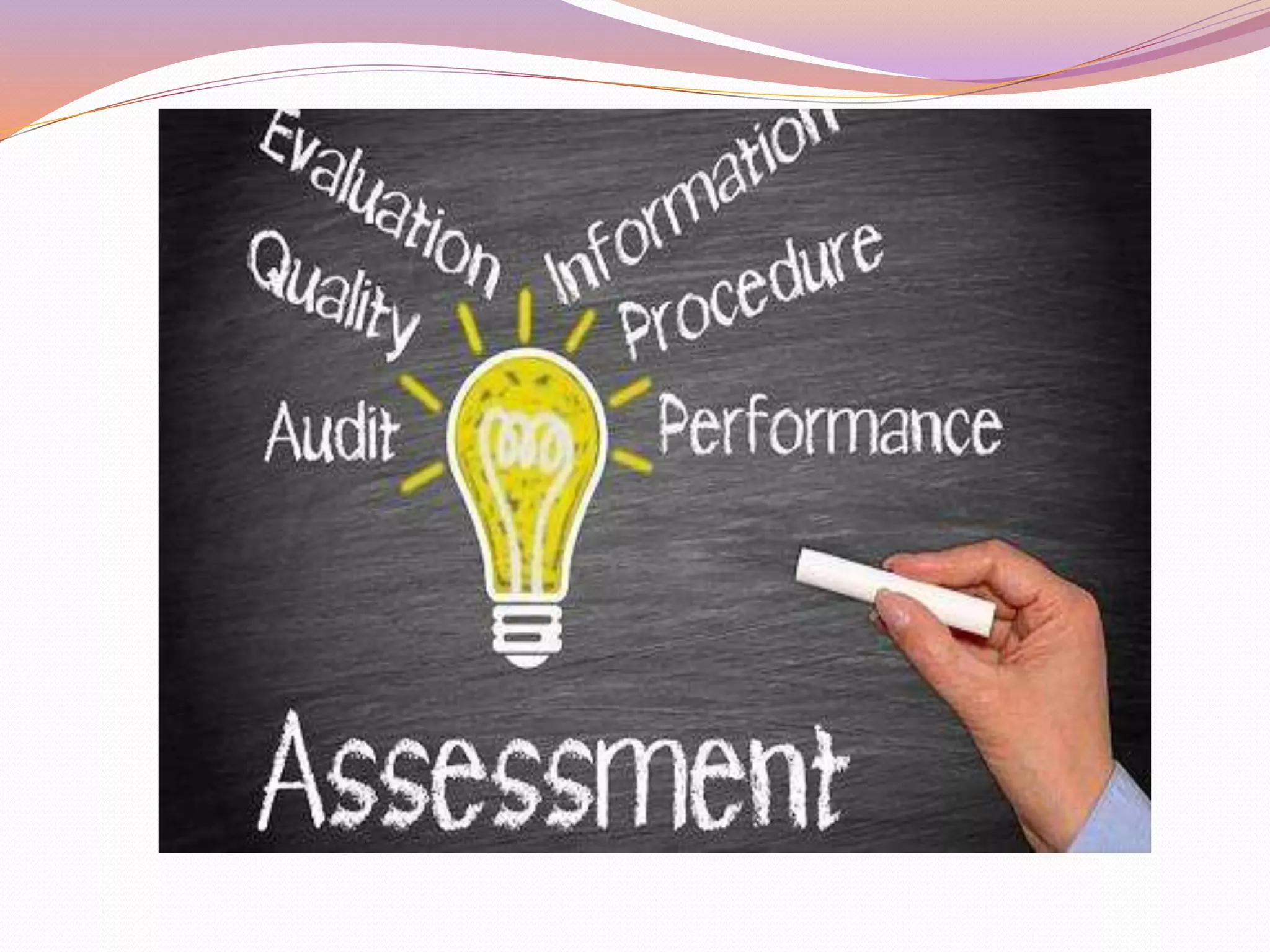
ASSESSMENT
 DEFINITIOn
Assessment is the process of gathering and
discussing information from multiple and diverse
sources in order to develop a deep
understanding of what students know,
understand and can do with their knowledge as a
result of their educational experiences .
 PRINCIPLES OF ASSESSMENT
Assessment should be aimed at improving
student performance.
Assessment should be based on an
understanding on how students learn.
Assessment should be an integral component of
course design and not something to add
afterwards.
Good assessment provides useful information to
report credibly to parents on students
achievements.
Good assessment requires clarity of purpose
,goals , standards and criteria.
Good assessment requires a variety of
measures.
Assessment methods used should be valid,
reliable and consistent.
Assessment requires attention to outcome and
 Purposes of assessment
Gathers information to assist in decision making :
1. screening
2. monitoring student’s progress
3. assigning grads or ranks .
Determining one’s own instructional
effectiveness .
Clarifying teacher’s instructional intentions.
 FUNCTIONS OF ASSESSMENT
Capturing student time and attention .
Generating appropriate student learning activity.
Providing timely feedback which student pay
attention to.
Helping students to internalize the discipline’s
standards and notions of equality .
Generating marks or grades which distinguish
between students or enable pass/fail decisions to
be made .
TYPES OF ASSESSMENT
FORMATIVE ASSESSEMENT
SUMMATIVE ASSESSMENT
FORMATIVE ASSESSMENT:
• This occurs in the short term.
• Feedback to the learner is immediate.
• Enables the teacher to “turn on a dime”.
• Can be both formal and informal.
 Examples of formative assessment
A very interactive class discussion
A warm up
Closure or exit slip
A on the spot performance
A quiz
Class test
SUMMATIVE ASSESSMENT:
• This takes place at the end of a large chunk of
learning.
• Results may take to be returned to the
student/parent.
• Feedback to the student is usually very limited.
 Examples on summative assessment
End term exams or annual examination
A final project
End of unit or chapter test
Practical examination
 ADVANTAGES OF ASSESSMENT
Helps in knowing the position of a student when
they enter a course.
It provides data on student learning.
In accordance to the student’s achievement, the
curriculum and teaching methods can be
adjusted .
 DISADVANTAGES OF ASSESSMENT
It limits the potential of a student to a mere ‘test’.
Under supervision & pressure ,creativity and
performance is affected.
The parameter to judging knowledge is just a test
score.
SUMMARY
In this presentation , we have covered the following
thing:
 Definition of assessment
 Principles and purposes of assessment
 Functions of assessment
 Types of assessment : formative and summative
with examples
 Advantages and disadvantages of assessment
EDUCATIONAL ASSESSMENT

EDUCATIONAL ASSESSMENT

  • 1.
    EDUCATIONAL ASSESSMENT AND EVALUATION SUBMITTEDTO: SUBMITTED BY: MRS. HEMLATA MA’AM MANJEET KAUR TUTOR PROMILA CON , SJH SAPNA SINGH B. SC. (hons.)nsg. 2nd year
  • 3.
    ASSESSMENT  DEFINITIOn Assessment isthe process of gathering and discussing information from multiple and diverse sources in order to develop a deep understanding of what students know, understand and can do with their knowledge as a result of their educational experiences .
  • 4.
     PRINCIPLES OFASSESSMENT Assessment should be aimed at improving student performance. Assessment should be based on an understanding on how students learn. Assessment should be an integral component of course design and not something to add afterwards.
  • 6.
    Good assessment providesuseful information to report credibly to parents on students achievements. Good assessment requires clarity of purpose ,goals , standards and criteria. Good assessment requires a variety of measures. Assessment methods used should be valid, reliable and consistent. Assessment requires attention to outcome and
  • 7.
     Purposes ofassessment Gathers information to assist in decision making : 1. screening 2. monitoring student’s progress 3. assigning grads or ranks . Determining one’s own instructional effectiveness . Clarifying teacher’s instructional intentions.
  • 9.
     FUNCTIONS OFASSESSMENT Capturing student time and attention . Generating appropriate student learning activity. Providing timely feedback which student pay attention to. Helping students to internalize the discipline’s standards and notions of equality . Generating marks or grades which distinguish between students or enable pass/fail decisions to be made .
  • 10.
    TYPES OF ASSESSMENT FORMATIVEASSESSEMENT SUMMATIVE ASSESSMENT
  • 12.
    FORMATIVE ASSESSMENT: • Thisoccurs in the short term. • Feedback to the learner is immediate. • Enables the teacher to “turn on a dime”. • Can be both formal and informal.
  • 13.
     Examples offormative assessment A very interactive class discussion A warm up Closure or exit slip A on the spot performance A quiz Class test
  • 14.
    SUMMATIVE ASSESSMENT: • Thistakes place at the end of a large chunk of learning. • Results may take to be returned to the student/parent. • Feedback to the student is usually very limited.
  • 15.
     Examples onsummative assessment End term exams or annual examination A final project End of unit or chapter test Practical examination
  • 17.
     ADVANTAGES OFASSESSMENT Helps in knowing the position of a student when they enter a course. It provides data on student learning. In accordance to the student’s achievement, the curriculum and teaching methods can be adjusted .
  • 18.
     DISADVANTAGES OFASSESSMENT It limits the potential of a student to a mere ‘test’. Under supervision & pressure ,creativity and performance is affected. The parameter to judging knowledge is just a test score.
  • 19.
    SUMMARY In this presentation, we have covered the following thing:  Definition of assessment  Principles and purposes of assessment  Functions of assessment  Types of assessment : formative and summative with examples  Advantages and disadvantages of assessment