ASSIGNMENT
TOPIC NAME:
Educational Approches
SUBMITTED TO:
DR.IRUM UZAIR
SUBJECT:
Comperative Educaton
COURSE CODE:
EDUC-5123
SEMESTER:
BS EDUCATION 4th
SEMESTER (2023-2027)
GROUP MEMBERS:
MEHAK NOOR (ROLL NO 10)
MUTEEBAASLAM (ROLL NO 17)
BISSAM (LEADER) (ROLL NO 25)
KASHIF LATIF (ROLL NO 26)
INSTITUTE OF EDUCATION
UNIVERSITY OF SARGODHA
Educational Approches
 Introduction
Educational approaches refer to the methods, strategies, and philosophies used by educators to
facilitate learning. These approaches shape the way teaching and learning happen, including how
information is presented, how students engage with material, and how their progress is assessed.
 Types of Educational Approches:
 Traditional Approach
 Constructivist Approach
 Montessori Approach
 Inquiry-Based Learning
 Experiential Learning
 Behaviorist Approach
 Humanistic Approach
Traditional Approch:
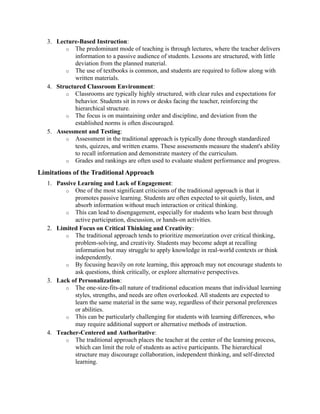
The traditional approach to education is one of the oldest
and most widely recognized educational models. It is often
characterized by teacher-centered instruction, where the
teacher plays the central role in delivering knowledge, while
students are expected to passively absorb the information.
This approach has its roots in classical education and
remains influential in many educational systems around the
world. Here’s a detailed exploration of its key aspects,
strengths, and limitations:
Key Characteristics of the Traditional Approach
1. Teacher-Centered Learning:
o The teacher is the primary authority figure in the classroom and the main source
of knowledge. Instruction is typically delivered through lectures or presentations.
o Students are expected to listen attentively, take notes, and memorize the material
for assessments. There is less emphasis on active participation or student-led
discussions.
2. Curriculum Focus:
o The traditional approach often follows a fixed, standardized curriculum. Core
subjects like mathematics, science, language arts, and history are emphasized,
with a focus on knowledge acquisition.
o The curriculum tends to be uniform, meaning all students learn the same material
in the same way, regardless of individual differences.
3. Lecture-Based Instruction:
o The predominant mode of teaching is through lectures, where the teacher delivers
information to a passive audience of students. Lessons are structured, with little
deviation from the planned material.
o The use of textbooks is common, and students are required to follow along with
written materials.
4. Structured Classroom Environment:
o Classrooms are typically highly structured, with clear rules and expectations for
behavior. Students sit in rows or desks facing the teacher, reinforcing the
hierarchical structure.
o The focus is on maintaining order and discipline, and deviation from the
established norms is often discouraged.
5. Assessment and Testing:
o Assessment in the traditional approach is typically done through standardized
tests, quizzes, and written exams. These assessments measure the student's ability
to recall information and demonstrate mastery of the curriculum.
o Grades and rankings are often used to evaluate student performance and progress.
Limitations of the Traditional Approach
1. Passive Learning and Lack of Engagement:
o One of the most significant criticisms of the traditional approach is that it
promotes passive learning. Students are often expected to sit quietly, listen, and
absorb information without much interaction or critical thinking.
o This can lead to disengagement, especially for students who learn best through
active participation, discussion, or hands-on activities.
2. Limited Focus on Critical Thinking and Creativity:
o The traditional approach tends to prioritize memorization over critical thinking,
problem-solving, and creativity. Students may become adept at recalling
information but may struggle to apply knowledge in real-world contexts or think
independently.
o By focusing heavily on rote learning, this approach may not encourage students to
ask questions, think critically, or explore alternative perspectives.
3. Lack of Personalization:
o The one-size-fits-all nature of traditional education means that individual learning
styles, strengths, and needs are often overlooked. All students are expected to
learn the same material in the same way, regardless of their personal preferences
or abilities.
o This can be particularly challenging for students with learning differences, who
may require additional support or alternative methods of instruction.
4. Teacher-Centered and Authoritative:
o The traditional approach places the teacher at the center of the learning process,
which can limit the role of students as active participants. The hierarchical
structure may discourage collaboration, independent thinking, and self-directed
learning.
o In some cases, students may feel disconnected from the learning process, as they
have little control over what they learn or how they engage with the material.
5. Overemphasis on Testing:
o Traditional education often emphasizes performance on standardized tests and
exams. While these assessments provide measurable outcomes, they may not
accurately reflect a student’s understanding or potential.
o The pressure to perform well on tests can lead to stress and anxiety for students,
and may encourage a narrow focus on test preparation rather than deeper learning.
Constructivist approach
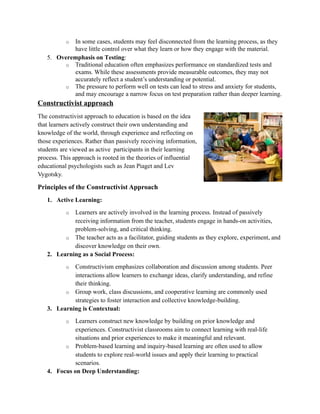
The constructivist approach to education is based on the idea
that learners actively construct their own understanding and
knowledge of the world, through experience and reflecting on
those experiences. Rather than passively receiving information,
students are viewed as active participants in their learning
process. This approach is rooted in the theories of influential
educational psychologists such as Jean Piaget and Lev
Vygotsky.
Principles of the Constructivist Approach
1. Active Learning:
o Learners are actively involved in the learning process. Instead of passively
receiving information from the teacher, students engage in hands-on activities,
problem-solving, and critical thinking.
o The teacher acts as a facilitator, guiding students as they explore, experiment, and
discover knowledge on their own.
2. Learning as a Social Process:
o Constructivism emphasizes collaboration and discussion among students. Peer
interactions allow learners to exchange ideas, clarify understanding, and refine
their thinking.
o Group work, class discussions, and cooperative learning are commonly used
strategies to foster interaction and collective knowledge-building.
3. Learning is Contextual:
o Learners construct new knowledge by building on prior knowledge and
experiences. Constructivist classrooms aim to connect learning with real-life
situations and prior experiences to make it meaningful and relevant.
o Problem-based learning and inquiry-based learning are often used to allow
students to explore real-world issues and apply their learning to practical
scenarios.
4. Focus on Deep Understanding:
o Constructivism encourages learners to think critically and understand concepts
deeply, rather than memorizing facts. Students are encouraged to ask questions,
seek answers, and engage in reflective thinking.
o The goal is not just to acquire knowledge but to understand how and why things
happen. Learners develop the ability to apply their knowledge in new and
unfamiliar situations.
5. Reflection:
o Reflection is a key component of the constructivist approach. Learners are
encouraged to reflect on their learning experiences, assess their understanding,
and identify areas for further exploration.
o This reflective process allows students to consolidate their learning and gain
insights into their own thinking processes (known as metacognition).
Instructional Strategies in the Constructivist Approach
Problem-Based Learning (PBL):
o In PBL, students are presented with a real-world problem and are tasked with
finding a solution. This requires them to research, collaborate, and apply their
knowledge in a practical context.
o The teacher’s role is to facilitate the process by providing guidance and resources
but not to dictate how the problem should be solved.
Inquiry-Based Learning:
o Students are encouraged to ask questions, investigate topics, and draw
conclusions based on their findings. This approach fosters curiosity and develops
research skills.
o The inquiry process typically involves questioning, investigating, creating,
discussing, and reflecting.
Collaborative Learning:
o Students work in groups to share ideas, solve problems, and complete projects.
Collaborative learning promotes the exchange of diverse perspectives and allows
students to learn from one another.
o Group work also helps develop communication and teamwork skills, which are
essential for the 21st-century workforce.
Scaffolding:
o Teachers provide temporary support to help students achieve tasks that they
would not be able to complete independently. As students become more
competent, the support is gradually withdrawn, promoting independence.
o Scaffolding techniques include modeling, giving hints, providing feedback, and
breaking tasks into smaller, manageable steps.
Limitations of the Constructivist Approach
1. Time-Consuming:Constructivist learning often requires more time than traditional
methods, as students need time to explore, reflect, and construct their understanding. This
can be challenging when there are curriculum time constraints.
2. Requires Skilled Teachers:Teachers need to be well-trained in facilitation and
scaffolding techniques. It can be challenging for teachers to know how much guidance to
provide without stifling students' autonomy or leaving them struggling.
3. Assessment Challenges:Traditional assessments (like standardized tests) are often not
well-suited to constructivist learning, which emphasizes process and application over
memorization. This can make it difficult to measure student progress in standardized
systems.
4. May Not Work for All Students:Some students may struggle with the autonomy and
open-ended nature of constructivist learning, particularly those who thrive in more
structured environments.
Montessori Approach
The Montessori approach to education, developed by Dr. Maria
Montessori in the early 20th century, is a child-centered
educational method based on scientific observations of children's
learning processes. Montessori believed that children are
naturally eager for knowledge and capable of initiating learning
in a supportive, prepared environment. This method emphasizes
independence, freedom within limits, and respect for the natural
psychological, physical, and social development of the child.
Key Principles of Montessori Education
Child-Centered Learning:
o In the Montessori method, the child is placed at the center of the learning process.
The belief is that children are naturally curious and learn best when they are
allowed to explore topics of interest at their own pace.
o The teacher's role is to observe the child’s interests and provide an environment
rich in materials that foster exploration and learning.
Prepared Environment:
o The classroom, known as the "prepared environment," is carefully designed to
facilitate independent learning and exploration. It includes materials and activities
that cater to different stages of development.
o Everything in the Montessori classroom is arranged to be accessible to children.
Shelves are low, materials are neatly organized, and the environment is orderly to
promote concentration and self-directed learning.
o The environment is typically divided into distinct areas such as practical life,
sensorial, language, mathematics, and cultural subjects (science, geography, art,
etc.).
Freedom and Independence:
o Children are given the freedom to choose their activities and work at their own
pace. They are encouraged to make decisions about what they want to learn and
when.
o Montessori education promotes independence, teaching children how to take care
of themselves and their environment (e.g., cleaning up after themselves, preparing
snacks, or organizing their learning space).
Hands-On Learning:
o Montessori education emphasizes hands-on, experiential learning. Children use
specially designed materials to explore concepts in a concrete way before moving
on to abstract ideas.
o The materials are self-correcting, meaning that children can recognize their
mistakes and correct them without adult intervention. This promotes autonomy
and builds problem-solving skills.
Role of the Teacher (Guide):
o In Montessori classrooms, teachers are referred to as guides or facilitators. Their
role is not to direct the learning but to prepare and maintain the learning
environment and observe the child’s development.
o Teachers introduce new materials and lessons when a child is ready but allow the
child to independently explore the materials. They provide support and guidance
only when necessary.
Limitations of the Montessori Approach
1. Lack of Structure for Some Students:
o While Montessori’s emphasis on freedom is beneficial for many children, some
may struggle without a more structured learning environment. Children who need
more direction or thrive on external motivation may not adjust as well to
Montessori’s open-ended approach.
2. Requires Special Training for Teachers:
o Montessori teachers require specific training to understand the philosophy,
materials, and methods of teaching. This can make it difficult to implement
Montessori education in schools that do not have access to properly trained
educators.
3. May Not Align with Standardized Testing:
o Montessori’s focus on self-directed learning and individualized progress can
sometimes conflict with traditional standardized testing and assessment methods.
Montessori students may not be as prepared for the expectations of conventional
schooling or testing frameworks.
4. Limited Social Interaction in Some Classrooms:
o While Montessori promotes peer learning, the emphasis on individual work can
sometimes limit social interaction. Some children may benefit from more
collaborative, group-based learning experiences than what is typically offered in
Montessori environments.
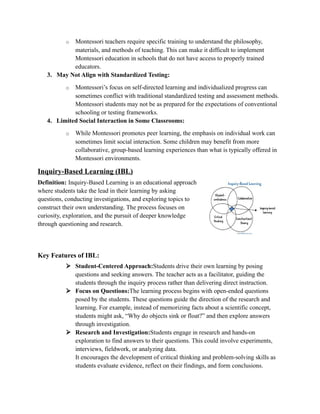
Inquiry-Based Learning (IBL)
Definition: Inquiry-Based Learning is an educational approach
where students take the lead in their learning by asking
questions, conducting investigations, and exploring topics to
construct their own understanding. The process focuses on
curiosity, exploration, and the pursuit of deeper knowledge
through questioning and research.
Key Features of IBL:
 Student-Centered Approach:Students drive their own learning by posing
questions and seeking answers. The teacher acts as a facilitator, guiding the
students through the inquiry process rather than delivering direct instruction.
 Focus on Questions:The learning process begins with open-ended questions
posed by the students. These questions guide the direction of the research and
learning. For example, instead of memorizing facts about a scientific concept,
students might ask, “Why do objects sink or float?” and then explore answers
through investigation.
 Research and Investigation:Students engage in research and hands-on
exploration to find answers to their questions. This could involve experiments,
interviews, fieldwork, or analyzing data.
It encourages the development of critical thinking and problem-solving skills as
students evaluate evidence, reflect on their findings, and form conclusions.
 Teacher as a Guide:The teacher’s role is to facilitate learning by providing
resources, scaffolding the process, and supporting students as they explore and
make sense of the information.The teacher may introduce relevant content,
suggest tools or methods for investigation, and offer feedback on student
progress.
Benefits of IBL:
Encourages Critical Thinking:Inquiry-based learning fosters deep thinking and
reflection as students are required to analyze information, draw conclusions, and solve
problems.
Promotes Engagement and Curiosity:Students are more motivated to learn when they
have the autonomy to explore topics that interest them. The sense of ownership over their
learning process increases engagement.
Develops Research and Investigation Skills:Students gain experience in the research
process, learning how to collect, evaluate, and present data. These skills are valuable for
academic pursuits and real-world problem-solving.
Supports Differentiation:Since students explore topics based on their interests and
learning styles, inquiry-based learning naturally supports differentiation in the classroom.
Challenges of IBL:
Requires Time:Inquiry-based learning can be time-consuming, as students must
investigate and research their questions. This may pose a challenge in environments with
rigid curriculum constraints.
Demanding for Teachers:The teacher must carefully plan and scaffold the learning
process while ensuring that students remain focused and make meaningful progress.
Managing the open-ended nature of inquiry can be challenging.
May Be Difficult for Some Learners:Not all students may be comfortable with the level
of independence required in IBL. Some may struggle to formulate questions or conduct
research without clear guidance.
Experiential Learning (EL)
Definition: Experiential Learning is a process of learning
through direct experience , reflection, and application. This
approach is based on the idea that learning is best achieved
when students actively participate in experiences that allow
them to apply concepts in real-life contexts, followed by
reflecting on those experiences to deepen understanding.
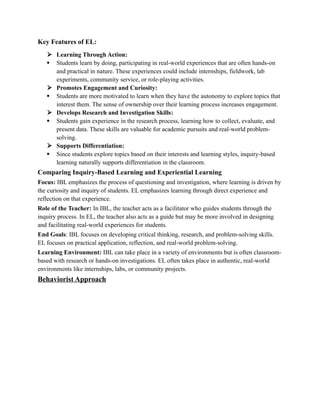
Key Features of EL:
 Learning Through Action:
 Students learn by doing, participating in real-world experiences that are often hands-on
and practical in nature. These experiences could include internships, fieldwork, lab
experiments, community service, or role-playing activities.
 Promotes Engagement and Curiosity:
 Students are more motivated to learn when they have the autonomy to explore topics that
interest them. The sense of ownership over their learning process increases engagement.
 Develops Research and Investigation Skills:
 Students gain experience in the research process, learning how to collect, evaluate, and
present data. These skills are valuable for academic pursuits and real-world problem-
solving.
 Supports Differentiation:
 Since students explore topics based on their interests and learning styles, inquiry-based
learning naturally supports differentiation in the classroom.
Comparing Inquiry-Based Learning and Experiential Learning
Focus: IBL emphasizes the process of questioning and investigation, where learning is driven by
the curiosity and inquiry of students. EL emphasizes learning through direct experience and
reflection on that experience.
Role of the Teacher: In IBL, the teacher acts as a facilitator who guides students through the
inquiry process. In EL, the teacher also acts as a guide but may be more involved in designing
and facilitating real-world experiences for students.
End Goals: IBL focuses on developing critical thinking, research, and problem-solving skills.
EL focuses on practical application, reflection, and real-world problem-solving.
Learning Environment: IBL can take place in a variety of environments but is often classroom-
based with research or hands-on investigations. EL often takes place in authentic, real-world
environments like internships, labs, or community projects.
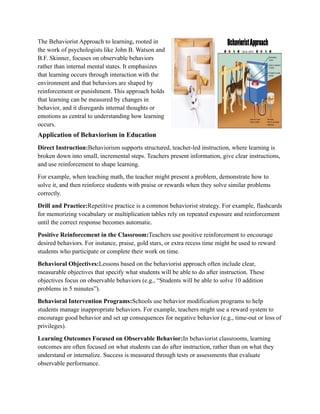
Behaviorist Approach
The Behaviorist Approach to learning, rooted in
the work of psychologists like John B. Watson and
B.F. Skinner, focuses on observable behaviors
rather than internal mental states. It emphasizes
that learning occurs through interaction with the
environment and that behaviors are shaped by
reinforcement or punishment. This approach holds
that learning can be measured by changes in
behavior, and it disregards internal thoughts or
emotions as central to understanding how learning
occurs.
Application of Behaviorism in Education
Direct Instruction:Behaviorism supports structured, teacher-led instruction, where learning is
broken down into small, incremental steps. Teachers present information, give clear instructions,
and use reinforcement to shape learning.
For example, when teaching math, the teacher might present a problem, demonstrate how to
solve it, and then reinforce students with praise or rewards when they solve similar problems
correctly.
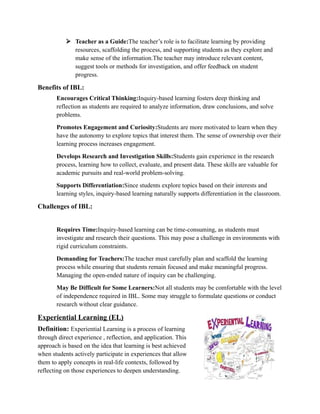
Drill and Practice:Repetitive practice is a common behaviorist strategy. For example, flashcards
for memorizing vocabulary or multiplication tables rely on repeated exposure and reinforcement
until the correct response becomes automatic.
Positive Reinforcement in the Classroom:Teachers use positive reinforcement to encourage
desired behaviors. For instance, praise, gold stars, or extra recess time might be used to reward
students who participate or complete their work on time.
Behavioral Objectives:Lessons based on the behaviorist approach often include clear,
measurable objectives that specify what students will be able to do after instruction. These
objectives focus on observable behaviors (e.g., “Students will be able to solve 10 addition
problems in 5 minutes”).
Behavioral Intervention Programs:Schools use behavior modification programs to help
students manage inappropriate behaviors. For example, teachers might use a reward system to
encourage good behavior and set up consequences for negative behavior (e.g., time-out or loss of
privileges).
Learning Outcomes Focused on Observable Behavior:In behaviorist classrooms, learning
outcomes are often focused on what students can do after instruction, rather than on what they
understand or internalize. Success is measured through tests or assessments that evaluate
observable performance.
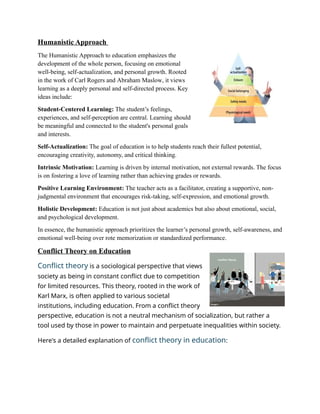
Humanistic Approach
The Humanistic Approach to education emphasizes the
development of the whole person, focusing on emotional
well-being, self-actualization, and personal growth. Rooted
in the work of Carl Rogers and Abraham Maslow, it views
learning as a deeply personal and self-directed process. Key
ideas include:
Student-Centered Learning: The student’s feelings,
experiences, and self-perception are central. Learning should
be meaningful and connected to the student's personal goals
and interests.
Self-Actualization: The goal of education is to help students reach their fullest potential,
encouraging creativity, autonomy, and critical thinking.
Intrinsic Motivation: Learning is driven by internal motivation, not external rewards. The focus
is on fostering a love of learning rather than achieving grades or rewards.
Positive Learning Environment: The teacher acts as a facilitator, creating a supportive, non-
judgmental environment that encourages risk-taking, self-expression, and emotional growth.
Holistic Development: Education is not just about academics but also about emotional, social,
and psychological development.
In essence, the humanistic approach prioritizes the learner’s personal growth, self-awareness, and
emotional well-being over rote memorization or standardized performance.
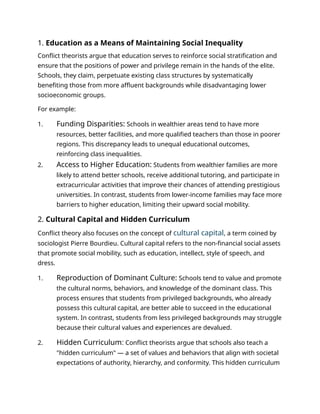
Conflict Theory on Education
Conflict theory is a sociological perspective that views
society as being in constant conflict due to competition
for limited resources. This theory, rooted in the work of
Karl Marx, is often applied to various societal
institutions, including education. From a conflict theory
perspective, education is not a neutral mechanism of socialization, but rather a
tool used by those in power to maintain and perpetuate inequalities within society.
Here's a detailed explanation of conflict theory in education:
1. Education as a Means of Maintaining Social Inequality
Conflict theorists argue that education serves to reinforce social stratification and
ensure that the positions of power and privilege remain in the hands of the elite.
Schools, they claim, perpetuate existing class structures by systematically
benefiting those from more affluent backgrounds while disadvantaging lower
socioeconomic groups.
For example:
1. Funding Disparities: Schools in wealthier areas tend to have more
resources, better facilities, and more qualified teachers than those in poorer
regions. This discrepancy leads to unequal educational outcomes,
reinforcing class inequalities.
2. Access to Higher Education: Students from wealthier families are more
likely to attend better schools, receive additional tutoring, and participate in
extracurricular activities that improve their chances of attending prestigious
universities. In contrast, students from lower-income families may face more
barriers to higher education, limiting their upward social mobility.
2. Cultural Capital and Hidden Curriculum
Conflict theory also focuses on the concept of cultural capital, a term coined by
sociologist Pierre Bourdieu. Cultural capital refers to the non-financial social assets
that promote social mobility, such as education, intellect, style of speech, and
dress.
1. Reproduction of Dominant Culture: Schools tend to value and promote
the cultural norms, behaviors, and knowledge of the dominant class. This
process ensures that students from privileged backgrounds, who already
possess this cultural capital, are better able to succeed in the educational
system. In contrast, students from less privileged backgrounds may struggle
because their cultural values and experiences are devalued.
2. Hidden Curriculum: Conflict theorists argue that schools also teach a
"hidden curriculum" — a set of values and behaviors that align with societal
expectations of authority, hierarchy, and conformity. This hidden curriculum
helps to reproduce the labor force needed in a capitalist society. Working-
class students, for example, may be subtly prepared for blue-collar jobs that
require obedience and routine work, while students from privileged
backgrounds are prepared for leadership and managerial roles.
3. Credentialism
Conflict theory also highlights credentialism, the idea that educational
qualifications (degrees, certifications) are increasingly required for jobs, even when
these qualifications may not be directly related to the skills needed for the job. This
system benefits those who can afford to pursue higher education, creating a
barrier for others.
Credentialism allows the dominant class to monopolize certain jobs, ensuring that
higher-paying and prestigious occupations remain accessible to those who can
afford to spend more time and money on education.
4. Tracking and Labeling
Another key concept within conflict theory’s view on education is tracking, or the
practice of grouping students according to their perceived ability or academic
achievement.
1. Reinforcing Class Divisions: Conflict theorists argue that tracking tends
to reinforce existing class inequalities because students from affluent
backgrounds are more likely to be placed in higher tracks (advanced or
honors programs), while students from lower socioeconomic backgrounds
are more often placed in lower tracks. Once placed in a lower track, it can be
difficult for students to move upward, which limits their future
opportunities.
2. Labeling Theory: This suggests that the labels applied to students, such
as "gifted" or "remedial," can significantly influence their educational
experience. When students are labeled in ways that reflect stereotypes
about their social class or racial background, it can lead to a self-fulfilling
prophecy where they internalize those labels and perform according to
expectations, whether high or low.
5. Education as Ideological Control
Conflict theorists also argue that education serves as a means of ideological
control. Through the curriculum and the hidden curriculum, schools instill values
and beliefs that align with the interests of the ruling class, promoting a sense of
acceptance of social inequality.
1. Legitimization of Inequality: For example, the meritocratic ideal — the
belief that hard work and talent determine success — is often emphasized in
schools. However, conflict theorists argue that this ignores the systemic
barriers that prevent disadvantaged groups from achieving success, while
legitimizing the success of the wealthy as a result of individual effort rather
than privilege.
6. Racial and Gender Inequalities
Conflict theorists also apply their perspective to issues of race and gender in
education. They argue that the education system reproduces racial and gender
inequalities by:
1. Promoting Eurocentric curricula that marginalize the histories and
contributions of minority groups.
2. Enforcing gender roles through socialization in classrooms.
3. Perpetuating racial biases through discriminatory disciplinary practices and
unequal treatment of students of color.
Criticism of Conflict Theory in Education
While conflict theory provides a useful lens to examine power dynamics in
education, it has been criticized for its overly negative and deterministic view.
Critics argue that the theory underestimates the role of individual agency and the
ways in which education can provide opportunities for social mobility. Moreover,
they suggest that conflict theorists may overlook the complexities and nuances of
how schools operate and how education can foster positive social change.
Conclusion
In summary, conflict theory views education as a tool that perpetuates social
inequalities by favoring those from privileged backgrounds and maintaining the
status quo of a stratified society. While it highlights critical issues within the
educational system, such as funding disparities, cultural biases, and tracking, it
also opens the door for discussions on how education can be reformed to create a
more just and equitable society.
OPEN SYSTEM THEORY:
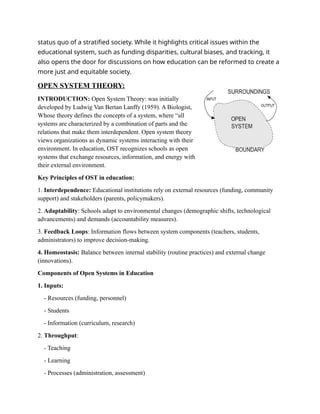
INTRODUCTION: Open System Theory: was initially
developed by Ludwig Van Bertan Lanffy (1959). A Biologist,
Whose theory defines the concepts of a system, where “all
systems are characterized by a combination of parts and the
relations that make them interdependent. Open system theory
views organizations as dynamic systems interacting with their
environment. In education, OST recognizes schools as open
systems that exchange resources, information, and energy with
their external environment.
Key Principles of OST in education:
1. Interdependence: Educational institutions rely on external resources (funding, community
support) and stakeholders (parents, policymakers).
2. Adaptability: Schools adapt to environmental changes (demographic shifts, technological
advancements) and demands (accountability measures).
3. Feedback Loops: Information flows between system components (teachers, students,
administrators) to improve decision-making.
4. Homeostasis: Balance between internal stability (routine practices) and external change
(innovations).
Components of Open Systems in Education
1. Inputs:
- Resources (funding, personnel)
- Students
- Information (curriculum, research)
2. Throughput:
- Teaching
- Learning
- Processes (administration, assessment)
3. Outputs:
- Graduates
- Knowledge
- Skills
4. Feedback:
- Evaluation
- Assessment
- Research
OPEN SYSTEM THEORY ADVANTAGES:
Theoretical Benefits
1. Holistic understanding: Considers education as an interconnected system.
2. Dynamic perspective: Recognizes constant change and adaptation.
3. Interdependence: Emphasizes relationships between components.
4. Feedback loops: Encourages continuous improvement.
Practical Applications
1. Adaptive curriculum design: Responsive to changing societal needs.
2. Collaborative teaching: Fosters teacher professionalism and teamwork.
3. Student-centered learning: Focuses on individual needs and interests.
4. Community engagement: Encourages partnerships and resource sharing.
Educational Outcomes
1. Improved student outcomes: Personalized learning and effective assessment.
2. Teacher development: Continuous learning and growth.
3. Increased efficiency: Resource optimization and reduced waste.
4. Enhanced innovation: Encourages creativity and experimentation.
Organizational Benefits
1. Flexible decision-making: Responsive to changing circumstances.
2. Decentralized leadership: Empowers teachers and staff.
3. Cross-functional teams: Fosters collaboration and communication.
4. Continuous improvement: Encourages innovation and progress.
Real-World Examples
1. Project-Based Learning (PBL)
2. Competency-Based Education (CBE)
3. Personalized Learning Plans (PLPs)
4. Community-Based Learning (CBL)
DISADVANTAGES OF OPEN SYSTEM : Here are the disadvantages of open system theory;
Theoretical Limitations:
1. Overemphasis on adaptability: Neglects stability and continuity.
2. Lack of clear boundaries: Difficulty defining system components.
3. Insufficient attention to power dynamics: Ignores inequality and social justice.
4. Overreliance on feedback loops: Assumes effective communication.
Practical Challenges:
1. Complexity and unpredictability: Difficult to manage and anticipate change.
2. Resistance to change: Inertia and entrenched interests.
3. Resource constraints: Limited funding, personnel, and infrastructure.
4. Difficulty scaling innovations: Challenges replicating successful programs.
Educational Concerns:
1. Potential for fragmentation: Lack of coherence and coordination.
2. Overemphasis on external accountability: Neglects internal motivation.
3. Insufficient attention to teacher agency: Undervalues teacher professionalism.
4. Difficulty measuring success: Challenges evaluating complex, dynamic systems.
Alternative Perspectives:
1. Critical Theory: Emphasizes power dynamics, social justice.
2. Chaos Theory: Recognizes complexity, unpredictability.
3. Social Network Theory: Highlights relationships, networks.
4. Complexity Theory: Focuses on self-organization, emergence.
CONCLUSION: Open system theories has advantages over other theories. Because it takes
your environment into account, an open system approach gets a more realistic picture of the
pressure on you, your organization and your students.
REFERENCE:
1.Locke, J. (1689). Some Thoughts Concerning Education.
2. Rousseau, J. J. (1762). Emile.
3. Pestalozzi, J. H. (1801). How Gertrude Teaches Her Children.
4. Bagley, W. C. (1934). The Educative Process.
5.Scott, W.R (2002) organizations: Rational, natural, and open systems. Upper saddle River N.J
prentice hall.
6. M.W Meyer (E.d), Environments and organizations (pp. 78 – 109). San Francisco: Jossey –
Bass
7.Alexs’ Book (Affiliate link): case studies in courageous communication.
https://www.amazon.com/gp/product
8.Alexs’ classes at communication coach academy: essential professional communication skills:
https://bit.ly/essentialcommskills
9.Effective listening skills for leaders https://bit.ly/listeningskillsforleaders.
10.Developing stakeholder relationships for effective team leadership:
11.Watson, J. B. (1913). "Psychology as the Behaviorist Views It." Psychological Review, 20(2),
158-177.
12. Skinner, B. F. (1938). "The Behavior of Organisms: An Experimental Analysis."
13. Pavlov, I. P. (1927). "Conditioned Reflexes."
14. Bowles, S., & Gintis, H. (1976). Schooling in Capitalist America.
15. Bourdieu, P., & Passeron, J. C. (1977). Reproduction in Education, Society and Culture
16. Freire, P. (1970). Pedagogy of the Oppressed.
17. Bertalanffy, L. von. (1968). General System Theory: Foundations, Development,
Applications.
18. Katz, D. (1978). The Social Psychology of Organizations.
19. Argyris, C. (1999). On Organizational Learning.
20. Senge, P. M. (1990). The Fifth Discipline: The Art & Practice of The Learning Organization.

Educational Approaches comperative_eduction

  • 1.
    ASSIGNMENT TOPIC NAME: Educational Approches SUBMITTEDTO: DR.IRUM UZAIR SUBJECT: Comperative Educaton COURSE CODE: EDUC-5123 SEMESTER: BS EDUCATION 4th SEMESTER (2023-2027) GROUP MEMBERS: MEHAK NOOR (ROLL NO 10) MUTEEBAASLAM (ROLL NO 17) BISSAM (LEADER) (ROLL NO 25) KASHIF LATIF (ROLL NO 26) INSTITUTE OF EDUCATION UNIVERSITY OF SARGODHA
  • 2.
    Educational Approches  Introduction Educationalapproaches refer to the methods, strategies, and philosophies used by educators to facilitate learning. These approaches shape the way teaching and learning happen, including how information is presented, how students engage with material, and how their progress is assessed.  Types of Educational Approches:  Traditional Approach  Constructivist Approach  Montessori Approach  Inquiry-Based Learning  Experiential Learning  Behaviorist Approach  Humanistic Approach Traditional Approch: The traditional approach to education is one of the oldest and most widely recognized educational models. It is often characterized by teacher-centered instruction, where the teacher plays the central role in delivering knowledge, while students are expected to passively absorb the information. This approach has its roots in classical education and remains influential in many educational systems around the world. Here’s a detailed exploration of its key aspects, strengths, and limitations: Key Characteristics of the Traditional Approach 1. Teacher-Centered Learning: o The teacher is the primary authority figure in the classroom and the main source of knowledge. Instruction is typically delivered through lectures or presentations. o Students are expected to listen attentively, take notes, and memorize the material for assessments. There is less emphasis on active participation or student-led discussions. 2. Curriculum Focus: o The traditional approach often follows a fixed, standardized curriculum. Core subjects like mathematics, science, language arts, and history are emphasized, with a focus on knowledge acquisition. o The curriculum tends to be uniform, meaning all students learn the same material in the same way, regardless of individual differences.
  • 3.
    3. Lecture-Based Instruction: oThe predominant mode of teaching is through lectures, where the teacher delivers information to a passive audience of students. Lessons are structured, with little deviation from the planned material. o The use of textbooks is common, and students are required to follow along with written materials. 4. Structured Classroom Environment: o Classrooms are typically highly structured, with clear rules and expectations for behavior. Students sit in rows or desks facing the teacher, reinforcing the hierarchical structure. o The focus is on maintaining order and discipline, and deviation from the established norms is often discouraged. 5. Assessment and Testing: o Assessment in the traditional approach is typically done through standardized tests, quizzes, and written exams. These assessments measure the student's ability to recall information and demonstrate mastery of the curriculum. o Grades and rankings are often used to evaluate student performance and progress. Limitations of the Traditional Approach 1. Passive Learning and Lack of Engagement: o One of the most significant criticisms of the traditional approach is that it promotes passive learning. Students are often expected to sit quietly, listen, and absorb information without much interaction or critical thinking. o This can lead to disengagement, especially for students who learn best through active participation, discussion, or hands-on activities. 2. Limited Focus on Critical Thinking and Creativity: o The traditional approach tends to prioritize memorization over critical thinking, problem-solving, and creativity. Students may become adept at recalling information but may struggle to apply knowledge in real-world contexts or think independently. o By focusing heavily on rote learning, this approach may not encourage students to ask questions, think critically, or explore alternative perspectives. 3. Lack of Personalization: o The one-size-fits-all nature of traditional education means that individual learning styles, strengths, and needs are often overlooked. All students are expected to learn the same material in the same way, regardless of their personal preferences or abilities. o This can be particularly challenging for students with learning differences, who may require additional support or alternative methods of instruction. 4. Teacher-Centered and Authoritative: o The traditional approach places the teacher at the center of the learning process, which can limit the role of students as active participants. The hierarchical structure may discourage collaboration, independent thinking, and self-directed learning.
  • 4.
    o In somecases, students may feel disconnected from the learning process, as they have little control over what they learn or how they engage with the material. 5. Overemphasis on Testing: o Traditional education often emphasizes performance on standardized tests and exams. While these assessments provide measurable outcomes, they may not accurately reflect a student’s understanding or potential. o The pressure to perform well on tests can lead to stress and anxiety for students, and may encourage a narrow focus on test preparation rather than deeper learning. Constructivist approach The constructivist approach to education is based on the idea that learners actively construct their own understanding and knowledge of the world, through experience and reflecting on those experiences. Rather than passively receiving information, students are viewed as active participants in their learning process. This approach is rooted in the theories of influential educational psychologists such as Jean Piaget and Lev Vygotsky. Principles of the Constructivist Approach 1. Active Learning: o Learners are actively involved in the learning process. Instead of passively receiving information from the teacher, students engage in hands-on activities, problem-solving, and critical thinking. o The teacher acts as a facilitator, guiding students as they explore, experiment, and discover knowledge on their own. 2. Learning as a Social Process: o Constructivism emphasizes collaboration and discussion among students. Peer interactions allow learners to exchange ideas, clarify understanding, and refine their thinking. o Group work, class discussions, and cooperative learning are commonly used strategies to foster interaction and collective knowledge-building. 3. Learning is Contextual: o Learners construct new knowledge by building on prior knowledge and experiences. Constructivist classrooms aim to connect learning with real-life situations and prior experiences to make it meaningful and relevant. o Problem-based learning and inquiry-based learning are often used to allow students to explore real-world issues and apply their learning to practical scenarios. 4. Focus on Deep Understanding:
  • 5.
    o Constructivism encourageslearners to think critically and understand concepts deeply, rather than memorizing facts. Students are encouraged to ask questions, seek answers, and engage in reflective thinking. o The goal is not just to acquire knowledge but to understand how and why things happen. Learners develop the ability to apply their knowledge in new and unfamiliar situations. 5. Reflection: o Reflection is a key component of the constructivist approach. Learners are encouraged to reflect on their learning experiences, assess their understanding, and identify areas for further exploration. o This reflective process allows students to consolidate their learning and gain insights into their own thinking processes (known as metacognition). Instructional Strategies in the Constructivist Approach Problem-Based Learning (PBL): o In PBL, students are presented with a real-world problem and are tasked with finding a solution. This requires them to research, collaborate, and apply their knowledge in a practical context. o The teacher’s role is to facilitate the process by providing guidance and resources but not to dictate how the problem should be solved. Inquiry-Based Learning: o Students are encouraged to ask questions, investigate topics, and draw conclusions based on their findings. This approach fosters curiosity and develops research skills. o The inquiry process typically involves questioning, investigating, creating, discussing, and reflecting. Collaborative Learning: o Students work in groups to share ideas, solve problems, and complete projects. Collaborative learning promotes the exchange of diverse perspectives and allows students to learn from one another. o Group work also helps develop communication and teamwork skills, which are essential for the 21st-century workforce. Scaffolding: o Teachers provide temporary support to help students achieve tasks that they would not be able to complete independently. As students become more competent, the support is gradually withdrawn, promoting independence.
  • 6.
    o Scaffolding techniquesinclude modeling, giving hints, providing feedback, and breaking tasks into smaller, manageable steps. Limitations of the Constructivist Approach 1. Time-Consuming:Constructivist learning often requires more time than traditional methods, as students need time to explore, reflect, and construct their understanding. This can be challenging when there are curriculum time constraints. 2. Requires Skilled Teachers:Teachers need to be well-trained in facilitation and scaffolding techniques. It can be challenging for teachers to know how much guidance to provide without stifling students' autonomy or leaving them struggling. 3. Assessment Challenges:Traditional assessments (like standardized tests) are often not well-suited to constructivist learning, which emphasizes process and application over memorization. This can make it difficult to measure student progress in standardized systems. 4. May Not Work for All Students:Some students may struggle with the autonomy and open-ended nature of constructivist learning, particularly those who thrive in more structured environments. Montessori Approach The Montessori approach to education, developed by Dr. Maria Montessori in the early 20th century, is a child-centered educational method based on scientific observations of children's learning processes. Montessori believed that children are naturally eager for knowledge and capable of initiating learning in a supportive, prepared environment. This method emphasizes independence, freedom within limits, and respect for the natural psychological, physical, and social development of the child. Key Principles of Montessori Education Child-Centered Learning: o In the Montessori method, the child is placed at the center of the learning process. The belief is that children are naturally curious and learn best when they are allowed to explore topics of interest at their own pace. o The teacher's role is to observe the child’s interests and provide an environment rich in materials that foster exploration and learning. Prepared Environment: o The classroom, known as the "prepared environment," is carefully designed to facilitate independent learning and exploration. It includes materials and activities that cater to different stages of development.
  • 7.
    o Everything inthe Montessori classroom is arranged to be accessible to children. Shelves are low, materials are neatly organized, and the environment is orderly to promote concentration and self-directed learning. o The environment is typically divided into distinct areas such as practical life, sensorial, language, mathematics, and cultural subjects (science, geography, art, etc.). Freedom and Independence: o Children are given the freedom to choose their activities and work at their own pace. They are encouraged to make decisions about what they want to learn and when. o Montessori education promotes independence, teaching children how to take care of themselves and their environment (e.g., cleaning up after themselves, preparing snacks, or organizing their learning space). Hands-On Learning: o Montessori education emphasizes hands-on, experiential learning. Children use specially designed materials to explore concepts in a concrete way before moving on to abstract ideas. o The materials are self-correcting, meaning that children can recognize their mistakes and correct them without adult intervention. This promotes autonomy and builds problem-solving skills. Role of the Teacher (Guide): o In Montessori classrooms, teachers are referred to as guides or facilitators. Their role is not to direct the learning but to prepare and maintain the learning environment and observe the child’s development. o Teachers introduce new materials and lessons when a child is ready but allow the child to independently explore the materials. They provide support and guidance only when necessary. Limitations of the Montessori Approach 1. Lack of Structure for Some Students: o While Montessori’s emphasis on freedom is beneficial for many children, some may struggle without a more structured learning environment. Children who need more direction or thrive on external motivation may not adjust as well to Montessori’s open-ended approach. 2. Requires Special Training for Teachers:
  • 8.
    o Montessori teachersrequire specific training to understand the philosophy, materials, and methods of teaching. This can make it difficult to implement Montessori education in schools that do not have access to properly trained educators. 3. May Not Align with Standardized Testing: o Montessori’s focus on self-directed learning and individualized progress can sometimes conflict with traditional standardized testing and assessment methods. Montessori students may not be as prepared for the expectations of conventional schooling or testing frameworks. 4. Limited Social Interaction in Some Classrooms: o While Montessori promotes peer learning, the emphasis on individual work can sometimes limit social interaction. Some children may benefit from more collaborative, group-based learning experiences than what is typically offered in Montessori environments. Inquiry-Based Learning (IBL) Definition: Inquiry-Based Learning is an educational approach where students take the lead in their learning by asking questions, conducting investigations, and exploring topics to construct their own understanding. The process focuses on curiosity, exploration, and the pursuit of deeper knowledge through questioning and research. Key Features of IBL:  Student-Centered Approach:Students drive their own learning by posing questions and seeking answers. The teacher acts as a facilitator, guiding the students through the inquiry process rather than delivering direct instruction.  Focus on Questions:The learning process begins with open-ended questions posed by the students. These questions guide the direction of the research and learning. For example, instead of memorizing facts about a scientific concept, students might ask, “Why do objects sink or float?” and then explore answers through investigation.  Research and Investigation:Students engage in research and hands-on exploration to find answers to their questions. This could involve experiments, interviews, fieldwork, or analyzing data. It encourages the development of critical thinking and problem-solving skills as students evaluate evidence, reflect on their findings, and form conclusions.
  • 9.
     Teacher asa Guide:The teacher’s role is to facilitate learning by providing resources, scaffolding the process, and supporting students as they explore and make sense of the information.The teacher may introduce relevant content, suggest tools or methods for investigation, and offer feedback on student progress. Benefits of IBL: Encourages Critical Thinking:Inquiry-based learning fosters deep thinking and reflection as students are required to analyze information, draw conclusions, and solve problems. Promotes Engagement and Curiosity:Students are more motivated to learn when they have the autonomy to explore topics that interest them. The sense of ownership over their learning process increases engagement. Develops Research and Investigation Skills:Students gain experience in the research process, learning how to collect, evaluate, and present data. These skills are valuable for academic pursuits and real-world problem-solving. Supports Differentiation:Since students explore topics based on their interests and learning styles, inquiry-based learning naturally supports differentiation in the classroom. Challenges of IBL: Requires Time:Inquiry-based learning can be time-consuming, as students must investigate and research their questions. This may pose a challenge in environments with rigid curriculum constraints. Demanding for Teachers:The teacher must carefully plan and scaffold the learning process while ensuring that students remain focused and make meaningful progress. Managing the open-ended nature of inquiry can be challenging. May Be Difficult for Some Learners:Not all students may be comfortable with the level of independence required in IBL. Some may struggle to formulate questions or conduct research without clear guidance. Experiential Learning (EL) Definition: Experiential Learning is a process of learning through direct experience , reflection, and application. This approach is based on the idea that learning is best achieved when students actively participate in experiences that allow them to apply concepts in real-life contexts, followed by reflecting on those experiences to deepen understanding.
  • 10.
    Key Features ofEL:  Learning Through Action:  Students learn by doing, participating in real-world experiences that are often hands-on and practical in nature. These experiences could include internships, fieldwork, lab experiments, community service, or role-playing activities.  Promotes Engagement and Curiosity:  Students are more motivated to learn when they have the autonomy to explore topics that interest them. The sense of ownership over their learning process increases engagement.  Develops Research and Investigation Skills:  Students gain experience in the research process, learning how to collect, evaluate, and present data. These skills are valuable for academic pursuits and real-world problem- solving.  Supports Differentiation:  Since students explore topics based on their interests and learning styles, inquiry-based learning naturally supports differentiation in the classroom. Comparing Inquiry-Based Learning and Experiential Learning Focus: IBL emphasizes the process of questioning and investigation, where learning is driven by the curiosity and inquiry of students. EL emphasizes learning through direct experience and reflection on that experience. Role of the Teacher: In IBL, the teacher acts as a facilitator who guides students through the inquiry process. In EL, the teacher also acts as a guide but may be more involved in designing and facilitating real-world experiences for students. End Goals: IBL focuses on developing critical thinking, research, and problem-solving skills. EL focuses on practical application, reflection, and real-world problem-solving. Learning Environment: IBL can take place in a variety of environments but is often classroom- based with research or hands-on investigations. EL often takes place in authentic, real-world environments like internships, labs, or community projects. Behaviorist Approach
  • 11.
    The Behaviorist Approachto learning, rooted in the work of psychologists like John B. Watson and B.F. Skinner, focuses on observable behaviors rather than internal mental states. It emphasizes that learning occurs through interaction with the environment and that behaviors are shaped by reinforcement or punishment. This approach holds that learning can be measured by changes in behavior, and it disregards internal thoughts or emotions as central to understanding how learning occurs. Application of Behaviorism in Education Direct Instruction:Behaviorism supports structured, teacher-led instruction, where learning is broken down into small, incremental steps. Teachers present information, give clear instructions, and use reinforcement to shape learning. For example, when teaching math, the teacher might present a problem, demonstrate how to solve it, and then reinforce students with praise or rewards when they solve similar problems correctly. Drill and Practice:Repetitive practice is a common behaviorist strategy. For example, flashcards for memorizing vocabulary or multiplication tables rely on repeated exposure and reinforcement until the correct response becomes automatic. Positive Reinforcement in the Classroom:Teachers use positive reinforcement to encourage desired behaviors. For instance, praise, gold stars, or extra recess time might be used to reward students who participate or complete their work on time. Behavioral Objectives:Lessons based on the behaviorist approach often include clear, measurable objectives that specify what students will be able to do after instruction. These objectives focus on observable behaviors (e.g., “Students will be able to solve 10 addition problems in 5 minutes”). Behavioral Intervention Programs:Schools use behavior modification programs to help students manage inappropriate behaviors. For example, teachers might use a reward system to encourage good behavior and set up consequences for negative behavior (e.g., time-out or loss of privileges). Learning Outcomes Focused on Observable Behavior:In behaviorist classrooms, learning outcomes are often focused on what students can do after instruction, rather than on what they understand or internalize. Success is measured through tests or assessments that evaluate observable performance.
  • 12.
    Humanistic Approach The HumanisticApproach to education emphasizes the development of the whole person, focusing on emotional well-being, self-actualization, and personal growth. Rooted in the work of Carl Rogers and Abraham Maslow, it views learning as a deeply personal and self-directed process. Key ideas include: Student-Centered Learning: The student’s feelings, experiences, and self-perception are central. Learning should be meaningful and connected to the student's personal goals and interests. Self-Actualization: The goal of education is to help students reach their fullest potential, encouraging creativity, autonomy, and critical thinking. Intrinsic Motivation: Learning is driven by internal motivation, not external rewards. The focus is on fostering a love of learning rather than achieving grades or rewards. Positive Learning Environment: The teacher acts as a facilitator, creating a supportive, non- judgmental environment that encourages risk-taking, self-expression, and emotional growth. Holistic Development: Education is not just about academics but also about emotional, social, and psychological development. In essence, the humanistic approach prioritizes the learner’s personal growth, self-awareness, and emotional well-being over rote memorization or standardized performance. Conflict Theory on Education Conflict theory is a sociological perspective that views society as being in constant conflict due to competition for limited resources. This theory, rooted in the work of Karl Marx, is often applied to various societal institutions, including education. From a conflict theory perspective, education is not a neutral mechanism of socialization, but rather a tool used by those in power to maintain and perpetuate inequalities within society. Here's a detailed explanation of conflict theory in education:
  • 13.
    1. Education asa Means of Maintaining Social Inequality Conflict theorists argue that education serves to reinforce social stratification and ensure that the positions of power and privilege remain in the hands of the elite. Schools, they claim, perpetuate existing class structures by systematically benefiting those from more affluent backgrounds while disadvantaging lower socioeconomic groups. For example: 1. Funding Disparities: Schools in wealthier areas tend to have more resources, better facilities, and more qualified teachers than those in poorer regions. This discrepancy leads to unequal educational outcomes, reinforcing class inequalities. 2. Access to Higher Education: Students from wealthier families are more likely to attend better schools, receive additional tutoring, and participate in extracurricular activities that improve their chances of attending prestigious universities. In contrast, students from lower-income families may face more barriers to higher education, limiting their upward social mobility. 2. Cultural Capital and Hidden Curriculum Conflict theory also focuses on the concept of cultural capital, a term coined by sociologist Pierre Bourdieu. Cultural capital refers to the non-financial social assets that promote social mobility, such as education, intellect, style of speech, and dress. 1. Reproduction of Dominant Culture: Schools tend to value and promote the cultural norms, behaviors, and knowledge of the dominant class. This process ensures that students from privileged backgrounds, who already possess this cultural capital, are better able to succeed in the educational system. In contrast, students from less privileged backgrounds may struggle because their cultural values and experiences are devalued. 2. Hidden Curriculum: Conflict theorists argue that schools also teach a "hidden curriculum" — a set of values and behaviors that align with societal expectations of authority, hierarchy, and conformity. This hidden curriculum
  • 14.
    helps to reproducethe labor force needed in a capitalist society. Working- class students, for example, may be subtly prepared for blue-collar jobs that require obedience and routine work, while students from privileged backgrounds are prepared for leadership and managerial roles. 3. Credentialism Conflict theory also highlights credentialism, the idea that educational qualifications (degrees, certifications) are increasingly required for jobs, even when these qualifications may not be directly related to the skills needed for the job. This system benefits those who can afford to pursue higher education, creating a barrier for others. Credentialism allows the dominant class to monopolize certain jobs, ensuring that higher-paying and prestigious occupations remain accessible to those who can afford to spend more time and money on education. 4. Tracking and Labeling Another key concept within conflict theory’s view on education is tracking, or the practice of grouping students according to their perceived ability or academic achievement. 1. Reinforcing Class Divisions: Conflict theorists argue that tracking tends to reinforce existing class inequalities because students from affluent backgrounds are more likely to be placed in higher tracks (advanced or honors programs), while students from lower socioeconomic backgrounds are more often placed in lower tracks. Once placed in a lower track, it can be difficult for students to move upward, which limits their future opportunities. 2. Labeling Theory: This suggests that the labels applied to students, such as "gifted" or "remedial," can significantly influence their educational experience. When students are labeled in ways that reflect stereotypes about their social class or racial background, it can lead to a self-fulfilling prophecy where they internalize those labels and perform according to expectations, whether high or low.
  • 15.
    5. Education asIdeological Control Conflict theorists also argue that education serves as a means of ideological control. Through the curriculum and the hidden curriculum, schools instill values and beliefs that align with the interests of the ruling class, promoting a sense of acceptance of social inequality. 1. Legitimization of Inequality: For example, the meritocratic ideal — the belief that hard work and talent determine success — is often emphasized in schools. However, conflict theorists argue that this ignores the systemic barriers that prevent disadvantaged groups from achieving success, while legitimizing the success of the wealthy as a result of individual effort rather than privilege. 6. Racial and Gender Inequalities Conflict theorists also apply their perspective to issues of race and gender in education. They argue that the education system reproduces racial and gender inequalities by: 1. Promoting Eurocentric curricula that marginalize the histories and contributions of minority groups. 2. Enforcing gender roles through socialization in classrooms. 3. Perpetuating racial biases through discriminatory disciplinary practices and unequal treatment of students of color. Criticism of Conflict Theory in Education While conflict theory provides a useful lens to examine power dynamics in education, it has been criticized for its overly negative and deterministic view. Critics argue that the theory underestimates the role of individual agency and the ways in which education can provide opportunities for social mobility. Moreover, they suggest that conflict theorists may overlook the complexities and nuances of how schools operate and how education can foster positive social change. Conclusion In summary, conflict theory views education as a tool that perpetuates social inequalities by favoring those from privileged backgrounds and maintaining the
  • 16.
    status quo ofa stratified society. While it highlights critical issues within the educational system, such as funding disparities, cultural biases, and tracking, it also opens the door for discussions on how education can be reformed to create a more just and equitable society. OPEN SYSTEM THEORY: INTRODUCTION: Open System Theory: was initially developed by Ludwig Van Bertan Lanffy (1959). A Biologist, Whose theory defines the concepts of a system, where “all systems are characterized by a combination of parts and the relations that make them interdependent. Open system theory views organizations as dynamic systems interacting with their environment. In education, OST recognizes schools as open systems that exchange resources, information, and energy with their external environment. Key Principles of OST in education: 1. Interdependence: Educational institutions rely on external resources (funding, community support) and stakeholders (parents, policymakers). 2. Adaptability: Schools adapt to environmental changes (demographic shifts, technological advancements) and demands (accountability measures). 3. Feedback Loops: Information flows between system components (teachers, students, administrators) to improve decision-making. 4. Homeostasis: Balance between internal stability (routine practices) and external change (innovations). Components of Open Systems in Education 1. Inputs: - Resources (funding, personnel) - Students - Information (curriculum, research) 2. Throughput: - Teaching - Learning - Processes (administration, assessment)
  • 17.
    3. Outputs: - Graduates -Knowledge - Skills 4. Feedback: - Evaluation - Assessment - Research OPEN SYSTEM THEORY ADVANTAGES: Theoretical Benefits 1. Holistic understanding: Considers education as an interconnected system. 2. Dynamic perspective: Recognizes constant change and adaptation. 3. Interdependence: Emphasizes relationships between components. 4. Feedback loops: Encourages continuous improvement. Practical Applications 1. Adaptive curriculum design: Responsive to changing societal needs. 2. Collaborative teaching: Fosters teacher professionalism and teamwork. 3. Student-centered learning: Focuses on individual needs and interests. 4. Community engagement: Encourages partnerships and resource sharing. Educational Outcomes 1. Improved student outcomes: Personalized learning and effective assessment. 2. Teacher development: Continuous learning and growth. 3. Increased efficiency: Resource optimization and reduced waste. 4. Enhanced innovation: Encourages creativity and experimentation. Organizational Benefits 1. Flexible decision-making: Responsive to changing circumstances.
  • 18.
    2. Decentralized leadership:Empowers teachers and staff. 3. Cross-functional teams: Fosters collaboration and communication. 4. Continuous improvement: Encourages innovation and progress. Real-World Examples 1. Project-Based Learning (PBL) 2. Competency-Based Education (CBE) 3. Personalized Learning Plans (PLPs) 4. Community-Based Learning (CBL) DISADVANTAGES OF OPEN SYSTEM : Here are the disadvantages of open system theory; Theoretical Limitations: 1. Overemphasis on adaptability: Neglects stability and continuity. 2. Lack of clear boundaries: Difficulty defining system components. 3. Insufficient attention to power dynamics: Ignores inequality and social justice. 4. Overreliance on feedback loops: Assumes effective communication. Practical Challenges: 1. Complexity and unpredictability: Difficult to manage and anticipate change. 2. Resistance to change: Inertia and entrenched interests. 3. Resource constraints: Limited funding, personnel, and infrastructure. 4. Difficulty scaling innovations: Challenges replicating successful programs. Educational Concerns: 1. Potential for fragmentation: Lack of coherence and coordination. 2. Overemphasis on external accountability: Neglects internal motivation. 3. Insufficient attention to teacher agency: Undervalues teacher professionalism. 4. Difficulty measuring success: Challenges evaluating complex, dynamic systems. Alternative Perspectives: 1. Critical Theory: Emphasizes power dynamics, social justice. 2. Chaos Theory: Recognizes complexity, unpredictability.
  • 19.
    3. Social NetworkTheory: Highlights relationships, networks. 4. Complexity Theory: Focuses on self-organization, emergence. CONCLUSION: Open system theories has advantages over other theories. Because it takes your environment into account, an open system approach gets a more realistic picture of the pressure on you, your organization and your students.
  • 20.
    REFERENCE: 1.Locke, J. (1689).Some Thoughts Concerning Education. 2. Rousseau, J. J. (1762). Emile. 3. Pestalozzi, J. H. (1801). How Gertrude Teaches Her Children. 4. Bagley, W. C. (1934). The Educative Process. 5.Scott, W.R (2002) organizations: Rational, natural, and open systems. Upper saddle River N.J prentice hall. 6. M.W Meyer (E.d), Environments and organizations (pp. 78 – 109). San Francisco: Jossey – Bass 7.Alexs’ Book (Affiliate link): case studies in courageous communication. https://www.amazon.com/gp/product 8.Alexs’ classes at communication coach academy: essential professional communication skills: https://bit.ly/essentialcommskills 9.Effective listening skills for leaders https://bit.ly/listeningskillsforleaders. 10.Developing stakeholder relationships for effective team leadership: 11.Watson, J. B. (1913). "Psychology as the Behaviorist Views It." Psychological Review, 20(2), 158-177. 12. Skinner, B. F. (1938). "The Behavior of Organisms: An Experimental Analysis." 13. Pavlov, I. P. (1927). "Conditioned Reflexes." 14. Bowles, S., & Gintis, H. (1976). Schooling in Capitalist America. 15. Bourdieu, P., & Passeron, J. C. (1977). Reproduction in Education, Society and Culture 16. Freire, P. (1970). Pedagogy of the Oppressed. 17. Bertalanffy, L. von. (1968). General System Theory: Foundations, Development, Applications. 18. Katz, D. (1978). The Social Psychology of Organizations. 19. Argyris, C. (1999). On Organizational Learning. 20. Senge, P. M. (1990). The Fifth Discipline: The Art & Practice of The Learning Organization.