EDP Environment
Mr.N.DEVARAM
ASSISTANT PROFESSSOR
Sri Ramakrishna College of Arts & Science
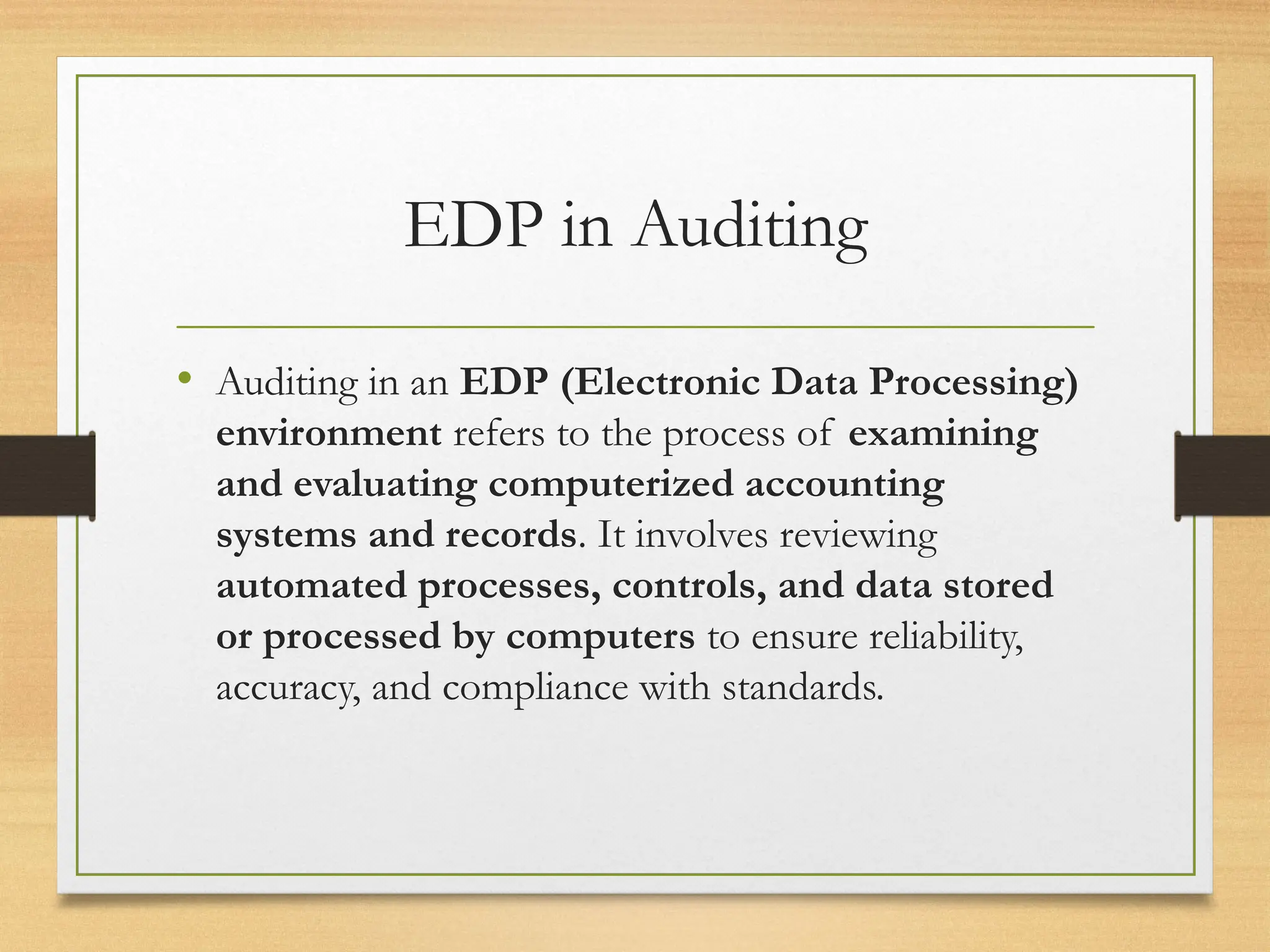
EDP in Auditing
• Auditing in an EDP (Electronic Data Processing)
environment refers to the process of examining
and evaluating computerized accounting
systems and records. It involves reviewing
automated processes, controls, and data stored
or processed by computers to ensure reliability,
accuracy, and compliance with standards.
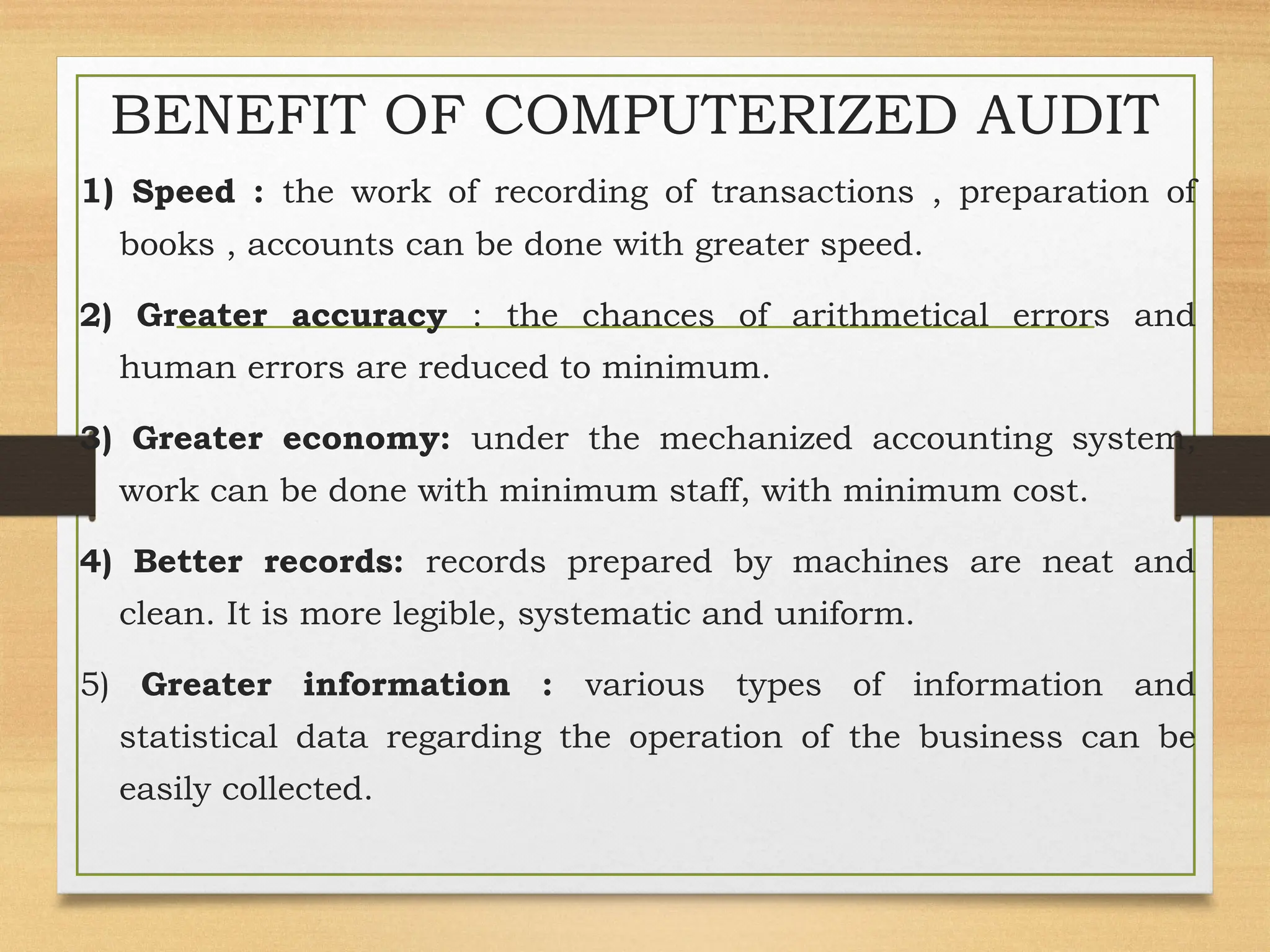
BENEFIT OF COMPUTERIZED AUDIT
1) Speed : the work of recording of transactions , preparation of
books , accounts can be done with greater speed.
2) Greater accuracy : the chances of arithmetical errors and
human errors are reduced to minimum.
3) Greater economy: under the mechanized accounting system,
work can be done with minimum staff, with minimum cost.
4) Better records: records prepared by machines are neat and
clean. It is more legible, systematic and uniform.
5) Greater information : various types of information and
statistical data regarding the operation of the business can be
easily collected.
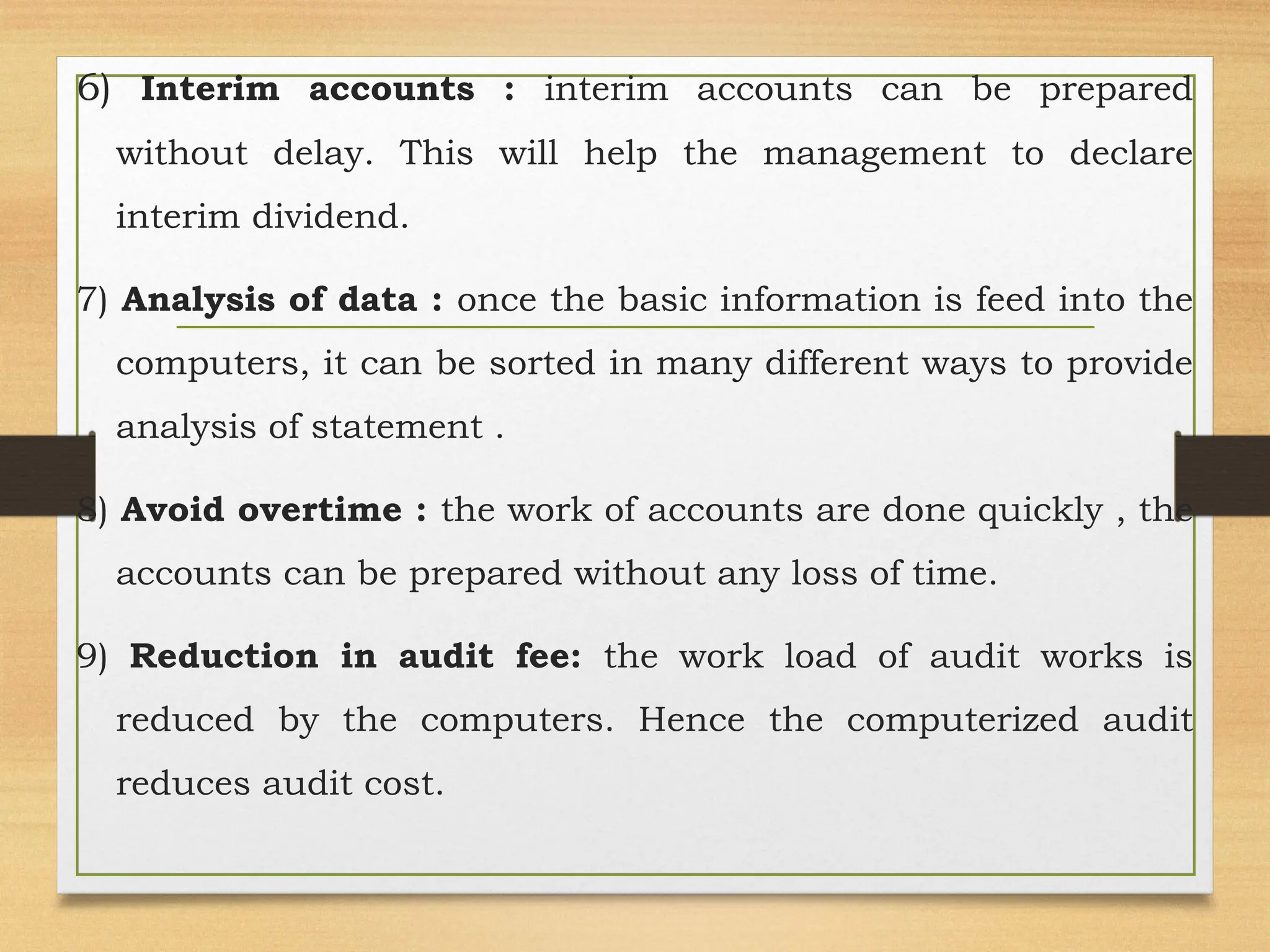
6) Interim accounts : interim accounts can be prepared
without delay. This will help the management to declare
interim dividend.
7) Analysis of data : once the basic information is feed into the
computers, it can be sorted in many different ways to provide
analysis of statement .
8) Avoid overtime : the work of accounts are done quickly , the
accounts can be prepared without any loss of time.
9) Reduction in audit fee: the work load of audit works is
reduced by the computers. Hence the computerized audit
reduces audit cost.
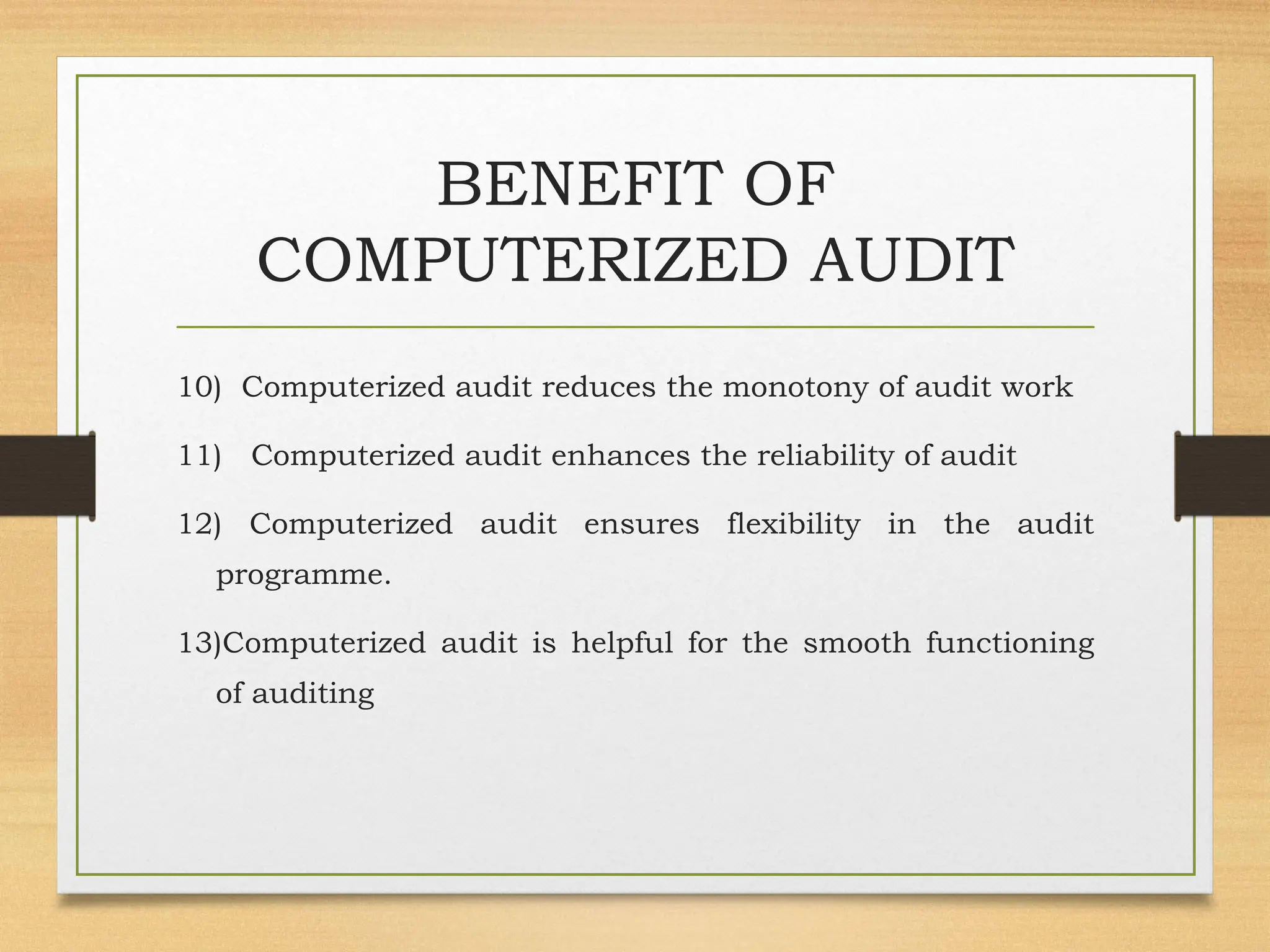
BENEFIT OF
COMPUTERIZED AUDIT
10) Computerized audit reduces the monotony of audit work
11) Computerized audit enhances the reliability of audit
12) Computerized audit ensures flexibility in the audit
programme.
13)Computerized audit is helpful for the smooth functioning
of auditing
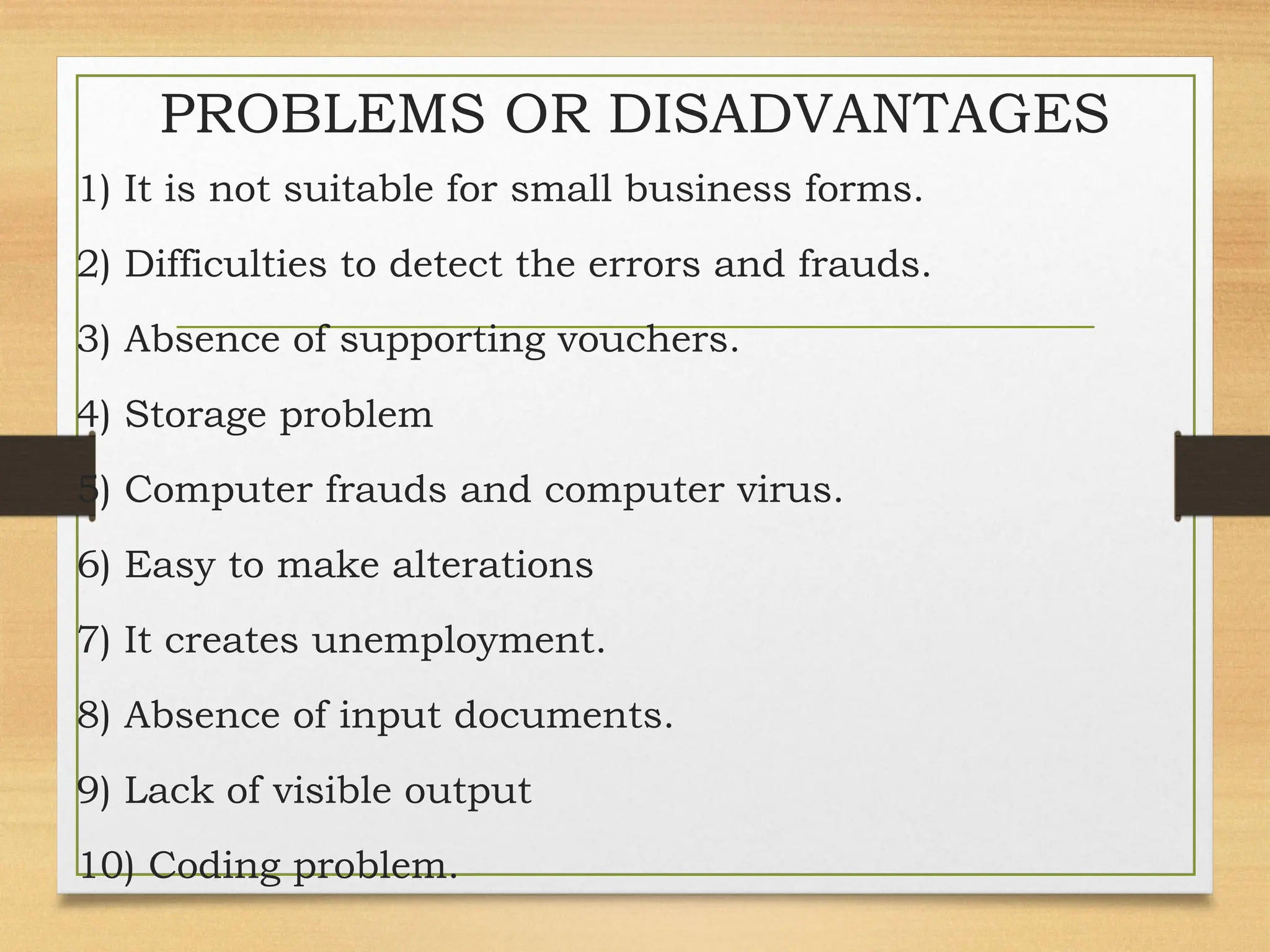
PROBLEMS OR DISADVANTAGES
1) It is not suitable for small business forms.
2) Difficulties to detect the errors and frauds.
3) Absence of supporting vouchers.
4) Storage problem
5) Computer frauds and computer virus.
6) Easy to make alterations
7) It creates unemployment.
8) Absence of input documents.
9) Lack of visible output
10) Coding problem.
AUDIT APPROACHES IN AN
EDP ENVIRONMENT
There are three approaches to auditing in
an EDP environment . They are
1)Auditing around the computer
2)Auditing with the computer
3)Auditing through the computer
AUDITING AROUND THE
COMPUTER
Auditing around the computer is an audit
approach under which an auditor carries out
the audit in the same way as in a traditional
or Manual system except that, instead of
examining hand written books, he examines
computer printouts.
Auditing with computers: -
• under this approach, the auditor does the
audit work with the help of computers that is
general software. Under this approach, audit
work is carried on in an traditional manner,
but the computer software is used for certain
operations.
Auditing through the computer
Auditing through the computer means
making use of computer in auditing. Under
this approach the auditor evaluates the
internal control relating to EDP and on the
basis of evaluation , he determines the nature
, timing , and extent of his sustentative
procedures.
INTERNAL CONTROL UNDER
AN EDP ENVIRONMENT
For the control of various problems connected with the
installation and operation of computers in accounting and
auditing, there should exist an adequate and satisfactory
internal control system in the undertaking . The internal
control system should be reliable , effective, and should
provide timely , authorized and required data from the
system. The various internal controls required to be
enforced under an EDP environment may be broadly
classified into two categories.
EDP environment
They are,
1) General EDP controls
2) EDP application controls
GENERAL EDP CONTROLS.
The purpose of general EDP control is to establish a
frame work of overall control over EDP activities. Some
of the important general EDP controls are,
1)Division of responsibility or duties.
2)Control over development and maintenance of software
3)Control over operators.
4)Control over data access and program access.
5) Control over editing of data.
6) Storage control.
7)Hardware control.
EDP APPLICATION
CONTROL
For the smooth working of EDP system,
besides the general EDP controls, there should
certain special EDP application controls. The
important EDP application controls are
1) Control over input
2) Control over processing
3) Output control
Professional Ethics in EDP
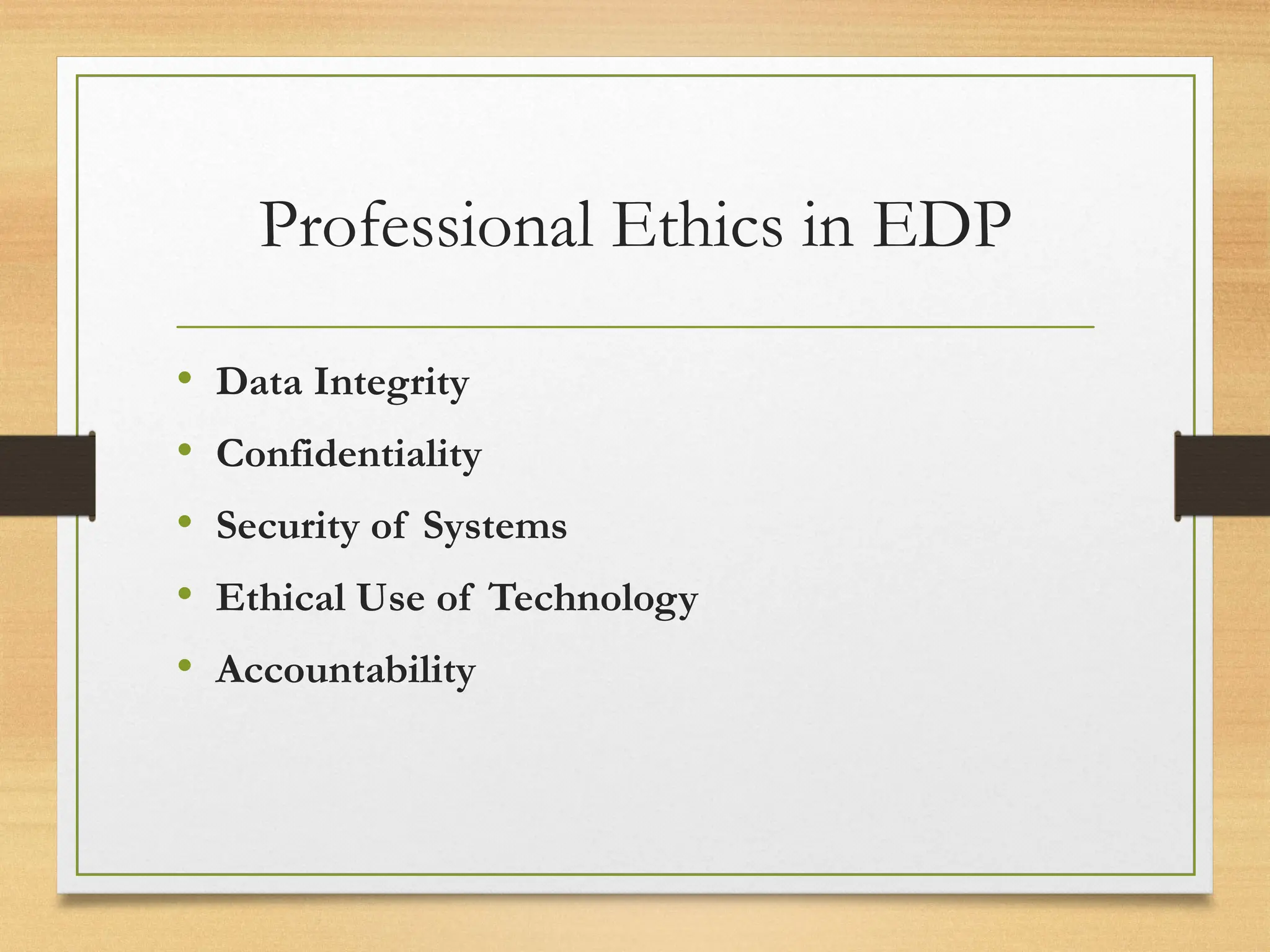
• Data Integrity
• Confidentiality
• Security of Systems
• Ethical Use of Technology
• Accountability
Professional Ethics in EDP
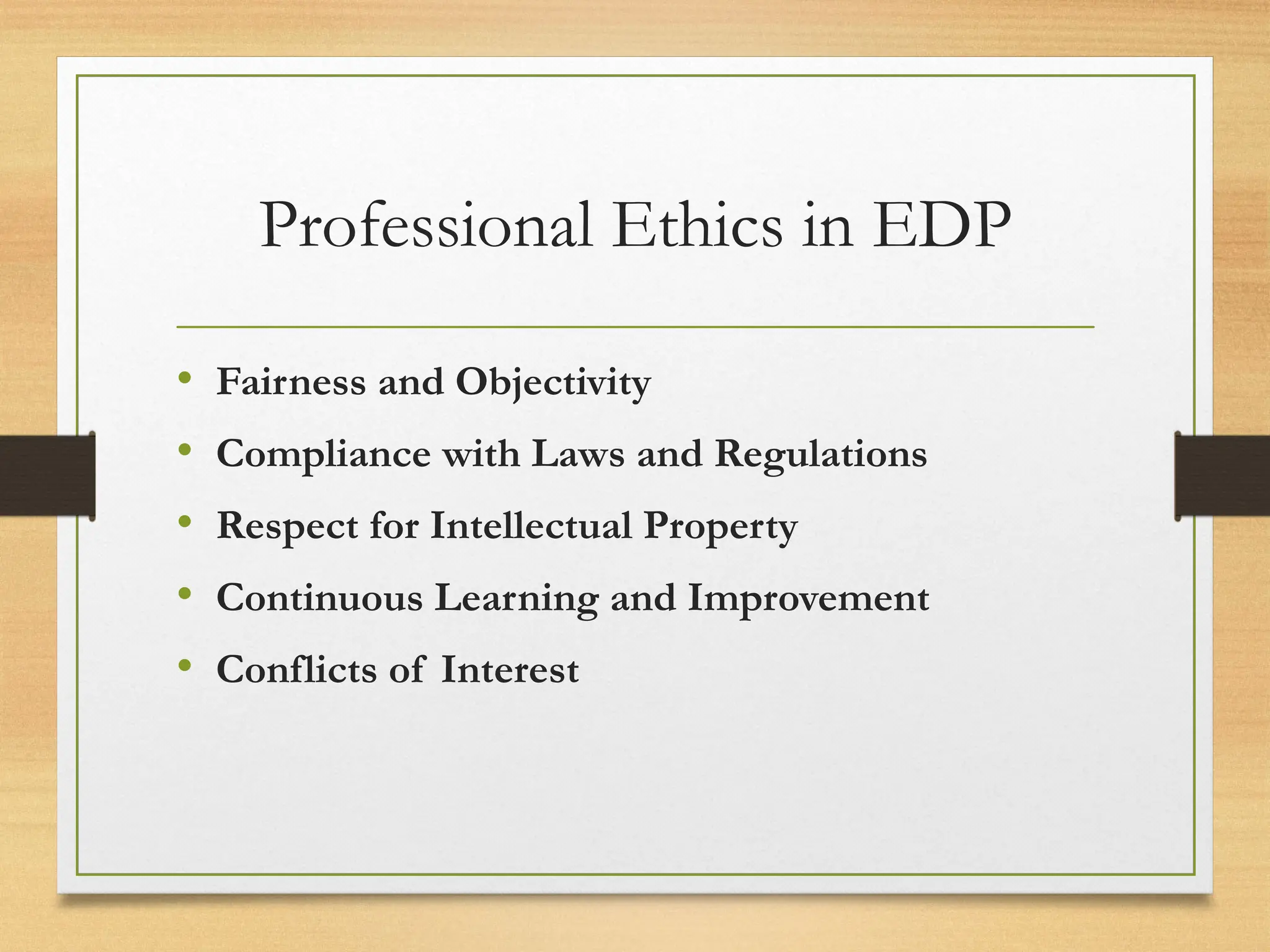
• Fairness and Objectivity
• Compliance with Laws and Regulations
• Respect for Intellectual Property
• Continuous Learning and Improvement
• Conflicts of Interest
EDP in Auditing - Benefits - Problems - Professional Ethics in EDP environment

  • 1.
    EDP Environment Mr.N.DEVARAM ASSISTANT PROFESSSOR SriRamakrishna College of Arts & Science
  • 2.
    EDP in Auditing •Auditing in an EDP (Electronic Data Processing) environment refers to the process of examining and evaluating computerized accounting systems and records. It involves reviewing automated processes, controls, and data stored or processed by computers to ensure reliability, accuracy, and compliance with standards.
  • 3.
    BENEFIT OF COMPUTERIZEDAUDIT 1) Speed : the work of recording of transactions , preparation of books , accounts can be done with greater speed. 2) Greater accuracy : the chances of arithmetical errors and human errors are reduced to minimum. 3) Greater economy: under the mechanized accounting system, work can be done with minimum staff, with minimum cost. 4) Better records: records prepared by machines are neat and clean. It is more legible, systematic and uniform. 5) Greater information : various types of information and statistical data regarding the operation of the business can be easily collected.
  • 4.
    6) Interim accounts: interim accounts can be prepared without delay. This will help the management to declare interim dividend. 7) Analysis of data : once the basic information is feed into the computers, it can be sorted in many different ways to provide analysis of statement . 8) Avoid overtime : the work of accounts are done quickly , the accounts can be prepared without any loss of time. 9) Reduction in audit fee: the work load of audit works is reduced by the computers. Hence the computerized audit reduces audit cost.
  • 5.
    BENEFIT OF COMPUTERIZED AUDIT 10)Computerized audit reduces the monotony of audit work 11) Computerized audit enhances the reliability of audit 12) Computerized audit ensures flexibility in the audit programme. 13)Computerized audit is helpful for the smooth functioning of auditing
  • 6.
    PROBLEMS OR DISADVANTAGES 1)It is not suitable for small business forms. 2) Difficulties to detect the errors and frauds. 3) Absence of supporting vouchers. 4) Storage problem 5) Computer frauds and computer virus. 6) Easy to make alterations 7) It creates unemployment. 8) Absence of input documents. 9) Lack of visible output 10) Coding problem.
  • 7.
    AUDIT APPROACHES INAN EDP ENVIRONMENT There are three approaches to auditing in an EDP environment . They are 1)Auditing around the computer 2)Auditing with the computer 3)Auditing through the computer
  • 8.
    AUDITING AROUND THE COMPUTER Auditingaround the computer is an audit approach under which an auditor carries out the audit in the same way as in a traditional or Manual system except that, instead of examining hand written books, he examines computer printouts.
  • 9.
    Auditing with computers:- • under this approach, the auditor does the audit work with the help of computers that is general software. Under this approach, audit work is carried on in an traditional manner, but the computer software is used for certain operations.
  • 10.
    Auditing through thecomputer Auditing through the computer means making use of computer in auditing. Under this approach the auditor evaluates the internal control relating to EDP and on the basis of evaluation , he determines the nature , timing , and extent of his sustentative procedures.
  • 11.
    INTERNAL CONTROL UNDER ANEDP ENVIRONMENT For the control of various problems connected with the installation and operation of computers in accounting and auditing, there should exist an adequate and satisfactory internal control system in the undertaking . The internal control system should be reliable , effective, and should provide timely , authorized and required data from the system. The various internal controls required to be enforced under an EDP environment may be broadly classified into two categories.
  • 12.
    EDP environment They are, 1)General EDP controls 2) EDP application controls
  • 13.
    GENERAL EDP CONTROLS. Thepurpose of general EDP control is to establish a frame work of overall control over EDP activities. Some of the important general EDP controls are, 1)Division of responsibility or duties. 2)Control over development and maintenance of software 3)Control over operators. 4)Control over data access and program access. 5) Control over editing of data. 6) Storage control. 7)Hardware control.
  • 14.
    EDP APPLICATION CONTROL For thesmooth working of EDP system, besides the general EDP controls, there should certain special EDP application controls. The important EDP application controls are 1) Control over input 2) Control over processing 3) Output control
  • 15.
    Professional Ethics inEDP • Data Integrity • Confidentiality • Security of Systems • Ethical Use of Technology • Accountability
  • 16.
    Professional Ethics inEDP • Fairness and Objectivity • Compliance with Laws and Regulations • Respect for Intellectual Property • Continuous Learning and Improvement • Conflicts of Interest