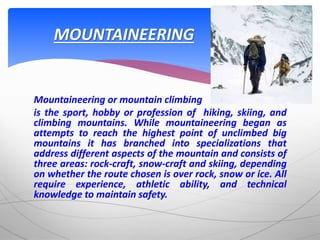
Mountaineering or mountain climbing
is the sport, hobby or profession of hiking, skiing, and
climbing mountains. While mountaineering began as
attempts to reach the highest point of unclimbed big
mountains it has branched into specializations that
address different aspects of the mountain and consists of
three areas: rock-craft, snow-craft and skiing, depending
on whether the route chosen is over rock, snow or ice. All
require experience, athletic ability, and technical
knowledge to maintain safety.
MOUNTAINEERING
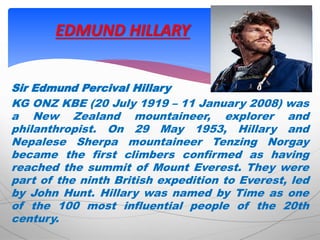
Sir Edmund Percival Hillary
KG ONZ KBE (20 July 1919 – 11 January 2008) was
a New Zealand mountaineer, explorer and
philanthropist. On 29 May 1953, Hillary and
Nepalese Sherpa mountaineer Tenzing Norgay
became the first climbers confirmed as having
reached the summit of Mount Everest. They were
part of the ninth British expedition to Everest, led
by John Hunt. Hillary was named by Time as one
of the 100 most influential people of the 20th
century.
EDMUND HILLARY
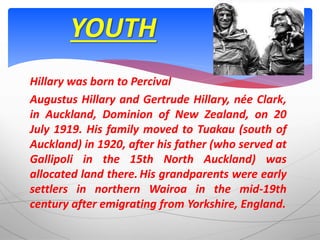
Hillary was born to Percival
Augustus Hillary and Gertrude Hillary, née Clark,
in Auckland, Dominion of New Zealand, on 20
July 1919. His family moved to Tuakau (south of
Auckland) in 1920, after his father (who served at
Gallipoli in the 15th North Auckland) was
allocated land there. His grandparents were early
settlers in northern Wairoa in the mid-19th
century after emigrating from Yorkshire, England.
YOUTH
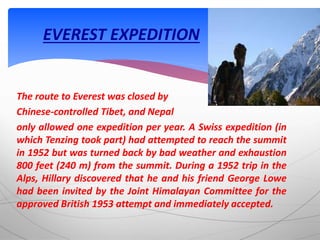
The route to Everest was closed by
Chinese-controlled Tibet, and Nepal
only allowed one expedition per year. A Swiss expedition (in
which Tenzing took part) had attempted to reach the summit
in 1952 but was turned back by bad weather and exhaustion
800 feet (240 m) from the summit. During a 1952 trip in the
Alps, Hillary discovered that he and his friend George Lowe
had been invited by the Joint Himalayan Committee for the
approved British 1953 attempt and immediately accepted.
EVEREST EXPEDITION
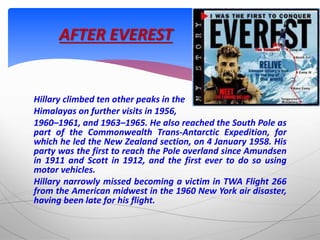
Hillary climbed ten other peaks in the
Himalayas on further visits in 1956,
1960–1961, and 1963–1965. He also reached the South Pole as
part of the Commonwealth Trans-Antarctic Expedition, for
which he led the New Zealand section, on 4 January 1958. His
party was the first to reach the Pole overland since Amundsen
in 1911 and Scott in 1912, and the first ever to do so using
motor vehicles.
Hillary narrowly missed becoming a victim in TWA Flight 266
from the American midwest in the 1960 New York air disaster,
having been late for his flight.
AFTER EVEREST
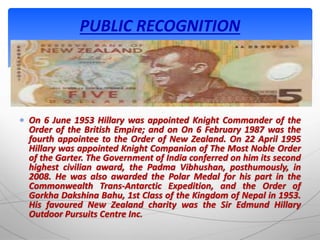
 On 6 June 1953 Hillary was appointed Knight Commander of the
Order of the British Empire; and on On 6 February 1987 was the
fourth appointee to the Order of New Zealand. On 22 April 1995
Hillary was appointed Knight Companion of The Most Noble Order
of the Garter. The Government of India conferred on him its second
highest civilian award, the Padma Vibhushan, posthumously, in
2008. He was also awarded the Polar Medal for his part in the
Commonwealth Trans-Antarctic Expedition, and the Order of
Gorkha Dakshina Bahu, 1st Class of the Kingdom of Nepal in 1953.
His favoured New Zealand charity was the Sir Edmund Hillary
Outdoor Pursuits Centre Inc.
PUBLIC RECOGNITION
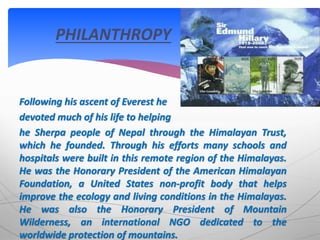
Following his ascent of Everest he
devoted much of his life to helping
he Sherpa people of Nepal through the Himalayan Trust,
which he founded. Through his efforts many schools and
hospitals were built in this remote region of the Himalayas.
He was the Honorary President of the American Himalayan
Foundation, a United States non-profit body that helps
improve the ecology and living conditions in the Himalayas.
He was also the Honorary President of Mountain
Wilderness, an international NGO dedicated to the
worldwide protection of mountains.
PHILANTHROPY
On 11 January 2008, Hillary died of heart failure at the
Auckland City Hospital at around 9 am NZDT (10
January at 20:00 UTC) at the age of 88.Hillary's death
was announced by New Zealand Prime Minister Helen
Clark at around 11:20 am. She stated that his death
was a "profound loss to New Zealand". His death was
recognised by the lowering of flags to half-mast on all
Government and public buildings and at Scott Base in
Antarctica.Actor and adventurer Brian Blessed, who
attempted to climb Everest three times, described Sir
Edmund as a "kind of titan". He was in hospital at the
time of his death but was expected to come home that
day according to his family.
DEATH
MADEBY- ASHISHKUMAR
SUBJECT-ENGLISH
TOPIC-MOUNTAINEER
CLASS-VIII-A
SUBJECTTEACHER-MRS. BINDUSINHA

Edmund hillary

  • 2.
    Mountaineering or mountainclimbing is the sport, hobby or profession of hiking, skiing, and climbing mountains. While mountaineering began as attempts to reach the highest point of unclimbed big mountains it has branched into specializations that address different aspects of the mountain and consists of three areas: rock-craft, snow-craft and skiing, depending on whether the route chosen is over rock, snow or ice. All require experience, athletic ability, and technical knowledge to maintain safety. MOUNTAINEERING
  • 3.
    Sir Edmund PercivalHillary KG ONZ KBE (20 July 1919 – 11 January 2008) was a New Zealand mountaineer, explorer and philanthropist. On 29 May 1953, Hillary and Nepalese Sherpa mountaineer Tenzing Norgay became the first climbers confirmed as having reached the summit of Mount Everest. They were part of the ninth British expedition to Everest, led by John Hunt. Hillary was named by Time as one of the 100 most influential people of the 20th century. EDMUND HILLARY
  • 4.
    Hillary was bornto Percival Augustus Hillary and Gertrude Hillary, née Clark, in Auckland, Dominion of New Zealand, on 20 July 1919. His family moved to Tuakau (south of Auckland) in 1920, after his father (who served at Gallipoli in the 15th North Auckland) was allocated land there. His grandparents were early settlers in northern Wairoa in the mid-19th century after emigrating from Yorkshire, England. YOUTH
  • 5.
    The route toEverest was closed by Chinese-controlled Tibet, and Nepal only allowed one expedition per year. A Swiss expedition (in which Tenzing took part) had attempted to reach the summit in 1952 but was turned back by bad weather and exhaustion 800 feet (240 m) from the summit. During a 1952 trip in the Alps, Hillary discovered that he and his friend George Lowe had been invited by the Joint Himalayan Committee for the approved British 1953 attempt and immediately accepted. EVEREST EXPEDITION
  • 6.
    Hillary climbed tenother peaks in the Himalayas on further visits in 1956, 1960–1961, and 1963–1965. He also reached the South Pole as part of the Commonwealth Trans-Antarctic Expedition, for which he led the New Zealand section, on 4 January 1958. His party was the first to reach the Pole overland since Amundsen in 1911 and Scott in 1912, and the first ever to do so using motor vehicles. Hillary narrowly missed becoming a victim in TWA Flight 266 from the American midwest in the 1960 New York air disaster, having been late for his flight. AFTER EVEREST
  • 7.
     On 6June 1953 Hillary was appointed Knight Commander of the Order of the British Empire; and on On 6 February 1987 was the fourth appointee to the Order of New Zealand. On 22 April 1995 Hillary was appointed Knight Companion of The Most Noble Order of the Garter. The Government of India conferred on him its second highest civilian award, the Padma Vibhushan, posthumously, in 2008. He was also awarded the Polar Medal for his part in the Commonwealth Trans-Antarctic Expedition, and the Order of Gorkha Dakshina Bahu, 1st Class of the Kingdom of Nepal in 1953. His favoured New Zealand charity was the Sir Edmund Hillary Outdoor Pursuits Centre Inc. PUBLIC RECOGNITION
  • 8.
    Following his ascentof Everest he devoted much of his life to helping he Sherpa people of Nepal through the Himalayan Trust, which he founded. Through his efforts many schools and hospitals were built in this remote region of the Himalayas. He was the Honorary President of the American Himalayan Foundation, a United States non-profit body that helps improve the ecology and living conditions in the Himalayas. He was also the Honorary President of Mountain Wilderness, an international NGO dedicated to the worldwide protection of mountains. PHILANTHROPY
  • 9.
    On 11 January2008, Hillary died of heart failure at the Auckland City Hospital at around 9 am NZDT (10 January at 20:00 UTC) at the age of 88.Hillary's death was announced by New Zealand Prime Minister Helen Clark at around 11:20 am. She stated that his death was a "profound loss to New Zealand". His death was recognised by the lowering of flags to half-mast on all Government and public buildings and at Scott Base in Antarctica.Actor and adventurer Brian Blessed, who attempted to climb Everest three times, described Sir Edmund as a "kind of titan". He was in hospital at the time of his death but was expected to come home that day according to his family. DEATH
  • 11.