Yes, but…
EDLA 615
Misconceptions…
• The need to “teach to the test” – as if the only
way to raise test scores causes us to “teach
worse”. (p. 306 Wiggins & McTigue)
• “The bottom line is that we should be
teaching to standards and developing the
kinds of complex assessments reflected in the
language of the standards”. (p.309 Wiggins &
McTigue)
Misconceptions…
• There’s too much content to be taught…
• “Content standards were intended to specify
what is most important for students to know
and be able to do, thus providing a much-
needed focus and prioritization for curriculum,
instruction and assessment.” (p.309).
• Remember, the textbook is a resource.
TIMSS
• Trends in International Mathematics and Science Study
• provides reliable and timely data on the mathematics
and science achievement of U.S. 4th- and 8th-grade
students compared to that of students in other
countries. TIMSS data have been collected in 1995,
1999, 2003, 2007, and 2011. The next data collection is
in 2015.
• Average Performance of U.S. Students Relative to
International Peers on the Most Recent International
Assessments in Reading, Mathematics, and Science:
Results from PIRLS 2006, TIMSS 2007, and PISA 2009
Misconceptions…
• There’s not enough time to do everything
• The authors suggest –
• Each year, interested parties in every school
must ask themselves..
• “What approaches to curriculum design,
teaching and assessing actually yield the
greatest student learning”? (p.317)
• “Let the local research focus on a single unit –
small in scope but deep”. (p.317)
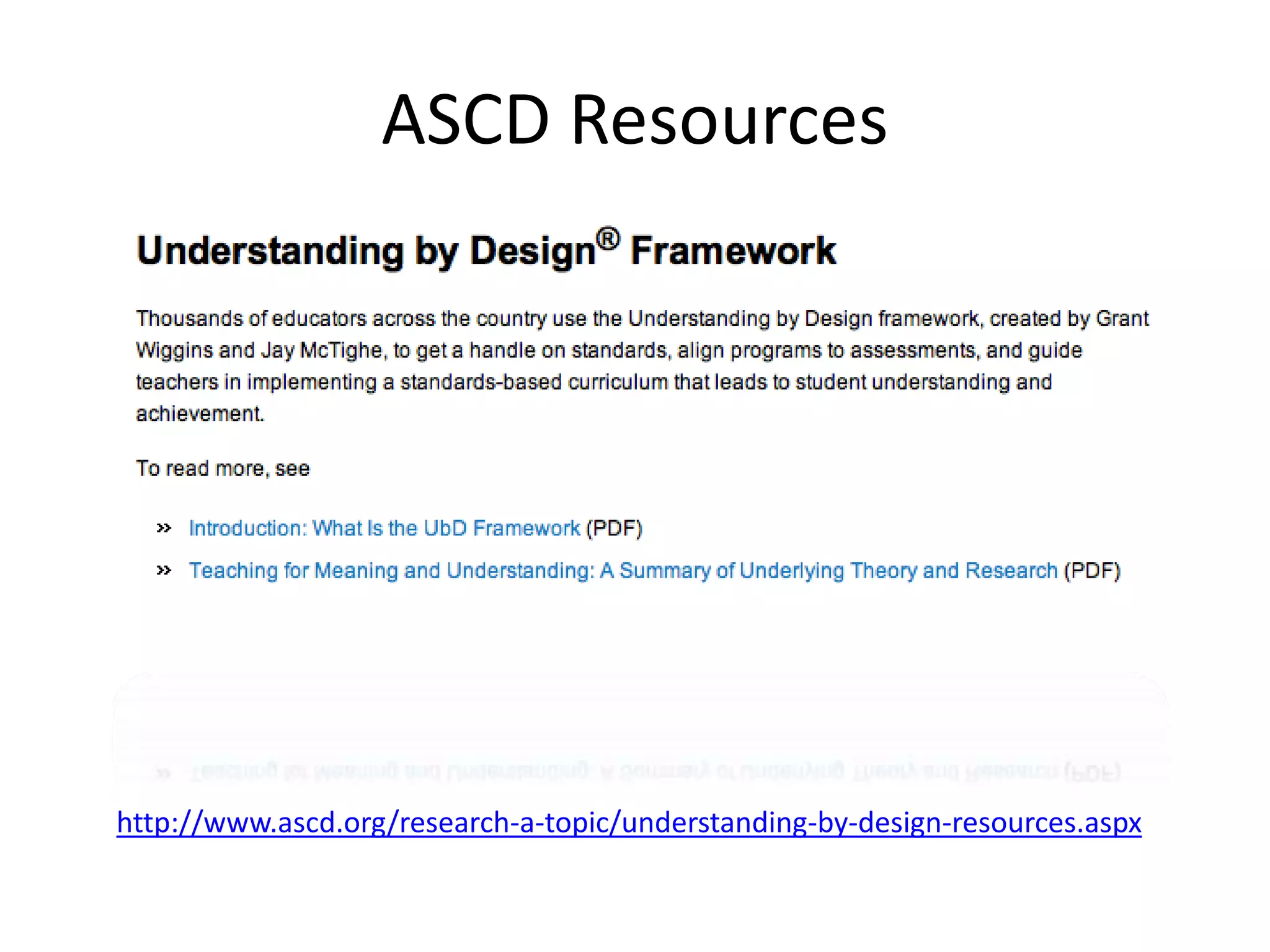
ASCD Resources
http://www.ascd.org/research-a-topic/understanding-by-design-resources.aspx
Your Role as a technology coach
• When you become a tech coach, ask for
planning periods to be a part of your schedule
• Work with teachers on how technology can be
incorporated into their content area.
• Both “push-in” support and individual support
are needed
Be a good listener
• Listen to their needs, and determine what
technology (if any!) can support their goals
Learning comes first, not tools
• Ask colleagues for recommendations
• Take it for a test drive
• Brainstorm potential lessons
• Explore available support
• Look for teacher reviews online
ISTE NETS-C
http://www.iste.org/standards/standards-for-coaches
• Chief Information Officer
• Career Counselor
• Computerized 3 D Modeling
Machinist
• Senior Technology Security
• Molecular Beam Epitaxy
Technician and/or Engineer
• Epitaxial Engineer
• DNA Lab Technician
• Nano-Technician
• Endoscopy Technician
• Bio-Engineer
• Instrumentation Technician
• Intermediate Biomedical
Engineer Technician
• Medical Ethicist
• Sarbanes-Oxley Auditor
• GEO Technical Technician
• Quality Process Engineer
• Fabrication Operator Wafer
• Optical Maintenance Technician
• Office Space Coordinator
• NOC Specialist (Fiber Optics
Technician)
• Telecommunications Engineer
• Optical Manufacturing Technician
• Controls Technician
• Administrative Eligibility
Specialist
• Computer Forensic Analyst
What Are The New Jobs?
Jobs That Will Boom In 2020
1. Data Crunching
2. Counseling and Therapy
3. Scientific Research
4. Computer Engineering
5. Veterinarians
6. Environmental and Conservation Science
7. Healthcare fields
8. Management
9. Finance
10. Entrepreneurship
Source: Newman, R. “10 Businesses that Will Boom in 2020,” U.S. News, September 2012
#1: Sense-Making:
DEFINITION: ability to determine the
deeper meaning or significance of
what is being expressed
Future
Work
Skills
2020
http://cdn.theatlantic.com/static/front/docs/sponsored/phoenix/future_work_skills_2020.pdf
#2: Social Intelligence
DEFINITION: ability to connect to
others in a deep and direct way, to
sense and stimulate reactions and
desired interactions
#3: Novel and Adaptive Thinking
DEFINITION: proficiency at
thinking and coming up with
solutions and responses beyond
that which is rote or rule-based
Lucrative Careers for 2030
1. Digital Architect: Designs a selection of virtual buildings for advertisers and
retailer to market their products
2. Home Carer: Helps care for elderly people in their own homes
3. Elderly Well-Being Consultant: Specializes in holistic and personalized care
for the elderly
4. Body Part Maker: Creates living body parts for soldiers and athletes
5. Nano-medic: Creates very small implants for health monitoring and self-
medication
6. Vertical Farmer: Farms crops upwards rather than across flat fields to save
space
7. Waste Data Handler: Disposes of your data waste in a responsible way
8. Climate Controller: Manages and modifies weather patterns
9. Personal Branding Manager: Develops and manages your personal brand
10. Time Broker: Handles time banked by customer in lieu of money for goods or
services
Source: Winch, J. “!0 Well Paid Jobs of the Future,” The Telegraph, February 2013)
Technology Skills?
CCSS Trivia:
The words
“technology”
“digital”
and
“multimedia”
appear in the
Common Core
State Standards
approximately
____ times.86
The Common Core State Standards:
Reach Higher, Teach Clearly, Learn Deeply
Which word appears in the ELA
standards 122 times?
Sources: 61 times
Research: 57 times
Evidence
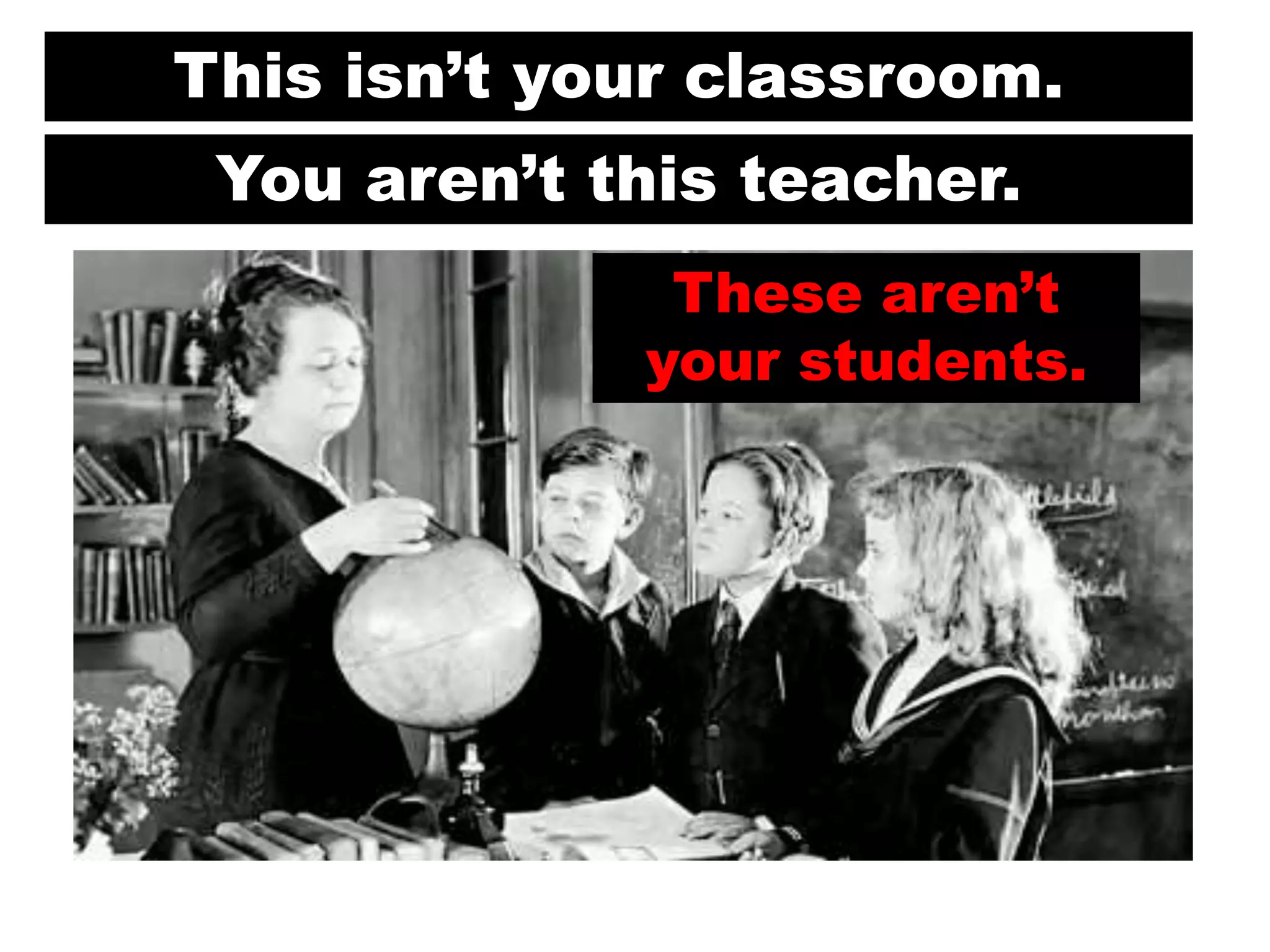
You aren’t this teacher.
This isn’t your classroom.
These aren’t
your students.
Here’s What We Know…
Create - requiring deep
consideration of audience,
purpose, structure, text features,
and format.
Collaborate - forcing students to
plan, adopt, adapt, rethink, and
revise, all higher-level practices.
Evaluate - necessitating that
students make critical judgment
calls about how information is
presented and shared.
Integrate - emphasizing design,
and producing considerable
cognitive load on a learner.
What is
digital
literacy?
Padlet link here
“Digital literacy is imperative for America’s economic future
and possessing these skills is absolutely essential for
accessing the jobs and education opportunities that will enable
current and future generations to compete in the 21st century
workforce.”
…”in the U.S. today, more than 80 percent of Fortune 500
companies post their job openings online only and require
online applications.”
…”Fifty percent of today’s jobs require technology skills, and
this percentage is expected to grow to 77 percent in the next
decade.”
Source: Mike Bolognini, July 1, 2013: Digital Literacy is Imperative for America’s Economic Future
Students who are digitally literate:
What’s the Connection Between CCSS and Digital Literacy?
ALA Definition of Digital Literacy
…_______________ digital information in a variety of
formats.
…use relevant ___________ to judge the quality of the
information.
…use these skills and the appropriate technologies to
_______ and collaborate with others.
…use diverse technologies appropriately, effectively
and ________ to search for information..
Students who are digitally literate:
What’s the Connection Between CCSS and Digital Literacy?
ALA Definition of Digital Literacy
…evaluate digital information in a variety of formats.
…use relevant evidence to judge the quality of the
information.
…use these skills and the appropriate technologies to
communicate and collaborate with others.
…use diverse technologies appropriately, effectively
and strategically to search for information.
A digitally literate person:
● possesses the variety of skills—cognitive
and technical—required to find,
understand, evaluate, create, and
communicate digital information in a wide
variety of formats;
● is able to use diverse technologies
appropriately, effectively and strategically
to search for and retrieve information,
interpret search results, and uses relevant
evidence to judge the quality of the
information retrieved;
● uses these skills and the appropriate
technologies to communicate and
collaborate with peers, colleagues, family,
and on occasion the general public;
● uses these skills to participate actively in
civic society and contribute to a vibrant,
informed, and engaged community.
30
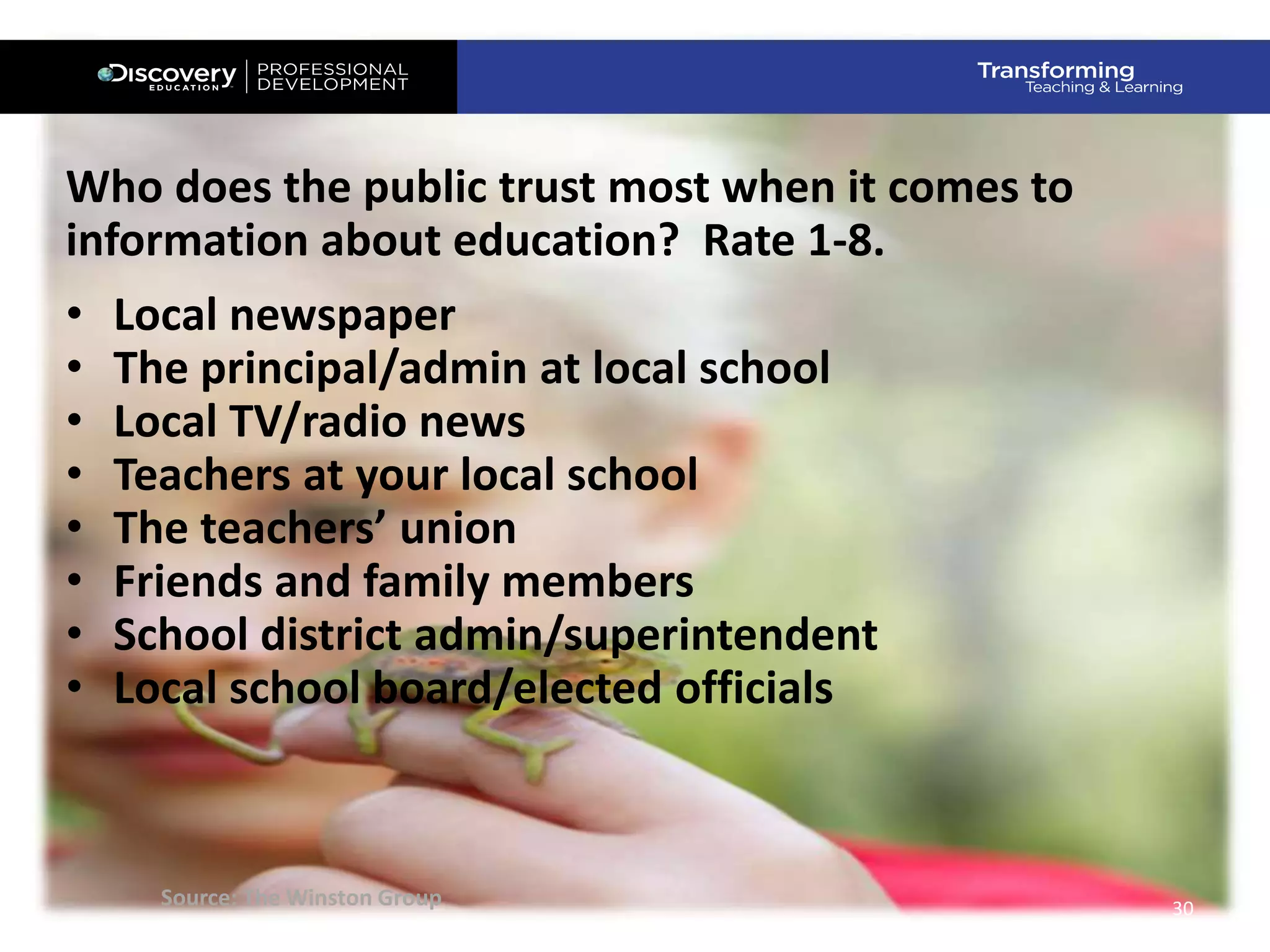
Who does the public trust most when it comes to
information about education? Rate 1-8.
• Local newspaper
• The principal/admin at local school
• Local TV/radio news
• Teachers at your local school
• The teachers’ union
• Friends and family members
• School district admin/superintendent
• Local school board/elected officials
Source: The Winston Group
31
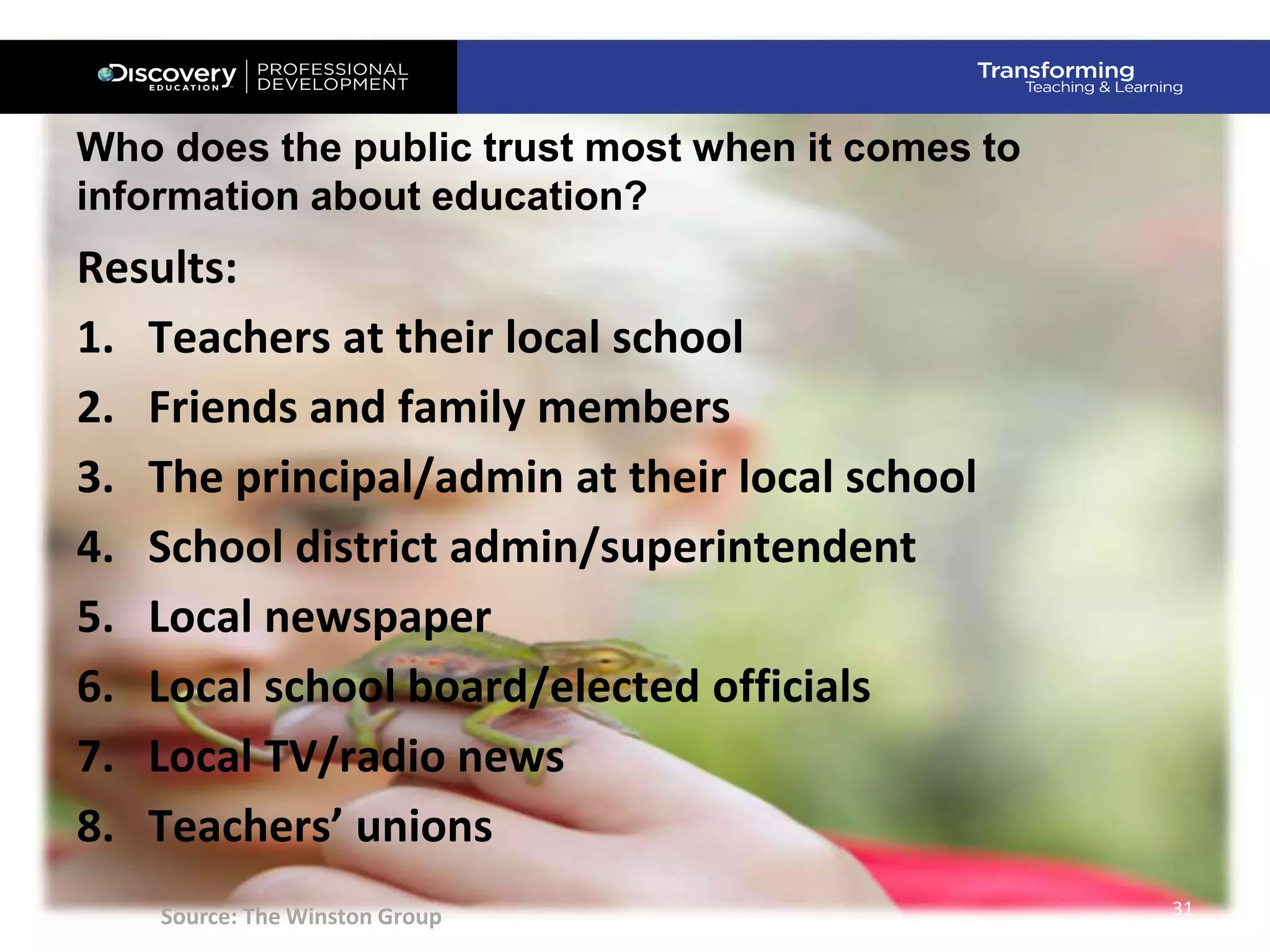
Who does the public trust most when it comes to
information about education?
Results:
1. Teachers at their local school
2. Friends and family members
3. The principal/admin at their local school
4. School district admin/superintendent
5. Local newspaper
6. Local school board/elected officials
7. Local TV/radio news
8. Teachers’ unions
Source: The Winston Group
Confirmed vs. MythBuster
VS..
Confirmed vs. Myth
?
Confirmed vs. Myth
?
Confirmed vs. Myth
?
“Argument” and “Persuasion”
When writing to persuade, writers employ a variety of
persuasive strategies. One common strategy is an appeal to
the credibility, character, or authority of the writer (or speaker).
When writers establish that they are knowledgeable and
trustworthy, audiences are more likely to believe what they
say. Another is an appeal to the audience’s self-interest,
sense of identity, or emotions, any of which can sway an
audience.
A logical argument, on the other hand, convinces the
audience because of the perceived merit and reasonableness
of the claims and proofs offered rather than either the
emotions the writing evokes in the audience or the character
or credentials of the writer. The Standards place special
emphasis on writing logical arguments as a particularly
important form of college- and career-ready writing.
Confirmed vs. Myth
?
Confirmed vs. Myth
?
Complexity is a key aspect of rigor.
Confirmed vs. Myth
?
Confirmed vs. Myth
?
Complexity is a key aspect of rigor.
Confirmed vs. Myth
?
Confirmed vs. Myth
?

Edla615

  • 1.
  • 2.
    Misconceptions… • The needto “teach to the test” – as if the only way to raise test scores causes us to “teach worse”. (p. 306 Wiggins & McTigue) • “The bottom line is that we should be teaching to standards and developing the kinds of complex assessments reflected in the language of the standards”. (p.309 Wiggins & McTigue)
  • 3.
    Misconceptions… • There’s toomuch content to be taught… • “Content standards were intended to specify what is most important for students to know and be able to do, thus providing a much- needed focus and prioritization for curriculum, instruction and assessment.” (p.309). • Remember, the textbook is a resource.
  • 4.
    TIMSS • Trends inInternational Mathematics and Science Study • provides reliable and timely data on the mathematics and science achievement of U.S. 4th- and 8th-grade students compared to that of students in other countries. TIMSS data have been collected in 1995, 1999, 2003, 2007, and 2011. The next data collection is in 2015. • Average Performance of U.S. Students Relative to International Peers on the Most Recent International Assessments in Reading, Mathematics, and Science: Results from PIRLS 2006, TIMSS 2007, and PISA 2009
  • 6.
    Misconceptions… • There’s notenough time to do everything • The authors suggest – • Each year, interested parties in every school must ask themselves.. • “What approaches to curriculum design, teaching and assessing actually yield the greatest student learning”? (p.317) • “Let the local research focus on a single unit – small in scope but deep”. (p.317)
  • 7.
  • 8.
    Your Role asa technology coach • When you become a tech coach, ask for planning periods to be a part of your schedule • Work with teachers on how technology can be incorporated into their content area. • Both “push-in” support and individual support are needed
  • 9.
    Be a goodlistener • Listen to their needs, and determine what technology (if any!) can support their goals
  • 10.
    Learning comes first,not tools • Ask colleagues for recommendations • Take it for a test drive • Brainstorm potential lessons • Explore available support • Look for teacher reviews online
  • 11.
  • 12.
    • Chief InformationOfficer • Career Counselor • Computerized 3 D Modeling Machinist • Senior Technology Security • Molecular Beam Epitaxy Technician and/or Engineer • Epitaxial Engineer • DNA Lab Technician • Nano-Technician • Endoscopy Technician • Bio-Engineer • Instrumentation Technician • Intermediate Biomedical Engineer Technician • Medical Ethicist • Sarbanes-Oxley Auditor • GEO Technical Technician • Quality Process Engineer • Fabrication Operator Wafer • Optical Maintenance Technician • Office Space Coordinator • NOC Specialist (Fiber Optics Technician) • Telecommunications Engineer • Optical Manufacturing Technician • Controls Technician • Administrative Eligibility Specialist • Computer Forensic Analyst What Are The New Jobs?
  • 13.
    Jobs That WillBoom In 2020 1. Data Crunching 2. Counseling and Therapy 3. Scientific Research 4. Computer Engineering 5. Veterinarians 6. Environmental and Conservation Science 7. Healthcare fields 8. Management 9. Finance 10. Entrepreneurship Source: Newman, R. “10 Businesses that Will Boom in 2020,” U.S. News, September 2012
  • 14.
    #1: Sense-Making: DEFINITION: abilityto determine the deeper meaning or significance of what is being expressed Future Work Skills 2020 http://cdn.theatlantic.com/static/front/docs/sponsored/phoenix/future_work_skills_2020.pdf #2: Social Intelligence DEFINITION: ability to connect to others in a deep and direct way, to sense and stimulate reactions and desired interactions #3: Novel and Adaptive Thinking DEFINITION: proficiency at thinking and coming up with solutions and responses beyond that which is rote or rule-based
  • 15.
    Lucrative Careers for2030 1. Digital Architect: Designs a selection of virtual buildings for advertisers and retailer to market their products 2. Home Carer: Helps care for elderly people in their own homes 3. Elderly Well-Being Consultant: Specializes in holistic and personalized care for the elderly 4. Body Part Maker: Creates living body parts for soldiers and athletes 5. Nano-medic: Creates very small implants for health monitoring and self- medication 6. Vertical Farmer: Farms crops upwards rather than across flat fields to save space 7. Waste Data Handler: Disposes of your data waste in a responsible way 8. Climate Controller: Manages and modifies weather patterns 9. Personal Branding Manager: Develops and manages your personal brand 10. Time Broker: Handles time banked by customer in lieu of money for goods or services Source: Winch, J. “!0 Well Paid Jobs of the Future,” The Telegraph, February 2013)
  • 16.
  • 17.
    CCSS Trivia: The words “technology” “digital” and “multimedia” appearin the Common Core State Standards approximately ____ times.86
  • 18.
    The Common CoreState Standards: Reach Higher, Teach Clearly, Learn Deeply Which word appears in the ELA standards 122 times? Sources: 61 times Research: 57 times Evidence
  • 19.
    You aren’t thisteacher. This isn’t your classroom. These aren’t your students.
  • 20.
  • 21.
  • 22.
    Create - requiringdeep consideration of audience, purpose, structure, text features, and format. Collaborate - forcing students to plan, adopt, adapt, rethink, and revise, all higher-level practices. Evaluate - necessitating that students make critical judgment calls about how information is presented and shared. Integrate - emphasizing design, and producing considerable cognitive load on a learner.
  • 24.
  • 25.
    “Digital literacy isimperative for America’s economic future and possessing these skills is absolutely essential for accessing the jobs and education opportunities that will enable current and future generations to compete in the 21st century workforce.” …”in the U.S. today, more than 80 percent of Fortune 500 companies post their job openings online only and require online applications.” …”Fifty percent of today’s jobs require technology skills, and this percentage is expected to grow to 77 percent in the next decade.” Source: Mike Bolognini, July 1, 2013: Digital Literacy is Imperative for America’s Economic Future
  • 26.
    Students who aredigitally literate: What’s the Connection Between CCSS and Digital Literacy? ALA Definition of Digital Literacy …_______________ digital information in a variety of formats. …use relevant ___________ to judge the quality of the information. …use these skills and the appropriate technologies to _______ and collaborate with others. …use diverse technologies appropriately, effectively and ________ to search for information..
  • 27.
    Students who aredigitally literate: What’s the Connection Between CCSS and Digital Literacy? ALA Definition of Digital Literacy …evaluate digital information in a variety of formats. …use relevant evidence to judge the quality of the information. …use these skills and the appropriate technologies to communicate and collaborate with others. …use diverse technologies appropriately, effectively and strategically to search for information.
  • 28.
    A digitally literateperson: ● possesses the variety of skills—cognitive and technical—required to find, understand, evaluate, create, and communicate digital information in a wide variety of formats; ● is able to use diverse technologies appropriately, effectively and strategically to search for and retrieve information, interpret search results, and uses relevant evidence to judge the quality of the information retrieved; ● uses these skills and the appropriate technologies to communicate and collaborate with peers, colleagues, family, and on occasion the general public; ● uses these skills to participate actively in civic society and contribute to a vibrant, informed, and engaged community.
  • 30.
    30 Who does thepublic trust most when it comes to information about education? Rate 1-8. • Local newspaper • The principal/admin at local school • Local TV/radio news • Teachers at your local school • The teachers’ union • Friends and family members • School district admin/superintendent • Local school board/elected officials Source: The Winston Group
  • 31.
    31 Who does thepublic trust most when it comes to information about education? Results: 1. Teachers at their local school 2. Friends and family members 3. The principal/admin at their local school 4. School district admin/superintendent 5. Local newspaper 6. Local school board/elected officials 7. Local TV/radio news 8. Teachers’ unions Source: The Winston Group
  • 32.
  • 33.
  • 34.
  • 35.
  • 36.
    “Argument” and “Persuasion” Whenwriting to persuade, writers employ a variety of persuasive strategies. One common strategy is an appeal to the credibility, character, or authority of the writer (or speaker). When writers establish that they are knowledgeable and trustworthy, audiences are more likely to believe what they say. Another is an appeal to the audience’s self-interest, sense of identity, or emotions, any of which can sway an audience. A logical argument, on the other hand, convinces the audience because of the perceived merit and reasonableness of the claims and proofs offered rather than either the emotions the writing evokes in the audience or the character or credentials of the writer. The Standards place special emphasis on writing logical arguments as a particularly important form of college- and career-ready writing.
  • 37.
  • 38.
  • 39.
    Complexity is akey aspect of rigor. Confirmed vs. Myth ?
  • 40.
    Confirmed vs. Myth ? Complexityis a key aspect of rigor.
  • 41.
  • 42.

Editor's Notes

  • #6 What resonated with you? For me, there are two things.
  • #14 Here are some of the things that resonate with me: changing landscape of jobs.
  • #19 Let’s look at some Common Core trivia.
  • #20 Here’s the second thing that resonated with me. Read slide. The unpredictability of the job markets parallels with the unpredictability and changing profile of our students. Here are some things we know.
  • #21 We have data that shows how students spend their time…A recent profile of today’s students showed.
  • #22 We also know that our educational targets are requiring that all students are college and career ready. The Common Core State Standards are about preparing all students to be college and career ready.
  • #23 The 4 big ideas of the Common Core…
  • #25 Work in pairs to research a definition of digital literacy… paste definition in padlet. Discuss commonalities of posted definitions
  • #27 http://www.youtube.com/watch?v=X5ySocUyI7I Does this sound familiar?
  • #28 http://www.youtube.com/watch?v=X5ySocUyI7I Does this sound familiar?
  • #29 Definition from ALA
  • #31  Discuss these questions among your table and write down your answers.
  • #32 Note that teachers report that they trust principals the most. The public also reports that they’d like more coverage of education issues. What do they get now? Sports, crime, events. Very little about academics.
  • #33 Myths:
  • #35 The standards are for ALL students. The standards address students with special needs in several ways.
  • #36 The standards are for ALL students. The standards address students with special needs in several ways.
  • #39 Technology can quickly become yesterday’s diorama if the learning targets aren’t clear.
  • #43 Ask for justification. Discuss examples of something that is difficult, but not complex (i.e., a math problem)