PROCESS REDESIGN
Richard Winters MD FACEP
Chairman, Dept of Emergency Medicine
Saint Agnes Medical Center
Fresno CA
Emergency Department
Improving ED Patient Experience Through Expedited Door to Doctor Time
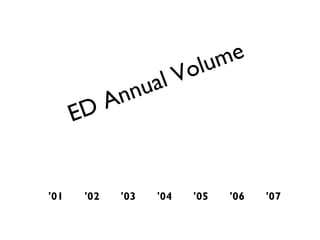
49 k
52 k
53 k 54 k
59 k
61 k
66 k
'01 '02 '03 '04 '05 '06 '07
ED Annual Volume
Results were Immediate.
200
Left Without
Being Seen
13%
Left Without
Being Seen
1%
84
14
16
10
Pre Post
Bed to MD
Arrival to Bed
Minutes to Provider
90
24
14
1
3
5
1
11
1
Pre Post
Patient Satisfaction
Security
Incidents
26month
Security
Incidents
16month
Home
1 hour 20 minutes
Faster
Admits
2 hours
Faster
Redesign Process
Golden Rules of Intake
QUESTIONS?
Richard Winters MD FACEP
Saint Agnes Medical Center
Fresno CA

ED Process Redesign

Editor's Notes

  • #2 Our ED process redesign began in December of this past year. Brief summary of how we have improved the care of our patients. We decreased the wait times to see physicians. We decreased the cycle times (how long patients are in the department). We decreased the numbers of patients left without being seen. Specifically Process Redesign. Obviously no new ED. No extra nurses or techs. No additional FTEs. Partnership of individuals involved. Active involvement of administration, techs, physicians, nurses, security.
  • #3 33% increase in volume since 2001, 8% increase between 2006 and 2007, and we are on track to see 70K this year UMC closed April 2007, New ED opened in 2005 Amidst a nursing shortage. Amidst a limited physical plant. 70 minute door to doctor time, LWBS 25 patients per day, 3000 to 7000 displaced inpatient care hours, 5150 from 3 to 30 patients/month Patient satisfaction scores in the red Why the volume has risen so much? Are there more Primary Care MDs or less? Are patients demanding higher tech or lower tech? Is the population growing? Is medicine getting more complex? So what can we do to see an increasing volume of patients.
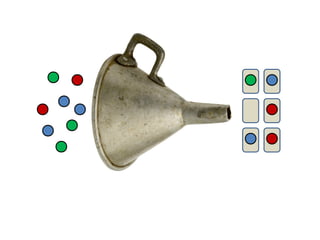
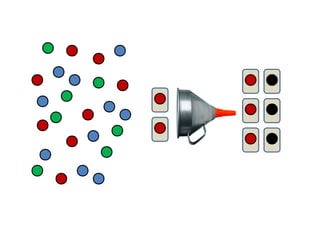
  • #4 This is the old ED process. The same process designed in the mid-1970s. Rusty old funnel represents triage. On the left side is the waiting room and the right are the coveted ED beds. What happens when you get a bed? What happens when the beds are full and only one opens up? What happens when we a short a nurse? When we are holding admissions in the ED? When the lab is delayed because it hasn’t been drawn? When the volume of patients increases by 8%? How satisfied are the patients? The nurses and staff?
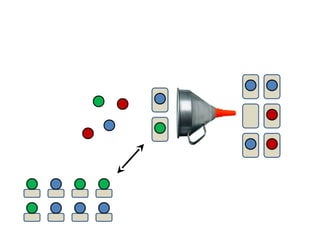
  • #5 Care has centered around the availability of a gurney, a bed. No gurney, no care. Would it be nice to have a gurney and nurse for every patient? Yes. Is it possible amidst limited resources? No.
  • #6 The heart of our new process is a group of eight beds that we call “intake beds”. 4 beds are staffed by a nurse practitioner and four beds are staffed by an emergency physician. The nurse practitioner sees the lower acuity coughs, runny noses and finger lacerations. The physician sees the others. In these beds we get things started. In these beds we can often provide all the care a patient needs. No more waiting for hours to get thing started. Each of these four beds is staffed by 2 nurses, a tech, a phlebotomist and a registration clerk. This is a location of flow. There is a time limit of 20 minutes per patient. So the physician has 5 minutes to spend with each of the patients in his or her intake area. We frontload care. We start IV’s give fluids and medicines, order and draw blood tests and xrays. Things get done.
  • #7 When they are done with the intake process they either go to an emergency department bed or they go to a chair in our sublobby to await results and further care.
  • #8 No longer is a bed required for care. Patients don’t have to wait for care to start.
  • #10 200 patients came to our ED each day pre- process change. 200 patients come to our ED post-process change. Now we see them all.
  • #11 However, pre-process change 25 patients would leave before being seen, before receiving care. The Trinity goal is 2%. Community has rates in the upper teens.
  • #12 Post process change 2 patients leave each day. Assuming average collections of $300 per outpatient > $225,000/month > $2.7 million per year
  • #13 Pre: 31% of patients were seen within 30 minutes Post: 78% of patients are being seen within 30 minutes
  • #14 18 categories Confidence and Trust in Physicians was in the 60s and went to the 90s Nurses in the 60s and went to the upper 80s There is a big difference between wondering if and when you are going to be seen and being aware that things are in process. Labs are being done, xrays are being reviewed.
  • #15 Security was a big issue. It started out as a potential deal-stopper.People refusing to work at Quick Look Triage fearing for their safety. They moved from behind bullet proof glass to an open desk. We had some champions who worked in quick look those initial days. It became evident that in decreasing the wait to be seen we diffused the anxiety and the fear that the patients and their families were having about their care. Or their perceived lack of care.
  • #18 Decreased to just over 3 hours Pre 260 minutes: 4h Post 186 minutes: 3h
  • #19 Decreased 117 minutes Pre: 9h 20 min Post: 7h 20 min
  • #21 Multidisciplinary Team: Champions Administration, Decision Support, Process Improvement, QualityRegistration, Staff (RN, Tech, Secretaries, Unit Coordinators) Lab, Imaging, Cardiology Security Physicians, NPs, Pas Separated into groups: Supply, process, data, staffing
  • #22 Two Discrete Steps or phases Phase 1 vs Phase 2 Intake Process Redesign vs Patient Flow to Disposition Step 2: Zones of care, discharge teams, start teams, crew resource management Concentrating on the ED microsystem We are working on ED boarding, surge planning, etc through PACE of care which is the hospital initiative
  • #23 Each step was broken down into multiple steps. Insert stormy beach metaphor Iterative process, constantly revisiting concerns and broken processes Discuss IV fluids and initial concerns that dissipated. Eg with hyperemesis gravidarum
  • #24 Discuss individual golden rules. If nurse feels patient is not safe to go to the sublobby for any reason…they don’t. Staffing first to intake Iv narcotics 20 minutes
  • #25 We create a department newsletter. Techs, nurses, physicians, managers write articles, take pictures. Important to have champions. Important that management is not dictating the changes but that it is driven by the nurses, the techs, the md’s, etc.
  • #26 Barriers to intake working In many ways similar to the barriers of the traditional model. But you still can lose the flow of intake. Boarding (displaced inpatients) Surges Staffing Shortage