Economic Ordered
Quantity (EOQ)
By
Prof. R. V. Kolhe
Assistant Professor
Department of Civil Engineering
Sanjivani College of Engineering, Kopargaon
Inventory Costs
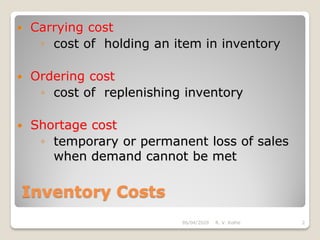
 Carrying cost
◦ cost of holding an item in inventory
 Ordering cost
◦ cost of replenishing inventory
 Shortage cost
◦ temporary or permanent loss of sales
when demand cannot be met
06/04/2020 2R. V. Kolhe
ECONOMIC ORDER QUANTITY
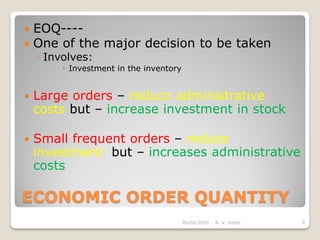
 EOQ----
 One of the major decision to be taken
◦ Involves:
 Investment in the inventory
 Large orders – reduce administrative
costs but – increase investment in stock
 Small frequent orders – reduce
investment but – increases administrative
costs
06/04/2020 3R. V. Kolhe
INVENTORY COSTS
 Holding costs- (INVENTORY CARRYING COST)
it consists of
 Purchase cost
 storage cost,
 capital cost and
 obsolescence/ shrinkage cost.
 Purchase cost Actual cost of purchase
 Storage cost includes rent, depreciation,
insurance, tax, security, personnel, etc;
 capital cost includes loss of interest,
opportunity cost interest paid;
 Shrinkage cost includes pilferage and breakage.
06/04/2020 R. V. Kolhe 4
 Setup or ordering costs –
(Procurement Cost)
 These are fixed costs associated with the
production of a lot internally and placing an
order externally with a vendor.
 These are independent of the no. of
units ordered.
 Setup costs includes time for setup of
jigs/fixture etc.
 Ordering cost includes telephone
charges, delivery fee, time required
for purchase order, expediting cost.
06/04/2020 R. V. Kolhe 5
EOQ Assumptions
 Known & constant demand
 Known & constant lead time
 Instantaneous receipt of material
 No quantity discounts
 Only order (setup) cost & holding cost
 No stockouts
06/04/2020 R. V. Kolhe 6
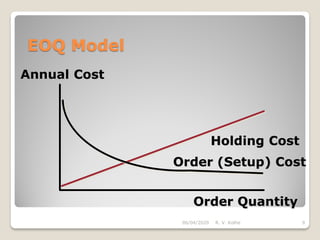
EOQ Model Graphical
Order Quantity
Annual Cost
06/04/2020 R. V. Kolhe 7
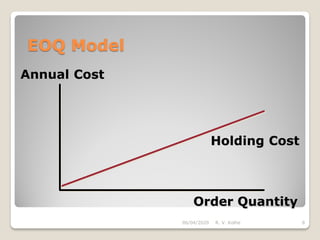
Order Quantity
Annual Cost
Holding Cost
EOQ Model
06/04/2020 R. V. Kolhe 8
Order Quantity
Annual Cost
Holding Cost
Order (Setup) Cost
EOQ Model
06/04/2020 R. V. Kolhe 9
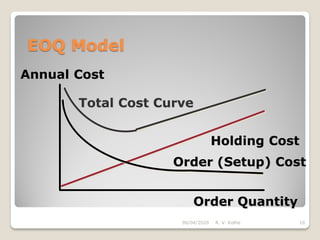
Order Quantity
Annual Cost
Holding Cost
Total Cost Curve
Order (Setup) Cost
EOQ Model
06/04/2020 R. V. Kolhe 10
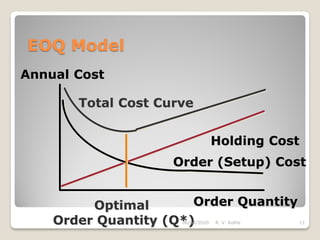
Order Quantity
Annual Cost
Holding Cost
Total Cost Curve
Order (Setup) Cost
Optimal
Order Quantity (Q*)
EOQ Model
06/04/2020 R. V. Kolhe 11
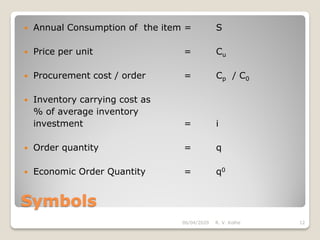
Symbols
 Annual Consumption of the item = S
 Price per unit = Cu
 Procurement cost / order = Cp / C0
 Inventory carrying cost as
% of average inventory
investment = i
 Order quantity = q
 Economic Order Quantity = q0
06/04/2020 R. V. Kolhe 12
Optimising Costs
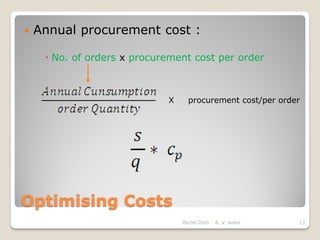
 Annual procurement cost :
 No. of orders x procurement cost per order
06/04/2020 R. V. Kolhe 13
X procurement cost/per order
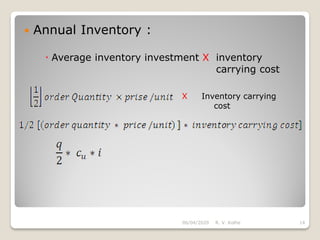
 Annual Inventory :
 Average inventory investment X inventory
carrying cost
06/04/2020 R. V. Kolhe 14
X Inventory carrying
cost
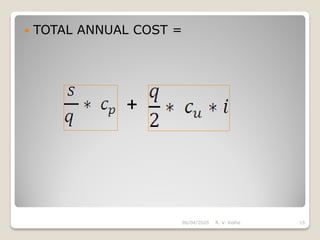
 TOTAL ANNUAL COST =
06/04/2020 R. V. Kolhe 15
+
Optimisation of the model
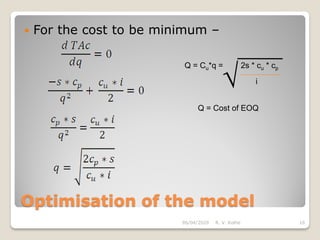
 For the cost to be minimum –
06/04/2020 R. V. Kolhe 16
Q = Cu*q = 2s * cu * cp
i√
Q = Cost of EOQ
06/04/2020 R. V. Kolhe 17
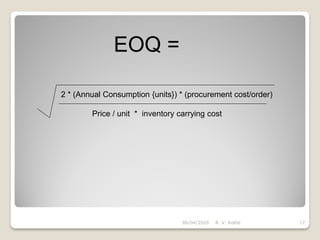
2 * (Annual Consumption {units}) * (procurement cost/order)
Price / unit * inventory carrying cost
EOQ =
AN ALTERNATIVE FORMULA
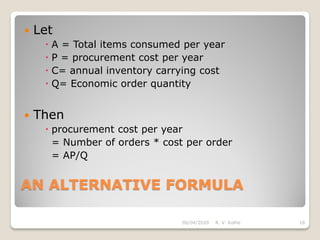
 Let
 A = Total items consumed per year
 P = procurement cost per year
 C= annual inventory carrying cost
 Q= Economic order quantity
 Then
 procurement cost per year
= Number of orders * cost per order
= AP/Q
06/04/2020 R. V. Kolhe 18
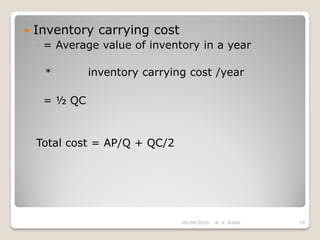
 Inventory carrying cost
◦ = Average value of inventory in a year
* inventory carrying cost /year
= ½ QC
Total cost = AP/Q + QC/2
06/04/2020 R. V. Kolhe 19
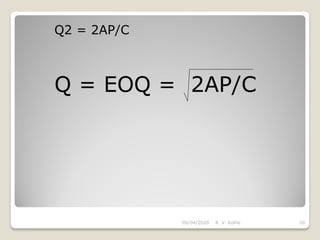
Q2 = 2AP/C
Q = EOQ = 2AP/C
06/04/2020 R. V. Kolhe 20
Thank You
06/04/2020 R. V. Kolhe 21

Economic Ordered Quantity (EOQ)

  • 1.
    Economic Ordered Quantity (EOQ) By Prof.R. V. Kolhe Assistant Professor Department of Civil Engineering Sanjivani College of Engineering, Kopargaon
  • 2.
    Inventory Costs  Carryingcost ◦ cost of holding an item in inventory  Ordering cost ◦ cost of replenishing inventory  Shortage cost ◦ temporary or permanent loss of sales when demand cannot be met 06/04/2020 2R. V. Kolhe
  • 3.
    ECONOMIC ORDER QUANTITY EOQ----  One of the major decision to be taken ◦ Involves:  Investment in the inventory  Large orders – reduce administrative costs but – increase investment in stock  Small frequent orders – reduce investment but – increases administrative costs 06/04/2020 3R. V. Kolhe
  • 4.
    INVENTORY COSTS  Holdingcosts- (INVENTORY CARRYING COST) it consists of  Purchase cost  storage cost,  capital cost and  obsolescence/ shrinkage cost.  Purchase cost Actual cost of purchase  Storage cost includes rent, depreciation, insurance, tax, security, personnel, etc;  capital cost includes loss of interest, opportunity cost interest paid;  Shrinkage cost includes pilferage and breakage. 06/04/2020 R. V. Kolhe 4
  • 5.
     Setup orordering costs – (Procurement Cost)  These are fixed costs associated with the production of a lot internally and placing an order externally with a vendor.  These are independent of the no. of units ordered.  Setup costs includes time for setup of jigs/fixture etc.  Ordering cost includes telephone charges, delivery fee, time required for purchase order, expediting cost. 06/04/2020 R. V. Kolhe 5
  • 6.
    EOQ Assumptions  Known& constant demand  Known & constant lead time  Instantaneous receipt of material  No quantity discounts  Only order (setup) cost & holding cost  No stockouts 06/04/2020 R. V. Kolhe 6
  • 7.
    EOQ Model Graphical OrderQuantity Annual Cost 06/04/2020 R. V. Kolhe 7
  • 8.
    Order Quantity Annual Cost HoldingCost EOQ Model 06/04/2020 R. V. Kolhe 8
  • 9.
    Order Quantity Annual Cost HoldingCost Order (Setup) Cost EOQ Model 06/04/2020 R. V. Kolhe 9
  • 10.
    Order Quantity Annual Cost HoldingCost Total Cost Curve Order (Setup) Cost EOQ Model 06/04/2020 R. V. Kolhe 10
  • 11.
    Order Quantity Annual Cost HoldingCost Total Cost Curve Order (Setup) Cost Optimal Order Quantity (Q*) EOQ Model 06/04/2020 R. V. Kolhe 11
  • 12.
    Symbols  Annual Consumptionof the item = S  Price per unit = Cu  Procurement cost / order = Cp / C0  Inventory carrying cost as % of average inventory investment = i  Order quantity = q  Economic Order Quantity = q0 06/04/2020 R. V. Kolhe 12
  • 13.
    Optimising Costs  Annualprocurement cost :  No. of orders x procurement cost per order 06/04/2020 R. V. Kolhe 13 X procurement cost/per order
  • 14.
     Annual Inventory:  Average inventory investment X inventory carrying cost 06/04/2020 R. V. Kolhe 14 X Inventory carrying cost
  • 15.
     TOTAL ANNUALCOST = 06/04/2020 R. V. Kolhe 15 +
  • 16.
    Optimisation of themodel  For the cost to be minimum – 06/04/2020 R. V. Kolhe 16 Q = Cu*q = 2s * cu * cp i√ Q = Cost of EOQ
  • 17.
    06/04/2020 R. V.Kolhe 17 2 * (Annual Consumption {units}) * (procurement cost/order) Price / unit * inventory carrying cost EOQ =
  • 18.
    AN ALTERNATIVE FORMULA Let  A = Total items consumed per year  P = procurement cost per year  C= annual inventory carrying cost  Q= Economic order quantity  Then  procurement cost per year = Number of orders * cost per order = AP/Q 06/04/2020 R. V. Kolhe 18
  • 19.
     Inventory carryingcost ◦ = Average value of inventory in a year * inventory carrying cost /year = ½ QC Total cost = AP/Q + QC/2 06/04/2020 R. V. Kolhe 19
  • 20.
    Q2 = 2AP/C Q= EOQ = 2AP/C 06/04/2020 R. V. Kolhe 20
  • 21.