Economic Development and Resources
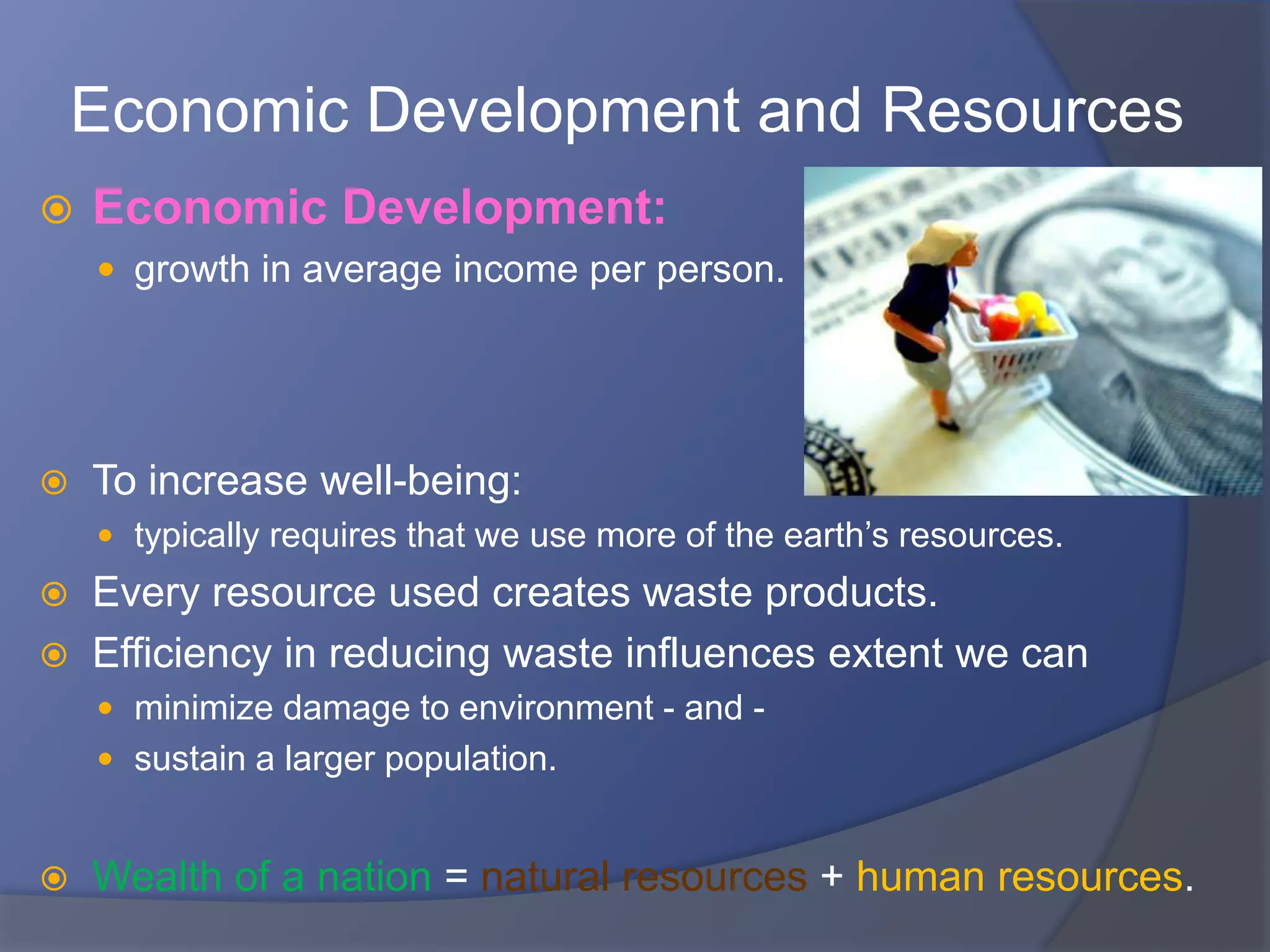
   Economic Development:
     growth in average income per person.


   To increase well-being:
     typically requires that we use more of the earth’s resources.
   Every resource used creates waste products.
   Efficiency in reducing waste influences extent we can
     minimize damage to environment - and -
     sustain a larger population.


   Wealth of a nation = natural resources + human resources.
Relationship between Growth and
                  Development
   Economic Growth:
     increase in total amount of
      productivity in a country.

   Economic Development:
     growth in average income per person.


   You can have economic growth
    without economic development - if -
     Population is growing faster than the economy.

   You can theoretically have economic development
    without economic growth - if –
     Population is declining (but this is not common)
GNI: Gross National Income
   GNI can be measured as:
     currency at exchange rates – or –
     purchasing power parity (PPP).


   Purchasing Power Parity
     How much money would be needed to purchase the
     same goods and services in two countries
      ○ Equates two exchange rates so we can compare
      ○ exchange rate between one currency and another currency is in
        equlibirium when their domestic purchasing powers at that rate of
        exchange are equivalent

      ○ Big Mac Index
      ○ Starbucks Tall Latte Index
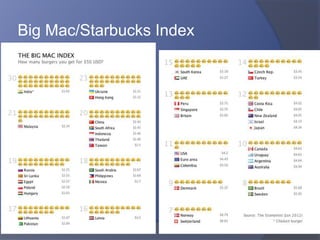
Big Mac/Starbucks Index
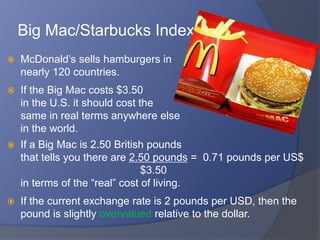
   McDonald’s sells hamburgers in
    nearly 120 countries.
   If the Big Mac costs $3.50
    in the U.S. it should cost the
    same in real terms anywhere else
    in the world.
   If a Big Mac is 2.50 British pounds
    that tells you there are 2.50 pounds = 0.71 pounds per US$
                                $3.50
    in terms of the “real” cost of living.
   If the current exchange rate is 2 pounds per USD, then the
    pound is slightly overvalued relative to the dollar.
Big Mac/Starbucks Index
   If a Starbucks latte is $3.00 in the US
    and 60 Mexican pesos, there are
    60 pesos = 20 pesos per US$
      $3.00
    in terms of the “real” cost of living.
   If the current exchange rate is 13.2 pesos
    per USD, then the peso is slightly
    undervalued relative to the dollar.

   Why it’s useful:
     based on well-known food whose price is easily tracked in many countries
     includes input costs from a wide range of sectors in the local economy
      ○ agricultural commodities (beef, bread, lettuce, cheese)
      ○ labor (blue and white collar)
      ○ Advertising
      ○ rent & real estate costs
      ○ transportation
Big Mac/Starbucks Index

Economic development and resources

  • 1.
    Economic Development andResources  Economic Development:  growth in average income per person.  To increase well-being:  typically requires that we use more of the earth’s resources.  Every resource used creates waste products.  Efficiency in reducing waste influences extent we can  minimize damage to environment - and -  sustain a larger population.  Wealth of a nation = natural resources + human resources.
  • 2.
    Relationship between Growthand Development  Economic Growth:  increase in total amount of productivity in a country.  Economic Development:  growth in average income per person.  You can have economic growth without economic development - if -  Population is growing faster than the economy.  You can theoretically have economic development without economic growth - if –  Population is declining (but this is not common)
  • 3.
    GNI: Gross NationalIncome  GNI can be measured as:  currency at exchange rates – or –  purchasing power parity (PPP).  Purchasing Power Parity  How much money would be needed to purchase the same goods and services in two countries ○ Equates two exchange rates so we can compare ○ exchange rate between one currency and another currency is in equlibirium when their domestic purchasing powers at that rate of exchange are equivalent ○ Big Mac Index ○ Starbucks Tall Latte Index
  • 4.
    Big Mac/Starbucks Index  McDonald’s sells hamburgers in nearly 120 countries.  If the Big Mac costs $3.50 in the U.S. it should cost the same in real terms anywhere else in the world.  If a Big Mac is 2.50 British pounds that tells you there are 2.50 pounds = 0.71 pounds per US$ $3.50 in terms of the “real” cost of living.  If the current exchange rate is 2 pounds per USD, then the pound is slightly overvalued relative to the dollar.
  • 5.
    Big Mac/Starbucks Index  If a Starbucks latte is $3.00 in the US and 60 Mexican pesos, there are  60 pesos = 20 pesos per US$ $3.00 in terms of the “real” cost of living.  If the current exchange rate is 13.2 pesos per USD, then the peso is slightly undervalued relative to the dollar.  Why it’s useful:  based on well-known food whose price is easily tracked in many countries  includes input costs from a wide range of sectors in the local economy ○ agricultural commodities (beef, bread, lettuce, cheese) ○ labor (blue and white collar) ○ Advertising ○ rent & real estate costs ○ transportation
  • 6.