



PRESENTED BY
Mohammad Faheem Hasan 17-1-12-0011
TABLE OF CONTENTS
1. Introduction.
2. Objectives.
3. Methodology.
4. Topics Discussion.
5. Findings.
6. Recommendations.
7. Summary.
8. Conclusion.
INTRODUCTION –
COMMERCE
 Commerce is a division of trade or
production which deals with the exchange of
goods and services from producer to final
consumer.
INTRODUCTION –
E-COMMERCE
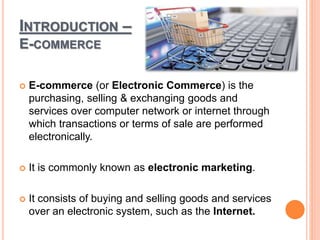
 E-commerce (or Electronic Commerce) is the
purchasing, selling & exchanging goods and
services over computer network or internet through
which transactions or terms of sale are performed
electronically.
 It is commonly known as electronic marketing.
 It consists of buying and selling goods and services
over an electronic system, such as the Internet.
OBJECTIVES
 High Reachability - The main objective and at the
same time need is traction on your web store.
Ofcourse, if you are selling products online what
you require are customers. If you are getting good
reachability, then your business will definitely grow.
Therefore, one of the objective is high reachability.
 High Conversions - If people are coming on your
web store and purchasing something then, it will
calculate as conversions and from the number of
people who are buying stuff from your web store we
can calculate the conversion rate.
OBJECTIVES
 Customer Satisfaction - Customer is the main part
of any E-commerce business so its very important
to make your customer happy and satisfied. By
providing quality and desirable products, on time
delivery, 24*7 customer support, and timely sale &
best deal offers you can make your customer
happy. It is one of the main objectives of E-
commerce.
 Social Popularity - Unless and until you are not
famous and popular among people you cannot
establish your brand. social presence with Omni
Channel & Digital Marketing is essential for any
E-commerce business.
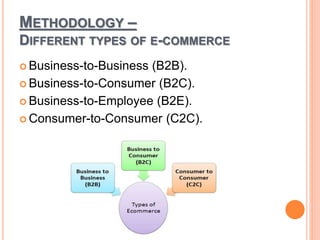
METHODOLOGY –
DIFFERENT TYPES OF E-COMMERCE
 Business-to-Business (B2B).
 Business-to-Consumer (B2C).
 Business-to-Employee (B2E).
 Consumer-to-Consumer (C2C).
BUSINESS-TO-BUSINESS (B2B)
 B2B stands for Business to Business. It consists of
largest form of E-Commerce. This model defines
that buyer and seller are two different entities. It is
similar to manufacturer, issuing goods to the retailer
or wholesaler.
Example : Dell deals computers and other associated
accessories online, but it is does not make up all
those products. So, in govern to deal those products,
first step is to purchases them from unlike businesses
i.e. the producers of those products.
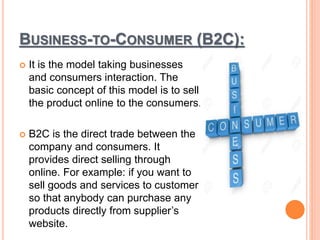
BUSINESS-TO-CONSUMER (B2C):
 It is the model taking businesses
and consumers interaction. The
basic concept of this model is to sell
the product online to the consumers.
 B2C is the direct trade between the
company and consumers. It
provides direct selling through
online. For example: if you want to
sell goods and services to customer
so that anybody can purchase any
products directly from supplier’s
website.
BUSINESS-TO-EMPLOYEE (B2E)
 Business-to-employee (B2E) electronic commerce
uses an intrabusiness network which allows
companies to provide products and/or services to
their employees. Typically, companies use B2E
networks to automate employee-related corporate
processes.
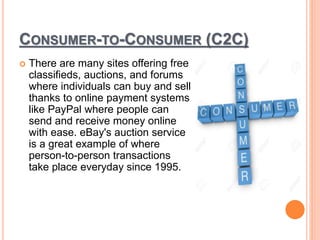
CONSUMER-TO-CONSUMER (C2C)
 There are many sites offering free
classifieds, auctions, and forums
where individuals can buy and sell
thanks to online payment systems
like PayPal where people can
send and receive money online
with ease. eBay's auction service
is a great example of where
person-to-person transactions
take place everyday since 1995.
TOPICS DISCUSSION
ADVANTAGES OF E-COMMERCE
 Faster buying/selling procedure, as well as easy to find
products.
 Buying/selling 24/7.
 Easy to start and manage a business.
 Low operational costs and better quality of services.
 Customers can easily select products from different
providers without moving around physically.
DISADVANTAGES OF E-COMMERCE
 Unable to examine products personally
 Not everyone is connected to the Internet
 There is the possibility of credit card number theft
 Mechanical failures can cause unpredictable effects
on the total processes.
CUSTOMER INTIMACY
 Interactive marketing and personalization.
 Customer Self Service.
FINDINGS
 There is no freedom to the dealers to operate an e-
commerce site because the law permits manufactures
to limit the number of dealers authorized to sell their
products in particular places.
 Manufacturers don’t have freedom to operate an e-
commerce site because of the manufacturer's individual
agreements with one or more selected dealers as not to
operate an e-commerce site.
 Customers do not have whole information about
operating an ecommerce site for e-buying procedure.
FINDINGS
 Most of the people are unsuccessful to use Net banking
and email account because either they are ignorant or
even don’t remember their login ID and password.
 Planners fail to give employees the whole picture and in
such circumstances the training and setting up
incentives for workers to embrace the strategy may
assist.
 In staffing, particularly in the sales department along
with traditional salesman, the internet operating sales
force is needed.
RECOMMENDATIONS
 The similar study can be undertaken in the other
companies or more companies.
 The research can be done with a longer period.
 Government should take initiatives to spread
awareness about E-commerce in rural areas.
 Specific strategies and programmes should be
undertaken in order to create confidence in common
people, so that they can freely make use of E-
commerce.
SUMMARY
 The Internet has lead to the birth and evolution,
E-commerce. E-commerce has now become a key
component of several organizations in the daily
running of their business.
 As the Internet and in turn, E-commerce has
developed, and continues to evolve and grow, it is
vital that any organization, in any particular industry,
must base its strategic planning around such a
rapidly growing medium.
CONCLUSION
 E-commerce has grown significantly during the past
12 years. E-commerce has not only change the
way consumers view their purchasing power but
also help skyrocketed the economy.
 E-commerce is a helpful technology that gives the
consumer access to business and companies all
over the world.
 Once consumers and businesses realize some of
the dangers of e-commerce, there could less
incidents of identity theft and credit card fraud.
THANK YOU


E-commerce - MIS Presentation

  • 3.
    PRESENTED BY Mohammad FaheemHasan 17-1-12-0011
  • 4.
    TABLE OF CONTENTS 1.Introduction. 2. Objectives. 3. Methodology. 4. Topics Discussion. 5. Findings. 6. Recommendations. 7. Summary. 8. Conclusion.
  • 5.
    INTRODUCTION – COMMERCE  Commerceis a division of trade or production which deals with the exchange of goods and services from producer to final consumer.
  • 6.
    INTRODUCTION – E-COMMERCE  E-commerce(or Electronic Commerce) is the purchasing, selling & exchanging goods and services over computer network or internet through which transactions or terms of sale are performed electronically.  It is commonly known as electronic marketing.  It consists of buying and selling goods and services over an electronic system, such as the Internet.
  • 7.
    OBJECTIVES  High Reachability- The main objective and at the same time need is traction on your web store. Ofcourse, if you are selling products online what you require are customers. If you are getting good reachability, then your business will definitely grow. Therefore, one of the objective is high reachability.  High Conversions - If people are coming on your web store and purchasing something then, it will calculate as conversions and from the number of people who are buying stuff from your web store we can calculate the conversion rate.
  • 8.
    OBJECTIVES  Customer Satisfaction- Customer is the main part of any E-commerce business so its very important to make your customer happy and satisfied. By providing quality and desirable products, on time delivery, 24*7 customer support, and timely sale & best deal offers you can make your customer happy. It is one of the main objectives of E- commerce.  Social Popularity - Unless and until you are not famous and popular among people you cannot establish your brand. social presence with Omni Channel & Digital Marketing is essential for any E-commerce business.
  • 9.
    METHODOLOGY – DIFFERENT TYPESOF E-COMMERCE  Business-to-Business (B2B).  Business-to-Consumer (B2C).  Business-to-Employee (B2E).  Consumer-to-Consumer (C2C).
  • 10.
    BUSINESS-TO-BUSINESS (B2B)  B2Bstands for Business to Business. It consists of largest form of E-Commerce. This model defines that buyer and seller are two different entities. It is similar to manufacturer, issuing goods to the retailer or wholesaler. Example : Dell deals computers and other associated accessories online, but it is does not make up all those products. So, in govern to deal those products, first step is to purchases them from unlike businesses i.e. the producers of those products.
  • 11.
    BUSINESS-TO-CONSUMER (B2C):  Itis the model taking businesses and consumers interaction. The basic concept of this model is to sell the product online to the consumers.  B2C is the direct trade between the company and consumers. It provides direct selling through online. For example: if you want to sell goods and services to customer so that anybody can purchase any products directly from supplier’s website.
  • 12.
    BUSINESS-TO-EMPLOYEE (B2E)  Business-to-employee(B2E) electronic commerce uses an intrabusiness network which allows companies to provide products and/or services to their employees. Typically, companies use B2E networks to automate employee-related corporate processes.
  • 13.
    CONSUMER-TO-CONSUMER (C2C)  Thereare many sites offering free classifieds, auctions, and forums where individuals can buy and sell thanks to online payment systems like PayPal where people can send and receive money online with ease. eBay's auction service is a great example of where person-to-person transactions take place everyday since 1995.
  • 14.
  • 15.
    ADVANTAGES OF E-COMMERCE Faster buying/selling procedure, as well as easy to find products.  Buying/selling 24/7.  Easy to start and manage a business.  Low operational costs and better quality of services.  Customers can easily select products from different providers without moving around physically.
  • 16.
    DISADVANTAGES OF E-COMMERCE Unable to examine products personally  Not everyone is connected to the Internet  There is the possibility of credit card number theft  Mechanical failures can cause unpredictable effects on the total processes.
  • 17.
    CUSTOMER INTIMACY  Interactivemarketing and personalization.  Customer Self Service.
  • 18.
    FINDINGS  There isno freedom to the dealers to operate an e- commerce site because the law permits manufactures to limit the number of dealers authorized to sell their products in particular places.  Manufacturers don’t have freedom to operate an e- commerce site because of the manufacturer's individual agreements with one or more selected dealers as not to operate an e-commerce site.  Customers do not have whole information about operating an ecommerce site for e-buying procedure.
  • 19.
    FINDINGS  Most ofthe people are unsuccessful to use Net banking and email account because either they are ignorant or even don’t remember their login ID and password.  Planners fail to give employees the whole picture and in such circumstances the training and setting up incentives for workers to embrace the strategy may assist.  In staffing, particularly in the sales department along with traditional salesman, the internet operating sales force is needed.
  • 20.
    RECOMMENDATIONS  The similarstudy can be undertaken in the other companies or more companies.  The research can be done with a longer period.  Government should take initiatives to spread awareness about E-commerce in rural areas.  Specific strategies and programmes should be undertaken in order to create confidence in common people, so that they can freely make use of E- commerce.
  • 21.
    SUMMARY  The Internethas lead to the birth and evolution, E-commerce. E-commerce has now become a key component of several organizations in the daily running of their business.  As the Internet and in turn, E-commerce has developed, and continues to evolve and grow, it is vital that any organization, in any particular industry, must base its strategic planning around such a rapidly growing medium.
  • 22.
    CONCLUSION  E-commerce hasgrown significantly during the past 12 years. E-commerce has not only change the way consumers view their purchasing power but also help skyrocketed the economy.  E-commerce is a helpful technology that gives the consumer access to business and companies all over the world.  Once consumers and businesses realize some of the dangers of e-commerce, there could less incidents of identity theft and credit card fraud.
  • 24.