ECOMMERCE BUSINESS
MODELS, STAKEHOLDERS & CHALLENGES
Ecommerce Business
Models
B2B Classifieds & Services
B2C
Retail
Classifieds & Services
Automobile, Travel
Real Estate
Healthcare
Jobs, Recruitment
Entertainment
Social Media
Digital Downloads
Financial Services
C2C Classifieds, services, retail
C2B 3rd party vendors
P2P File sharing via software
B2G Consultants, online apps rental
G2B Tenders
G2G National security, law enforcement
G2C Visa, property, voter service
Real Time
Monitoring
Multiple
Access
Effective
Adaptability
Low
Training
Cost
Low Cost
Greater
Accessibility
2Ecommerce Business Models
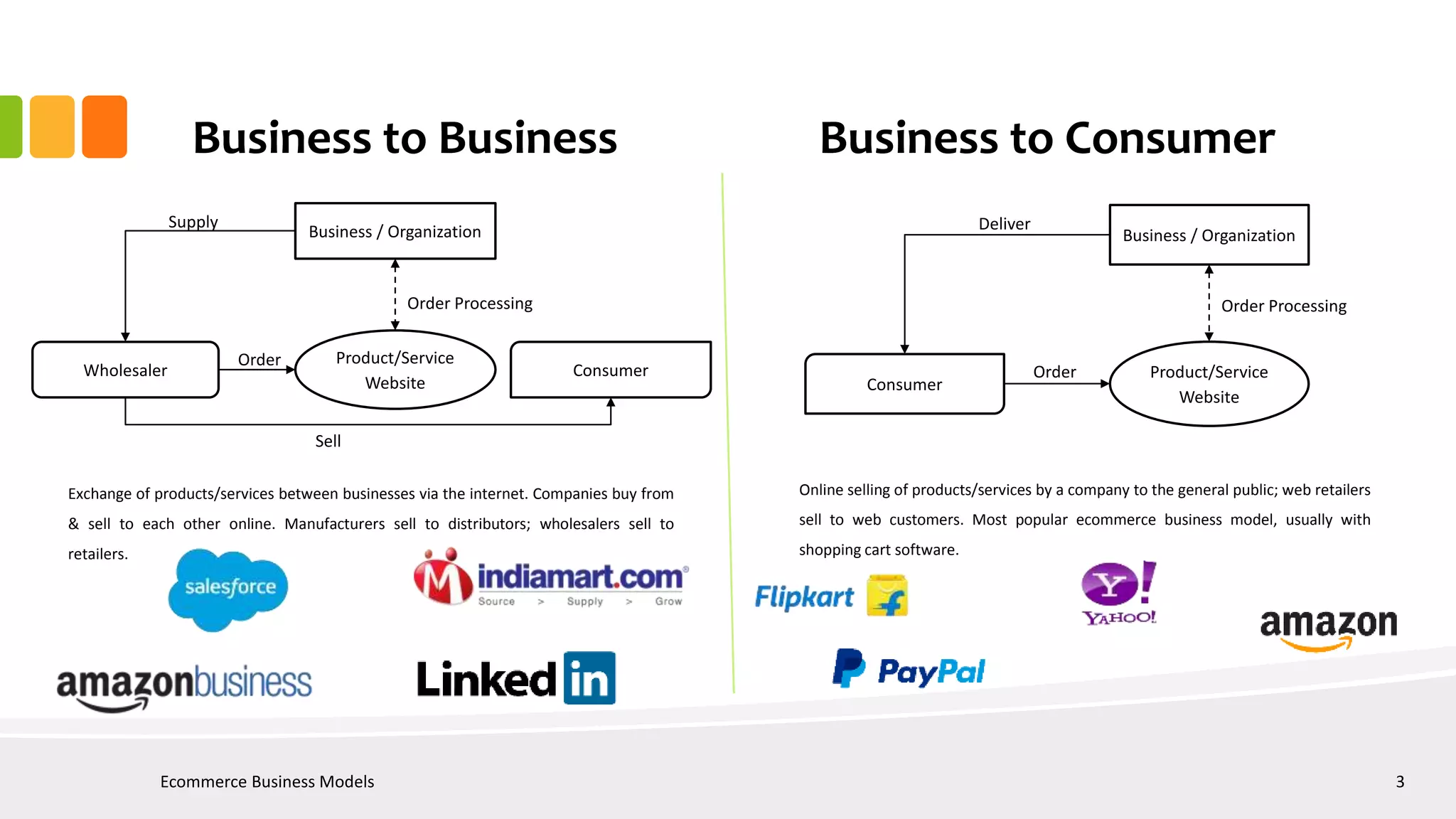
Business to Business Business to Consumer
Wholesaler
Product/Service
Website
Consumer
Business / Organization
Order
Order Processing
Supply
Sell
3
Product/Service
Website
Business / Organization
Consumer
Order
Order Processing
Deliver
Exchange of products/services between businesses via the internet. Companies buy from
& sell to each other online. Manufacturers sell to distributors; wholesalers sell to
retailers.
Online selling of products/services by a company to the general public; web retailers
sell to web customers. Most popular ecommerce business model, usually with
shopping cart software.
Ecommerce Business Models
Consumer to Consumer Consumer to Business
4
Product/Service
Website
Consumer (Seller)
Consumer (Buyer)
Wants to sell
Wants to buy
Sell
Pay
Product/Service
Website
Consumer
Business / Organization
Online transaction between two or more individuals; selling products/services to one
another. Commonly used ecommerce business model for online auctions
An ecommerce business model where a consumer provides a product/service
to an organization. Consumer decides the price.
Ecommerce Business Models
Business to Government Government to Business
5
Business / Organization
Product/Service
Website
Government
Product/Service
Website
Government
Business / Organization
Business & government agencies use certain websites to exchange information and/or do business with each other. B2G may include the rental of online applications & databases designed
especially for use by government agencies.. G2B may include demand for information from the business in any life situation or a transfer of an official document to the statutory body.
Ecommerce Business Models
Government to Government Government to Citizen
6
Product/Service
Website
Government
Government
Product/Service
Website
Government
Citizen
Through technology, a government offers a variety of ICT services to its citizens
in an efficient way, thus strengthening the relationship with the citizens.
An ecommerce business model where information systems are shared between various
government agencies; support e-government initiatives by improving data sharing &
communication.
Ecommerce Business Models
7
An ecommerce business model where internet users share files & computer
resources directly using specialized software, no need of a central webserver.
Illegal downloading of copyright content continues.
• A model where wireless digital devices are used to perform web-based
transactions; an extension of various existing ecommerce business models.
• By scanning QR codes using smartphones, products can be purchased from the
internet – most common example of M-Commerce (Mobile-Commerce).
• Consumers can also avail various travel packages, mobile banking, etc.
• Information services like stock quotes, auctions, etc. are readily available.
M-Governance
Peer to Peer M-Commerce
An extension of e-government business models through the use of mobile
technologies for public service delivery. M-Governance complements E-
Governance.
Ecommerce Business Models
COMMON B2C RETAIL MODELS
8Ecommerce Business Models
KEY STAKEHOLDERS
9
Government(PolicyMaker)
Supplier
• Airlines
• Railways
• Roadways
• Retailers
• Individuals
• Service providers
Ecommerce Players
Buyer
• Individuals
• businesses
Financial
Intermediaries
Network Service
Providers
(IBM, Cisco)
Internet Service
Providers
(Airtel, Etisalat)
Logistics
Providers
(DHL, FedEx)
Social Networking
Sites
(Facebook, Twitter)
Call Centers
Core Layer
Enables supporting
the core layer
According to EY, there are multiple stakeholders engaged in the ecommerce sector. They coordinate with each other to facilitate the 3 main flows in an ecommerce
transaction:
• Product flow: Movement of goods from suppliers to end customers through ecommerce &logistic players.
• Information flow: Information transmission of orders from customers & subsequent information flow of order status through the value chain.
• Monetary flow: Payments from consumers to ecommerce players and/or suppliers & vice-versa through financial intermediaries.
Ecommerce Business Models
ECOMMERCE STATISTICS
10
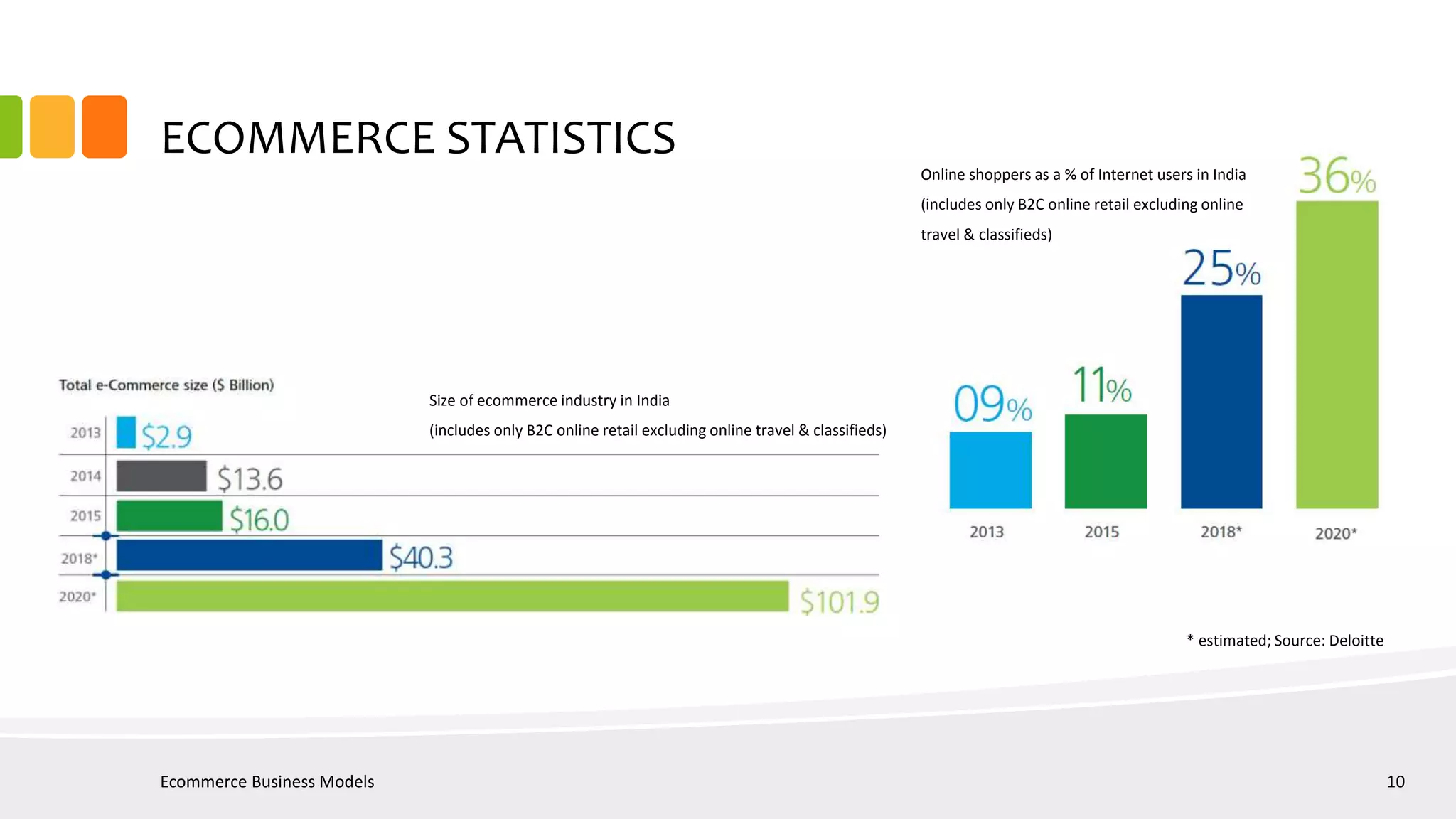
Online shoppers as a % of Internet users in India
(includes only B2C online retail excluding online
travel & classifieds)
Size of ecommerce industry in India
(includes only B2C online retail excluding online travel & classifieds)
* estimated; Source: Deloitte
Ecommerce Business Models
11
MODES OF ECOMMERCE PAYMENTS
Ecommerce Business Models
* Source: Nielsen Survey, Q4 2015
12
B2B Platform Owners
Unorganised due to lack of education on how
to use the technology.
Nominations for Public Sector Enterprise (PSE)
poor due to lack of transparent & efficient
competitive bidding.
B2C Platform Owners
Dependency on network & bandwidth; failure
of digital payments.
Lack of customer loyalty; customer prefers
discounted products.
Inefficient reverse logistics leading to high
inventory costs.
Dependency on telecom operators for rural
penetration.
High cost of customer acquisition due to
intense competitive discounts.
Merchant’s lack of online experience due to
lack of education on how to use the
technology.
B2C Aggregators
Dependency on multiple entities.
Dependency on network & bandwidth.
Regulatory challenges due to lack of proper tax
structures, vigilance, overall governance, etc.
CHALLENGES FACED BY STAKEHOLDERS
Cash on Delivery (CoD) most preferred
payment mode; leading to high returns.
Ecommerce Business Models
13
MSME Merchants
Lack of expertise in peripheral activities.
Technology integration & perception gap.
High cost of finance due to high interest
costs.
Differential delivery rates charged by
different platforms.
Mobile apps on various platforms; big
merchants can afford to build good apps.
Logistics Service Providers
Inefficient reverse logistics leading to high
inventory costs.
Poor tracking facilities due to lack of proper
GPS.
Air cargo not properly established.
Internet accessibility & affordability.
Scale up handling capacity & hardware cost.
Long waiting times at border check posts
due to some non-compliance issues.
Poor infrastructure; bad roads, railways
don’t allow partial usage of containers.
Policy Makers
Regulatory challenges due to lack of proper
tax structures, vigilance, overall
governance, etc.
Weak inter-linkages of government
departments & agencies.
Price regulation & quality control.
Tracking road & rail transport.
Lack of proper digitisation due to high costs
& resistance to upgrade from obsolete
systems.
Difficult to differentiate between local
goods & and interstate goods, leading to tax
leakage or evasion.
CHALLENGES FACED BY STAKEHOLDERS (continued)
Cash on Delivery (CoD) most preferred
payment mode; leading to high returns.
Ecommerce Business Models
Payment
•Payment gateway vulnerabilities.
•Card fraud using stolen credit/debit card info.
•Cash on delivery like fraud by cash collection
agent.
Online Placement Processing
•Unauthorised/fake orders.
•Unauthorised price change.
•Inflated MRP for fake discounts.
•Presence of blacklisted entities in the absence of
adequate vendor due diligence.
Returns & Refunds
•Return of used product.
•Counterfeit product returns.
•Tampering with product in order to return it.
•Customer initiates chargeback without returning
the product.
Seller Vendors Positioning
•Ghost vendors fraud.
•Fake/forged documents for registration.
•Impersonation by sellers for buy back of goods.
•Inadequate vendor background checks.
Delivery Logistics
•Theft of goods from warehouse.
•Delivery of defective/counterfeit product.
•Change of shipping address after placing order.
•Product intentionally misplaced/not delivered.
System/Network Operations
•Pharming.
•Cyber attacks.
•Phishing fraud.
•System manipulation like availing discount on
expired coupons.
FRAUD RISKS FACED BY ECOMMERCE INDUSTRY
* indicative list
14Ecommerce Business Models
SUCCESS FACTORS FOR ECOMMERCE INDUSTRY
Continuous innovation
Nimbleness to scale & sustain
Digitisation & integration of processes
Training & technological advancement of merchants
High-end & disruptive data analytics to spot ‘real-time’ opportunities
According to Deloitte, it is imperative for ecommerce companies to focus not only
on business-as-usual but also on disruptive growth to remain differentiated &
build a legacy.
15Ecommerce Business Models
THANK YOU

Ecommerce Business Models

  • 1.
  • 2.
    Ecommerce Business Models B2B Classifieds& Services B2C Retail Classifieds & Services Automobile, Travel Real Estate Healthcare Jobs, Recruitment Entertainment Social Media Digital Downloads Financial Services C2C Classifieds, services, retail C2B 3rd party vendors P2P File sharing via software B2G Consultants, online apps rental G2B Tenders G2G National security, law enforcement G2C Visa, property, voter service Real Time Monitoring Multiple Access Effective Adaptability Low Training Cost Low Cost Greater Accessibility 2Ecommerce Business Models
  • 3.
    Business to BusinessBusiness to Consumer Wholesaler Product/Service Website Consumer Business / Organization Order Order Processing Supply Sell 3 Product/Service Website Business / Organization Consumer Order Order Processing Deliver Exchange of products/services between businesses via the internet. Companies buy from & sell to each other online. Manufacturers sell to distributors; wholesalers sell to retailers. Online selling of products/services by a company to the general public; web retailers sell to web customers. Most popular ecommerce business model, usually with shopping cart software. Ecommerce Business Models
  • 4.
    Consumer to ConsumerConsumer to Business 4 Product/Service Website Consumer (Seller) Consumer (Buyer) Wants to sell Wants to buy Sell Pay Product/Service Website Consumer Business / Organization Online transaction between two or more individuals; selling products/services to one another. Commonly used ecommerce business model for online auctions An ecommerce business model where a consumer provides a product/service to an organization. Consumer decides the price. Ecommerce Business Models
  • 5.
    Business to GovernmentGovernment to Business 5 Business / Organization Product/Service Website Government Product/Service Website Government Business / Organization Business & government agencies use certain websites to exchange information and/or do business with each other. B2G may include the rental of online applications & databases designed especially for use by government agencies.. G2B may include demand for information from the business in any life situation or a transfer of an official document to the statutory body. Ecommerce Business Models
  • 6.
    Government to GovernmentGovernment to Citizen 6 Product/Service Website Government Government Product/Service Website Government Citizen Through technology, a government offers a variety of ICT services to its citizens in an efficient way, thus strengthening the relationship with the citizens. An ecommerce business model where information systems are shared between various government agencies; support e-government initiatives by improving data sharing & communication. Ecommerce Business Models
  • 7.
    7 An ecommerce businessmodel where internet users share files & computer resources directly using specialized software, no need of a central webserver. Illegal downloading of copyright content continues. • A model where wireless digital devices are used to perform web-based transactions; an extension of various existing ecommerce business models. • By scanning QR codes using smartphones, products can be purchased from the internet – most common example of M-Commerce (Mobile-Commerce). • Consumers can also avail various travel packages, mobile banking, etc. • Information services like stock quotes, auctions, etc. are readily available. M-Governance Peer to Peer M-Commerce An extension of e-government business models through the use of mobile technologies for public service delivery. M-Governance complements E- Governance. Ecommerce Business Models
  • 8.
    COMMON B2C RETAILMODELS 8Ecommerce Business Models
  • 9.
    KEY STAKEHOLDERS 9 Government(PolicyMaker) Supplier • Airlines •Railways • Roadways • Retailers • Individuals • Service providers Ecommerce Players Buyer • Individuals • businesses Financial Intermediaries Network Service Providers (IBM, Cisco) Internet Service Providers (Airtel, Etisalat) Logistics Providers (DHL, FedEx) Social Networking Sites (Facebook, Twitter) Call Centers Core Layer Enables supporting the core layer According to EY, there are multiple stakeholders engaged in the ecommerce sector. They coordinate with each other to facilitate the 3 main flows in an ecommerce transaction: • Product flow: Movement of goods from suppliers to end customers through ecommerce &logistic players. • Information flow: Information transmission of orders from customers & subsequent information flow of order status through the value chain. • Monetary flow: Payments from consumers to ecommerce players and/or suppliers & vice-versa through financial intermediaries. Ecommerce Business Models
  • 10.
    ECOMMERCE STATISTICS 10 Online shoppersas a % of Internet users in India (includes only B2C online retail excluding online travel & classifieds) Size of ecommerce industry in India (includes only B2C online retail excluding online travel & classifieds) * estimated; Source: Deloitte Ecommerce Business Models
  • 11.
    11 MODES OF ECOMMERCEPAYMENTS Ecommerce Business Models * Source: Nielsen Survey, Q4 2015
  • 12.
    12 B2B Platform Owners Unorganiseddue to lack of education on how to use the technology. Nominations for Public Sector Enterprise (PSE) poor due to lack of transparent & efficient competitive bidding. B2C Platform Owners Dependency on network & bandwidth; failure of digital payments. Lack of customer loyalty; customer prefers discounted products. Inefficient reverse logistics leading to high inventory costs. Dependency on telecom operators for rural penetration. High cost of customer acquisition due to intense competitive discounts. Merchant’s lack of online experience due to lack of education on how to use the technology. B2C Aggregators Dependency on multiple entities. Dependency on network & bandwidth. Regulatory challenges due to lack of proper tax structures, vigilance, overall governance, etc. CHALLENGES FACED BY STAKEHOLDERS Cash on Delivery (CoD) most preferred payment mode; leading to high returns. Ecommerce Business Models
  • 13.
    13 MSME Merchants Lack ofexpertise in peripheral activities. Technology integration & perception gap. High cost of finance due to high interest costs. Differential delivery rates charged by different platforms. Mobile apps on various platforms; big merchants can afford to build good apps. Logistics Service Providers Inefficient reverse logistics leading to high inventory costs. Poor tracking facilities due to lack of proper GPS. Air cargo not properly established. Internet accessibility & affordability. Scale up handling capacity & hardware cost. Long waiting times at border check posts due to some non-compliance issues. Poor infrastructure; bad roads, railways don’t allow partial usage of containers. Policy Makers Regulatory challenges due to lack of proper tax structures, vigilance, overall governance, etc. Weak inter-linkages of government departments & agencies. Price regulation & quality control. Tracking road & rail transport. Lack of proper digitisation due to high costs & resistance to upgrade from obsolete systems. Difficult to differentiate between local goods & and interstate goods, leading to tax leakage or evasion. CHALLENGES FACED BY STAKEHOLDERS (continued) Cash on Delivery (CoD) most preferred payment mode; leading to high returns. Ecommerce Business Models
  • 14.
    Payment •Payment gateway vulnerabilities. •Cardfraud using stolen credit/debit card info. •Cash on delivery like fraud by cash collection agent. Online Placement Processing •Unauthorised/fake orders. •Unauthorised price change. •Inflated MRP for fake discounts. •Presence of blacklisted entities in the absence of adequate vendor due diligence. Returns & Refunds •Return of used product. •Counterfeit product returns. •Tampering with product in order to return it. •Customer initiates chargeback without returning the product. Seller Vendors Positioning •Ghost vendors fraud. •Fake/forged documents for registration. •Impersonation by sellers for buy back of goods. •Inadequate vendor background checks. Delivery Logistics •Theft of goods from warehouse. •Delivery of defective/counterfeit product. •Change of shipping address after placing order. •Product intentionally misplaced/not delivered. System/Network Operations •Pharming. •Cyber attacks. •Phishing fraud. •System manipulation like availing discount on expired coupons. FRAUD RISKS FACED BY ECOMMERCE INDUSTRY * indicative list 14Ecommerce Business Models
  • 15.
    SUCCESS FACTORS FORECOMMERCE INDUSTRY Continuous innovation Nimbleness to scale & sustain Digitisation & integration of processes Training & technological advancement of merchants High-end & disruptive data analytics to spot ‘real-time’ opportunities According to Deloitte, it is imperative for ecommerce companies to focus not only on business-as-usual but also on disruptive growth to remain differentiated & build a legacy. 15Ecommerce Business Models
  • 16.