What’s happening these days
at Eclipse? Philippe Krief
Research Relations Director
2
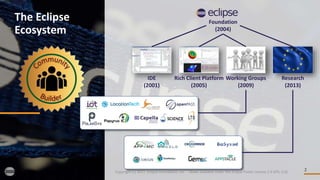
The Eclipse
Ecosystem
Copyright (c) 2017, Eclipse Foundation, Inc. - Made available under the Eclipse Public License 2.0 (EPL-2.0)
Foundation
(2004)
IDE
(2001)
Rich Client Platform
(2005)
Working Groups
(2009)
Research
(2013)
33
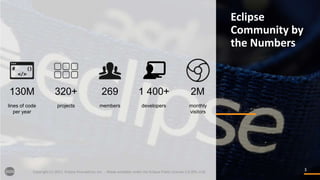
Eclipse
Community by
the Numbers
Copyright (c) 2017, Eclipse Foundation, Inc. - Made available under the Eclipse Public License 2.0 (EPL-2.0)
130M
lines of code
per year
320+
projects
269
members
1 400+
developers
2M
monthly
visitors
4
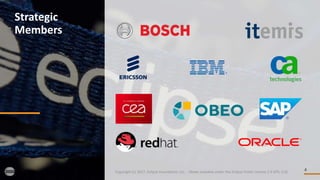
Strategic
Members
Copyright (c) 2017, Eclipse Foundation, Inc. - Made available under the Eclipse Public License 2.0 (EPL-2.0)
5
IP Management & Licensing
A Pillar of Open Collaborations
Copyright (c) 2017, Eclipse Foundation, Inc. - Made available under the Eclipse Public License 2.0 (EPL-2.0)
66
What’s Your
(IP Due Diligence)
Type?
Copyright (c) 2017, Eclipse Foundation, Inc. - Made available under the Eclipse Public License 2.0 (EPL-2.0)
The purpose of the Eclipse Foundation IP Policy is to
set forth the general principles under which the
Eclipse Foundation shall:
a) accept Content,
b) redistribute Content,
c) host Content, and
d) manage other intellectual property matters.
Type A
• license certification
Type B
• license certification
• provenance check
• code scan
7
Eclipse Public
License 2.0
Copyright (c) 2017, Eclipse Foundation, Inc. - Made available under the Eclipse Public License 2.0 (EPL-2.0)
• Why?
• The EPL-1.0 is very close to the Common Public License;
• Essentially 16 years old.
• A lot of the motivation was to reflect the norms and expectations of an
industry that has changed a lot in that time.
• Major changes between EPL-1.0 and EPL-2.0
• Broadened to refer to “content” (to include icons, gifs, documents,… )
• Removed references to New York State law;
• Included a definition for “Modified Works”
• Included a definition for “Derivative Works”; and
• The license now includes an option to add a secondary license for GPL-
2.0+ compatibility.
• Resources
• https://www.eclipse.org/org/documents/epl-2.0/
• https://www.eclipse.org/org/documents/epl-2.0/faq.php
8
@thelastminute
The Eclipse Foundation is becoming
the source for innovation and
collaboration in the Java ecosystem
The JAVA wave
Copyright (c) 2017, Eclipse Foundation, Inc. - Made available under the Eclipse Public License 2.0 (EPL-2.0)
9
Java 9 Support
on the Day
of Release
Copyright (c) 2017, Eclipse Foundation, Inc. - Made available under the Eclipse Public License 2.0 (EPL-2.0)
1010
Eclipse
Copyright (c) 2017, Eclipse Foundation, Inc. - Made available under the Eclipse Public License 2.0 (EPL-2.0)
• Java VM for Cloud Native Computing
• 50% less memory for the same
performance
• GPU utilization
11
Eclipse
Copyright (c) 2017, Eclipse Foundation, Inc. - Made available under the Eclipse Public License 2.0 (EPL-2.0)
• Specifications for Java microservices
architecture
1212
Eclipse
Enterprise
for Java (EE4J)
Copyright (c) 2017, Eclipse Foundation, Inc. - Made available under the Eclipse Public License 2.0 (EPL-2.0)
• Open community for Java EE
• Benefits: Agile, Flexible, Open, Compatible, Multi-vendors
• Transition to EE4J in 2018
• GlassFish 5.0/Java EE 8 Ris (Reference Implementations), TCKs
(Technology Compatibility Kits), product docs
• Process for existing and new specs
• Compatibility process
• Technology evolution, MicroProfile integration
• Oracle Java EE Support through Java EE 8
• Continuity for Java EE community
Moving Java EE to
Eclipse Foundation
13
EE4J First
contributions /
subprojects
Copyright (c) 2017, Eclipse Foundation, Inc. - Made available under the Eclipse Public License 2.0 (EPL-2.0)
1. Eclipse Grizzly NIO framework has been designed to help developers to take
advantage of the Java™ NIO API.
2. Eclipse Jersey provides a reference implementation for Java API for RESTful
Web Services (JAX-RS), starting from the specification defined by JSR-339.
3. Eclipse JSON Processing provides the API, TCK, and a reference implementation
for Java API for JSON Processing, starting from the specification defined by JSR-
374.
4. Eclipse Message Service API for Java provides the API and TCK for Java™
Message Service (JMS) API, starting from the specification defined by JSR-914.
5. Eclipse Mojarra provides the API, TCK, and a reference implementation for
JavaServer™ Faces, starting from the specification defined by JSR-372.
6. Eclipse OpenMQ provides a reference implementation for Java™ Message
Service (JMS), starting from the specification defined by JSR-914.
7. Eclipse RESTful Web Services API for Java provides the API and TCK for Java
API for RESTful Web Services (JAX-RS), starting from the specification defined by
JSR-339.
8. Eclipse Tyrus provides a reference implementation for Java API for WebSocket,
starting from the specification defined by JSR-356.
9. Eclipse WebSocket API for Java provides the API and TCK for Java API for
WebSocket, starting from the specification defined by JSR-356.
14
The Eclipse Foundation is becoming
a platform for collaboration and
innovation in Industry and Research
Successful working groups
Copyright (c) 2017, Eclipse Foundation, Inc. - Made available under the Eclipse Public License 2.0 (EPL-2.0)
15Copyright (c) 2017, Eclipse Foundation, Inc. - Made available under the Eclipse Public License 2.0 (EPL-2.0)
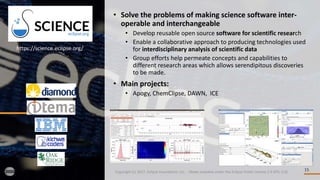
• Solve the problems of making science software inter-
operable and interchangeable
• Develop reusable open source software for scientific research
• Enable a collaborative approach to producing technologies used
for interdisciplinary analysis of scientific data
• Group efforts help permeate concepts and capabilities to
different research areas which allows serendipitous discoveries
to be made.
• Main projects:
• Apogy, ChemClipse, DAWN, ICE
https://science.eclipse.org/
1616Copyright (c) 2017, Eclipse Foundation, Inc. - Made available under the Eclipse Public License 2.0 (EPL-2.0)
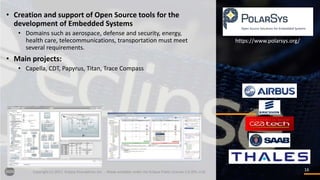
• Creation and support of Open Source tools for the
development of Embedded Systems
• Domains such as aerospace, defense and security, energy,
health care, telecommunications, transportation must meet
several requirements.
• Main projects:
• Capella, CDT, Papyrus, Titan, Trace Compass
https://www.polarsys.org/
17Copyright (c) 2017, Eclipse Foundation, Inc. - Made available under the Eclipse Public License 2.0 (EPL-2.0)
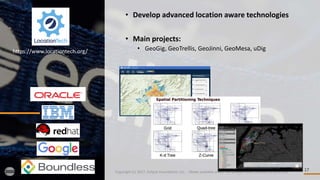
• Develop advanced location aware technologies
• Main projects:
• GeoGig, GeoTrellis, GeoJinni, GeoMesa, uDighttps://www.locationtech.org/
1818Copyright (c) 2017, Eclipse Foundation, Inc. - Made available under the Eclipse Public License 2.0 (EPL-2.0)
• Establish an Internet of Things based on open technologies
• Main projects:
Vorto
https://iot.eclipse.org/
19
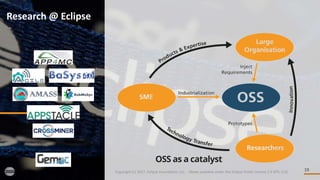
Research @ Eclipse
Copyright (c) 2017, Eclipse Foundation, Inc. - Made available under the Eclipse Public License 2.0 (EPL-2.0)
20Copyright (c) 2017, Eclipse Foundation, Inc. - Made available under the Eclipse Public License 2.0 (EPL-2.0)
21
Thank you
Philippe Krief
philippe.krief@eclipse-foundation.org
https://www.eclipsecon.org
Copyright (c) 2017, Eclipse Foundation, Inc. - Made available under the Eclipse Public License 2.0 (EPL-2.0)

EclipseDay Lyon: What’s happening these days at Eclipse?

  • 1.
    What’s happening thesedays at Eclipse? Philippe Krief Research Relations Director
  • 2.
    2 The Eclipse Ecosystem Copyright (c)2017, Eclipse Foundation, Inc. - Made available under the Eclipse Public License 2.0 (EPL-2.0) Foundation (2004) IDE (2001) Rich Client Platform (2005) Working Groups (2009) Research (2013)
  • 3.
    33 Eclipse Community by the Numbers Copyright(c) 2017, Eclipse Foundation, Inc. - Made available under the Eclipse Public License 2.0 (EPL-2.0) 130M lines of code per year 320+ projects 269 members 1 400+ developers 2M monthly visitors
  • 4.
    4 Strategic Members Copyright (c) 2017,Eclipse Foundation, Inc. - Made available under the Eclipse Public License 2.0 (EPL-2.0)
  • 5.
    5 IP Management &Licensing A Pillar of Open Collaborations Copyright (c) 2017, Eclipse Foundation, Inc. - Made available under the Eclipse Public License 2.0 (EPL-2.0)
  • 6.
    66 What’s Your (IP DueDiligence) Type? Copyright (c) 2017, Eclipse Foundation, Inc. - Made available under the Eclipse Public License 2.0 (EPL-2.0) The purpose of the Eclipse Foundation IP Policy is to set forth the general principles under which the Eclipse Foundation shall: a) accept Content, b) redistribute Content, c) host Content, and d) manage other intellectual property matters. Type A • license certification Type B • license certification • provenance check • code scan
  • 7.
    7 Eclipse Public License 2.0 Copyright(c) 2017, Eclipse Foundation, Inc. - Made available under the Eclipse Public License 2.0 (EPL-2.0) • Why? • The EPL-1.0 is very close to the Common Public License; • Essentially 16 years old. • A lot of the motivation was to reflect the norms and expectations of an industry that has changed a lot in that time. • Major changes between EPL-1.0 and EPL-2.0 • Broadened to refer to “content” (to include icons, gifs, documents,… ) • Removed references to New York State law; • Included a definition for “Modified Works” • Included a definition for “Derivative Works”; and • The license now includes an option to add a secondary license for GPL- 2.0+ compatibility. • Resources • https://www.eclipse.org/org/documents/epl-2.0/ • https://www.eclipse.org/org/documents/epl-2.0/faq.php
  • 8.
    8 @thelastminute The Eclipse Foundationis becoming the source for innovation and collaboration in the Java ecosystem The JAVA wave Copyright (c) 2017, Eclipse Foundation, Inc. - Made available under the Eclipse Public License 2.0 (EPL-2.0)
  • 9.
    9 Java 9 Support onthe Day of Release Copyright (c) 2017, Eclipse Foundation, Inc. - Made available under the Eclipse Public License 2.0 (EPL-2.0)
  • 10.
    1010 Eclipse Copyright (c) 2017,Eclipse Foundation, Inc. - Made available under the Eclipse Public License 2.0 (EPL-2.0) • Java VM for Cloud Native Computing • 50% less memory for the same performance • GPU utilization
  • 11.
    11 Eclipse Copyright (c) 2017,Eclipse Foundation, Inc. - Made available under the Eclipse Public License 2.0 (EPL-2.0) • Specifications for Java microservices architecture
  • 12.
    1212 Eclipse Enterprise for Java (EE4J) Copyright(c) 2017, Eclipse Foundation, Inc. - Made available under the Eclipse Public License 2.0 (EPL-2.0) • Open community for Java EE • Benefits: Agile, Flexible, Open, Compatible, Multi-vendors • Transition to EE4J in 2018 • GlassFish 5.0/Java EE 8 Ris (Reference Implementations), TCKs (Technology Compatibility Kits), product docs • Process for existing and new specs • Compatibility process • Technology evolution, MicroProfile integration • Oracle Java EE Support through Java EE 8 • Continuity for Java EE community Moving Java EE to Eclipse Foundation
  • 13.
    13 EE4J First contributions / subprojects Copyright(c) 2017, Eclipse Foundation, Inc. - Made available under the Eclipse Public License 2.0 (EPL-2.0) 1. Eclipse Grizzly NIO framework has been designed to help developers to take advantage of the Java™ NIO API. 2. Eclipse Jersey provides a reference implementation for Java API for RESTful Web Services (JAX-RS), starting from the specification defined by JSR-339. 3. Eclipse JSON Processing provides the API, TCK, and a reference implementation for Java API for JSON Processing, starting from the specification defined by JSR- 374. 4. Eclipse Message Service API for Java provides the API and TCK for Java™ Message Service (JMS) API, starting from the specification defined by JSR-914. 5. Eclipse Mojarra provides the API, TCK, and a reference implementation for JavaServer™ Faces, starting from the specification defined by JSR-372. 6. Eclipse OpenMQ provides a reference implementation for Java™ Message Service (JMS), starting from the specification defined by JSR-914. 7. Eclipse RESTful Web Services API for Java provides the API and TCK for Java API for RESTful Web Services (JAX-RS), starting from the specification defined by JSR-339. 8. Eclipse Tyrus provides a reference implementation for Java API for WebSocket, starting from the specification defined by JSR-356. 9. Eclipse WebSocket API for Java provides the API and TCK for Java API for WebSocket, starting from the specification defined by JSR-356.
  • 14.
    14 The Eclipse Foundationis becoming a platform for collaboration and innovation in Industry and Research Successful working groups Copyright (c) 2017, Eclipse Foundation, Inc. - Made available under the Eclipse Public License 2.0 (EPL-2.0)
  • 15.
    15Copyright (c) 2017,Eclipse Foundation, Inc. - Made available under the Eclipse Public License 2.0 (EPL-2.0) • Solve the problems of making science software inter- operable and interchangeable • Develop reusable open source software for scientific research • Enable a collaborative approach to producing technologies used for interdisciplinary analysis of scientific data • Group efforts help permeate concepts and capabilities to different research areas which allows serendipitous discoveries to be made. • Main projects: • Apogy, ChemClipse, DAWN, ICE https://science.eclipse.org/
  • 16.
    1616Copyright (c) 2017,Eclipse Foundation, Inc. - Made available under the Eclipse Public License 2.0 (EPL-2.0) • Creation and support of Open Source tools for the development of Embedded Systems • Domains such as aerospace, defense and security, energy, health care, telecommunications, transportation must meet several requirements. • Main projects: • Capella, CDT, Papyrus, Titan, Trace Compass https://www.polarsys.org/
  • 17.
    17Copyright (c) 2017,Eclipse Foundation, Inc. - Made available under the Eclipse Public License 2.0 (EPL-2.0) • Develop advanced location aware technologies • Main projects: • GeoGig, GeoTrellis, GeoJinni, GeoMesa, uDighttps://www.locationtech.org/
  • 18.
    1818Copyright (c) 2017,Eclipse Foundation, Inc. - Made available under the Eclipse Public License 2.0 (EPL-2.0) • Establish an Internet of Things based on open technologies • Main projects: Vorto https://iot.eclipse.org/
  • 19.
    19 Research @ Eclipse Copyright(c) 2017, Eclipse Foundation, Inc. - Made available under the Eclipse Public License 2.0 (EPL-2.0)
  • 20.
    20Copyright (c) 2017,Eclipse Foundation, Inc. - Made available under the Eclipse Public License 2.0 (EPL-2.0)
  • 21.
    21 Thank you Philippe Krief philippe.krief@eclipse-foundation.org https://www.eclipsecon.org Copyright(c) 2017, Eclipse Foundation, Inc. - Made available under the Eclipse Public License 2.0 (EPL-2.0)

Editor's Notes

  • #3 Community
  • #4 Add missing members
  • #7 License certification: Scan the code to obtain the terms and conditions under which such Content would be distributed by the Eclipse Foundation, and ensure that such terms are consistent with the Project Licenses Non Eclipse Content is conformed to the current licensing guidelines as provided by the EMO. Provenance check: Run and analyze the results of a scan tool provided by the EMO to help confirm the provenance of the Content. Confirm the provenance of the Content by asking the redistributors(s), maintainers(s), and/or the original author(s) of the Content questions such as: What is your process to obtain the necessary rights to enable you to redistribute the author(s)’ work? Did you agree to your code being distributed, under the applicable license agreement(s)? Did you write the code in question? Does anyone else have rights to the code in question?
  • #8 EPLv2 broadened to refer to “content” Many projects include icons, gifs, documents so it makes sense to ensure that there is no ambiguity that they are covered Removed references to New York State “Derivative Works” shall mean any work, whether in Source Code or other form, that is based on (or derived from) the Program and for which the editorial revisions, annotations, elaborations, or other modifications represent, as a whole, an original work of authorship. “Modified Works” shall mean any work in Source Code or other form that results from an addition to, deletion from, or modification of the contents of the Program, including, for purposes of clarity any new file in Source Code form that contains any contents of the Program. Modified Works shall not include works that contain only declarations, interfaces, types, classes, structures, or files of the Program solely in each case in order to link to, bind by name, or subclass the Program or Modified Works thereof.
  • #10 Oracle shipping Java 9 this past September. It was a major change to the Java language and required substantial work to support. Thank the JDT and Platform team for releasing Java 9 support on the release day.  
  • #11 Earlier this year, IBM open source their J9 virtual machine technology in a project called Eclipse OpenJ9. This project is really focused on Java for cloud native computing. The current benchmarks are pretty impressive. An application running on OpenJ9 uses 50% less memory for the same performance as using the OpenJDK VM. This is a significant cost savings for any large-scale cloud native application. GPU: Graphical Processor Unit
  • #13 And finally you might have heard Oracle has announced Java 44 is moving to the Eclipse Foundation. I get asked a lot ‘What does this mean?’. It means all of Java EE is being moved to a new top-level Eclipse EE4J project. This includes all the existing Java EE specs, TCK and reference implementations. You can expect to see very soon Glassfish will become Eclipse Glassfish.