(eBook PDF) Data Analytics for Accounting 2nd Edition By Vernon Richardson
(eBook PDF) Data Analytics for Accounting 2nd Edition By Vernon Richardson
(eBook PDF) Data Analytics for Accounting 2nd Edition By Vernon Richardson
(eBook PDF) Data Analytics for Accounting 2nd Edition By Vernon Richardson
(eBook PDF) Data Analytics for Accounting 2nd Edition By Vernon Richardson
1.
Quick and EasyEbook Downloads – Start Now at ebookluna.com for Instant Access
(eBook PDF) Data Analytics for Accounting 2nd
Edition By Vernon Richardson
https://ebookluna.com/product/ebook-pdf-data-analytics-for-
accounting-2nd-edition-by-vernon-richardson/
OR CLICK BUTTON
DOWLOAD EBOOK
Instantly Access and Download Textbook at https://ebookluna.com
2.
ric37831_fm_i-xxv.indd i 11/19/1907:33 PM
Vernon J. Richardson
University of Arkansas, Baruch College
Ryan A. Teeter
University of Pittsburgh
Katie L. Terrell
University of Arkansas
Data Analytics for
Accounting
SECOND EDITION
Final PDF to printer
ix
ric37831_fm_i-xxv.indd ix 11/19/1907:33 PM
Main Text Features Confirming Pages
38
ric37831_ch02_038-091.indd 38 09/03/1904:17PM
A Look at This Chapter
Thischapterprovidesanoverviewofthetypesofdatathatareusedintheaccountingcycleandcommondatathat
arestoredinarelationaldatabase.ThesecondstepoftheIMPACTcycleis“masteringthedata.”Wewilldescribe
howdataarerequestedandextractedtoanswerbusinessquestionsandhowtotransformdataforuseviadataprepa-
ration,validation,andcleaning.Weconcludewithanexplanationofhowtoloaddataintothe
appropriatetoolin
preparationforanalyzingdatatomakedecisions.
A Look Back
Chapter1definedDataAnalyticsandexplainedthatthevalueofDataAnalyticsisintheinsightsitprovides.
WedescribedtheDataAnalyticsProcessusingtheIMPACTcyclemodelandexplainedhowthisprocessisused
toaddressbothbusinessandaccountingquestions.Wespecificallyemphasizedtheimportanceofidentifying
appropriatequestionsthatdataanalyticsmightbeabletoaddress.
A Look Ahead
Chapter3describeshowtogofromdefiningbusinessproblemstoanalyzingdata,answeringquestions,and
addressingbusinessproblems.Weidentifyfourtypesofdataanalyticsanddescribevariousapproachesand
techniquesthataremostrelevanttoanalyzingaccountingdata.
MasteringtheData
Chapter 2
Chapter Maps
These maps provide a guide of what we’re
going to cover in the chapter as well as a
guide of what we’ve just learned and what’s
coming next.
Confirming Pages
44 Chapter 2 Mastering the Data
DATA DICTIONARIES
PROGRESS CHECK
1. Referring to Exhibit 2-1, locate the relationship between the Supplier and
Purchase Order tables. What is the unique identifier of each table? (The unique
identifier attribute is called the primary key—more on how it’s determined in the
next learning objective.) Which table contains the attribute that creates the rela-
tionship? (This attribute is called the foreign key—more on how it’s determined in
the next learning objective.)
2. Referring to Exhibit 2-1, review the attributes in the Purchase Order table. There
are two foreign keys listed in this table that do not relate to any of the tables in
the diagram. Which tables do you think they are? What type of data would be
stored in those two tables?
3. Refer to the two tables that you identified in Progress Check 2 above that would
relate to the Purchase Order table, but are not pictured in this diagram. Draw
a sketch of what the UML Class Diagram would look like if those tables were
included. Draw the two classes to represent the two tables (i.e., rectangles), the
relationships that should exist, and identify the Primary Keys for the two new
tables.
Progress Checks
Periodic progress check questions are posed to
the students throughout each chapter. These
checks provoke the student to stop and con-
sider the concepts presented.
Chapter-Opening Vignettes
Because companies are facing the new and
exciting opportunities with their use of Data
Analytics to help with accounting and busi-
ness decisions, we detail what they’re doing
and why in our chapter-opening vignettes.
Confirming Pages
39
ric37831_ch02_038-091.indd 39 09/03/1904:17PM
We are lucky to live in a world in which data are abundant.
However, even with rich sources of data, when it comes to being
able to analyze data and turn them into useful information and
insights, very rarely can an analyst hop right into a dataset and
begin analyzing. Datasets almost always need to be cleaned
and validated before they can be used. Not knowing how to
clean and validate data can, at best, lead to frustration and poor
insights and, at worst, lead to horrible security violations. While
this text takes advantage of open source datasets, these datas-
ets have all been scrubbed not only for accuracy, but also to pro-
tect the security and privacy of any individual or company whose
details were in the original dataset.
In 2015, a pair of researchers named Emil Kirkegaard and
Julius Daugbejerg Bjerrekaer scraped data from OkCupid, a free dating website, and provided the data onto the
“Open Science Framework,” a platform researchers use to obtain and share raw data. While the aim of the Open
Science Framework is to increase transparency, the researchers in this instance took that a step too far—and a step
into illegal territory. Kirkegaard and Bjerrekaer did not obtain permission from OkCupid or from the 70,000 OkCupid
users whose identities, ages, genders, religions, personality traits, and other personal details maintained by the dat-
ing site were provided to the public without any work being done to anonymize or sanitize the data. If the researchers
had taken the time to not just validate that the data were complete, but also to sanitize them to protect the individuals’
identities, this would not have been a threat or a news story. On May 13, 2015, the Open Science Framework removed
the OkCupid data from the platform, but the damage of the privacy breach had already been done.1
1
B. Resnick, “Researchers Just Released Profile Data on 70,000 OkCupid Users without Permission,”
2016, http://www.vox.com/2016/5/12/11666116/70000-okcupid-users-data-release (accessed
October 31, 2016).
OBJECTIVES
After reading this chapter, you should be able to:
LO 2-1 Understand how data are organized in an accounting information
system.
LO 2-2 Understand how data are stored in a relational database.
LO 2-3 Explain and apply extraction, transformation, and loading (ETL)
techniques.
Wichy/Shutterstock
Learning Objectives
We feature learning objectives at the beginning
of each chapter. Having these learning object-
ives provides students with an overview of the
concepts to be taught in the chapter and the
labs.
Final PDF to printer
5.
x
ric37831_fm_i-xxv.indd x 11/19/1907:33 PM
Answers to Progress Checks
Allow students to evaluate if they are on track with
their understanding of the materials presented in
the chapter.
End-of-Chapter Materials Confirming Pages
54
ric37831_ch02_038-091.indd 54 09/03/1904:17PM
ANSWERS TO PROGRESS CHECKS
1. The unique identifier of the Supplier table is [Supplier ID], and the unique identifier of the
Purchase Order table is [PO No.]. The Purchase Order table contains the foreign key.
2. The foreign key attributes in the Purchase Order table that do not relate to any tables
in the view are EmployeeID and CashDisbursementID. These attributes probably relate
to the Employee table (so that we can tell which employee was responsible for each
Purchase Order) and the Cash Disbursement table (so that we can tell if the Purchase
Orders have been paid for yet, and if so, on which check). The Employee table would be
a complete listing of each Employee, as well containing the details about each employee
(for example, phone number, address, etc.). The Cash Disbursement table would be a
listing of the payments the company has made.
3.
Materials Table
PK: Item_Number
1 1
1
*
*
*
Purchase Order Table
PK: PO_Number
FK: Supplier ID
FK: EmployeeID
FK: CashDisbursementID
Supplier Table
PK: Supplier ID
EmployeesTable
PK: EmployeeID
Purchase Order Details
Table
Composite PK:
FK: Item_Number
FK: PO_Number
CashDisbursement
Table
PK: Check Number
4. The purpose of the primary key is to uniquely identify each record in a table. The pur-
pose of a foreign key is to create a relationship between two tables. The purpose of a
descriptive attribute is to provide meaningful information about each record in a table.
Descriptive attributes aren’t required for a database to run, but they are necessary for
people to gain business information about the data stored in their databases.
5. Data dictionaries provide descriptions of the function (e.g., Primary Key or Foreign Key
when applicable), datatype, and field names associated with each column (attribute) of
a database. Data dictionaries are especially important when databases contain several
different tables and many different attributes in order to help analysts identify the infor-
mation they need to perform their analysis.
6. Depending on the level of security afforded to a business analyst, she can either obtain
data directly from the database herself or she can request the data. When obtaining
data herself, the analyst must have access to the raw data in the database and a firm
knowledge of SQL and data extraction techniques. When requesting the data, the ana-
lyst doesn’t need the same level of extraction skills, but she still needs to be familiar with
the data enough in order to identify which tables and attributes contain the information
she requires.
7. Four common issues that must be fixed are removing headings or subtotals, cleaning
leading zeroes or nonprintable characters, formatting negative numbers, and correcting
inconsistencies across the data.
Multiple Choice Questions
Quickly assess student’s knowledge of chapter
content.
Confirming Pages
8. Why is Supplier ID considered to be a primary key for a Supplier table?
a. It contains a unique identifier for each supplier.
b. It is a 10-digit number.
c. It can either be for a vendor or miscellaneous provider.
d. It is used to identify different supplier categories.
9. What are attributes that exist in a relational database that are neither primary nor for-
eign keys?
a. Nondescript attributes
b. Descriptive attributes
c. Composite key
d. Relational table attributes
10. Which of these is not included in the five steps of the ETL process?
a. Determine the purpose and scope of the data request.
b. Obtain the data.
c. Validate the data for completeness and integrity.
d. Scrub the data.
Discussion Questions
1. The advantages of a relational database include limiting the amount of redundant data
that are stored in a database. Why is this an important advantage? What can go wrong
when redundant data are stored?
2. The advantages of a relational database include integrating business processes. Why
is it preferable to integrate business processes in one information system, rather than
store different business process data in separate, isolated databases?
3. Even though it is preferable to store data in a relational database, storing data across
separate tables can make data analysis cumbersome. Describe three reasons it is worth
the trouble to store data in a relational database.
4. Among the advantages of using a relational database is enforcing business rules. Based
on your understanding of how the structure of a relational database helps prevent data
redundancy and other advantages, how does the primary key/foreign key relationship
structure help enforce a business rule that indicates that a company shouldn’t process
any purchase orders from suppliers who don’t exist in the database?
5. What is the purpose of a data dictionary? Identify four different attributes that could be
stored in a data dictionary, and describe the purpose of each.
6. In the ETL process, the first step is extracting the data. When you are obtaining the data
yourself, what are the steps to identifying the data that you need to extract?
7. In the ETL process, if the analyst does not have the security permissions to access
the data directly, then he or she will need to fill out a data request form. While this
doesn’t necessarily require the analyst to know extraction techniques, why does the
analyst still need to understand the raw data very well in order to complete the data
request?
8. In the ETL process, when an analyst is completing the data request form, there are a
number of fields that the analyst is required to complete. Why do you think it is important
Discussion Questions
Provide questions for group discussion.
Confirming P
Multiple Choice Questions
1. Mastering the data can also be described via the ETL process. The ETL process
stands for:
a. extract, total, and load data.
b. enter, transform, and load data.
c. extract, transform, and load data.
d. enter, total, and load data.
2. Which of the following describes part of the goal of the ETL process:
a. identify which approach to data analytics should be used.
b. load the data into a relational database for storage.
c. communicate the results and insights found through the analysis.
d. identify and obtain the data needed for solving the problem.
3. The advantages of storing data in a relational database include which of the following?
a. Help in enforcing business rules
b. Increased information redundancy
c. Integrating business processes
d. All of the above
e. Only A and B
f. Only B and C
g. Only A and C
4. The purpose of transforming data is:
a. to validate the data for completeness and integrity.
b. to load the data into the appropriate tool for analysis.
c. to obtain the data from the appropriate source.
d. to identify which data are necessary to complete the analysis.
5. Which attribute is required to exist in each table of a relational database and serves as
the “unique identifier” for each record in a table?
a. Foreign key
b. Unique identifier
c. Primary key
d. Key attribute
6. The metadata that describes each attribute in a database is which of the following?
a. Composite primary key
b. Data dictionary
c. Descriptive attributes
d. Flat file
7. As mentioned in the chapter, which of the following is not a common way that data will
need to be cleaned after extraction and validation?
a. Remove headings and subtotals.
b. Format negative numbers.
c. Clean up trailing zeroes.
®
Final PDF to printer
6.
ric37831_fm_i-xxv.indd xi 11/19/1907:33 PM
End-of-Chapter Materials xi
Problems
Challenge the student’s ability to see relation-
ships in the learning objectives by employing
higher-level thinking and analytical skills.
Labs
Give students hands-on experience working with
different types of data and the tools used to ana-
lyze them. Students will conduct data analysis
using Excel, Access (including SQL), Tableau,
IDEA, XBRL, and Weka.
Comprehensive Cases
Use a real-life Big Data set based on Dillard’s
actual company data. This dataset allows students
to build their skills and test their conclusions
across concepts covered in each chapter. The
Comprehensive Cases can be followed continu-
ously from the first chapter or picked up at any
later point in the book; enough information is
provided to ensure students can get right to work.
ric37831_ch02_038-091.indd 57
10.
be the effect of the following?
a. Transforming NULL and N/A values into blanks
b. Transforming NULL and N/A values into zeroes
c. Deleting records that have NULL and N/A values from your dataset
(Hint: Think about the impact on different aggregate functions, such as COUNT and
AVERAGE.)
Problems
The following problems correspond to the College Scorecard data. You should be able to
answer each question by just looking at the data dictionary included in Appendix K, but if
you would like to use the raw data, feel free to do so (CollegeScorecard_RawData.txt).
1. Which attributes from the College Scorecard data would you need to compare cost of
attendance across types of institutions (public, private nonprofit, or private for-profit)?
2. Which attributes from the College Scorecard data would you need to compare SAT
scores across types of institutions (public, private nonprofit, or private for-profit)?
3. Which attributes from the College Scorecard data would you need to compare levels of
diversity across types of institutions (public, private nonprofit, or private for-profit)?
4. If you were conducting a data analysis in order to compare the percentage of students
who receive federal loans at universities above and below the median cost of atten-
dance across all institutions, your analysis would require several steps. One of the steps
is to know what question needs to be answered first in order to complete the analysis.
Come up with a set of questions that need to be answered.
5. If you were analyzing the levels of diversity across public and private institutions using
the College Scorecard data, how would you define diversity in terms of the data pro-
vided? Would it be beneficial to combine attributes?
6. Which attributes from the College Scorecard data would you need to compare comple-
tion rate across types of institutions (public, private nonprofit, or private for-profit)?
7. Which attributes from the College Scorecard data would you need to compare the
percentage of students who receive federal loans at universities above and below the
median cost of attendance across all institutions (public, private nonprofit, or private
for-profit)?
8. Which attributes from the College Scorecard data would you need to determine if differ-
ent regions of the country have significantly different costs of attendance?
9. Use the College Scorecard data to determine if different regions of the country have
significantly different costs of attendance (same as Problem 6) and fill out a data request
form in order to extract the appropriate data. Use the template from the chapter as a
guide.
Confirm
58
Oneofthebiggestchallengesyoufacewithdataanalysisisgettingtheright
mayhavethebestquestionsintheworld,butiftherearenodataavailabletosu
hypothesis,youwillhavedifficultyprovidingvalue.Additionally,therearein
whichtheITworkersmaybereluctanttosharedatawithyou.Theymaysendi
data,thewrongdata,orcompletelyignoreyourrequest.Bepersistent,andyoum
lookforcreativewaystofindinsightwithanincompletepicture.
Company summary
Sláinteisafictionalbrewerythathasrecentlygonethroughbigchanges.Sláintes
ferentproducts.Thebreweryhasonlyrecentlyexpandeditsbusinesstodistributin
statetoninestates,andnowitsbusinesshasbegunstabilizingaftertheexpansion
stabilitycomesaneedforbetteranalysis.YouhavebeenhiredbySláintetohel
mentbetterunderstandthecompany’ssalesdataandprovideinputforitsstrategic
Data
• Datarequestform
Technique
• Notechnicalexperienceisnecessaryforthislab.
Software needed
• Wordprocessor
In this lab, you will:
Part1:Identifyappropriatequestionsanddevelopahypothesisforeachquest
Part2:Generatearequestfordata.
Part3:Assessthedatayoureceive.
Part 1: Identify the Questions
OneofSláinte’sfirstprioritiesistoidentifyitsareasofsuccessaswellasareaso
improvement.Yourmanagerhasaskedyoutofocusspecificallyonsalesdataat
Thisincludesdatarelatedtosalesorders,products,andcustomers.
Q1. GiventhatyouarenewandtryingtogetagrasponSláinte’soperation
three questions related to salesthatwouldhelpyoubeginyouranalysis
example,how many products were sold in each state?
Q2. Nowhypothesize the answerstoeachofthequestions.Remember,you
don’thavetobecorrectatthispoint.Theywillhelpyouunderstandw
ofdatayouarelookingfor.Forexample:500 in Missouri, 6,000 in Penn
4,000 in New York, etc.
Q3. Finally,foreachquestion,identify the specific tables and attributestha
neededtoansweryourquestions.UseLab Exhibit 2-1Aforguidanceo
tablesandattributesareavailable.Forexample,toanswerthequestion
statesales,youwouldneedthe[Customer_St]attributethatislocated
[Customer]mastertableaswellasthe[Sales_Order_Quantity_Sold]
inthe[Sales]table.Ifyouhadaccesstostoreordistributioncenterlo
data,youmayalsolookfora[State]fieldthere,aswell.
Lab 2-1 Create a Request for Data Extraction
Confirm
80
ric37831_ch02_038-091.indd 80 09
10. Takeascreenshotofyourresults(labelit2-7A).
11. Whenyoulookattheseresults,youmaywonderwhatsomeoftheattributes
re
Forexample,TRAN_TYPEonlyreturnsvalueswithP.Toviewothertypesof
couldfilteroutanyrecordthathasaTRAN_TYPEofP.Executethefollowing
SELECT TOP 10 *
FROM TRANSACT
WHERE TRAN_TYPE 'P'
Part 4: Address and Refine Results
Q3. Whatdoyouthink‘P’and‘R’representintheTRAN_TYPEtable?H
transactionsdifferiftheyarerepresentedby‘P’or‘R’?
Q4. Whatbenefitcanyougainfromselectingonlythetopfewrowsofyou
particularlyfromalargedataset?
End of Lab
7. Becausethisdatasetismassive,itcantakeaverylongtimeforthesystemto
thecompletesetofdataforsomeofthebiggertables(suchasTRANSACT)
wouldliketoviewjustthetopfewrowsofadatasettogetthefeelforwhatt
dataisinthetable,youcandosowithaquery.
IntheSELECTline,youcantypeTOP#beforethecolumnsyouwouldl
Anytypeoffiltering,aggregating,andorderingwillstillworkthroughthere
query,butselectingthetopfewwillhelpthequeryrunfasterbyreturninga
theresult.
8. Toviewthetop10rowsintheTRANSACTtable,typethefollowingqueryi
querywindow:
SELECT TOP 10 *
FROM TRANSACT
9. Toseetheresultofthequery,clickExecute.F5alsoworkstorunqueriesas
PCshortcut.
Source:MicrosoftSQLServer
ManagementStudio.
Company summary
Dillard’sisadepartmentstorewithapproximately330storesin29states.Itshead
inLittleRock,Arkansas.YoucanlearnmoreaboutDillard’sbylookingatfinance.
(Tickersymbol=DDS)andtheWikipediasiteforDDS.You’llquicklynotethat
DillardIIisanaccountinggradoftheUniversityofArkansasandtheWalton
Lab 2-8 Comprehensive Case: Dillard’s Store Data:
Connecting Excel to a SQL Database
Final PDF to printer
7.
xii
ric37831_fm_i-xxv.indd xii 11/19/1907:33 PM
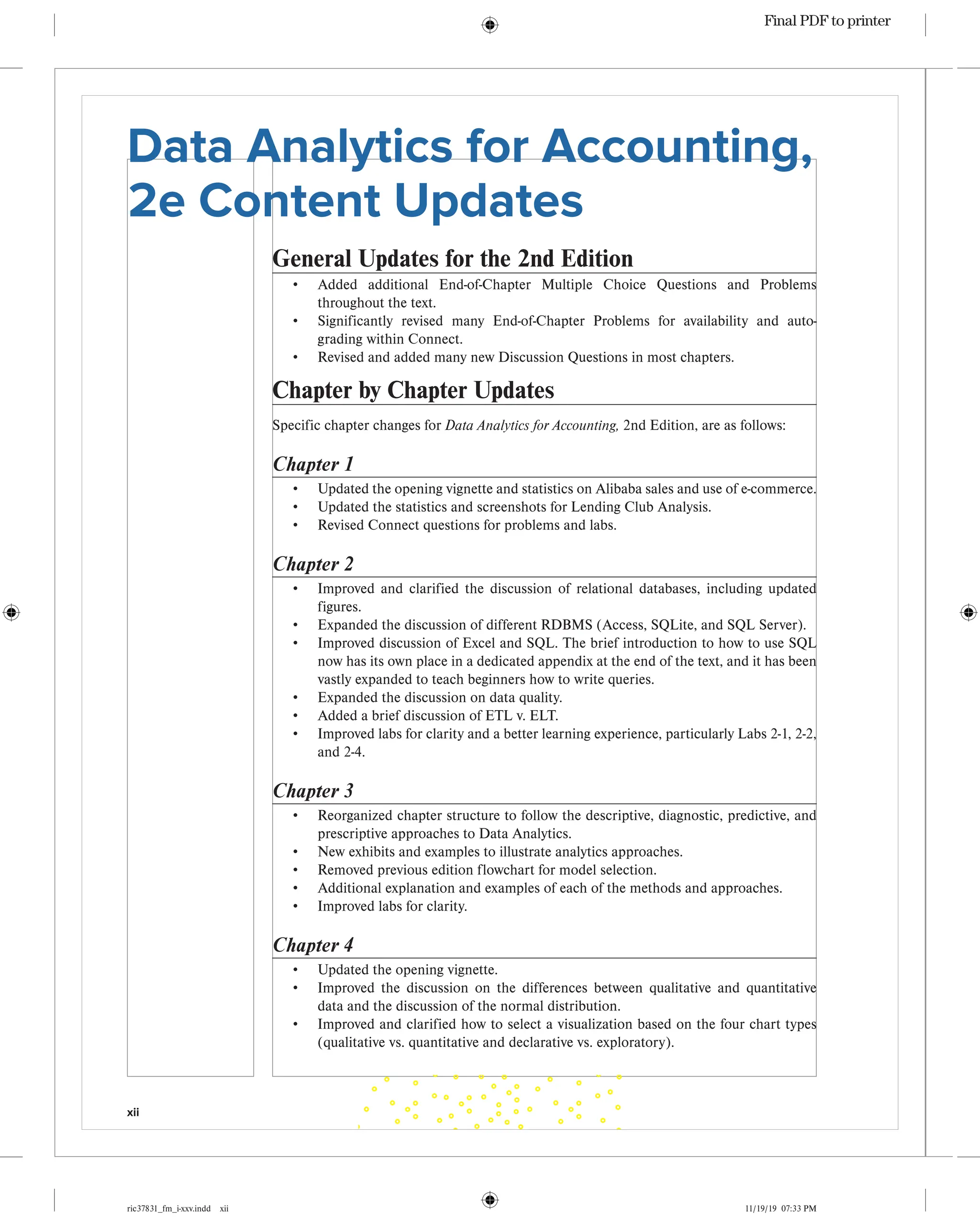
Data Analytics for Accounting,
2e Content Updates
General Updates for the 2nd Edition
• Added additional End-of-Chapter Multiple Choice Questions and Problems
throughout the text.
• Significantly revised many End-of-Chapter Problems for availability and auto-
grading within Connect.
• Revised and added many new Discussion Questions in most chapters.
Chapter by Chapter Updates
Specific chapter changes for Data Analytics for Accounting, 2nd Edition, are as follows:
Chapter 1
• Updated the opening vignette and statistics on Alibaba sales and use of e-commerce.
• Updated the statistics and screenshots for Lending Club Analysis.
• Revised Connect questions for problems and labs.
Chapter 2
• Improved and clarified the discussion of relational databases, including updated
figures.
• Expanded the discussion of different RDBMS (Access, SQLite, and SQL Server).
• Improved discussion of Excel and SQL. The brief introduction to how to use SQL
now has its own place in a dedicated appendix at the end of the text, and it has been
vastly expanded to teach beginners how to write queries.
• Expanded the discussion on data quality.
• Added a brief discussion of ETL v. ELT.
• Improved labs for clarity and a better learning experience, particularly Labs 2-1, 2-2,
and 2-4.
Chapter 3
• Reorganized chapter structure to follow the descriptive, diagnostic, predictive, and
prescriptive approaches to Data Analytics.
• New exhibits and examples to illustrate analytics approaches.
• Removed previous edition flowchart for model selection.
• Additional explanation and examples of each of the methods and approaches.
• Improved labs for clarity.
Chapter 4
• Updated the opening vignette.
• Improved the discussion on the differences between qualitative and quantitative
data and the discussion of the normal distribution.
• Improved and clarified how to select a visualization based on the four chart types
(qualitative vs. quantitative and declarative vs. exploratory).
Final PDF to printer
8.
ric37831_fm_i-xxv.indd xiii 11/19/1907:33 PM
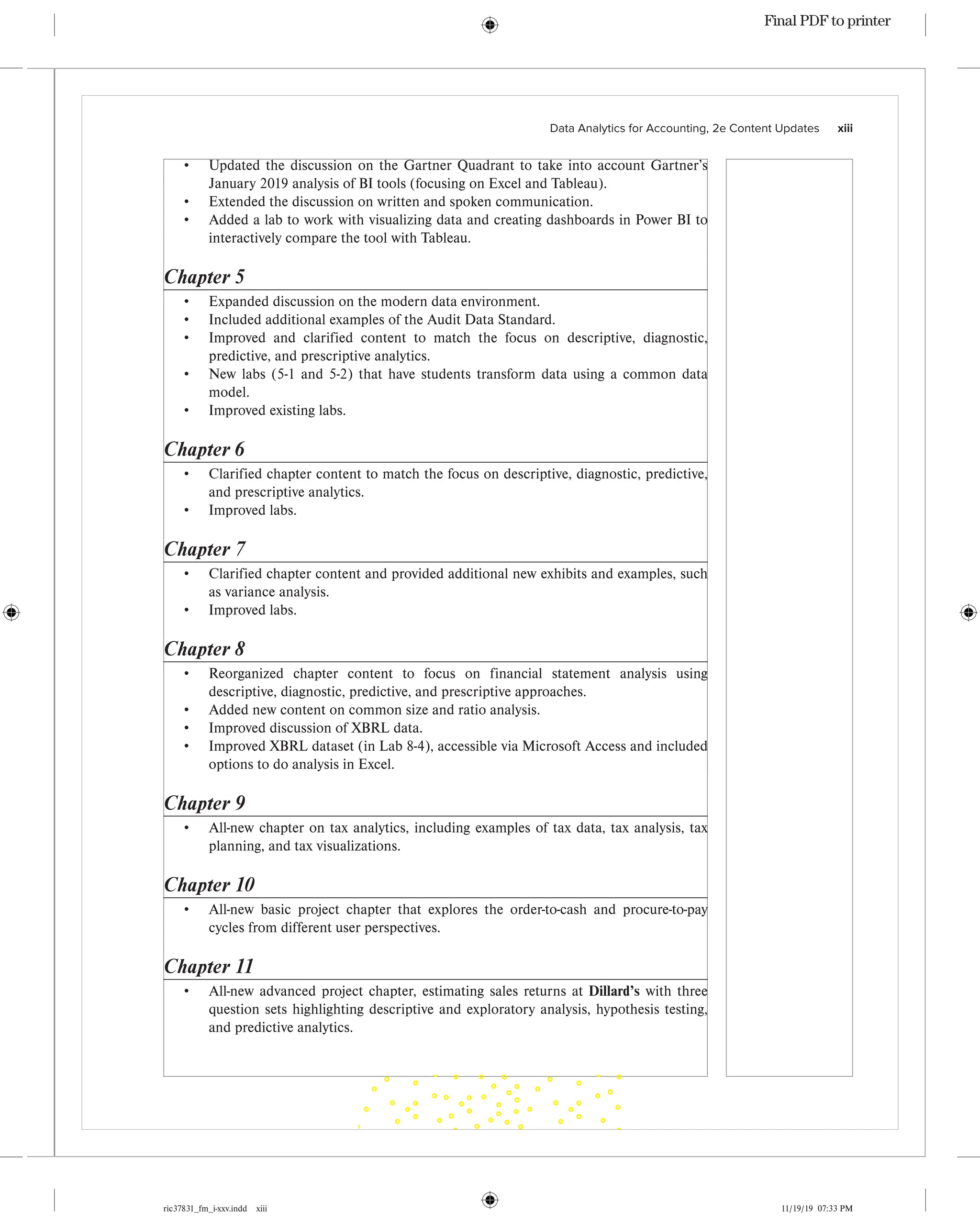
Data Analytics for Accounting, 2e Content Updates xiii
• Updated the discussion on the Gartner Quadrant to take into account Gartner’s
January 2019 analysis of BI tools (focusing on Excel and Tableau).
• Extended the discussion on written and spoken communication.
• Added a lab to work with visualizing data and creating dashboards in Power BI to
interactively compare the tool with Tableau.
Chapter 5
• Expanded discussion on the modern data environment.
• Included additional examples of the Audit Data Standard.
• Improved and clarified content to match the focus on descriptive, diagnostic,
predictive, and prescriptive analytics.
• New labs (5-1 and 5-2) that have students transform data using a common data
model.
• Improved existing labs.
Chapter 6
• Clarified chapter content to match the focus on descriptive, diagnostic, predictive,
and prescriptive analytics.
• Improved labs.
Chapter 7
• Clarified chapter content and provided additional new exhibits and examples, such
as variance analysis.
• Improved labs.
Chapter 8
• Reorganized chapter content to focus on financial statement analysis using
descriptive, diagnostic, predictive, and prescriptive approaches.
• Added new content on common size and ratio analysis.
• Improved discussion of XBRL data.
• Improved XBRL dataset (in Lab 8-4), accessible via Microsoft Access and included
options to do analysis in Excel.
Chapter 9
• All-new chapter on tax analytics, including examples of tax data, tax analysis, tax
planning, and tax visualizations.
Chapter 10
• All-new basic project chapter that explores the order-to-cash and procure-to-pay
cycles from different user perspectives.
Chapter 11
• All-new advanced project chapter, estimating sales returns at Dillard’s with three
question sets highlighting descriptive and exploratory analysis, hypothesis testing,
and predictive analytics.
Final PDF to printer
9.
ric37831_fm_i-xxv.indd xiv 11/19/1907:33 PM
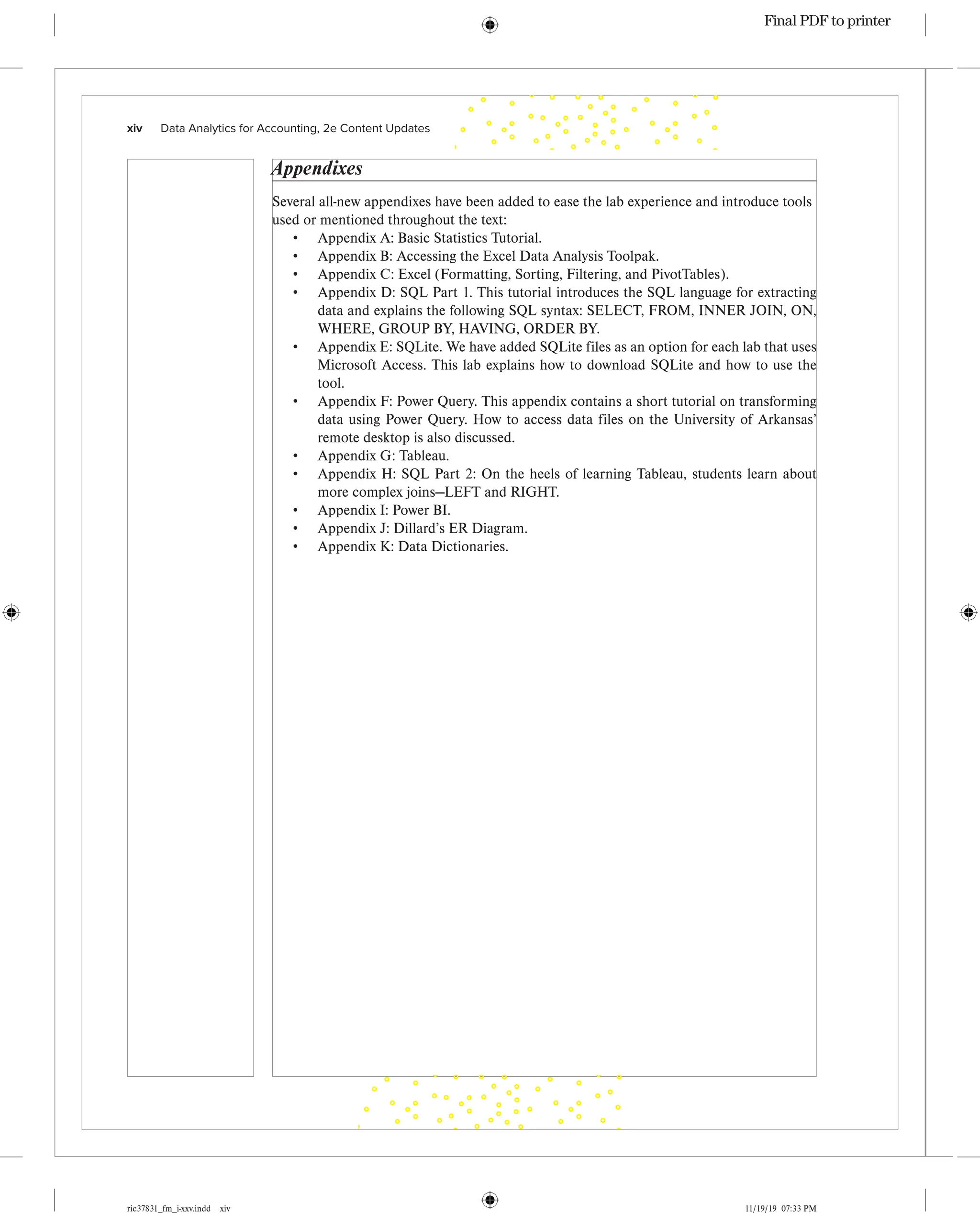
xiv Data Analytics for Accounting, 2e Content Updates
Appendixes
Several all-new appendixes have been added to ease the lab experience and introduce tools
used or mentioned throughout the text:
• Appendix A: Basic Statistics Tutorial.
• Appendix B: Accessing the Excel Data Analysis Toolpak.
• Appendix C: Excel (Formatting, Sorting, Filtering, and PivotTables).
• Appendix D: SQL Part 1. This tutorial introduces the SQL language for extracting
data and explains the following SQL syntax: SELECT, FROM, INNER JOIN, ON,
WHERE, GROUP BY, HAVING, ORDER BY.
• Appendix E: SQLite. We have added SQLite files as an option for each lab that uses
Microsoft Access. This lab explains how to download SQLite and how to use the
tool.
• Appendix F: Power Query. This appendix contains a short tutorial on transforming
data using Power Query. How to access data files on the University of Arkansas’
remote desktop is also discussed.
• Appendix G: Tableau.
• Appendix H: SQL Part 2: On the heels of learning Tableau, students learn about
more complex joins—LEFT and RIGHT.
• Appendix I: Power BI.
• Appendix J: Dillard’s ER Diagram.
• Appendix K: Data Dictionaries.
Final PDF to printer
10.
xv
ric37831_fm_i-xxv.indd xv 11/19/1907:33 PM
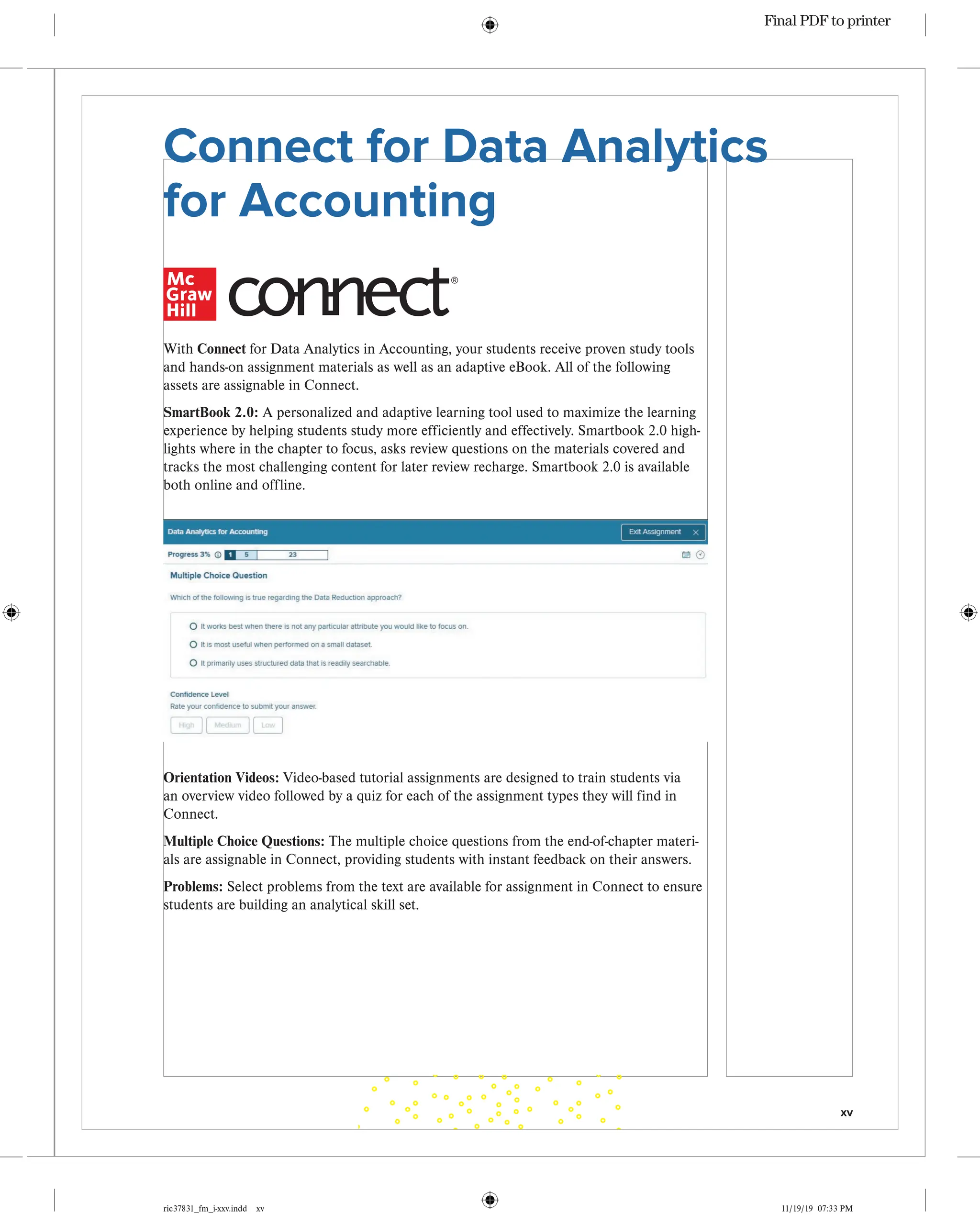
With Connect for Data Analytics in Accounting, your students receive proven study tools
and hands-on assignment materials as well as an adaptive eBook. All of the following
assets are assignable in Connect.
SmartBook 2.0: A personalized and adaptive learning tool used to maximize the learning
experience by helping students study more efficiently and effectively. Smartbook 2.0 high-
lights where in the chapter to focus, asks review questions on the materials covered and
tracks the most challenging content for later review recharge. Smartbook 2.0 is available
both online and offline.
Connect for Data Analytics
for Accounting
®
Orientation Videos: Video-based tutorial assignments are designed to train students via
an overview video followed by a quiz for each of the assignment types they will find in
Connect.
Multiple Choice Questions: The multiple choice questions from the end-of-chapter materi-
als are assignable in Connect, providing students with instant feedback on their answers.
Problems: Select problems from the text are available for assignment in Connect to ensure
students are building an analytical skill set.
Final PDF to printer
11.
ric37831_fm_i-xxv.indd xvi 11/19/1907:33 PM
xvi Connect for Data Analytics for Accounting
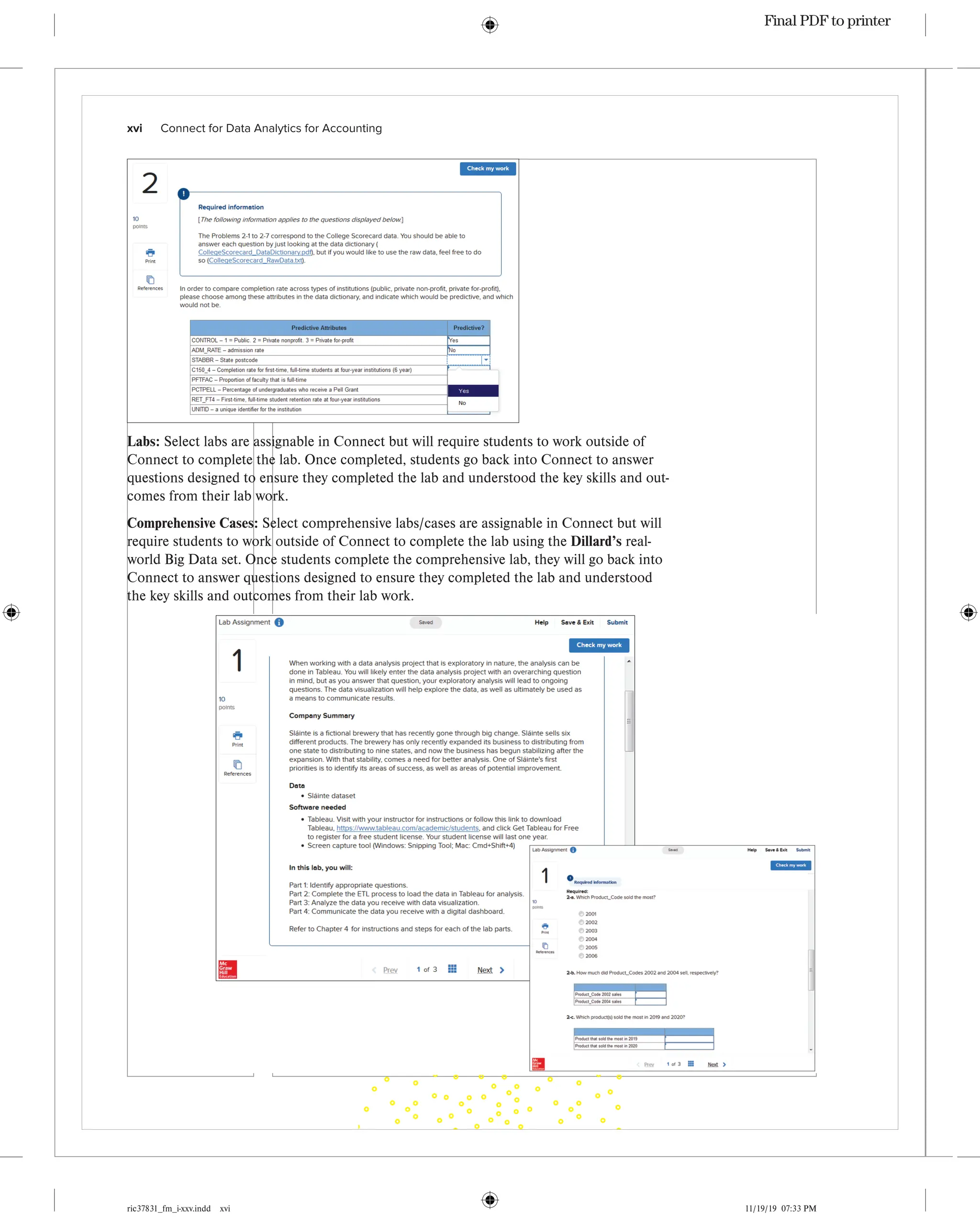
Labs: Select labs are assignable in Connect but will require students to work outside of
Connect to complete the lab. Once completed, students go back into Connect to answer
questions designed to ensure they completed the lab and understood the key skills and out-
comes from their lab work.
Comprehensive Cases: Select comprehensive labs/cases are assignable in Connect but will
require students to work outside of Connect to complete the lab using the Dillard’s real-
world Big Data set. Once students complete the comprehensive lab, they will go back into
Connect to answer questions designed to ensure they completed the lab and understood
the key skills and outcomes from their lab work.
Final PDF to printer
ric37831_fm_i-xxv.indd xvii 11/19/1907:33 PM
Connect for Data Analytics for Accounting xvii
Lab Walkthrough Videos: Get the help you need, when you need it. These author-led vid-
eos will explain how to access and use the tools needed to complete processes essential to
the labs.
Author Lecture Videos: Lecture Videos teach each chapter’s core learning objectives and
concepts through an author-developed, hands-on presentation, bringing the text content to
life. The videos have the touch and feel of a live lecture, rather than a canned presentation,
so you can learn at your own pace.
Test Bank: The test bank includes auto-graded multiple choice and true/false assessment
questions. It is available in Connect and Test Builder.
Final PDF to printer
14.
ric37831_fm_i-xxv.indd xviii 11/19/1907:33 PM
You’re in the driver’s seat.
Want to build your own course? No problem. Prefer to use our
turnkey, prebuilt course? Easy. Want to make changes throughout the
semester? Sure. And you’ll save time with Connect’s auto-grading too.
65%
Less Time
Grading
FOR INSTRUCTORS
Solutions for your
challenges.
A product isn’t a solution. Real
solutions are affordable, reliable,
and come with training and
ongoing support when you need it
and how you want it. Our Customer
Experience Group can also help
you troubleshoot tech problems—
although Connect’s 99% uptime
means you might not need to call
them. See for yourself at status.
mheducation.com
Checkmark: Jobalou/Getty Images
Make it simple,
make it affordable.
Connect makes it easy with seamless
integration using any of the major
Learning Management Systems—
Blackboard®, Canvas, and D2L, among
others—to let you organize your course
in one convenient location. Give your
students access to digital materials at
a discount with our inclusive access
program. Ask your McGraw-Hill
representative for more information.
Padlock: Jobalou/Getty Images
Laptop: McGraw-Hill; Woman/dog: George Doyle/Getty Images
They’ll thank you for it.
Adaptive study resources like SmartBook® 2.0
help your students be better prepared in less
time. You can transform your class time from
dull definitions to dynamic debates. Find out
more about the powerful personalized learning
experience available in SmartBook 2.0 at
www.mheducation.com/highered/connect/
smartbook
Final PDF to printer
15.
ric37831_fm_i-xxv.indd xix 11/19/1907:33 PM
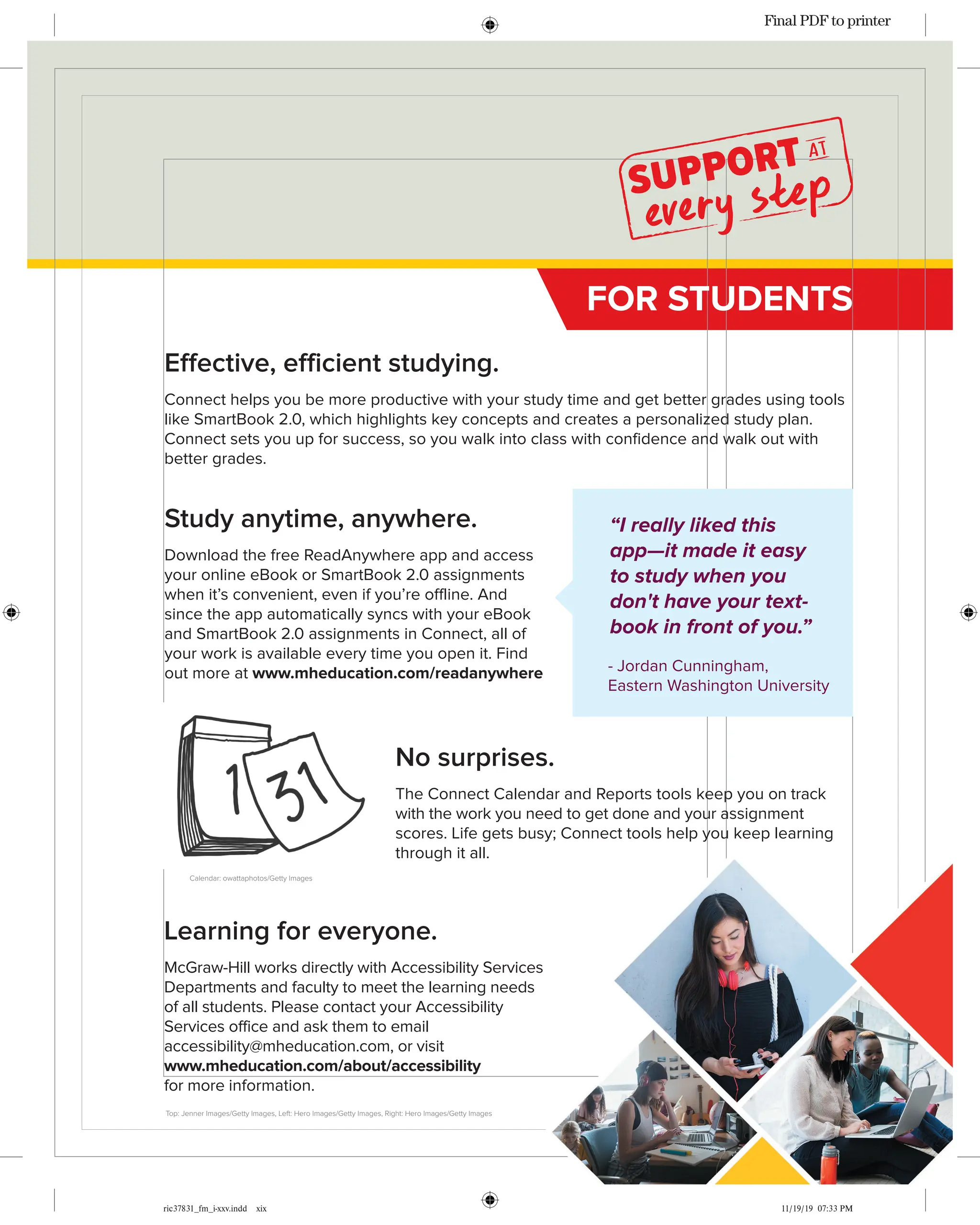
No surprises.
The Connect Calendar and Reports tools keep you on track
with the work you need to get done and your assignment
scores. Life gets busy; Connect tools help you keep learning
through it all.
Learning for everyone.
McGraw-Hill works directly with Accessibility Services
Departments and faculty to meet the learning needs
of all students. Please contact your Accessibility
Services office and ask them to email
accessibility@mheducation.com, or visit
www.mheducation.com/about/accessibility
for more information.
FOR STUDENTS
Top: Jenner Images/Getty Images, Left: Hero Images/Getty Images, Right: Hero Images/Getty Images
Calendar: owattaphotos/Getty Images
Effective, efficient studying.
Connect helps you be more productive with your study time and get better grades using tools
like SmartBook 2.0, which highlights key concepts and creates a personalized study plan.
Connect sets you up for success, so you walk into class with confidence and walk out with
better grades.
“I really liked this
app—it made it easy
to study when you
don't have your text-
book in front of you.”
- Jordan Cunningham,
Eastern Washington University
Study anytime, anywhere.
Download the free ReadAnywhere app and access
your online eBook or SmartBook 2.0 assignments
when it’s convenient, even if you’re offline. And
since the app automatically syncs with your eBook
and SmartBook 2.0 assignments in Connect, all of
your work is available every time you open it. Find
out more at www.mheducation.com/readanywhere
Final PDF to printer
16.
xx
ric37831_fm_i-xxv.indd xx 11/19/1907:33 PM
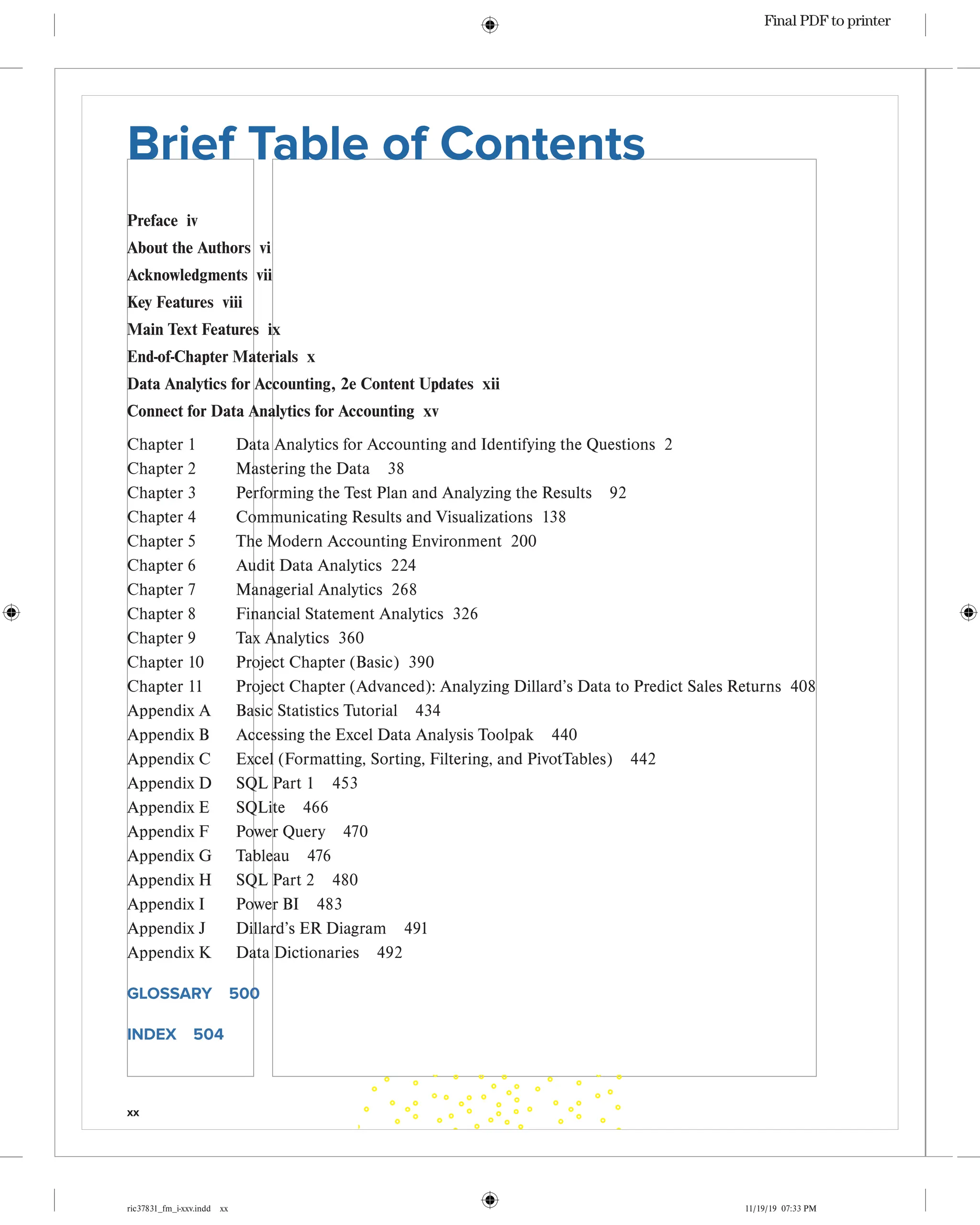
Brief Table of Contents
Preface iv
About the Authors vi
Acknowledgments vii
Key Features viii
Main Text Features ix
End-of-Chapter Materials x
Data Analytics for Accounting, 2e Content Updates xii
Connect for Data Analytics for Accounting xv
Chapter 1 Data Analytics for Accounting and Identifying the Questions 2
Chapter 2 Mastering the Data 38
Chapter 3 Performing the Test Plan and Analyzing the Results 92
Chapter 4 Communicating Results and Visualizations 138
Chapter 5 The Modern Accounting Environment 200
Chapter 6 Audit Data Analytics 224
Chapter 7 Managerial Analytics 268
Chapter 8 Financial Statement Analytics 326
Chapter 9 Tax Analytics 360
Chapter 10 Project Chapter (Basic) 390
Chapter 11
Project Chapter (Advanced): Analyzing Dillard’s Data to Predict Sales Returns 408
Appendix A Basic Statistics Tutorial 434
Appendix B Accessing the Excel Data Analysis Toolpak 440
Appendix C Excel (Formatting, Sorting, Filtering, and PivotTables) 442
Appendix D SQL Part 1 453
Appendix E SQLite 466
Appendix F Power Query 470
Appendix G Tableau 476
Appendix H SQL Part 2 480
Appendix I Power BI 483
Appendix J Dillard’s ER Diagram 491
Appendix K Data Dictionaries 492
GLOSSARY 500
INDEX 504
Final PDF to printer
17.
xxi
ric37831_fm_i-xxv.indd xxi 11/19/1907:33 PM
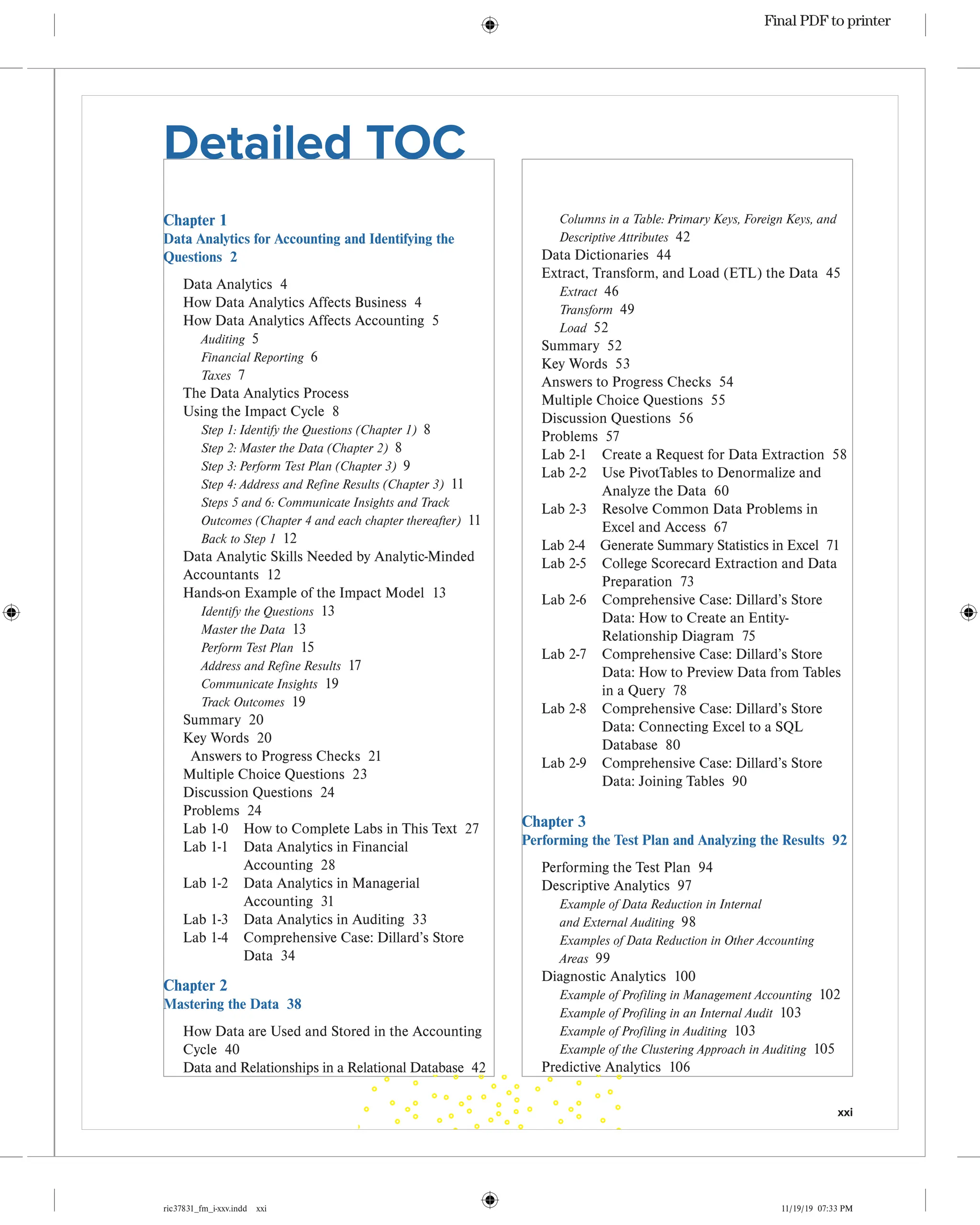
Chapter 1
Data Analytics for Accounting and Identifying the
Questions 2
Data Analytics 4
How Data Analytics Affects Business 4
How Data Analytics Affects Accounting 5
Auditing 5
Financial Reporting 6
Taxes 7
The Data Analytics Process
Using the Impact Cycle 8
Step 1: Identify the Questions (Chapter 1) 8
Step 2: Master the Data (Chapter 2) 8
Step 3: Perform Test Plan (Chapter 3) 9
Step 4: Address and Refine Results (Chapter 3) 11
Steps 5 and 6: Communicate Insights and Track
Outcomes (Chapter 4 and each chapter thereafter) 11
Back to Step 1 12
Data Analytic Skills Needed by Analytic-Minded
Accountants 12
Hands-on Example of the Impact Model 13
Identify the Questions 13
Master the Data 13
Perform Test Plan 15
Address and Refine Results 17
Communicate Insights 19
Track Outcomes 19
Summary 20
Key Words 20
Answers to Progress Checks 21
Multiple Choice Questions 23
Discussion Questions 24
Problems 24
Lab 1-0 How to Complete Labs in This Text 27
Lab 1-1
Data Analytics in Financial
Accounting 28
Lab 1-2
Data Analytics in Managerial
Accounting 31
Lab 1-3
Data Analytics in Auditing 33
Lab 1-4
Comprehensive Case: Dillard’s Store
Data 34
Chapter 2
Mastering the Data 38
How Data are Used and Stored in the Accounting
Cycle 40
Data and Relationships in a Relational Database 42
Columns in a Table: Primary Keys, Foreign Keys, and
Descriptive Attributes 42
Data Dictionaries 44
Extract, Transform, and Load (ETL) the Data 45
Extract 46
Transform 49
Load 52
Summary 52
Key Words 53
Answers to Progress Checks 54
Multiple Choice Questions 55
Discussion Questions 56
Problems 57
Lab 2-1 Create a Request for Data Extraction 58
Lab 2-2
Use PivotTables to Denormalize and
Analyze the Data 60
Lab 2-3
Resolve Common Data Problems in
Excel and Access 67
Lab 2-4
Generate Summary Statistics in Excel 71
Lab 2-5
College Scorecard Extraction and Data
Preparation 73
Lab 2-6
Comprehensive Case: Dillard’s Store
Data: How to Create an Entity-
Relationship Diagram 75
Lab 2-7
Comprehensive Case: Dillard’s Store
Data: How to Preview Data from Tables
in a Query 78
Lab 2-8
Comprehensive Case: Dillard’s Store
Data: Connecting Excel to a SQL
Database 80
Lab 2-9
Comprehensive Case: Dillard’s Store
Data: Joining Tables 90
Chapter 3
Performing the Test Plan and Analyzing the Results 92
Performing the Test Plan 94
Descriptive Analytics 97
Example of Data Reduction in Internal
and External Auditing 98
Examples of Data Reduction in Other Accounting
Areas 99
Diagnostic Analytics 100
Example of Profiling in Management Accounting 102
Example of Profiling in an Internal Audit 103
Example of Profiling in Auditing 103
Example of the Clustering Approach in Auditing 105
Predictive Analytics 106
Detailed TOC
Final PDF to printer
round face setin determined lines, and a moment later George Tubb
took the vacant place at Toby’s side.
“Pretty punk game, isn’t it?” he said.
Toby concealed his displeasure as best he could. “Well, it’s the first
one, you know. Can’t expect much of a first game. How did you get
on to-day?”
“Pretty good.” Toby was actually startled. Never before had he
heard Tubb approach so close to enthusiasm! Even the rest of his
response couldn’t altogether spoil the first part. “I’m through to-day,
though. I only agreed to keep on for the week, you know. Well,
here’s your fat friend coming back, and I’ll beat it. So long, Tucker.”
“So long,” answered Toby. To himself he added viciously, “I’d like
to punch your silly head!”
20.
“T
CHAPTER X
TOBY EMPTIESHIS LOCKER
he cheek of him!” exclaimed Sid, seating himself. “What do
you think he asked me to do?”
“Go away?” hazarded Toby.
“Asked me to lend him another half! Said he’d pay it all back next
Wednesday, when he gets his allowance. What do you know about
that? That fellow’s got the makings of a financier!”
“Or a grafter,” laughed Toby. Sid shook his head.
“No, his method is too high-class. He will be a J. Pierpont
Rockefeller at thirty. Well, anyway, I told him what I thought of him.”
“Then you didn’t get your dollar, eh? Look here, if you’re hard-up,
Sid, I can lend you——”
“No, thanks. I’m all right. I don’t need that dollar just now, but
he’s been owing it since three days before the end of last term, and
I thought it was time he paid it. That was all. Maybe he will on
Wednesday. If he doesn’t I’ll land on his neck! Not that I care so
much about the dollar and a half, but it’s the principle of the——”
“Dollar, you mean, don’t you?”
“Dollar? Dollar and a half. He owed me a dollar before.”
“Do you mean that you lent him the half?” exclaimed Toby
incredulously. Sid looked surprised.
“I told you, didn’t I? That’s what I was kicking about.”
“But—but you didn’t have to lend him any more, did you?”
21.
“Have to? N-no,I didn’t have to, but what are you going to do
when a fellow comes at you like that? Oh, he will come across some
day. I’m not worrying.”
Toby laughed. “You’re easy, Sid,” he said. “I suppose next
Wednesday he will borrow another fifty cents from you! If fellows
were all like you I could be a Rockefeller myself! Here they come!”
Yardley managed to chalk up twelve more points in the last two
periods and to keep Greenburg High from scoring. Greenburg
weakened badly toward the last, although, like her opponent, she
made constant changes in her line-up. During the final period there
were moments when the stream of incoming substitutes from the
Yardley bench was almost unbroken. Mr. Lyle used three full elevens
that afternoon, and then threw in a couple more players just for
good measure. There were occasional flashes of brilliancy on the
part of the Blue, but for the most part the contest was uninteresting
and the playing ragged. Greenburg certainly deserved to lose, but it
is doubtful if Yardley deserved to win. However, no one expected
much from the team in that game, and no one was very critical.
That evening, alone for awhile in Number 12, Arnold had gone to
a lecture in Assembly Hall,—Toby forced himself to face a decision
regarding football. Earlier in the week he had promised himself to
quit to-day, but now he discovered that he didn’t want to quit. This
quarter-back business was mighty interesting, he acknowledged. Not
that he supposed for a minute that he would make good on the job:
he would never get so that he could rival Frick; never, perhaps,
equal Rawson; but a fellow needed some sort of exercise and
football provided it. It was really his duty to keep himself in training
for hockey.
On the other hand, Latin was proving quite as difficult as he had
predicted, and one or two other courses promised to claim lots of his
time. If he really meant to win a scholarship next term he couldn’t
afford too many distractions. It was easy enough to say that football
work need not interfere with studies, but football work had a way of
doing that very thing. It wasn’t so much the time spent in actual
22.
practice or playthat counted as it was the time a fellow gave to
thinking about football. The sport had a way of seizing a fellow’s
interest to the exclusion of all else. And toward the end of the
season, as the Big Game loomed near, it was just about as easy for a
football player to give serious attention to his studies as it was for a
boy with a new red sled to display enthusiasm for the woodpile!
Toby had learned this solely from observation, but he knew it was
so.
Toby’s father was a boat-builder, and while the past season had
seen a remarkable revival of the business, yet there were four of
them in the family, and while business had increased so had living
costs. It behooved Toby to get through the year as economically as
possible, and a scholarship award of perhaps eighty dollars would
make a big difference. He must do his level best to secure that. That
decided, had he the right to give the necessary time to football?
Especially as, after the Christmas recess, hockey would claim him. If
it came to choosing between the two, he would choose hockey.
Hockey was Toby’s game. He had proved himself in that. In football
he might never become more than a second-rate player, or even a
third. If he resolutely gave up football this minute and worked hard
at his studies until Christmas, he wouldn’t have to worry about the
time he gave to hockey. Hockey didn’t make the demands that
football did, anyway. Well, then——
Toby frowned and thought, and made up his mind and unmade it
several times, during the succeeding hour. Then Arnold came
bustling in and what his final decision was Toby never knew. But
when he awoke Sunday morning he discovered that his mind had
attended to the matter by itself while he slept, and in the afternoon,
returning from a walk with Arnold and Frank along the river, he
excused himself and ran into the gymnasium and down to the
locker-room. When he overtook his companions he carried an armful
of football togs.
“What—what——” exclaimed Arnold.
23.
“I’ve decided notto play football, after all,” explained Toby calmly,
“so I thought I might as well clear out my locker to-day. There aren’t
enough of them to go around, you know.”
“Oh, you make me tired!” wailed Arnold. “I thought that was all
settled.”
“It is, now,” responded Toby cheerfully.
“But why?” demanded Arnold impatiently.
Toby explained, but Arnold refused to be satisfied. Somewhat to
Toby’s relief, Frank interrupted soothingly. “Let him alone, Arn. I
guess he’s right about it. It isn’t as if—well, what I mean is, he’s not
absolutely necessary, you know. It isn’t as if he was on the First
Team. The Second’s got plenty of material, and Toby’s not fooling
himself into thinking he’s a wonderful player. They’ll worry along
without him. No use spoiling a good hockey man to make a—a——”
“Punk football man,” supplied Toby pleasantly. “You aren’t
flattering, Frank, but I guess you’re right.”
“No, he isn’t, he’s dead wrong,” said Arnold vehemently. “You
could be a rattling good football player, Toby, a corking one! I know
it! And now you’re queering everything. You make me sick. If you
don’t dump those things back in that locker the first thing to-morrow
morning I’ll—I’ll never forgive you, Toby!”
“Oh, yes, you will,” said Toby. “You’re quite wrong about me as a
football player, Arn. I’m pretty sure of that. Anyway, as Frank says,
they don’t need me, and I do need that scholarship.”
“I hope you choke on it,” growled Arnold disgustedly, and relapsed
into aggrieved silence.
But in spite of the certainty that he had decided wisely and rightly,
Toby felt a trifle dissatisfied the next afternoon, and somewhat at a
loose end. He determined to devote the first hour and a half after
his final recitation to hard study, telling himself that he would have
the room to himself and that Whitson would be delightfully quiet and
conducive to work. Afterwards he would walk over and watch First
24.
Team practice forawhile. But, although he found the quietude and
solitude he expected, it wasn’t so easy to put his mind on his books.
The sunlit world outside called loudly, he couldn’t get comfortable in
the chair and, in spite of good intentions, his mind insisted on
wandering toward the gridiron. But he stuck it out to the prescribed
moment and then fairly ran downstairs and into the late afternoon
sunshine, uncomfortably conscious that he had spent an hour and a
half to no purpose. Still, to-morrow he would do better, he promised.
By the time he had seated himself in the grandstand, watching the
First Team in a spirited practice game, he had recovered his spirits.
On the further gridiron the Second was hard at it, but Toby decided
to stay away from that quarter to-day. Grover Beech might say
unpleasant things about “quitters,” and while Toby’s conscience was
quite clear, he realized that the Second Team captain would have his
own point of view. But although he managed to evade Beech for the
time, a meeting was inevitable, and it occurred after supper that
evening. They both left their tables at the same moment and came
together at the door. Beech looked a trifle huffy.
“What’s the stupendous idea, Tucker?” he demanded. “You know
we practice on Mondays just like any other day.”
“Why, I—Didn’t Gyp tell you?”
“Gyp? Yes, he said something about your not reporting to-day, but
that didn’t mean anything to me. What’s the scheme, old man?”
Toby explained, not very eloquently because Beech’s expression
became momentarily more and more disapproving. Once or twice
the captain uttered a dry “Huh!” or gestured impatience, but he
heard Toby through. Then, however, he broke out with force and
emphasis. Toby, backed up against the long hatrack, was aware of
the curious looks bent on him by those who passed, and even read
sympathy in some glances. Doubtless Beech’s attitude looked rather
threatening!
“You poor fish!” said the captain pityingly. “Hasn’t any one ever
told you about duty? What do you think you are, anyway? A—a real,
25.
sure-enough Person? You’renot, Tucker my lad, you’re just a simple
little cog in the Wheel of Progress. You’re not at all important as an
individual. You’re merely an entity. Now——”
“Hold on! I’m not sure I ought to let you call me that!”
“Shut up! I’ll call you worse in a minute, maybe a microbe or a
protoplasm. Look here, Tucker, joking aside, you can’t do this, you
know. Every fellow has a duty to the School——”
“I know, and every fellow has a duty to himself, Beech. I need
that scholarship——”
“Get it! I’m not objecting, my son! But don’t throw the team down
to do it. Shucks, you can play football for a month or six weeks
longer without losing the scholarship! Come on, Tucker, don’t be a
worm!”
“But—but what difference does it make?” pleaded Toby. “I’m no
football wonder. You’ve got half a dozen fellows to fill in for me. It
isn’t like I was any account, Beech!”
“What are you doing? Fishing for compliments? Come on and quit
your kidding! Do you suppose Burtis would have put you with the
quarters if he hadn’t seen that you had the stuff in you?”
“But I haven’t! I can’t play quarter-back for a cent, Beech, honest!
Besides, there’s Frick and Rawson and Stair——”
“Listen, Tucker, I know who we’ve got just as well as you do.
Those fellows are all right, but not one of them has any better
chance of copping the job than you have. And we want the best
fellow to get it. So you come on back to-morrow, Tucker my lad, and
be properly ashamed of yourself. And don’t let’s have any more talk
about scholarships and things. If you can’t play a little football and
keep your end up in classes you’re less of a man than I thought you
were. And that’s that!”
“Well, I’ll see,” answered Toby dubiously. “It’s all well enough——”
26.
“You’ll see nothing,”said Beech sternly. “You’ll be on the field to-
morrow at three-fifteen dressed to play. By the way, where’d you get
hold of that chap Tubbs?”
“Why, I just happened to run across him. He was having sort of a
poor time of it and I thought if I could get him interested in
something he might pull himself together.” Toby was rather
apologetic. “He didn’t want to do it and I was afraid he wouldn’t
stick it long.”
“How do you mean, wouldn’t stick it?”
“Why, he’s quit, hasn’t he? He told me Saturday he was going to.”
“He was out to-day all right. Shucks, he isn’t going to quit. He’s
stringing you. He’s liking it well enough now, and unless I miss my
guess he’s going to make a few of our bunch sit up and take notice.
The boy’s a natural-born end! Well, see you to-morrow, old man. So
long!”
George Tubb a “natural-born end”! Toby forgot for the moment
the complication just introduced into his own affairs in surprise over
Beech’s appraisal of Tubb. That the latter would make good on the
gridiron Toby had never for an instant believed. He had only hoped
that the dissatisfied youth would find in football a new and sufficient
interest to reconcile him to the school and, perhaps, a means of
making friends. Well, he was certainly quite as pleased as he was
surprised! In view of what Beech had just told him, however, he
wondered why Tubb had threatened only two days ago to quit; and,
still wondering, he kept on to the third floor instead of stopping at
the second and knocked at the door of Number 31.
27.
O
CHAPTER XI
TOM FANNING,OPTIMIST
nly Horace Ramsey was at home when Toby entered Number
31. Ramsey appeared very glad to see the visitor, and he was
quite fussed-up during the process of getting Toby comfortably
seated. The room was one of the better ones on the third floor, and
one of the occupants, probably Ramsey, had added to the scanty
equipment supplied by the school. Although the evening had turned
decidedly cool, both windows were wide open, and it was not until
Toby had glanced at them a bit uneasily several times that Ramsey
took the hint.
“It is sort of cold in here, I guess,” he said, as he closed the
windows. “I’m used to a cold room, though. Plenty of fresh air is
what I like. Mr. Bendix says you can’t have too much of it. George
doesn’t like it much, though, and we scrap a good deal about having
the windows open.”
“George? Oh, you mean Tubb. How are you and he getting on
now? Hitting it off any better?”
Horace Ramsey smiled. “Oh, yes, we get on all right. He’s a cranky
chap, though. I have to handle him carefully. He gets the most awful
grouches you ever saw. Gets positively ugly and hates himself. Still,
he’s been some better the last few days.” Ramsey chuckled. “Guess I
have, too. At first I used to let go of my temper and—well, you
found us at it one night. Remember? Now I just let him growl and he
gets over it after a bit. He’s really not a bad sort when you get to
know him.”
“I thought I might find him in,” explained Toby. Then a faint
expression of disappointment on the other’s face made him add:
28.
“And then Iwanted to see how you were getting on, too, Ramsey.
You’re looking pretty fit. Been playing much tennis?”
“Every day. A fellow named Lingard, a Fourth Class fellow, and I
have been at it a lot. Don’t know if you know him, Tucker. Sort of a
lanky chap, with——”
“Yes, I know Tommy. Didn’t know he was a tennis player, though.”
“He isn’t,” laughed Ramsey. “At least, not much of one. But neither
am I just now, and I sort of like to play with a chap I can lick now
and then. Maybe it isn’t good practice, though. There’s a fellow
named Colcord who gave me a couple of sets this afternoon. He’s
pretty good at it. Beat me both sets, 6 to 3. I’d like to take you on
again, Tucker. I guess I could give you a better fight now that I’ve
had some practice. Mr. Bendix says it’ll take several weeks to get my
muscles loosened up.”
“I dare say. Had much trouble with your heart lately?”
“N-no, very little. I get out of breath pretty easily, but Mr. Bendix
says that’s because I’m carrying too much weight. Maybe my heart’s
all right after all, just as he says it is. He sort of—what I mean is,
you can’t help believing what he says, can you? He’s supposed to
know a lot about physical training and—and all that, isn’t he?” Toby
nodded assent. “I like him a lot, anyway, and I’m doing just what he
tells me, even to nearly freezing in here with the windows open.”
Toby laughed. “Thought you said you were used to cold rooms,
Ramsey!”
“Well, I—I meant I was getting used to them,” answered the other,
grinning.
“Tubb is still with the Second Team, I hear,” said Toby.
“Yes. That reminds me! He was quite excited this afternoon
because you weren’t on the field. Don’t know what business it is of
his, but he kept chewing the rag about it.”
29.
“No, I—I cutpractice to-day. Fact is, I——” Then he stopped. He
had been about to add that he was through with football for the
season, but he suddenly realized that it wasn’t true, that to-morrow
would find him back again. “How’s Tubb getting on?” he asked
instead.
“Oh, pretty well, I guess. He hasn’t said so, but when he doesn’t
growl about a thing I know it’s all right. Last week he kept telling
how hard they made him work and saying he was going to quit, but
he’s shut up about it lately.”
A few minutes afterward, going down to the floor below, Toby
shook his head dubiously. “It’s funny the way I make up my mind to
things lately without knowing it. When I went upstairs I thought I
was going to be firm with Beech and stay out of it. Then, first thing I
knew, I’d decided to keep on! Wonder if there’s something wrong
with my bean!”
Back in Number 12, Toby found a scrawl from Arnold bidding him
follow to Frank’s room in Clarke, but he crumpled it up and, after a
moment’s reflection, dropped it in the waste-basket and settled
himself at the table. He got in some good licks of study that evening
and was annoyingly superior and virtuous when Arnold returned at
bedtime.
The next afternoon Toby took his togs back to the gymnasium.
Fortunately, although he had given up his locker, no one had secured
it. If Coach Burtis knew of his defection the day before he made no
sign. Grover Beech, however, nodded commendingly, and, or so Toby
thought, Roy Frick, at present the most promising of the quarter-
backs, viewed his return with a noticeable lack of cordiality. For
several afternoons Toby toiled and drudged willingly and
contentedly. Mr. Burtis was allowing but three scrimmages a week,
and in none of them did Toby appear. The fact puzzled the boy
considerably, but he kept his puzzlement to himself. Even Bird, who
could not be considered first-class quarter-back material by any
stretch of imagination, got in for a few minutes in each practice
game. Toby invariably retired to the bench when the line-up came
30.
and, blanket-swathed, watchedand wondered throughout the ten or
fifteen minute periods. On one such occasion he found a seat beside
George Tubb. He and George had met and spoken before, but only
briefly. To-day Toby viewed George with real surprise. Seen at close
quarters, the younger fellow showed the results of a week of football
work very plainly. He had a much better color, looked several pounds
thinner—and considerably harder—and had lost some of the
discontent usually so eloquently expressed by his countenance. But
there was plenty of the old George W. Tubb left, as Toby soon
discovered.
“They’ve got me playing end,” said George. “It’s a rotten position.
I told that big guy with the swelled head that I wanted——”
“Meaning the coach?” asked Toby.
“Sure! I told him I was a half-back, but he thinks he knows it all.”
“Too bad,” commented Toby innocently, “because, of course, a
fellow can’t do good work out of his right position. I suppose you’re
making rather a mess of end, Tubb.”
“Who says that?” demanded George, with a scowl.
“Why, no one. I just thought, from what you said——”
“Well, I guess I’m doing as well as Connell; and he’s been playing
two years at it. But this business doesn’t get a fellow anywhere.
What’s it amount to, anyway? They say we’ll play a couple of dozen
games with the First and run up against two or three bum teams
around here, and then it’s all over, and the First Team gets the glory.
Maybe I’ll stick it out awhile longer, but life’s too short to spend a
month and a half at this sort of stuff.”
He glanced sidewise at Toby as he finished, and Toby caught the
glance and understood. George had no intention of quitting, and
never had had since the first day! What he wanted was Toby to ask
him not to! Toby suppressed a smile.
“I wouldn’t do that, Tubb,” he said earnestly. “I—I wish you
wouldn’t. You see, I have a hunch that you’ve got in you to make a
31.
pretty good player,and—well, I wish you’d give yourself a fair
chance. As a favor to me, Tubb, I wish you’d try to stick it out.”
George growled and scowled, but Toby didn’t miss the look of
satisfaction that flickered for an instant in his eyes. After a moment
of weighty hesitation George sighed wearily. “Well, I guess another
week or two won’t hurt me,” he said ungraciously. “I’ll stick around
until I get Connell’s number, anyway. You got me into this, Tucker,
and——” George stopped abruptly, leaped to his feet and dropped
his blanket. “I’ve got to go in! See you later!”
Then he legged it to where Coach Burtis was beckoning, leaving
Toby grinning broadly. “He’s just the biggest kind of a kid,” thought
Toby. “Wants friendship and hasn’t the slightest idea how to get it!”
But if Toby was allowed no opportunity to achieve glory that week,
at least none begrudged him hard work. He was allowed to labor to
his heart’s content. Nay, he was urged to! Coach Burtis seemed to
be distinctly unhappy if Toby happened on a moment’s idleness
during practice time, and he or Captain Beech was forever at hand
to suggest a new activity. Toby got to hate the tackling dummy with
a deep and bitter hatred. He told Arnold he couldn’t enjoy his meals
any longer because his mouth was always filled with dirt. Arnold
advised him to close his mouth when he did his tackling.
For the First Team, on which Arnold was alternating with Bates at
right half-back, life had become real and earnest. Coach Lyle had
made a wholesale cut in the squad and fellows who were “up” in
football affairs professed themselves already able to tell you what
the line-up would be in the final game of the season with
Broadwood. And a good many did tell—if you’d listen. Frank Lamson
was also trying for a half-back position, but Frank’s chances were not
considered brilliant. At least, though, he survived the cut, and when,
on Saturday, the team played its second game, with Tyron School,
Frank displaced Roover in the last quarter and sent his stock up
tremendously by a slashing fourteen-yard run that netted Yardley’s
last score. Toby saw the final half of the game from the bleachers
and yelled like a Comanche when Frank fairly smashed his way
32.
through the Tyronbacks and went over the line near the corner of
the field with two of the enemy clinging to him like limpets. Yardley’s
work showed the effect of a week’s hard practice and some
indication of promise. Teamwork was totally lacking, however, and it
was individual brilliancy that ran the score up to 29 points. Curran,
at quarter-back, and Noyes, who substituted for him, handled the
team well. On the whole, although Tyron had managed to secure 6
points by two easy field-goals, Yardley Hall was satisfied with her
team’s showing, and felt that there was reason to expect a
successful season. As, however, October was still but a few days old,
the conclusion may have been a trifle premature.
Captain Fanning, naturally optimistic, viewed the future very
cheerfully indeed that evening. He was a tall, fine-looking chap, was
Tom, and immensely popular. If he had any discernible fault it was
that popularity meant a little too much to him, that he was a bit too
dependent on the goodwill of his fellows. Criticism didn’t agree with
Tom. It didn’t make him angry, but it hurt his feelings. On the other
hand, praise was meat and drink to him, and if you wanted to hear
him purr you had only to stroke him. But every one liked him, the
juniors in Merle Hall, the First Class fellows in Dudley and the faculty
members as well. And he was a really remarkable football player, as
he had proved last season. His more ardent admirers went so far as
to believe that so long as Tom Fanning played left tackle it didn’t
matter much who else was on that side of center. Like most brilliant
players, though, he was better offensively than defensively. As a
captain Tom had yet to be proved, for neither personal popularity
nor individual ability necessarily insures leadership. Tom believed
very thoroughly in himself, however, and if any one held doubts as to
his fitness for the captaincy that person was not Tom.
To-night, tilted back in a chair against Toby’s bed, his long legs
stretched before him, his hands in his trousers pockets, and a
contented smile on his good-looking countenance, Tom was doing
his own stroking. “Really, Arnold,” he was saying, “we’ve got a
ripping lot of fellows this year, now haven’t we? Take the line from
end to end, you can’t beat it! I don’t care whether Candee or Orlie
33.
Simpson plays centeror whether Jim Rose or Twining plays left
guard. Any way you look at it it’s a corking line. That’s the beauty of
having really good substitutes. As for the back-field, why, with you
and Larry and Roover and Curran—or Noyes, for that matter—there
won’t be a better one in this corner of the world this fall!”
“Say, Tom, how do you get that way?” asked Arnold, who was
struggling into a clean collar. “The team’s all right, old dear, but we
haven’t won the Broadwood game quite yet. To listen to you a fellow
would think we’d just hung the ball in the Trophy Room!”
Tom laughed good-naturedly. “Well, I’ve picked out a place for it,
Arn! Oh, we’ll have our little setbacks and we’ll lose a game or two
one way or another, but that isn’t troubling me any. Why——”
“All right, but don’t talk like that so the fellows can hear you,”
protested Arnold, more than half serious. “The worst thing that can
happen to a team is for it to get the happy, confident feeling. Just as
soon as it does it gets a silly grin on its face—or faces, rather—and
dies in its tracks. I’d like it better if you’d cultivate a fine grouch,
Tom.”
“Maybe I shall later, but you can’t make me grouchy to-night. I tell
you, Arn, we showed what we had to-day. Take the team as it
played this afternoon and teach it to work together and you’ve got a
real machine, son. And Broadwood’ll know it some day!”
“I know. We have got some good players, and that’s no dream,
but just at present it’s too much of an all-star aggregation to make a
hit with me. There’s a heap of work ahead of us, old dear, before we
get to be a real football team, and don’t you forget that for a little
minute!”
“Oh, you’re a regular Calamity Jane,” jeered Tom. “Come on, or
we’ll be late. Where’s Tucker? Isn’t he coming?”
“Yes, he will be here in a minute, I guess. And Frank’s going, too.”
“Lamson?” Tom’s brow clouded for an instant. “Say, Arn, he made
a nifty touchdown to-day, didn’t he?”
34.
“I thought so.But you needn’t cry about it.”
“I’m not. I was only wondering—You know, to my mind, Morris
Roover’s the right chap there, Arn. Now suppose Lamson keeps on
as he did this afternoon, eh?”
“Why, he will get the place, won’t he? You want the best man
there, don’t you?”
“Rather! But Roover’s tried pretty hard for it. I mean, I’d be sorry
if he lost out. He had hard luck last fall, you know. Got sick in the
middle of the season and didn’t even get his letter. I suppose he’s
hoping to make good this year.”
“What of it? He’s got another year after this. The trouble with you,
Tom, is that you can’t forget your friendships on the gridiron. It
won’t do, believe me. Friendship ceases at three-fifteen, or it ought
to, when you’re captain. If it wasn’t for Mr. Lyle you’d have Sim
Clarke playing end and Snow at guard and—and all the rest of your
cronies—including me—on the team, and it would be a bum outfit.
Friendship’s no good when it comes to picking a team, Tom.”
“Nonsense!” retorted the other. He didn’t seem displeased,
though. “Of course I’d like to have my friends on the team; any
fellow would; but they won’t get any favoritism from me.”
“Oh, no, none at all!” answered Arnold, buttoning his vest. “Look
here, old dear, if I ever suspect that you’re trying to put me across
because I’m a friend I’ll quit the team cold!”
“Oh, rot! You know perfectly well that you and Bates are the best
we have for the position, and as far as I’m concerned I don’t care
which of you gets it.”
“Stick to that and all will be well! What time have you got? I
wonder what’s happened to Frank and——”
Toby’s appearance interrupted him and a minute later they were
on their way, picking up Frank Lamson outside. They were going to
the movies in Greenburg, the larger town across the river. There was
a small moving picture theater in Wissining, no more than half a mile
35.
from school, thatwas well patronized by Yardley, but in Greenburg
there were three of them to choose from, and to-night the boys had
secured leave for the whole evening and so had plenty of time to
make the longer journey. Besides, at Greenburg you got two pictures
and listened to real music from an organ, while at the local house
your entertainment was over in an hour and the piano was very tin-
panny. Tom Fanning ranged beside Toby on the way down the hill
and Arnold and Frank followed. Tom was still full of football and
optimism, and Toby heard a good deal about the team’s wonderful
prospects and didn’t have to do any of the talking. By the time the
bridge was reached, however, Tom had worked off some of his
enthusiasm and inquired about Toby’s fortunes.
“Arn says he finally persuaded you to try for the Second,” he said.
“Like it?”
“Yes, I like it very well,” answered Toby. “Only I can’t seem to take
it as seriously as most of the fellows. Ought I to, Fanning? What I
mean is, just how important is playing football on the Second Team?
I wanted to quit last week and Arnold had a fit and Grover Beech
read the riot act to me. I thought football, especially Second Team
football, was a lark, but I’m beginning to think that it’s not!”
“Well, I suppose we do take football rather too seriously,” replied
Tom leniently. “But, hang it, Tucker, if you’re going to do a thing why
not do it well? Why not put your whole heart into it? Of course, the
Second Team isn’t as important as the First, but it’s just as well for
the fellows who play on it to think it is. If they didn’t, they wouldn’t
work so hard and we wouldn’t turn out such a good Second Team.
And, after all, a good Second is important, because it gives us
practice.”
“When do you begin playing us?” asked Toby.
“Next week. Tuesday, probably. What are you trying for?”
“Quarter. Sounds conceited, doesn’t it?”
“Not a bit! Why? A quarter-back isn’t any better than a guard or
an end, is he? It takes just as much ability to play one position well
36.
as it doesanother.”
“Y-yes, I suppose so, but—it seems to me a fellow’s got to know a
whole lot in order to run the team right.”
“Oh, yes, he has. But it comes down to knowing a few plays and
when to call for them, and remembering your signals. After all, it’s
the captain that’s the general. Half the time a quarter doesn’t get
much chance to boss the thing. The coach maps the game out
beforehand, the captain holds the reins and the quarter-back does
the yelling.” Tom laughed. “Anyway, that’s pretty close to it, Tucker.”
“That doesn’t sound so bad,” Toby said in relieved tones. “I was
sort of scared, you see; thought I might have to run the whole
business if I happened to get put in some time. I’d make rather a
mess of it if I did, I guess!”
“Not you, Tucker. You’re rather the type to make good, I’d say. I
hope you get the place.”
“Thanks,” answered Toby, dubiously. “You mean kindly, no doubt,
but I guess I’d just as lief some one else got it. Frick has it now and
I dare say he will keep it. He will so far as I’m concerned!”
“You don’t seem to have a very high notion of your ability,”
laughed Tom. “Don’t be too humble, Tucker, or folks will begin to
think the way you talk. And, look here, there’ll be a chance for you
on the First next year, for both Curran and Noyes will be gone, and
the rest of the lot aren’t very promising. So just you keep going,
Tucker.”
“Oh, I’ll keep going all right,” replied Toby sadly. “They won’t let
me do anything else. They’re always picking on me.”
“Who?”
“Mr. Burtis and Beech. They sit up together until daylight finding
stunts for me to do the next day!”
“Sounds to me,” said Tom thoughtfully, “as if you were better than
you make yourself out, old man. Or else you imagine things.”
37.
“Let’s say thelast guess is right,” laughed Toby.
They visited two theaters before they found one whose bill
promised the sort of entertainment they wanted, and found seats
just before the house darkened. During the announcement of
coming attractions some one tapped Toby on the shoulder and he
looked around in the half-gloom and saw Horace Ramsey seated
behind him in company with George Tubb. Horace was evidently
pleased when Toby recognized him and spoke to him, but George’s
only response to Toby’s whispered greeting was a nod and a scowl.
Going homeward, two hours later, the quartet grew to a round
dozen as other Yardley boys joined it, and Arnold observed that
maybe it was just as well there were plenty of them as the “town
thugs,” as he called them, had been getting “fresh” lately. “Casement
and another chap were coming back the other night and got into a
fine old scrap with a gang of the toughs,” he explained. “They had to
beat it finally. Loring got a beautiful black eye out of it. He says
there were four of them against him and the other chap. Hence the
retreat.”
“That’s something new, isn’t it?” asked a boy on the other side of
Arnold. “We never used to have any trouble with the town fellows.”
“They’re chaps from the new mill they built last year, I believe.
Rather a tough lot, I guess. They’ll get all they want, though, if they
keep on. Wouldn’t be a bad thing for some of them to turn up now
and try to start something,” Arnold chuckled. “They won’t, though,
when they see the size of our party.” And, although their progress
out of Greenburg was anything but quiet, none disputed their way.
38.
T
CHAPTER XII
FIRST TEAMVS. SECOND
he Second Team started its training table Monday. The First had
done so a week earlier. The tables, each accommodating
eighteen persons, occupied the two farther corners of the dining-
hall. That of the First Team was given a certain degree of privacy by
two oak screens similar to the one that stood before the door
leading to the pantry, but the Second Team consumed its meals in
full view of the world. Joining the training table, Toby discovered,
added no luxuries to your menu. Rather, it did quite otherwise, for
pastry and puddings, save for one or two very simple concoctions,
were sternly barred. You got rather more beef and lamb—too
underdone to please Toby—and eggs were a drug on the market.
Potatoes were served sparingly and only in the baked condition. On
the whole, there was a notable monotony to the training table fare,
but as the fellows were generally extremely hungry that didn’t
trouble them greatly.
Toby’s presence at the Second Team board was somewhat of a
surprise to Toby, since, as there were places for only seventeen
players,—Coach Burtis sat at the head of the table,—it seemed to
him that he was displacing more deserving talent. Why he should be
there and Stair and Bird not there, was a conundrum, a conundrum
that was partly answered for him that Monday afternoon.
“You’re on B Team, Tucker,” announced Mr. Burtis when, at four
o’clock, the players were called back to the bench. “Show me what
you’ve learned the last week. You’ll have Lippman at half and I want
you to use him whenever you can. Play him hard. He will stand it.
And don’t neglect your kicking game just because your punters
aren’t the best. The only way for them to learn is to have it to do.
39.
Keep to simpleplays; B Team doesn’t know anything complicated;
and speed it up all you know how.”
“Y-yes, sir,” agreed Toby. Then he shed his blanket and wondered
whether he had learned anything the last week, and if he had what
it was! However, it wouldn’t do to let either the coach or the players
guess the trepidation he felt, and so he pulled on his head-guard
quite snappily and limbered up his legs, as, he judged, was the
approved thing to do, and looked as smiling and care-free as
possible. Then the two teams trotted out, A with the ball, and Gyp
blew a whistle and his troubles had begun.
But, after all, the troubles weren’t so many, nor so formidable. He
made mistakes, and he shared in a perfectly ghastly fumble on A’s
twenty-six yards, and twice he got his signals so badly mixed that
the whole team howled at him. But, on the other hand, he put vim
into his fellows and followed the coach’s directions regarding
Lippman and the kicking game and the use of simple plays, and
before the period had ended he had the exquisite pleasure of
watching the pigskin skin the enemy’s cross-bar for a three-point
tally. He could have wept tears of joy on Crawford’s neck for that
thirty-yard drop-kick, and A Team’s sullen resentment was an added
delight. But B had to pay for her cheekiness. Already A had scored a
touchdown, and now, bitterly resentful, she set to work to wreak
vengeance. And she did it finally, for three long runs by Nelson and
White took the ball back to B’s thirty-five yards and White plugged
along for another down through a crumbling right side in spite of
Toby’s shrill exhortations, and Stover banged into Sid Creel, at
center, and piled through to the eighteen. Toby was very glad when
time was called for Sid’s recovery, for B was on the run and
becoming more disorganized each moment. He spent a precious two
minutes ranging the line and “talking Dutch,” and when Sid, looking
vague and dizzy, shuffled into his position again there was a
perceptible stiffening of the defense. But it couldn’t last against A’s
battering-ram tactics, and presently it was crumbling again. Short
gains but steady, and B was on her last white line, and it was second
down and every one was shouting or grunting. Toby gritted his teeth
40.
and danced aboutand hurled defiance across the bent backs before
him, all the time trying with the intensity of despair to guess the play
that was coming. He did guess, but he guessed wrong, and Nelson
shot unexpectedly outside right tackle, straight for the center of the
goal, and the only satisfaction Toby got was in sitting on Nelson’s
head after he had been pulled down by Crawford. Bowen grinned
miserably, and every B Team fellow was very, very careful not so
much as to look at him; for Bowen was right tackle and had been
most ingloriously eliminated. After that the horn squawked and the
half was over.
Toby and several others who had played through the whole twelve
minutes were dismissed to the showers, although all would have
preferred staying and watching the second half. Instead, they
argued hotly all the way up to the gymnasium—the two teams being
very equally represented—and still argued, though with diminished
heat, while the showers hissed. Toby was secretly rather well
satisfied with his performance that afternoon until, later, he learned
that B Team, under Roy Frick’s generalship, had actually scored a
touchdown in the last period of play!
On Tuesday, after a half-hour of light practice, the Second trotted
over to the First Team field and, before a large and interested
audience, was badly mauled and beaten. Frick and Rawson played
quarter through two twelve-minute halves, and Toby and Stair—Bird,
it seemed, had retired to private life—sat on the bench and watched
and worried, trying to believe that things would have gone no better
for the Second if they had taken part. Second used most of her
substitutes in a vain effort to stave off, not defeat, for that was
inevitable, but dishonor, and could make nothing of it. First Team
piled up the scores with a merciless and monotonous succession and
the audience yawned and drifted away.
“What’s that?” asked Lou Stair drearily. “Twenty-three?”
“Twenty-six,” answered Toby glumly.
41.
“Gee-jiminy-gosh!” groaned Stair.“Say, what’s the matter with the
Second, anyway? What’s got into ’em, Tucker! Look at Smith, will
you? Why doesn’t he get down? Why doesn’t Frick get after him? He
thinks he’s a skyscraper! And there goes Dawson off-side again!
Gee, our bunch is playing like sand-lot kids! Well, he got away with
it, and that’s something!”
“What of it?” asked Toby dully. “We didn’t make enough to plant a
row of beans on! That’s third. White’ll have to punt.”
“Yeah, as much as ten yards!” jeered Stair. “What’d I tell you?
Guess he’s got a friend on the side-line, the way he kicked the ball
there! Well, here’s where First scores again!”
And presently First did that very thing, Toby’s gloom being slightly
relieved by the fact that it was Arnold who took the ball over by a
slashing run from the Second’s eighteen yards. Gloom enveloped the
whole blanketed line of watchers that second half, for they had been
doing a good deal of talking as to what was to happen to the First
Team when they tried conclusions. In fact, Second had even gone so
far as to hint that the real reason Coach Lyle hadn’t let his team face
the Second before was his fear of a disastrous defeat. Toby
wondered how Coach Burtis, pacing tranquilly to and fro along the
side-line, his hands buried in his trousers pockets, could maintain his
expression of unconcern in the face of such direful happenings! Toby
would have felt a heap better if Mr. Burtis had scowled or kicked at a
pebble or shown distress in some other manner. The coach’s
unruffled demeanor seemed to Toby to smack of treason! He was
very glad when that farcical game came to an end with a final score
of 33 to 0.
Second, fagged, disheveled, outraged, climbed a weary path to
the gymnasium, muttering threats of vengeance; hearing which
Coach Burtis smiled a secret smile of satisfaction. Toby felt quite
disgraced until the lapse of an hour or two brought a realization of
the fact that such things had happened before and would happen
again, and that no one took them very seriously. At supper Mr. Burtis
ate quite as much as usual and with as much enjoyment, and talked
42.
and jested inhis accustomed manner; which encouraged Toby to
satisfy a really ravenous hunger. After a steak and a baked potato
and the usual trimmings he found that he could view the afternoon’s
Waterloo with equanimity. There was, he reflected, another day
coming!
Wednesday found Toby learning A Team signals, his allegiance
transferred to that squad by order of the coach. In the scrimmage
Rawson led B Team and Toby adorned the bench until near the end
of the second half. Then Frick came out and Toby went in and
received an evil and portentous wink from Sid Creel. That wink said
very plainly: “You wait till I get at you, you renegade!” Just at first it
was a bit disconcerting to find himself slamming into his former
teammates and to realize that they not only no longer loved him but
were eager to grind his face in the earth and otherwise degrade him!
Before the game was over, though, he had very effectually forgotten
the old ties and was glorying in every foot of territory conquered by
A Team. It was remarkable what a healthy antagonism existed
between the two squads. Before the scrimmage they were all
Second Team fellows, and afterwards, in the locker-room, they
fraternized nicely, but while the game lasted they were enemies and
aliens, and neither side asked quarter. Toby, during a busy six or
seven minutes of play that afternoon, was rather rudely handled by
his former comrades, and made his way up the hill with a ruddy
nose and several assorted contusions. But he had the satisfaction of
a touchdown and a brief word of commendation from Coach Burtis;
and nothing else much mattered.
Thursday they went against the First again and, while they were
once more decisively trimmed, they made a far better showing. Toby
got in for the whole of the second half and, after recovering from a
bad attack of stage fright, gave a fairly good account of himself.
Toby wasn’t one to seek personal glory, and there were times when
he might have taken the ball himself and didn’t. He did get off one
good twenty-yard sprint with the pigskin clasped in the cradle of his
elbow, and got a hearty thump on his back from Arnold as he trotted
by that member of the enemy forces and a rousing acclaim from the
43.
stands. But forthe rest Toby stayed modestly in position, letting
Nelson and White and, less frequently, Stover, perform the back-field
stunts—or try to. First Team was fast rounding into a hard-working,
aggressive, snappy organization, and facing her was no child’s play.
That the Second held her to four scores that day, and credited
herself with a field-goal, speaks well for Coach Burtis’ charges.
Second didn’t consider that she had actually wiped out the stigma of
Tuesday’s overwhelming defeat, but she derived a lot of comfort
from her showing, and White, whose capable foot had secured that
goal from the field, was a twenty-four hour hero. It was even
whispered that Coach Lyle had been seen looking hard at White and
that the latter’s transfer to the First Team was inevitable. Which,
while it may have brought pleasant anticipations to the Second Team
while full-back, filled the rest of the fellows with gloomy forebodings.
“That’s the way they do,” lamented Farquhar, the rangy left tackle.
“Just as soon as we get a fellow so’s he’s some use to us they nab
him for the First. What’s the use of that? If they want us to give ’em
good practice they ought to let us have some decent players. But
they don’t. Last year they swiped three of our fellows two weeks
before the Broadwood game. They make me very weary!”
However, it seemed that Second’s fears might be groundless, for
Friday found White still with them, and he was still with them the
following day when the First went up against Forest Hill School.
44.
I
CHAPTER XIII
TEAM-MATES FALLOUT
t was a brute of a day, with a chilling, drizzling rain and a sodden,
sloppy field. Toby had been out of sorts since the moment of his
awakening to a dimly-lighted room and the sound of dripping eaves.
He had pecked at his breakfast, more than usually averse to the
ruddiness of his steak and willing to exchange a whole pitcher of
milk for one heartening cup of hot coffee. Recitations went badly.
There was an evident listlessness on the part of the students and a
consequent lack of sympathy on the part of the instructors. In Latin
Toby made a horrid mess of things, his brain having apparently
forgotten to function, and “Chawles,” as Mr. Coburn was known
among the boys, became quite testy and rendered a lengthy oration
on the shortcomings of the class, which, while intended for the
entire assemblage, was aimed directly at Toby. I mention these
incidents that you may better understand what happened in the
afternoon when the Second Team stood rather morosely around in
the drizzle and waited for practice to start and Toby, hands rolled in
his sweater, glowered across to where the First Team was warming
up for the Forest Hill contest and damp but enthusiastic cheers arose
from the stands. It seemed to Toby that a whole lot of fellows,
including T. Tucker, were wasting the golden moments of life in vain
pursuits. Could Toby have chosen an occupation just then he would
have been a bearded and brawny pirate afloat on a tropic sea, a
cutlass between his teeth and an assortment of pistols thrust in his
blood-red sash. Which shows that Toby’s normally gentle and sane
disposition had a bad kink in it to-day.
And at such an inopportune moment Roy Frick, whose disposition,
unlike Toby’s, was never worthy of being termed gentle, saw fit to
45.
make himself obnoxious.In justice to Frick it should be explained
that he had an inherent dislike for the sensation of raindrops
trickling down the back of his neck, which sensation he was now
having. Frick was a sturdily-made, hard-muscled fellow of seventeen
with a broad, not ill-favored face. He was vain, arrogant and
pugnacious, although there were those who said that he liked to talk
fight better than he liked to fight. Perhaps in an effort to forget his
misery, Frick had taken a ball from the canvas sack in which they
were brought to the field and was passing with Lippman. Frick was
behind Toby, but the latter was dimly aware of what was going on,
just as he was aware of the late-comers, George Tubb among them,
who were dawdling down from the gymnasium. Once the pigskin,
made slippery by the rain, escaped from Frick and bobbed across the
wet turf to where Toby stood, and Toby sent it trickling back with a
touch of his foot. Perhaps there was something antagonistic in the
brief, careless glance exchanged with Frick, for Toby felt antagonistic
to everything at the moment. In any case, Frick doubtless resented
that look, and a minute later the football collided with a dull, damp
thump against the back of Toby’s head.
“Sorry!” called Frick grinning. “The ball’s slippery, Tucker.”
Toby flushed, walked onto the gridiron, where the pigskin was
wobbling erratically about, and picked it up. Then, facing the longest
stretch of the field and trying to recall all he had learned of punting,
he swung his right foot against the dropping ball and was rewarded
with a very healthy-sounding thump. Such a performance in a game
would have won him applause, for the ball, in spite of its sodden
condition, arched toward the further corner of the field in a fine,
long flight and came to earth a full forty-five yards away. But there
was no applause on this occasion, unless the amused glances of
those who happened to see the feat could have been construed as
applausive. Frick came running, his face redder than Toby’s had
been.
“What’s the idea, Tucker?” he demanded threateningly. “You go
and fetch that now!”
46.
“Not likely,” answeredToby in a growl.
“Yes, you will, or I’ll knock your red head off! You get it, do you
hear?”
Toby’s face paled from red to white. “Yes, I hear,” he said in a low
and steady voice. He covered the distance of a scant yard that
separated them in one quick step. “I hear a lot I don’t take stock in,
Frick. I hear you’re a fighter, for instance!”
Frick’s right arm went back, elbow crooked, hand clenched, and
his right foot moved back with it, but Toby didn’t wait. Instead, he
stepped suddenly forward with his own left foot and thrust shoulder
and flattened hand against Frick’s chest with the result that the
latter staggered back, failed to recover his balance and sat down
hard. He was up in an instant, his eyes blazing, silent, and just a bit
doubtful. And Toby, who had followed, stood ready. But, while a fight
would have been a welcome relief from boredom, the others
interposed. Watson and Farquhar and Sid Creel and several more got
between the opponents with words of caution and displeasure.
“Cut it, you chumps!” said the big center, pushing Frick away.
“Here comes Mr. Burtis!”
“What do I care?” cried Frick. “Think he’s going to knock me down
and get away with it? Let go of me, Ben, or I’ll—I’ll smash you! I
will! Take your hands——”
But Watson wouldn’t, and Farquhar was there too, soothing and
ridiculing, and every one had mixed in and the incident was perforce
closed. And lest Toby, who really seemed quite calm and peaceable,
should attempt to continue the discussion, Sid Creel and Stover
stood guard over him. And onto the scene strode Coach Burtis and
Captain Beech, suspicious but asking no questions, and every one
strolled casually somewhere else and looked very innocent.
“What was the trouble?” whispered Sid Creel as he and Toby
wandered along the side-line. Toby related the incident in a few
words, and Sid observed him curiously.
47.
“Gee, you musthave had a grouch,” he exclaimed wonderingly.
“Never knew you had a temper like that, Toby!”
“Well, I have,” answered Toby dryly. “Of course, it was a silly thing
to do, but he had no business lamming me with that wet ball!”
Sid grinned. “Well, it wasn’t his fault the ball was wet, was it?” he
asked.
Toby managed a weak smile. “It’s his fault he will have to chase
after it,” he answered.
But of course Frick didn’t have to do any such thing. There is
always some obliging person about in such an emergency, and it
was young Lovett, hopeful candidate for end position, who scurried
off and brought it back to an indignant Gyp. Then practice began
and every one had other things to think of for the succeeding hour.
Now and again Toby and Roy Frick encountered each other, on
which occasions Frick glowered or sneered and Toby pretended to
have forgotten the other’s existence. Toby was rather ashamed of
himself by now and quite willing to consider the affair closed.
There was no scrimmage this afternoon, and at a little after four
the squad was dismissed. Taking only time enough to wrap
themselves in blankets, the Second hurried in a body across to the
other gridiron and won a ripple of laughter as they appeared like so
many blue wraiths, around the corner of the covered stand. It
seemed like an accident, but possibly wasn’t, that George Tubb
scuttled into the seat next to Toby.
“Guess that guy would have mopped the ground up with you if the
fellows hadn’t butted in,” observed George with one of his malicious
grins. “He’s a lot heavier than you, Tucker.”
“I had a lucky escape then,” replied Toby. “Know what the score is
here?”
“Nothing to nothing. Forest Hill’s too fast for those First Team
yaps. Say, I wish Frick would try to get gay with me some day! I
don’t like that blow-hard.”
48.
“Perhaps he will,”said Toby pleasantly. “At least, you can hope,
Tubb.”
George eyed him suspiciously. Toby’s tone had suggested that he
viewed the idea with favor. George grunted. “Well, if he ever does he
will get a lot more’n he expects,” he growled. “You ought to have
handed him a punch instead of just pushing him, Tucker. He’ll be
after you the first chance he gets. They say he’s a clever scrapper,
too.”
“Do they?” asked Toby indifferently. “Then there’ll probably be
enough left for you to tackle, Tubb.”
The third period ended just then, and Toby’s gaze, turning away
from the players, encountered Tubb’s. For some reason Tubb
colored, and then blurted: “Say, you never came around to the room
like you said you were going to, Tucker. You’re getting sort of
choosey, too, I suppose.”
“I called last week, Tubb. You were out. Didn’t Ramsey tell you?”
“Yes. I forgot. How’d you know I’d be out?” Again that
objectionable grin! Toby frowned.
“I didn’t,” he said shortly. Then: “Can’t you ever be decent, Tubb?”
he asked. “This thing of always having a chip on your shoulder is a
bit tiresome.”
“I haven’t any chip.” Tubb laughed a mixture of apology and
defiance. “I’ve got some—some pride, though! No fellow needs to
know me if he doesn’t want to!”
“That goes without saying,” answered Toby dryly.
George scowled darkly. “Well, it’s so. A lot of you guys with wrist-
watches make me tired! Gee, if——”
“I don’t happen to wear a wrist-watch, Tubb, and making you tired
is nothing in my young life,” said Toby wearily. “Let’s cut out the
love-pats. I’m not feeling awfully gay to-day. How do you like playing
end?”
49.
“All right,” repliedGeorge after a moment. “If Mr. Burtis wasn’t a
bonehead, though, he’d let me play half. I always have played half.”
“Always?” asked Toby, idly, watching Snowden kick-off to Forest
Hill. “How long is ‘always’?”
“Well, last year and some the year before. I was the best back on
our team, anyway!”
“I didn’t know you had played so much. When I asked you——”
“Oh, well, you sounded so blamed patronizing,” growled George.
“Didn’t mean to. I’m glad you stuck it out on the squad, Tubb.
Beech said the other day that—well, he seemed to think you were
going to make a pretty good end.”
“Huh!” said George scornfully. “I could show him some real end
playing right now if he’d give me a chance! But he’s stuck on
Mawson and Connell.” In spite of his words, Toby got the idea that
George was nevertheless pleased by the compliment to his playing.
“I suppose they belong to the same Society Beech does!”
“No, as a matter of fact, Tubb, Beech is Cambridge and Connell is
Oxford. I don’t know which Mawson is, but I don’t think it matters. I
wouldn’t make remarks of that sort if I were you. Fellows don’t like
them.”
If Tubb made any reply Toby didn’t hear it, for Halliday had got
away around Forest Hill’s left and pulled down a long and desperate
forward-pass, and now he was streaking up the field with the ball
and the stand was on its feet, shouting and imploring. Halliday
dodged the first of the enemy and sped on. Then the Forest Hill
quarter was on him, there was a confusion of rolling bodies and Ted
was free again to go plunging on toward the nearing goal-line. The
pursuit gained but never quite reached him, and Ted at last subsided
between the posts. That was all the scoring done by either team,
and shortly after Captain Fanning had missed an easy goal the game
ended. The visitors considered, and not without reason, that they
50.
had virtually wonthe honors of the day and departed cheering
through the twilight drizzle.
51.
T
CHAPTER XIV
TOBY ATQUARTER
he outcome of the Forest Hill game was a favorite topic of
discussion during the next few days. Although Yardley had won
in the last four minutes, by means of a well-earned touchdown
following a forward pass, the general opinion was that the Blue had
been largely outplayed by a lighter but much faster eleven. Of
course, reverses were to be expected, but after Yardley’s showing in
the Tyron game it did seem that she should have done better against
a “small school team” like Forest Hill. On the other hand, the local
football historians reminded that some six seasons ago, Forest Hill
had actually won from Yardley, 5 to 3, and that it was no uncommon
thing for the smaller school to score against the Blue.
Rumors of changes in the line-up spread, and it was whispered
that all was not serene between captain and coach. Arnold was
decidedly glum that Saturday evening, and, although the usual
excursion to Greenburg in search of moving picture thrills was made,
he was no great addition to the company. Afterwards, when they
were preparing for bed, Toby told him that he was foolish to let
football worry him so. “Any one might think you were captain of the
eleven instead of Fanning,” said Toby. “You act——”
“I wish I was—were—was——”
“‘Were’ will do. Why do you wish you was—were?”
“Because I’d drop two or three of the ‘dead-ones’ and have a team
instead of a bunch of stars!”
Toby weighed that in silence. Finally: “Who are the ‘dead-ones’?”
he asked.
52.
Arnold shook hishead. “Guess I oughtn’t to talk about it,” he
muttered. “It’s not my business.”
“Right you are! Just remember that. If it’s not your business, don’t
worry about it.”
“That’s easy enough to say,” Arnold grumbled. After a moment he
said explosively, dropping a shoe to the floor in emphasis: “Why Mr.
Lyle doesn’t jump in and fire a couple of those fellows is what gets
me! If he hasn’t got the backbone to stand up against Tom he
oughtn’t to be coach.”
“Oh, well, the season’s young yet,” answered Toby easily. “Maybe
Mr. Lyle is sort of ‘watchful waiting.’ I’m thinking of going to sleep.
When you get through holding your foot in your hand and making
faces you might put out the light. It works quite easily. You just turn
the thingumbob there. Don’t blow it out, please, because——”
“Because it might stop your chatter! All right. Good-night.”
The rumored changes in the First Team line-up didn’t materialize,
however; at least not during the following week. Arnold reported
that things were going better and gave credit to Mr. Lyle, who, it
seemed, had delivered a few well-chosen words on Monday, before
practice. “He’s really got some of the loafers at work,” said Arnold.
“Even Stone is showing a little animation!”
“Stone being one of the ‘dead-ones’?”
“Well, he hasn’t looked very much alive until this week,” answered
Arnold. “I dare say we’ll get our gait by Saturday. They say Brown
and Young’s is a tough bunch of scrappers. I hope they are. We
need to go up against something that has a wallop!”
“You did that very thing yesterday,” said Toby.
“You’re not far off, at that,” agreed the other. “Your team put up a
mighty pretty scrap. If you’d been half as good on defense as you
were on attack——”
53.
Welcome to ourwebsite – the ideal destination for book lovers and
knowledge seekers. With a mission to inspire endlessly, we offer a
vast collection of books, ranging from classic literary works to
specialized publications, self-development books, and children's
literature. Each book is a new journey of discovery, expanding
knowledge and enriching the soul of the reade
Our website is not just a platform for buying books, but a bridge
connecting readers to the timeless values of culture and wisdom. With
an elegant, user-friendly interface and an intelligent search system,
we are committed to providing a quick and convenient shopping
experience. Additionally, our special promotions and home delivery
services ensure that you save time and fully enjoy the joy of reading.
Let us accompany you on the journey of exploring knowledge and
personal growth!
ebookluna.com
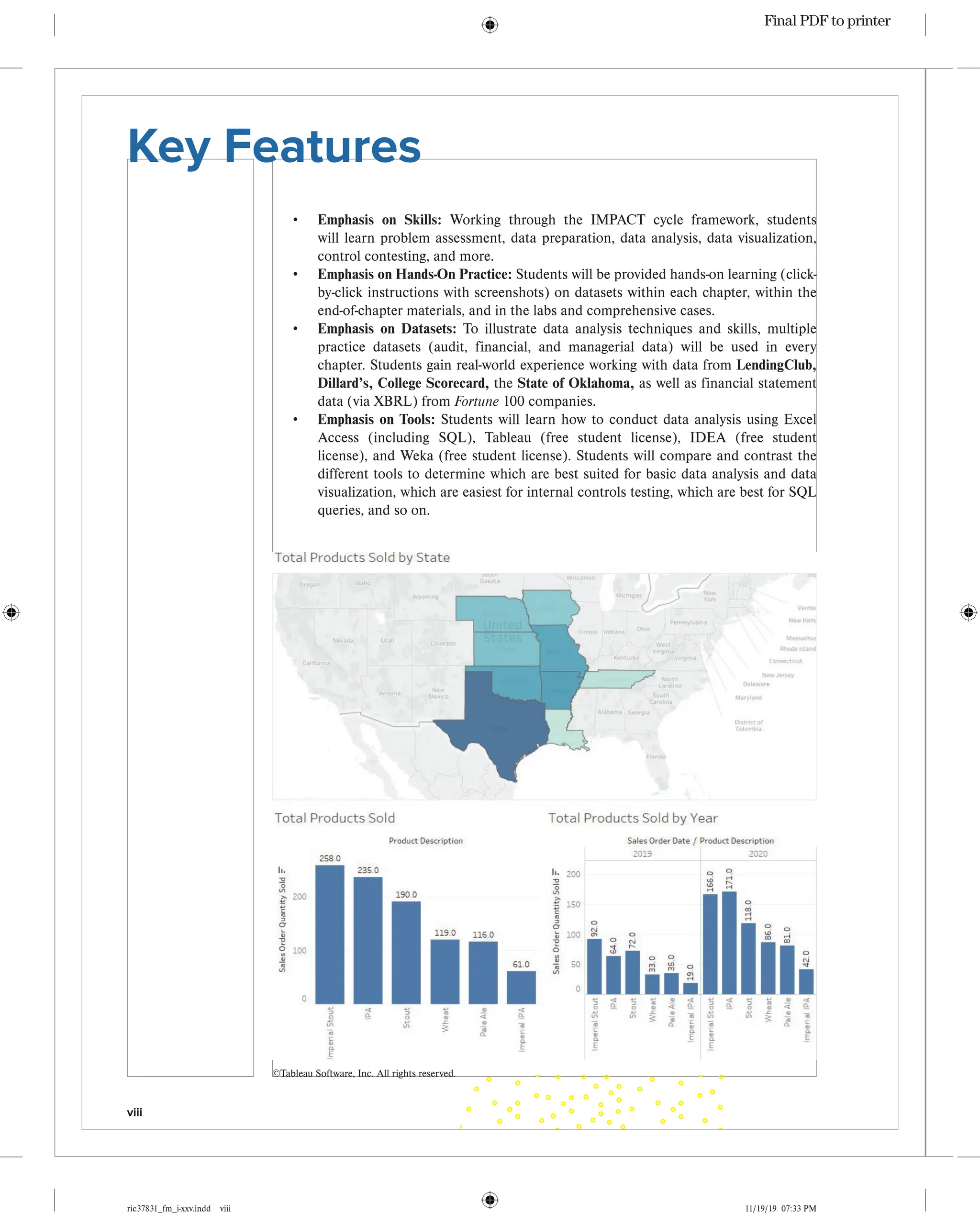
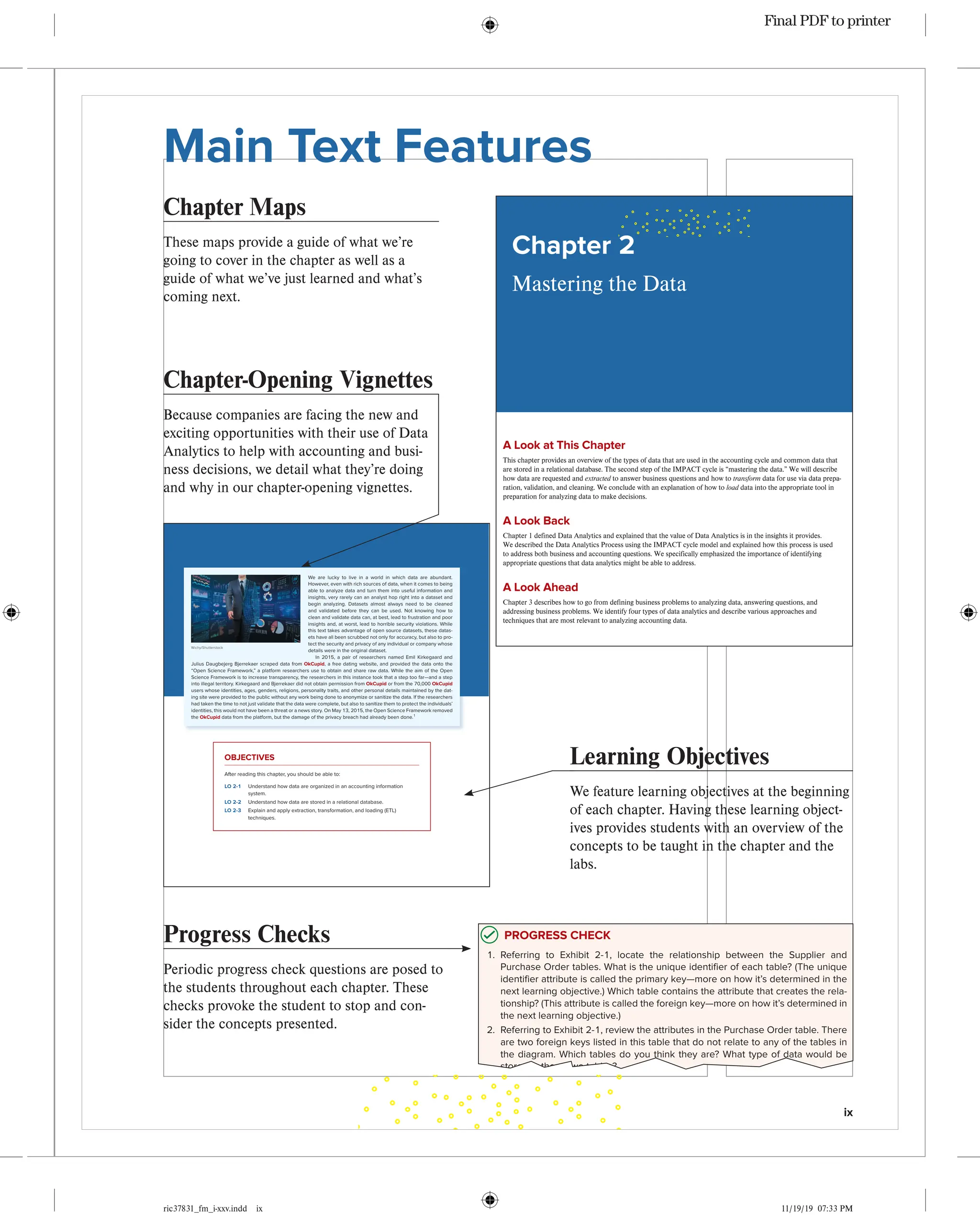
![x
ric37831_fm_i-xxv.indd x 11/19/19 07:33 PM
Answers to Progress Checks
Allow students to evaluate if they are on track with
their understanding of the materials presented in
the chapter.
End-of-Chapter Materials Confirming Pages
54
ric37831_ch02_038-091.indd 54 09/03/1904:17PM
ANSWERS TO PROGRESS CHECKS
1. The unique identifier of the Supplier table is [Supplier ID], and the unique identifier of the
Purchase Order table is [PO No.]. The Purchase Order table contains the foreign key.
2. The foreign key attributes in the Purchase Order table that do not relate to any tables
in the view are EmployeeID and CashDisbursementID. These attributes probably relate
to the Employee table (so that we can tell which employee was responsible for each
Purchase Order) and the Cash Disbursement table (so that we can tell if the Purchase
Orders have been paid for yet, and if so, on which check). The Employee table would be
a complete listing of each Employee, as well containing the details about each employee
(for example, phone number, address, etc.). The Cash Disbursement table would be a
listing of the payments the company has made.
3.
Materials Table
PK: Item_Number
1 1
1
*
*
*
Purchase Order Table
PK: PO_Number
FK: Supplier ID
FK: EmployeeID
FK: CashDisbursementID
Supplier Table
PK: Supplier ID
EmployeesTable
PK: EmployeeID
Purchase Order Details
Table
Composite PK:
FK: Item_Number
FK: PO_Number
CashDisbursement
Table
PK: Check Number
4. The purpose of the primary key is to uniquely identify each record in a table. The pur-
pose of a foreign key is to create a relationship between two tables. The purpose of a
descriptive attribute is to provide meaningful information about each record in a table.
Descriptive attributes aren’t required for a database to run, but they are necessary for
people to gain business information about the data stored in their databases.
5. Data dictionaries provide descriptions of the function (e.g., Primary Key or Foreign Key
when applicable), datatype, and field names associated with each column (attribute) of
a database. Data dictionaries are especially important when databases contain several
different tables and many different attributes in order to help analysts identify the infor-
mation they need to perform their analysis.
6. Depending on the level of security afforded to a business analyst, she can either obtain
data directly from the database herself or she can request the data. When obtaining
data herself, the analyst must have access to the raw data in the database and a firm
knowledge of SQL and data extraction techniques. When requesting the data, the ana-
lyst doesn’t need the same level of extraction skills, but she still needs to be familiar with
the data enough in order to identify which tables and attributes contain the information
she requires.
7. Four common issues that must be fixed are removing headings or subtotals, cleaning
leading zeroes or nonprintable characters, formatting negative numbers, and correcting
inconsistencies across the data.
Multiple Choice Questions
Quickly assess student’s knowledge of chapter
content.
Confirming Pages
8. Why is Supplier ID considered to be a primary key for a Supplier table?
a. It contains a unique identifier for each supplier.
b. It is a 10-digit number.
c. It can either be for a vendor or miscellaneous provider.
d. It is used to identify different supplier categories.
9. What are attributes that exist in a relational database that are neither primary nor for-
eign keys?
a. Nondescript attributes
b. Descriptive attributes
c. Composite key
d. Relational table attributes
10. Which of these is not included in the five steps of the ETL process?
a. Determine the purpose and scope of the data request.
b. Obtain the data.
c. Validate the data for completeness and integrity.
d. Scrub the data.
Discussion Questions
1. The advantages of a relational database include limiting the amount of redundant data
that are stored in a database. Why is this an important advantage? What can go wrong
when redundant data are stored?
2. The advantages of a relational database include integrating business processes. Why
is it preferable to integrate business processes in one information system, rather than
store different business process data in separate, isolated databases?
3. Even though it is preferable to store data in a relational database, storing data across
separate tables can make data analysis cumbersome. Describe three reasons it is worth
the trouble to store data in a relational database.
4. Among the advantages of using a relational database is enforcing business rules. Based
on your understanding of how the structure of a relational database helps prevent data
redundancy and other advantages, how does the primary key/foreign key relationship
structure help enforce a business rule that indicates that a company shouldn’t process
any purchase orders from suppliers who don’t exist in the database?
5. What is the purpose of a data dictionary? Identify four different attributes that could be
stored in a data dictionary, and describe the purpose of each.
6. In the ETL process, the first step is extracting the data. When you are obtaining the data
yourself, what are the steps to identifying the data that you need to extract?
7. In the ETL process, if the analyst does not have the security permissions to access
the data directly, then he or she will need to fill out a data request form. While this
doesn’t necessarily require the analyst to know extraction techniques, why does the
analyst still need to understand the raw data very well in order to complete the data
request?
8. In the ETL process, when an analyst is completing the data request form, there are a
number of fields that the analyst is required to complete. Why do you think it is important
Discussion Questions
Provide questions for group discussion.
Confirming P
Multiple Choice Questions
1. Mastering the data can also be described via the ETL process. The ETL process
stands for:
a. extract, total, and load data.
b. enter, transform, and load data.
c. extract, transform, and load data.
d. enter, total, and load data.
2. Which of the following describes part of the goal of the ETL process:
a. identify which approach to data analytics should be used.
b. load the data into a relational database for storage.
c. communicate the results and insights found through the analysis.
d. identify and obtain the data needed for solving the problem.
3. The advantages of storing data in a relational database include which of the following?
a. Help in enforcing business rules
b. Increased information redundancy
c. Integrating business processes
d. All of the above
e. Only A and B
f. Only B and C
g. Only A and C
4. The purpose of transforming data is:
a. to validate the data for completeness and integrity.
b. to load the data into the appropriate tool for analysis.
c. to obtain the data from the appropriate source.
d. to identify which data are necessary to complete the analysis.
5. Which attribute is required to exist in each table of a relational database and serves as
the “unique identifier” for each record in a table?
a. Foreign key
b. Unique identifier
c. Primary key
d. Key attribute
6. The metadata that describes each attribute in a database is which of the following?
a. Composite primary key
b. Data dictionary
c. Descriptive attributes
d. Flat file
7. As mentioned in the chapter, which of the following is not a common way that data will
need to be cleaned after extraction and validation?
a. Remove headings and subtotals.
b. Format negative numbers.
c. Clean up trailing zeroes.
®
Final PDF to printer](https://image.slidesharecdn.com/15396-250324215622-64b9d179/75/eBook-PDF-Data-Analytics-for-Accounting-2nd-Edition-By-Vernon-Richardson-5-2048.jpg)
![ric37831_fm_i-xxv.indd xi 11/19/19 07:33 PM
End-of-Chapter Materials xi
Problems
Challenge the student’s ability to see relation-
ships in the learning objectives by employing
higher-level thinking and analytical skills.
Labs
Give students hands-on experience working with
different types of data and the tools used to ana-
lyze them. Students will conduct data analysis
using Excel, Access (including SQL), Tableau,
IDEA, XBRL, and Weka.
Comprehensive Cases
Use a real-life Big Data set based on Dillard’s
actual company data. This dataset allows students
to build their skills and test their conclusions
across concepts covered in each chapter. The
Comprehensive Cases can be followed continu-
ously from the first chapter or picked up at any
later point in the book; enough information is
provided to ensure students can get right to work.
ric37831_ch02_038-091.indd 57
10.
be the effect of the following?
a. Transforming NULL and N/A values into blanks
b. Transforming NULL and N/A values into zeroes
c. Deleting records that have NULL and N/A values from your dataset
(Hint: Think about the impact on different aggregate functions, such as COUNT and
AVERAGE.)
Problems
The following problems correspond to the College Scorecard data. You should be able to
answer each question by just looking at the data dictionary included in Appendix K, but if
you would like to use the raw data, feel free to do so (CollegeScorecard_RawData.txt).
1. Which attributes from the College Scorecard data would you need to compare cost of
attendance across types of institutions (public, private nonprofit, or private for-profit)?
2. Which attributes from the College Scorecard data would you need to compare SAT
scores across types of institutions (public, private nonprofit, or private for-profit)?
3. Which attributes from the College Scorecard data would you need to compare levels of
diversity across types of institutions (public, private nonprofit, or private for-profit)?
4. If you were conducting a data analysis in order to compare the percentage of students
who receive federal loans at universities above and below the median cost of atten-
dance across all institutions, your analysis would require several steps. One of the steps
is to know what question needs to be answered first in order to complete the analysis.
Come up with a set of questions that need to be answered.
5. If you were analyzing the levels of diversity across public and private institutions using
the College Scorecard data, how would you define diversity in terms of the data pro-
vided? Would it be beneficial to combine attributes?
6. Which attributes from the College Scorecard data would you need to compare comple-
tion rate across types of institutions (public, private nonprofit, or private for-profit)?
7. Which attributes from the College Scorecard data would you need to compare the
percentage of students who receive federal loans at universities above and below the
median cost of attendance across all institutions (public, private nonprofit, or private
for-profit)?
8. Which attributes from the College Scorecard data would you need to determine if differ-
ent regions of the country have significantly different costs of attendance?
9. Use the College Scorecard data to determine if different regions of the country have
significantly different costs of attendance (same as Problem 6) and fill out a data request
form in order to extract the appropriate data. Use the template from the chapter as a
guide.
Confirm
58
Oneofthebiggestchallengesyoufacewithdataanalysisisgettingtheright
mayhavethebestquestionsintheworld,butiftherearenodataavailabletosu
hypothesis,youwillhavedifficultyprovidingvalue.Additionally,therearein
whichtheITworkersmaybereluctanttosharedatawithyou.Theymaysendi
data,thewrongdata,orcompletelyignoreyourrequest.Bepersistent,andyoum
lookforcreativewaystofindinsightwithanincompletepicture.
Company summary
Sláinteisafictionalbrewerythathasrecentlygonethroughbigchanges.Sláintes
ferentproducts.Thebreweryhasonlyrecentlyexpandeditsbusinesstodistributin
statetoninestates,andnowitsbusinesshasbegunstabilizingaftertheexpansion
stabilitycomesaneedforbetteranalysis.YouhavebeenhiredbySláintetohel
mentbetterunderstandthecompany’ssalesdataandprovideinputforitsstrategic
Data
• Datarequestform
Technique
• Notechnicalexperienceisnecessaryforthislab.
Software needed
• Wordprocessor
In this lab, you will:
Part1:Identifyappropriatequestionsanddevelopahypothesisforeachquest
Part2:Generatearequestfordata.
Part3:Assessthedatayoureceive.
Part 1: Identify the Questions
OneofSláinte’sfirstprioritiesistoidentifyitsareasofsuccessaswellasareaso
improvement.Yourmanagerhasaskedyoutofocusspecificallyonsalesdataat
Thisincludesdatarelatedtosalesorders,products,andcustomers.
Q1. GiventhatyouarenewandtryingtogetagrasponSláinte’soperation
three questions related to salesthatwouldhelpyoubeginyouranalysis
example,how many products were sold in each state?
Q2. Nowhypothesize the answerstoeachofthequestions.Remember,you
don’thavetobecorrectatthispoint.Theywillhelpyouunderstandw
ofdatayouarelookingfor.Forexample:500 in Missouri, 6,000 in Penn
4,000 in New York, etc.
Q3. Finally,foreachquestion,identify the specific tables and attributestha
neededtoansweryourquestions.UseLab Exhibit 2-1Aforguidanceo
tablesandattributesareavailable.Forexample,toanswerthequestion
statesales,youwouldneedthe[Customer_St]attributethatislocated
[Customer]mastertableaswellasthe[Sales_Order_Quantity_Sold]
inthe[Sales]table.Ifyouhadaccesstostoreordistributioncenterlo
data,youmayalsolookfora[State]fieldthere,aswell.
Lab 2-1 Create a Request for Data Extraction
Confirm
80
ric37831_ch02_038-091.indd 80 09
10. Takeascreenshotofyourresults(labelit2-7A).
11. Whenyoulookattheseresults,youmaywonderwhatsomeoftheattributes
re
Forexample,TRAN_TYPEonlyreturnsvalueswithP.Toviewothertypesof
couldfilteroutanyrecordthathasaTRAN_TYPEofP.Executethefollowing
SELECT TOP 10 *
FROM TRANSACT
WHERE TRAN_TYPE 'P'
Part 4: Address and Refine Results
Q3. Whatdoyouthink‘P’and‘R’representintheTRAN_TYPEtable?H
transactionsdifferiftheyarerepresentedby‘P’or‘R’?
Q4. Whatbenefitcanyougainfromselectingonlythetopfewrowsofyou
particularlyfromalargedataset?
End of Lab
7. Becausethisdatasetismassive,itcantakeaverylongtimeforthesystemto
thecompletesetofdataforsomeofthebiggertables(suchasTRANSACT)
wouldliketoviewjustthetopfewrowsofadatasettogetthefeelforwhatt
dataisinthetable,youcandosowithaquery.
IntheSELECTline,youcantypeTOP#beforethecolumnsyouwouldl
Anytypeoffiltering,aggregating,andorderingwillstillworkthroughthere
query,butselectingthetopfewwillhelpthequeryrunfasterbyreturninga
theresult.
8. Toviewthetop10rowsintheTRANSACTtable,typethefollowingqueryi
querywindow:
SELECT TOP 10 *
FROM TRANSACT
9. Toseetheresultofthequery,clickExecute.F5alsoworkstorunqueriesas
PCshortcut.
Source:MicrosoftSQLServer
ManagementStudio.
Company summary
Dillard’sisadepartmentstorewithapproximately330storesin29states.Itshead
inLittleRock,Arkansas.YoucanlearnmoreaboutDillard’sbylookingatfinance.
(Tickersymbol=DDS)andtheWikipediasiteforDDS.You’llquicklynotethat
DillardIIisanaccountinggradoftheUniversityofArkansasandtheWalton
Lab 2-8 Comprehensive Case: Dillard’s Store Data:
Connecting Excel to a SQL Database
Final PDF to printer](https://image.slidesharecdn.com/15396-250324215622-64b9d179/75/eBook-PDF-Data-Analytics-for-Accounting-2nd-Edition-By-Vernon-Richardson-6-2048.jpg)