GCSE Geography Easter Revision
 
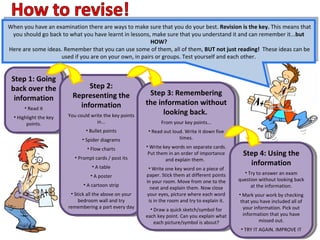
When you have an examination there are ways to make sure that you do your best.  Revision is the key.  This means that you should go back to what you have learnt in lessons, make sure that you understand it and can remember it... but HOW? Here are some ideas. Remember that you can use some of them, all of them,  BUT not just reading!  These ideas can be used if you are on your own, in pairs or groups. Test yourself and each other. Step 1: Going back over the information Read it Highlight the key points. Step 2: Representing the information You could write the key points in... Bullet points Spider diagrams Flow charts Prompt cards / post its A table A poster A cartoon strip Stick all the above on your bedroom wall and try remembering a part every day Step 3: Remembering the information without looking back.  From your key points... Read out loud. Write it down five times. Write key words on separate cards. Put them in an order of importance and explain them.  Write one key word on a piece of paper. Stick them at different points in your room. Move from one to the next and explain them. Now close your eyes, picture where each word is in the room and try to explain it. Draw a quick sketch/symbol for each key point. Can you explain what each picture/symbol is about? Step 4: Using the information Try to answer an exam question without looking back at the information. Mark your work by checking that you have included all of your information. Pick out information that you have missed out. TRY IT AGAIN. IMPROVE IT
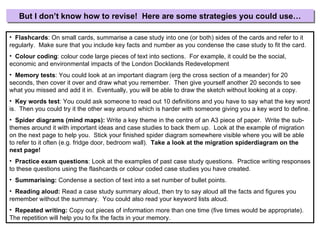
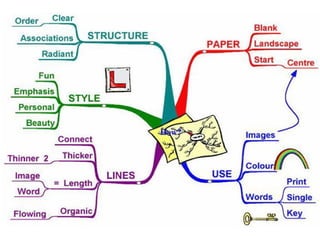
Flashcards : On small cards, summarise a case study into one (or both) sides of the cards and refer to it regularly.  Make sure that you include key facts and number as you condense the case study to fit the card.  Colour coding : colour code large pieces of text into sections.  For example, it could be the social, economic and environmental impacts of the London Docklands Redevelopment Memory tests : You could look at an important diagram (erg the cross section of a meander) for 20 seconds, then cover it over and draw what you remember.  Then give yourself another 20 seconds to see what you missed and add it in.  Eventually, you will be able to draw the sketch without looking at a copy. Key words test : You could ask someone to read out 10 definitions and you have to say what the key word is.  Then you could try it the other way around which is harder with someone giving you a key word to define. Spider diagrams (mind maps):  Write a key theme in the centre of an A3 piece of paper.  Write the sub-themes around it with important ideas and case studies to back them up.  Look at the example of migration on the next page to help you.  Stick your finished spider diagram somewhere visible where you will be able to refer to it often (e.g. fridge door, bedroom wall).  Take a look at the migration spiderdiagram on the next page! Practice exam questions : Look at the examples of past case study questions.  Practice writing responses to these questions using the flashcards or colour coded case studies you have created.  Summarising:  Condense a section of text into a set number of bullet points.  Reading aloud:  Read a case study summary aloud, then try to say aloud all the facts and figures you remember without the summary.  You could also read your keyword lists aloud.  Repeated writing:  Copy out pieces of information more than one time (five times would be appropriate).  The repetition will help you to fix the facts in your memory. But I don’t know how to revise!  Here are some strategies you could use…
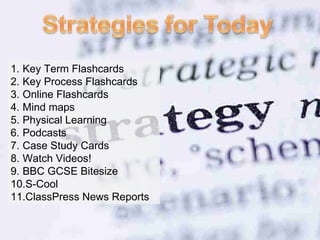
Key Term Flashcards Key Process Flashcards Online Flashcards Mind maps Physical Learning Podcasts Case Study Cards Watch Videos! BBC GCSE Bitesize S-Cool ClassPress News Reports
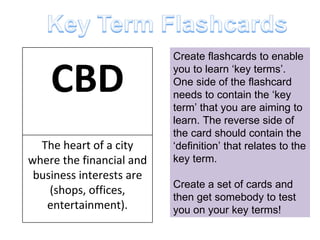
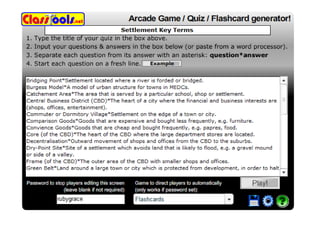
Create flashcards to enable you to learn ‘key terms’. One side of the flashcard needs to contain the ‘key term’ that you are aiming to learn. The reverse side of the card should contain the ‘definition’ that relates to the key term. Create a set of cards and then get somebody to test you on your key terms! CBD The heart of a city where the financial and business interests are (shops, offices, entertainment).
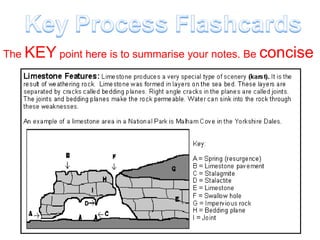
The  KEY  point here is to summarise your notes. Be  concise
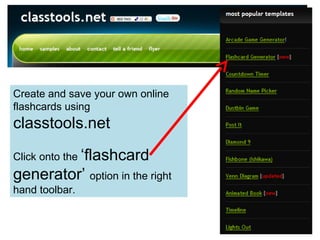
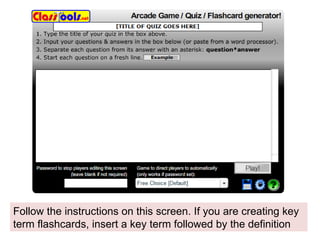
Create and save your own online flashcards using  classtools.net Click onto the  ‘flashcard generator’  option in the right hand toolbar.
Follow the instructions on this screen. If you are creating key term flashcards, insert a key term followed by the definition
 
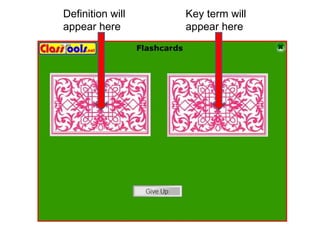
Definition will appear here Key term will appear here
 
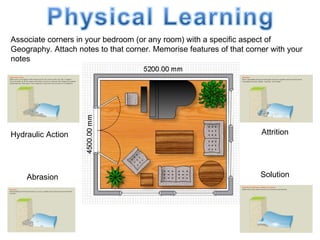
Associate corners in your bedroom (or any room) with a specific aspect of Geography. Attach notes to that corner. Memorise features of that corner with your notes Hydraulic Action Abrasion Attrition Solution
www.gcsepod.co.uk http://lhs.typepad.co.uk/weblog/geography/ http://geocrest.podomatic.com/ http://cgz.e2bn.net/e2bn/leas/c99/schools/cgz/accounts/staff/rchambers/GeoBytes/Homepage/index.htm
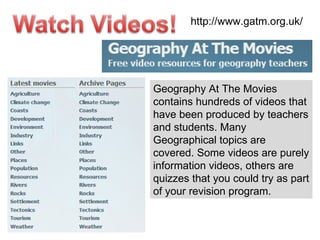
http://www.gatm.org.uk/ Geography At The Movies contains hundreds of videos that have been produced by teachers and students. Many Geographical topics are covered. Some videos are purely information videos, others are quizzes that you could try as part of your revision program.
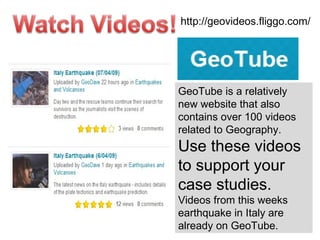
GeoTube is a relatively new website that also contains over 100 videos related to Geography.  Use these videos to support your case studies. Videos from this weeks earthquake in Italy are already on GeoTube. http://geovideos.fliggo.com/
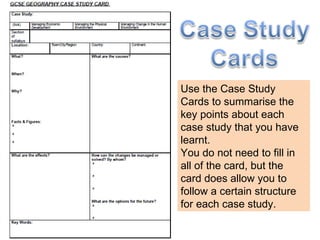
Use the Case Study Cards to summarise the key points about each case study that you have learnt. You do not need to fill in all of the card, but the card does allow you to follow a certain structure for each case study.
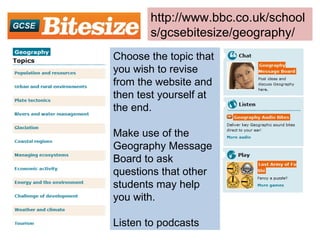
Choose the topic that you wish to revise from the website and then test yourself at the end. Make use of the Geography Message Board to ask questions that other students may help you with. Listen to podcasts http://www.bbc.co.uk/schools/gcsebitesize/geography/
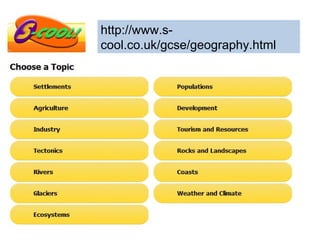
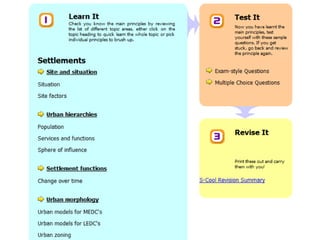
http://www.s-cool.co.uk/gcse/geography.html
 
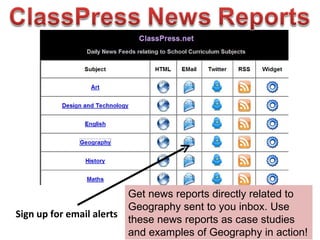
Sign up for email alerts Get news reports directly related to Geography sent to you inbox. Use these news reports as case studies and examples of Geography in action!
Image on Slide 2 from Flickr member Gembledine  Slide 3 ‘How to revise’ produced by Jo Blackmore, Okhampton College Slide 4 ‘Revision strategies’ produced by Jo Blackmore, Okhampton College Image on Slide 5 from Flickr member joey.ganoza Image on Slide 14 from Flickr member Oliver Lavery

Easter Revision Session

  • 1.
  • 2.
  • 3.
    When you havean examination there are ways to make sure that you do your best. Revision is the key. This means that you should go back to what you have learnt in lessons, make sure that you understand it and can remember it... but HOW? Here are some ideas. Remember that you can use some of them, all of them, BUT not just reading! These ideas can be used if you are on your own, in pairs or groups. Test yourself and each other. Step 1: Going back over the information Read it Highlight the key points. Step 2: Representing the information You could write the key points in... Bullet points Spider diagrams Flow charts Prompt cards / post its A table A poster A cartoon strip Stick all the above on your bedroom wall and try remembering a part every day Step 3: Remembering the information without looking back. From your key points... Read out loud. Write it down five times. Write key words on separate cards. Put them in an order of importance and explain them. Write one key word on a piece of paper. Stick them at different points in your room. Move from one to the next and explain them. Now close your eyes, picture where each word is in the room and try to explain it. Draw a quick sketch/symbol for each key point. Can you explain what each picture/symbol is about? Step 4: Using the information Try to answer an exam question without looking back at the information. Mark your work by checking that you have included all of your information. Pick out information that you have missed out. TRY IT AGAIN. IMPROVE IT
  • 4.
    Flashcards : Onsmall cards, summarise a case study into one (or both) sides of the cards and refer to it regularly. Make sure that you include key facts and number as you condense the case study to fit the card. Colour coding : colour code large pieces of text into sections. For example, it could be the social, economic and environmental impacts of the London Docklands Redevelopment Memory tests : You could look at an important diagram (erg the cross section of a meander) for 20 seconds, then cover it over and draw what you remember. Then give yourself another 20 seconds to see what you missed and add it in. Eventually, you will be able to draw the sketch without looking at a copy. Key words test : You could ask someone to read out 10 definitions and you have to say what the key word is. Then you could try it the other way around which is harder with someone giving you a key word to define. Spider diagrams (mind maps): Write a key theme in the centre of an A3 piece of paper. Write the sub-themes around it with important ideas and case studies to back them up. Look at the example of migration on the next page to help you. Stick your finished spider diagram somewhere visible where you will be able to refer to it often (e.g. fridge door, bedroom wall). Take a look at the migration spiderdiagram on the next page! Practice exam questions : Look at the examples of past case study questions. Practice writing responses to these questions using the flashcards or colour coded case studies you have created. Summarising: Condense a section of text into a set number of bullet points. Reading aloud: Read a case study summary aloud, then try to say aloud all the facts and figures you remember without the summary. You could also read your keyword lists aloud. Repeated writing: Copy out pieces of information more than one time (five times would be appropriate). The repetition will help you to fix the facts in your memory. But I don’t know how to revise! Here are some strategies you could use…
  • 5.
    Key Term FlashcardsKey Process Flashcards Online Flashcards Mind maps Physical Learning Podcasts Case Study Cards Watch Videos! BBC GCSE Bitesize S-Cool ClassPress News Reports
  • 6.
    Create flashcards toenable you to learn ‘key terms’. One side of the flashcard needs to contain the ‘key term’ that you are aiming to learn. The reverse side of the card should contain the ‘definition’ that relates to the key term. Create a set of cards and then get somebody to test you on your key terms! CBD The heart of a city where the financial and business interests are (shops, offices, entertainment).
  • 7.
    The KEY point here is to summarise your notes. Be concise
  • 8.
    Create and saveyour own online flashcards using classtools.net Click onto the ‘flashcard generator’ option in the right hand toolbar.
  • 9.
    Follow the instructionson this screen. If you are creating key term flashcards, insert a key term followed by the definition
  • 10.
  • 11.
    Definition will appearhere Key term will appear here
  • 12.
  • 13.
    Associate corners inyour bedroom (or any room) with a specific aspect of Geography. Attach notes to that corner. Memorise features of that corner with your notes Hydraulic Action Abrasion Attrition Solution
  • 14.
    www.gcsepod.co.uk http://lhs.typepad.co.uk/weblog/geography/ http://geocrest.podomatic.com/http://cgz.e2bn.net/e2bn/leas/c99/schools/cgz/accounts/staff/rchambers/GeoBytes/Homepage/index.htm
  • 15.
    http://www.gatm.org.uk/ Geography AtThe Movies contains hundreds of videos that have been produced by teachers and students. Many Geographical topics are covered. Some videos are purely information videos, others are quizzes that you could try as part of your revision program.
  • 16.
    GeoTube is arelatively new website that also contains over 100 videos related to Geography. Use these videos to support your case studies. Videos from this weeks earthquake in Italy are already on GeoTube. http://geovideos.fliggo.com/
  • 17.
    Use the CaseStudy Cards to summarise the key points about each case study that you have learnt. You do not need to fill in all of the card, but the card does allow you to follow a certain structure for each case study.
  • 18.
    Choose the topicthat you wish to revise from the website and then test yourself at the end. Make use of the Geography Message Board to ask questions that other students may help you with. Listen to podcasts http://www.bbc.co.uk/schools/gcsebitesize/geography/
  • 19.
  • 20.
  • 21.
    Sign up foremail alerts Get news reports directly related to Geography sent to you inbox. Use these news reports as case studies and examples of Geography in action!
  • 22.
    Image on Slide2 from Flickr member Gembledine Slide 3 ‘How to revise’ produced by Jo Blackmore, Okhampton College Slide 4 ‘Revision strategies’ produced by Jo Blackmore, Okhampton College Image on Slide 5 from Flickr member joey.ganoza Image on Slide 14 from Flickr member Oliver Lavery