Easter
History

When is Easter celebrated?

Holy week

Traditions

Attributes of Easter

This is interesting!
History
      Easter was started to celebrate earlier
than Christmas. At about III-IV century AD.
      Egg dyeing in Lithuania is mentioned in
one of Martynas Mažvydas chants (1549).
Folkrore says about magical egg power: at the
end of XIX century lithuanians still used to
sacrifice and egg to Žemyna.

                            Back to main
                            page.
When is Easter celebrated?
      Easter is celebrated on the first Sunday
after the first full moon after the spring equinox.
      So, the celebration of Easter may vary
every year from March 22 to April 25.
Holy Week
• The celebration of Easter in the Catholic Church begins on
  Holy Thursday and continuous all Easter period.
• On Saturday, which may nol always known as Holy, the
  celebration of Easter night begins after the sundown.
• Church bells and the organ stops on Holy Thursday.
• The cross is solemnly honored on Good Friday, Christ‘s
  suffering, death and burial day .
• A wake is performed next to symbolic tomb of Christ, his
  passion and death is considered, fire and water is sanctified
  on Holy Saturday.
• At midnight again organ and bells are played and very
  solemn Mass is held.
• The first day of Easter begins on Sunday.
Traditions
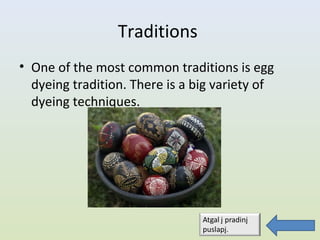
• One of the most common traditions is egg
  dyeing tradition. There is a big variety of
  dyeing techniques.
Other traditions
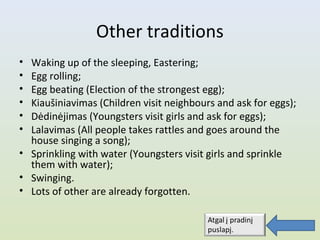
• Waking up of the sleeping, Eastering;
• Egg rolling;
• Egg beating (Election of the strongest egg);
• Kiaušiniavimas (Children visit neighbours and ask for eggs);
• Dėdinėjimas (Youngsters visit girls and ask for eggs);
• Lalavimas (All people takes rattles and goes around the
  house singing a song);
• Sprinkling with water (Youngsters visit girls and sprinkle
  them with water);
• Swinging.
• Lots of other are already forgotten.
Attributes of Easter
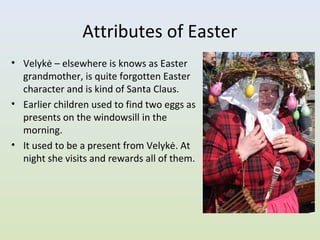
• Velykė – elsewhere is knows as Easter
  grandmother, is quite forgotten Easter
  character and is kind of Santa Claus.
• Earlier children used to find two eggs as
  presents on the windowsill in the
  morning.
• It used to be a present from Velykė. At
  night she visits and rewards all of them.
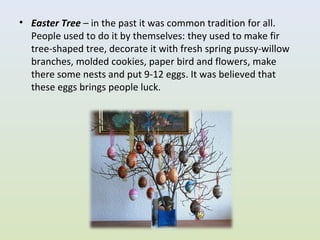
• Easter Tree – in the past it was common tradition for all.
  People used to do it by themselves: they used to make fir
  tree-shaped tree, decorate it with fresh spring pussy-willow
  branches, molded cookies, paper bird and flowers, make
  there some nests and put 9-12 eggs. It was believed that
  these eggs brings people luck.
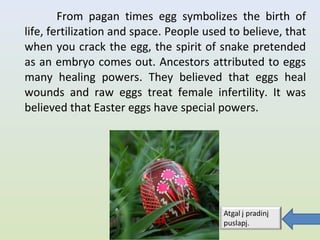
From pagan times egg symbolizes the birth of
life, fertilization and space. People used to believe, that
when you crack the egg, the spirit of snake pretended
as an embryo comes out. Ancestors attributed to eggs
many healing powers. They believed that eggs heal
wounds and raw eggs treat female infertility. It was
believed that Easter eggs have special powers.
Interesting!
        It is not allowed to sleep for a long time on
Easter day as you may have a headache for a long
time.
Also you may have a headache if you brush your
hair on this day.
It is inappropriate to visit guests on Easter day. If
however someone comes, you need to give him to
clean fur.
At Easter it is not allowed to move or disturb the
ground, otherwise the ice rain will destroy the
crops.
Thank You


Made by Paulius and Žavinta 8d.

Easter

  • 1.
    Easter History When is Eastercelebrated? Holy week Traditions Attributes of Easter This is interesting!
  • 2.
    History Easter was started to celebrate earlier than Christmas. At about III-IV century AD. Egg dyeing in Lithuania is mentioned in one of Martynas Mažvydas chants (1549). Folkrore says about magical egg power: at the end of XIX century lithuanians still used to sacrifice and egg to Žemyna. Back to main page.
  • 3.
    When is Eastercelebrated? Easter is celebrated on the first Sunday after the first full moon after the spring equinox. So, the celebration of Easter may vary every year from March 22 to April 25.
  • 4.
    Holy Week • Thecelebration of Easter in the Catholic Church begins on Holy Thursday and continuous all Easter period. • On Saturday, which may nol always known as Holy, the celebration of Easter night begins after the sundown. • Church bells and the organ stops on Holy Thursday. • The cross is solemnly honored on Good Friday, Christ‘s suffering, death and burial day . • A wake is performed next to symbolic tomb of Christ, his passion and death is considered, fire and water is sanctified on Holy Saturday. • At midnight again organ and bells are played and very solemn Mass is held. • The first day of Easter begins on Sunday.
  • 5.
    Traditions • One ofthe most common traditions is egg dyeing tradition. There is a big variety of dyeing techniques.
  • 6.
    Other traditions • Wakingup of the sleeping, Eastering; • Egg rolling; • Egg beating (Election of the strongest egg); • Kiaušiniavimas (Children visit neighbours and ask for eggs); • Dėdinėjimas (Youngsters visit girls and ask for eggs); • Lalavimas (All people takes rattles and goes around the house singing a song); • Sprinkling with water (Youngsters visit girls and sprinkle them with water); • Swinging. • Lots of other are already forgotten.
  • 7.
    Attributes of Easter •Velykė – elsewhere is knows as Easter grandmother, is quite forgotten Easter character and is kind of Santa Claus. • Earlier children used to find two eggs as presents on the windowsill in the morning. • It used to be a present from Velykė. At night she visits and rewards all of them.
  • 8.
    • Easter Tree– in the past it was common tradition for all. People used to do it by themselves: they used to make fir tree-shaped tree, decorate it with fresh spring pussy-willow branches, molded cookies, paper bird and flowers, make there some nests and put 9-12 eggs. It was believed that these eggs brings people luck.
  • 9.
    From pagan timesegg symbolizes the birth of life, fertilization and space. People used to believe, that when you crack the egg, the spirit of snake pretended as an embryo comes out. Ancestors attributed to eggs many healing powers. They believed that eggs heal wounds and raw eggs treat female infertility. It was believed that Easter eggs have special powers.
  • 10.
    Interesting! It is not allowed to sleep for a long time on Easter day as you may have a headache for a long time. Also you may have a headache if you brush your hair on this day. It is inappropriate to visit guests on Easter day. If however someone comes, you need to give him to clean fur. At Easter it is not allowed to move or disturb the ground, otherwise the ice rain will destroy the crops.
  • 11.
    Thank You Made byPaulius and Žavinta 8d.