MMM – Group 5 
Presentation on ONLINE 
TEACHING & LEARNING 
Name Course Roll No 
_____________ MMM _____ 
_____________ MMM _____
What is Online Learning?
What is Online Learning? 
• Online teaching and learning is faculty-delivered 
instruction via the Internet. Online 
instruction includes real-time (synchronous) 
and anytime, anywhere (asynchronous) 
interactions. 
• The term online learning includes a number of 
computer-assisted instruction methods.
• Online learning is most effective when delivered 
by teachers experienced in their subject matter. 
The best way to maintain the connection 
between online education and the values of 
traditional education is through ensuring that 
online learning is “delivered” by teachers, fully 
qualified and interested in teaching online in a 
web-based environment (Feenberg 1998).
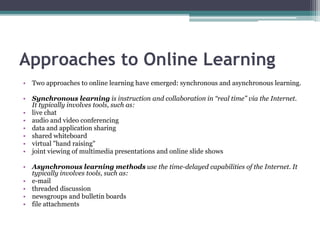
Approaches to Online Learning 
• Two approaches to online learning have emerged: synchronous and asynchronous learning. 
• Synchronous learning is instruction and collaboration in “real time” via the Internet. 
It typically involves tools, such as: 
• live chat 
• audio and video conferencing 
• data and application sharing 
• shared whiteboard 
• virtual "hand raising" 
• joint viewing of multimedia presentations and online slide shows 
• Asynchronous learning methods use the time-delayed capabilities of the Internet. It 
typically involves tools, such as: 
• e-mail 
• threaded discussion 
• newsgroups and bulletin boards 
• file attachments
ADVANTAGES of ONLINE LEARNING
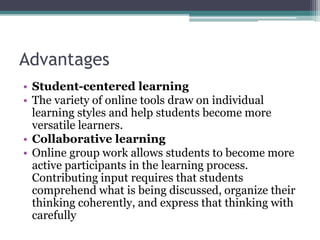
Advantages 
• Student-centered learning 
• The variety of online tools draw on individual 
learning styles and help students become more 
versatile learners. 
• Collaborative learning 
• Online group work allows students to become more 
active participants in the learning process. 
Contributing input requires that students 
comprehend what is being discussed, organize their 
thinking coherently, and express that thinking with 
carefully
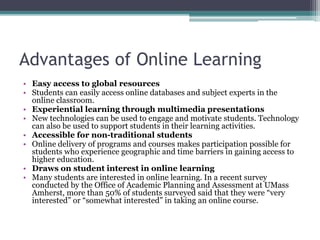
Advantages of Online Learning 
• Easy access to global resources 
• Students can easily access online databases and subject experts in the 
online classroom. 
• Experiential learning through multimedia presentations 
• New technologies can be used to engage and motivate students. Technology 
can also be used to support students in their learning activities. 
• Accessible for non-traditional students 
• Online delivery of programs and courses makes participation possible for 
students who experience geographic and time barriers in gaining access to 
higher education. 
• Draws on student interest in online learning 
• Many students are interested in online learning. In a recent survey 
conducted by the Office of Academic Planning and Assessment at UMass 
Amherst, more than 50% of students surveyed said that they were “very 
interested” or “somewhat interested” in taking an online course.
Advantages of Teaching Online 
• Offer the opportunity to think about teaching in new ways 
• Online teaching can allow you to experiment with techniques only available in online 
environments, such as threaded discussions and webliographies. 
• Provide ideas and techniques to implement in traditional courses 
• Online email discussions, a frequently-used practice in online learning, can be incorporated 
into traditional courses to facilitate group work. Other techniques, such as web-based 
course calendars and sample papers posted on the Internet (with student permission) can 
easily be incorporated into a traditional course. 
• Expand the reach of the curriculum 
• Online teaching can expand existing curriculum to students on a regional, national, and 
international level. 
• Professional satisfaction 
• Teaching online can be an enormously rewarding experience for teachers. Teachers often 
cite the diversity of students in online courses as one of the most rewarding aspects of 
teaching online. 
• Instructor convenience 
• Teaching online can offer teachers conveniences not available in traditional classroom 
settings; for example, at-home office hours and flexible work schedules.
Statistics of E-Learning
Statistics of E-Learning 
• In 2011, it was estimated that about $35.6 billion 
was spent on self-paced eLearning across the globe. 
Today, e-Learning is a $56.2 billion industry, and 
it's going to double by 2015. 
• Corporations now report that e-Learning is the 
second most valuable training method that they use. 
This is no surprise, given that e-Learning saves 
businesses at least 50% when they replace 
traditional instructor-based training with e- 
Learning. Not to mention that e-Learning cuts down 
instruction time by up to 60%.
Statistics of E-Learning 
• e-Learning is also Eco-friendly. Recent studies 
conducted by Britain's Open University have found 
that e-Learning consumes 90% less energy than 
traditional courses. The amount of CO2 emissions 
(per student) is also reduced by up to 85%. 
• Over 41.7% percent of global Fortune 500 
companies now use some form of educational 
technology to instruct employees during formal 
learning hours, and that figure is only going to 
steadily increase in future years.
Statistics of E-Learning 
• The world's most rapidly growing e-Learning 
markets are Malaysia and Vietnam. In fact, the 
estimated 5 year annual growth rate for the 
Asian e-Learning market is 17.3%. That is the 
highest compound annual growth rate of any 
global region.
Statistics of E-Learning 
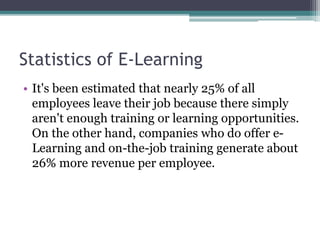
• It's been estimated that nearly 25% of all 
employees leave their job because there simply 
aren't enough training or learning opportunities. 
On the other hand, companies who do offer e- 
Learning and on-the-job training generate about 
26% more revenue per employee.
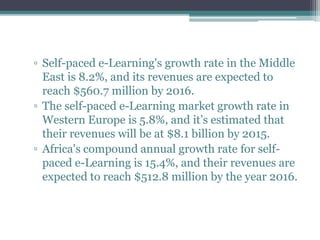
▫ Self-paced e-Learning's growth rate in the Middle 
East is 8.2%, and its revenues are expected to 
reach $560.7 million by 2016. 
▫ The self-paced e-Learning market growth rate in 
Western Europe is 5.8%, and it’s estimated that 
their revenues will be at $8.1 billion by 2015. 
▫ Africa's compound annual growth rate for self-paced 
e-Learning is 15.4%, and their revenues are 
expected to reach $512.8 million by the year 2016.
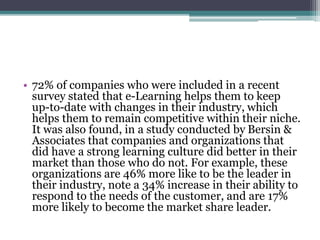
• 72% of companies who were included in a recent 
survey stated that e-Learning helps them to keep 
up-to-date with changes in their industry, which 
helps them to remain competitive within their niche. 
It was also found, in a study conducted by Bersin & 
Associates that companies and organizations that 
did have a strong learning culture did better in their 
market than those who do not. For example, these 
organizations are 46% more like to be the leader in 
their industry, note a 34% increase in their ability to 
respond to the needs of the customer, and are 17% 
more likely to become the market share leader.
Challenges of Teaching Online
Challenges of Teaching Online 
• Familiarity with the online environment 
• Capacity to use the medium to its advantage 
• Being available to students on an extended basis 
electronically 
• Providing quick responses and feedback to 
students
Assessing Student Learning
Assessing Student Learning 
• Assessment is the systematic collection and 
analysis of information to improve student 
learning. 
• In assessing online learning, it is important to 
create a “mix” of assignments that cover the 
multiple dimensions of learning that online 
courses can employ. Traditional tests become a 
smaller part of the grade as you move towards 
encouraging student interaction on group 
projects and other activities.
• Communicate expectations 
Students in online courses are in particular need of 
clear information about course requirements and 
instructor expectations. Therefore, develop specific 
grading guidelines for course assignments and 
activities ahead of time so students know in advance 
what is expected of them. For example, articulate 
what are appropriate responses to questions in 
online discussions, what is a substantive answer 
versus a superficial response, etc. Providing 
students with specific examples of the kinds of work 
you are looking for is also helpful.
• Keep track of student performance 
The gradebook option in online software 
packages makes it possible to store all 
information about students’ performance in one 
place. Many also make it possible for students to 
look up their own progress on assignments
• Give prompt feedback 
• At the start of the semester, clarify the type of feedback you will be 
giving (regarding discussion participation, writing assignments, 
group work, etc.) so students have a clearer sense of what to expect 
from you. 
• Students want feedback on assignments, but it is often difficult to 
provide much feedback when you use a number of varied 
assignments throughout the semester. One instructor uses a 
೦,೦+,೦- system to provide a quick response to students. 
• A number of gradebook features have a comment section where the 
instructor can give specific feedback to a student on an assignment 
that can only be seen by the instructor and that student. 
•
• Encourage active learning 
• Help students become more reflective learners by asking them 
to set their goals for the course at the beginning of the 
semester. At the end of the course, ask them to return to their 
goals to reflect upon what they’ve accomplished. 
• The majority of students focus their academic effort on those 
elements of the course that will affect their grade in the 
course. Be sure that your grading policies reinforce the 
activities and assignments you value and that you take 
advantage of learning activities that are particularly suited for 
an online course. For example, if you want students to 
meaningfully participate in online discussions, be sure to 
include participation as part of the grading scheme.
• Evaluate participation in threaded 
discussions 
• Require students to participate in specific 
numbers of threaded discussions. 
• Have interactive learning activities (e.g., 
threaded discussion) account for a high 
percentage of the course grade. 
• Identify the qualities you look for in discussions 
and grade students according to those criteria

E learning Project

  • 1.
    MMM – Group5 Presentation on ONLINE TEACHING & LEARNING Name Course Roll No _____________ MMM _____ _____________ MMM _____ _____________ MMM _____ _____________ MMM _____ _____________ MMM _____ _____________ MMM _____
  • 2.
    What is OnlineLearning?
  • 3.
    What is OnlineLearning? • Online teaching and learning is faculty-delivered instruction via the Internet. Online instruction includes real-time (synchronous) and anytime, anywhere (asynchronous) interactions. • The term online learning includes a number of computer-assisted instruction methods.
  • 4.
    • Online learningis most effective when delivered by teachers experienced in their subject matter. The best way to maintain the connection between online education and the values of traditional education is through ensuring that online learning is “delivered” by teachers, fully qualified and interested in teaching online in a web-based environment (Feenberg 1998).
  • 5.
    Approaches to OnlineLearning • Two approaches to online learning have emerged: synchronous and asynchronous learning. • Synchronous learning is instruction and collaboration in “real time” via the Internet. It typically involves tools, such as: • live chat • audio and video conferencing • data and application sharing • shared whiteboard • virtual "hand raising" • joint viewing of multimedia presentations and online slide shows • Asynchronous learning methods use the time-delayed capabilities of the Internet. It typically involves tools, such as: • e-mail • threaded discussion • newsgroups and bulletin boards • file attachments
  • 6.
  • 7.
    Advantages • Student-centeredlearning • The variety of online tools draw on individual learning styles and help students become more versatile learners. • Collaborative learning • Online group work allows students to become more active participants in the learning process. Contributing input requires that students comprehend what is being discussed, organize their thinking coherently, and express that thinking with carefully
  • 8.
    Advantages of OnlineLearning • Easy access to global resources • Students can easily access online databases and subject experts in the online classroom. • Experiential learning through multimedia presentations • New technologies can be used to engage and motivate students. Technology can also be used to support students in their learning activities. • Accessible for non-traditional students • Online delivery of programs and courses makes participation possible for students who experience geographic and time barriers in gaining access to higher education. • Draws on student interest in online learning • Many students are interested in online learning. In a recent survey conducted by the Office of Academic Planning and Assessment at UMass Amherst, more than 50% of students surveyed said that they were “very interested” or “somewhat interested” in taking an online course.
  • 9.
    Advantages of TeachingOnline • Offer the opportunity to think about teaching in new ways • Online teaching can allow you to experiment with techniques only available in online environments, such as threaded discussions and webliographies. • Provide ideas and techniques to implement in traditional courses • Online email discussions, a frequently-used practice in online learning, can be incorporated into traditional courses to facilitate group work. Other techniques, such as web-based course calendars and sample papers posted on the Internet (with student permission) can easily be incorporated into a traditional course. • Expand the reach of the curriculum • Online teaching can expand existing curriculum to students on a regional, national, and international level. • Professional satisfaction • Teaching online can be an enormously rewarding experience for teachers. Teachers often cite the diversity of students in online courses as one of the most rewarding aspects of teaching online. • Instructor convenience • Teaching online can offer teachers conveniences not available in traditional classroom settings; for example, at-home office hours and flexible work schedules.
  • 10.
  • 11.
    Statistics of E-Learning • In 2011, it was estimated that about $35.6 billion was spent on self-paced eLearning across the globe. Today, e-Learning is a $56.2 billion industry, and it's going to double by 2015. • Corporations now report that e-Learning is the second most valuable training method that they use. This is no surprise, given that e-Learning saves businesses at least 50% when they replace traditional instructor-based training with e- Learning. Not to mention that e-Learning cuts down instruction time by up to 60%.
  • 12.
    Statistics of E-Learning • e-Learning is also Eco-friendly. Recent studies conducted by Britain's Open University have found that e-Learning consumes 90% less energy than traditional courses. The amount of CO2 emissions (per student) is also reduced by up to 85%. • Over 41.7% percent of global Fortune 500 companies now use some form of educational technology to instruct employees during formal learning hours, and that figure is only going to steadily increase in future years.
  • 13.
    Statistics of E-Learning • The world's most rapidly growing e-Learning markets are Malaysia and Vietnam. In fact, the estimated 5 year annual growth rate for the Asian e-Learning market is 17.3%. That is the highest compound annual growth rate of any global region.
  • 14.
    Statistics of E-Learning • It's been estimated that nearly 25% of all employees leave their job because there simply aren't enough training or learning opportunities. On the other hand, companies who do offer e- Learning and on-the-job training generate about 26% more revenue per employee.
  • 15.
    ▫ Self-paced e-Learning'sgrowth rate in the Middle East is 8.2%, and its revenues are expected to reach $560.7 million by 2016. ▫ The self-paced e-Learning market growth rate in Western Europe is 5.8%, and it’s estimated that their revenues will be at $8.1 billion by 2015. ▫ Africa's compound annual growth rate for self-paced e-Learning is 15.4%, and their revenues are expected to reach $512.8 million by the year 2016.
  • 16.
    • 72% ofcompanies who were included in a recent survey stated that e-Learning helps them to keep up-to-date with changes in their industry, which helps them to remain competitive within their niche. It was also found, in a study conducted by Bersin & Associates that companies and organizations that did have a strong learning culture did better in their market than those who do not. For example, these organizations are 46% more like to be the leader in their industry, note a 34% increase in their ability to respond to the needs of the customer, and are 17% more likely to become the market share leader.
  • 17.
  • 18.
    Challenges of TeachingOnline • Familiarity with the online environment • Capacity to use the medium to its advantage • Being available to students on an extended basis electronically • Providing quick responses and feedback to students
  • 19.
  • 20.
    Assessing Student Learning • Assessment is the systematic collection and analysis of information to improve student learning. • In assessing online learning, it is important to create a “mix” of assignments that cover the multiple dimensions of learning that online courses can employ. Traditional tests become a smaller part of the grade as you move towards encouraging student interaction on group projects and other activities.
  • 21.
    • Communicate expectations Students in online courses are in particular need of clear information about course requirements and instructor expectations. Therefore, develop specific grading guidelines for course assignments and activities ahead of time so students know in advance what is expected of them. For example, articulate what are appropriate responses to questions in online discussions, what is a substantive answer versus a superficial response, etc. Providing students with specific examples of the kinds of work you are looking for is also helpful.
  • 22.
    • Keep trackof student performance The gradebook option in online software packages makes it possible to store all information about students’ performance in one place. Many also make it possible for students to look up their own progress on assignments
  • 23.
    • Give promptfeedback • At the start of the semester, clarify the type of feedback you will be giving (regarding discussion participation, writing assignments, group work, etc.) so students have a clearer sense of what to expect from you. • Students want feedback on assignments, but it is often difficult to provide much feedback when you use a number of varied assignments throughout the semester. One instructor uses a ೦,೦+,೦- system to provide a quick response to students. • A number of gradebook features have a comment section where the instructor can give specific feedback to a student on an assignment that can only be seen by the instructor and that student. •
  • 24.
    • Encourage activelearning • Help students become more reflective learners by asking them to set their goals for the course at the beginning of the semester. At the end of the course, ask them to return to their goals to reflect upon what they’ve accomplished. • The majority of students focus their academic effort on those elements of the course that will affect their grade in the course. Be sure that your grading policies reinforce the activities and assignments you value and that you take advantage of learning activities that are particularly suited for an online course. For example, if you want students to meaningfully participate in online discussions, be sure to include participation as part of the grading scheme.
  • 25.
    • Evaluate participationin threaded discussions • Require students to participate in specific numbers of threaded discussions. • Have interactive learning activities (e.g., threaded discussion) account for a high percentage of the course grade. • Identify the qualities you look for in discussions and grade students according to those criteria