E-learning analysis and design framework author: Eric Kluijfhout, eric.kluijfhout@gmail.com   This work is licensed under the Creative Commons Attribution-NonCommercial-ShareAlike License. To view a copy of this license, visit http://creativecommons.org/licenses/devnations/2.0/ or send a letter to Creative Commons, 559 Nathan Abbott Way, Stanford, California 94305, USA.  
E-learning analysis and design framework For the Institute for Community Participation, Bethlehem University through Maastricht School of Management by Eric Kluijfhout
Outline Recap of analysis and design framework Framework dimensions detailed E-learning movers E-learning inhibitors E-learning prerequisites
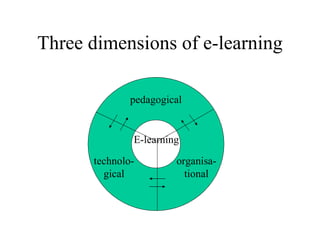
Three dimensions of e-learning pedagogical technolo- gical organisa- tional E-learning
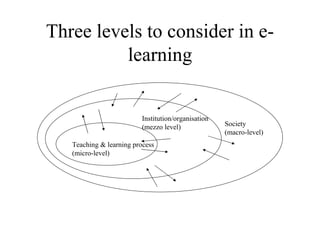
Three levels to consider in e-learning Teaching & learning process (micro-level) Institution/organisation (mezzo level) Society (macro-level)
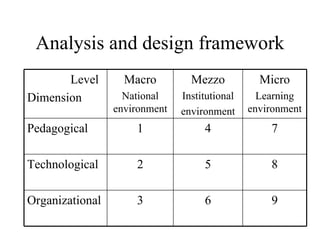
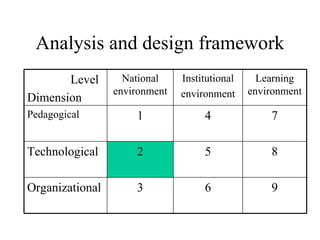
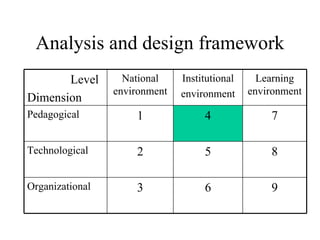
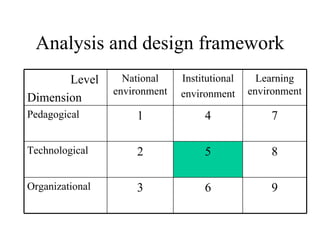
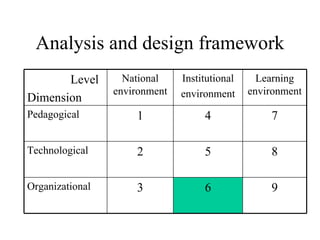
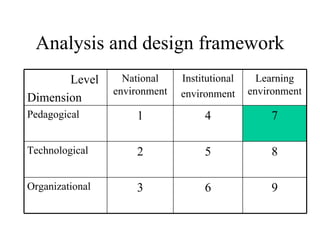
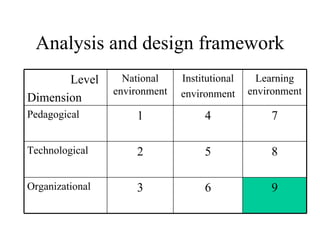
Analysis and design framework Level Dimension Macro National environment Mezzo Institutional environment Micro Learning environment Pedagogical 1 4 7 Technological 2 5 8 Organizational 3 6 9
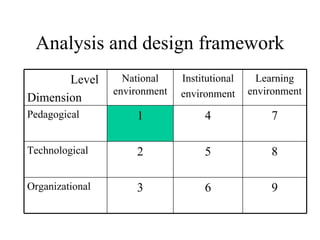
Analysis and design framework Level Dimension National environment Institutional environment Learning environment Pedagogical 1 4 7 Technological 2 5 8 Organizational 3 6 9
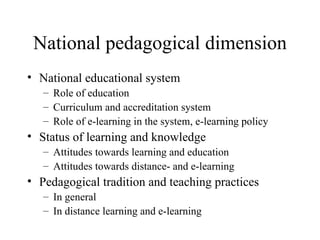
National pedagogical dimension National educational system Role of education Curriculum and accreditation system Role of e-learning in the system, e-learning policy Status of learning and knowledge Attitudes towards learning and education Attitudes towards distance- and e-learning Pedagogical tradition and teaching practices In general In distance learning and e-learning
Analysis and design framework Level Dimension National environment Institutional environment Learning environment Pedagogical 1 4 7 Technological 2 5 8 Organizational 3 6 9
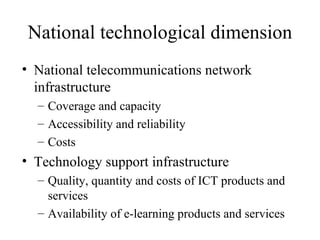
National technological dimension National telecommunications network infrastructure Coverage and capacity Accessibility and reliability Costs Technology support infrastructure Quality, quantity and costs of ICT products and services Availability of e-learning products and services
Analysis and design framework Level Dimension National environment Institutional environment Learning environment Pedagogical 1 4 7 Technological 2 5 8 Organizational 3 6 9
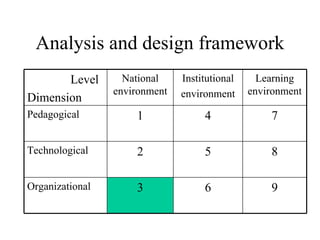
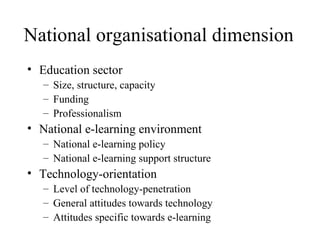
National organisational dimension Education sector Size, structure, capacity Funding Professionalism National e-learning environment National e-learning policy National e-learning support structure  Technology-orientation Level of technology-penetration General attitudes towards technology Attitudes specific towards e-learning
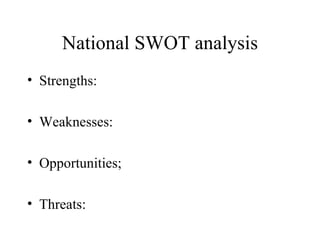
National SWOT analysis Strengths: Weaknesses: Opportunities; Threats:
Analysis and design framework Level Dimension National environment Institutional environment Learning environment Pedagogical 1 4 7 Technological 2 5 8 Organizational 3 6 9
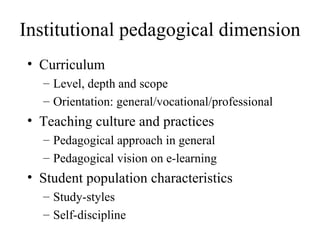
Institutional pedagogical dimension Curriculum Level, depth and scope Orientation: general/vocational/professional Teaching culture and practices Pedagogical approach in general Pedagogical vision on e-learning Student population characteristics Study-styles Self-discipline
Analysis and design framework Level Dimension National environment Institutional environment Learning environment Pedagogical 1 4 7 Technological 2 5 8 Organizational 3 6 9
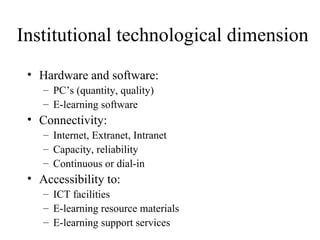
Institutional technological dimension Hardware and software: PC’s (quantity, quality) E-learning software Connectivity: Internet, Extranet, Intranet Capacity, reliability Continuous or dial-in Accessibility to: ICT facilities E-learning resource materials E-learning support services
Analysis and design framework Level Dimension National environment Institutional environment Learning environment Pedagogical 1 4 7 Technological 2 5 8 Organizational 3 6 9
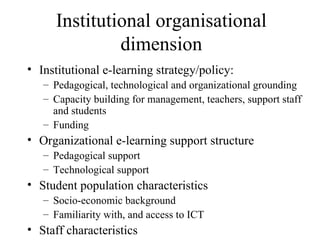
Institutional organisational dimension Institutional e-learning strategy/policy: Pedagogical, technological and organizational grounding Capacity building for management, teachers, support staff and students Funding Organizational e-learning support structure Pedagogical support Technological support Student population characteristics Socio-economic background Familiarity with, and access to ICT Staff characteristics
BU institutional SWOT analysis Strengths: Weaknesses: Opportunities; Threats:
Analysis and design framework Level Dimension National environment Institutional environment Learning environment Pedagogical 1 4 7 Technological 2 5 8 Organizational 3 6 9
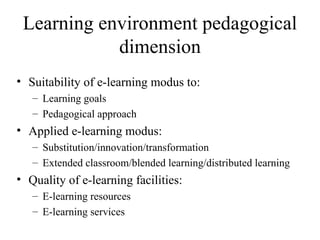
Learning environment pedagogical dimension Suitability of e-learning modus to: Learning goals Pedagogical approach Applied e-learning modus:  Substitution/innovation/transformation Extended classroom/blended learning/distributed learning  Quality of e-learning facilities:  E-learning resources E-learning services
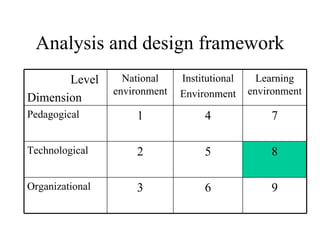
Analysis and design framework Level Dimension National environment Institutional Environment Learning environment Pedagogical 1 4 7 Technological 2 5 8 Organizational 3 6 9
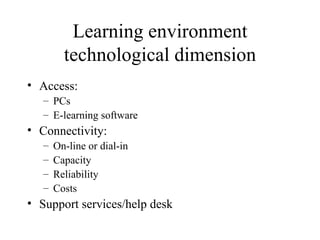
Learning environment technological dimension Access: PCs E-learning software Connectivity: On-line or dial-in Capacity Reliability Costs Support services/help desk
Analysis and design framework Level Dimension National environment Institutional environment Learning environment Pedagogical 1 4 7 Technological 2 5 8 Organizational 3 6 9
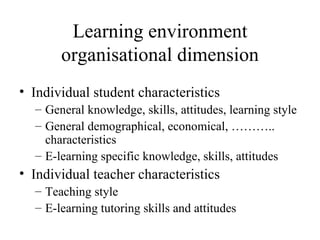
Learning environment organisational dimension Individual student characteristics General knowledge, skills, attitudes, learning style General demographical, economical, ……….. characteristics E-learning specific knowledge, skills, attitudes Individual teacher characteristics Teaching style E-learning tutoring skills and attitudes
Micro SWOT analysis Strengths: Weaknesses: Opportunities; Threats:
Prerequisites at national level Realistic national e-learning policy E-learning innovation programmes and funds Telecommunications infrastructure Internet services providers Reliable hardware and software suppliers ICT training and manpower providers Distance teaching/e-learning association(s) Pre- and in-service teacher training programmes in e-learning Openness to (technological) innovation Best practices examples
Prerequisites at institutional level Vision and realistic expectations Enthusiastic individuals and role models Management support Flexible organizational structure and practices Budget Institutional innovation record Capable staff in various (new) roles ………………………………… .
Student prerequisites Access to computer (content presentation) Internet connectivity (communication) Basic computer skills Openness towards e-learning Self-directedness and study discipline ……………………………

E learning analysis and design framework

  • 1.
    E-learning analysis anddesign framework author: Eric Kluijfhout, eric.kluijfhout@gmail.com   This work is licensed under the Creative Commons Attribution-NonCommercial-ShareAlike License. To view a copy of this license, visit http://creativecommons.org/licenses/devnations/2.0/ or send a letter to Creative Commons, 559 Nathan Abbott Way, Stanford, California 94305, USA.  
  • 2.
    E-learning analysis anddesign framework For the Institute for Community Participation, Bethlehem University through Maastricht School of Management by Eric Kluijfhout
  • 3.
    Outline Recap ofanalysis and design framework Framework dimensions detailed E-learning movers E-learning inhibitors E-learning prerequisites
  • 4.
    Three dimensions ofe-learning pedagogical technolo- gical organisa- tional E-learning
  • 5.
    Three levels toconsider in e-learning Teaching & learning process (micro-level) Institution/organisation (mezzo level) Society (macro-level)
  • 6.
    Analysis and designframework Level Dimension Macro National environment Mezzo Institutional environment Micro Learning environment Pedagogical 1 4 7 Technological 2 5 8 Organizational 3 6 9
  • 7.
    Analysis and designframework Level Dimension National environment Institutional environment Learning environment Pedagogical 1 4 7 Technological 2 5 8 Organizational 3 6 9
  • 8.
    National pedagogical dimensionNational educational system Role of education Curriculum and accreditation system Role of e-learning in the system, e-learning policy Status of learning and knowledge Attitudes towards learning and education Attitudes towards distance- and e-learning Pedagogical tradition and teaching practices In general In distance learning and e-learning
  • 9.
    Analysis and designframework Level Dimension National environment Institutional environment Learning environment Pedagogical 1 4 7 Technological 2 5 8 Organizational 3 6 9
  • 10.
    National technological dimensionNational telecommunications network infrastructure Coverage and capacity Accessibility and reliability Costs Technology support infrastructure Quality, quantity and costs of ICT products and services Availability of e-learning products and services
  • 11.
    Analysis and designframework Level Dimension National environment Institutional environment Learning environment Pedagogical 1 4 7 Technological 2 5 8 Organizational 3 6 9
  • 12.
    National organisational dimensionEducation sector Size, structure, capacity Funding Professionalism National e-learning environment National e-learning policy National e-learning support structure Technology-orientation Level of technology-penetration General attitudes towards technology Attitudes specific towards e-learning
  • 13.
    National SWOT analysisStrengths: Weaknesses: Opportunities; Threats:
  • 14.
    Analysis and designframework Level Dimension National environment Institutional environment Learning environment Pedagogical 1 4 7 Technological 2 5 8 Organizational 3 6 9
  • 15.
    Institutional pedagogical dimensionCurriculum Level, depth and scope Orientation: general/vocational/professional Teaching culture and practices Pedagogical approach in general Pedagogical vision on e-learning Student population characteristics Study-styles Self-discipline
  • 16.
    Analysis and designframework Level Dimension National environment Institutional environment Learning environment Pedagogical 1 4 7 Technological 2 5 8 Organizational 3 6 9
  • 17.
    Institutional technological dimensionHardware and software: PC’s (quantity, quality) E-learning software Connectivity: Internet, Extranet, Intranet Capacity, reliability Continuous or dial-in Accessibility to: ICT facilities E-learning resource materials E-learning support services
  • 18.
    Analysis and designframework Level Dimension National environment Institutional environment Learning environment Pedagogical 1 4 7 Technological 2 5 8 Organizational 3 6 9
  • 19.
    Institutional organisational dimensionInstitutional e-learning strategy/policy: Pedagogical, technological and organizational grounding Capacity building for management, teachers, support staff and students Funding Organizational e-learning support structure Pedagogical support Technological support Student population characteristics Socio-economic background Familiarity with, and access to ICT Staff characteristics
  • 20.
    BU institutional SWOTanalysis Strengths: Weaknesses: Opportunities; Threats:
  • 21.
    Analysis and designframework Level Dimension National environment Institutional environment Learning environment Pedagogical 1 4 7 Technological 2 5 8 Organizational 3 6 9
  • 22.
    Learning environment pedagogicaldimension Suitability of e-learning modus to: Learning goals Pedagogical approach Applied e-learning modus: Substitution/innovation/transformation Extended classroom/blended learning/distributed learning Quality of e-learning facilities: E-learning resources E-learning services
  • 23.
    Analysis and designframework Level Dimension National environment Institutional Environment Learning environment Pedagogical 1 4 7 Technological 2 5 8 Organizational 3 6 9
  • 24.
    Learning environment technologicaldimension Access: PCs E-learning software Connectivity: On-line or dial-in Capacity Reliability Costs Support services/help desk
  • 25.
    Analysis and designframework Level Dimension National environment Institutional environment Learning environment Pedagogical 1 4 7 Technological 2 5 8 Organizational 3 6 9
  • 26.
    Learning environment organisationaldimension Individual student characteristics General knowledge, skills, attitudes, learning style General demographical, economical, ……….. characteristics E-learning specific knowledge, skills, attitudes Individual teacher characteristics Teaching style E-learning tutoring skills and attitudes
  • 27.
    Micro SWOT analysisStrengths: Weaknesses: Opportunities; Threats:
  • 28.
    Prerequisites at nationallevel Realistic national e-learning policy E-learning innovation programmes and funds Telecommunications infrastructure Internet services providers Reliable hardware and software suppliers ICT training and manpower providers Distance teaching/e-learning association(s) Pre- and in-service teacher training programmes in e-learning Openness to (technological) innovation Best practices examples
  • 29.
    Prerequisites at institutionallevel Vision and realistic expectations Enthusiastic individuals and role models Management support Flexible organizational structure and practices Budget Institutional innovation record Capable staff in various (new) roles ………………………………… .
  • 30.
    Student prerequisites Accessto computer (content presentation) Internet connectivity (communication) Basic computer skills Openness towards e-learning Self-directedness and study discipline ……………………………

Editor's Notes

  • #7 Often no clear demarcation/some overlap between cells!! We will discuss each cell, for general (in terms of facilitating or inhibiting e-learning) as well as e-learning specific.
  • #13 Non-pedagogical and non-technical issues, but IN SUPPORT of pedagogy and technology.
  • #18 Accessibility at institutional level: Learning resources: e.g. to on-line libraries, own library with CD-ROM’s, learning objects repository, etc. Support services: e.g. domain-specific communities, e-learning support communities, etc.
  • #23 Learning resources: course texts, library access, web (google), other students Learning services: tutoring, self-tests, …………
  • #29 National e-learning policy should be medium-long term (3-5 years rolling plan) and include also the role of non-gevernmental players. E-learning programmes are medium-term (1-3 yeaqrs) and should be derived from the long-term policy. Distance teaching/e-learning organizations along the lines of educational levels (secondary, tertiary), professional associations (IT staff, teachers, ….) or economical sectors (education, government, private sector). Teacher training: often the present generation of teachers is ‘lost’ Reliable hardware and software suppliers: e-learning requires stable hardware and software services. Internet services providers: to provide reliable connectivity ICT training and manpower providers: without competent and responsible people, no technology can function