Making sense of the Internet business landscape
Massive channel disintermediation?
Delineation between technology producers and
technology users?
Conducts of Dot-com
Performance of vogue virtual integrations?
Evan & Wurster
Less about any specific new technology than a new
behavior for reaching critical mass;
The universal pervasion of open standards;
The precipitate changes of the structure of entire industry
and the ways companies compete
M. Porter:
Return to the fundamental principles underlying the
novelty of phenomena
Be shaped and reshaped by customers and the
business community
Emerging through evolution and adaptation
A flexible Value web (network) dominated a
single/dedicated value chain
The properties of models
Enable study of the structure of a complex system,
relationships among structural elements, assumptions,
and a description of the system in action
Can be built before the real system to help predict how the
system might respond if we change the structure,
structure, relationships, and assumptions
A model in the world of business
A description of a complex business that enables study of
its structure, the relationships among structural elements,
and how it will respond in the real world
A business model depicts the content,
structure, and governance of
transactions designed so as to create
value through the exploitation of
business opportunities.
Amit & Zott (SMJ, 2001, p.511)
The good or information that are being exchanged
The resources and capabilities that are required to
enable the exchange
E.g., transparency of transaction, vertical &
horizontal expansion of product/service, the degree
of customization, technologies of transaction
The parties that participate in the exchange
The ways in which these parties are linked
The order process and the adopted exchange
mechanism
E.g., the providers of complementary assets,
transaction speed, mode, simplicity, safety & reliability,
integration of online & offline supply chains
The ways in which flows of information, resources,
and goods are controlled by the relative parties
The incentives for the participants in transactions
E.g.,cooperative and shared incentive among allied
partners, commitment and investment of co-
specialized assets, loyalty maintenance
A description of roles and relationships
among a firm’s consumers, customers, allies,
and suppliers that identifies the major flows
of product, information, and money, and the
major benefits to participants, almost, over
Internet .
(Weill & Vitale, Place to Space, 2001, p.34)
Distributors models
Focused distributor models
Retailer, marketplace, aggregator/infomediary, exchange,
E*trade, Amazon
Portal models
Horizontal, vertical, affinity, AOL, Yahoo!, iVillage
Producer models
Manufacturers, service providers, educators, advisors,
information/news service, custom suppliers, Ford, GE, Boeing,
Ernst & Yong, WSJ, McGraw-Hill
Infrastructure provider models: to construct business that
deliver the technology infrastructure
Focused distributor
Infrastructure retailer/marketplace/exchange, CompUSA, Staples,
IngramMicro, Egghead
Portal
Horizontal/vertical infrastructure portals, AOL, AT&T, Oracle
Producer
Equipment/component manufacturers, infrastructure software/services
firms, IBM, Dell, Compaq, Oracle, Ariba, MS, Doubleclick
Custom software/hardware suppliers, Dell, Andersen Consulting
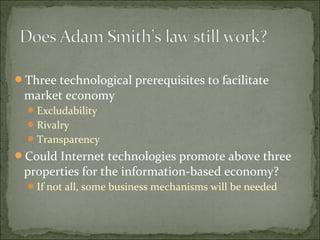
Three technological prerequisites to facilitate
market economy
Excludability
Rivalry
Transparency
Could Internet technologies promote above three
properties for the information-based economy?
If not all, some business mechanisms will be needed
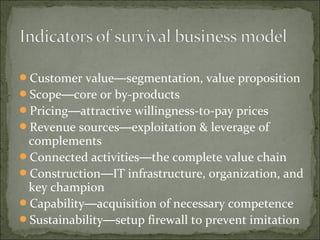
Customer value—segmentation, value proposition
Scope—core or by-products
Pricing—attractive willingness-to-pay prices
Revenue sources—exploitation & leverage of
complements
Connected activities—the complete value chain
Construction—IT infrastructure, organization, and
key champion
Capability—acquisition of necessary competence
Sustainability—setup firewall to prevent imitation
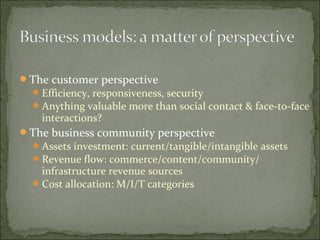
The customer perspective
Efficiency, responsiveness, security
Anything valuable more than social contact & face-to-face
interactions?
The business community perspective
Assets investment: current/tangible/intangible assets
Revenue flow: commerce/content/community/
infrastructure revenue sources
Cost allocation: M/I/T categories
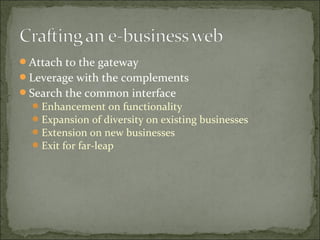
Attach to the gateway
Leverage with the complements
Search the common interface
Enhancement on functionality
Expansion of diversity on existing businesses
Extension on new businesses
Exit for far-leap
Evans, P. and T. Wurster (1997), “Strategy and the
New Economics of Information,” Harvard Business
Review, 75(5), Sept.-Oct., pp.70-83.
Porter, M. E. (2001), “Strategy and the Internet,”
Harvard Business Review, 79(3), March, pp.62-78.
Chatterjee, Debabroto, Rajdeep Grewal and V.
Sambamurthy (2002), “Shaping Up for E-commerce:
Institutional Enablers of the Organizational
Assimilation of Web Technologies,” MIS Quarterly,
Volume 26, Number 2, pp.65-89.
Fichman, R. G. and Kemerer C. F. (1999), “The Illusion
Diffusion of Innovation: An Examination of Assimilation
Gaps,” Information Systems Research, Sept. pp, 255-275.
Kline, R. B. (1998), Principles and Practices of Structural
Equation Modeling, The Guilford Press, New Work.
Grover, Varun, and Pradipkumar Ramanlal (1999), “Six
Myths of Information and Markets: Information
Technology Network, Electronic Commerce, and the Battle
for Consumer Surplus,” MIS Quarterly, Volume 23, Number
4, pp.469-495.
Stigler, George (1961), "The Economics of Information",
Journal of Political Economy.
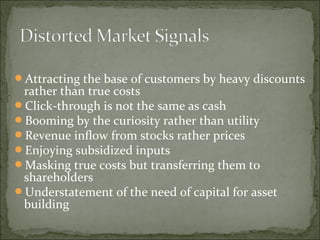
Attracting the base of customers by heavy discounts
rather than true costs
Click-through is not the same as cash
Booming by the curiosity rather than utility
Revenue inflow from stocks rather prices
Enjoying subsidized inputs
Masking true costs but transferring them to
shareholders
Understatement of the need of capital for asset
building
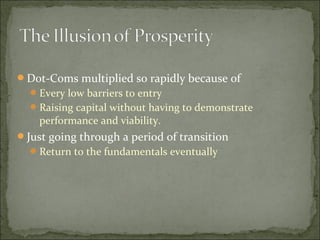
Dot-Coms multiplied so rapidly because of
Every low barriers to entry
Raising capital without having to demonstrate
performance and viability.
Just going through a period of transition
Return to the fundamentals eventually
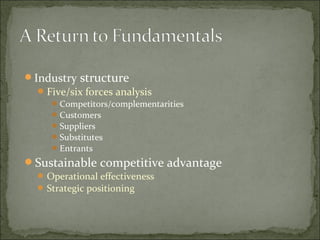
Industry structure
Five/six forces analysis
Competitors/complementarities
Customers
Suppliers
Substitutes
Entrants
Sustainable competitive advantage
Operational effectiveness
Strategic positioning

E commerce buissness-model

  • 1.
    Making sense ofthe Internet business landscape
  • 2.
    Massive channel disintermediation? Delineationbetween technology producers and technology users? Conducts of Dot-com Performance of vogue virtual integrations?
  • 3.
    Evan & Wurster Lessabout any specific new technology than a new behavior for reaching critical mass; The universal pervasion of open standards; The precipitate changes of the structure of entire industry and the ways companies compete M. Porter: Return to the fundamental principles underlying the novelty of phenomena
  • 4.
    Be shaped andreshaped by customers and the business community Emerging through evolution and adaptation A flexible Value web (network) dominated a single/dedicated value chain
  • 5.
    The properties ofmodels Enable study of the structure of a complex system, relationships among structural elements, assumptions, and a description of the system in action Can be built before the real system to help predict how the system might respond if we change the structure, structure, relationships, and assumptions A model in the world of business A description of a complex business that enables study of its structure, the relationships among structural elements, and how it will respond in the real world
  • 6.
    A business modeldepicts the content, structure, and governance of transactions designed so as to create value through the exploitation of business opportunities. Amit & Zott (SMJ, 2001, p.511)
  • 7.
    The good orinformation that are being exchanged The resources and capabilities that are required to enable the exchange E.g., transparency of transaction, vertical & horizontal expansion of product/service, the degree of customization, technologies of transaction
  • 8.
    The parties thatparticipate in the exchange The ways in which these parties are linked The order process and the adopted exchange mechanism E.g., the providers of complementary assets, transaction speed, mode, simplicity, safety & reliability, integration of online & offline supply chains
  • 9.
    The ways inwhich flows of information, resources, and goods are controlled by the relative parties The incentives for the participants in transactions E.g.,cooperative and shared incentive among allied partners, commitment and investment of co- specialized assets, loyalty maintenance
  • 10.
    A description ofroles and relationships among a firm’s consumers, customers, allies, and suppliers that identifies the major flows of product, information, and money, and the major benefits to participants, almost, over Internet . (Weill & Vitale, Place to Space, 2001, p.34)
  • 11.
    Distributors models Focused distributormodels Retailer, marketplace, aggregator/infomediary, exchange, E*trade, Amazon Portal models Horizontal, vertical, affinity, AOL, Yahoo!, iVillage Producer models Manufacturers, service providers, educators, advisors, information/news service, custom suppliers, Ford, GE, Boeing, Ernst & Yong, WSJ, McGraw-Hill
  • 12.
    Infrastructure provider models:to construct business that deliver the technology infrastructure Focused distributor Infrastructure retailer/marketplace/exchange, CompUSA, Staples, IngramMicro, Egghead Portal Horizontal/vertical infrastructure portals, AOL, AT&T, Oracle Producer Equipment/component manufacturers, infrastructure software/services firms, IBM, Dell, Compaq, Oracle, Ariba, MS, Doubleclick Custom software/hardware suppliers, Dell, Andersen Consulting
  • 13.
    Three technological prerequisitesto facilitate market economy Excludability Rivalry Transparency Could Internet technologies promote above three properties for the information-based economy? If not all, some business mechanisms will be needed
  • 14.
    Customer value—segmentation, valueproposition Scope—core or by-products Pricing—attractive willingness-to-pay prices Revenue sources—exploitation & leverage of complements Connected activities—the complete value chain Construction—IT infrastructure, organization, and key champion Capability—acquisition of necessary competence Sustainability—setup firewall to prevent imitation
  • 15.
    The customer perspective Efficiency,responsiveness, security Anything valuable more than social contact & face-to-face interactions? The business community perspective Assets investment: current/tangible/intangible assets Revenue flow: commerce/content/community/ infrastructure revenue sources Cost allocation: M/I/T categories
  • 16.
    Attach to thegateway Leverage with the complements Search the common interface Enhancement on functionality Expansion of diversity on existing businesses Extension on new businesses Exit for far-leap
  • 17.
    Evans, P. andT. Wurster (1997), “Strategy and the New Economics of Information,” Harvard Business Review, 75(5), Sept.-Oct., pp.70-83. Porter, M. E. (2001), “Strategy and the Internet,” Harvard Business Review, 79(3), March, pp.62-78.
  • 18.
    Chatterjee, Debabroto, RajdeepGrewal and V. Sambamurthy (2002), “Shaping Up for E-commerce: Institutional Enablers of the Organizational Assimilation of Web Technologies,” MIS Quarterly, Volume 26, Number 2, pp.65-89. Fichman, R. G. and Kemerer C. F. (1999), “The Illusion Diffusion of Innovation: An Examination of Assimilation Gaps,” Information Systems Research, Sept. pp, 255-275. Kline, R. B. (1998), Principles and Practices of Structural Equation Modeling, The Guilford Press, New Work.
  • 19.
    Grover, Varun, andPradipkumar Ramanlal (1999), “Six Myths of Information and Markets: Information Technology Network, Electronic Commerce, and the Battle for Consumer Surplus,” MIS Quarterly, Volume 23, Number 4, pp.469-495. Stigler, George (1961), "The Economics of Information", Journal of Political Economy.
  • 20.
    Attracting the baseof customers by heavy discounts rather than true costs Click-through is not the same as cash Booming by the curiosity rather than utility Revenue inflow from stocks rather prices Enjoying subsidized inputs Masking true costs but transferring them to shareholders Understatement of the need of capital for asset building
  • 21.
    Dot-Coms multiplied sorapidly because of Every low barriers to entry Raising capital without having to demonstrate performance and viability. Just going through a period of transition Return to the fundamentals eventually
  • 22.
    Industry structure Five/six forcesanalysis Competitors/complementarities Customers Suppliers Substitutes Entrants Sustainable competitive advantage Operational effectiveness Strategic positioning