Presented byBanita Swain
Asish ku. Pani
COMMERCE
 Commerce is a division of trade or

production which deals with the
exchange of goods and services from
producer to final consumer
E-COMMERCE
 It is commonly known as electronic marketing.
 It consist of buying and selling goods and services over

an electronic system such as the internet.
 E-commerce is the purchasing , selling & exchanging

goods and services over computer network or internet
through which transactions or terms of sale are
performed electronically.
E-commerce vs. E-business
 We use the term e-business to refer primarily to the

digital enablement of transactions and processes
within a firm, involving information systems under the
control of the firm.
 E-commerce include commercial transactions

involving an exchange of value across organizational
boundaries
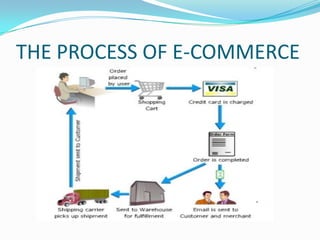
THE PROCESS OF E-COMMERCE
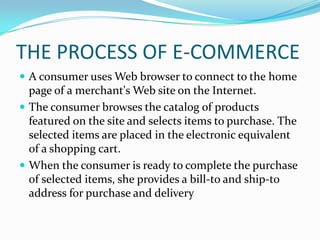
 A consumer uses Web browser to connect to the home

page of a merchant's Web site on the Internet.
 The consumer browses the catalog of products
featured on the site and selects items to purchase. The
selected items are placed in the electronic equivalent
of a shopping cart.
 When the consumer is ready to complete the purchase
of selected items, she provides a bill-to and ship-to
address for purchase and delivery
CONTINUE: When the credit card number is validated and the

order is completed at the Commerce Server site, the
merchant's site displays a receipt confirming the
customer's purchase.
 The Commerce Server site then forwards the order to a

Processing Network for payment processing and
fulfilment.
Different types of e-commerce
 Business-to-business (B2B)
 Business-to-Consumer (B2C)
 Business-to-government (B2G)
 Consumer-to-consumer (C2C)
 Mobile commerce (m-commerce)
What is B2B e-commerce?
 B2B e-commerce is simply defined as ecommerce
between companies. About 80% of e-commerce is
of this type.
 Examples:
 Intel selling microprocessor to Dell
 Heinz selling ketchup to Mc Donalds
What is B2C ecommerce?
 Business-to-consumer e-commerce, or commerce
between companies and consumers, involves
customers gathering information; purchasing
physical goods or receiving products over an

electronic network.
 Example:
 Dell selling me a laptop
What is B2G ecommerce?
 Business-to-government e-commerce or B2G is
generally defined as commerce between
companies and the public sector. It refers to the
use of the Internet for public procurement,

licensing procedures, and other governmentrelated operations
 Example:
 Business pay taxes, file reports, or sell goods and services

to Govt. agencies.
What is C2C ecommerce?
 Consumer-to-consumer e-commerce or C2C is
simply commerce between private individuals or
consumers.
 Example:
 Mary buying an iPod from Tom on eBay
 Me selling a car to my neighbour
What is m-commerce?
 M-commerce (mobile commerce) is the buying
and selling of goods and services through wireless
technology-i.e., handheld devices such as cellular
telephones
 Mobile Ticketing
 Information Services
 Mobile Banking
ADVANTAGES OF E-COMMERCE
 Faster buying/selling procedure, as well as easy to find







products.
Buying/selling 24/7.
More reach to customers, there is no theoretical
geographic limitations.
Low operational costs and better quality of services.
No need of physical company set-ups.
Easy to start and manage a business.
Customers can easily select products from different
providers without moving around physically.
DISADVANTAGES OF E-COMMERCE
 Unable to examine products personally
 Not everyone is connected to the Internet

 There is the possibility of credit card number theft
 Mechanical failures can cause unpredictable effects on

the total processes.
E commerce

E commerce

  • 1.
  • 2.
    COMMERCE  Commerce isa division of trade or production which deals with the exchange of goods and services from producer to final consumer
  • 3.
    E-COMMERCE  It iscommonly known as electronic marketing.  It consist of buying and selling goods and services over an electronic system such as the internet.  E-commerce is the purchasing , selling & exchanging goods and services over computer network or internet through which transactions or terms of sale are performed electronically.
  • 4.
    E-commerce vs. E-business We use the term e-business to refer primarily to the digital enablement of transactions and processes within a firm, involving information systems under the control of the firm.  E-commerce include commercial transactions involving an exchange of value across organizational boundaries
  • 5.
    THE PROCESS OFE-COMMERCE
  • 6.
    THE PROCESS OFE-COMMERCE  A consumer uses Web browser to connect to the home page of a merchant's Web site on the Internet.  The consumer browses the catalog of products featured on the site and selects items to purchase. The selected items are placed in the electronic equivalent of a shopping cart.  When the consumer is ready to complete the purchase of selected items, she provides a bill-to and ship-to address for purchase and delivery
  • 7.
    CONTINUE: When thecredit card number is validated and the order is completed at the Commerce Server site, the merchant's site displays a receipt confirming the customer's purchase.  The Commerce Server site then forwards the order to a Processing Network for payment processing and fulfilment.
  • 8.
    Different types ofe-commerce  Business-to-business (B2B)  Business-to-Consumer (B2C)  Business-to-government (B2G)  Consumer-to-consumer (C2C)  Mobile commerce (m-commerce)
  • 9.
    What is B2Be-commerce?  B2B e-commerce is simply defined as ecommerce between companies. About 80% of e-commerce is of this type.  Examples:  Intel selling microprocessor to Dell  Heinz selling ketchup to Mc Donalds
  • 10.
    What is B2Cecommerce?  Business-to-consumer e-commerce, or commerce between companies and consumers, involves customers gathering information; purchasing physical goods or receiving products over an electronic network.  Example:  Dell selling me a laptop
  • 11.
    What is B2Gecommerce?  Business-to-government e-commerce or B2G is generally defined as commerce between companies and the public sector. It refers to the use of the Internet for public procurement, licensing procedures, and other governmentrelated operations  Example:  Business pay taxes, file reports, or sell goods and services to Govt. agencies.
  • 12.
    What is C2Cecommerce?  Consumer-to-consumer e-commerce or C2C is simply commerce between private individuals or consumers.  Example:  Mary buying an iPod from Tom on eBay  Me selling a car to my neighbour
  • 13.
    What is m-commerce? M-commerce (mobile commerce) is the buying and selling of goods and services through wireless technology-i.e., handheld devices such as cellular telephones  Mobile Ticketing  Information Services  Mobile Banking
  • 14.
    ADVANTAGES OF E-COMMERCE Faster buying/selling procedure, as well as easy to find       products. Buying/selling 24/7. More reach to customers, there is no theoretical geographic limitations. Low operational costs and better quality of services. No need of physical company set-ups. Easy to start and manage a business. Customers can easily select products from different providers without moving around physically.
  • 15.
    DISADVANTAGES OF E-COMMERCE Unable to examine products personally  Not everyone is connected to the Internet  There is the possibility of credit card number theft  Mechanical failures can cause unpredictable effects on the total processes.