Presentation on
“Dynamic mechanical analysis (DMA)”
Presented to:
Dr. Shaikh Md. Mominul Alam
Professor and Head,
Department of Textile Machinery Design and Maintenance,
Bangladesh University of Textiles.
Presented by:
Bijay Kumar
Department of Fabric Engineering
ID: 2018-2-2-009
Dynamic mechanical analysis (DMA)
Dynamic mechanical analysis (abbreviated DMA, also known as dynamic
mechanical spectroscopy) is a technique used to study and characterize
materials. It is most useful for studying the viscoelastic behavior of polymers.
Dynamic Mechanical Analysis (DMA) is a technique that is widely used to
characterize a material’s properties as a function of temperature, time,
frequency, stress, atmosphere or a combination of these parameters.
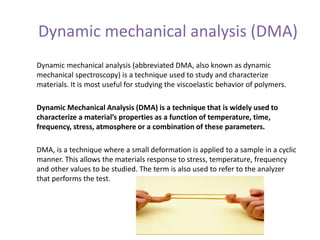
DMA, is a technique where a small deformation is applied to a sample in a cyclic
manner. This allows the materials response to stress, temperature, frequency
and other values to be studied. The term is also used to refer to the analyzer
that performs the test.
How to analyze properties?
 DMA is a measuring instrument which is used to determine the dynamic
characteristics of materials.
 It applies a dynamic oscillating force to a sample and analyze the
material’s response to that cyclic force.
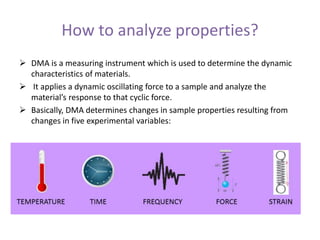
 Basically, DMA determines changes in sample properties resulting from
changes in five experimental variables:
Which materials can be analyzed with
DMA ?
 Polymers
 Elastomers
 Composites
 Metals and alloys
 Ceramics, glass
 Adhesives
 Elastomers
 Metals and alloys
 Ceramics, glass
 Adhesives
 Bitumen
 Paint and varnish
 Cosmetics
 Oils
 Biomaterials
 Leather, skin hair….
Theory
Viscosity: resistance to flow
Elasticity: ability to revert back to original shape
Complex dynamic modulus (E*)
Ratio of applied stress to measured strain
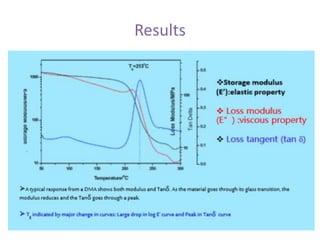
Storage modulus (E’)
Energy stored elastically during deformation
E’= E* cosδ
Loss modulus (E’’)
Energy loss during deformation
E” = E* sinδ
Loss tangent (tanδ) or damping or loss factor
shows the ability of material to dissipate the energy
Tanδ= E’’/E
APPLICATIONS OF D.M.A.
 Measurement of the glass transition temperature of polymers
 Varying the composition of monomers
 Effectively evaluate the miscibility of polymers
 To characterize the glass transition temperature of a material
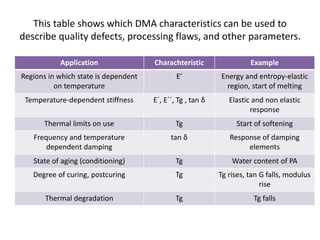
This table shows which DMA characteristics can be used to
describe quality defects, processing flaws, and other parameters.
Application Charachteristic Example
Regions in which state is dependent
on temperature
E’ Energy and entropy-elastic
region, start of melting
Temperature-dependent stiffness E´, E´´, Tg , tan δ Elastic and non elastic
response
Thermal limits on use Tg Start of softening
Frequency and temperature
dependent damping
tan δ Response of damping
elements
State of aging (conditioning) Tg Water content of PA
Degree of curing, postcuring Tg Tg rises, tan G falls, modulus
rise
Thermal degradation Tg Tg falls
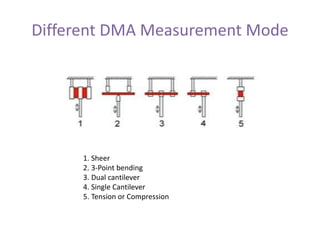
Different DMA Measurement Mode
1. Sheer
2. 3-Point bending
3. Dual cantilever
4. Single Cantilever
5. Tension or Compression
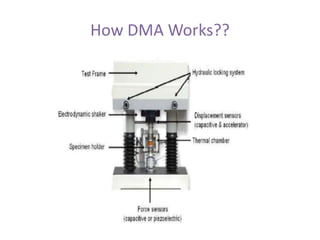
How DMA Works??
Continued….
1. Preparation of Specimen
2. Installation of the selected specimen holder
3. Installation of the prepared specimen into the specimen
holder inside thermal chamber
4. Start temperature, finish temperature, and step
5. Application of dynamic excitation (stress or strain) on the
specimen by dynamic shaker through entire temperature
range
6. Then DMA records the response of specimen and
determines: E’, E”, Tanδ
7. Identify transition temperatures based on noticeable
changes in curves
Continued….
The basic principle of the instrument is to exert a dynamic
excitation of known amplitude and frequency to a specimen of
known dimensions. The measurement of strains and
dynamic forces yields the specimen’s stiffness. From the
known geometry, one can derive mechanical properties of the
material, such as modulus and loss factor. Thus, a tension test
can be used to get Young’s modulus, whereas a shear test yields
the shear modulus.
The presence of the thermal chamber allows performing
measurements at different temperatures and thus
determining materials’ glass transition temperature. Also, the
possibility to have the deformation amplitude vary during the
measurement allows accessing the non-linear behavior of
materials. The control of the excitation shape, combined with
cycle counting, allows implementing fatigue tests.
Results

Dynamic mechanical analysis (DMA)

  • 1.
    Presentation on “Dynamic mechanicalanalysis (DMA)” Presented to: Dr. Shaikh Md. Mominul Alam Professor and Head, Department of Textile Machinery Design and Maintenance, Bangladesh University of Textiles. Presented by: Bijay Kumar Department of Fabric Engineering ID: 2018-2-2-009
  • 2.
    Dynamic mechanical analysis(DMA) Dynamic mechanical analysis (abbreviated DMA, also known as dynamic mechanical spectroscopy) is a technique used to study and characterize materials. It is most useful for studying the viscoelastic behavior of polymers. Dynamic Mechanical Analysis (DMA) is a technique that is widely used to characterize a material’s properties as a function of temperature, time, frequency, stress, atmosphere or a combination of these parameters. DMA, is a technique where a small deformation is applied to a sample in a cyclic manner. This allows the materials response to stress, temperature, frequency and other values to be studied. The term is also used to refer to the analyzer that performs the test.
  • 3.
    How to analyzeproperties?  DMA is a measuring instrument which is used to determine the dynamic characteristics of materials.  It applies a dynamic oscillating force to a sample and analyze the material’s response to that cyclic force.  Basically, DMA determines changes in sample properties resulting from changes in five experimental variables:
  • 4.
    Which materials canbe analyzed with DMA ?  Polymers  Elastomers  Composites  Metals and alloys  Ceramics, glass  Adhesives  Elastomers  Metals and alloys  Ceramics, glass  Adhesives  Bitumen  Paint and varnish  Cosmetics  Oils  Biomaterials  Leather, skin hair….
  • 5.
    Theory Viscosity: resistance toflow Elasticity: ability to revert back to original shape Complex dynamic modulus (E*) Ratio of applied stress to measured strain Storage modulus (E’) Energy stored elastically during deformation E’= E* cosδ Loss modulus (E’’) Energy loss during deformation E” = E* sinδ Loss tangent (tanδ) or damping or loss factor shows the ability of material to dissipate the energy Tanδ= E’’/E
  • 6.
    APPLICATIONS OF D.M.A. Measurement of the glass transition temperature of polymers  Varying the composition of monomers  Effectively evaluate the miscibility of polymers  To characterize the glass transition temperature of a material
  • 7.
    This table showswhich DMA characteristics can be used to describe quality defects, processing flaws, and other parameters. Application Charachteristic Example Regions in which state is dependent on temperature E’ Energy and entropy-elastic region, start of melting Temperature-dependent stiffness E´, E´´, Tg , tan δ Elastic and non elastic response Thermal limits on use Tg Start of softening Frequency and temperature dependent damping tan δ Response of damping elements State of aging (conditioning) Tg Water content of PA Degree of curing, postcuring Tg Tg rises, tan G falls, modulus rise Thermal degradation Tg Tg falls
  • 8.
    Different DMA MeasurementMode 1. Sheer 2. 3-Point bending 3. Dual cantilever 4. Single Cantilever 5. Tension or Compression
  • 9.
  • 10.
    Continued…. 1. Preparation ofSpecimen 2. Installation of the selected specimen holder 3. Installation of the prepared specimen into the specimen holder inside thermal chamber 4. Start temperature, finish temperature, and step 5. Application of dynamic excitation (stress or strain) on the specimen by dynamic shaker through entire temperature range 6. Then DMA records the response of specimen and determines: E’, E”, Tanδ 7. Identify transition temperatures based on noticeable changes in curves
  • 11.
    Continued…. The basic principleof the instrument is to exert a dynamic excitation of known amplitude and frequency to a specimen of known dimensions. The measurement of strains and dynamic forces yields the specimen’s stiffness. From the known geometry, one can derive mechanical properties of the material, such as modulus and loss factor. Thus, a tension test can be used to get Young’s modulus, whereas a shear test yields the shear modulus. The presence of the thermal chamber allows performing measurements at different temperatures and thus determining materials’ glass transition temperature. Also, the possibility to have the deformation amplitude vary during the measurement allows accessing the non-linear behavior of materials. The control of the excitation shape, combined with cycle counting, allows implementing fatigue tests.
  • 12.