













Two sided Relationship
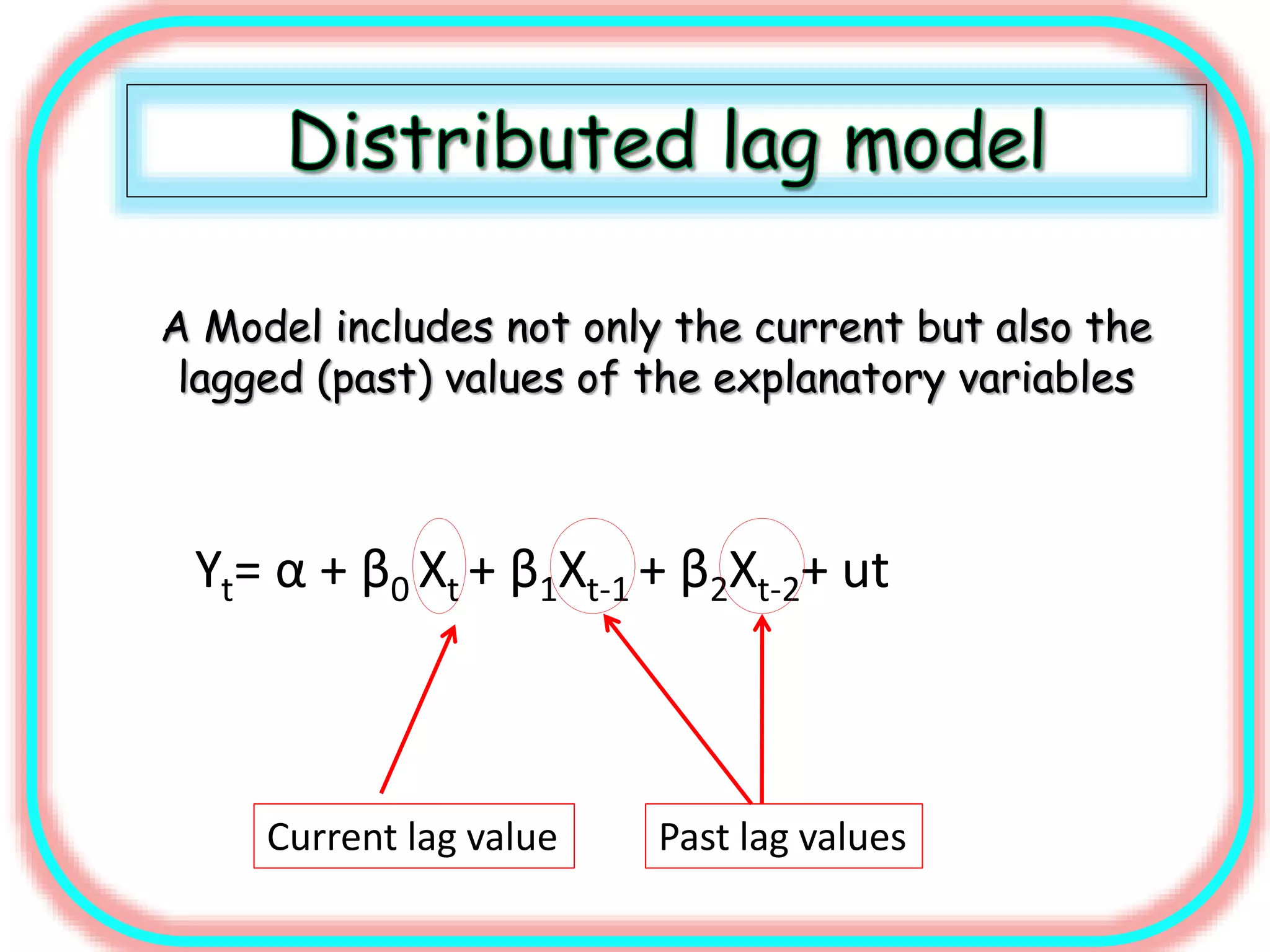
A Model includes not only the current but also the
lagged (past) values of the explanatory variables
Past lag valuesCurrent lag value
Yt= α + β0 Xt + β1Xt-1 + β2Xt-2+ ut
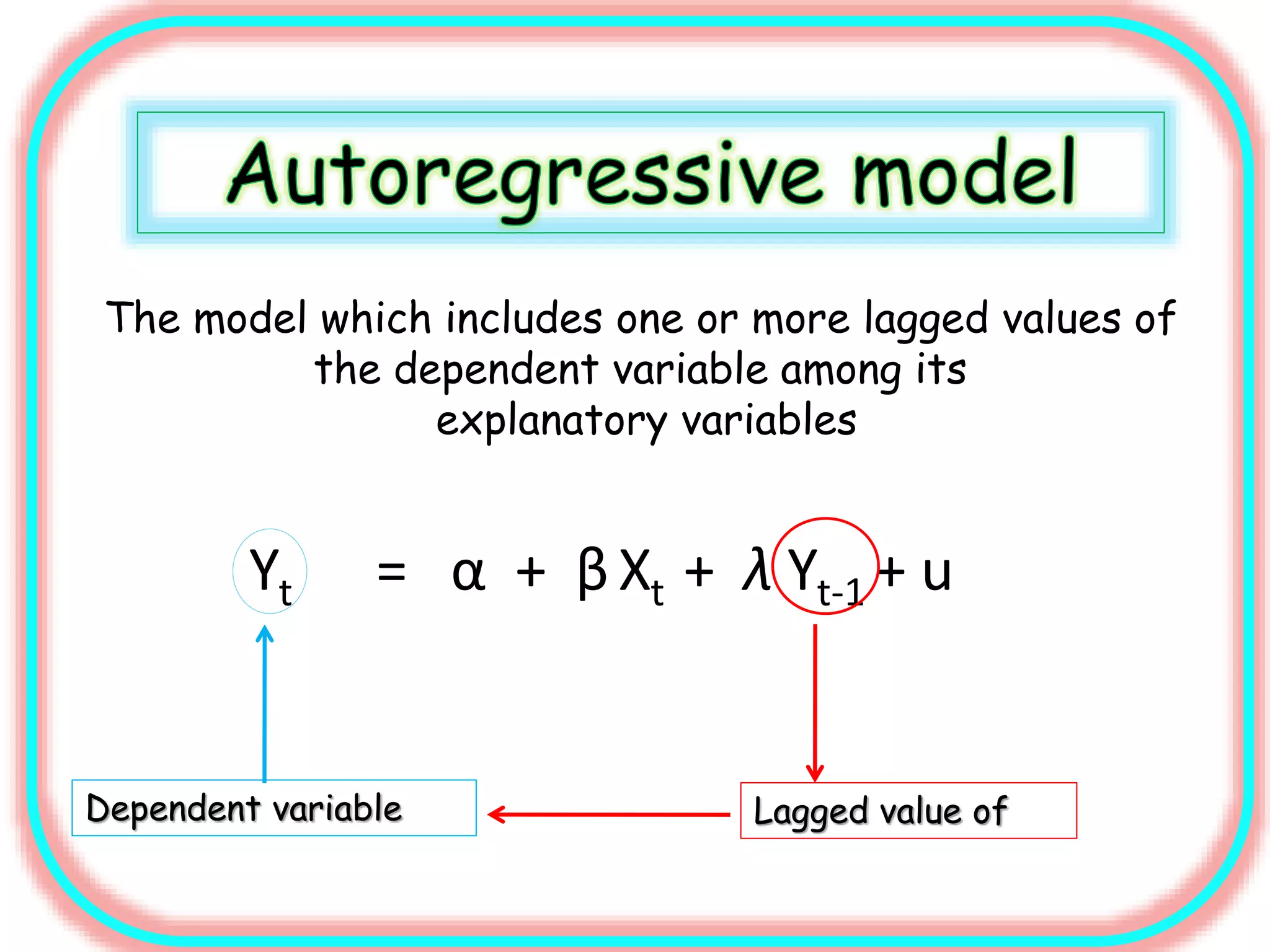
The model which includes one or more lagged values of
the dependent variable among its
explanatory variables
Lagged value ofDependent variable
Yt = α + βXt + λ Yt-1 + u
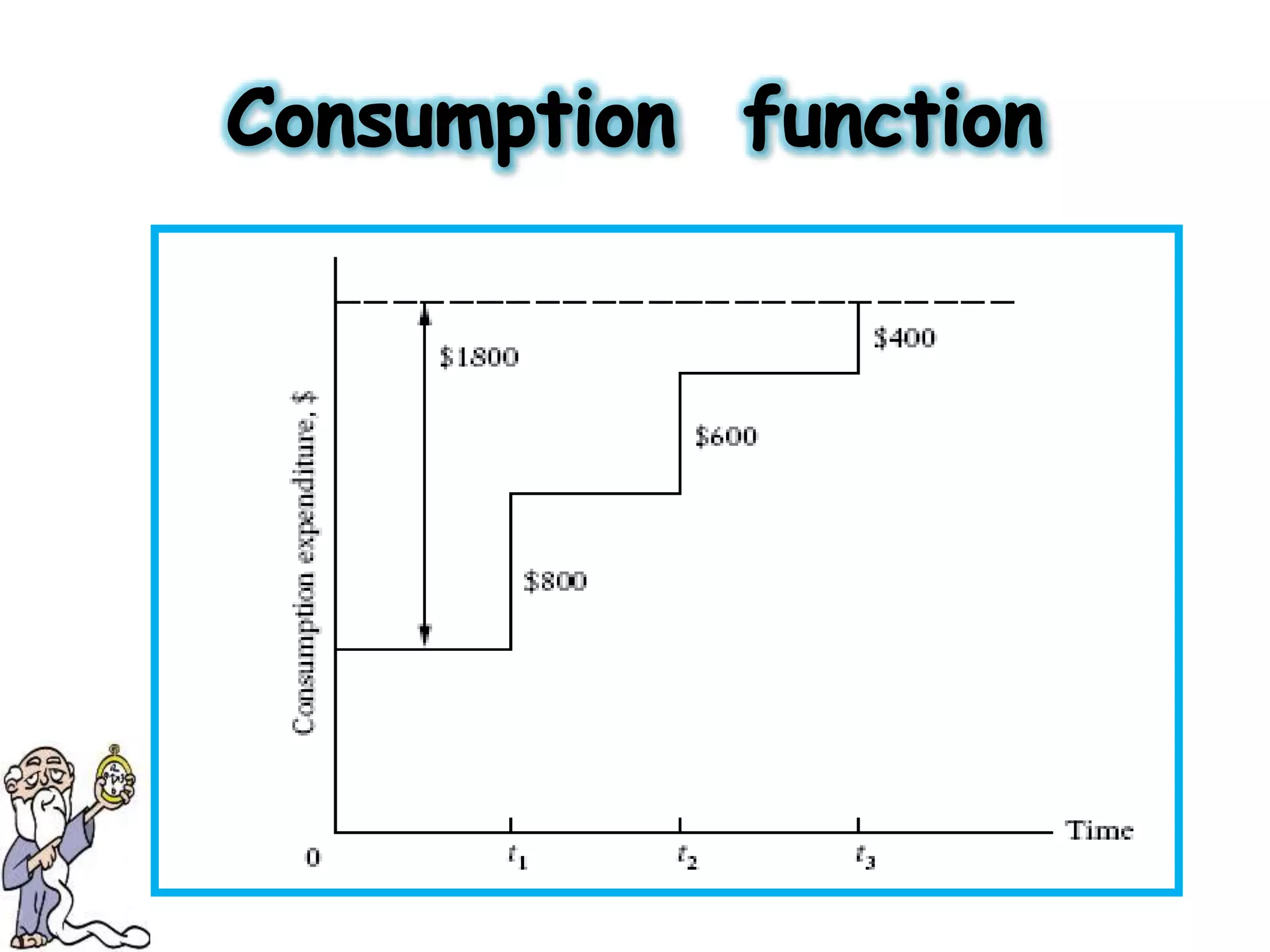
What are the role of lags in
Economics
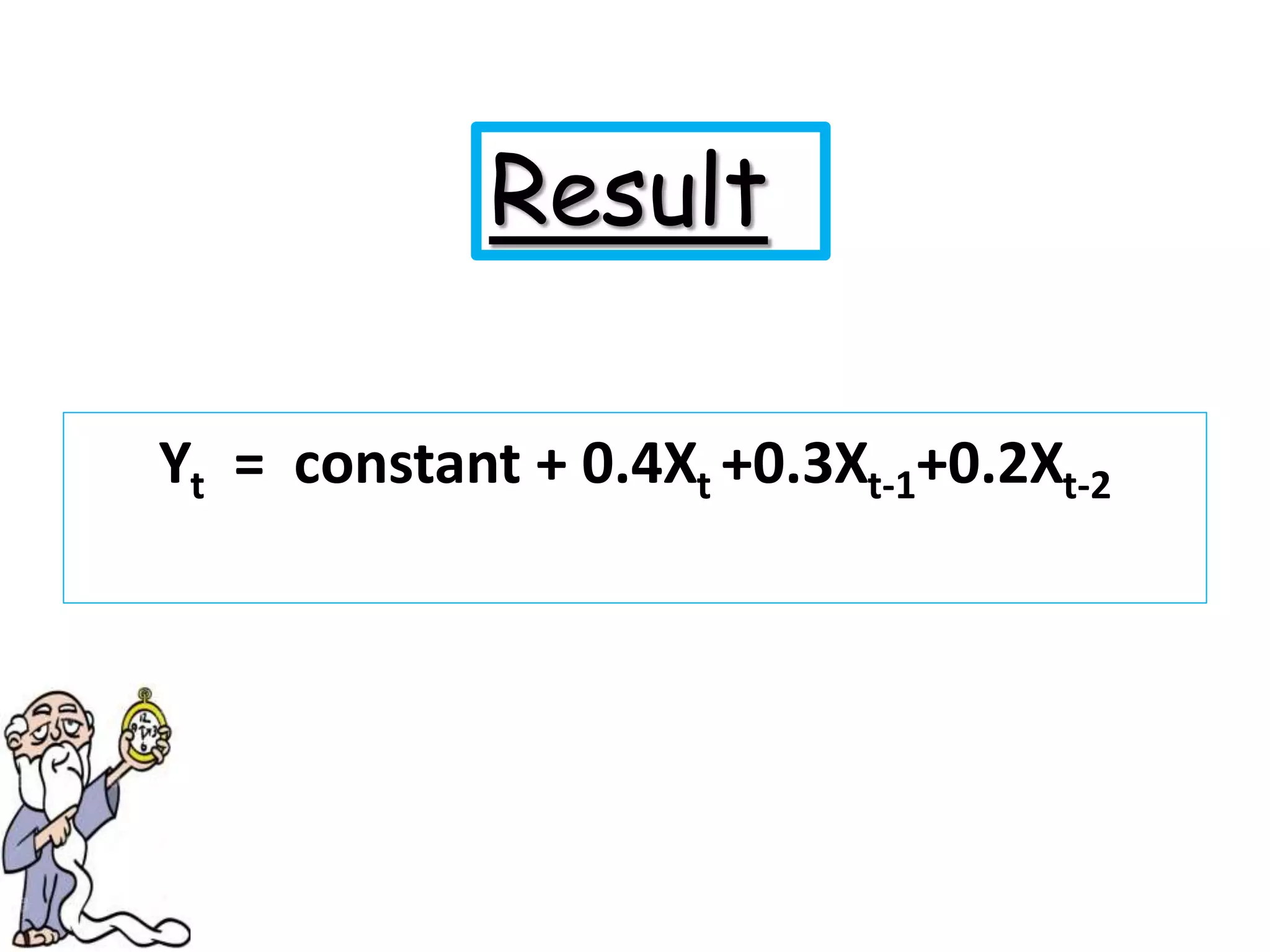
Yt = constant + 0.4Xt +0.3Xt-1+0.2Xt-2
Result
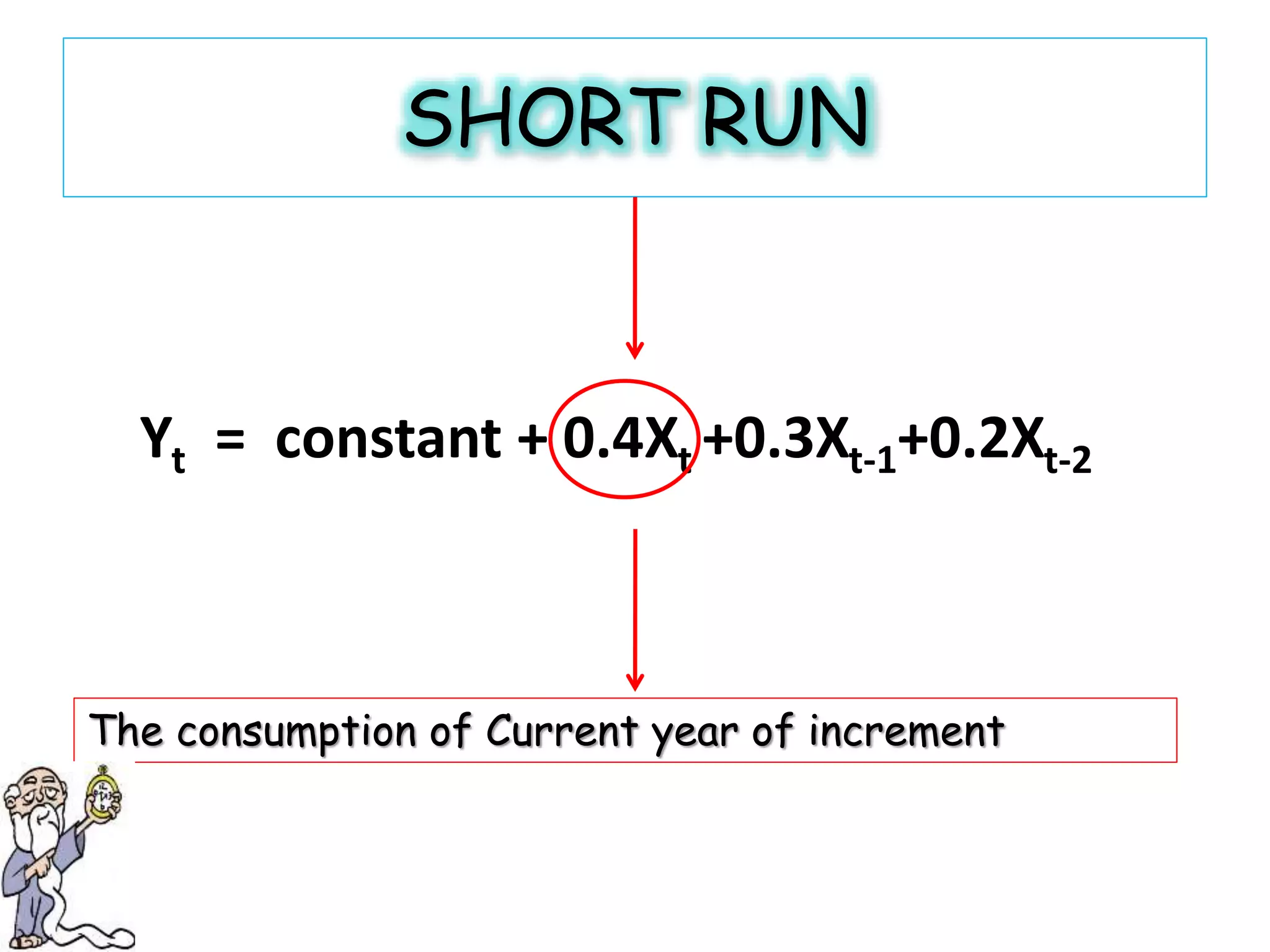
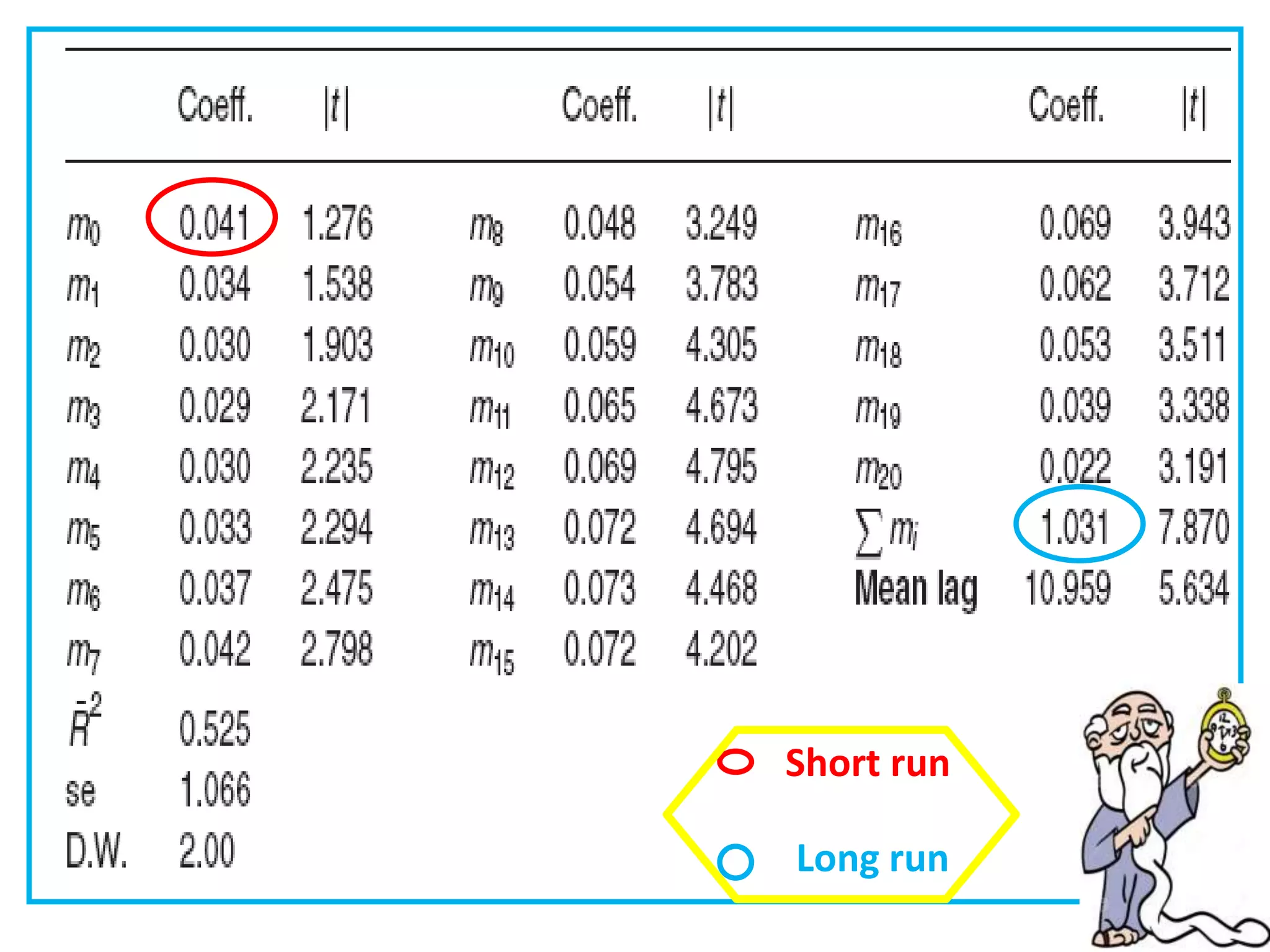
SHORT RUN
Yt = constant + 0.4Xt +0.3Xt-1+0.2Xt-2
The consumption of Current year of increment
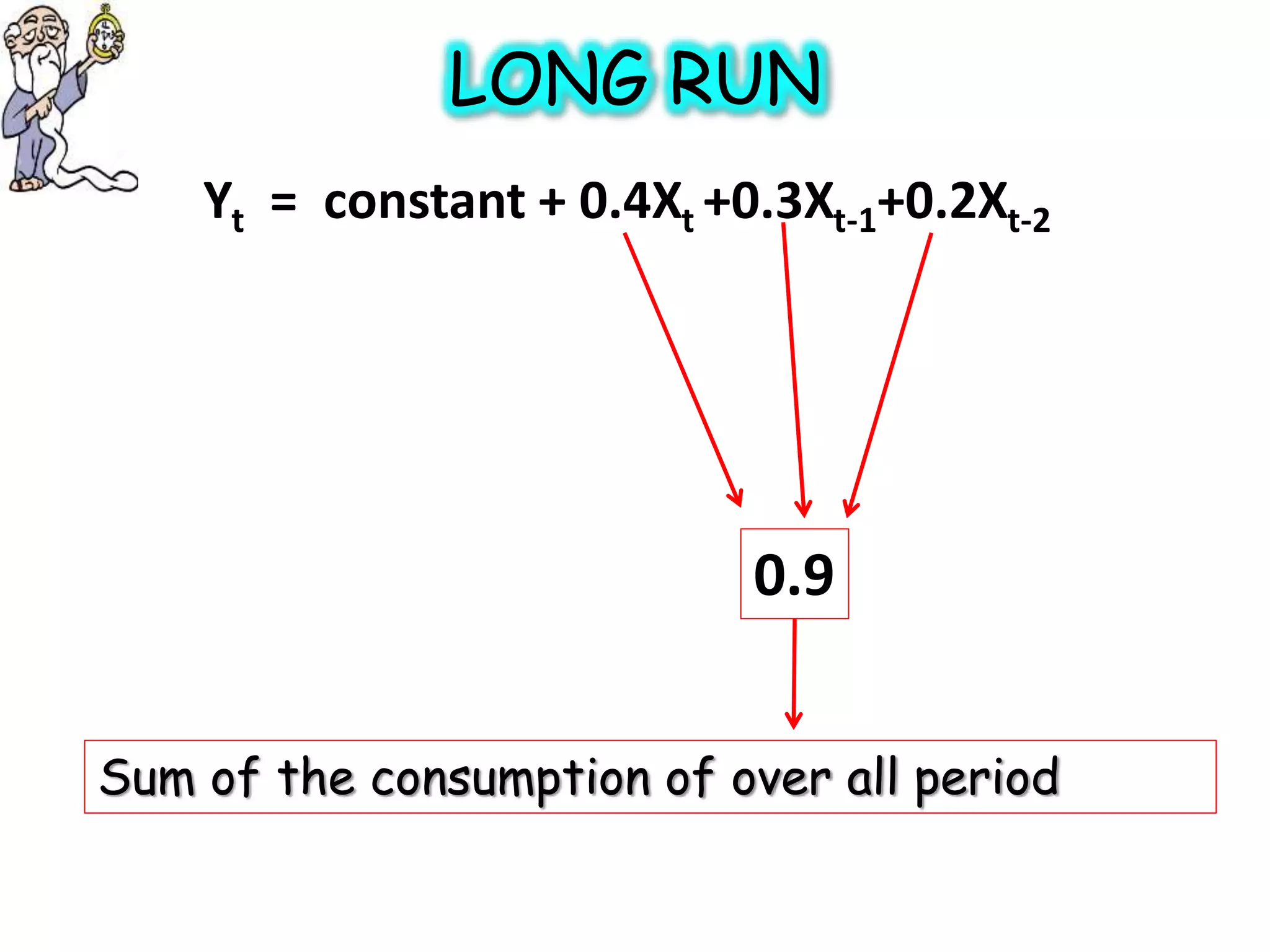
LONG RUN
Yt = constant + 0.4Xt +0.3Xt-1+0.2Xt-2
0.9
Sum of the consumption of over all period
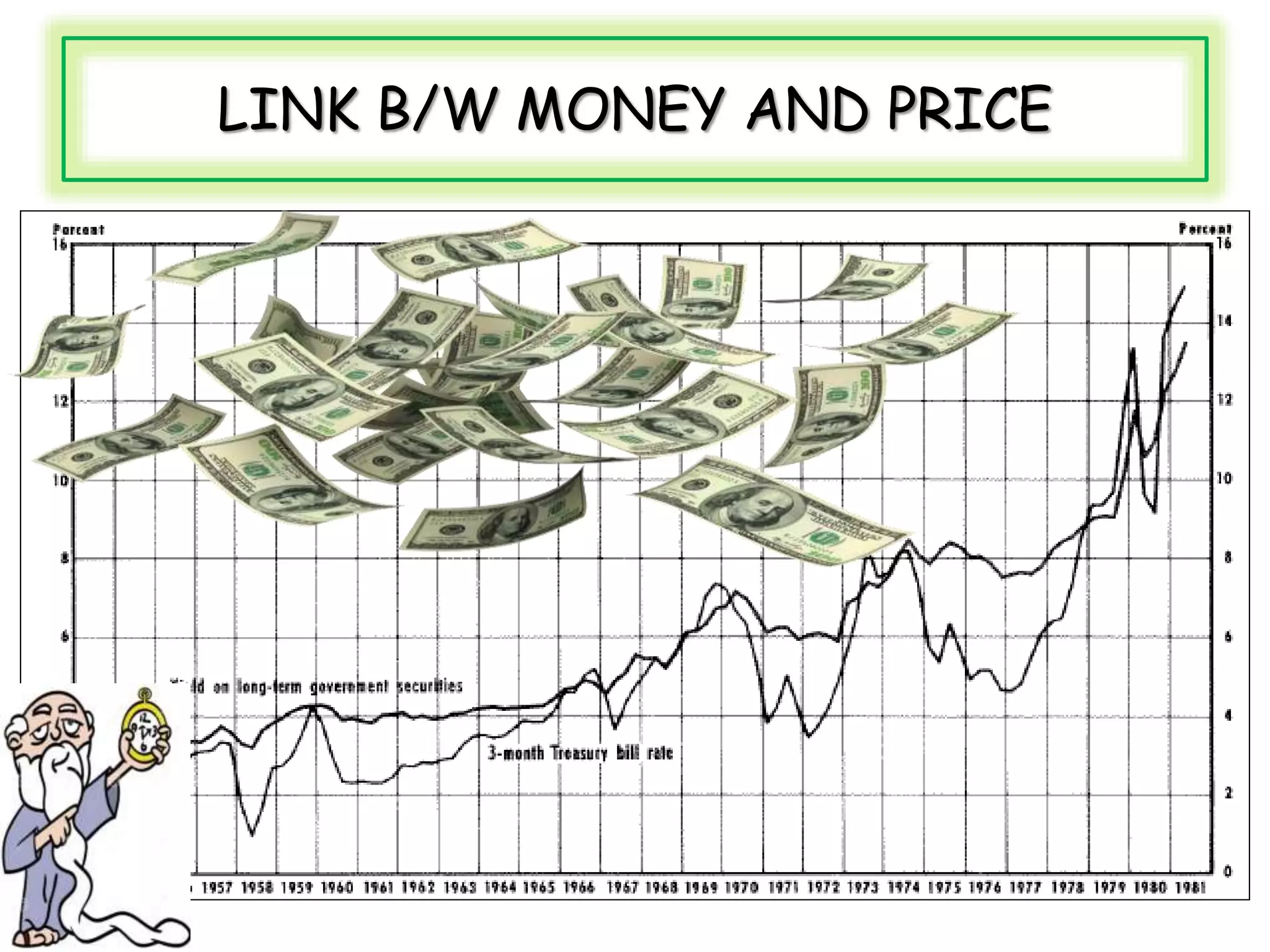
LINK B/W MONEY AND PRICE
Short run
Long run
Lag b/w R&D Expenditure And
Productivity
Economists have used two rather different styles of research
in their attempts
• To assess the contribution of research and development
(R&D) expenditures.
• For economic growth
Paul R. Krugman
(Princeton University)
By
Maurice Obstfeld
(University of California, Berkeley)
B Marc J. Melitz
(Harvard University)
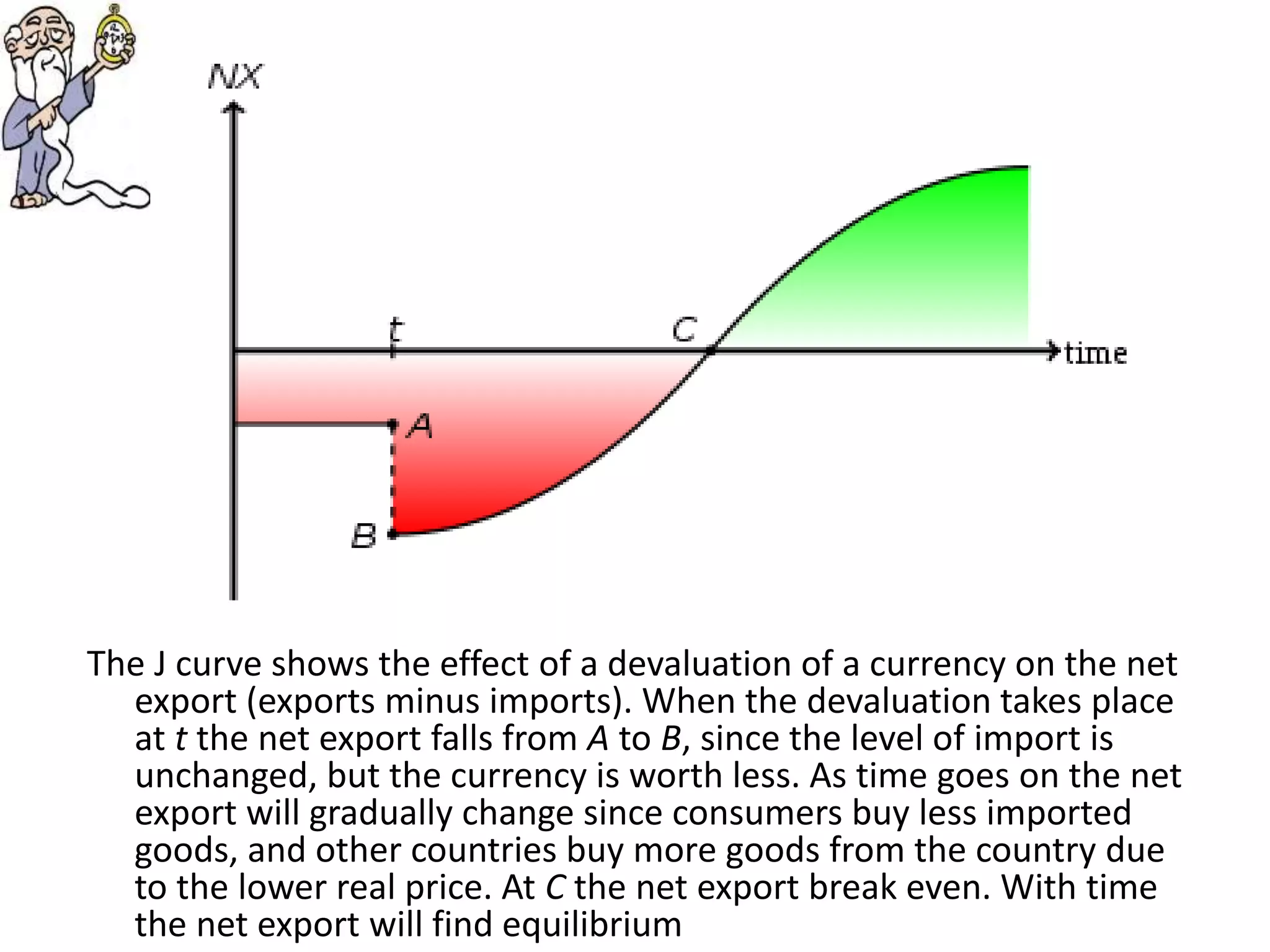
The J curve shows the effect of a devaluation of a currency on the net
export (exports minus imports). When the devaluation takes place
at t the net export falls from A to B, since the level of import is
unchanged, but the currency is worth less. As time goes on the net
export will gradually change since consumers buy less imported
goods, and other countries buy more goods from the country due
to the lower real price. At C the net export break even. With time
the net export will find equilibrium
Technological reasons
Old Computers
Alternate of computers: laptop
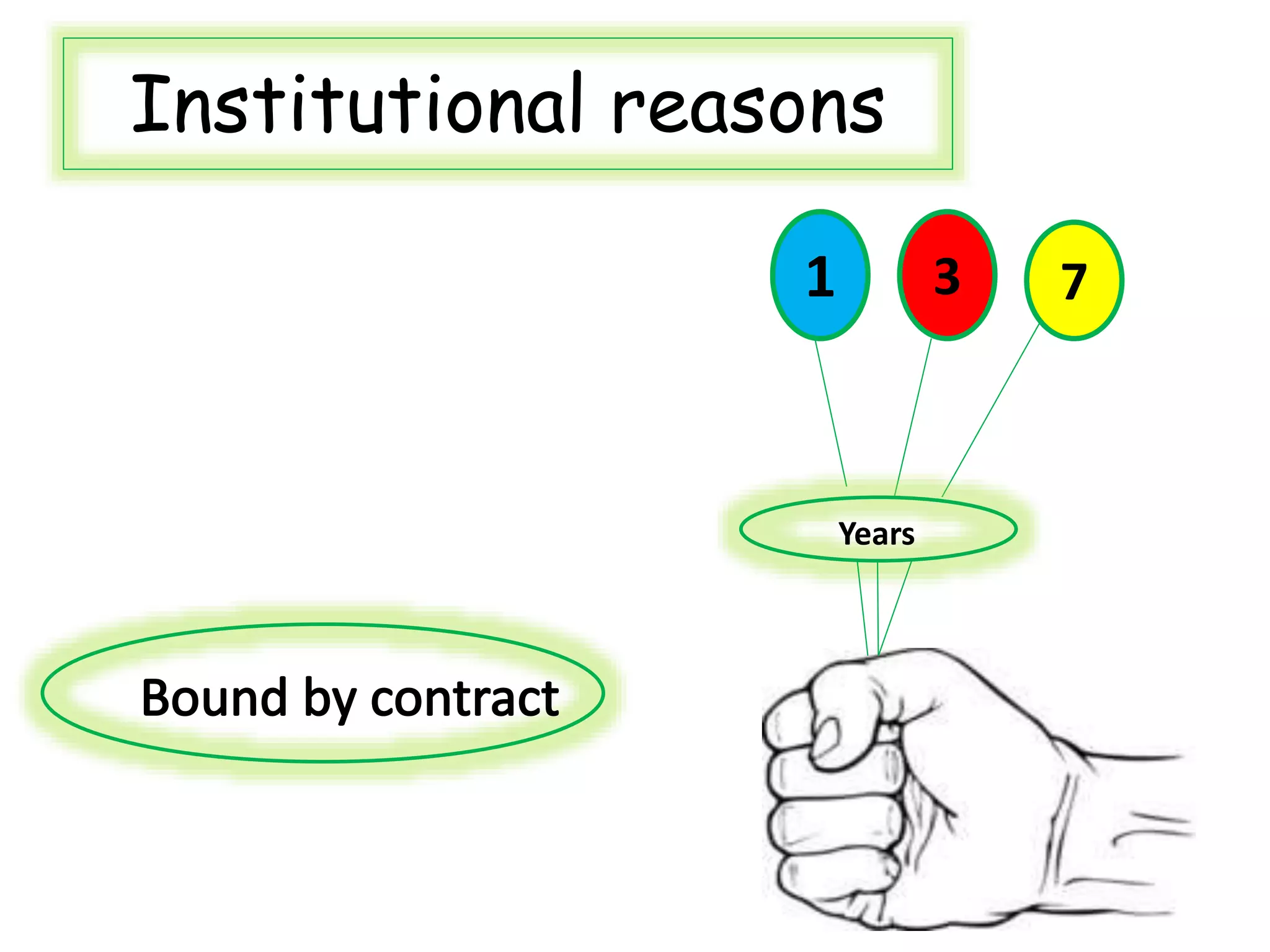
Institutional reasons
1 3 7
Years
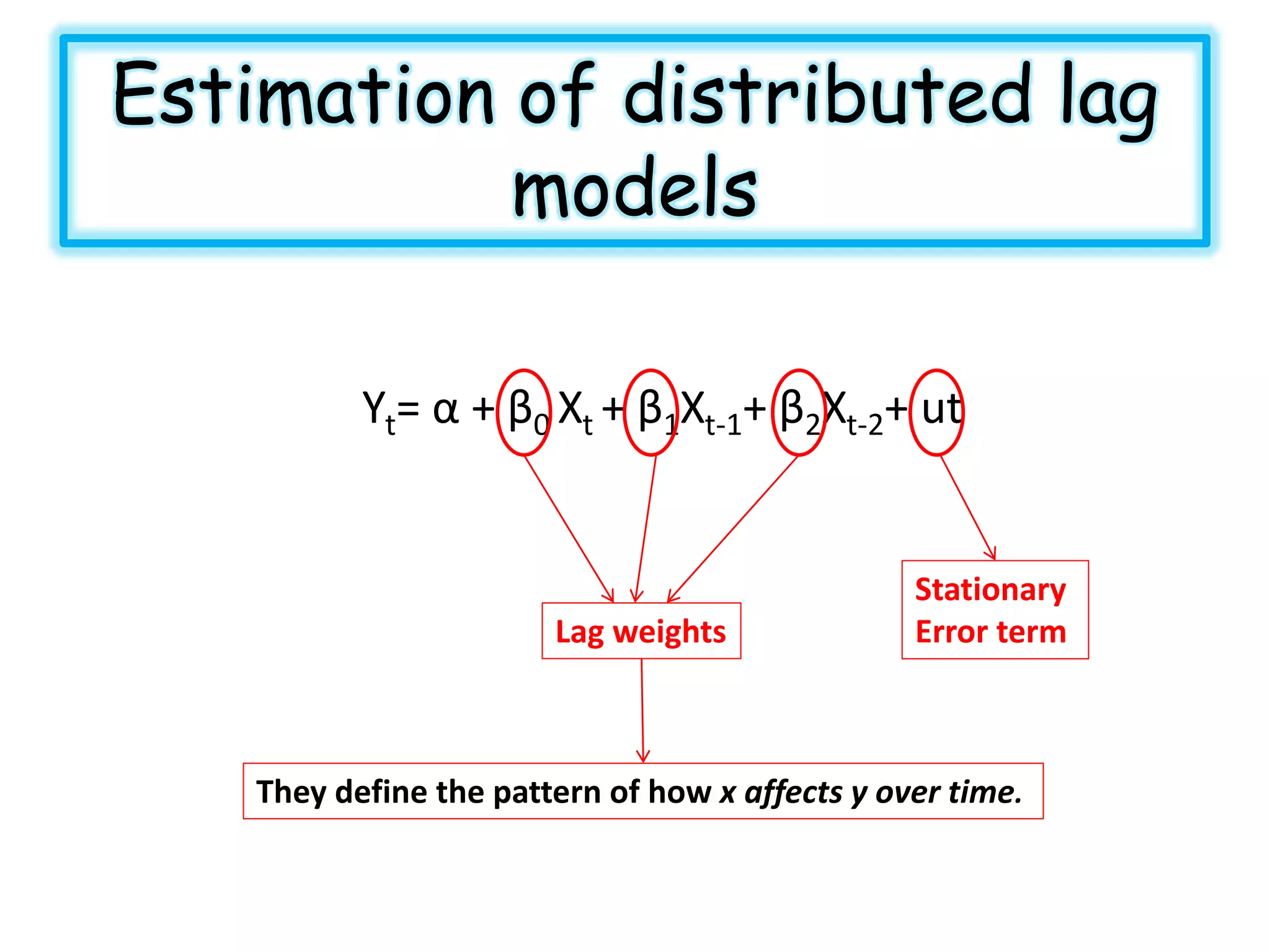
Estimation of distributed lag
models
Yt= α + β0 Xt + β1Xt-1+ β2Xt-2+ ut
Lag weights
They define the pattern of how x affects y over time.
Stationary
Error term
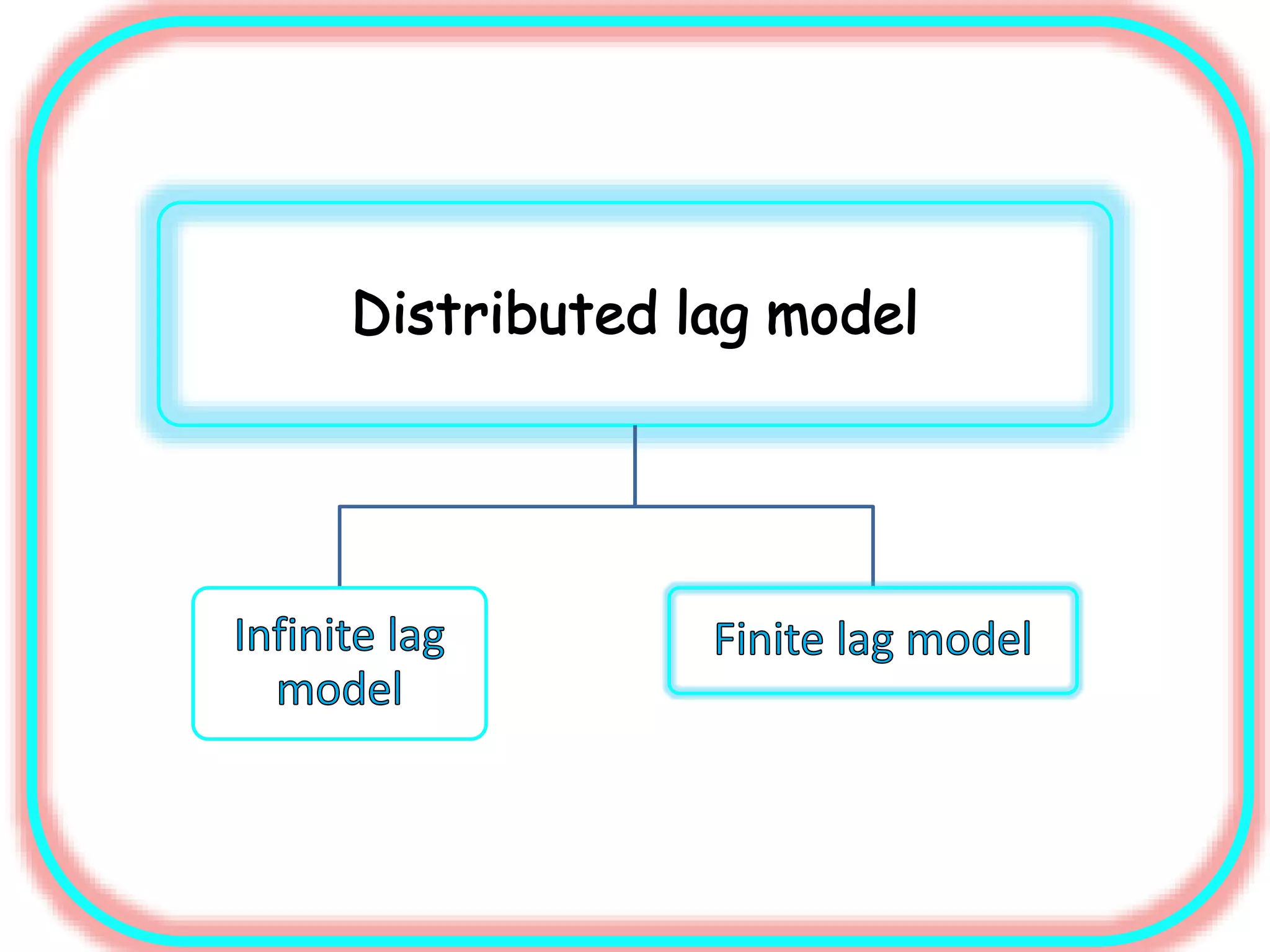
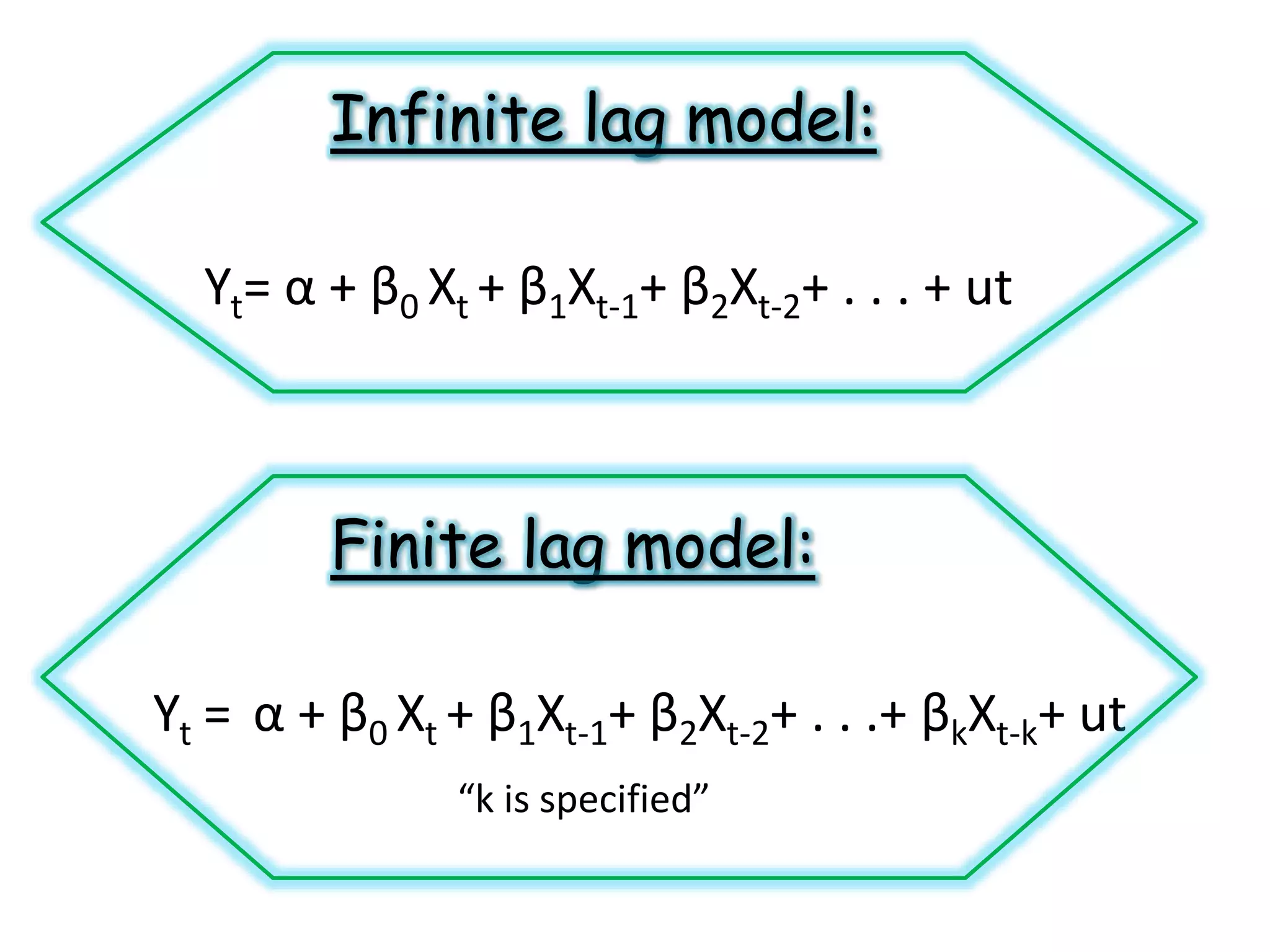
Infinite lag model:
Yt= α + β0 Xt + β1Xt-1+ β2Xt-2+ . . . + ut
Finite lag model:
Yt = α + β0 Xt + β1Xt-1+ β2Xt-2+ . . .+ βkXt-k+ ut
“k is specified”
*
*
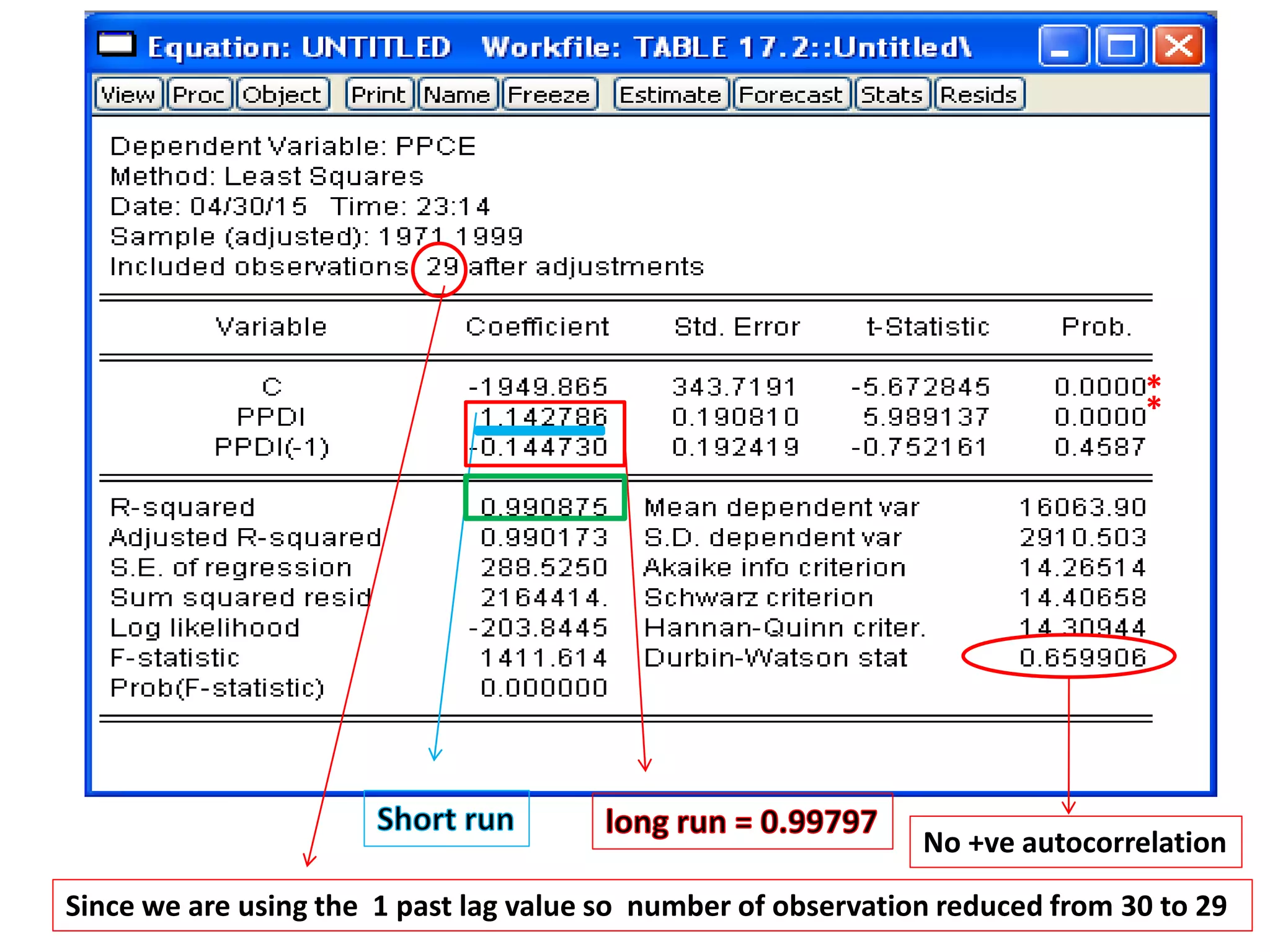
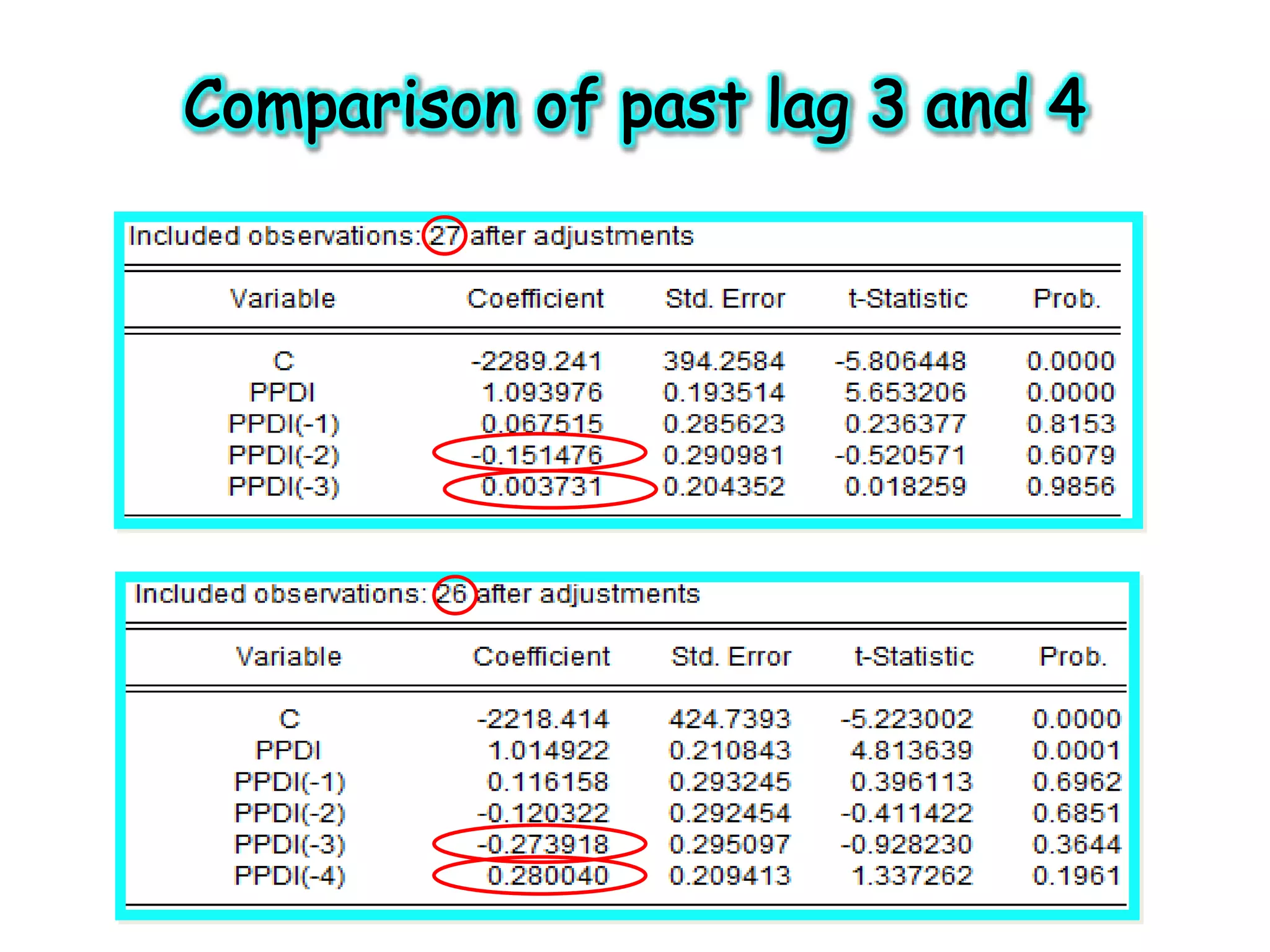
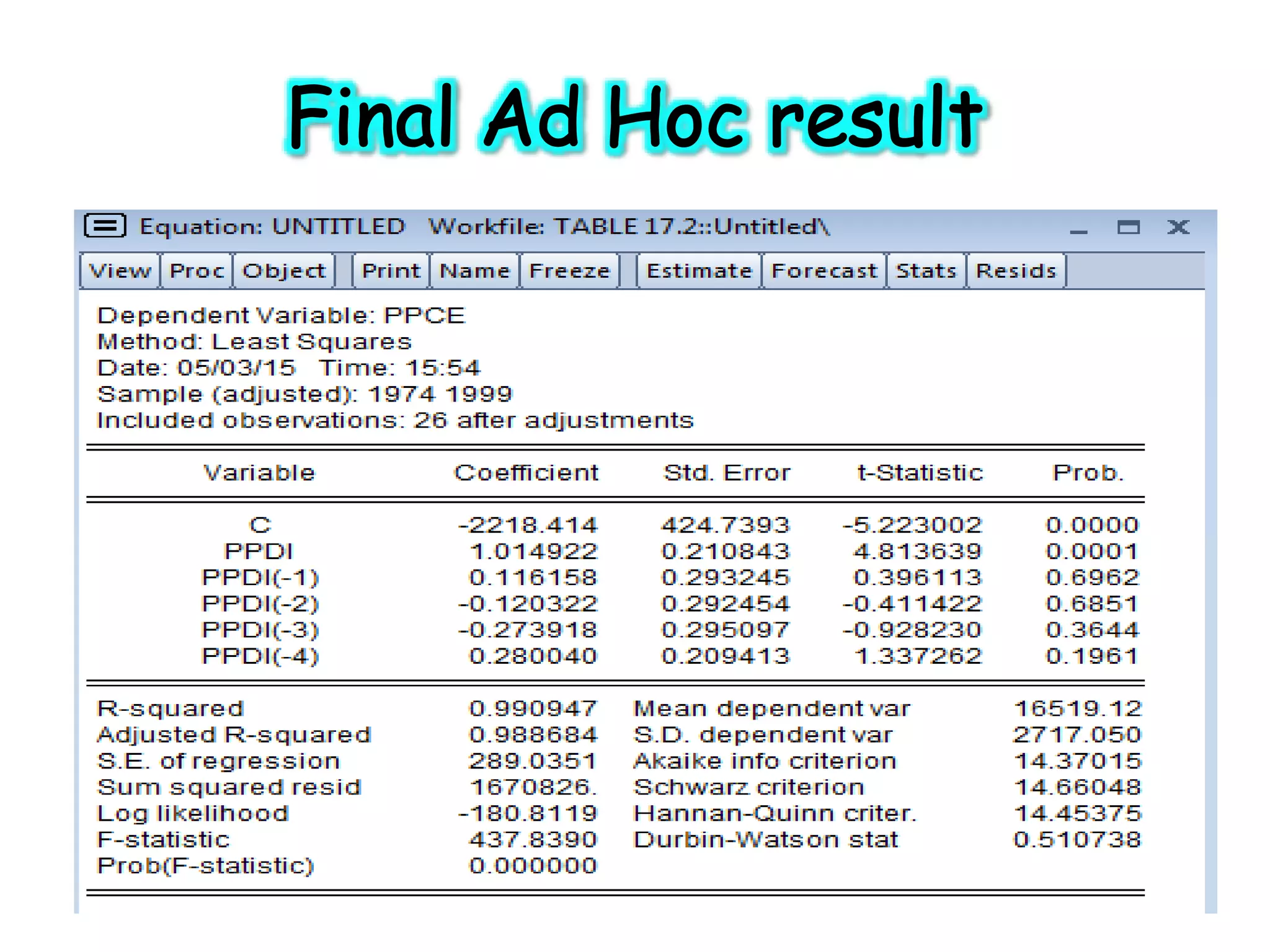
Since we are using the 1 past lag value so number of observation reduced from 30 to 29
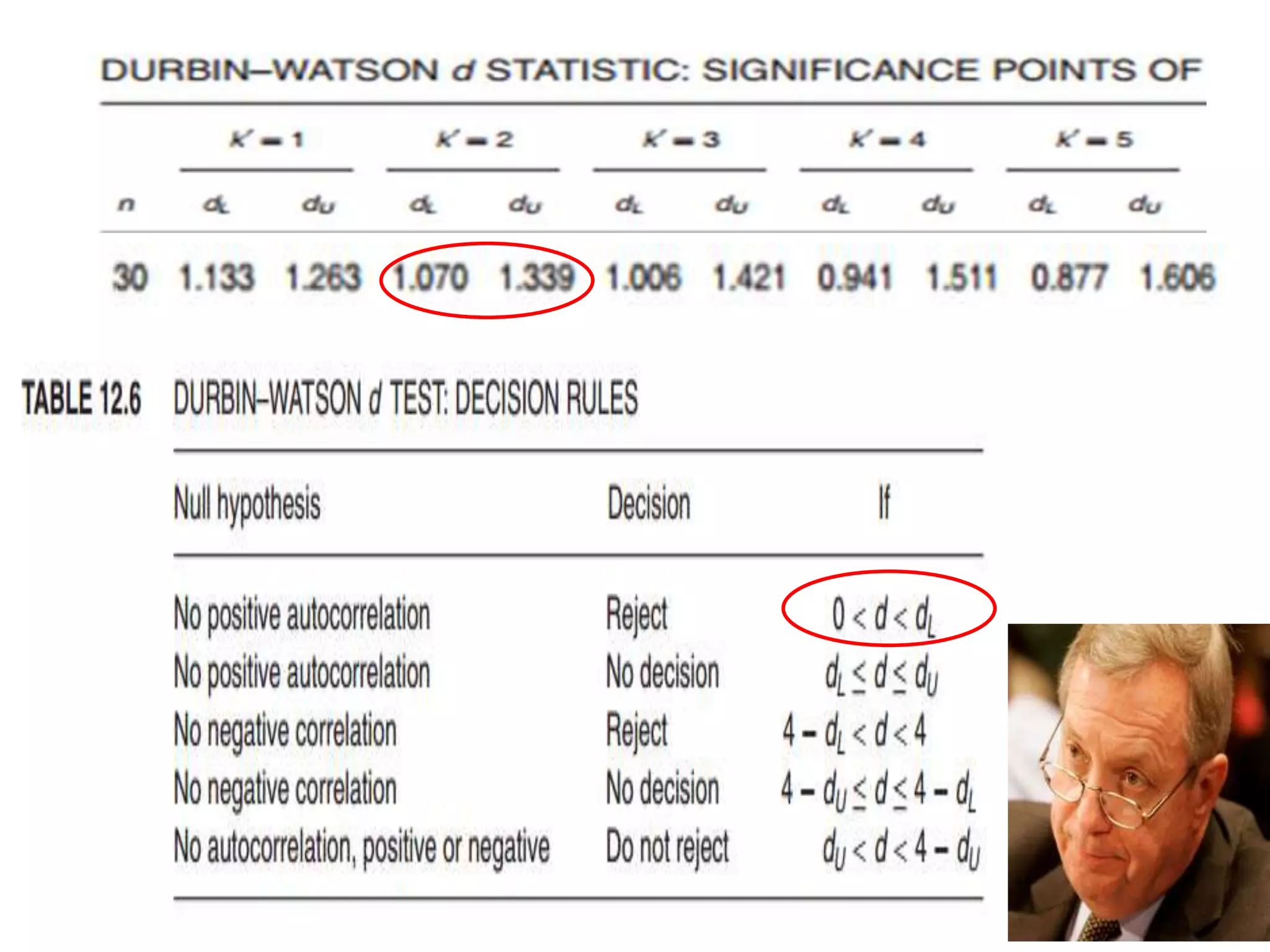
No +ve autocorrelation
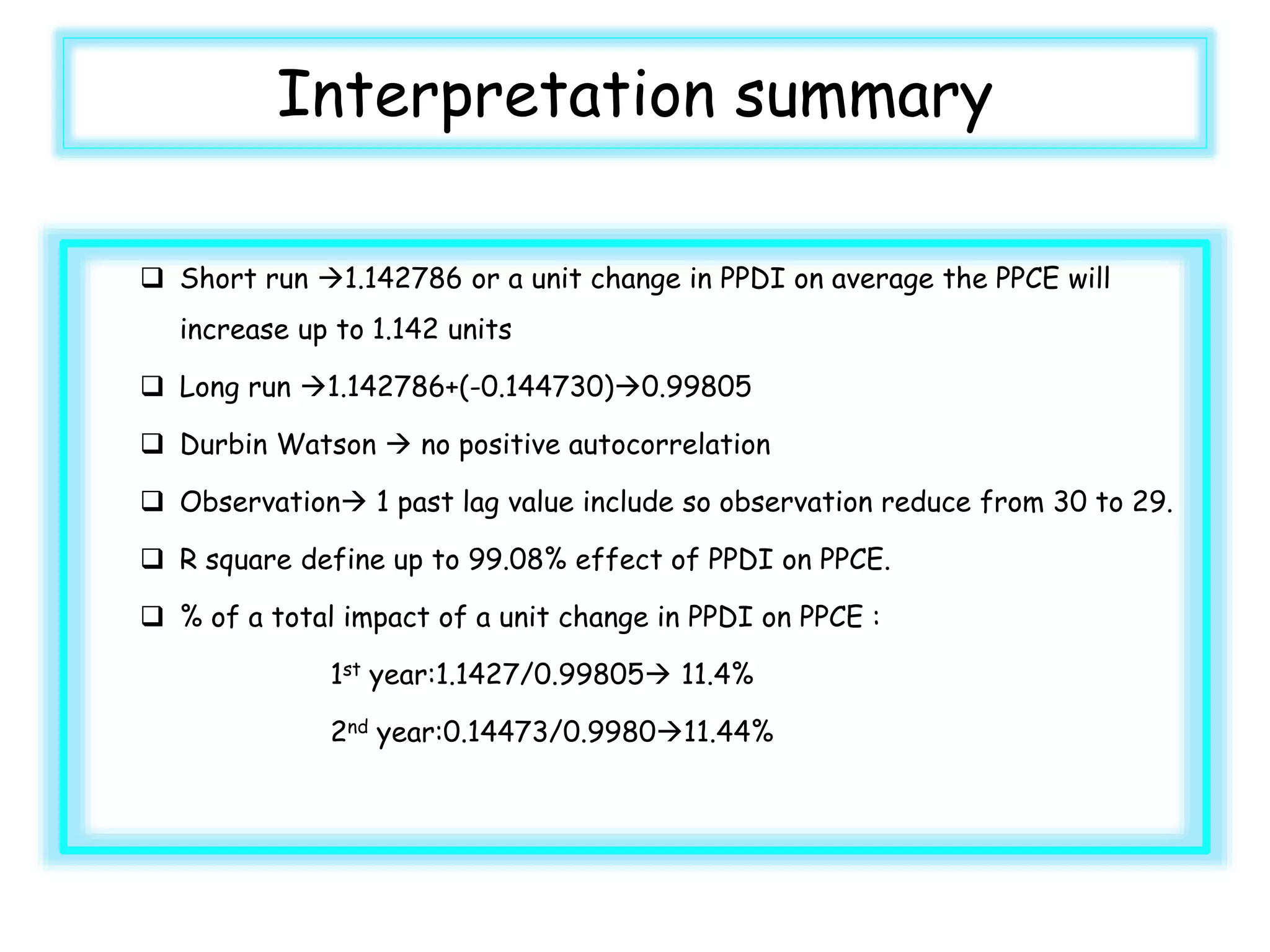
Interpretation summary
 Short run 1.142786 or a unit change in PPDI on average the PPCE will
increase up to 1.142 units
 Long run 1.142786+(-0.144730)0.99805
 Durbin Watson  no positive autocorrelation
 Observation 1 past lag value include so observation reduce from 30 to 29.
 R square define up to 99.08% effect of PPDI on PPCE.
 % of a total impact of a unit change in PPDI on PPCE :
1st year:1.1427/0.99805 11.4%
2nd year:0.14473/0.998011.44%
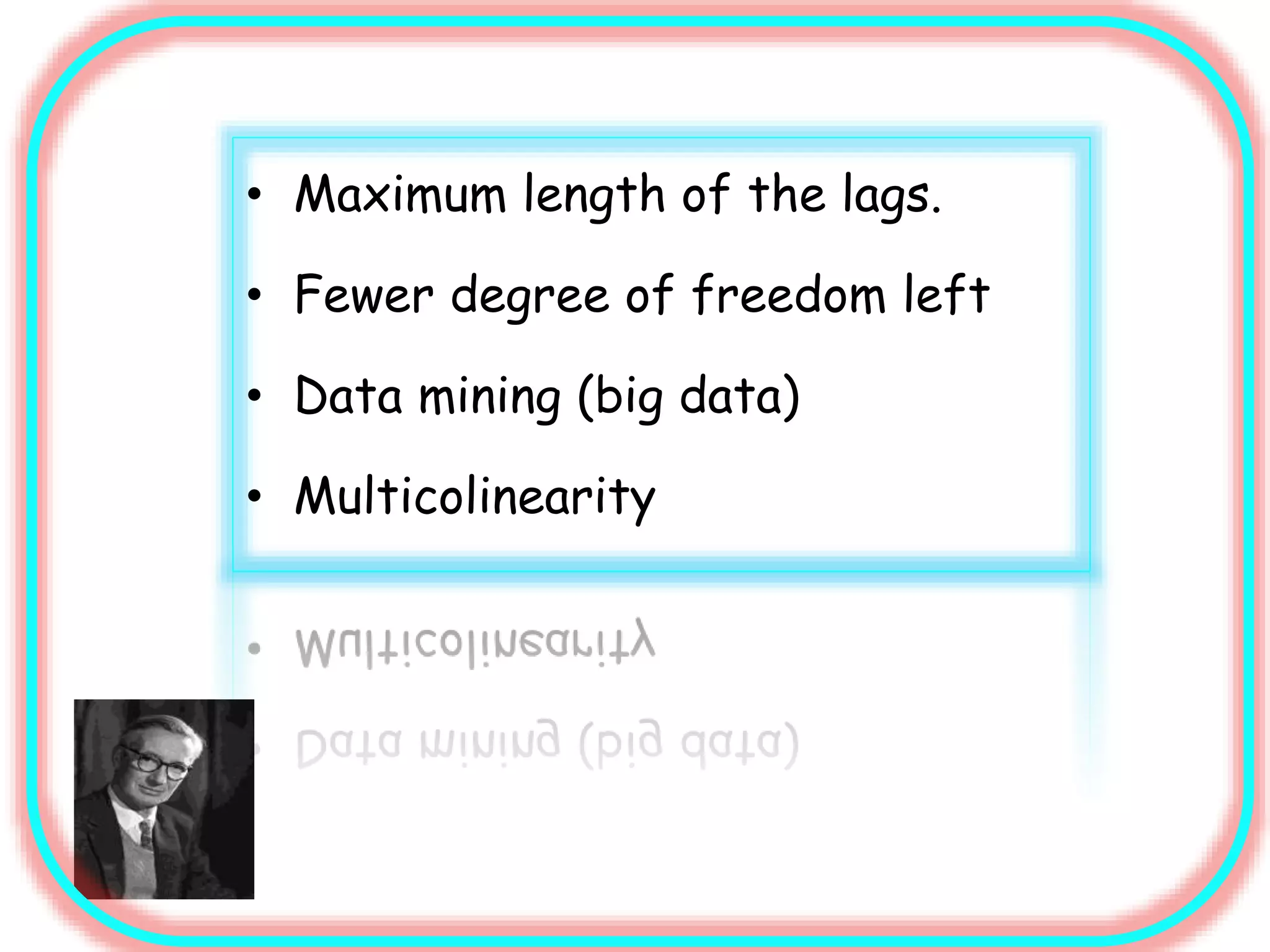
• Maximum length of the lags.
• Fewer degree of freedom left
• Data mining (big data)
• Multicolinearity
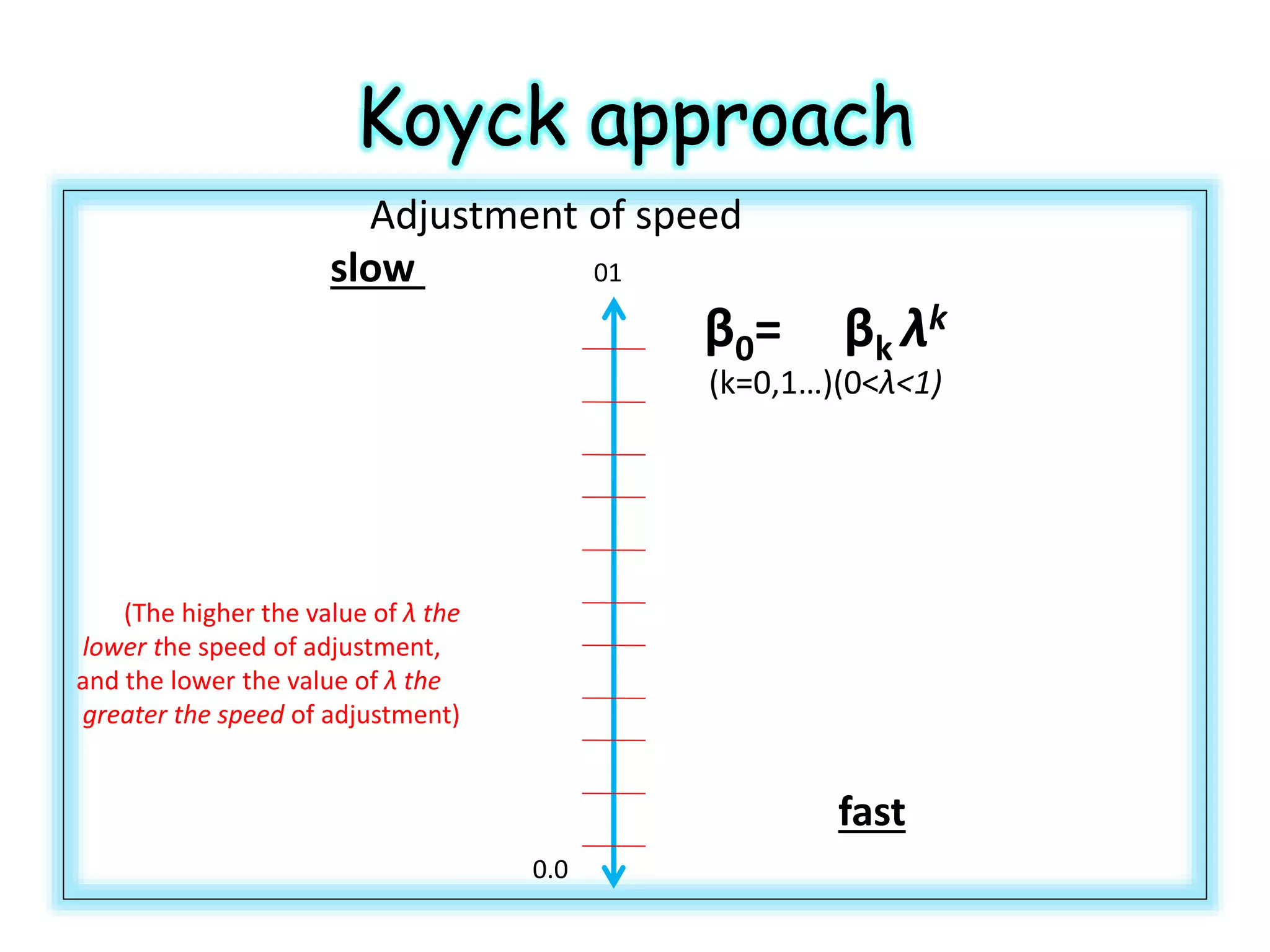
Koyck approach
Adjustment of speed
slow 01
β0= βk λk
(k=0,1…)(0<λ<1)
(The higher the value of λ the
lower the speed of adjustment,
and the lower the value of λ the
greater the speed of adjustment)
fast
0.0
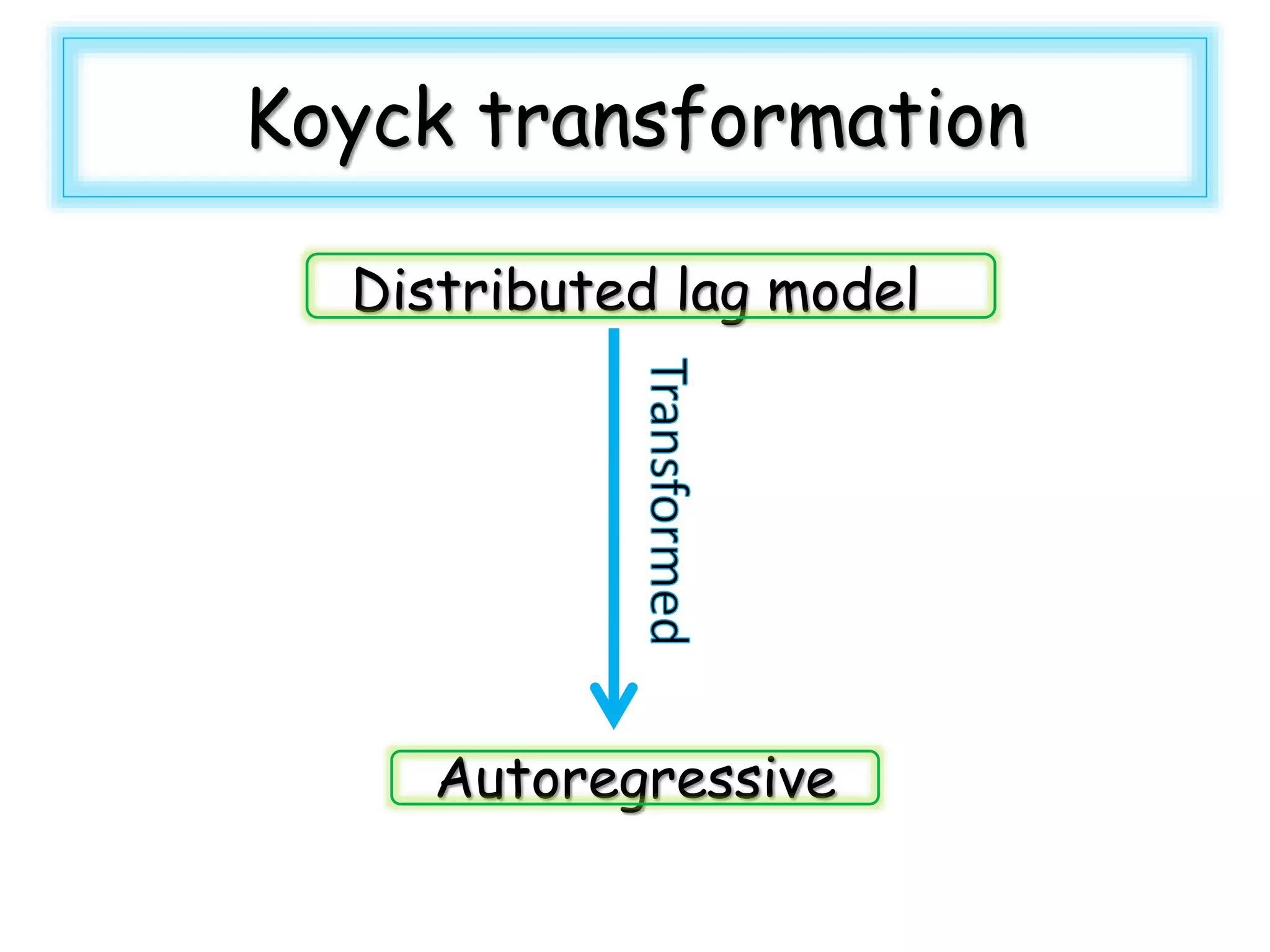
Koyck transformation
Distributed lag model
Autoregressive
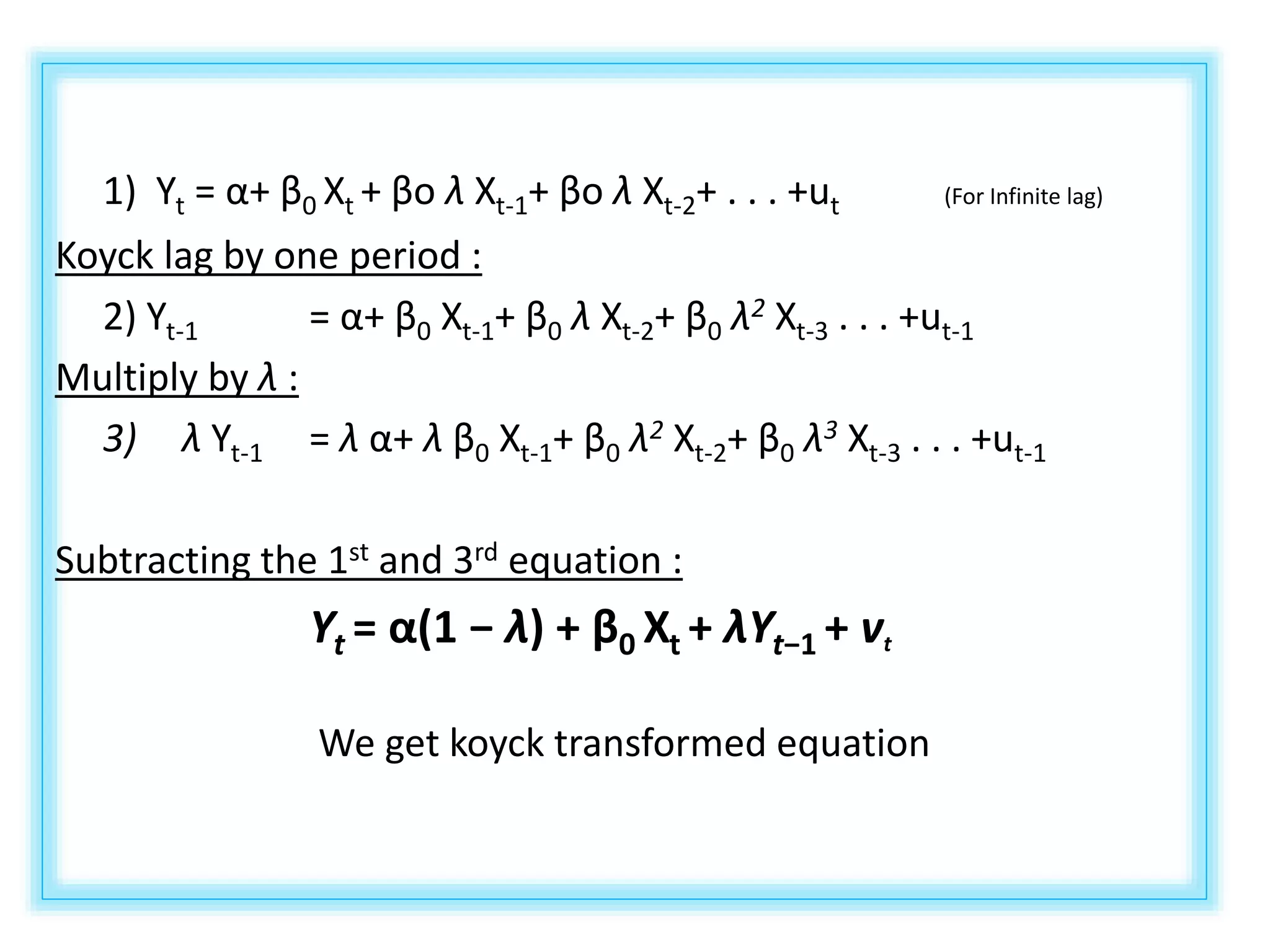
1) Yt = α+ β0 Xt + βo λ Xt-1+ βo λ Xt-2+ . . . +ut (For Infinite lag)
Koyck lag by one period :
2) Yt-1 = α+ β0 Xt-1+ β0 λ Xt-2+ β0 λ2 Xt-3 . . . +ut-1
Multiply by λ :
3) λ Yt-1 = λ α+ λ β0 Xt-1+ β0 λ2 Xt-2+ β0 λ3 Xt-3 . . . +ut-1
Subtracting the 1st and 3rd equation :
Yt = α(1 − λ) + β0 Xt + λYt−1 + vt
We get koyck transformed equation
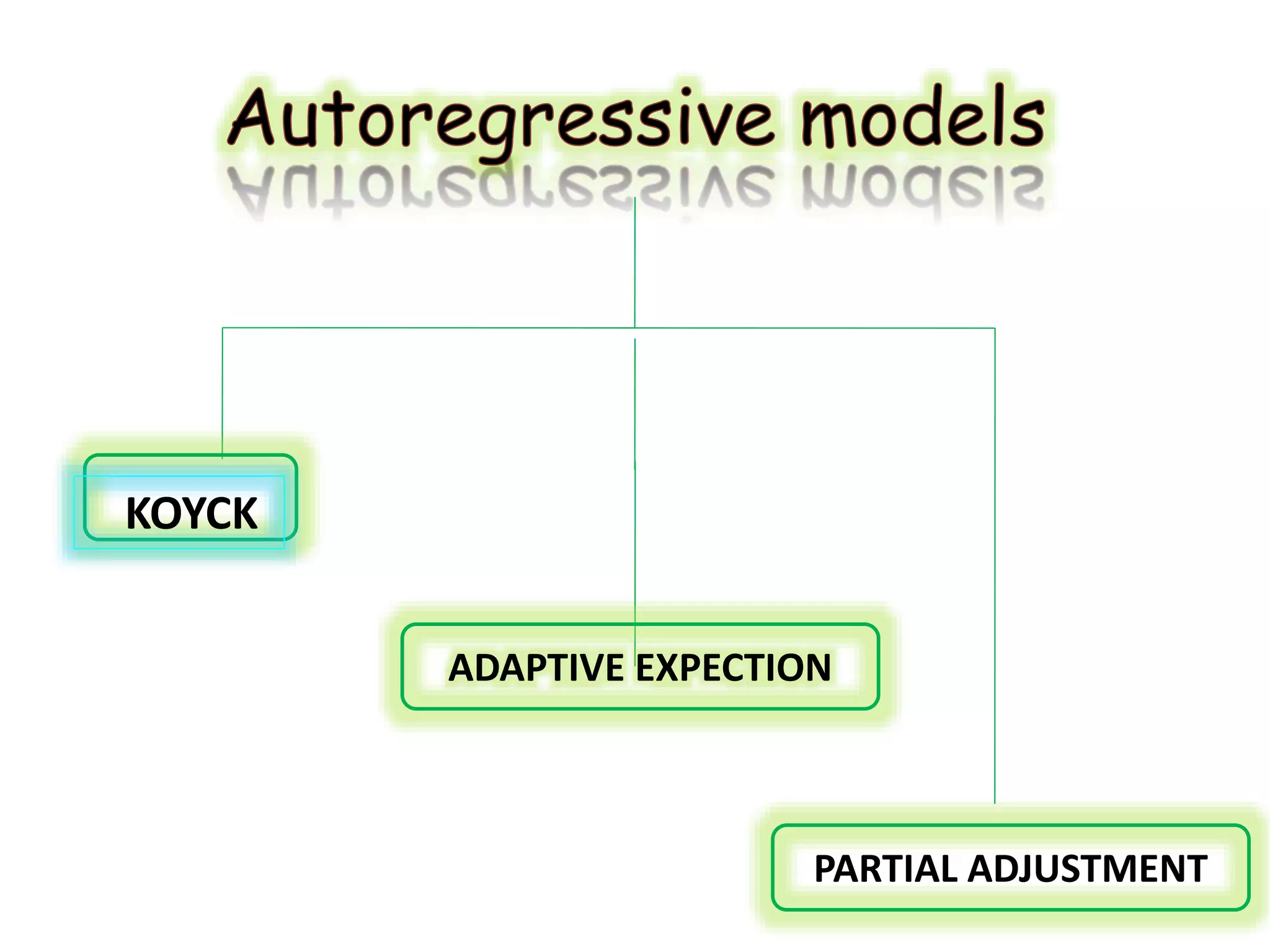
ADAPTIVE EXPECTION
PARTIAL ADJUSTMENT
KOYCK
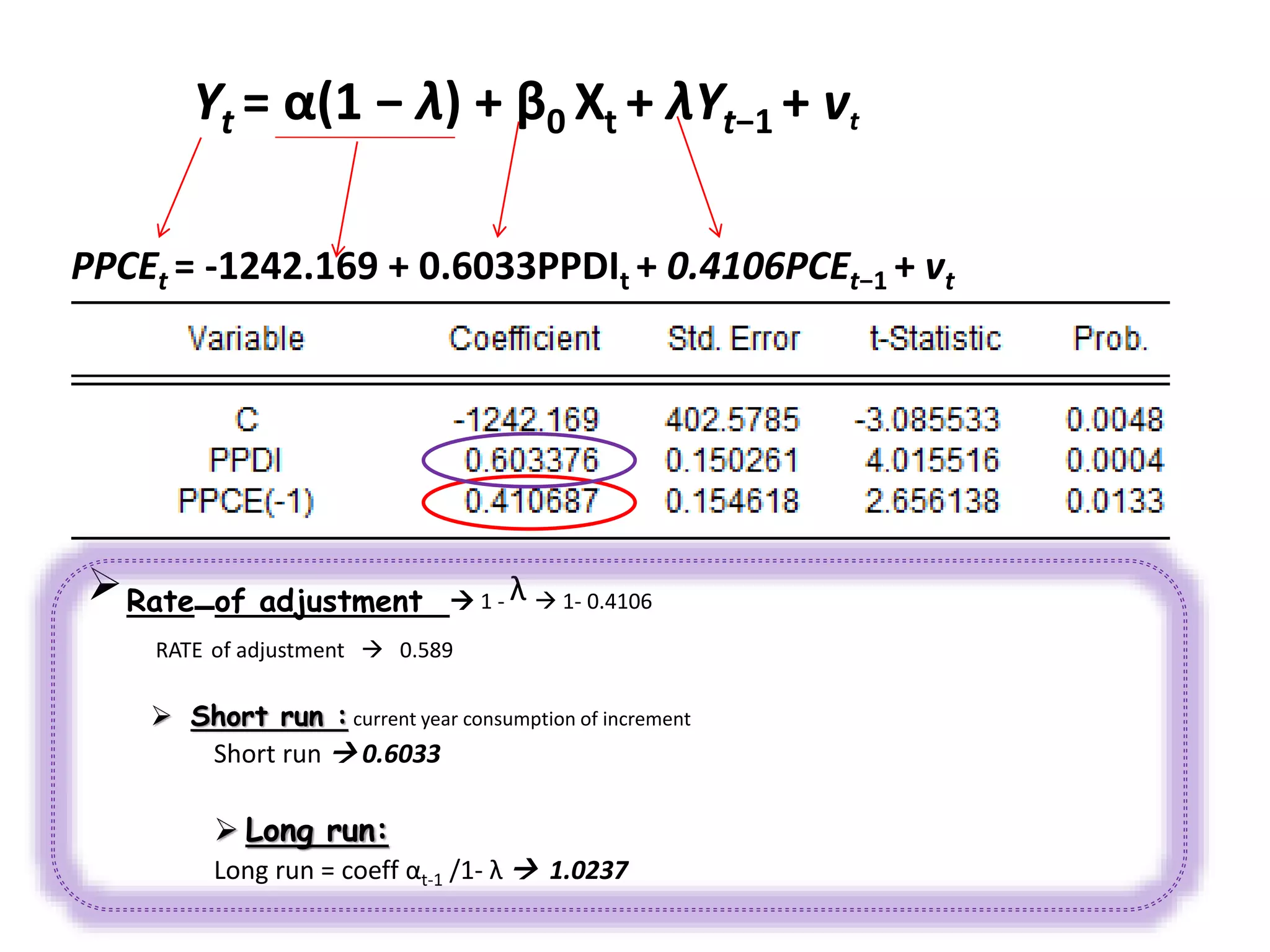
Yt = α(1 − λ) + β0 Xt + λYt−1 + vt
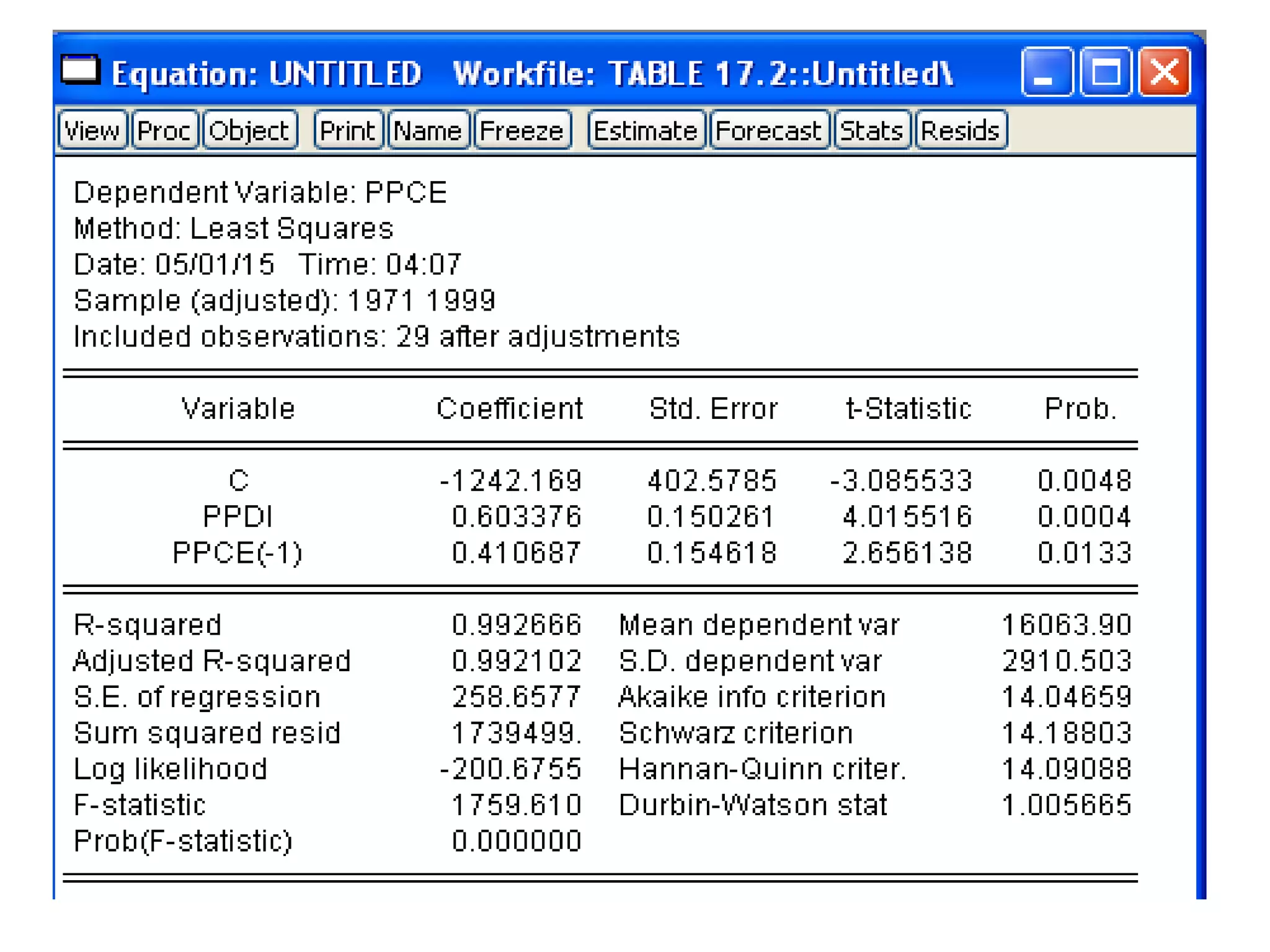
PPCEt = -1242.169 + 0.6033PPDIt + 0.4106PCEt−1 + vt
Rate of adjustment  1 - λ  1- 0.4106
RATE of adjustment  0.589
 Short run : current year consumption of increment
Short run  0.6033
 Long run:
Long run = coeff αt-1 /1- λ  1.0237
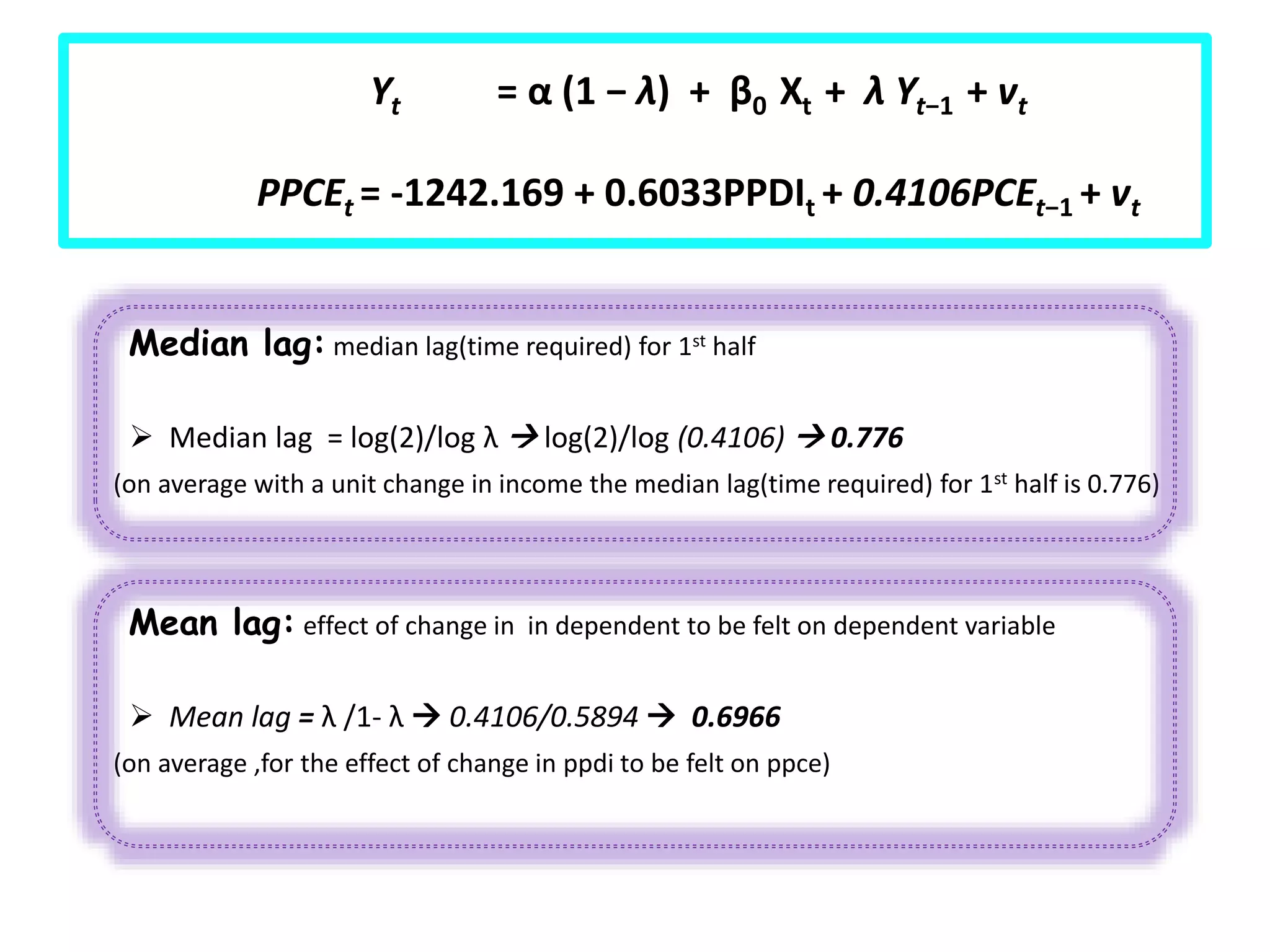
Yt = α (1 − λ) + β0 Xt + λ Yt−1 + vt
PPCEt = -1242.169 + 0.6033PPDIt + 0.4106PCEt−1 + vt
Median lag: median lag(time required) for 1st half
 Median lag = log(2)/log λ  log(2)/log (0.4106)  0.776
(on average with a unit change in income the median lag(time required) for 1st half is 0.776)
Mean lag: effect of change in in dependent to be felt on dependent variable
 Mean lag = λ /1- λ  0.4106/0.5894  0.6966
(on average ,for the effect of change in ppdi to be felt on ppce)
 Durbin h test  (1-d/2)[n/1-n{var(αt-1 )} ]1/2
Durbin h test  (0.4972) [(30/1-30(0.239) ]1/2
Durbin h test  5.1191
( Durbin h ~ Norm distribution , As h value exceed ±3 , so the probability is highly significant
Decision:
There is a positive autocorrelation ,
Yt = α (1 − λ) + β0 Xt + λ Yt−1 + vt
PPCEt = -1242.169 + 0.6033PPDIt + 0.4106PCEt−1 + vt
DYNAMIC ECONOMETRIC MODELS BY Ammara Aftab

DYNAMIC ECONOMETRIC MODELS BY Ammara Aftab

  • 2.
  • 6.
    A Model includesnot only the current but also the lagged (past) values of the explanatory variables Past lag valuesCurrent lag value Yt= α + β0 Xt + β1Xt-1 + β2Xt-2+ ut
  • 7.
    The model whichincludes one or more lagged values of the dependent variable among its explanatory variables Lagged value ofDependent variable Yt = α + βXt + λ Yt-1 + u
  • 8.
    What are therole of lags in Economics
  • 11.
    Yt = constant+ 0.4Xt +0.3Xt-1+0.2Xt-2 Result
  • 12.
    SHORT RUN Yt =constant + 0.4Xt +0.3Xt-1+0.2Xt-2 The consumption of Current year of increment
  • 13.
    LONG RUN Yt =constant + 0.4Xt +0.3Xt-1+0.2Xt-2 0.9 Sum of the consumption of over all period
  • 14.
    LINK B/W MONEYAND PRICE
  • 15.
  • 16.
    Lag b/w R&DExpenditure And Productivity
  • 17.
    Economists have usedtwo rather different styles of research in their attempts • To assess the contribution of research and development (R&D) expenditures. • For economic growth
  • 18.
    Paul R. Krugman (PrincetonUniversity) By Maurice Obstfeld (University of California, Berkeley) B Marc J. Melitz (Harvard University)
  • 19.
    The J curveshows the effect of a devaluation of a currency on the net export (exports minus imports). When the devaluation takes place at t the net export falls from A to B, since the level of import is unchanged, but the currency is worth less. As time goes on the net export will gradually change since consumers buy less imported goods, and other countries buy more goods from the country due to the lower real price. At C the net export break even. With time the net export will find equilibrium
  • 23.
  • 24.
  • 25.
  • 26.
  • 27.
    Estimation of distributedlag models Yt= α + β0 Xt + β1Xt-1+ β2Xt-2+ ut Lag weights They define the pattern of how x affects y over time. Stationary Error term
  • 29.
    Infinite lag model: Yt=α + β0 Xt + β1Xt-1+ β2Xt-2+ . . . + ut Finite lag model: Yt = α + β0 Xt + β1Xt-1+ β2Xt-2+ . . .+ βkXt-k+ ut “k is specified”
  • 31.
    * * Since we areusing the 1 past lag value so number of observation reduced from 30 to 29 No +ve autocorrelation
  • 33.
    Interpretation summary  Shortrun 1.142786 or a unit change in PPDI on average the PPCE will increase up to 1.142 units  Long run 1.142786+(-0.144730)0.99805  Durbin Watson  no positive autocorrelation  Observation 1 past lag value include so observation reduce from 30 to 29.  R square define up to 99.08% effect of PPDI on PPCE.  % of a total impact of a unit change in PPDI on PPCE : 1st year:1.1427/0.99805 11.4% 2nd year:0.14473/0.998011.44%
  • 39.
    • Maximum lengthof the lags. • Fewer degree of freedom left • Data mining (big data) • Multicolinearity
  • 40.
    Koyck approach Adjustment ofspeed slow 01 β0= βk λk (k=0,1…)(0<λ<1) (The higher the value of λ the lower the speed of adjustment, and the lower the value of λ the greater the speed of adjustment) fast 0.0
  • 41.
  • 42.
    1) Yt =α+ β0 Xt + βo λ Xt-1+ βo λ Xt-2+ . . . +ut (For Infinite lag) Koyck lag by one period : 2) Yt-1 = α+ β0 Xt-1+ β0 λ Xt-2+ β0 λ2 Xt-3 . . . +ut-1 Multiply by λ : 3) λ Yt-1 = λ α+ λ β0 Xt-1+ β0 λ2 Xt-2+ β0 λ3 Xt-3 . . . +ut-1 Subtracting the 1st and 3rd equation : Yt = α(1 − λ) + β0 Xt + λYt−1 + vt We get koyck transformed equation
  • 44.
  • 47.
    Yt = α(1− λ) + β0 Xt + λYt−1 + vt PPCEt = -1242.169 + 0.6033PPDIt + 0.4106PCEt−1 + vt Rate of adjustment  1 - λ  1- 0.4106 RATE of adjustment  0.589  Short run : current year consumption of increment Short run  0.6033  Long run: Long run = coeff αt-1 /1- λ  1.0237
  • 48.
    Yt = α(1 − λ) + β0 Xt + λ Yt−1 + vt PPCEt = -1242.169 + 0.6033PPDIt + 0.4106PCEt−1 + vt Median lag: median lag(time required) for 1st half  Median lag = log(2)/log λ  log(2)/log (0.4106)  0.776 (on average with a unit change in income the median lag(time required) for 1st half is 0.776) Mean lag: effect of change in in dependent to be felt on dependent variable  Mean lag = λ /1- λ  0.4106/0.5894  0.6966 (on average ,for the effect of change in ppdi to be felt on ppce)
  • 49.
     Durbin htest  (1-d/2)[n/1-n{var(αt-1 )} ]1/2 Durbin h test  (0.4972) [(30/1-30(0.239) ]1/2 Durbin h test  5.1191 ( Durbin h ~ Norm distribution , As h value exceed ±3 , so the probability is highly significant Decision: There is a positive autocorrelation , Yt = α (1 − λ) + β0 Xt + λ Yt−1 + vt PPCEt = -1242.169 + 0.6033PPDIt + 0.4106PCEt−1 + vt