Dummy Variable
Regression Models
What is Dummy Variable?
• Variables that are essentially qualitative in
nature (or) variables that are not readily
quantifiable
• Examples: gender, marital status, race,
colour, religion, nationality, geographical
location, political/policy changes, party
affiliation
Other Names for Dummy Variable
Indicator variables
Binary variables
Categorical variables
Dichotomous variables
Qualitative variables
Why Dummy Variable Regression?
• To include qualitative variables as an
explanatory variable in the regression
model
• Example: If we want to see whether gender
discrimination has any influence on
earnings, apart from other factors
How to quantify qualitative aspect?
• By constructing artificial variables that take
on values of 1 or 0 (zero)
• 1 indicates presence of that attribute
• 0 indicates absence of that attribute
• Example:
(1) Gender = 1 if the respondent is female
= 0 if the respondent is male
(2) Time = 1 if war time; 0 if peacetime
• Here variables with values 1 and 0 are
called dummy variables
Types of Dummy Variable Models
(1) Analysis of Variance (ANOVA) Model: All
explanatory variables are dummy variables
(2) Analysis of Covariance (ANCOVA) Model:
Mix of quantitative and qualitative
explanatory variables
ANOVA Model
• Suppose we want to measure impact of
GENDER on wages/employee compensation
• In particular, we are interested to know
whether female employees are
discriminated against their male
counterparts
• Gender is not strictly quantifiable
• Hence, we describe gender using dummy
variable
D = 1 if male respondent
= 0 if female respondent [reference group]
Let the regression model as
Yi =  +  D + ui (1)
(where Y-Monthly salary)
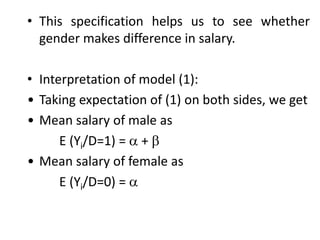
• This specification helps us to see whether
gender makes difference in salary.
• Interpretation of model (1):
• Taking expectation of (1) on both sides, we get
• Mean salary of male as
E (Yi/D=1) =  + 
• Mean salary of female as
E (Yi/D=0) = 
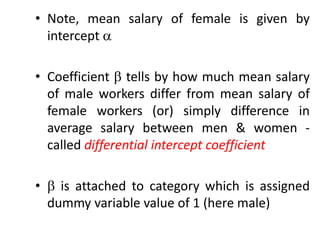
• Note, mean salary of female is given by
intercept 
• Coefficient  tells by how much mean salary
of male workers differ from mean salary of
female workers (or) simply difference in
average salary between men & women -
called differential intercept coefficient
•  is attached to category which is assigned
dummy variable value of 1 (here male)
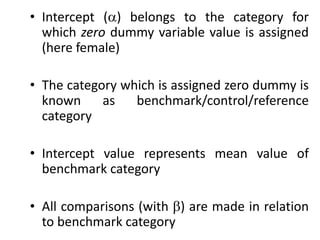
• Intercept () belongs to the category for
which zero dummy variable value is assigned
(here female)
• The category which is assigned zero dummy is
known as benchmark/control/reference
category
• Intercept value represents mean value of
benchmark category
• All comparisons (with ) are made in relation
to benchmark category
• Hypothesis testing:
• Done in the usual way
• H0 :  = 0 [No gender discrimination in salary
determination/no statistically significant
difference in salaries between males and
females]
• H1 :   0 [Gender discrimination is present in
salary determination]
• Use t – statistics
• If  is significantly different from zero, we can
accept alternate hypothesis
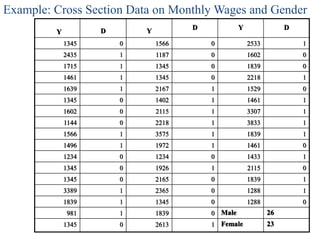
Example: Cross Section Data on Monthly Wages and Gender
Y D Y D Y D
1345 0 1566 0 2533 1
2435 1 1187 0 1602 0
1715 1 1345 0 1839 0
1461 1 1345 0 2218 1
1639 1 2167 1 1529 0
1345 0 1402 1 1461 1
1602 0 2115 1 3307 1
1144 0 2218 1 3833 1
1566 1 3575 1 1839 1
1496 1 1972 1 1461 0
1234 0 1234 0 1433 1
1345 0 1926 1 2115 0
1345 0 2165 0 1839 1
3389 1 2365 0 1288 1
1839 1 1345 0 1288 0
981 1 1839 0 Male 26
1345 0 2613 1 Female 23
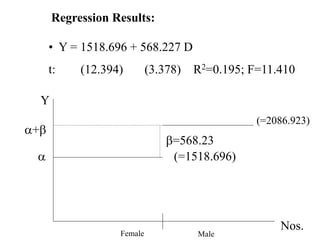
Regression Results:
• Y = 1518.696 + 568.227 D
t: (12.394) (3.378) R2=0.195; F=11.410
Female Male
 (=1518.696)
+
=568.23
(=2086.923)
Y
Nos.
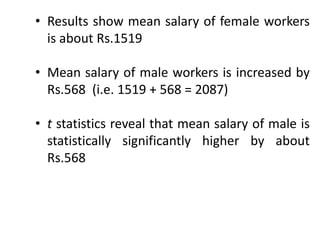
• Results show mean salary of female workers
is about Rs.1519
• Mean salary of male workers is increased by
Rs.568 (i.e. 1519 + 568 = 2087)
• t statistics reveal that mean salary of male is
statistically significantly higher by about
Rs.568
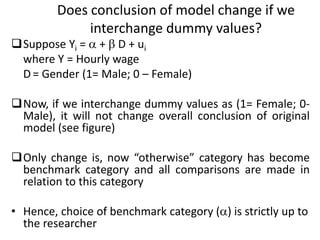
Does conclusion of model change if we
interchange dummy values?
Suppose Yi =  +  D + ui
where Y = Hourly wage
D = Gender (1= Male; 0 – Female)
Now, if we interchange dummy values as (1= Female; 0-
Male), it will not change overall conclusion of original
model (see figure)
Only change is, now “otherwise” category has become
benchmark category and all comparisons are made in
relation to this category
• Hence, choice of benchmark category () is strictly up to
the researcher
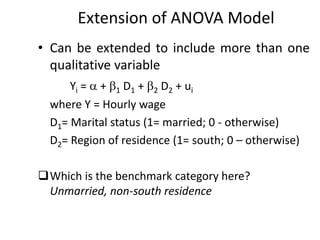
Extension of ANOVA Model
• Can be extended to include more than one
qualitative variable
Yi =  + 1 D1 + 2 D2 + ui
where Y = Hourly wage
D1= Marital status (1= married; 0 - otherwise)
D2= Region of residence (1= south; 0 – otherwise)
Which is the benchmark category here?
Unmarried, non-south residence
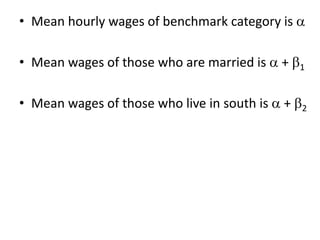
• Mean hourly wages of benchmark category is 
• Mean wages of those who are married is  + 1
• Mean wages of those who live in south is  + 2
ANCOVA Model
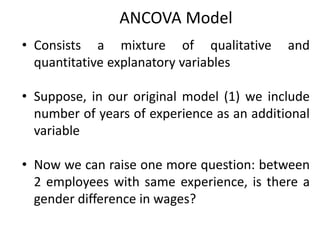
• Consists a mixture of qualitative and
quantitative explanatory variables
• Suppose, in our original model (1) we include
number of years of experience as an additional
variable
• Now we can raise one more question: between
2 employees with same experience, is there a
gender difference in wages?
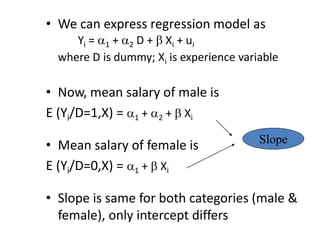
• We can express regression model as
Yi = 1 + 2 D +  Xi + ui
where D is dummy; Xi is experience variable
• Now, mean salary of male is
E (Yi/D=1,X) = 1 + 2 +  Xi
• Mean salary of female is
E (Yi/D=0,X) = 1 +  Xi
• Slope is same for both categories (male &
female), only intercept differs
Slope
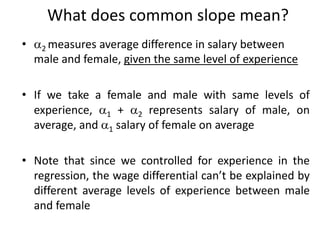
What does common slope mean?
• 2 measures average difference in salary between
male and female, given the same level of experience
• If we take a female and male with same levels of
experience, 1 + 2 represents salary of male, on
average, and 1 salary of female on average
• Note that since we controlled for experience in the
regression, the wage differential can’t be explained by
different average levels of experience between male
and female
• Hence, we can conclude that wage differential is
due to gender factor
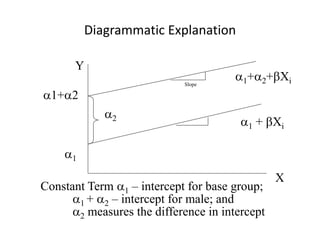
Diagrammatic Explanation
X
Y
1 + Xi
1+2+Xi
Constant Term 1 – intercept for base group;
1 + 2 – intercept for male; and
2 measures the difference in intercept
1
2
1+2
Slope
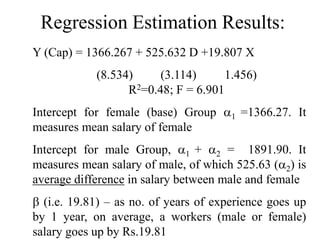
Regression Estimation Results:
Y (Cap) = 1366.267 + 525.632 D +19.807 X
(8.534) (3.114) 1.456)
R2=0.48; F = 6.901
Intercept for female (base) Group 1 =1366.27. It
measures mean salary of female
Intercept for male Group, 1 + 2 = 1891.90. It
measures mean salary of male, of which 525.63 (2) is
average difference in salary between male and female
 (i.e. 19.81) – as no. of years of experience goes up
by 1 year, on average, a workers (male or female)
salary goes up by Rs.19.81
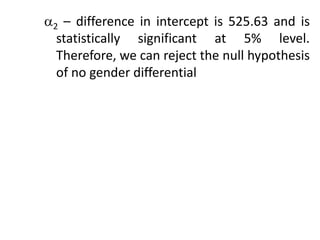
2 – difference in intercept is 525.63 and is
statistically significant at 5% level.
Therefore, we can reject the null hypothesis
of no gender differential
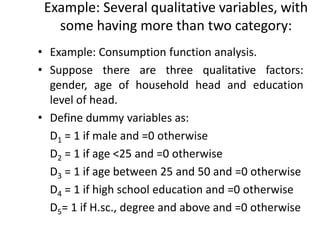
Example: Several qualitative variables, with
some having more than two category:
• Example: Consumption function analysis.
• Suppose there are three qualitative factors:
gender, age of household head and education
level of head.
• Define dummy variables as:
D1 = 1 if male and =0 otherwise
D2 = 1 if age <25 and =0 otherwise
D3 = 1 if age between 25 and 50 and =0 otherwise
D4 = 1 if high school education and =0 otherwise
D5= 1 if H.sc., degree and above and =0 otherwise
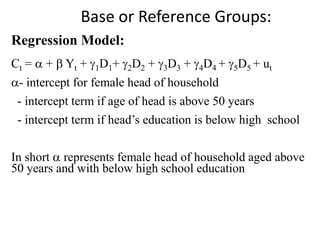
Base or Reference Groups:
Regression Model:
Ct =  +  Yt + 1D1+ 2D2 + 3D3 + 4D4 + 5D5 + ut
- intercept for female head of household
- intercept term if age of head is above 50 years
- intercept term if head’s education is below high school
In short  represents female head of household aged above
50 years and with below high school education
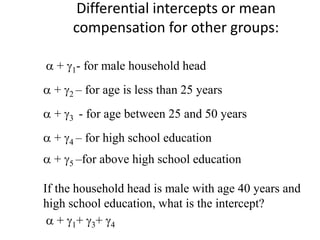
Differential intercepts or mean
compensation for other groups:
 + 1- for male household head
 + 2 – for age is less than 25 years
 + 3 - for age between 25 and 50 years
 + 4 – for high school education
 + 5 –for above high school education
If the household head is male with age 40 years and
high school education, what is the intercept?
 + 1+ 3+ 4
Interactions Involving Dummy Variables
• Consider the following model:
Yi = 1 + 2 D2i + 3 D3i +  Xi + ui ----- (1)
Yi = Hourly wage
Xi = Education (years of schooling)
D2 = 1 if female, 0 if male [GENDER]
D3 = 1 if black, 0 if white [RACE]
Note that in this model dummy variables are
interactive in nature. How?
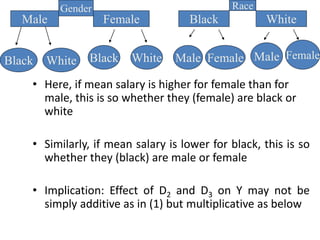
• Here, if mean salary is higher for female than for
male, this is so whether they (female) are black or
white
• Similarly, if mean salary is lower for black, this is so
whether they (black) are male or female
• Implication: Effect of D2 and D3 on Y may not be
simply additive as in (1) but multiplicative as below
Male Female Black White
Black White Black White Male Female Male Female
Gender Race
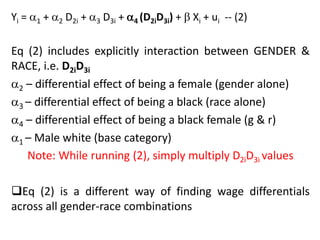
Yi = 1 + 2 D2i + 3 D3i + 4 (D2iD3i) +  Xi + ui -- (2)
Eq (2) includes explicitly interaction between GENDER &
RACE, i.e. D2iD3i
2 – differential effect of being a female (gender alone)
3 – differential effect of being a black (race alone)
4 – differential effect of being a black female (g & r)
1 – Male white (base category)
Note: While running (2), simply multiply D2iD3i values
Eq (2) is a different way of finding wage differentials
across all gender-race combinations
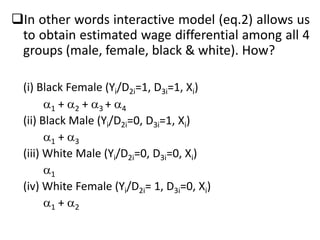
In other words interactive model (eq.2) allows us
to obtain estimated wage differential among all 4
groups (male, female, black & white). How?
(i) Black Female (Yi/D2i=1, D3i=1, Xi)
1 + 2 + 3 + 4
(ii) Black Male (Yi/D2i=0, D3i=1, Xi)
1 + 3
(iii) White Male (Yi/D2i=0, D3i=0, Xi)
1
(iv) White Female (Yi/D2i= 1, D3i=0, Xi)
1 + 2
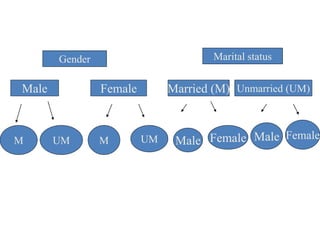
Male Female Married (M) Unmarried (UM)
M UM M UM Male Female Male Female
Gender Marital status

Dummyvariable1

  • 1.
  • 2.
    What is DummyVariable? • Variables that are essentially qualitative in nature (or) variables that are not readily quantifiable • Examples: gender, marital status, race, colour, religion, nationality, geographical location, political/policy changes, party affiliation
  • 3.
    Other Names forDummy Variable Indicator variables Binary variables Categorical variables Dichotomous variables Qualitative variables
  • 4.
    Why Dummy VariableRegression? • To include qualitative variables as an explanatory variable in the regression model • Example: If we want to see whether gender discrimination has any influence on earnings, apart from other factors
  • 5.
    How to quantifyqualitative aspect? • By constructing artificial variables that take on values of 1 or 0 (zero) • 1 indicates presence of that attribute • 0 indicates absence of that attribute • Example: (1) Gender = 1 if the respondent is female = 0 if the respondent is male (2) Time = 1 if war time; 0 if peacetime • Here variables with values 1 and 0 are called dummy variables
  • 6.
    Types of DummyVariable Models (1) Analysis of Variance (ANOVA) Model: All explanatory variables are dummy variables (2) Analysis of Covariance (ANCOVA) Model: Mix of quantitative and qualitative explanatory variables
  • 7.
    ANOVA Model • Supposewe want to measure impact of GENDER on wages/employee compensation • In particular, we are interested to know whether female employees are discriminated against their male counterparts • Gender is not strictly quantifiable
  • 8.
    • Hence, wedescribe gender using dummy variable D = 1 if male respondent = 0 if female respondent [reference group] Let the regression model as Yi =  +  D + ui (1) (where Y-Monthly salary)
  • 9.
    • This specificationhelps us to see whether gender makes difference in salary. • Interpretation of model (1): • Taking expectation of (1) on both sides, we get • Mean salary of male as E (Yi/D=1) =  +  • Mean salary of female as E (Yi/D=0) = 
  • 10.
    • Note, meansalary of female is given by intercept  • Coefficient  tells by how much mean salary of male workers differ from mean salary of female workers (or) simply difference in average salary between men & women - called differential intercept coefficient •  is attached to category which is assigned dummy variable value of 1 (here male)
  • 11.
    • Intercept ()belongs to the category for which zero dummy variable value is assigned (here female) • The category which is assigned zero dummy is known as benchmark/control/reference category • Intercept value represents mean value of benchmark category • All comparisons (with ) are made in relation to benchmark category
  • 12.
    • Hypothesis testing: •Done in the usual way • H0 :  = 0 [No gender discrimination in salary determination/no statistically significant difference in salaries between males and females] • H1 :   0 [Gender discrimination is present in salary determination] • Use t – statistics • If  is significantly different from zero, we can accept alternate hypothesis
  • 13.
    Example: Cross SectionData on Monthly Wages and Gender Y D Y D Y D 1345 0 1566 0 2533 1 2435 1 1187 0 1602 0 1715 1 1345 0 1839 0 1461 1 1345 0 2218 1 1639 1 2167 1 1529 0 1345 0 1402 1 1461 1 1602 0 2115 1 3307 1 1144 0 2218 1 3833 1 1566 1 3575 1 1839 1 1496 1 1972 1 1461 0 1234 0 1234 0 1433 1 1345 0 1926 1 2115 0 1345 0 2165 0 1839 1 3389 1 2365 0 1288 1 1839 1 1345 0 1288 0 981 1 1839 0 Male 26 1345 0 2613 1 Female 23
  • 14.
    Regression Results: • Y= 1518.696 + 568.227 D t: (12.394) (3.378) R2=0.195; F=11.410 Female Male  (=1518.696) + =568.23 (=2086.923) Y Nos.
  • 15.
    • Results showmean salary of female workers is about Rs.1519 • Mean salary of male workers is increased by Rs.568 (i.e. 1519 + 568 = 2087) • t statistics reveal that mean salary of male is statistically significantly higher by about Rs.568
  • 16.
    Does conclusion ofmodel change if we interchange dummy values? Suppose Yi =  +  D + ui where Y = Hourly wage D = Gender (1= Male; 0 – Female) Now, if we interchange dummy values as (1= Female; 0- Male), it will not change overall conclusion of original model (see figure) Only change is, now “otherwise” category has become benchmark category and all comparisons are made in relation to this category • Hence, choice of benchmark category () is strictly up to the researcher
  • 17.
    Extension of ANOVAModel • Can be extended to include more than one qualitative variable Yi =  + 1 D1 + 2 D2 + ui where Y = Hourly wage D1= Marital status (1= married; 0 - otherwise) D2= Region of residence (1= south; 0 – otherwise) Which is the benchmark category here? Unmarried, non-south residence
  • 18.
    • Mean hourlywages of benchmark category is  • Mean wages of those who are married is  + 1 • Mean wages of those who live in south is  + 2
  • 20.
    ANCOVA Model • Consistsa mixture of qualitative and quantitative explanatory variables • Suppose, in our original model (1) we include number of years of experience as an additional variable • Now we can raise one more question: between 2 employees with same experience, is there a gender difference in wages?
  • 21.
    • We canexpress regression model as Yi = 1 + 2 D +  Xi + ui where D is dummy; Xi is experience variable • Now, mean salary of male is E (Yi/D=1,X) = 1 + 2 +  Xi • Mean salary of female is E (Yi/D=0,X) = 1 +  Xi • Slope is same for both categories (male & female), only intercept differs Slope
  • 22.
    What does commonslope mean? • 2 measures average difference in salary between male and female, given the same level of experience • If we take a female and male with same levels of experience, 1 + 2 represents salary of male, on average, and 1 salary of female on average • Note that since we controlled for experience in the regression, the wage differential can’t be explained by different average levels of experience between male and female
  • 23.
    • Hence, wecan conclude that wage differential is due to gender factor
  • 24.
    Diagrammatic Explanation X Y 1 +Xi 1+2+Xi Constant Term 1 – intercept for base group; 1 + 2 – intercept for male; and 2 measures the difference in intercept 1 2 1+2 Slope
  • 25.
    Regression Estimation Results: Y(Cap) = 1366.267 + 525.632 D +19.807 X (8.534) (3.114) 1.456) R2=0.48; F = 6.901 Intercept for female (base) Group 1 =1366.27. It measures mean salary of female Intercept for male Group, 1 + 2 = 1891.90. It measures mean salary of male, of which 525.63 (2) is average difference in salary between male and female  (i.e. 19.81) – as no. of years of experience goes up by 1 year, on average, a workers (male or female) salary goes up by Rs.19.81
  • 26.
    2 – differencein intercept is 525.63 and is statistically significant at 5% level. Therefore, we can reject the null hypothesis of no gender differential
  • 27.
    Example: Several qualitativevariables, with some having more than two category: • Example: Consumption function analysis. • Suppose there are three qualitative factors: gender, age of household head and education level of head. • Define dummy variables as: D1 = 1 if male and =0 otherwise D2 = 1 if age <25 and =0 otherwise D3 = 1 if age between 25 and 50 and =0 otherwise D4 = 1 if high school education and =0 otherwise D5= 1 if H.sc., degree and above and =0 otherwise
  • 28.
    Base or ReferenceGroups: Regression Model: Ct =  +  Yt + 1D1+ 2D2 + 3D3 + 4D4 + 5D5 + ut - intercept for female head of household - intercept term if age of head is above 50 years - intercept term if head’s education is below high school In short  represents female head of household aged above 50 years and with below high school education
  • 29.
    Differential intercepts ormean compensation for other groups:  + 1- for male household head  + 2 – for age is less than 25 years  + 3 - for age between 25 and 50 years  + 4 – for high school education  + 5 –for above high school education If the household head is male with age 40 years and high school education, what is the intercept?  + 1+ 3+ 4
  • 30.
    Interactions Involving DummyVariables • Consider the following model: Yi = 1 + 2 D2i + 3 D3i +  Xi + ui ----- (1) Yi = Hourly wage Xi = Education (years of schooling) D2 = 1 if female, 0 if male [GENDER] D3 = 1 if black, 0 if white [RACE] Note that in this model dummy variables are interactive in nature. How?
  • 31.
    • Here, ifmean salary is higher for female than for male, this is so whether they (female) are black or white • Similarly, if mean salary is lower for black, this is so whether they (black) are male or female • Implication: Effect of D2 and D3 on Y may not be simply additive as in (1) but multiplicative as below Male Female Black White Black White Black White Male Female Male Female Gender Race
  • 32.
    Yi = 1+ 2 D2i + 3 D3i + 4 (D2iD3i) +  Xi + ui -- (2) Eq (2) includes explicitly interaction between GENDER & RACE, i.e. D2iD3i 2 – differential effect of being a female (gender alone) 3 – differential effect of being a black (race alone) 4 – differential effect of being a black female (g & r) 1 – Male white (base category) Note: While running (2), simply multiply D2iD3i values Eq (2) is a different way of finding wage differentials across all gender-race combinations
  • 33.
    In other wordsinteractive model (eq.2) allows us to obtain estimated wage differential among all 4 groups (male, female, black & white). How? (i) Black Female (Yi/D2i=1, D3i=1, Xi) 1 + 2 + 3 + 4 (ii) Black Male (Yi/D2i=0, D3i=1, Xi) 1 + 3 (iii) White Male (Yi/D2i=0, D3i=0, Xi) 1 (iv) White Female (Yi/D2i= 1, D3i=0, Xi) 1 + 2
  • 34.
    Male Female Married(M) Unmarried (UM) M UM M UM Male Female Male Female Gender Marital status