By – Akhilesh shukla
CA Final
Introduction
Concept of Double Taxation
DTAA
Sec 90 & 91 of IT Act 1961,
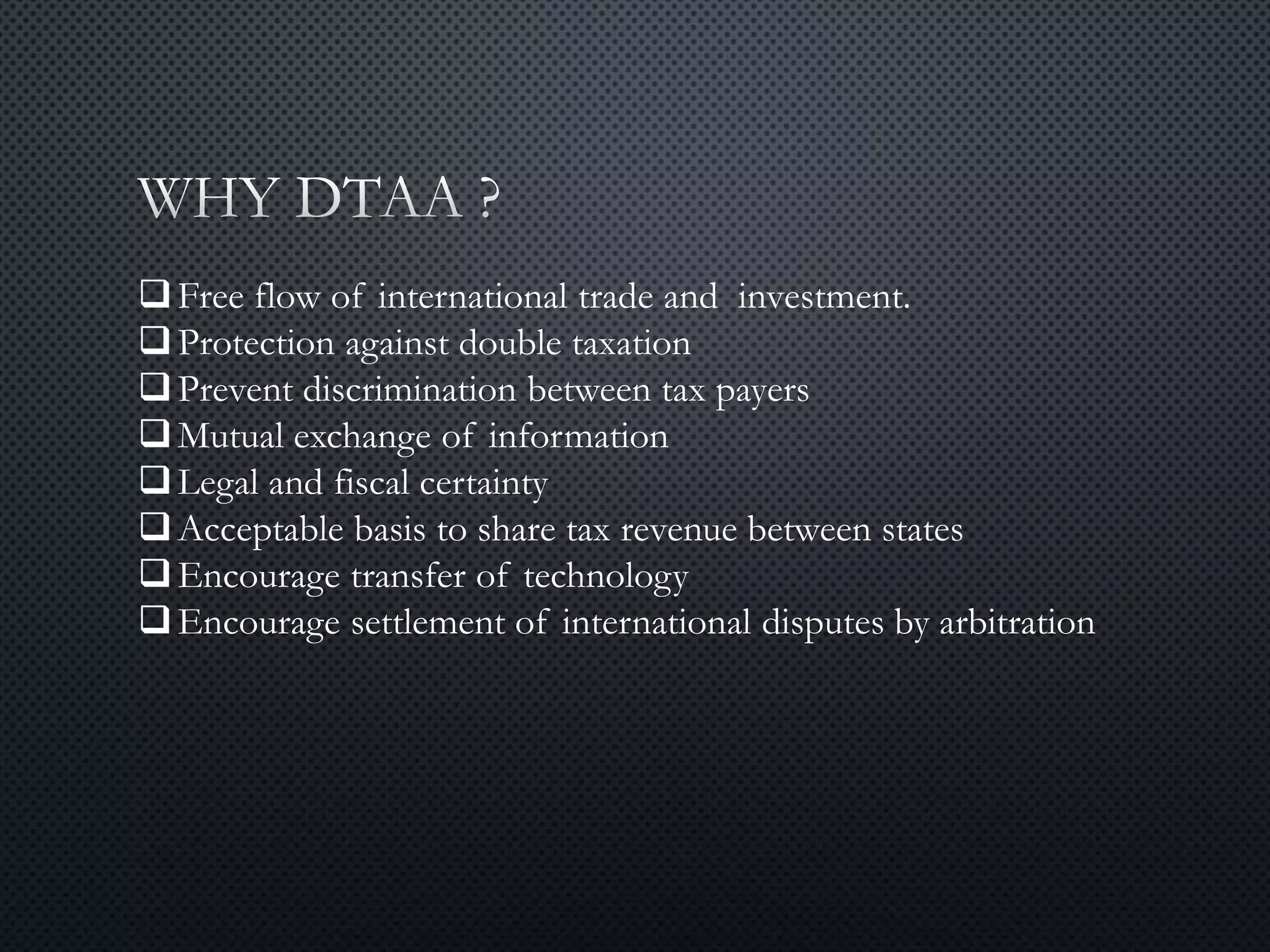
WHY DTAA
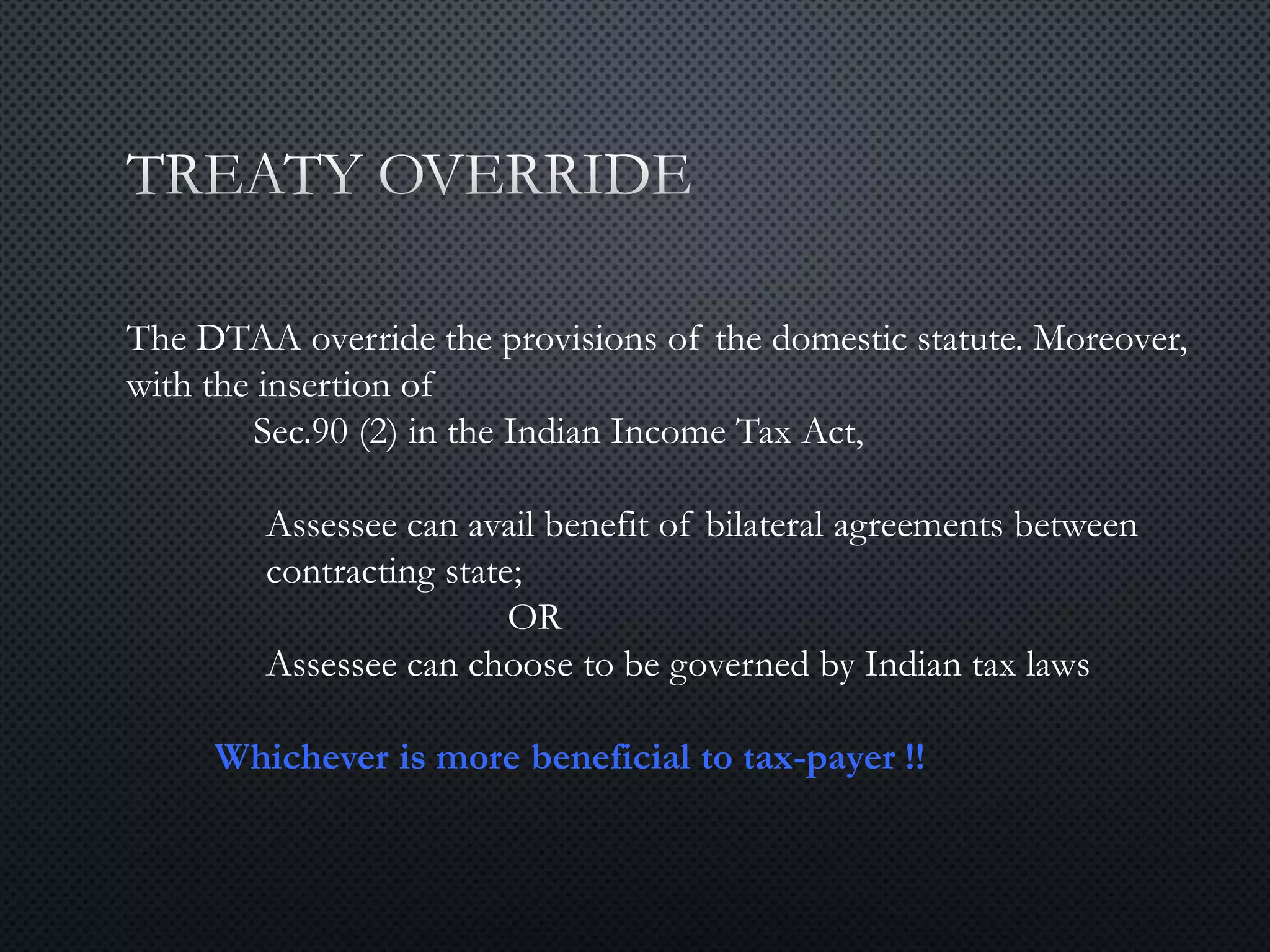
Treaty Override
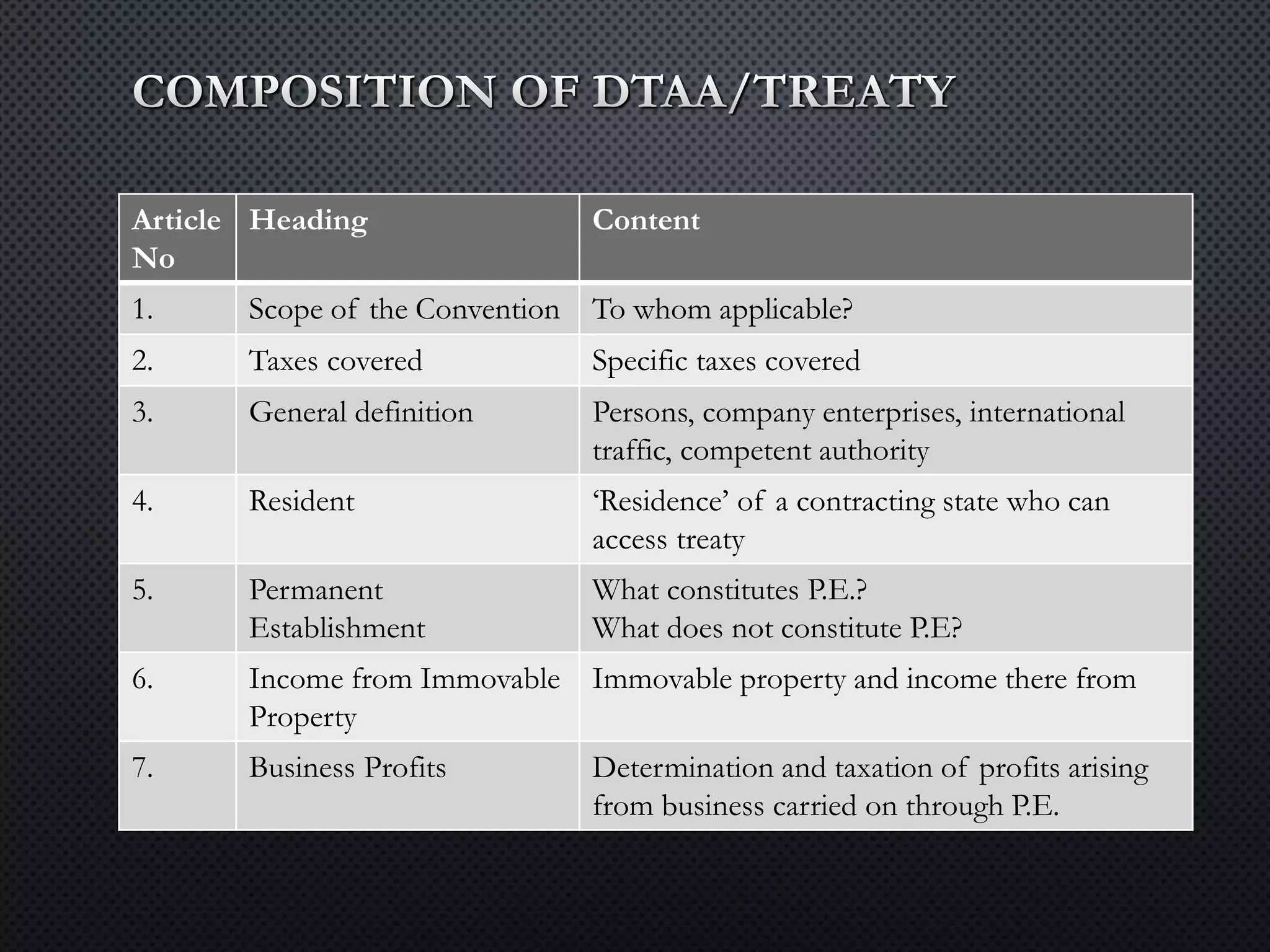
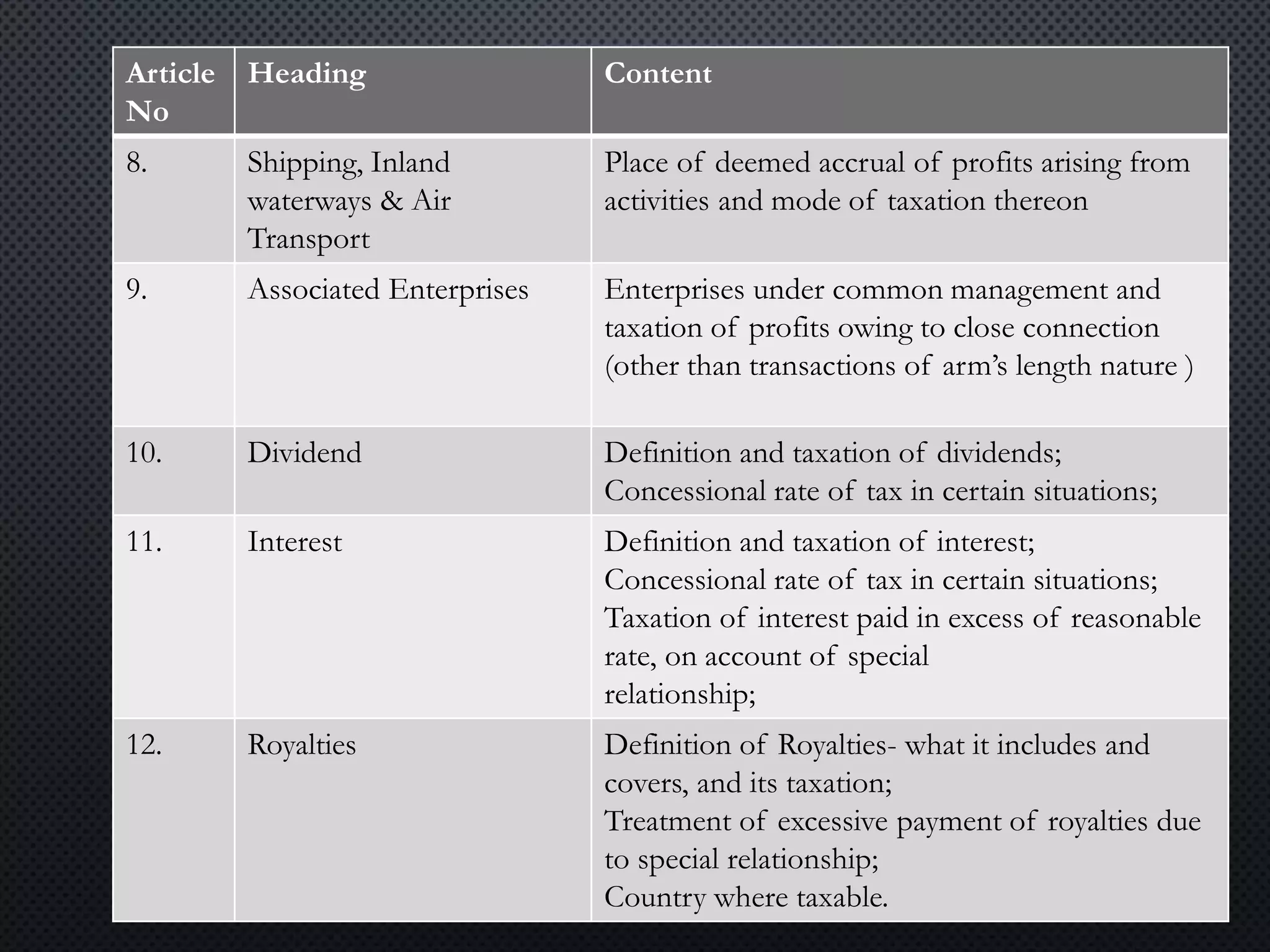
Composition of DTAA
Methods of elimination of Double Taxation
Double Non Taxation
Asseesse’s Approach to DTAA
Some Practical issue’s
Those who are migrating to other countries to earn a living have to
pay taxes in their country of residence as per prevalent taxes laws
of the country. However, it is quite likely that these people have
certain investments in their home country, India, and they are liable
to pay taxes on gains made from such investments in India. So far
this is fine and surely acceptable to all concerned.
The problem arises when they are told that as per the globally
accepted norms, if a taxpayer is resident in one country but
has a source of income situated in another country, there is a
situation at hand where his income is taxed in both countries, or
Double Taxation occurs
 JURISDICTIONAL DOUBLE TAXATION - One and the
same person is taxed on the same income in more than
one state. This may happen for one of the following
reasons:
 Residence in one state and source in another state
 Triangular taxation
 ECONOMIC DOUBLE TAXATION - Two separate persons
are taxed on the same income in more than one state
 Foreign income taxed in the hand of overseas company
distributing dividend and dividend taxed in the hands of
shareholder
 Taxation in source country in the hands of a partnership
entity whereas in the residence county, partners of such
partnership are taxable
Hence need for elimination of Double taxation!
Definition - It is a formally concluded & ratified agreement
between two independent (Bilateral treaty) or more than two
independent (Multilateral treaty) nations on matter concerning
taxation.
These treaties are based on the general principles laid down in
the model draft of the Organisation for Economic
Cooperation and Development (OECD) with suitable
modifications as agreed to by the other contracting countries.
There are different models for DTAA are available but
agreement are categorised on the basis of scope
Comprehensive agreement : Scope addressed to all sources
of income
Illustratively : USA,UK
Limited agreement : Scope only cover :
Illustratively : Lebanon , Pakistan
 Income from operation of aircrafts & Ships
 Estates
 Inheritance
 Gifts
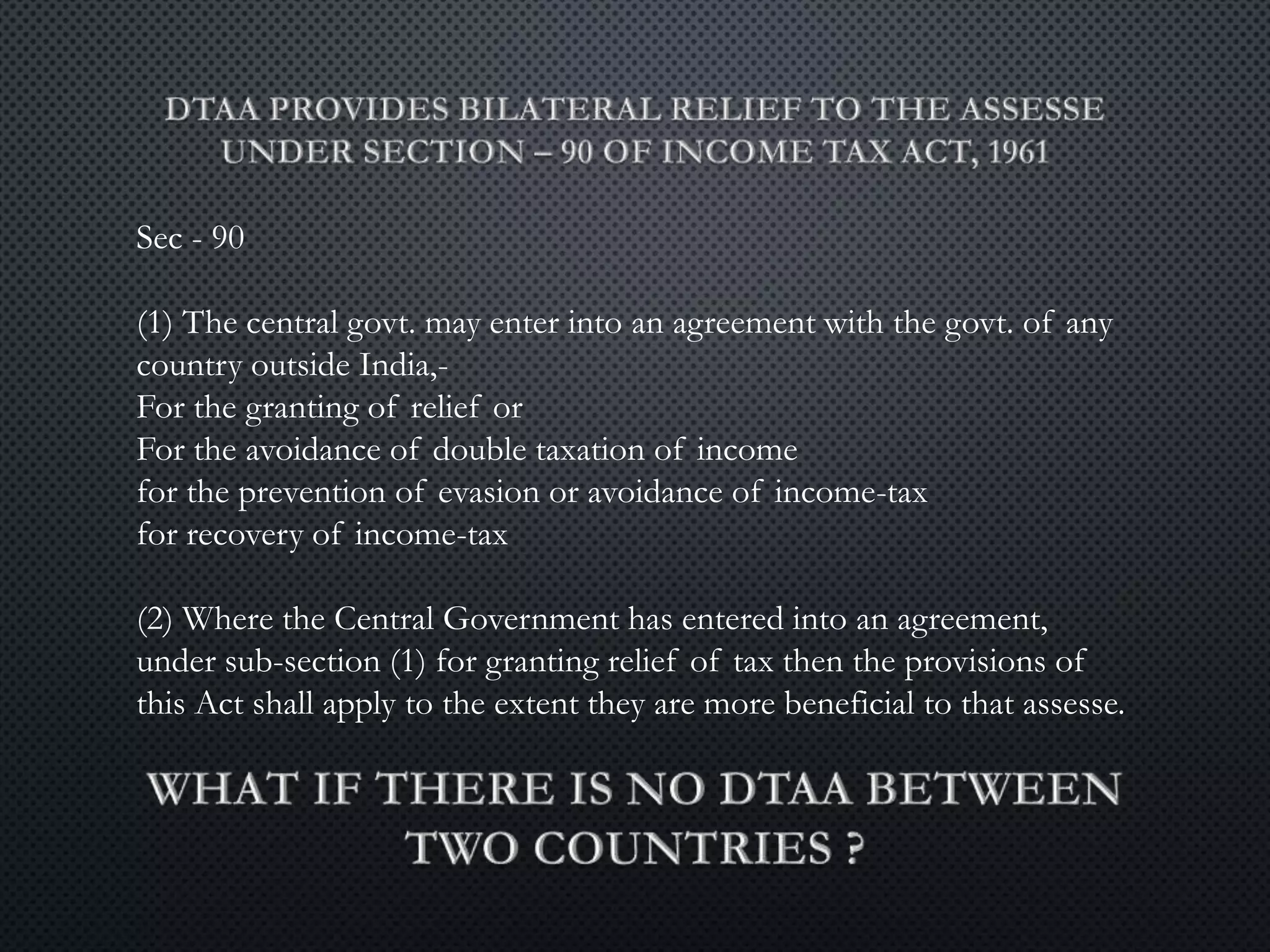
Sec - 90
(1) The central govt. may enter into an agreement with the govt. of any
country outside India,-
For the granting of relief or
For the avoidance of double taxation of income
for the prevention of evasion or avoidance of income-tax
for recovery of income-tax
(2) Where the Central Government has entered into an agreement,
under sub-section (1) for granting relief of tax then the provisions of
this Act shall apply to the extent they are more beneficial to that assesse.
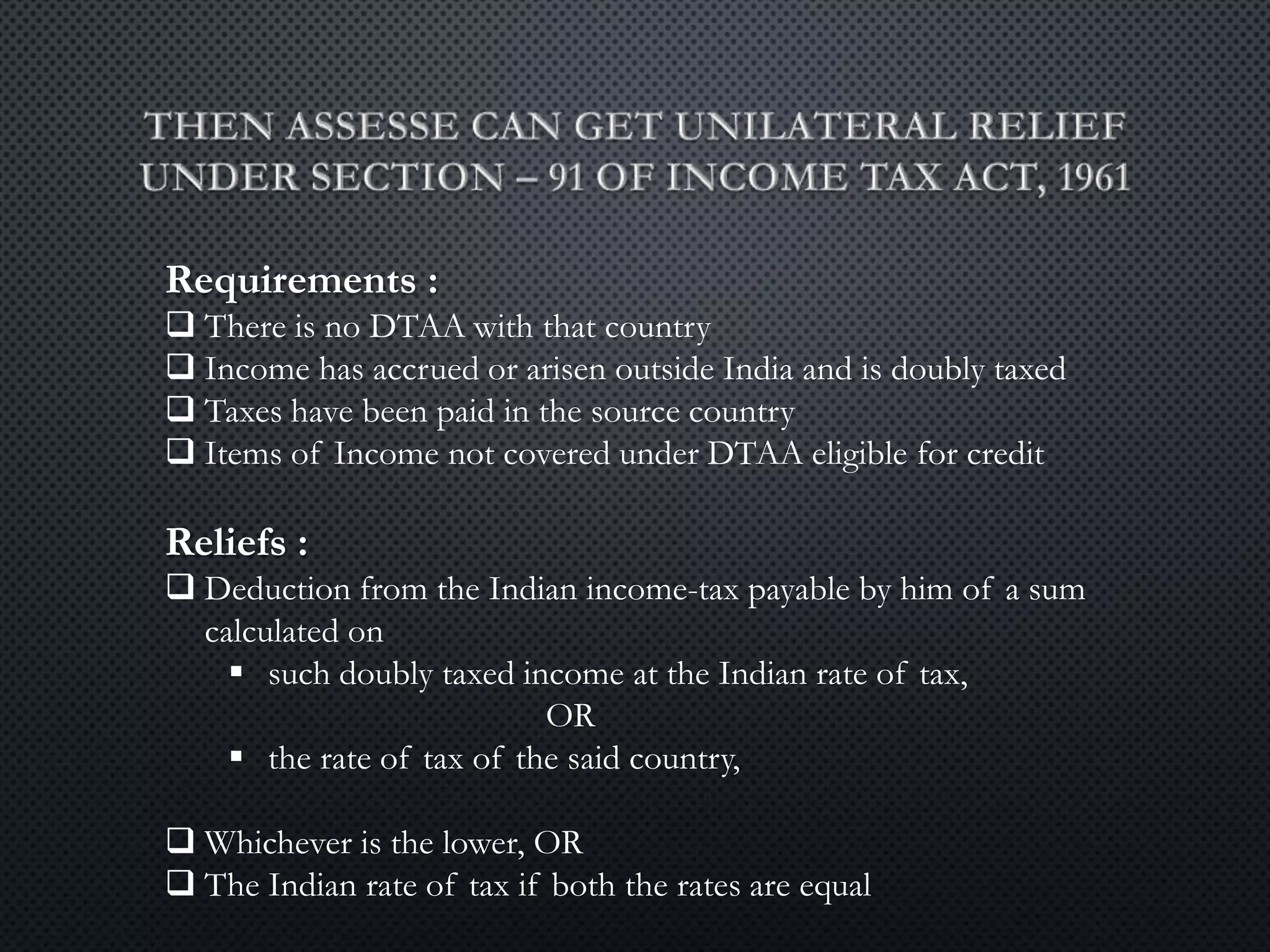
Requirements :
 There is no DTAA with that country
 Income has accrued or arisen outside India and is doubly taxed
 Taxes have been paid in the source country
 Items of Income not covered under DTAA eligible for credit
Reliefs :
 Deduction from the Indian income-tax payable by him of a sum
calculated on
 such doubly taxed income at the Indian rate of tax,
OR
 the rate of tax of the said country,
 Whichever is the lower, OR
 The Indian rate of tax if both the rates are equal
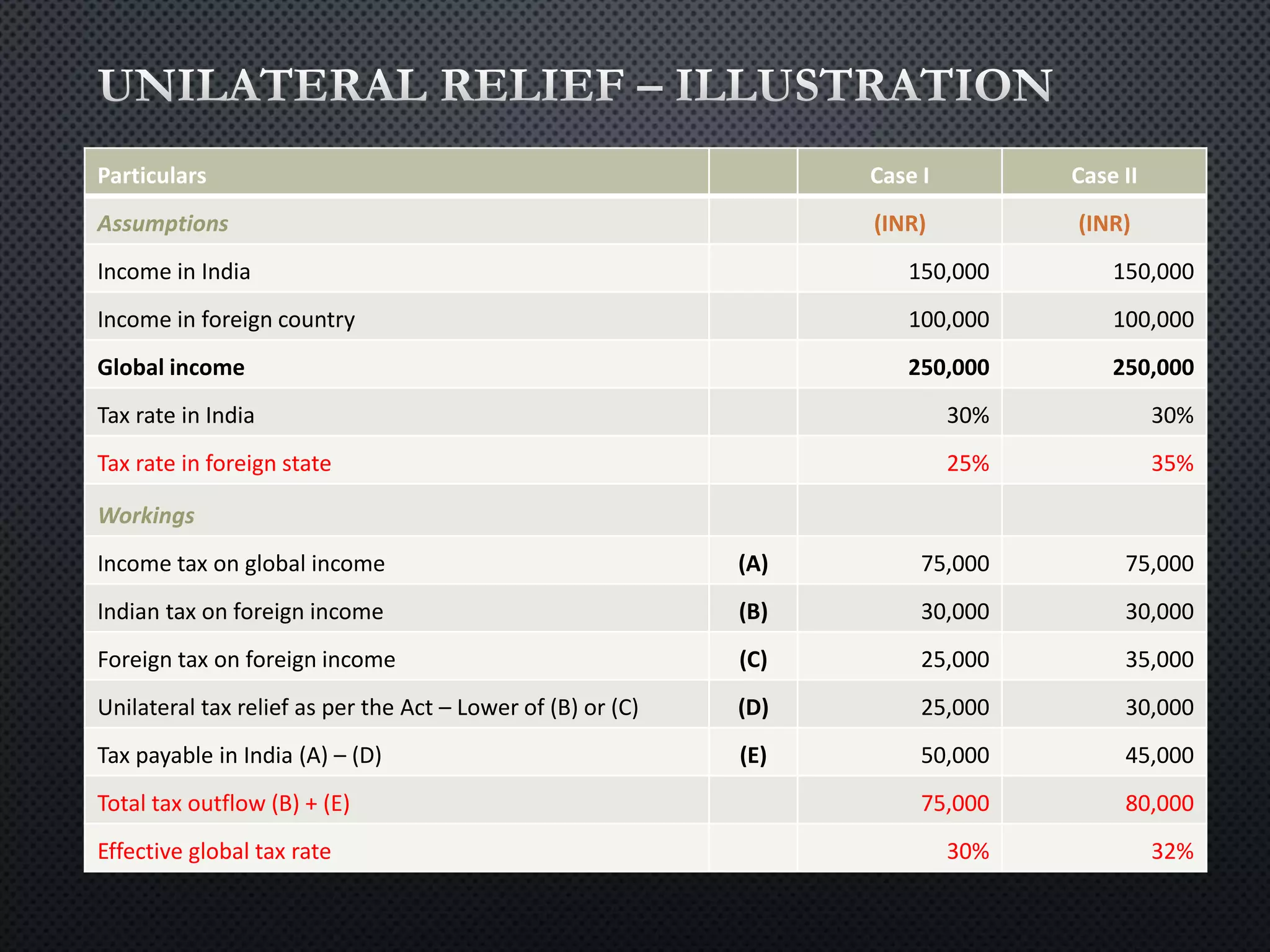
Particulars Case I Case II
Assumptions (INR) (INR)
Income in India 150,000 150,000
Income in foreign country 100,000 100,000
Global income 250,000 250,000
Tax rate in India 30% 30%
Tax rate in foreign state 25% 35%
Workings
Income tax on global income (A) 75,000 75,000
Indian tax on foreign income (B) 30,000 30,000
Foreign tax on foreign income (C) 25,000 35,000
Unilateral tax relief as per the Act – Lower of (B) or (C) (D) 25,000 30,000
Tax payable in India (A) – (D) (E) 50,000 45,000
Total tax outflow (B) + (E) 75,000 80,000
Effective global tax rate 30% 32%
Free flow of international trade and investment.
Protection against double taxation
Prevent discrimination between tax payers
Mutual exchange of information
Legal and fiscal certainty
Acceptable basis to share tax revenue between states
Encourage transfer of technology
Encourage settlement of international disputes by arbitration
The DTAA override the provisions of the domestic statute. Moreover,
with the insertion of
Sec.90 (2) in the Indian Income Tax Act,
Assessee can avail benefit of bilateral agreements between
contracting state;
OR
Assessee can choose to be governed by Indian tax laws
Whichever is more beneficial to tax-payer !!
 Contracting State - country which enters into Treaty
 State of Residence- Country where a person resides
 State of Source- Country where income arises
 Enterprise of a Contracting State- Any taxable unit
(including individuals of a Contracting State)
 Permanent Establishment - A fixed base of an enterprise
in the state of
 Source (usually a branch of a foreign company and in
some cases wholly – owned subsidiaries as well)
 Income arising in Contracting state - Income arising in a
State of a source
Article
No
Heading Content
1. Scope of the Convention To whom applicable?
2. Taxes covered Specific taxes covered
3. General definition Persons, company enterprises, international
traffic, competent authority
4. Resident ‘Residence’ of a contracting state who can
access treaty
5. Permanent
Establishment
What constitutes P.E.?
What does not constitute P.E?
6. Income from Immovable
Property
Immovable property and income there from
7. Business Profits Determination and taxation of profits arising
from business carried on through P.E.
Article
No
Heading Content
8. Shipping, Inland
waterways & Air
Transport
Place of deemed accrual of profits arising from
activities and mode of taxation thereon
9. Associated Enterprises Enterprises under common management and
taxation of profits owing to close connection
(other than transactions of arm’s length nature )
10. Dividend Definition and taxation of dividends;
Concessional rate of tax in certain situations;
11. Interest Definition and taxation of interest;
Concessional rate of tax in certain situations;
Taxation of interest paid in excess of reasonable
rate, on account of special
relationship;
12. Royalties Definition of Royalties- what it includes and
covers, and its taxation;
Treatment of excessive payment of royalties due
to special relationship;
Country where taxable.
Article
No
Heading Content
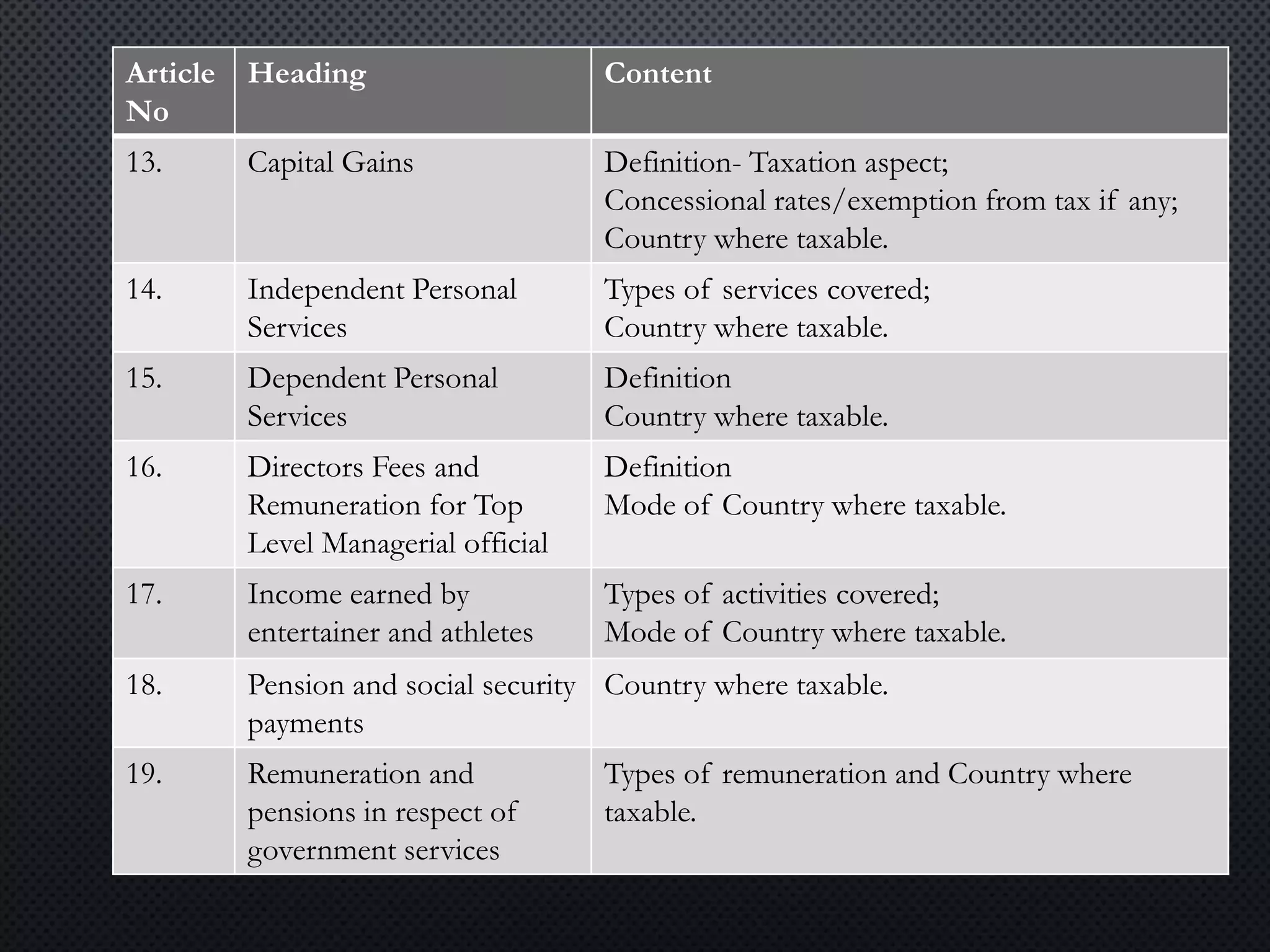
13. Capital Gains Definition- Taxation aspect;
Concessional rates/exemption from tax if any;
Country where taxable.
14. Independent Personal
Services
Types of services covered;
Country where taxable.
15. Dependent Personal
Services
Definition
Country where taxable.
16. Directors Fees and
Remuneration for Top
Level Managerial official
Definition
Mode of Country where taxable.
17. Income earned by
entertainer and athletes
Types of activities covered;
Mode of Country where taxable.
18. Pension and social security
payments
Country where taxable.
19. Remuneration and
pensions in respect of
government services
Types of remuneration and Country where
taxable.
Article
No
Heading Content
20. Payment received by
students and
apprentices
Taxation / Exemption of payments received by
student and apprentices.
21. Other Income Residual Article to cover income not covered
under other ‘Articles’, mode of
taxation and country where taxable
22. Capital (Tax on wealth) Definition – made – and country where taxable
23. Method of elimination Exemption Method / Credit Method
24. Non Discrimination (Equitable) Basis of taxing Nationals and citizens
of foreign state
25. Mutual Agreement
Procedure
Where taxation is not as per provisions of the
convention, a ‘person’ may
present his case to Competent Authorities of
respective states.Procedure in such cases
26. Exchange of Information Competent Authorities to exchange information
for carrying out provisions
of the convention.
Methodology.
Article
No
Heading Content
27. Assistance in collection of
taxes
28. Diplomatic agents and
Consular corps (Officers)
Privileges of this category to remain unaffected
29. Territorial Extension
30. Entry into force Effective date from which convention comes
into force;
Assessment year from which it comes into force.
31. Termination Time – Notice period – Mode.
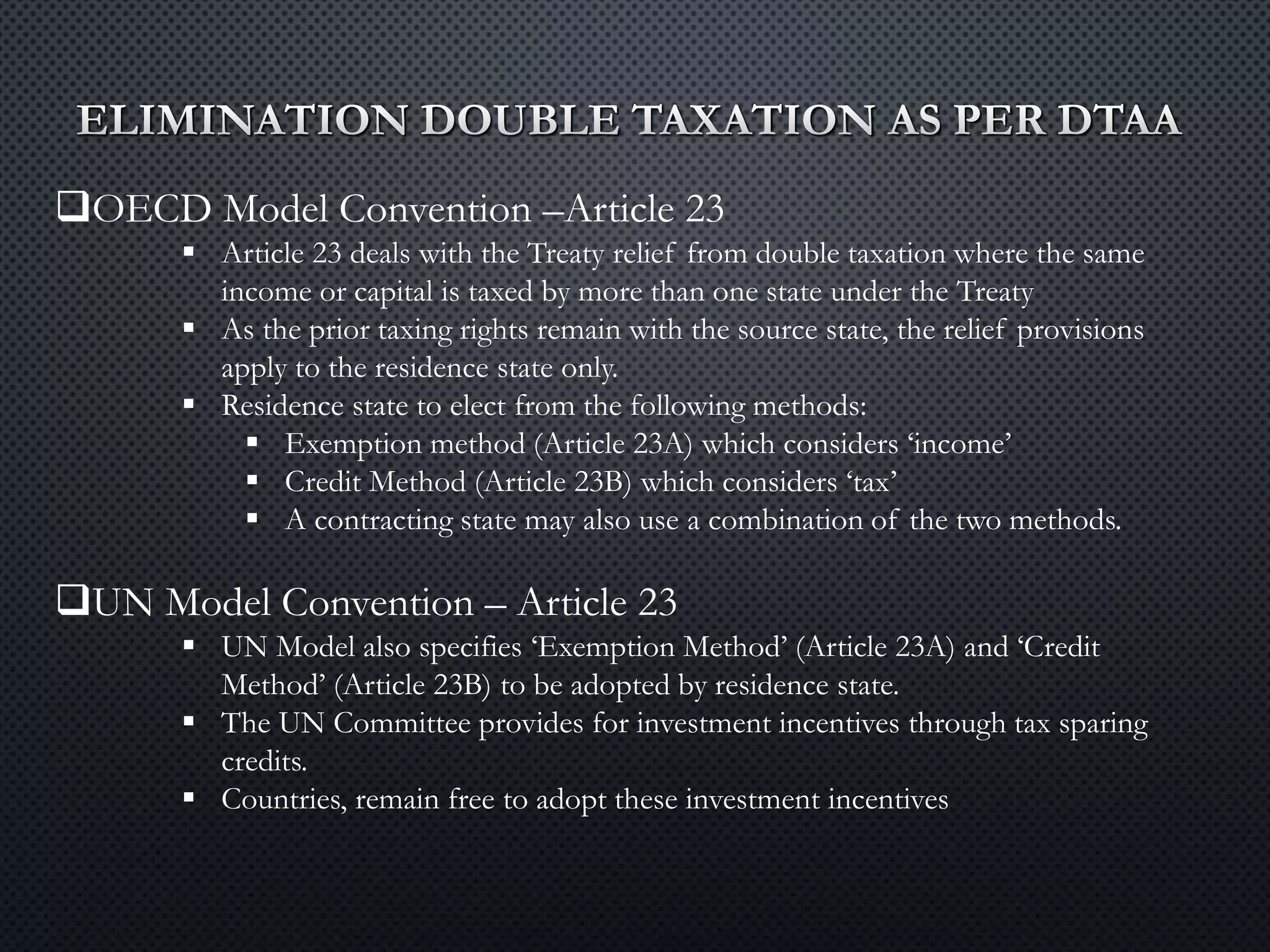
OECD Model Convention –Article 23
 Article 23 deals with the Treaty relief from double taxation where the same
income or capital is taxed by more than one state under the Treaty
 As the prior taxing rights remain with the source state, the relief provisions
apply to the residence state only.
 Residence state to elect from the following methods:
 Exemption method (Article 23A) which considers ‘income’
 Credit Method (Article 23B) which considers ‘tax’
 A contracting state may also use a combination of the two methods.
UN Model Convention – Article 23
 UN Model also specifies ‘Exemption Method’ (Article 23A) and ‘Credit
Method’ (Article 23B) to be adopted by residence state.
 The UN Committee provides for investment incentives through tax sparing
credits.
 Countries, remain free to adopt these investment incentives
Methods
Exemption
Exemption with
progression
Credit
Full credit Tax sparingOrdinary
Credit
Underlying
tax credit
Full exemption
 UNDER THIS METHOD, THE RESIDENCE COUNTRY EXEMPTS THE INCOME
ARISING IN THE SOURCE COUNTRY
 INCOME WOULD BE CHARGEABLE TO TAX ONLY IN THE SOURCE COUNTRY
 GENERALLY PREFERRED IN DTAAS BETWEEN A DEVELOPED COUNTRY
AND DEVELOPING COUNTRY, AS THE DEVELOPED COUNTRY WOULD
GENERALLY BE EXPORTING CAPITAL AND TECHNOLOGY TO DEVELOPING
COUNTRY
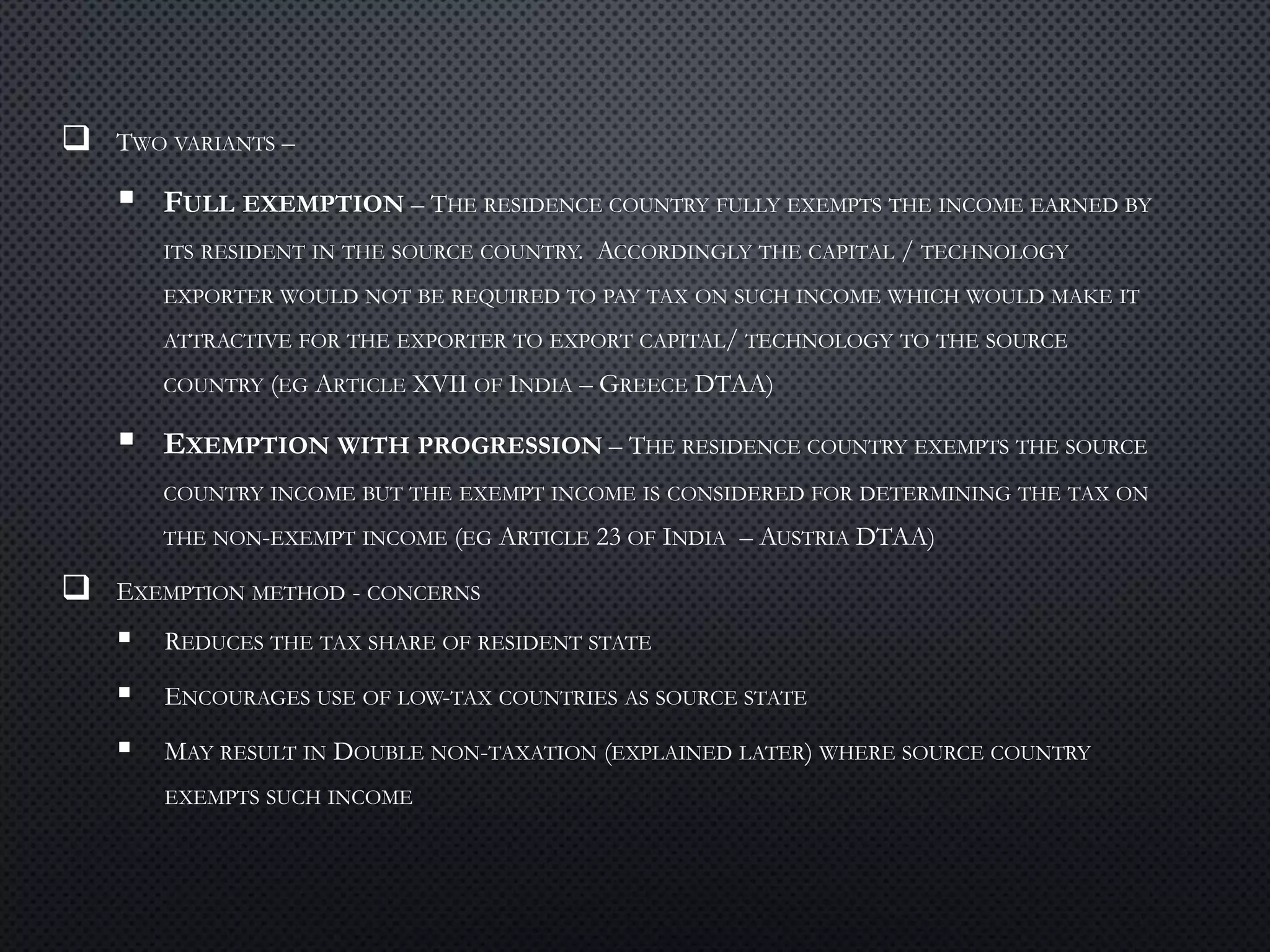
 TWO VARIANTS –
 FULL EXEMPTION – THE RESIDENCE COUNTRY FULLY EXEMPTS THE INCOME EARNED BY
ITS RESIDENT IN THE SOURCE COUNTRY. ACCORDINGLY THE CAPITAL / TECHNOLOGY
EXPORTER WOULD NOT BE REQUIRED TO PAY TAX ON SUCH INCOME WHICH WOULD MAKE IT
ATTRACTIVE FOR THE EXPORTER TO EXPORT CAPITAL/ TECHNOLOGY TO THE SOURCE
COUNTRY (EG ARTICLE XVII OF INDIA – GREECE DTAA)
 EXEMPTION WITH PROGRESSION – THE RESIDENCE COUNTRY EXEMPTS THE SOURCE
COUNTRY INCOME BUT THE EXEMPT INCOME IS CONSIDERED FOR DETERMINING THE TAX ON
THE NON-EXEMPT INCOME (EG ARTICLE 23 OF INDIA – AUSTRIA DTAA)
 EXEMPTION METHOD - CONCERNS
 REDUCES THE TAX SHARE OF RESIDENT STATE
 ENCOURAGES USE OF LOW-TAX COUNTRIES AS SOURCE STATE
 MAY RESULT IN DOUBLE NON-TAXATION (EXPLAINED LATER) WHERE SOURCE COUNTRY
EXEMPTS SUCH INCOME
 UNDER THIS METHOD, THE RESIDENCE COUNTRY EXEMPTS THE TAXES PAID
IN THE SOURCE COUNTRY
 FOR THE RESIDENCE COUNTRY, THE LOSS OF REVENUE IS GENERALLY LOWER
IN CREDIT METHOD, THEREFORE GENERALLY MOST DTAAS RELIEVE
DOUBLE TAXATION ONLY THROUGH CREDIT METHOD
 NON-REFUNDABLE TAX CREDIT – IN CASE THE TAX PAYABLE IN
RESIDENT STATE IS LESS THAN THE CREDIT AVAILABLE OR THE
RELEVANT INCOME IS EXEMPT IN RESIDENT STATE, THE RESIDENT
WOULD NEVER GET REFUND OF THE EXCESS CREDIT FOR THE TAXES
PAID IN SOURCE STATE
 Four variants
 Full credit – Resident state grants credit for the taxes paid in the
Source State without any restriction
 Ordinary credit – Tax credit is restricted to lower of the taxes to
be paid in the Resident state or the actual taxes discharged in the
Source state
 Tax sparing – Income exempt in the Source state. However such
income is taxable in the Resident state for which the resident state
provides for deemed tax exemption or deemed tax credit
 Underlying tax credit – Mechanism to eliminate a form of
‘economic double taxation’
 SOURCE COUNTRY OFFERS TAX INCENTIVES TO INVESTORS WITH NIL OR REDUCED
TAX RATE WHICH RESULT IN REDUCED OR NO TAX PAYABLE IN THE SOURCE
COUNTRY.
 A NOTIONAL TAX CREDIT IS GRANTED IN THE RESIDENT COUNTRY FOR THE TAX
NOT PAID UNDER SPECIAL INCENTIVE SCHEMES/ALLOWANCES IN THE SOURCE
COUNTRY.
 GENERALLY ATTACHED TO INCOME LIKE DIVIDEND, INTEREST, ROYALTIES, FOREIGN
BRANCH / PERMANENT ESTABLISHMENT INCOME
 TREATY PRESCRIBES EXACT NATURE OF SUCH TAX FREE INCOME;
• E.G. INDIA-US- SEC 10A INCOME
 ABSENCE OF TAX SPARING CLAUSE IN THE TREATIES WOULD RESULT IN THE
TRANSFER OF TAX REVENUES FROM SOURCE TO RESIDENT STATE WITH NO
ULTIMATE BENEFIT TO THE TAX PAYER.
 CONCEPT:
 A FORM OF RELIEF FROM ‘ECONOMICAL DOUBLE TAXATION’.
 COMPUTATION METHODOLOGY
 CO-RELATION OF DIVIDENDS TO POST TAX PROFITS OF SUBSIDIARY
 EFFECT OF EXCHANGE RATES
 REQUIREMENT OF SUBSTANTIAL SHAREHOLDING
 ALSO APPLIED UNDER CFC REGULATIONS
 INDIA’S TAX TREATY WITH SINGAPORE AND MAURITIUS PROVIDE FOR UNDERLYING
CREDIT.
 SOME COUNTRIES SPECIFY UP TO HOW MANY LAYERS, UTC CAN BE CLAIMED
 UTC UNDER NATIONAL TAX LAW – EG. SINGAPORE, UK, MAURITIUS ETC.
DOUBLE NON-TAXATION IS A SITUATION WHERE ON ACCOUNT OF BENEFITS
AVAILABLE UNDER DTAA, A TAX PAYER IS NOT LIABLE TO TAX IN BOTH THE
RESIDENT STATE AS WELL AS SOURCE STATE
CAPITAL GAINS TAXABILITY UNDER THE INDIA – MAURITIUS TAX TREATY IS A
CLASSIC EXAMPLE OF THE SAME
Company X
(Mauritius
resident)
Mauritius
Capital Gains exempt in India for a
Mauritius resident as per DTAA
between India and Mauritius
Capital Gains exempt
in Mauritius as per
Mauritius tax laws
India
Indian Co
Shares held
Mr X
Sale of
shares of
Indian Co
 As visible from the diagram, the above arrangement discharges Company X
from tax liability from both the Resident state (Mauritius) as well as Source
state (India)
 Some companies take undue advantage of the above arrangement by merely
incorporating subsidiaries in low-tax jurisdictions and by shifting the profits
through legal planning into these subsidiaries
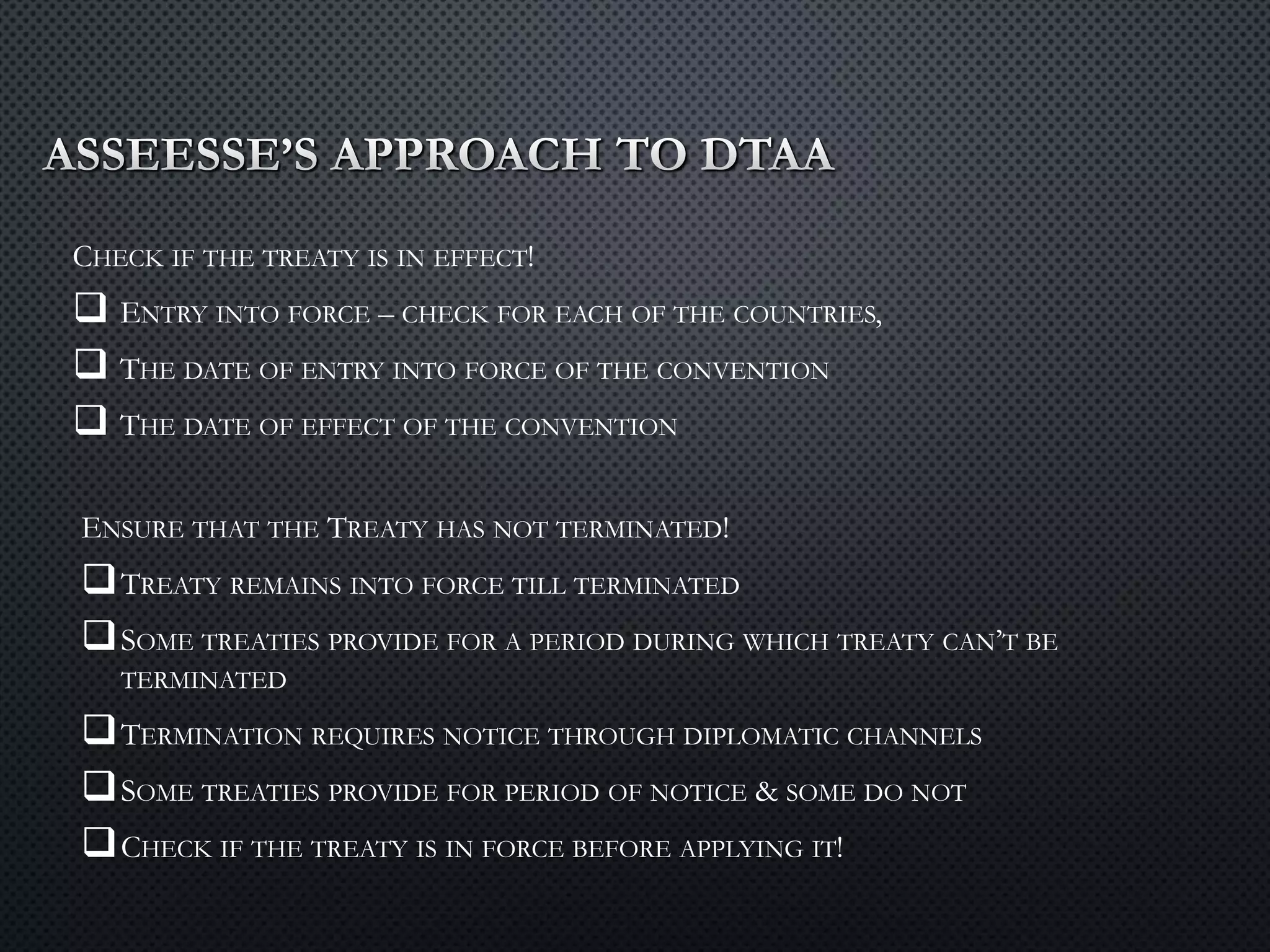
CHECK IF THE TREATY IS IN EFFECT!
 ENTRY INTO FORCE – CHECK FOR EACH OF THE COUNTRIES,
 THE DATE OF ENTRY INTO FORCE OF THE CONVENTION
 THE DATE OF EFFECT OF THE CONVENTION
ENSURE THAT THE TREATY HAS NOT TERMINATED!
TREATY REMAINS INTO FORCE TILL TERMINATED
SOME TREATIES PROVIDE FOR A PERIOD DURING WHICH TREATY CAN’T BE
TERMINATED
TERMINATION REQUIRES NOTICE THROUGH DIPLOMATIC CHANNELS
SOME TREATIES PROVIDE FOR PERIOD OF NOTICE & SOME DO NOT
CHECK IF THE TREATY IS IN FORCE BEFORE APPLYING IT!
 Dividend Distribution Tax – no credit if there is no underlying tax
credit
 Different Assessment Period
 Timing of Tax Filings in both countries
 Different method of income computation
 Conversion of Forex
 Shifting of Residence and Timing Difference
 Undue advantage merely incorporating subsidiaries in low-tax
jurisdictions and by shifting the profits through legal planning into
these subsidiaries
DTAA - Double Taxation Avoidance Agreement

DTAA - Double Taxation Avoidance Agreement

  • 1.
    By – Akhileshshukla CA Final
  • 2.
    Introduction Concept of DoubleTaxation DTAA Sec 90 & 91 of IT Act 1961, WHY DTAA Treaty Override Composition of DTAA Methods of elimination of Double Taxation Double Non Taxation Asseesse’s Approach to DTAA Some Practical issue’s
  • 3.
    Those who aremigrating to other countries to earn a living have to pay taxes in their country of residence as per prevalent taxes laws of the country. However, it is quite likely that these people have certain investments in their home country, India, and they are liable to pay taxes on gains made from such investments in India. So far this is fine and surely acceptable to all concerned. The problem arises when they are told that as per the globally accepted norms, if a taxpayer is resident in one country but has a source of income situated in another country, there is a situation at hand where his income is taxed in both countries, or Double Taxation occurs
  • 4.
     JURISDICTIONAL DOUBLETAXATION - One and the same person is taxed on the same income in more than one state. This may happen for one of the following reasons:  Residence in one state and source in another state  Triangular taxation  ECONOMIC DOUBLE TAXATION - Two separate persons are taxed on the same income in more than one state  Foreign income taxed in the hand of overseas company distributing dividend and dividend taxed in the hands of shareholder  Taxation in source country in the hands of a partnership entity whereas in the residence county, partners of such partnership are taxable Hence need for elimination of Double taxation!
  • 5.
    Definition - Itis a formally concluded & ratified agreement between two independent (Bilateral treaty) or more than two independent (Multilateral treaty) nations on matter concerning taxation. These treaties are based on the general principles laid down in the model draft of the Organisation for Economic Cooperation and Development (OECD) with suitable modifications as agreed to by the other contracting countries.
  • 6.
    There are differentmodels for DTAA are available but agreement are categorised on the basis of scope Comprehensive agreement : Scope addressed to all sources of income Illustratively : USA,UK Limited agreement : Scope only cover : Illustratively : Lebanon , Pakistan  Income from operation of aircrafts & Ships  Estates  Inheritance  Gifts
  • 7.
    Sec - 90 (1)The central govt. may enter into an agreement with the govt. of any country outside India,- For the granting of relief or For the avoidance of double taxation of income for the prevention of evasion or avoidance of income-tax for recovery of income-tax (2) Where the Central Government has entered into an agreement, under sub-section (1) for granting relief of tax then the provisions of this Act shall apply to the extent they are more beneficial to that assesse.
  • 8.
    Requirements :  Thereis no DTAA with that country  Income has accrued or arisen outside India and is doubly taxed  Taxes have been paid in the source country  Items of Income not covered under DTAA eligible for credit Reliefs :  Deduction from the Indian income-tax payable by him of a sum calculated on  such doubly taxed income at the Indian rate of tax, OR  the rate of tax of the said country,  Whichever is the lower, OR  The Indian rate of tax if both the rates are equal
  • 9.
    Particulars Case ICase II Assumptions (INR) (INR) Income in India 150,000 150,000 Income in foreign country 100,000 100,000 Global income 250,000 250,000 Tax rate in India 30% 30% Tax rate in foreign state 25% 35% Workings Income tax on global income (A) 75,000 75,000 Indian tax on foreign income (B) 30,000 30,000 Foreign tax on foreign income (C) 25,000 35,000 Unilateral tax relief as per the Act – Lower of (B) or (C) (D) 25,000 30,000 Tax payable in India (A) – (D) (E) 50,000 45,000 Total tax outflow (B) + (E) 75,000 80,000 Effective global tax rate 30% 32%
  • 10.
    Free flow ofinternational trade and investment. Protection against double taxation Prevent discrimination between tax payers Mutual exchange of information Legal and fiscal certainty Acceptable basis to share tax revenue between states Encourage transfer of technology Encourage settlement of international disputes by arbitration
  • 11.
    The DTAA overridethe provisions of the domestic statute. Moreover, with the insertion of Sec.90 (2) in the Indian Income Tax Act, Assessee can avail benefit of bilateral agreements between contracting state; OR Assessee can choose to be governed by Indian tax laws Whichever is more beneficial to tax-payer !!
  • 12.
     Contracting State- country which enters into Treaty  State of Residence- Country where a person resides  State of Source- Country where income arises  Enterprise of a Contracting State- Any taxable unit (including individuals of a Contracting State)  Permanent Establishment - A fixed base of an enterprise in the state of  Source (usually a branch of a foreign company and in some cases wholly – owned subsidiaries as well)  Income arising in Contracting state - Income arising in a State of a source
  • 13.
    Article No Heading Content 1. Scopeof the Convention To whom applicable? 2. Taxes covered Specific taxes covered 3. General definition Persons, company enterprises, international traffic, competent authority 4. Resident ‘Residence’ of a contracting state who can access treaty 5. Permanent Establishment What constitutes P.E.? What does not constitute P.E? 6. Income from Immovable Property Immovable property and income there from 7. Business Profits Determination and taxation of profits arising from business carried on through P.E.
  • 14.
    Article No Heading Content 8. Shipping,Inland waterways & Air Transport Place of deemed accrual of profits arising from activities and mode of taxation thereon 9. Associated Enterprises Enterprises under common management and taxation of profits owing to close connection (other than transactions of arm’s length nature ) 10. Dividend Definition and taxation of dividends; Concessional rate of tax in certain situations; 11. Interest Definition and taxation of interest; Concessional rate of tax in certain situations; Taxation of interest paid in excess of reasonable rate, on account of special relationship; 12. Royalties Definition of Royalties- what it includes and covers, and its taxation; Treatment of excessive payment of royalties due to special relationship; Country where taxable.
  • 15.
    Article No Heading Content 13. CapitalGains Definition- Taxation aspect; Concessional rates/exemption from tax if any; Country where taxable. 14. Independent Personal Services Types of services covered; Country where taxable. 15. Dependent Personal Services Definition Country where taxable. 16. Directors Fees and Remuneration for Top Level Managerial official Definition Mode of Country where taxable. 17. Income earned by entertainer and athletes Types of activities covered; Mode of Country where taxable. 18. Pension and social security payments Country where taxable. 19. Remuneration and pensions in respect of government services Types of remuneration and Country where taxable.
  • 16.
    Article No Heading Content 20. Paymentreceived by students and apprentices Taxation / Exemption of payments received by student and apprentices. 21. Other Income Residual Article to cover income not covered under other ‘Articles’, mode of taxation and country where taxable 22. Capital (Tax on wealth) Definition – made – and country where taxable 23. Method of elimination Exemption Method / Credit Method 24. Non Discrimination (Equitable) Basis of taxing Nationals and citizens of foreign state 25. Mutual Agreement Procedure Where taxation is not as per provisions of the convention, a ‘person’ may present his case to Competent Authorities of respective states.Procedure in such cases 26. Exchange of Information Competent Authorities to exchange information for carrying out provisions of the convention. Methodology.
  • 17.
    Article No Heading Content 27. Assistancein collection of taxes 28. Diplomatic agents and Consular corps (Officers) Privileges of this category to remain unaffected 29. Territorial Extension 30. Entry into force Effective date from which convention comes into force; Assessment year from which it comes into force. 31. Termination Time – Notice period – Mode.
  • 18.
    OECD Model Convention–Article 23  Article 23 deals with the Treaty relief from double taxation where the same income or capital is taxed by more than one state under the Treaty  As the prior taxing rights remain with the source state, the relief provisions apply to the residence state only.  Residence state to elect from the following methods:  Exemption method (Article 23A) which considers ‘income’  Credit Method (Article 23B) which considers ‘tax’  A contracting state may also use a combination of the two methods. UN Model Convention – Article 23  UN Model also specifies ‘Exemption Method’ (Article 23A) and ‘Credit Method’ (Article 23B) to be adopted by residence state.  The UN Committee provides for investment incentives through tax sparing credits.  Countries, remain free to adopt these investment incentives
  • 19.
    Methods Exemption Exemption with progression Credit Full creditTax sparingOrdinary Credit Underlying tax credit Full exemption
  • 20.
     UNDER THISMETHOD, THE RESIDENCE COUNTRY EXEMPTS THE INCOME ARISING IN THE SOURCE COUNTRY  INCOME WOULD BE CHARGEABLE TO TAX ONLY IN THE SOURCE COUNTRY  GENERALLY PREFERRED IN DTAAS BETWEEN A DEVELOPED COUNTRY AND DEVELOPING COUNTRY, AS THE DEVELOPED COUNTRY WOULD GENERALLY BE EXPORTING CAPITAL AND TECHNOLOGY TO DEVELOPING COUNTRY
  • 21.
     TWO VARIANTS–  FULL EXEMPTION – THE RESIDENCE COUNTRY FULLY EXEMPTS THE INCOME EARNED BY ITS RESIDENT IN THE SOURCE COUNTRY. ACCORDINGLY THE CAPITAL / TECHNOLOGY EXPORTER WOULD NOT BE REQUIRED TO PAY TAX ON SUCH INCOME WHICH WOULD MAKE IT ATTRACTIVE FOR THE EXPORTER TO EXPORT CAPITAL/ TECHNOLOGY TO THE SOURCE COUNTRY (EG ARTICLE XVII OF INDIA – GREECE DTAA)  EXEMPTION WITH PROGRESSION – THE RESIDENCE COUNTRY EXEMPTS THE SOURCE COUNTRY INCOME BUT THE EXEMPT INCOME IS CONSIDERED FOR DETERMINING THE TAX ON THE NON-EXEMPT INCOME (EG ARTICLE 23 OF INDIA – AUSTRIA DTAA)  EXEMPTION METHOD - CONCERNS  REDUCES THE TAX SHARE OF RESIDENT STATE  ENCOURAGES USE OF LOW-TAX COUNTRIES AS SOURCE STATE  MAY RESULT IN DOUBLE NON-TAXATION (EXPLAINED LATER) WHERE SOURCE COUNTRY EXEMPTS SUCH INCOME
  • 22.
     UNDER THISMETHOD, THE RESIDENCE COUNTRY EXEMPTS THE TAXES PAID IN THE SOURCE COUNTRY  FOR THE RESIDENCE COUNTRY, THE LOSS OF REVENUE IS GENERALLY LOWER IN CREDIT METHOD, THEREFORE GENERALLY MOST DTAAS RELIEVE DOUBLE TAXATION ONLY THROUGH CREDIT METHOD  NON-REFUNDABLE TAX CREDIT – IN CASE THE TAX PAYABLE IN RESIDENT STATE IS LESS THAN THE CREDIT AVAILABLE OR THE RELEVANT INCOME IS EXEMPT IN RESIDENT STATE, THE RESIDENT WOULD NEVER GET REFUND OF THE EXCESS CREDIT FOR THE TAXES PAID IN SOURCE STATE
  • 23.
     Four variants Full credit – Resident state grants credit for the taxes paid in the Source State without any restriction  Ordinary credit – Tax credit is restricted to lower of the taxes to be paid in the Resident state or the actual taxes discharged in the Source state  Tax sparing – Income exempt in the Source state. However such income is taxable in the Resident state for which the resident state provides for deemed tax exemption or deemed tax credit  Underlying tax credit – Mechanism to eliminate a form of ‘economic double taxation’
  • 24.
     SOURCE COUNTRYOFFERS TAX INCENTIVES TO INVESTORS WITH NIL OR REDUCED TAX RATE WHICH RESULT IN REDUCED OR NO TAX PAYABLE IN THE SOURCE COUNTRY.  A NOTIONAL TAX CREDIT IS GRANTED IN THE RESIDENT COUNTRY FOR THE TAX NOT PAID UNDER SPECIAL INCENTIVE SCHEMES/ALLOWANCES IN THE SOURCE COUNTRY.  GENERALLY ATTACHED TO INCOME LIKE DIVIDEND, INTEREST, ROYALTIES, FOREIGN BRANCH / PERMANENT ESTABLISHMENT INCOME  TREATY PRESCRIBES EXACT NATURE OF SUCH TAX FREE INCOME; • E.G. INDIA-US- SEC 10A INCOME  ABSENCE OF TAX SPARING CLAUSE IN THE TREATIES WOULD RESULT IN THE TRANSFER OF TAX REVENUES FROM SOURCE TO RESIDENT STATE WITH NO ULTIMATE BENEFIT TO THE TAX PAYER.
  • 25.
     CONCEPT:  AFORM OF RELIEF FROM ‘ECONOMICAL DOUBLE TAXATION’.  COMPUTATION METHODOLOGY  CO-RELATION OF DIVIDENDS TO POST TAX PROFITS OF SUBSIDIARY  EFFECT OF EXCHANGE RATES  REQUIREMENT OF SUBSTANTIAL SHAREHOLDING  ALSO APPLIED UNDER CFC REGULATIONS  INDIA’S TAX TREATY WITH SINGAPORE AND MAURITIUS PROVIDE FOR UNDERLYING CREDIT.  SOME COUNTRIES SPECIFY UP TO HOW MANY LAYERS, UTC CAN BE CLAIMED  UTC UNDER NATIONAL TAX LAW – EG. SINGAPORE, UK, MAURITIUS ETC.
  • 26.
    DOUBLE NON-TAXATION ISA SITUATION WHERE ON ACCOUNT OF BENEFITS AVAILABLE UNDER DTAA, A TAX PAYER IS NOT LIABLE TO TAX IN BOTH THE RESIDENT STATE AS WELL AS SOURCE STATE CAPITAL GAINS TAXABILITY UNDER THE INDIA – MAURITIUS TAX TREATY IS A CLASSIC EXAMPLE OF THE SAME Company X (Mauritius resident) Mauritius Capital Gains exempt in India for a Mauritius resident as per DTAA between India and Mauritius Capital Gains exempt in Mauritius as per Mauritius tax laws India Indian Co Shares held Mr X Sale of shares of Indian Co
  • 27.
     As visiblefrom the diagram, the above arrangement discharges Company X from tax liability from both the Resident state (Mauritius) as well as Source state (India)  Some companies take undue advantage of the above arrangement by merely incorporating subsidiaries in low-tax jurisdictions and by shifting the profits through legal planning into these subsidiaries
  • 28.
    CHECK IF THETREATY IS IN EFFECT!  ENTRY INTO FORCE – CHECK FOR EACH OF THE COUNTRIES,  THE DATE OF ENTRY INTO FORCE OF THE CONVENTION  THE DATE OF EFFECT OF THE CONVENTION ENSURE THAT THE TREATY HAS NOT TERMINATED! TREATY REMAINS INTO FORCE TILL TERMINATED SOME TREATIES PROVIDE FOR A PERIOD DURING WHICH TREATY CAN’T BE TERMINATED TERMINATION REQUIRES NOTICE THROUGH DIPLOMATIC CHANNELS SOME TREATIES PROVIDE FOR PERIOD OF NOTICE & SOME DO NOT CHECK IF THE TREATY IS IN FORCE BEFORE APPLYING IT!
  • 29.
     Dividend DistributionTax – no credit if there is no underlying tax credit  Different Assessment Period  Timing of Tax Filings in both countries  Different method of income computation  Conversion of Forex  Shifting of Residence and Timing Difference  Undue advantage merely incorporating subsidiaries in low-tax jurisdictions and by shifting the profits through legal planning into these subsidiaries