

Presented By
Sharath G. Pillai
 The concept and applications of decision support
systems (DSS) help companies to make better business
decisions
 Attain the organizational objectives in an efficient way.
 Empowerment is important for having access to
information and resources, thinking critically, being
effective, create effecting change and building
confidence.
Definitions
 A Decision Support System (DSS) is an interactive computer based
system that help decision-makers use data and models to solve
structured, unstructured or semi-structured problems (Gore, 1983).
 Decision support systems can aid human cognitive deficiencies by
integrating various sources of information, providing intelligent
access to relevant knowledge, and aiding the process of structuring
decisions, they can also support choice from among well-defined
alternatives (Castro-Schez, Jimens, Moreno, & Rodringues, 2005).
 A properly designed DSS is an interactive software-based system
intended to help decision makers compile useful information from
raw data, documents, personal knowledge, and/or business models
to identify and solve problems and make decisions
.
 Decision Support Systems (DSS) are a specific class of
computerized information system that supports business and
organizational decision-making activities .
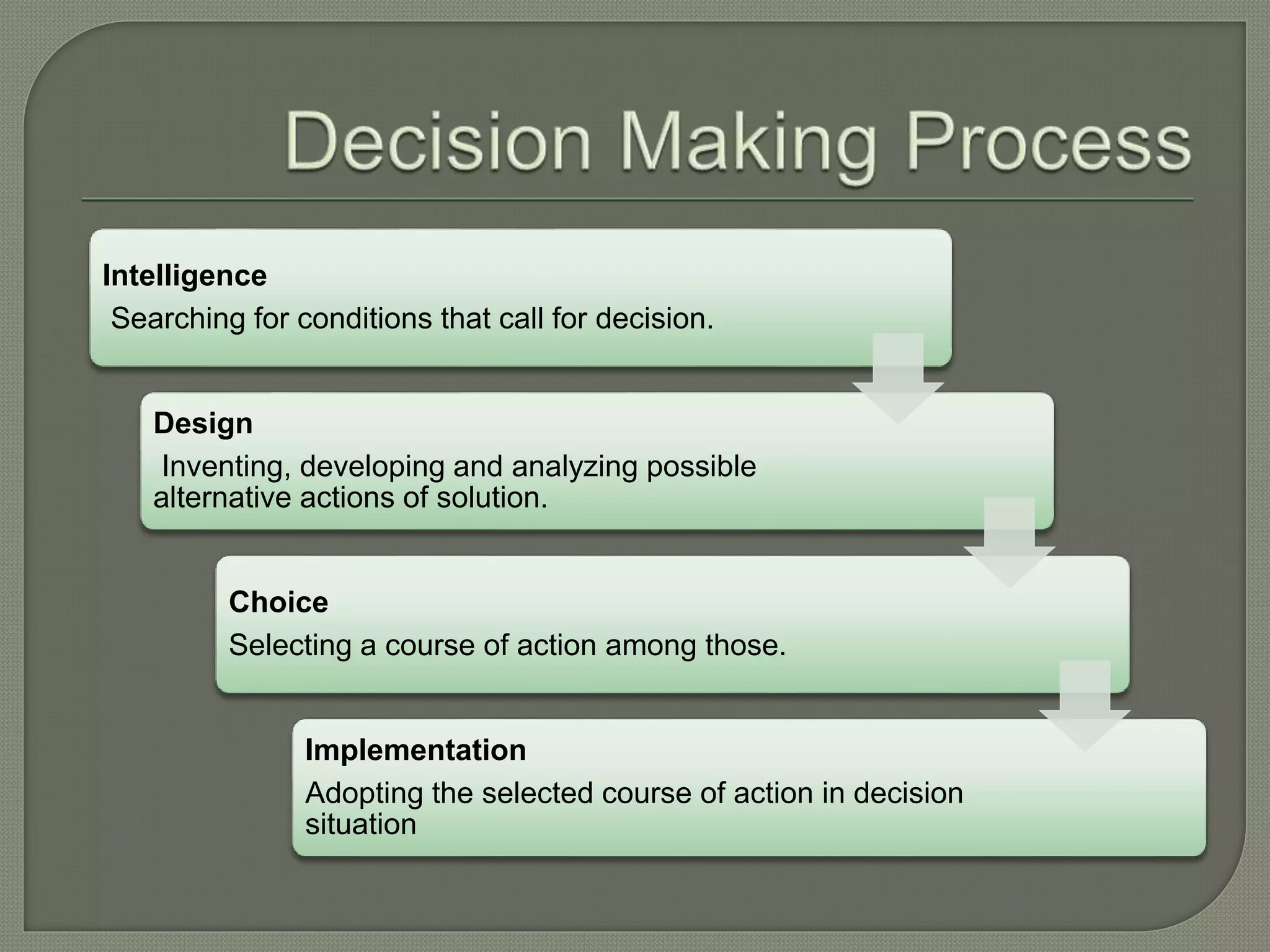
Intelligence
Searching for conditions that call for decision.
Design
Inventing, developing and analyzing possible
alternative actions of solution.
Choice
Selecting a course of action among those.
Implementation
Adopting the selected course of action in decision
situation
 DATA DRIVEN DSS. (Example: computer-based databases
that have a query system to check including the incorporation
of data to add value to existing databases.)
 MODEL-DRIVEN DSS. (Example :Deployment via
software/hardware in stand-alone PCs, client/server systems,
or the web)
 KNOWLEDGE DRIVEN DSS. (Example: Provides
specialized problem-solving expertise stored as facts, rules,
procedures, or in similar structures.)
 DOCUMENT DRIVEN DSS. ( Example: Unstructured
information in a variety of electronic formats.)
 COMMUNICATION DRIVEN DSS. (Examples: chats and
instant messaging software's, online collaboration and net-
meeting systems)
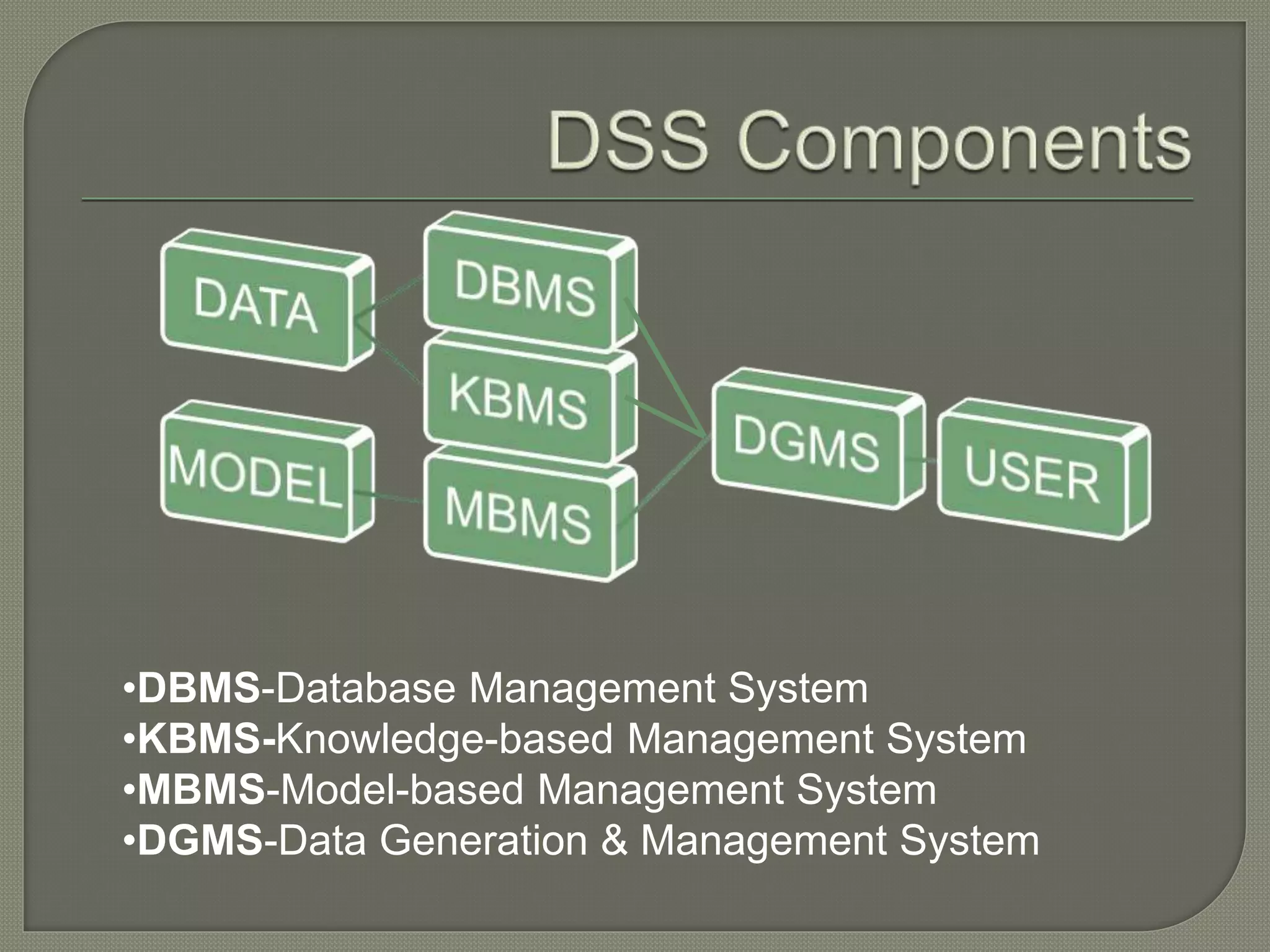
•DBMS-Database Management System
•KBMS-Knowledge-based Management System
•MBMS-Model-based Management System
•DGMS-Data Generation & Management System
 Airline Reservation system
No more seats available
Provide alternative flights you can use
Use the info to make flight plans
A Loan Manager can decide whether to grant loan to an applicant
Decision Making Software
E.g. Logical Decisions (30 days trial)
Expert Choice
Decide IT
1000Minds
 Improves personal efficiency
 Speed up the process of decision making
 Increases organizational control
 Encourages exploration and discovery on the part of the
decision maker
 Speeds up problem solving in an organization
 Facilitates interpersonal communication
 Promotes learning or training
 Generates new evidence in support of a decision
 Creates a competitive advantage over competition
 Reveals new approaches to thinking about the problem
space
 Helps automate managerial processes
 Create Innovative ideas to speed up the performance
Dss

Dss

  • 1.
  • 2.
     The conceptand applications of decision support systems (DSS) help companies to make better business decisions  Attain the organizational objectives in an efficient way.  Empowerment is important for having access to information and resources, thinking critically, being effective, create effecting change and building confidence.
  • 3.
    Definitions  A DecisionSupport System (DSS) is an interactive computer based system that help decision-makers use data and models to solve structured, unstructured or semi-structured problems (Gore, 1983).  Decision support systems can aid human cognitive deficiencies by integrating various sources of information, providing intelligent access to relevant knowledge, and aiding the process of structuring decisions, they can also support choice from among well-defined alternatives (Castro-Schez, Jimens, Moreno, & Rodringues, 2005).  A properly designed DSS is an interactive software-based system intended to help decision makers compile useful information from raw data, documents, personal knowledge, and/or business models to identify and solve problems and make decisions .  Decision Support Systems (DSS) are a specific class of computerized information system that supports business and organizational decision-making activities .
  • 4.
    Intelligence Searching for conditionsthat call for decision. Design Inventing, developing and analyzing possible alternative actions of solution. Choice Selecting a course of action among those. Implementation Adopting the selected course of action in decision situation
  • 5.
     DATA DRIVENDSS. (Example: computer-based databases that have a query system to check including the incorporation of data to add value to existing databases.)  MODEL-DRIVEN DSS. (Example :Deployment via software/hardware in stand-alone PCs, client/server systems, or the web)  KNOWLEDGE DRIVEN DSS. (Example: Provides specialized problem-solving expertise stored as facts, rules, procedures, or in similar structures.)  DOCUMENT DRIVEN DSS. ( Example: Unstructured information in a variety of electronic formats.)  COMMUNICATION DRIVEN DSS. (Examples: chats and instant messaging software's, online collaboration and net- meeting systems)
  • 6.
    •DBMS-Database Management System •KBMS-Knowledge-basedManagement System •MBMS-Model-based Management System •DGMS-Data Generation & Management System
  • 7.
     Airline Reservationsystem No more seats available Provide alternative flights you can use Use the info to make flight plans A Loan Manager can decide whether to grant loan to an applicant Decision Making Software E.g. Logical Decisions (30 days trial) Expert Choice Decide IT 1000Minds
  • 8.
     Improves personalefficiency  Speed up the process of decision making  Increases organizational control  Encourages exploration and discovery on the part of the decision maker  Speeds up problem solving in an organization  Facilitates interpersonal communication  Promotes learning or training  Generates new evidence in support of a decision  Creates a competitive advantage over competition  Reveals new approaches to thinking about the problem space  Helps automate managerial processes  Create Innovative ideas to speed up the performance