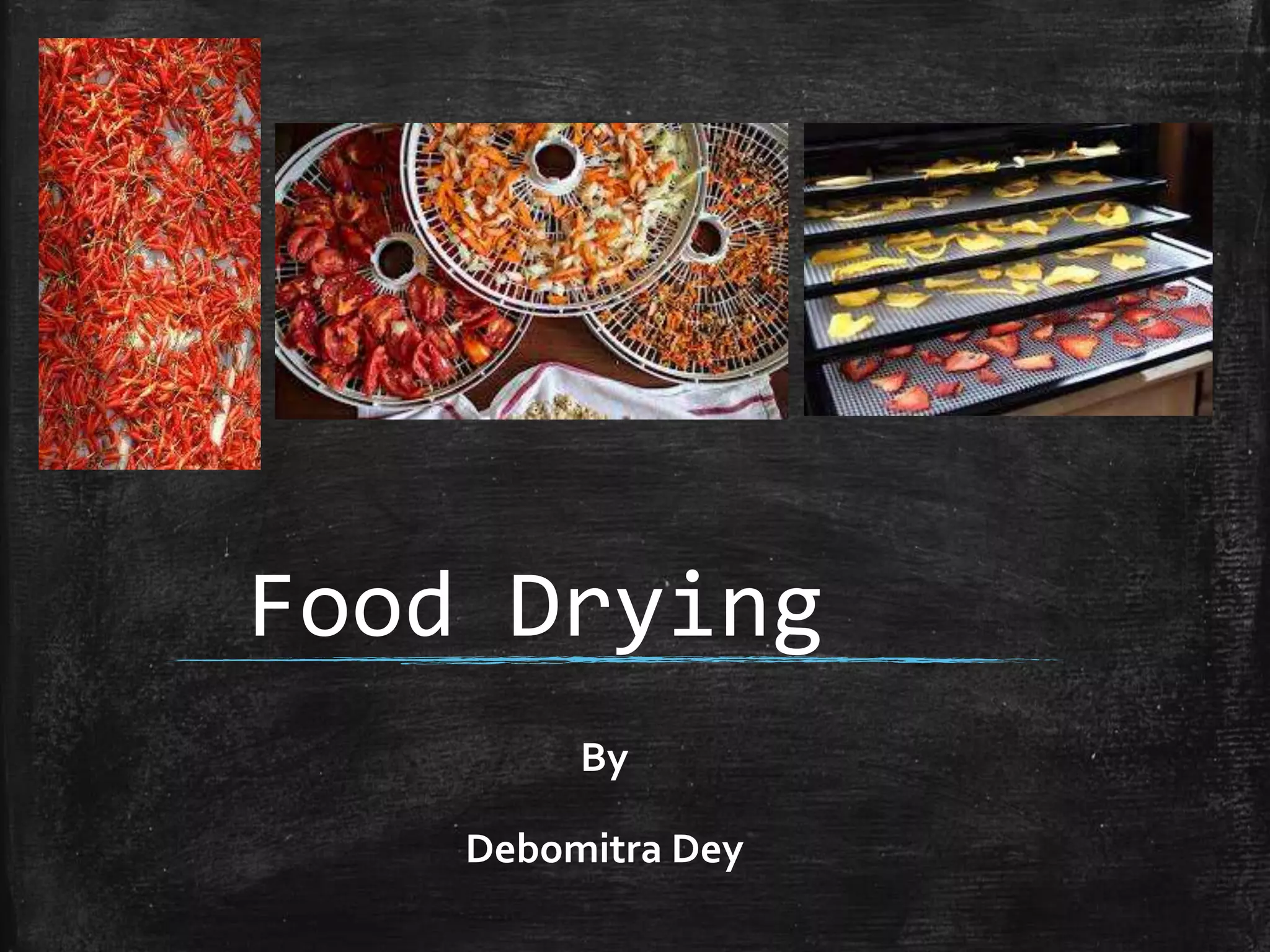
Food Drying
By
Debomitra Dey
DRYING
o Oldest method of Preservation.
o Important Unit Operation, can occur is conjunction with other
processes.
o Removal of water/moisture from a product to pre-
determined level, the low water activity attained by food
products extends the shelf life of dried foods without the
need for refrigerated storage or transportation.
o For e.g. Liquid milk is highly perishable, whereas milk
powders are more stable and easy for preservation and
handling.
12/9/2017 2
WATER ACTIVITY
o Dehydration accomplishes preservation in two ways:
1. Removes the water necessary for growth of microbes and
for enzymatic activity.
2. Removal of water, as it increases the osmotic pressure by
concentrating salts, sugars, acids thus creating
environment which is unfavourable for growth of
microbes.
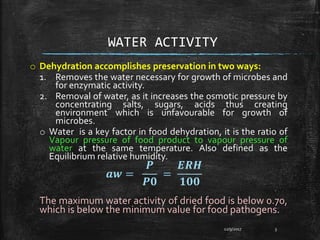
o Water is a key factor in food dehydration, it is the ratio of
Vapour pressure of food product to vapour pressure of
water at the same temperature. Also defined as the
Equilibrium relative humidity.
𝒂𝒘 =
𝑷
𝑷𝟎
=
𝑬𝑹𝑯
𝟏𝟎𝟎
The maximum water activity of dried food is below 0.70,
which is below the minimum value for food pathogens.
12/9/2017 3
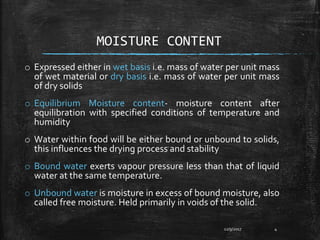
MOISTURE CONTENT
o Expressed either in wet basis i.e. mass of water per unit mass
of wet material or dry basis i.e. mass of water per unit mass
of dry solids
o Equilibrium Moisture content- moisture content after
equilibration with specified conditions of temperature and
humidity
o Water within food will be either bound or unbound to solids,
this influences the drying process and stability
o Bound water exerts vapour pressure less than that of liquid
water at the same temperature.
o Unbound water is moisture in excess of bound moisture, also
called free moisture. Held primarily in voids of the solid.
12/9/2017 4
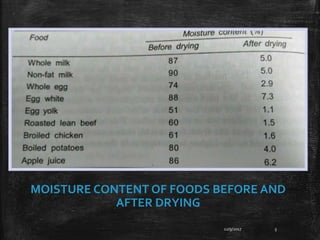
12/9/2017 5
MOISTURE CONTENT OF FOODS BEFORE AND
AFTER DRYING
RATE OF DRYING
The drying rate depends upon the following factors-
o Vapour pressure of water at drying temperature
o Vapour pressure of water in external
environment
o Equilibrium vapour pressure of water in the food
o Moisture content of food
12/9/2017 6
MECHANISM OF DRYING
1. INITIAL SETTLING DOWN- No loss of moisture, reaches
to wet bulb temperature.
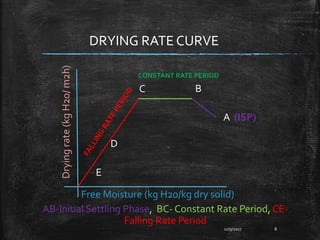
2. CONSTANT RATE PERIOD- CMC(Critical Moisture
content) is reached, moisture from food product to
atmosphere > moisture from atmosphere to outer surface
of grain.
3. FALLING RATE PERIOD- Rate of drying falls in this
period. Products can be packaged after this process, as
this marks the end of the process of drying.
12/9/2017 7
CONSTANT RATE PERIOD
12/9/2017 8
Free Moisture (kg H20/kg dry solid)
Drying
rate
(kg
H20/
m2h)
B
A (ISP)
C
D
E
AB-Initial Settling Phase, BC- Constant Rate Period, CE-
Falling Rate Period
DRYING RATE CURVE
FACTORS THAT INFLUENCE DRYING
OF FOOD
1. Drying Temperature- This varies with food and the method
of drying, greater the temperature difference between
heating medium and food, greater the rate of heat transfer
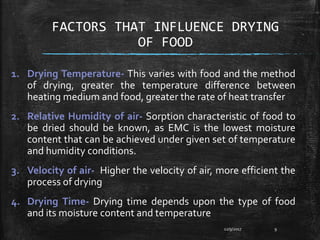
2. Relative Humidity of air- Sorption characteristic of food to
be dried should be known, as EMC is the lowest moisture
content that can be achieved under given set of temperature
and humidity conditions.
3. Velocity of air- Higher the velocity of air, more efficient the
process of drying
4. Drying Time- Drying time depends upon the type of food
and its moisture content and temperature
12/9/2017 9
o Preservation of foods
o Decreasing the weight and bulk of food to economize
shipping and canning costs
o Production of convenience products such as instant
coffee, milk powder, instant mash potatoes
12/9/2017 10
PURPOSE OF DRYING
DRYING PROCESSES
o Drying processes falls in 3 categories:
1. Air and contact drying- Heat is transferred
through food materials either from heated air
or heated surface.
2. Vacuum drying- Heat transfer is generally by
conduction sometimes by radiation.
3. Freeze drying- the water is sublimed off from
frozen food, structure of the food product is
maintained.
12/9/2017 11
12/9/2017 12
DRYERS
METHODS OF DRYING
1. SUN DRYING
2. USE OF MECHANICAL DRIERS
a) BY HEAT
b) DIRECTCONTACTWITH HEATED SURFACE
c) APPLICATION OF ENRGY FROM RADIATING
MICROWAVE OR DIELECTRIC SOURCE
3. FREEZE DRYING OR LYOPHILIZATION
12/9/2017 13
APPLICATION OF DRYER
12/9/2017 14
SELECTION OF DRYER
12/9/2017 15
1. Production capacity
2. Initial moisture content of product
3. Particle size distribution or shape of the product
4. Drying characteristic of product
5. Maximum allowable product temperature
6. Explosion characteristics (spray or fluid bed dryer)
7. Moisture isotherm
8. Physical data of material
SUN DRYING
o Oldest method of preservation of agricultural products (Imre, 1995;
Bolin & Salunkhe, 1982)
o Cheap method. Sun drying of food refers to foods that are dried under
the direct sun
o Radiant energy from sun provides heat to evaporate the water, while
wind helps to move the moisture and accelerates the process.
o Disadvantages- difficultly in controlling drying conditions, protection
from insects, pests, etc., availability of sun. 12/9/2017 16
HOT AIR DRYERS
o The food is in direct contact with moving stream
of hot air.
o Heat is supplied to product by convection
o The driers that are used for drying solid foods are-
12/9/2017 17
1. Kiln dryers
2. Cabinet tray
dryer
3. Pneumatic
dryer
4. Fluidized bed
dryer
5. Rotatory
dryer
6. Spray dryer
7. Bin dryer
8. Tunnel dryer
9. Conveyor
belt dryer
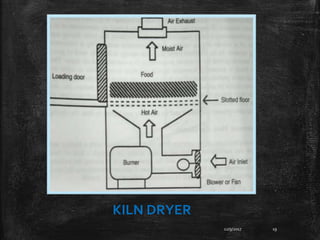
KILN DRYER
o Consists of a two-floor installation, burner or
furnace on the ground floor.
o Product is placed on the slatted floor and hot air is
forced from the lower floor.
o Drying times are quite long due to extensive
number of product processed during drying cycle
almost 20 tons per day.
o Dryer allows processing of liquid slurries to solid
materials, products like hops, apple rings, malt,
grains can be dried using Kiln dryer.
12/9/2017 18
12/9/2017 19
KILN DRYER
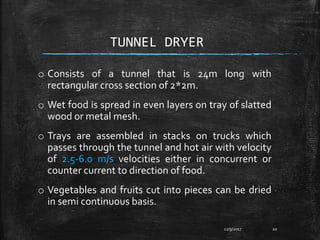
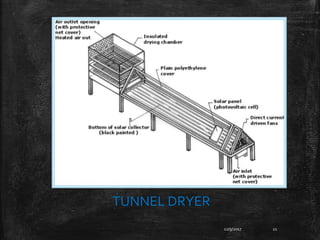
TUNNEL DRYER
o Consists of a tunnel that is 24m long with
rectangular cross section of 2*2m.
o Wet food is spread in even layers on tray of slatted
wood or metal mesh.
o Trays are assembled in stacks on trucks which
passes through the tunnel and hot air with velocity
of 2.5-6.0 m/s velocities either in concurrent or
counter current to direction of food.
o Vegetables and fruits cut into pieces can be dried
in semi continuous basis.
12/9/2017 20
12/9/2017 21
TUNNEL DRYER
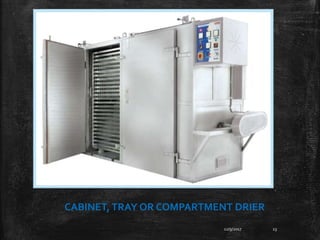
CABINET, TRAY OR COMAPARTMENT DRYER
o Insulated cabinet with air circulating fan which
moves the air through heater and then through
baffles which direct air between the trays of food.
o They vary in the number of trays, and have varied
application in the industry, which includes drying
fruits and vegetables at 1-20 tons/day.
o The installation is cheap and flexible.
12/9/2017 22
12/9/2017 23
CABINET,TRAY OR COMPARTMENT DRIER
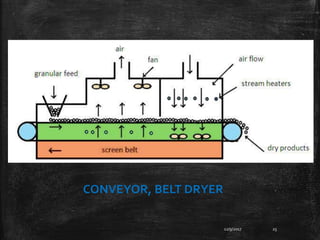
CONVEYOR, BELT DRIER
o Similar to tray dryer, but wet material is conveyed
through a tunnel on perforated (mesh) conveyors.
o The heated air is either directed up or down
through the conveyor, the layer of product either
maybe perpendicular or parallel to the surface
spread in thin layer.
o Dryers consists of two or more conveyors,
sometimes maybe up to five, they called Multiple
conveyors
o Used for drying vegetables and fruits mainly in
diced form.
12/9/2017 24
12/9/2017 25
CONVEYOR, BELT DRYER
12/9/2017 26
MULTI PASS CONVEYOR DRYER
PNEUMATIC DRIER
o Generally used for the finishing of dried powder or
granulated materials.
o The incoming material is usually pre-dried (Spray,
fluidized, etc.) to moisture level below 40% (wb).
o Dried product are separated from exhaust air by
cyclone or filters.
o Commercially used pneumatic driers are Flash and
Full ring dryer, used for drying powders like
potatoes, corn and starch.
12/9/2017 27
ROTARY DRIER
o Rotatory dryers are used to dry particulate solid foods
(Kelly, 1995).
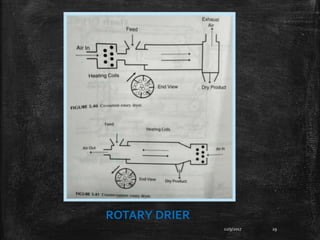
o The wet material is rotated in cylindrical shell and heated
air is passed through as the material is agitated.
o Drying medium is either hot air or combustion gases co-
currently or counter-currently.
o Size of dryers in usually 0.3m diameter-2m in length to
5m diameter-90m length.
o Application includes in drying of meat pellets, granulated
sugars, treatment of cocoa beans.
12/9/2017 28
12/9/2017 29
ROTARY DRIER
SPRAY DRIER
o It involves a suspended particle processing
operation that consists of particle formation as
well as drying
o It commonly used for processing of milk
powders, coffee, tea, whey solids, ice cream
mix, milk based baby foods, yeast extract,
edible proteins.
o Three steps of drying-
1. Atomization of feed
2. Spray air mixing and moisture evaporation
3. Separation of dry product from outlet air
12/9/2017 30
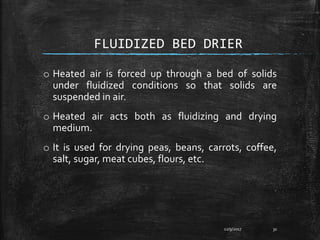
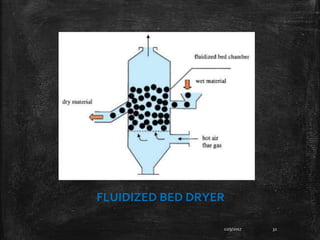
FLUIDIZED BED DRIER
o Heated air is forced up through a bed of solids
under fluidized conditions so that solids are
suspended in air.
o Heated air acts both as fluidizing and drying
medium.
o It is used for drying peas, beans, carrots, coffee,
salt, sugar, meat cubes, flours, etc.
12/9/2017 31
12/9/2017 32
FLUIDIZED BED DRYER
12/9/2017 33
CONTACT DRIERS
Consists of hot surface used as source of heat, necessary
for evaporation of moisture from thick liquids, pulps,
pastes or slurries.
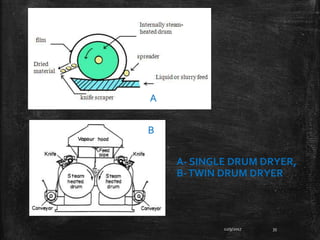
DRUM/ROLLER DRIER
o Can be used for drying liquid and slurry forms of food,
and foods which can withstand relatively high
temperature for short time.
o Used for drying milk, soup mixes, mashed potatoes.
o Double drum can be used for drying tomatoes,
pumpkin purees.
o Consists of single, double, twin drum with feed roller
and vacuum casing
o Film of feed material is uniform in depth, economic for
use as high rates of drying.
12/9/2017 34
12/9/2017 35
A
B
A- SINGLE DRUM DRYER,
B-TWIN DRUM DRYER
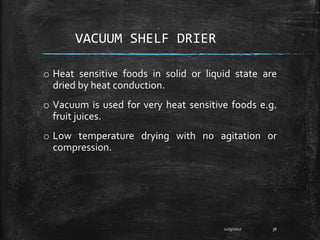
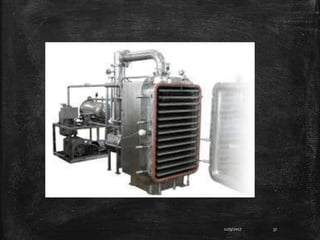
VACUUM SHELF DRIER
o Heat sensitive foods in solid or liquid state are
dried by heat conduction.
o Vacuum is used for very heat sensitive foods e.g.
fruit juices.
o Low temperature drying with no agitation or
compression.
12/9/2017 36
12/9/2017 37
VACUUM BAND DRIER
o It can be used to drying of liquids and slurries such as fruit
juices concentrates, tomato concentrates and coffee
extracts.
o ‘Puff Drying’ is a method to obtain rapid drying by
adjusting the vacuum to make the material puff by the
evolution of gases.
12/9/2017 38
NOVEL DRYING TECHNOLOGY
1. MICROWAVE DRYING- Microwave heating in
combination with hot air circulation is used for
drying. It can reduce drying time. Microwave-
vacuum drying has advantages over conventional
drying, as there is little shrinkage, reduced loss
of nutrients and flavours.
2. RADIO FREQUENCY DRYING- Uses frequency
in the range of 3-3000MHz, the penetration of RF
is large as compared to MW. The largest
application is in the finishing of dried post baked
biscuits and cereal product.
12/9/2017 39
FREEZE DRYING
o Removal of moisture as a result of sublimation of water (ice
to vapour) without phase change from solid to liquid.
o Latent heat is conducted inward through the layer of dried
material, water vapour is also transferred through the layer
of dried material, thus heat and mass transfer occur
simultaneously during freeze drying.
o Freeze dried products can be stored for unlimited time,
most physical, chemical, biological, organoleptic properties
is retained.
o Essentially used for preserving exotic fruits, spices, herbs,
instant dry soups, instant coffee.
12/9/2017 40
OSMOTIC DEHYDRATION
o Osmotic dehydration is the phenomenon of removal of water from
lower concentration of solute to higher concentration through
semi permeable membrane results in the equilibrium condition in
both sides of membrane (Tiwari 2005).
o Osmotic dehydration is preferred over other methods due to the
retention of colour, aroma, nutritional constituents and flavour.
o The most important products of commercial importance available
in market made from fruits are murabbas of gooseberry (Aonla),
apple, candies of different fruits and vegetables like pethas, sweets
of parwal made by osmosis in sugar syrup..
o Common methods of applying these processes include drying,
spray drying, freeze drying, freezing, vacuum packing, canning,
preserving in syrup (osmotic dehydration), sugar crystallization,
food irradiation and adding preservatives or inert gases such as
carbon dioxide
12/9/2017 41
FOAM DRYING
o Two methods for foam drying- Foam mat and Foam spray
drying
o Stable gas-liquid foam is prerequisite for foam drying.
Natural foam like egg white, vegetable proteins like soya
protein, gums, emulsifiers are used.
o Liquid foods are formed into a stable foam by the
addition of a stabiliser.
o The foam is spread on a perforated belt to a depth of 2–
3mm and dried
12/9/2017 42
12/9/2017 43
FOAM MAT DRYING
CHANGES THAT OCCUR DURING DRYING
1. Movement of solids- Soluble solids move towards the surface
because of Shrinkage, concentration gradient set up between
surface and the wet center.
2. Shrinkage- May influence the drying rates, due to changes in
surface areas, pressure gradients.
3. Cellular structure- Blanching makes cells more permeable hence
cooked meat, vegetable dry easily.
4. Case hardening- Common phenomenon in food with high
concentration of sugars and other solute.
5. Porosity- Escaping steam tends to puff product which desirable in
bakery products, makes structure more porous so as to facilitate
mass transfer and increase drying rate.
6. Chemical and other changes- Browning reactions, texture
changes, Flavour,Texture, Aroma, Denaturation of proteins.
12/9/2017 44
REFERENCES
1. Earle RL, Unit operations in Food Processing, Second Edition,
Pergamon Press,1983, Pg. 85-95
2. Unit operations in Agricultural Processes
3. Sivashankar B, Food Processing and Preservation, PHI Learning Pvt
Ltd, 2010, Pg. 219-229
4. Ramaswamy H, Marcotte M, Food Processing Principles and
Applications,Taylor and Francis,2009, Pg. 233-302
5. Yadav Ashok, Singh Satya, Osmotic dehydration of fruits and
vegetables: a review, Journal of Food Science and Technology,
September 2014,Volume 51, Issue 9, pp 1654-1673
Image source- Internet and above mentioned references
Video source- Internet
12/9/2017 45
12/9/2017 46

dryingdebomitra-171209201547.pdf

  • 1.
  • 2.
    DRYING o Oldest methodof Preservation. o Important Unit Operation, can occur is conjunction with other processes. o Removal of water/moisture from a product to pre- determined level, the low water activity attained by food products extends the shelf life of dried foods without the need for refrigerated storage or transportation. o For e.g. Liquid milk is highly perishable, whereas milk powders are more stable and easy for preservation and handling. 12/9/2017 2
  • 3.
    WATER ACTIVITY o Dehydrationaccomplishes preservation in two ways: 1. Removes the water necessary for growth of microbes and for enzymatic activity. 2. Removal of water, as it increases the osmotic pressure by concentrating salts, sugars, acids thus creating environment which is unfavourable for growth of microbes. o Water is a key factor in food dehydration, it is the ratio of Vapour pressure of food product to vapour pressure of water at the same temperature. Also defined as the Equilibrium relative humidity. 𝒂𝒘 = 𝑷 𝑷𝟎 = 𝑬𝑹𝑯 𝟏𝟎𝟎 The maximum water activity of dried food is below 0.70, which is below the minimum value for food pathogens. 12/9/2017 3
  • 4.
    MOISTURE CONTENT o Expressedeither in wet basis i.e. mass of water per unit mass of wet material or dry basis i.e. mass of water per unit mass of dry solids o Equilibrium Moisture content- moisture content after equilibration with specified conditions of temperature and humidity o Water within food will be either bound or unbound to solids, this influences the drying process and stability o Bound water exerts vapour pressure less than that of liquid water at the same temperature. o Unbound water is moisture in excess of bound moisture, also called free moisture. Held primarily in voids of the solid. 12/9/2017 4
  • 5.
    12/9/2017 5 MOISTURE CONTENTOF FOODS BEFORE AND AFTER DRYING
  • 6.
    RATE OF DRYING Thedrying rate depends upon the following factors- o Vapour pressure of water at drying temperature o Vapour pressure of water in external environment o Equilibrium vapour pressure of water in the food o Moisture content of food 12/9/2017 6
  • 7.
    MECHANISM OF DRYING 1.INITIAL SETTLING DOWN- No loss of moisture, reaches to wet bulb temperature. 2. CONSTANT RATE PERIOD- CMC(Critical Moisture content) is reached, moisture from food product to atmosphere > moisture from atmosphere to outer surface of grain. 3. FALLING RATE PERIOD- Rate of drying falls in this period. Products can be packaged after this process, as this marks the end of the process of drying. 12/9/2017 7
  • 8.
    CONSTANT RATE PERIOD 12/9/20178 Free Moisture (kg H20/kg dry solid) Drying rate (kg H20/ m2h) B A (ISP) C D E AB-Initial Settling Phase, BC- Constant Rate Period, CE- Falling Rate Period DRYING RATE CURVE
  • 9.
    FACTORS THAT INFLUENCEDRYING OF FOOD 1. Drying Temperature- This varies with food and the method of drying, greater the temperature difference between heating medium and food, greater the rate of heat transfer 2. Relative Humidity of air- Sorption characteristic of food to be dried should be known, as EMC is the lowest moisture content that can be achieved under given set of temperature and humidity conditions. 3. Velocity of air- Higher the velocity of air, more efficient the process of drying 4. Drying Time- Drying time depends upon the type of food and its moisture content and temperature 12/9/2017 9
  • 10.
    o Preservation offoods o Decreasing the weight and bulk of food to economize shipping and canning costs o Production of convenience products such as instant coffee, milk powder, instant mash potatoes 12/9/2017 10 PURPOSE OF DRYING
  • 11.
    DRYING PROCESSES o Dryingprocesses falls in 3 categories: 1. Air and contact drying- Heat is transferred through food materials either from heated air or heated surface. 2. Vacuum drying- Heat transfer is generally by conduction sometimes by radiation. 3. Freeze drying- the water is sublimed off from frozen food, structure of the food product is maintained. 12/9/2017 11
  • 12.
  • 13.
    METHODS OF DRYING 1.SUN DRYING 2. USE OF MECHANICAL DRIERS a) BY HEAT b) DIRECTCONTACTWITH HEATED SURFACE c) APPLICATION OF ENRGY FROM RADIATING MICROWAVE OR DIELECTRIC SOURCE 3. FREEZE DRYING OR LYOPHILIZATION 12/9/2017 13
  • 14.
  • 15.
    SELECTION OF DRYER 12/9/201715 1. Production capacity 2. Initial moisture content of product 3. Particle size distribution or shape of the product 4. Drying characteristic of product 5. Maximum allowable product temperature 6. Explosion characteristics (spray or fluid bed dryer) 7. Moisture isotherm 8. Physical data of material
  • 16.
    SUN DRYING o Oldestmethod of preservation of agricultural products (Imre, 1995; Bolin & Salunkhe, 1982) o Cheap method. Sun drying of food refers to foods that are dried under the direct sun o Radiant energy from sun provides heat to evaporate the water, while wind helps to move the moisture and accelerates the process. o Disadvantages- difficultly in controlling drying conditions, protection from insects, pests, etc., availability of sun. 12/9/2017 16
  • 17.
    HOT AIR DRYERS oThe food is in direct contact with moving stream of hot air. o Heat is supplied to product by convection o The driers that are used for drying solid foods are- 12/9/2017 17 1. Kiln dryers 2. Cabinet tray dryer 3. Pneumatic dryer 4. Fluidized bed dryer 5. Rotatory dryer 6. Spray dryer 7. Bin dryer 8. Tunnel dryer 9. Conveyor belt dryer
  • 18.
    KILN DRYER o Consistsof a two-floor installation, burner or furnace on the ground floor. o Product is placed on the slatted floor and hot air is forced from the lower floor. o Drying times are quite long due to extensive number of product processed during drying cycle almost 20 tons per day. o Dryer allows processing of liquid slurries to solid materials, products like hops, apple rings, malt, grains can be dried using Kiln dryer. 12/9/2017 18
  • 19.
  • 20.
    TUNNEL DRYER o Consistsof a tunnel that is 24m long with rectangular cross section of 2*2m. o Wet food is spread in even layers on tray of slatted wood or metal mesh. o Trays are assembled in stacks on trucks which passes through the tunnel and hot air with velocity of 2.5-6.0 m/s velocities either in concurrent or counter current to direction of food. o Vegetables and fruits cut into pieces can be dried in semi continuous basis. 12/9/2017 20
  • 21.
  • 22.
    CABINET, TRAY ORCOMAPARTMENT DRYER o Insulated cabinet with air circulating fan which moves the air through heater and then through baffles which direct air between the trays of food. o They vary in the number of trays, and have varied application in the industry, which includes drying fruits and vegetables at 1-20 tons/day. o The installation is cheap and flexible. 12/9/2017 22
  • 23.
  • 24.
    CONVEYOR, BELT DRIER oSimilar to tray dryer, but wet material is conveyed through a tunnel on perforated (mesh) conveyors. o The heated air is either directed up or down through the conveyor, the layer of product either maybe perpendicular or parallel to the surface spread in thin layer. o Dryers consists of two or more conveyors, sometimes maybe up to five, they called Multiple conveyors o Used for drying vegetables and fruits mainly in diced form. 12/9/2017 24
  • 25.
  • 26.
  • 27.
    PNEUMATIC DRIER o Generallyused for the finishing of dried powder or granulated materials. o The incoming material is usually pre-dried (Spray, fluidized, etc.) to moisture level below 40% (wb). o Dried product are separated from exhaust air by cyclone or filters. o Commercially used pneumatic driers are Flash and Full ring dryer, used for drying powders like potatoes, corn and starch. 12/9/2017 27
  • 28.
    ROTARY DRIER o Rotatorydryers are used to dry particulate solid foods (Kelly, 1995). o The wet material is rotated in cylindrical shell and heated air is passed through as the material is agitated. o Drying medium is either hot air or combustion gases co- currently or counter-currently. o Size of dryers in usually 0.3m diameter-2m in length to 5m diameter-90m length. o Application includes in drying of meat pellets, granulated sugars, treatment of cocoa beans. 12/9/2017 28
  • 29.
  • 30.
    SPRAY DRIER o Itinvolves a suspended particle processing operation that consists of particle formation as well as drying o It commonly used for processing of milk powders, coffee, tea, whey solids, ice cream mix, milk based baby foods, yeast extract, edible proteins. o Three steps of drying- 1. Atomization of feed 2. Spray air mixing and moisture evaporation 3. Separation of dry product from outlet air 12/9/2017 30
  • 31.
    FLUIDIZED BED DRIER oHeated air is forced up through a bed of solids under fluidized conditions so that solids are suspended in air. o Heated air acts both as fluidizing and drying medium. o It is used for drying peas, beans, carrots, coffee, salt, sugar, meat cubes, flours, etc. 12/9/2017 31
  • 32.
  • 33.
    12/9/2017 33 CONTACT DRIERS Consistsof hot surface used as source of heat, necessary for evaporation of moisture from thick liquids, pulps, pastes or slurries.
  • 34.
    DRUM/ROLLER DRIER o Canbe used for drying liquid and slurry forms of food, and foods which can withstand relatively high temperature for short time. o Used for drying milk, soup mixes, mashed potatoes. o Double drum can be used for drying tomatoes, pumpkin purees. o Consists of single, double, twin drum with feed roller and vacuum casing o Film of feed material is uniform in depth, economic for use as high rates of drying. 12/9/2017 34
  • 35.
    12/9/2017 35 A B A- SINGLEDRUM DRYER, B-TWIN DRUM DRYER
  • 36.
    VACUUM SHELF DRIER oHeat sensitive foods in solid or liquid state are dried by heat conduction. o Vacuum is used for very heat sensitive foods e.g. fruit juices. o Low temperature drying with no agitation or compression. 12/9/2017 36
  • 37.
  • 38.
    VACUUM BAND DRIER oIt can be used to drying of liquids and slurries such as fruit juices concentrates, tomato concentrates and coffee extracts. o ‘Puff Drying’ is a method to obtain rapid drying by adjusting the vacuum to make the material puff by the evolution of gases. 12/9/2017 38
  • 39.
    NOVEL DRYING TECHNOLOGY 1.MICROWAVE DRYING- Microwave heating in combination with hot air circulation is used for drying. It can reduce drying time. Microwave- vacuum drying has advantages over conventional drying, as there is little shrinkage, reduced loss of nutrients and flavours. 2. RADIO FREQUENCY DRYING- Uses frequency in the range of 3-3000MHz, the penetration of RF is large as compared to MW. The largest application is in the finishing of dried post baked biscuits and cereal product. 12/9/2017 39
  • 40.
    FREEZE DRYING o Removalof moisture as a result of sublimation of water (ice to vapour) without phase change from solid to liquid. o Latent heat is conducted inward through the layer of dried material, water vapour is also transferred through the layer of dried material, thus heat and mass transfer occur simultaneously during freeze drying. o Freeze dried products can be stored for unlimited time, most physical, chemical, biological, organoleptic properties is retained. o Essentially used for preserving exotic fruits, spices, herbs, instant dry soups, instant coffee. 12/9/2017 40
  • 41.
    OSMOTIC DEHYDRATION o Osmoticdehydration is the phenomenon of removal of water from lower concentration of solute to higher concentration through semi permeable membrane results in the equilibrium condition in both sides of membrane (Tiwari 2005). o Osmotic dehydration is preferred over other methods due to the retention of colour, aroma, nutritional constituents and flavour. o The most important products of commercial importance available in market made from fruits are murabbas of gooseberry (Aonla), apple, candies of different fruits and vegetables like pethas, sweets of parwal made by osmosis in sugar syrup.. o Common methods of applying these processes include drying, spray drying, freeze drying, freezing, vacuum packing, canning, preserving in syrup (osmotic dehydration), sugar crystallization, food irradiation and adding preservatives or inert gases such as carbon dioxide 12/9/2017 41
  • 42.
    FOAM DRYING o Twomethods for foam drying- Foam mat and Foam spray drying o Stable gas-liquid foam is prerequisite for foam drying. Natural foam like egg white, vegetable proteins like soya protein, gums, emulsifiers are used. o Liquid foods are formed into a stable foam by the addition of a stabiliser. o The foam is spread on a perforated belt to a depth of 2– 3mm and dried 12/9/2017 42
  • 43.
  • 44.
    CHANGES THAT OCCURDURING DRYING 1. Movement of solids- Soluble solids move towards the surface because of Shrinkage, concentration gradient set up between surface and the wet center. 2. Shrinkage- May influence the drying rates, due to changes in surface areas, pressure gradients. 3. Cellular structure- Blanching makes cells more permeable hence cooked meat, vegetable dry easily. 4. Case hardening- Common phenomenon in food with high concentration of sugars and other solute. 5. Porosity- Escaping steam tends to puff product which desirable in bakery products, makes structure more porous so as to facilitate mass transfer and increase drying rate. 6. Chemical and other changes- Browning reactions, texture changes, Flavour,Texture, Aroma, Denaturation of proteins. 12/9/2017 44
  • 45.
    REFERENCES 1. Earle RL,Unit operations in Food Processing, Second Edition, Pergamon Press,1983, Pg. 85-95 2. Unit operations in Agricultural Processes 3. Sivashankar B, Food Processing and Preservation, PHI Learning Pvt Ltd, 2010, Pg. 219-229 4. Ramaswamy H, Marcotte M, Food Processing Principles and Applications,Taylor and Francis,2009, Pg. 233-302 5. Yadav Ashok, Singh Satya, Osmotic dehydration of fruits and vegetables: a review, Journal of Food Science and Technology, September 2014,Volume 51, Issue 9, pp 1654-1673 Image source- Internet and above mentioned references Video source- Internet 12/9/2017 45
  • 46.