Drying
For D- Pharm Students
Presented By-Sandhya Punetha
Drying
 It is defined as a process of final removal of liquid from
solids by vaporisation with the aid of heat.
 The equipment used for drying is callef a dryer.
Theoryof
drying
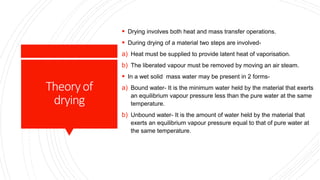
 Drying involves both heat and mass transfer operations.
 During drying of a material two steps are involved-
a) Heat must be supplied to provide latent heat of vaporisation.
b) The liberated vapour must be removed by moving an air steam.
 In a wet solid mass water may be present in 2 forms-
a) Bound water- It is the minimum water held by the material that exerts
an equilibrium vapour pressure less than the pure water at the same
temperature.
b) Unbound water- It is the amount of water held by the material that
exerts an equilibrium vapour pressure equal to that of pure water at
the same temperature.
Applicationsof
Drying
 In pharmaceutical industry it is used as a unit process in
the manufacture of granules which can be dispersed in
bulk or converted into tablets or capsules.
 It is also be used to reduce bulk and weight of the
material which reduces the cost of transportation and
storage.
 It helps in preservation of crude drugs.
 It also helps in size reduction of crude drugs.
 It is used in the processing of materials.
Equipments
usedfordrying
 Tray dryers.
 Fluidized bed dryers.
 Vacuum dryers.
 Freeze dryers.
Traydryer
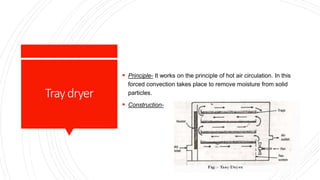
 Principle- It works on the principle of hot air circulation. In this
forced convection takes place to remove moisture from solid
particles.
 Construction-
Constructionof
trayer
 It consists of rectangular chamber which is insulated and
trayers are placed inside the chamber.
 In laboratory tray dryer consists of 3 trays and industry
tray dryer consists of 20 trays.
 Each tray is rectangular or square in shape and the
distance between both the tray is about 40mm.
 Dryer is fitted with a fan which circulate hot air into the
whole chamber.
Workingoftray
dryers
Working-
 Solid are inserted into the tray where fresh air is passed through
the inlet which passes through the heater and gets heated up.
 Hot air is circulated with the help of fans. The tray containing the
load remain in the dryer until the drying is complete.
 After that material is withdrawal and ready for drying the next
batch.
Uses- For drying sticky material and granular mass.
For drying crude drugs, chemical powders etc.
Advantagesand
disadvantages
 Advantages- Easy process.
Batch process.
Used for variety of materials.
 Disadvantages-. Require labour.
Costly
. Time consuming.
Fluidizedbed
dryer
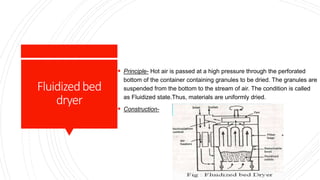
 Principle- Hot air is passed at a high pressure through the perforated
bottom of the container containing granules to be dried. The granules are
suspended from the bottom to the stream of air. The condition is called
as Fluidized state.Thus, materials are uniformly dried.
 Construction-
Construction of
fluidizedbed
dryer
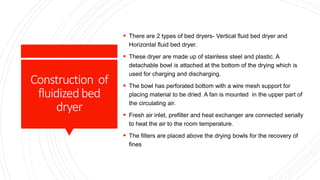
 There are 2 types of bed dryers- Vertical fluid bed dryer and
Horizontal fluid bed dryer.
 These dryer are made up of stainless steel and plastic. A
detachable bowl is attached at the bottom of the drying which is
used for charging and discharging.
 The bowl has perforated bottom with a wire mesh support for
placing material to be dried. A fan is mounted in the upper part of
the circulating air.
 Fresh air inlet, prefilter and heat exchanger are connected serially
to heat the air to the room temperature.
 The filters are placed above the drying bowls for the recovery of
fines
Working of
fluidizedbed
dryer
 The wet granules are placed into the detachable bowls and it is
placed into the dryer.
 Fresh air is passed through the inlet where it is heated by the
heater and the hot air is passed through the bed with optimum
velocity.
 Particles are suspended through fluidized state and get dried.
Uses- Drying of tablet granules.
Suitable for other processes like mixing etc.
Use for coating of granules.
Advantagesand
disadvantages
 Advantages- Fast processes.
Easy handling.
Suitable for thermolabile substances
. Available in different capacity.
 Disadvantages- Develop electric charges.
Attrition may occur.
VacuumDryer
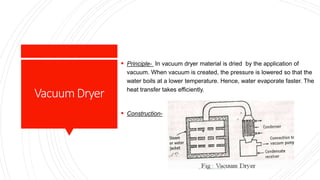
 Principle- In vacuum dryer material is dried by the application of
vacuum. When vacuum is created, the pressure is lowered so that the
water boils at a lower temperature. Hence, water evaporate faster. The
heat transfer takes efficiently.
 Construction-
Constructionof
vacuumdryer
 It is made up of iron heavy jacketed vessel.
 It consists of 20 hallow shelves which provides large
conduction area for heating.
 Over the shelves metal trays are placed for keeping the
materials.
 The oven door are tightly locked to give an air tight seal.
 Oven is connected to the vacuum pump by placing the
condenser in between.
Workingof
vacuumdryer
 Working-
 Materials to be dried are placed on the shelves of the tray.
 Pressure is decreased upto 30-60 kilopascal by means of
vacuum pump.
 Heat is supplied to the hollow jacket and shelves.
 With the help of vacuum evaporation takes place and
material is dried.
Uses- Drying of heat sensitive material.
Drugs containing toxic solvents.
Advantagesand
disadvantages
 Advantages-
Easy operating
Easy for batch process of different compounds.
Various modes can be used for heating.
 Disadvantages-
Low heat transfer efficiency.
Limited capacity.
More expensive.
FreezeDryers
(Lypophilization)
 Principle- In this water is removed from the frozen
process by sublimation ( direct change of any substance
from solid to gas). Solid-liquid-vapour equilibrium phase
diagram of water is useful to decide the experimental
conditions. The drying is achieved by subjecting material
to temperature and pressure below triple point.
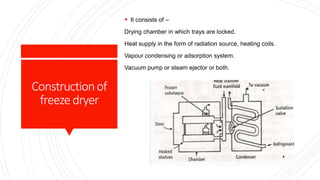
Constructionof
freezedryer
 It consists of –
Drying chamber in which trays are locked.
Heat supply in the form of radiation source, heating coils.
Vapour condensing or adsorption system.
Vacuum pump or steam ejector or both.
Workingof
freezedryer
 The working of freeze dryer involves the following steps-
a) Pre-treatment- This step is done to reduce the volume
of the solution to be introduced into the container which
has limited capacity. The solution is pre-concentrated
under normal vacuum tray drying. Sometimes solid or
liquid desiccants are also used for this purpose. This
reduces the actual drying by 8-10 times.
b) Pre-freezing- This is done to solidify water. The
ampoules, vials and bottles in which aqueous solution is
packed, are frozen in cold shelves at a temperature
below -50˚𝐶.
3) Primary drying- The material to be dried is spread in
order to increase the surface area for sublimation. The
temperature and pressure is kept below the triple point of
water for the sublimination of water. Heat is supplied which
transfers as latent heat and ice directly into vapour state
which are ultimately removed. Primary drying help to
remove about 98-99% moisture.
4) Secondary drying- The moisture left in the primary
drying is removed by an ordinary vacuum drying. The
vacuum drying is done at a temperature of 50-60˚C. The
rate of drying is very slow and its takes about 10-20 hours.
5) Packing- The biological products dried by freeze drying are
usually required to be in a sterile condition for injection. So, attention
must be paid to packaging of freeze dried products to ensure
protection from moisture. The containers should be closed under the
coontrolled atmospheric condition and also observing aseptic
conditions. The ampoules are sealed immediately after drying,
whereas the vials and bottles are closed as such or after replacement
of vacuum by inert gas. The containers are labelled and packed in
card-board boxes.
Uses- Used for drying of biological products like- antibiotics; blood
products; vaccines etc.
Used for thermo-labile pharmaceutical substances.
Advantages and
Disadvantages
 Advantages-
Thermo-labile substances can be dried.
Sterility can be maintained.
Moisture level can be kept as low as possible.
Material can be dried in its final container .
Product is porous and uniform.
 Disadvantages-
The product is prone to oxidation.
Expensive
Period of drying is high
Not suitable for non-aqueous solvents.
“ By failing to prepare, you
are preparing to fail”
THANK YOU

Drying

  • 1.
    Drying For D- PharmStudents Presented By-Sandhya Punetha
  • 2.
    Drying  It isdefined as a process of final removal of liquid from solids by vaporisation with the aid of heat.  The equipment used for drying is callef a dryer.
  • 3.
    Theoryof drying  Drying involvesboth heat and mass transfer operations.  During drying of a material two steps are involved- a) Heat must be supplied to provide latent heat of vaporisation. b) The liberated vapour must be removed by moving an air steam.  In a wet solid mass water may be present in 2 forms- a) Bound water- It is the minimum water held by the material that exerts an equilibrium vapour pressure less than the pure water at the same temperature. b) Unbound water- It is the amount of water held by the material that exerts an equilibrium vapour pressure equal to that of pure water at the same temperature.
  • 4.
    Applicationsof Drying  In pharmaceuticalindustry it is used as a unit process in the manufacture of granules which can be dispersed in bulk or converted into tablets or capsules.  It is also be used to reduce bulk and weight of the material which reduces the cost of transportation and storage.  It helps in preservation of crude drugs.  It also helps in size reduction of crude drugs.  It is used in the processing of materials.
  • 5.
    Equipments usedfordrying  Tray dryers. Fluidized bed dryers.  Vacuum dryers.  Freeze dryers.
  • 6.
    Traydryer  Principle- Itworks on the principle of hot air circulation. In this forced convection takes place to remove moisture from solid particles.  Construction-
  • 7.
    Constructionof trayer  It consistsof rectangular chamber which is insulated and trayers are placed inside the chamber.  In laboratory tray dryer consists of 3 trays and industry tray dryer consists of 20 trays.  Each tray is rectangular or square in shape and the distance between both the tray is about 40mm.  Dryer is fitted with a fan which circulate hot air into the whole chamber.
  • 8.
    Workingoftray dryers Working-  Solid areinserted into the tray where fresh air is passed through the inlet which passes through the heater and gets heated up.  Hot air is circulated with the help of fans. The tray containing the load remain in the dryer until the drying is complete.  After that material is withdrawal and ready for drying the next batch. Uses- For drying sticky material and granular mass. For drying crude drugs, chemical powders etc.
  • 9.
    Advantagesand disadvantages  Advantages- Easyprocess. Batch process. Used for variety of materials.  Disadvantages-. Require labour. Costly . Time consuming.
  • 10.
    Fluidizedbed dryer  Principle- Hotair is passed at a high pressure through the perforated bottom of the container containing granules to be dried. The granules are suspended from the bottom to the stream of air. The condition is called as Fluidized state.Thus, materials are uniformly dried.  Construction-
  • 11.
    Construction of fluidizedbed dryer  Thereare 2 types of bed dryers- Vertical fluid bed dryer and Horizontal fluid bed dryer.  These dryer are made up of stainless steel and plastic. A detachable bowl is attached at the bottom of the drying which is used for charging and discharging.  The bowl has perforated bottom with a wire mesh support for placing material to be dried. A fan is mounted in the upper part of the circulating air.  Fresh air inlet, prefilter and heat exchanger are connected serially to heat the air to the room temperature.  The filters are placed above the drying bowls for the recovery of fines
  • 12.
    Working of fluidizedbed dryer  Thewet granules are placed into the detachable bowls and it is placed into the dryer.  Fresh air is passed through the inlet where it is heated by the heater and the hot air is passed through the bed with optimum velocity.  Particles are suspended through fluidized state and get dried. Uses- Drying of tablet granules. Suitable for other processes like mixing etc. Use for coating of granules.
  • 13.
    Advantagesand disadvantages  Advantages- Fastprocesses. Easy handling. Suitable for thermolabile substances . Available in different capacity.  Disadvantages- Develop electric charges. Attrition may occur.
  • 14.
    VacuumDryer  Principle- Invacuum dryer material is dried by the application of vacuum. When vacuum is created, the pressure is lowered so that the water boils at a lower temperature. Hence, water evaporate faster. The heat transfer takes efficiently.  Construction-
  • 15.
    Constructionof vacuumdryer  It ismade up of iron heavy jacketed vessel.  It consists of 20 hallow shelves which provides large conduction area for heating.  Over the shelves metal trays are placed for keeping the materials.  The oven door are tightly locked to give an air tight seal.  Oven is connected to the vacuum pump by placing the condenser in between.
  • 16.
    Workingof vacuumdryer  Working-  Materialsto be dried are placed on the shelves of the tray.  Pressure is decreased upto 30-60 kilopascal by means of vacuum pump.  Heat is supplied to the hollow jacket and shelves.  With the help of vacuum evaporation takes place and material is dried. Uses- Drying of heat sensitive material. Drugs containing toxic solvents.
  • 17.
    Advantagesand disadvantages  Advantages- Easy operating Easyfor batch process of different compounds. Various modes can be used for heating.  Disadvantages- Low heat transfer efficiency. Limited capacity. More expensive.
  • 18.
    FreezeDryers (Lypophilization)  Principle- Inthis water is removed from the frozen process by sublimation ( direct change of any substance from solid to gas). Solid-liquid-vapour equilibrium phase diagram of water is useful to decide the experimental conditions. The drying is achieved by subjecting material to temperature and pressure below triple point.
  • 19.
    Constructionof freezedryer  It consistsof – Drying chamber in which trays are locked. Heat supply in the form of radiation source, heating coils. Vapour condensing or adsorption system. Vacuum pump or steam ejector or both.
  • 20.
    Workingof freezedryer  The workingof freeze dryer involves the following steps- a) Pre-treatment- This step is done to reduce the volume of the solution to be introduced into the container which has limited capacity. The solution is pre-concentrated under normal vacuum tray drying. Sometimes solid or liquid desiccants are also used for this purpose. This reduces the actual drying by 8-10 times. b) Pre-freezing- This is done to solidify water. The ampoules, vials and bottles in which aqueous solution is packed, are frozen in cold shelves at a temperature below -50˚𝐶.
  • 21.
    3) Primary drying-The material to be dried is spread in order to increase the surface area for sublimation. The temperature and pressure is kept below the triple point of water for the sublimination of water. Heat is supplied which transfers as latent heat and ice directly into vapour state which are ultimately removed. Primary drying help to remove about 98-99% moisture. 4) Secondary drying- The moisture left in the primary drying is removed by an ordinary vacuum drying. The vacuum drying is done at a temperature of 50-60˚C. The rate of drying is very slow and its takes about 10-20 hours.
  • 22.
    5) Packing- Thebiological products dried by freeze drying are usually required to be in a sterile condition for injection. So, attention must be paid to packaging of freeze dried products to ensure protection from moisture. The containers should be closed under the coontrolled atmospheric condition and also observing aseptic conditions. The ampoules are sealed immediately after drying, whereas the vials and bottles are closed as such or after replacement of vacuum by inert gas. The containers are labelled and packed in card-board boxes. Uses- Used for drying of biological products like- antibiotics; blood products; vaccines etc. Used for thermo-labile pharmaceutical substances.
  • 23.
    Advantages and Disadvantages  Advantages- Thermo-labilesubstances can be dried. Sterility can be maintained. Moisture level can be kept as low as possible. Material can be dried in its final container . Product is porous and uniform.  Disadvantages- The product is prone to oxidation. Expensive Period of drying is high Not suitable for non-aqueous solvents.
  • 24.
    “ By failingto prepare, you are preparing to fail” THANK YOU