Drug Design, Discovery and Development
Drug design, sometimes referred to as rational drug design or more
simply rational design, is the inventive process of finding new medications
based on the knowledge of a biological target. The drug is most commonly
an organic small molecule that activates or inhibits the function of a
biomolecule such as a protein (receptor or enzyme), which in turn results in
a therapeutic benefit to the patient. In the most basic sense, drug design
involves the design of small molecules that are complementary in shape
and charge to the biomolecular target with which they interact and therefore
will bind to it.
What is really meant by drug design is ligand design (i.e., design of a small
molecule that will bind tightly to its target). Although modeling techniques for
prediction of binding affinity are reasonably successful, there are many
other properties, such as bioavailability, metabolic half-life, lack of side
effects, etc., that first must be optimized before a ligand can become a safe
and efficacious drug.
The ‘drug design’ in a broader sense implies random
evaluation of synthetic as well as natural products in
bioassay systems, creation of newer drug molecules
based on biologically-active-prototypes derived from
either plant or animal kingdom (lead compound),
synthesis of congeners displaying interesting biological
actions by different approaches of molecular
modifications and finally precise design of a drug to
enable it to interact with a receptor site efficaciously.
Drug design frequently but not necessarily relies on
computer modeling techniques. This type of modeling is
often referred to as computer-aided drug design.
Finally, drug design that relies on the knowledge of the
three-dimensional structure of the biomolecular target is
known as structure-based drug design.
Drug Discovery: It is an effort to produce new drug
molecules from a lead compound by applying variety
of approaches of design. Drug design approach is
the prerequisite for drug discovery.
Drug Development: Drug development is the
process of establishing and marketing a biologically
active compound obtained by drug design, as a
suitable drug by observing pharmacokinetic (ADME),
toxicological and clinical parameters.
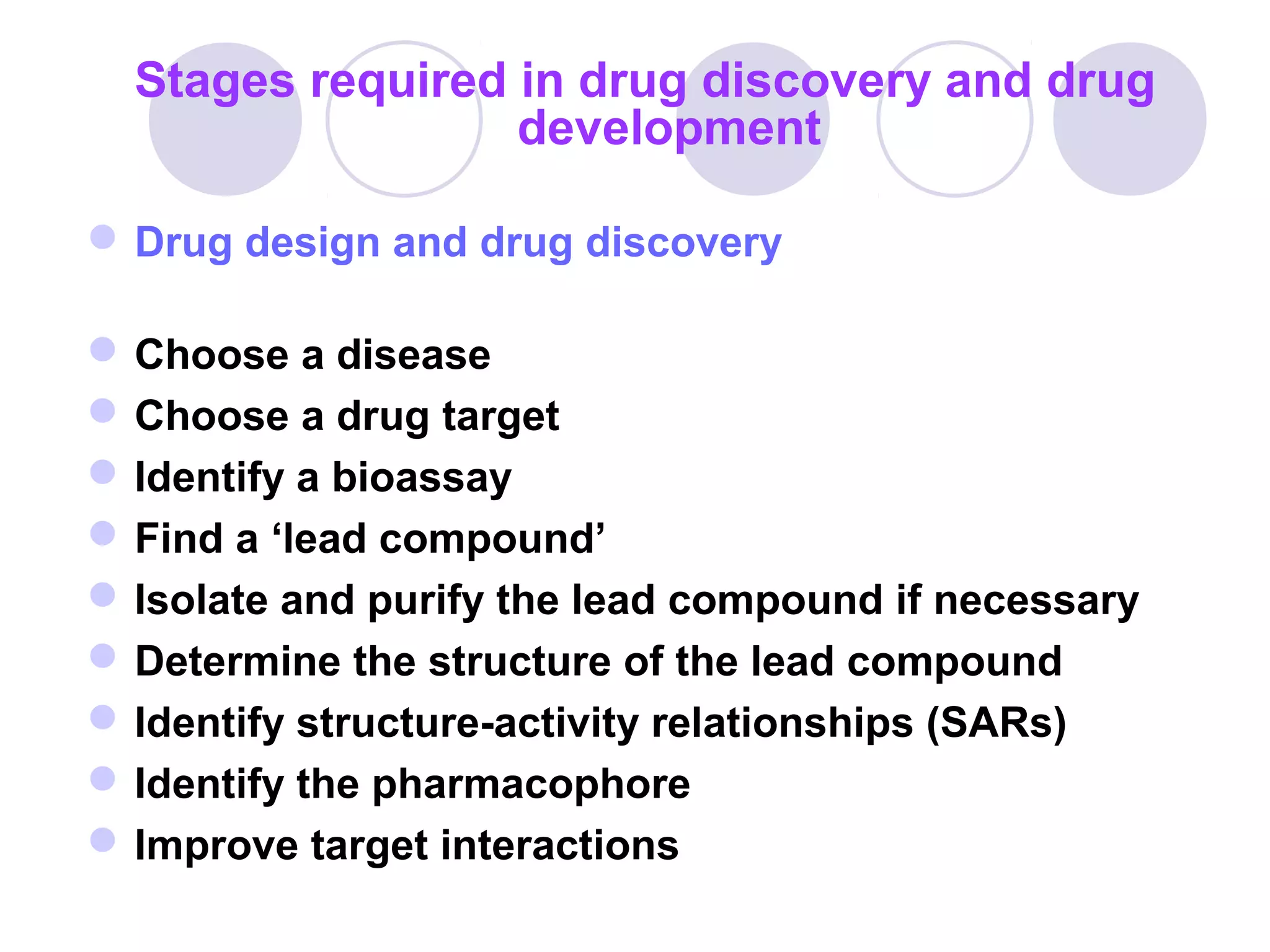
Stages required in drug discovery and drug
development
Drug design and drug discovery
Choose a disease
Choose a drug target
Identify a bioassay
Find a ‘lead compound’
Isolate and purify the lead compound if necessary
Determine the structure of the lead compound
Identify structure-activity relationships (SARs)
Identify the pharmacophore
Improve target interactions
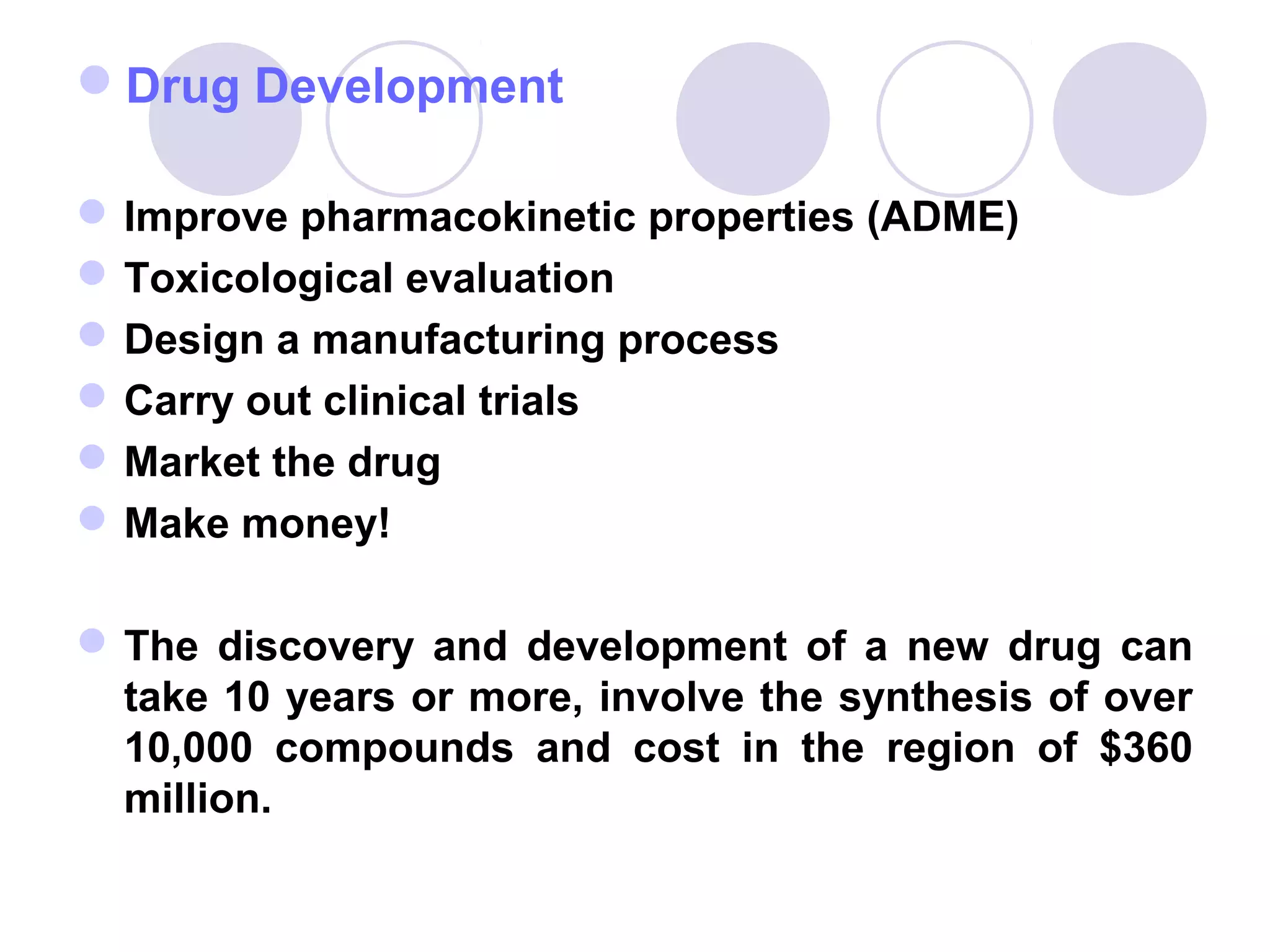
Drug Development
Improve pharmacokinetic properties (ADME)
Toxicological evaluation
Design a manufacturing process
Carry out clinical trials
Market the drug
Make money!
The discovery and development of a new drug can
take 10 years or more, involve the synthesis of over
10,000 compounds and cost in the region of $360
million.
Lead Compound
It is a chemical compound obtained from natural or
synthetic sources that possesses a particular
biological activity.
 A lead can be characterized as a compound that has
some desirable biological activity, not extremely polar
or lipophilic, and not contain toxic or reactive
functional groups. Often, molecular weight (<350) and
lipophilicity (log P<3) are considered the most
obvious characteristics of a drug-like lead.
The lead should also have a series of congeners that
modulate biological activity, indicating that further
structural modification will improve selectivity and
potency.
Drug design can be achieved by exploration of the
lead compounds, which involves the search for a
new lead or exploitation of the existing leads to
produce more active compounds with less toxicity
than the original lead compound.
 Example:
 i. Sulphanilamide- isolated from the degradation of prontosil or
synthesized chemically and acts as antibacterial agent.
 ii. Lead compound from natural sources: Morphine from opium,
cocaine from coca leaves, and quinine from the bark of
cinchona tree.
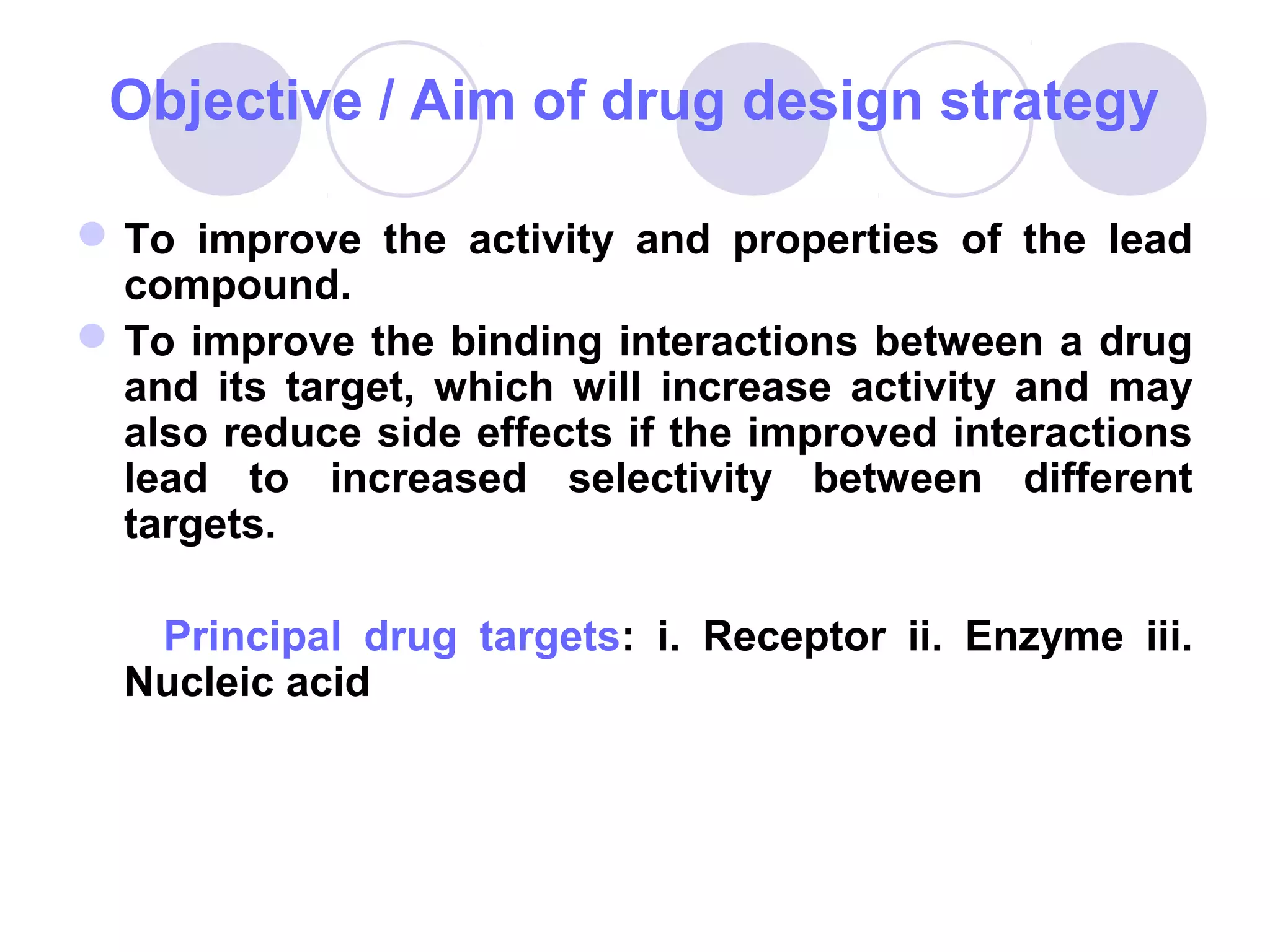
Objective / Aim of drug design strategy
To improve the activity and properties of the lead
compound.
To improve the binding interactions between a drug
and its target, which will increase activity and may
also reduce side effects if the improved interactions
lead to increased selectivity between different
targets.
Principal drug targets: i. Receptor ii. Enzyme iii.
Nucleic acid
TRADITIONAL DRUG DESIGN
(Pharmacophore-based drug design)
Lead generation:
Natural ligand / Screening
Biological Testing
Synthesis of New Compounds by
molecular modification of leads
Drug Design CycleDrug Design Cycle
If promising
Pre-Clinical Studies
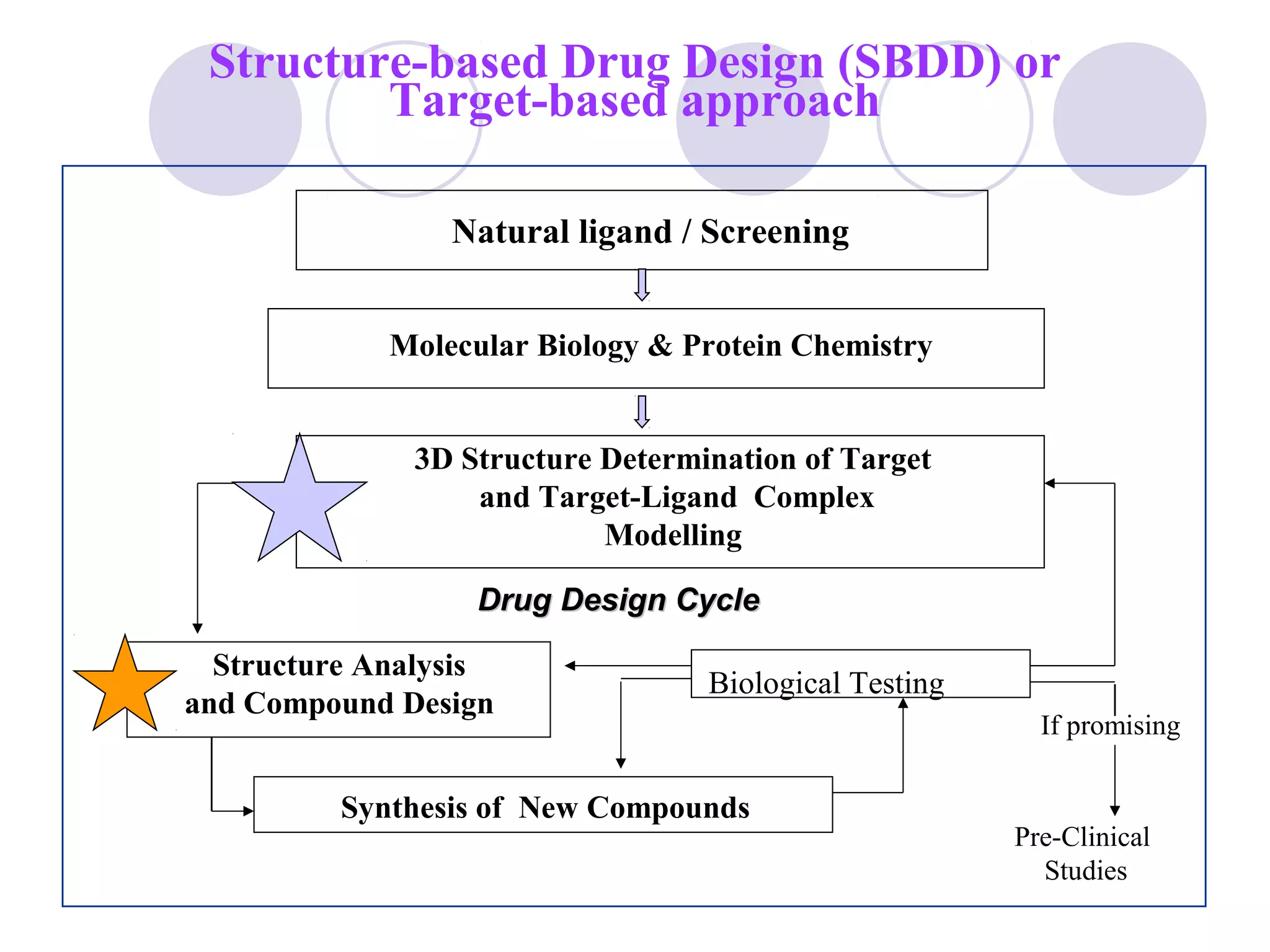
Structure-based Drug Design (SBDD) or
Target-based approach
Molecular Biology & Protein Chemistry
3D Structure Determination of Target
and Target-Ligand Complex
Modelling
Structure Analysis
and Compound Design
Biological Testing
Synthesis of New Compounds
If promising
Pre-Clinical
Studies
Drug Design CycleDrug Design Cycle
Natural ligand / Screening
A pharmacophore was first defined by Paul Ehrlich in 1909 as "a
molecular framework that carries (phoros) the essential features
responsible for a drug’s (=pharmacon's) biological activity“.
In 1977, this definition was updated by Peter Gund to "a set of
structural features in a molecule that is recognized at a receptor site
and is responsible for that molecule's biological activity“.
The IUPAC definition of a pharmacophore is "an ensemble of steric
and electronic features that is necessary to ensure the optimal
supramolecular interactions with a specific biological target and to
trigger (or block) its biological response".
Pharmacophore-based drug design
1. Determine identity of a “lead compound”:
Screen natural and synthetic banks of
compounds for activity
Folk medicine
Natural ligand
Drug already known
Computer-aided drug design
Computerized search of structural databases
2. Data collection: Publications; patents; biological
activity; NMR and X-ray data; physiochemical
properties to determine the effects of structural
changes on activity of drug: structure-activity
relationships (SARs)
3. Analysis: integrate information about drug (and
target) to generate hypothesis about activity. This
information will result in the identification of a
pharmacophore…
Pharmacophore-Based Drug Design: Methods
Four Methods used to design better drugs:
 Chemical modification / Molecular modification
 Database searching
 De novo (from the beginning) approach
 Manual
These approaches generate more data, which yet
again can be used to generate new hypotheses
and structures, etc.
Design method: Chemical modification
 Goal: Determine Structure- activity relationships to know what
functional groups are important to biological activity.
Procedure: Alter or remove groups using chemical synthesis
and test the activity of the altered molecule (analog). Infer role
of those groups in binding.
 Consequences of chemical modification to drug activity in
addition to altering binding interactions:
metabolism of drug
pharmacokinetics
Molecular modification of lead compound:
Formation of Analogues and Prodrugs
Drug design is usually achieved through molecular
modification of the lead compound. In the course of drug
design the two major types of chemical modifications are
achieved through the formation of analogues and prodrugs.
An analogue is normally accepted as being that modification
which brings about a carbon-skeletal transformation or
substituent synthesis. Examples: oxytetracycline,
demclocycline, chlortetracycline.
OH O OH
OH
O O
NH2
OH
N(CH3)2ClH3C OH
Chortetracycline
OH O OH
OH
O O
NH2
OH
N(CH3)2H3C OHOH
Oxytetracycline
OH O OH
OH
O O
NH2
OH
N(CH3)2Cl H OH
Demeclocycline
OH O OH
OH
O O
NH2
OH
N(CH3)2H3C OH
1
56
7
8
HH
Tetracycline
Activity: against wide range of gram-positive and gram-negative bacteria
including rickettsia, Mycoplasma etc.
Examples of drug design through the formation of analogues
The term prodrug is applied to either an appropriate
derivative of a drug that undergoes in vivo
hydrolysis of the parent drug, e.g., testosterone
propionate, chloramphenicol palmitate and the like;
or an analogue which is metabolically transformed
to a biologically active drug, for instance:
phenylbutazone undergoes in vivo hydroxylation to
oxyphenylbutazone.
N
N
Phenylbutazone
N
N
O
O
Oxyphenylbutazone
N
NHCH2CH2C
HO
H3C
Phenylbutazone alcohol
(Better tolerated than
phenylbutazone)
(uricosuric agent)
Antirheumatic drug
n-C4H9
O
O
n-C4H9
O
O
OH
Serendipitous drug discovery
"Serendipity" in drug discovery implies the finding of one
thing while looking for something else i.e. accidental
discovery or discovery by chance.
The discovery of penicillin's and sulfonamides as the
antibiotics and antibacterial agents respectively are the
suitable examples serendipitous drug discovery.
H2N SO2NH2
(1)(4)
Lead compound: p-aminobenzenesulphonamide, known as sulphanilamide
Activity: Antibacterial especially against some common gram-positive bacterial infections.
Diseases like pneumonia, meningitis, dysentery etc. acting as powerful bactericides.
Examples of Drug design through serendipity : Sulphonamides or Sulfa
Drugs
Sulphanilamide: first synthesized by Gelmo in 1908 as an intermediate in the study of azo dyes.
Therapeutic value was ascertained by Gerhard Domagk (German scientist) in 1935. Found active
against streptococci.
H2N SO2NH2 N SO2NH2ClN
Sulphanilamide
NaNO2/HCl
10 0C
Diazotized sulphanilamide
N SO2NH2NH2N
NH2H2N
P-aminophenyldiamine
Prontosil
Reduction
(in vivo)
H2N SO2NH2
Sulphanilamide
H2N SO2NH
Sulphpyridine: more potent than
sulphanilamide for the treatment
of pneumonia but more toxic.
N
H2N SO2NH
Sulphathiazole: very effective in
staphylococcal infections.
N
S
H2N SO2NH
Sulphadiazine: dysentery, pneumonia.
N
N
H2N SO2NH
N
O
CH3
Sulfamethoxazole: UTI, RTI, GI infections.
NH2
NH2
Serendipitous Discovery of Chlordiazepoxide (Librium)
without a Lead
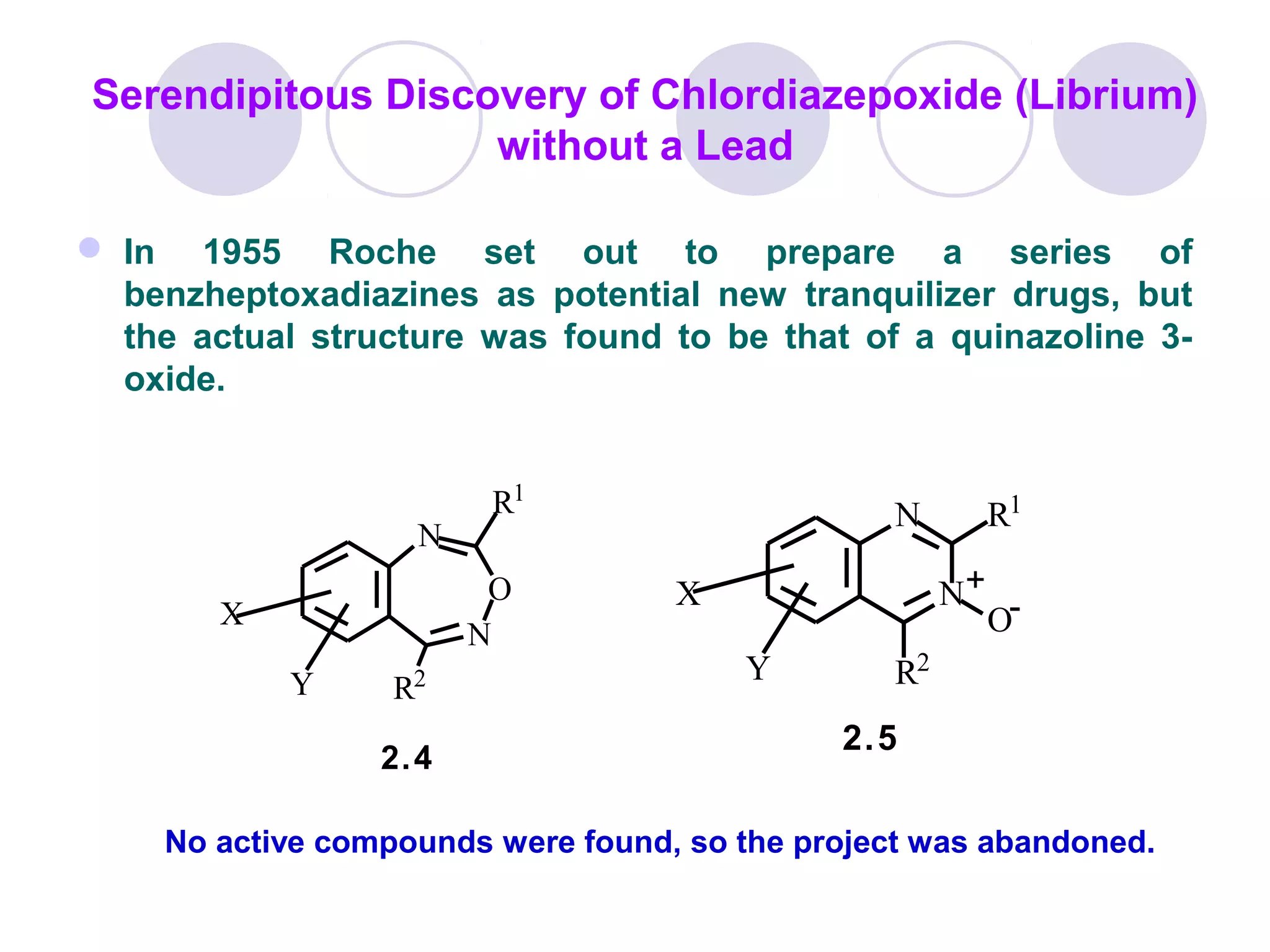
 In 1955 Roche set out to prepare a series of
benzheptoxadiazines as potential new tranquilizer drugs, but
the actual structure was found to be that of a quinazoline 3-
oxide.
2.4
N
O
N
R2
R1
X
Y
2.5
+
-N
N R1
O
R2
X
Y
No active compounds were found, so the project was abandoned.
In 1957, during a lab cleanup, a vial containing what was thought
to be the latter compound (X = 7-Cl, R1
= CH2NHCH3, R2
= C6H5)
was sent for testing, and it was highly active.
Further analysis showed that the actual structure of the
compound was the benzodiazepine 4-oxide (chlordiazepoxide
HCl), Librium (the first benzodiazepine) presumably produced in
an unexpected reaction of the corresponding chloromethyl
quinazoline 3-oxide with methylamine.
N
N CH2Cl
OCl
N
H
N NHCH3
OCl
CH2Cl
CH3NH2
N
CH2
N
NHCH3
Cl
Cl
OH
N
N CH2NHCH3
OCl
..
-+
-
+
-
+
. .
2.6
CH3NH2
N
N
Cl
NHCH3
. HCl
O
chlordiazepoxide HCl
2. 3
+
-

Drug design, discovery and development

  • 1.
    Drug Design, Discoveryand Development Drug design, sometimes referred to as rational drug design or more simply rational design, is the inventive process of finding new medications based on the knowledge of a biological target. The drug is most commonly an organic small molecule that activates or inhibits the function of a biomolecule such as a protein (receptor or enzyme), which in turn results in a therapeutic benefit to the patient. In the most basic sense, drug design involves the design of small molecules that are complementary in shape and charge to the biomolecular target with which they interact and therefore will bind to it. What is really meant by drug design is ligand design (i.e., design of a small molecule that will bind tightly to its target). Although modeling techniques for prediction of binding affinity are reasonably successful, there are many other properties, such as bioavailability, metabolic half-life, lack of side effects, etc., that first must be optimized before a ligand can become a safe and efficacious drug.
  • 2.
    The ‘drug design’in a broader sense implies random evaluation of synthetic as well as natural products in bioassay systems, creation of newer drug molecules based on biologically-active-prototypes derived from either plant or animal kingdom (lead compound), synthesis of congeners displaying interesting biological actions by different approaches of molecular modifications and finally precise design of a drug to enable it to interact with a receptor site efficaciously. Drug design frequently but not necessarily relies on computer modeling techniques. This type of modeling is often referred to as computer-aided drug design. Finally, drug design that relies on the knowledge of the three-dimensional structure of the biomolecular target is known as structure-based drug design.
  • 3.
    Drug Discovery: Itis an effort to produce new drug molecules from a lead compound by applying variety of approaches of design. Drug design approach is the prerequisite for drug discovery. Drug Development: Drug development is the process of establishing and marketing a biologically active compound obtained by drug design, as a suitable drug by observing pharmacokinetic (ADME), toxicological and clinical parameters.
  • 4.
    Stages required indrug discovery and drug development Drug design and drug discovery Choose a disease Choose a drug target Identify a bioassay Find a ‘lead compound’ Isolate and purify the lead compound if necessary Determine the structure of the lead compound Identify structure-activity relationships (SARs) Identify the pharmacophore Improve target interactions
  • 5.
    Drug Development Improve pharmacokineticproperties (ADME) Toxicological evaluation Design a manufacturing process Carry out clinical trials Market the drug Make money! The discovery and development of a new drug can take 10 years or more, involve the synthesis of over 10,000 compounds and cost in the region of $360 million.
  • 6.
    Lead Compound It isa chemical compound obtained from natural or synthetic sources that possesses a particular biological activity.  A lead can be characterized as a compound that has some desirable biological activity, not extremely polar or lipophilic, and not contain toxic or reactive functional groups. Often, molecular weight (<350) and lipophilicity (log P<3) are considered the most obvious characteristics of a drug-like lead. The lead should also have a series of congeners that modulate biological activity, indicating that further structural modification will improve selectivity and potency.
  • 7.
    Drug design canbe achieved by exploration of the lead compounds, which involves the search for a new lead or exploitation of the existing leads to produce more active compounds with less toxicity than the original lead compound.  Example:  i. Sulphanilamide- isolated from the degradation of prontosil or synthesized chemically and acts as antibacterial agent.  ii. Lead compound from natural sources: Morphine from opium, cocaine from coca leaves, and quinine from the bark of cinchona tree.
  • 8.
    Objective / Aimof drug design strategy To improve the activity and properties of the lead compound. To improve the binding interactions between a drug and its target, which will increase activity and may also reduce side effects if the improved interactions lead to increased selectivity between different targets. Principal drug targets: i. Receptor ii. Enzyme iii. Nucleic acid
  • 9.
    TRADITIONAL DRUG DESIGN (Pharmacophore-baseddrug design) Lead generation: Natural ligand / Screening Biological Testing Synthesis of New Compounds by molecular modification of leads Drug Design CycleDrug Design Cycle If promising Pre-Clinical Studies
  • 10.
    Structure-based Drug Design(SBDD) or Target-based approach Molecular Biology & Protein Chemistry 3D Structure Determination of Target and Target-Ligand Complex Modelling Structure Analysis and Compound Design Biological Testing Synthesis of New Compounds If promising Pre-Clinical Studies Drug Design CycleDrug Design Cycle Natural ligand / Screening
  • 11.
    A pharmacophore wasfirst defined by Paul Ehrlich in 1909 as "a molecular framework that carries (phoros) the essential features responsible for a drug’s (=pharmacon's) biological activity“. In 1977, this definition was updated by Peter Gund to "a set of structural features in a molecule that is recognized at a receptor site and is responsible for that molecule's biological activity“. The IUPAC definition of a pharmacophore is "an ensemble of steric and electronic features that is necessary to ensure the optimal supramolecular interactions with a specific biological target and to trigger (or block) its biological response".
  • 12.
    Pharmacophore-based drug design 1.Determine identity of a “lead compound”: Screen natural and synthetic banks of compounds for activity Folk medicine Natural ligand Drug already known Computer-aided drug design Computerized search of structural databases
  • 13.
    2. Data collection:Publications; patents; biological activity; NMR and X-ray data; physiochemical properties to determine the effects of structural changes on activity of drug: structure-activity relationships (SARs) 3. Analysis: integrate information about drug (and target) to generate hypothesis about activity. This information will result in the identification of a pharmacophore…
  • 14.
    Pharmacophore-Based Drug Design:Methods Four Methods used to design better drugs:  Chemical modification / Molecular modification  Database searching  De novo (from the beginning) approach  Manual These approaches generate more data, which yet again can be used to generate new hypotheses and structures, etc.
  • 15.
    Design method: Chemicalmodification  Goal: Determine Structure- activity relationships to know what functional groups are important to biological activity. Procedure: Alter or remove groups using chemical synthesis and test the activity of the altered molecule (analog). Infer role of those groups in binding.  Consequences of chemical modification to drug activity in addition to altering binding interactions: metabolism of drug pharmacokinetics
  • 16.
    Molecular modification oflead compound: Formation of Analogues and Prodrugs Drug design is usually achieved through molecular modification of the lead compound. In the course of drug design the two major types of chemical modifications are achieved through the formation of analogues and prodrugs. An analogue is normally accepted as being that modification which brings about a carbon-skeletal transformation or substituent synthesis. Examples: oxytetracycline, demclocycline, chlortetracycline.
  • 17.
    OH O OH OH OO NH2 OH N(CH3)2ClH3C OH Chortetracycline OH O OH OH O O NH2 OH N(CH3)2H3C OHOH Oxytetracycline OH O OH OH O O NH2 OH N(CH3)2Cl H OH Demeclocycline OH O OH OH O O NH2 OH N(CH3)2H3C OH 1 56 7 8 HH Tetracycline Activity: against wide range of gram-positive and gram-negative bacteria including rickettsia, Mycoplasma etc. Examples of drug design through the formation of analogues
  • 18.
    The term prodrugis applied to either an appropriate derivative of a drug that undergoes in vivo hydrolysis of the parent drug, e.g., testosterone propionate, chloramphenicol palmitate and the like; or an analogue which is metabolically transformed to a biologically active drug, for instance: phenylbutazone undergoes in vivo hydroxylation to oxyphenylbutazone.
  • 19.
    N N Phenylbutazone N N O O Oxyphenylbutazone N NHCH2CH2C HO H3C Phenylbutazone alcohol (Better toleratedthan phenylbutazone) (uricosuric agent) Antirheumatic drug n-C4H9 O O n-C4H9 O O OH
  • 20.
    Serendipitous drug discovery "Serendipity"in drug discovery implies the finding of one thing while looking for something else i.e. accidental discovery or discovery by chance. The discovery of penicillin's and sulfonamides as the antibiotics and antibacterial agents respectively are the suitable examples serendipitous drug discovery.
  • 21.
    H2N SO2NH2 (1)(4) Lead compound:p-aminobenzenesulphonamide, known as sulphanilamide Activity: Antibacterial especially against some common gram-positive bacterial infections. Diseases like pneumonia, meningitis, dysentery etc. acting as powerful bactericides. Examples of Drug design through serendipity : Sulphonamides or Sulfa Drugs Sulphanilamide: first synthesized by Gelmo in 1908 as an intermediate in the study of azo dyes. Therapeutic value was ascertained by Gerhard Domagk (German scientist) in 1935. Found active against streptococci. H2N SO2NH2 N SO2NH2ClN Sulphanilamide NaNO2/HCl 10 0C Diazotized sulphanilamide N SO2NH2NH2N NH2H2N P-aminophenyldiamine Prontosil Reduction (in vivo) H2N SO2NH2 Sulphanilamide H2N SO2NH Sulphpyridine: more potent than sulphanilamide for the treatment of pneumonia but more toxic. N H2N SO2NH Sulphathiazole: very effective in staphylococcal infections. N S H2N SO2NH Sulphadiazine: dysentery, pneumonia. N N H2N SO2NH N O CH3 Sulfamethoxazole: UTI, RTI, GI infections. NH2 NH2
  • 22.
    Serendipitous Discovery ofChlordiazepoxide (Librium) without a Lead  In 1955 Roche set out to prepare a series of benzheptoxadiazines as potential new tranquilizer drugs, but the actual structure was found to be that of a quinazoline 3- oxide. 2.4 N O N R2 R1 X Y 2.5 + -N N R1 O R2 X Y No active compounds were found, so the project was abandoned.
  • 23.
    In 1957, duringa lab cleanup, a vial containing what was thought to be the latter compound (X = 7-Cl, R1 = CH2NHCH3, R2 = C6H5) was sent for testing, and it was highly active. Further analysis showed that the actual structure of the compound was the benzodiazepine 4-oxide (chlordiazepoxide HCl), Librium (the first benzodiazepine) presumably produced in an unexpected reaction of the corresponding chloromethyl quinazoline 3-oxide with methylamine. N N CH2Cl OCl N H N NHCH3 OCl CH2Cl CH3NH2 N CH2 N NHCH3 Cl Cl OH N N CH2NHCH3 OCl .. -+ - + - + . . 2.6 CH3NH2 N N Cl NHCH3 . HCl O chlordiazepoxide HCl 2. 3 + -