ART AND CRAFT OF DRAFTING OF  DOCUMENTS APURVA AGARWAL December 16, 2006
APPLICABLE LAWS Constitution of India Companies Act, 1956 Indian Evidence Act, 1872 Indian Contract Act, 1872 Indian Stamp Act Registration Act Transfer of Property Act, 1882
INTRODUCTION
WHAT IS A DEED A deed is an instrument- Written on parchment/paper Executed by some person/corporation Making/confirming in/consenting to some assurance Of some interest in property
WHAT IS A DEED Or of some legal/equitable right, title/claim  Or undertaking/concurring in some other act Affecting the legal relations/position  Of a party to the instrument Or of some other act affecting other person/ corporation
SOME TYPES OF DEEDS Power of attorney under seal Patents Agreements : E.g.- agency, brokerage, copyright, sale etc. Deed of gift Arbitration agreements Lease deed of land Affidavits Wills
WHAT IS NOT A DEED The following instruments, though under  seal, are not termed as deeds – Awards Testamentary instruments Share certificates License to use patented articles Certificate of admission to a professional society Letters of ordination
WHAT IS A DOCUMENT Section 3 of the Indian Evidence Act, 1872, defines a document to mean Any matter, expressed/described Upon any substance  By means of letters/figures/marks/ more than one of these means  Intended to be used/ which may be used For recording that matter
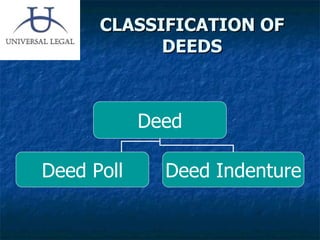
CLASSIFICATION OF DEEDS Deed Deed Poll Deed Indenture
DEED POLL A deed poll is a deed made by one party expressing his intention or two or more persons together expressing their common intention. Parchment required is usually shared even or polled at the top
DEED INDENTURE A deed indenture   is a deed between two or more persons evidencing some act or agreement between them, other than to express their intention. The document is executed in two parts, and they are indented or cut with a waving or indented line at the top.
CONVEYANCING AND DOCUMENTATION Conveyancing : Act of transferring property title from one person to another. Documentation : The preparation, finalisation and execution of documents.
DOCUMENTATION IN INDIA Drafting of deeds in metropolitan cities done by solicitors. Drafting in small towns done in vernacular forms. English precedents and forms adopted with minor modifications. Exact meaning of expressions used in the documents as applicable in India should be understood in accordance with Indian law.
PRINCIPLES OF GOOD DRAFTING
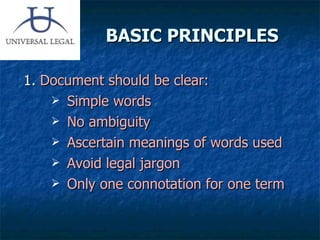
BASIC PRINCIPLES 1.  Document should be clear: Simple words No ambiguity Ascertain meanings of words used Avoid legal jargon Only one connotation for one term
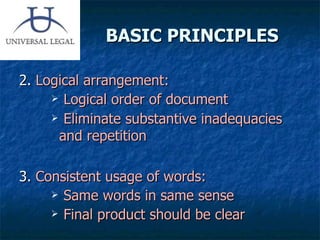
BASIC PRINCIPLES 2.  Logical arrangement:   Logical order of document Eliminate substantive inadequacies and repetition   3.  Consistent usage of words: Same words in same sense Final product should be clear
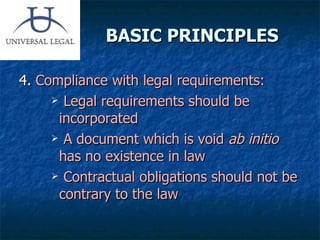
BASIC PRINCIPLES 4.  Compliance with legal requirements: Legal requirements should be incorporated A document which is void  ab initio  has no existence in law Contractual obligations should not be contrary to the law
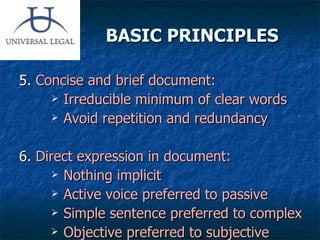
BASIC PRINCIPLES 5.  Concise and brief document: Irreducible minimum of clear words Avoid repetition and redundancy 6.  Direct expression in document: Nothing implicit Active voice preferred to passive Simple sentence preferred to complex Objective preferred to subjective
PRECAUTIONS Divide into paragraphs First word/ phrase of important part of deed in capitals Proper punctuation Use terms like ‘ not exceeding’ instead of ‘less than’ and ‘more than’ Clauses in subsequent paragraphs should not be referred without giving numbers
PRECAUTIONS Small sentences in simple language Avoid negatives in successive phrases State dates, sums and numbers in both figures and words Fill blank spaces in document before execution
ARTIFICIAL AIDS FOR DRAFTING Aids are used by a draftsman to give emphasis to the document at the appropriate places.  Intelligible numbering system Roman/Arabic numerals, capital/ lower case letters for sub-divisions
ARTIFICIAL AIDS FOR DRAFTING Capitalisation to show essentials of the document Paragraphing, spacing, and indenture Latin, Roman and purely technical terms in English italicised / underlined Headings and sub-headings Use of good quality paper No spelling/ grammatical/ typing mistake
DRAFTING FOR A CLIENT Form drafted for one client can never be used verbatim for another Document for every client should be drafted separately Exceptions: Forms like simple sale deed and wills
CHOICE OF DOCUMENT Collect facts from client Sift facts Understand client’s requirements Determine most appropriate legal document Selection of the right document is of vital  importance to the client for tax or other reasons.
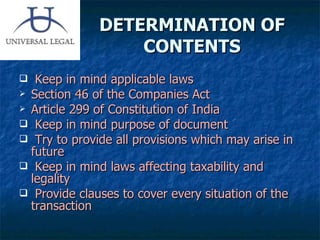
DETERMINATION OF CONTENTS Keep in mind applicable laws Section 46 of the Companies Act Article 299 of Constitution of India Keep in mind purpose of document Try to provide all provisions which may arise in future Keep in mind laws affecting taxability and legality Provide clauses to cover every situation of the transaction
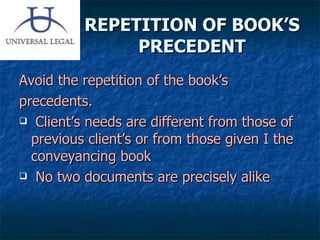
REPETITION OF BOOK’S PRECEDENT Avoid the repetition of the book’s  precedents. Client’s needs are different from those of previous client’s or from those given I the conveyancing book No two documents are precisely alike
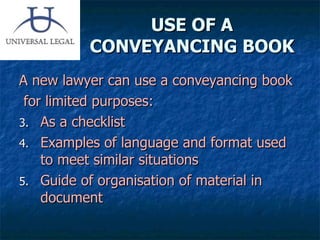
USE OF A CONVEYANCING BOOK A new lawyer can use a conveyancing book for limited purposes: As a checklist Examples of language and format used to meet similar situations Guide of organisation of material in document
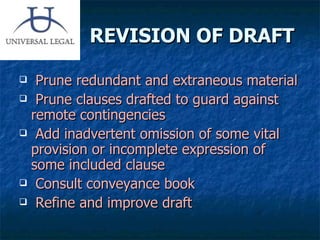
REVISION OF DRAFT Prune redundant and extraneous material Prune clauses drafted to guard against remote contingencies Add inadvertent omission of some vital provision or incomplete expression of some included clause Consult conveyance book Refine and improve draft
PARTS OF A DEED
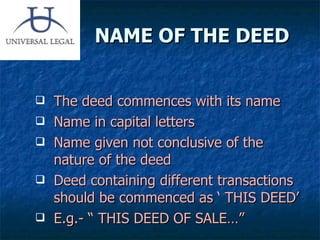
NAME OF THE DEED The deed commences with its name Name in capital letters Name given not conclusive of the nature of the deed Deed containing different transactions should be commenced as ‘ THIS DEED’   E.g.- “ THIS DEED OF SALE…”
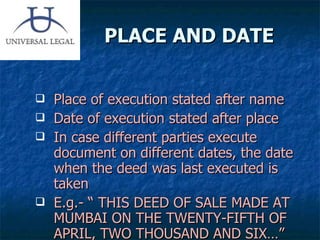
PLACE AND DATE  Place of execution stated after name Date of execution stated after place In case different parties execute document on different dates, the date when the deed was last executed is taken E.g.- “ THIS DEED OF SALE MADE AT MUMBAI ON THE TWENTY-FIFTH OF APRIL, TWO THOUSAND AND SIX…”
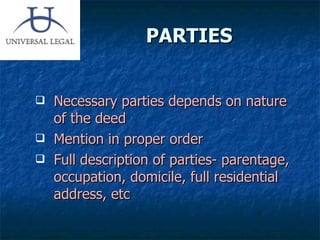
PARTIES  Necessary parties depends on nature of the deed Mention in proper order Full description of parties- parentage, occupation, domicile, full residential address, etc
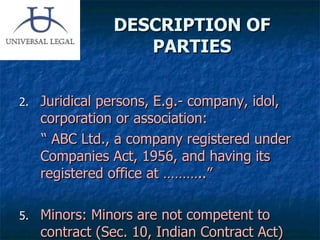
DESCRIPTION OF PARTIES Juridical persons, E.g.- company, idol, corporation or association: “  ABC Ltd., a company registered under Companies Act, 1956, and having its registered office at ………..” Minors: Minors are not competent to contract (Sec. 10, Indian Contract Act)
DESCRIPTION OF PARTIES … contd Persons of unsound mind: A person of unsound mind or a lunatic is not competent to contract (Sec. 12, Indian Contract Act) Trusts:  “ X, Y and Z, trustees of the estate of A”
DESCRIPTION OF PARTIES … contd Partnership Firm:  “  M/s ……….., a partnership firm, having its place of business at ……….. Acting through its partner A” Attorney: “  A, attorney of B ” “  B, acting or through his attorney A ”
DESCRIPTION OF PARTIES … contd Insolvent: The Official Assignee or Receiver appointed by the Court should be made party in his own name and the fact of vesting of property due to insolvency of the owner should be referred to in the recitals.
DESCRIPTION OF PARTIES … contd Pardanashin Ladies:  Where the transferor is a pardanashin lady the transferee should be cautious and the fact that the contents of the document have been explained to her and she is executing the document after clearly understanding the nature of the transaction, should be referred to in the recitals.
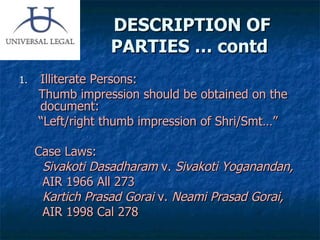
DESCRIPTION OF PARTIES … contd  Illiterate Persons: Thumb impression should be obtained on the document: “ Left/right thumb impression of Shri/Smt…” Case Laws:  Sivakoti Dasadharam  v.  Sivakoti Yoganandan,  AIR 1966 All 273 Kartich Prasad Gorai  v.  Neami Prasad Gorai,  AIR 1998 Cal 278
DESCRIPTION OF PARTIES … contd  Government: According to Article 299, of the Constitution, contracts where the Government of India or a State government is a party should be executed in the name of the President of India or the Governor of the State.
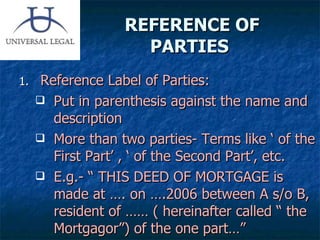
REFERENCE OF PARTIES  Reference Label of Parties: Put in parenthesis against the name and description More than two parties- Terms like ‘ of the First Part’ , ‘ of the Second Part’, etc. E.g.- “ THIS DEED OF MORTGAGE is made at …. on ….2006 between A s/o B, resident of …… ( hereinafter called “ the Mortgagor”) of the one part…”
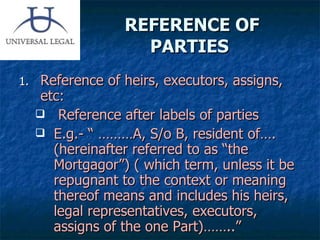
REFERENCE OF PARTIES  Reference of heirs, executors, assigns, etc: Reference after labels of parties E.g.- “ ………A, S/o B, resident of…. (hereinafter referred to as “the Mortgagor”) ( which term, unless it be repugnant to the context or meaning thereof means and includes his heirs, legal representatives, executors, assigns of the one Part)……..”
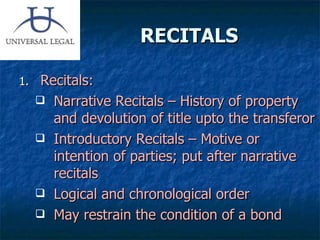
RECITALS  Recitals: Narrative Recitals – History of property and devolution of title upto the transferor Introductory Recitals – Motive or intention of parties; put after narrative recitals Logical and chronological order May restrain the condition of a bond
TESTATUM Testatum: After recitals Operative part of deed commences Form: “  NOW THIS DEED WITNESSETH AS FOLLOWS ” “  NOW THIS DEED WITNESES AS FOLLOWS ”
CONSIDERATION Consideration: Fully and truly set forth in the deed (Section 25, Indian Contract Act)  Need not be adequate Mere inadequacy not a ground for relief (  Vijaya Minerals Pvt Ltd  v.  Bikash Chandra Deb , AIR 1996 Cal 6)
RECEIPT  Receipt: Within parenthesis E.g.- “ NOW THIS DEED WITNESSETH THAT IN PURSUANCE OF THE SAID AGREEMENT AND IN CONSIDERATION OF A SUM OF Rs. 1,00,000/- ( Rupees One Lakh only) paid by the transferee to the transferor before the execution hereof ( the receipt of which the transferor does hereby acknowledge) ”
OPERATIVE WORDS  Operative Words: After testatum Clear and unambiguous Includes covenant on the part of the parties , e.g. – in a lease deed, the lessor and lessee covenant to perform duties
PARCELS  Parcels: Description of property after operative words Inaccurate/ insufficient description does not invalidate the document (  Lal Babu Yadav  v.  Ram Ilash Rai , AIR 1997 Pat 131) Section 17 & 21 of the Indian Registration Act
DESCRIPTION OF PROPERTY  Schedule of the Property: Description of property given in Schedule appended to the deed  Words “ and more particularly described in the schedule hereunder written” written in parcel of the deed
INCOMPLETE/ INSUFFICIENT DESCRIPTION Does not invalidate the document ( Lal Babu Yadav  v.  Ram Bilash Rai , AIR 1997 Pat 131)
MAP Map: Map of property annexed in deed  Referred to in parcel Form- “ The house delineated on the plan annexed hereto and thereon surrounded by red coloured boundary line.” Section 21(4) of Indian Registration Act
ESTATE All estate clause: Expresses that the transferor conveyed all his estate, interest, title, claim rights and demands whatsoever into or in the said property and any part thereof Makes clearer the rights, interests, title, etc. of the transferor
EXCEPTIONS  Exceptions and reservations: Exception- Part of thing granted which is in existence Reservation- Thing not in existence, but created or reserved out of land granted E.g.- “ Subject to the right of way over the land reserved unto the transferor ”
HABENDUM Habendum: Limits the granted estate Mentions liabilities and incidents subject to which the property is transferred E.g.- “ TO HAVE AND TO HOLD FOREVER ”
REDDENDUM Reddendum: Rent paid by lessee specified Specifies time and mode of payment E.g.- “ PAYING THEREFOR Rs.100/- rent per month by the 10 th  day the month of the following month, to which it relates. ”
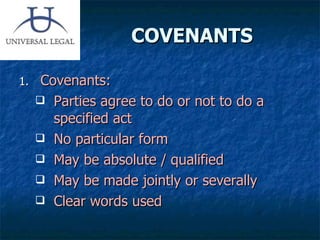
COVENANTS Covenants: Parties agree to do or not to do a specified act No particular form May be absolute / qualified May be made jointly or severally  Clear words used
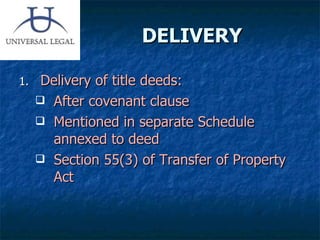
DELIVERY Delivery of title deeds: After covenant clause Mentioned in separate Schedule annexed to deed Section 55(3) of Transfer of Property Act
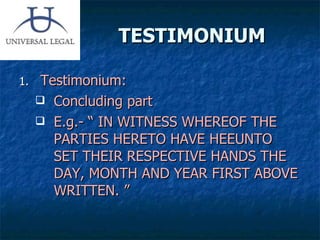
TESTIMONIUM Testimonium: Concluding part E.g.- “ IN WITNESS WHEREOF THE PARTIES HERETO HAVE HEEUNTO SET THEIR RESPECTIVE HANDS THE DAY, MONTH AND YEAR FIRST ABOVE WRITTEN. ”
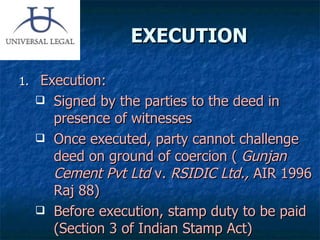
EXECUTION  Execution: Signed by the parties to the deed in presence of witnesses Once executed, party cannot challenge deed on ground of coercion (  Gunjan Cement Pvt Ltd  v.  RSIDIC Ltd.,  AIR 1996 Raj 88) Before execution, stamp duty to be paid (Section 3 of Indian Stamp Act)
ATTESTATION  Attestation: Two/ more witnesses (Section 3, Transfer of Property Act) Necessary in bond, gift mortgage, will and codicil Name and description of witnesses
ERRORS Errors and omissions: Errors corrected in engrossment- initialed by parties signing the deed Corrections may be noted in a Memorandum under the testimonium and a covenant added in post script after the testimonium
SUPPLEMENTAL DEEDS Endorsements and Supplemental Deeds: Additions/ alterations to a deed Form- usual form of deed  After names of the parties, following words added- “ supplemental to the deed of lease dated …… and made between the parties hereto ” Several deeds- mention in chronological order in recitals
ESCROW Limitation/ condition on delivery of deed Deed delivered to other party subject to the condition on happening of certain event  Deed comes into force on fulfillment of the condition
GOVERNING LAW Specify which law is applicable if parties belong to different jurisdictions  Specify which court will resolve the dispute – forum non convenience Arbitration – specify all details
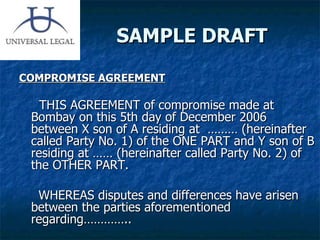
SAMPLE DRAFT COMPROMISE AGREEMENT THIS AGREEMENT of compromise made at Bombay on this 5th day of December 2006 between X son of A residing at  ……… (hereinafter called Party No. 1) of the ONE PART and Y son of B residing at …… (hereinafter called Party No. 2) of the OTHER PART. WHEREAS disputes and differences have arisen between the parties aforementioned regarding…………..
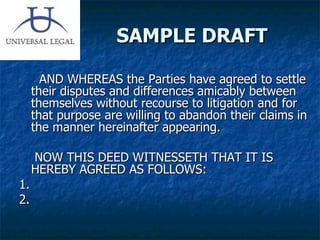
SAMPLE DRAFT AND WHEREAS the Parties have agreed to settle their disputes and differences amicably between themselves without recourse to litigation and for that purpose are willing to abandon their claims in the manner hereinafter appearing. NOW THIS DEED WITNESSETH THAT IT IS HEREBY AGREED AS FOLLOWS: 1. 2.
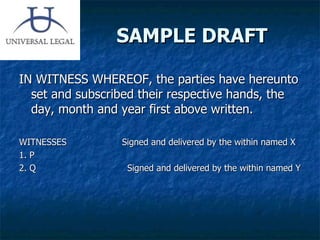
SAMPLE DRAFT IN WITNESS WHEREOF, the parties have hereunto set and subscribed their respective hands, the day, month and year first above written. WITNESSES  Signed and delivered by the within named X 1. P 2. Q  Signed and delivered by the within named Y
SUGGESTED READING Bharat’s Guide to Deeds and Documentation – By R.K. Gupta
THANK YOU
CONTACT US UNIVERSAL LEGAL 5th Floor, Kimatrai Building 77/79 Maharshi Karve Road Mumbai – 400 002 Phone :  2203 4293 - 95   Fax :    2203 9845 E-mail :   [email_address]

Drafting

  • 1.
    ART AND CRAFTOF DRAFTING OF DOCUMENTS APURVA AGARWAL December 16, 2006
  • 2.
    APPLICABLE LAWS Constitutionof India Companies Act, 1956 Indian Evidence Act, 1872 Indian Contract Act, 1872 Indian Stamp Act Registration Act Transfer of Property Act, 1882
  • 3.
  • 4.
    WHAT IS ADEED A deed is an instrument- Written on parchment/paper Executed by some person/corporation Making/confirming in/consenting to some assurance Of some interest in property
  • 5.
    WHAT IS ADEED Or of some legal/equitable right, title/claim Or undertaking/concurring in some other act Affecting the legal relations/position Of a party to the instrument Or of some other act affecting other person/ corporation
  • 6.
    SOME TYPES OFDEEDS Power of attorney under seal Patents Agreements : E.g.- agency, brokerage, copyright, sale etc. Deed of gift Arbitration agreements Lease deed of land Affidavits Wills
  • 7.
    WHAT IS NOTA DEED The following instruments, though under seal, are not termed as deeds – Awards Testamentary instruments Share certificates License to use patented articles Certificate of admission to a professional society Letters of ordination
  • 8.
    WHAT IS ADOCUMENT Section 3 of the Indian Evidence Act, 1872, defines a document to mean Any matter, expressed/described Upon any substance By means of letters/figures/marks/ more than one of these means Intended to be used/ which may be used For recording that matter
  • 9.
    CLASSIFICATION OF DEEDSDeed Deed Poll Deed Indenture
  • 10.
    DEED POLL Adeed poll is a deed made by one party expressing his intention or two or more persons together expressing their common intention. Parchment required is usually shared even or polled at the top
  • 11.
    DEED INDENTURE Adeed indenture is a deed between two or more persons evidencing some act or agreement between them, other than to express their intention. The document is executed in two parts, and they are indented or cut with a waving or indented line at the top.
  • 12.
    CONVEYANCING AND DOCUMENTATIONConveyancing : Act of transferring property title from one person to another. Documentation : The preparation, finalisation and execution of documents.
  • 13.
    DOCUMENTATION IN INDIADrafting of deeds in metropolitan cities done by solicitors. Drafting in small towns done in vernacular forms. English precedents and forms adopted with minor modifications. Exact meaning of expressions used in the documents as applicable in India should be understood in accordance with Indian law.
  • 14.
  • 15.
    BASIC PRINCIPLES 1. Document should be clear: Simple words No ambiguity Ascertain meanings of words used Avoid legal jargon Only one connotation for one term
  • 16.
    BASIC PRINCIPLES 2. Logical arrangement: Logical order of document Eliminate substantive inadequacies and repetition 3. Consistent usage of words: Same words in same sense Final product should be clear
  • 17.
    BASIC PRINCIPLES 4. Compliance with legal requirements: Legal requirements should be incorporated A document which is void ab initio has no existence in law Contractual obligations should not be contrary to the law
  • 18.
    BASIC PRINCIPLES 5. Concise and brief document: Irreducible minimum of clear words Avoid repetition and redundancy 6. Direct expression in document: Nothing implicit Active voice preferred to passive Simple sentence preferred to complex Objective preferred to subjective
  • 19.
    PRECAUTIONS Divide intoparagraphs First word/ phrase of important part of deed in capitals Proper punctuation Use terms like ‘ not exceeding’ instead of ‘less than’ and ‘more than’ Clauses in subsequent paragraphs should not be referred without giving numbers
  • 20.
    PRECAUTIONS Small sentencesin simple language Avoid negatives in successive phrases State dates, sums and numbers in both figures and words Fill blank spaces in document before execution
  • 21.
    ARTIFICIAL AIDS FORDRAFTING Aids are used by a draftsman to give emphasis to the document at the appropriate places. Intelligible numbering system Roman/Arabic numerals, capital/ lower case letters for sub-divisions
  • 22.
    ARTIFICIAL AIDS FORDRAFTING Capitalisation to show essentials of the document Paragraphing, spacing, and indenture Latin, Roman and purely technical terms in English italicised / underlined Headings and sub-headings Use of good quality paper No spelling/ grammatical/ typing mistake
  • 23.
    DRAFTING FOR ACLIENT Form drafted for one client can never be used verbatim for another Document for every client should be drafted separately Exceptions: Forms like simple sale deed and wills
  • 24.
    CHOICE OF DOCUMENTCollect facts from client Sift facts Understand client’s requirements Determine most appropriate legal document Selection of the right document is of vital importance to the client for tax or other reasons.
  • 25.
    DETERMINATION OF CONTENTSKeep in mind applicable laws Section 46 of the Companies Act Article 299 of Constitution of India Keep in mind purpose of document Try to provide all provisions which may arise in future Keep in mind laws affecting taxability and legality Provide clauses to cover every situation of the transaction
  • 26.
    REPETITION OF BOOK’SPRECEDENT Avoid the repetition of the book’s precedents. Client’s needs are different from those of previous client’s or from those given I the conveyancing book No two documents are precisely alike
  • 27.
    USE OF ACONVEYANCING BOOK A new lawyer can use a conveyancing book for limited purposes: As a checklist Examples of language and format used to meet similar situations Guide of organisation of material in document
  • 28.
    REVISION OF DRAFTPrune redundant and extraneous material Prune clauses drafted to guard against remote contingencies Add inadvertent omission of some vital provision or incomplete expression of some included clause Consult conveyance book Refine and improve draft
  • 29.
  • 30.
    NAME OF THEDEED The deed commences with its name Name in capital letters Name given not conclusive of the nature of the deed Deed containing different transactions should be commenced as ‘ THIS DEED’ E.g.- “ THIS DEED OF SALE…”
  • 31.
    PLACE AND DATE Place of execution stated after name Date of execution stated after place In case different parties execute document on different dates, the date when the deed was last executed is taken E.g.- “ THIS DEED OF SALE MADE AT MUMBAI ON THE TWENTY-FIFTH OF APRIL, TWO THOUSAND AND SIX…”
  • 32.
    PARTIES Necessaryparties depends on nature of the deed Mention in proper order Full description of parties- parentage, occupation, domicile, full residential address, etc
  • 33.
    DESCRIPTION OF PARTIESJuridical persons, E.g.- company, idol, corporation or association: “ ABC Ltd., a company registered under Companies Act, 1956, and having its registered office at ………..” Minors: Minors are not competent to contract (Sec. 10, Indian Contract Act)
  • 34.
    DESCRIPTION OF PARTIES… contd Persons of unsound mind: A person of unsound mind or a lunatic is not competent to contract (Sec. 12, Indian Contract Act) Trusts: “ X, Y and Z, trustees of the estate of A”
  • 35.
    DESCRIPTION OF PARTIES… contd Partnership Firm: “ M/s ……….., a partnership firm, having its place of business at ……….. Acting through its partner A” Attorney: “ A, attorney of B ” “ B, acting or through his attorney A ”
  • 36.
    DESCRIPTION OF PARTIES… contd Insolvent: The Official Assignee or Receiver appointed by the Court should be made party in his own name and the fact of vesting of property due to insolvency of the owner should be referred to in the recitals.
  • 37.
    DESCRIPTION OF PARTIES… contd Pardanashin Ladies: Where the transferor is a pardanashin lady the transferee should be cautious and the fact that the contents of the document have been explained to her and she is executing the document after clearly understanding the nature of the transaction, should be referred to in the recitals.
  • 38.
    DESCRIPTION OF PARTIES… contd Illiterate Persons: Thumb impression should be obtained on the document: “ Left/right thumb impression of Shri/Smt…” Case Laws: Sivakoti Dasadharam v. Sivakoti Yoganandan, AIR 1966 All 273 Kartich Prasad Gorai v. Neami Prasad Gorai, AIR 1998 Cal 278
  • 39.
    DESCRIPTION OF PARTIES… contd Government: According to Article 299, of the Constitution, contracts where the Government of India or a State government is a party should be executed in the name of the President of India or the Governor of the State.
  • 40.
    REFERENCE OF PARTIES Reference Label of Parties: Put in parenthesis against the name and description More than two parties- Terms like ‘ of the First Part’ , ‘ of the Second Part’, etc. E.g.- “ THIS DEED OF MORTGAGE is made at …. on ….2006 between A s/o B, resident of …… ( hereinafter called “ the Mortgagor”) of the one part…”
  • 41.
    REFERENCE OF PARTIES Reference of heirs, executors, assigns, etc: Reference after labels of parties E.g.- “ ………A, S/o B, resident of…. (hereinafter referred to as “the Mortgagor”) ( which term, unless it be repugnant to the context or meaning thereof means and includes his heirs, legal representatives, executors, assigns of the one Part)……..”
  • 42.
    RECITALS Recitals:Narrative Recitals – History of property and devolution of title upto the transferor Introductory Recitals – Motive or intention of parties; put after narrative recitals Logical and chronological order May restrain the condition of a bond
  • 43.
    TESTATUM Testatum: Afterrecitals Operative part of deed commences Form: “ NOW THIS DEED WITNESSETH AS FOLLOWS ” “ NOW THIS DEED WITNESES AS FOLLOWS ”
  • 44.
    CONSIDERATION Consideration: Fullyand truly set forth in the deed (Section 25, Indian Contract Act) Need not be adequate Mere inadequacy not a ground for relief ( Vijaya Minerals Pvt Ltd v. Bikash Chandra Deb , AIR 1996 Cal 6)
  • 45.
    RECEIPT Receipt:Within parenthesis E.g.- “ NOW THIS DEED WITNESSETH THAT IN PURSUANCE OF THE SAID AGREEMENT AND IN CONSIDERATION OF A SUM OF Rs. 1,00,000/- ( Rupees One Lakh only) paid by the transferee to the transferor before the execution hereof ( the receipt of which the transferor does hereby acknowledge) ”
  • 46.
    OPERATIVE WORDS Operative Words: After testatum Clear and unambiguous Includes covenant on the part of the parties , e.g. – in a lease deed, the lessor and lessee covenant to perform duties
  • 47.
    PARCELS Parcels:Description of property after operative words Inaccurate/ insufficient description does not invalidate the document ( Lal Babu Yadav v. Ram Ilash Rai , AIR 1997 Pat 131) Section 17 & 21 of the Indian Registration Act
  • 48.
    DESCRIPTION OF PROPERTY Schedule of the Property: Description of property given in Schedule appended to the deed Words “ and more particularly described in the schedule hereunder written” written in parcel of the deed
  • 49.
    INCOMPLETE/ INSUFFICIENT DESCRIPTIONDoes not invalidate the document ( Lal Babu Yadav v. Ram Bilash Rai , AIR 1997 Pat 131)
  • 50.
    MAP Map: Mapof property annexed in deed Referred to in parcel Form- “ The house delineated on the plan annexed hereto and thereon surrounded by red coloured boundary line.” Section 21(4) of Indian Registration Act
  • 51.
    ESTATE All estateclause: Expresses that the transferor conveyed all his estate, interest, title, claim rights and demands whatsoever into or in the said property and any part thereof Makes clearer the rights, interests, title, etc. of the transferor
  • 52.
    EXCEPTIONS Exceptionsand reservations: Exception- Part of thing granted which is in existence Reservation- Thing not in existence, but created or reserved out of land granted E.g.- “ Subject to the right of way over the land reserved unto the transferor ”
  • 53.
    HABENDUM Habendum: Limitsthe granted estate Mentions liabilities and incidents subject to which the property is transferred E.g.- “ TO HAVE AND TO HOLD FOREVER ”
  • 54.
    REDDENDUM Reddendum: Rentpaid by lessee specified Specifies time and mode of payment E.g.- “ PAYING THEREFOR Rs.100/- rent per month by the 10 th day the month of the following month, to which it relates. ”
  • 55.
    COVENANTS Covenants: Partiesagree to do or not to do a specified act No particular form May be absolute / qualified May be made jointly or severally Clear words used
  • 56.
    DELIVERY Delivery oftitle deeds: After covenant clause Mentioned in separate Schedule annexed to deed Section 55(3) of Transfer of Property Act
  • 57.
    TESTIMONIUM Testimonium: Concludingpart E.g.- “ IN WITNESS WHEREOF THE PARTIES HERETO HAVE HEEUNTO SET THEIR RESPECTIVE HANDS THE DAY, MONTH AND YEAR FIRST ABOVE WRITTEN. ”
  • 58.
    EXECUTION Execution:Signed by the parties to the deed in presence of witnesses Once executed, party cannot challenge deed on ground of coercion ( Gunjan Cement Pvt Ltd v. RSIDIC Ltd., AIR 1996 Raj 88) Before execution, stamp duty to be paid (Section 3 of Indian Stamp Act)
  • 59.
    ATTESTATION Attestation:Two/ more witnesses (Section 3, Transfer of Property Act) Necessary in bond, gift mortgage, will and codicil Name and description of witnesses
  • 60.
    ERRORS Errors andomissions: Errors corrected in engrossment- initialed by parties signing the deed Corrections may be noted in a Memorandum under the testimonium and a covenant added in post script after the testimonium
  • 61.
    SUPPLEMENTAL DEEDS Endorsementsand Supplemental Deeds: Additions/ alterations to a deed Form- usual form of deed After names of the parties, following words added- “ supplemental to the deed of lease dated …… and made between the parties hereto ” Several deeds- mention in chronological order in recitals
  • 62.
    ESCROW Limitation/ conditionon delivery of deed Deed delivered to other party subject to the condition on happening of certain event Deed comes into force on fulfillment of the condition
  • 63.
    GOVERNING LAW Specifywhich law is applicable if parties belong to different jurisdictions Specify which court will resolve the dispute – forum non convenience Arbitration – specify all details
  • 64.
    SAMPLE DRAFT COMPROMISEAGREEMENT THIS AGREEMENT of compromise made at Bombay on this 5th day of December 2006 between X son of A residing at ……… (hereinafter called Party No. 1) of the ONE PART and Y son of B residing at …… (hereinafter called Party No. 2) of the OTHER PART. WHEREAS disputes and differences have arisen between the parties aforementioned regarding…………..
  • 65.
    SAMPLE DRAFT ANDWHEREAS the Parties have agreed to settle their disputes and differences amicably between themselves without recourse to litigation and for that purpose are willing to abandon their claims in the manner hereinafter appearing. NOW THIS DEED WITNESSETH THAT IT IS HEREBY AGREED AS FOLLOWS: 1. 2.
  • 66.
    SAMPLE DRAFT INWITNESS WHEREOF, the parties have hereunto set and subscribed their respective hands, the day, month and year first above written. WITNESSES Signed and delivered by the within named X 1. P 2. Q Signed and delivered by the within named Y
  • 67.
    SUGGESTED READING Bharat’sGuide to Deeds and Documentation – By R.K. Gupta
  • 68.
  • 69.
    CONTACT US UNIVERSALLEGAL 5th Floor, Kimatrai Building 77/79 Maharshi Karve Road Mumbai – 400 002 Phone : 2203 4293 - 95 Fax : 2203 9845 E-mail : [email_address]