Want to know more? Please contact:
Fred Kizito f.kizito@cgiar.org
CIAT Soils Research Area, Nairobi, Kenya
Our partners
• Selian Agricultural Research Institute (SARI)
• Tanzania Livestock Research Institute (TALIRI)
Donor: This work is supported by the Africa Research
in Sustainable Intensification for the Next Generation
(Africa RISING) program which is supported by USAID
as part of the Feed the Future initiative
Photo credits: Juliet Braslow
In Northern Tanzania, CIAT is working with local communities
and decision makers to determine how to sustainably intensify
farming systems.
Ecosystem service modelling can help identify what benefits
(ecosystem services) people may get from more sustainable
systems.
Most ecosystem service modelling tools require land cover and
soil data at the very least. Often people use global datasets for
such assessments because locally available data is not
available.
Global datasets are important sources of information for
global, regional and national scale modelling.
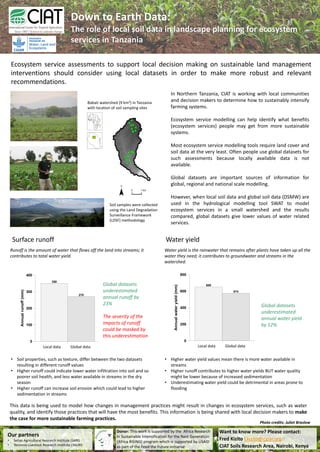
However, when local soil data and global soil data (DSMW) are
used in the hydrological modelling tool SWAT to model
ecosystem services in a small watershed and the results
compared, global datasets give lower values of water related
services.
Ecosystem service assessments to support local decision making on sustainable land management
interventions should consider using local datasets in order to make more robust and relevant
recommendations.
Down to Earth Data:
The role of local soil data in landscape planning for ecosystem
services in Tanzania
Soil samples were collected
using the Land Degradation
Surveillance Framework
(LDSF) methodology
Water yield
• Higher water yield values mean there is more water available in
streams
• Higher runoff contributes to higher water yields BUT water quality
might be lower because of increased sedimentation
• Underestimating water yield could be detrimental in areas prone to
flooding
Water yield
0
200
400
600
800
Annualwateryield(mm)
650
574
Water Yield Field scale data
Water Yield Global data
Runoff
0
100
200
300
400
Annualrunoff(mm)
350
2
Runoff Field scale
Runoff Global data
Local data Global data
Global datasets
underestimated
annual water yield
by 12%
Water yield is the rainwater that remains after plants have taken up all the
water they need; it contributes to groundwater and streams in the
watershed.
Surface runoff
• Soil properties, such as texture, differ between the two datasets
resulting in different runoff values
• Higher runoff could indicate lower water infiltration into soil and so
poorer soil health, and less water available in streams in the dry
season
• Higher runoff can increase soil erosion which could lead to higher
sedimentation in streams
cale data
data
Runoff
0
100
200
300
400
Annualrunoff(mm)
350
270
Runoff Field scale data
Runoff Global data
Local data Global data
Global datasets
underestimated
annual runoff by
23%
The severity of the
impacts of runoff
could be masked by
this underestimation
Runoff is the amount of water that flows off the land into streams; it
contributes to total water yield.
This data is being used to model how changes in management practices might result in changes in ecosystem services, such as water
quality, and identify those practices that will have the most benefits. This information is being shared with local decision makers to make
the case for more sustainable farming practices.
Babati watershed (9 km2) in Tanzania
with location of soil sampling sites

Down to Earth data

  • 1.
    Want to knowmore? Please contact: Fred Kizito f.kizito@cgiar.org CIAT Soils Research Area, Nairobi, Kenya Our partners • Selian Agricultural Research Institute (SARI) • Tanzania Livestock Research Institute (TALIRI) Donor: This work is supported by the Africa Research in Sustainable Intensification for the Next Generation (Africa RISING) program which is supported by USAID as part of the Feed the Future initiative Photo credits: Juliet Braslow In Northern Tanzania, CIAT is working with local communities and decision makers to determine how to sustainably intensify farming systems. Ecosystem service modelling can help identify what benefits (ecosystem services) people may get from more sustainable systems. Most ecosystem service modelling tools require land cover and soil data at the very least. Often people use global datasets for such assessments because locally available data is not available. Global datasets are important sources of information for global, regional and national scale modelling. However, when local soil data and global soil data (DSMW) are used in the hydrological modelling tool SWAT to model ecosystem services in a small watershed and the results compared, global datasets give lower values of water related services. Ecosystem service assessments to support local decision making on sustainable land management interventions should consider using local datasets in order to make more robust and relevant recommendations. Down to Earth Data: The role of local soil data in landscape planning for ecosystem services in Tanzania Soil samples were collected using the Land Degradation Surveillance Framework (LDSF) methodology Water yield • Higher water yield values mean there is more water available in streams • Higher runoff contributes to higher water yields BUT water quality might be lower because of increased sedimentation • Underestimating water yield could be detrimental in areas prone to flooding Water yield 0 200 400 600 800 Annualwateryield(mm) 650 574 Water Yield Field scale data Water Yield Global data Runoff 0 100 200 300 400 Annualrunoff(mm) 350 2 Runoff Field scale Runoff Global data Local data Global data Global datasets underestimated annual water yield by 12% Water yield is the rainwater that remains after plants have taken up all the water they need; it contributes to groundwater and streams in the watershed. Surface runoff • Soil properties, such as texture, differ between the two datasets resulting in different runoff values • Higher runoff could indicate lower water infiltration into soil and so poorer soil health, and less water available in streams in the dry season • Higher runoff can increase soil erosion which could lead to higher sedimentation in streams cale data data Runoff 0 100 200 300 400 Annualrunoff(mm) 350 270 Runoff Field scale data Runoff Global data Local data Global data Global datasets underestimated annual runoff by 23% The severity of the impacts of runoff could be masked by this underestimation Runoff is the amount of water that flows off the land into streams; it contributes to total water yield. This data is being used to model how changes in management practices might result in changes in ecosystem services, such as water quality, and identify those practices that will have the most benefits. This information is being shared with local decision makers to make the case for more sustainable farming practices. Babati watershed (9 km2) in Tanzania with location of soil sampling sites