DSM architecture, advantages
& disadvantages
Subject: DOS
CE-B
 Maulik togadiya
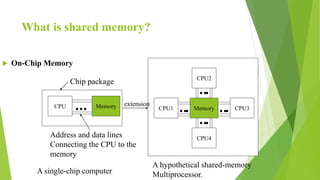
What is shared memory?
 On-Chip Memory
CPU Memory CPU1 Memory
CPU4
CPU2
CPU3
Chip package
Address and data lines
Connecting the CPU to the
memory
extension
A single-chip computer
A hypothetical shared-memory
Multiprocessor.
Introduction
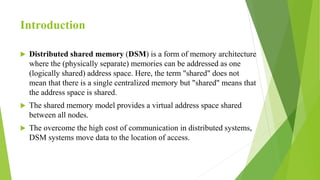
 Distributed shared memory (DSM) is a form of memory architecture
where the (physically separate) memories can be addressed as one
(logically shared) address space. Here, the term "shared" does not
mean that there is a single centralized memory but "shared" means that
the address space is shared.
 The shared memory model provides a virtual address space shared
between all nodes.
 The overcome the high cost of communication in distributed systems,
DSM systems move data to the location of access.
How it works?
 Data moves between main memory and secondary memory
(within a node) and between main memories of different nodes.
 When a process accesses data in the shared address space, the
mapping manager maps shared memory address to physical
memory (local or remote).
DSM architecture
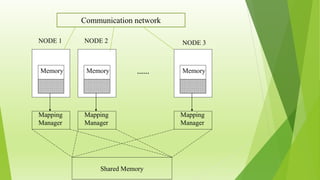
 High speed communication network is used for connecting nodes.
 A simple message passing system allows on different node to
exchange message with each other.
 Memory mapping manager routine in each node maps local
memory onto the shared virtual memory. For mapping operation,
the shared memory space is partitioned into blocks.
 The main memory of individual nodes is used to cache of shared
memory space.
Memory
Mapping
Manager
Memory
Mapping
Manager
Memory
Mapping
Manager
Shared Memory
NODE 1 NODE 2 NODE 3
Communication network
 Systems that support DSM,data moves between secondary memory
and main memory as well as between main memories of different
nodes.
 When process access data in shared address space, a mapping
manager maps the shared memory address to the physical memory.
The mapping manager is layer of software implemented either in
the operating kernel or as runtime library routine.
DSM architecture
Advantages
 Shields programmer from send/receive primitives.
 DSM is usually cheaper than using multiprocessor system.
 DSM provides large virtual memory space.
 DSM programs portable as they use common DSM programming
interface.
 It can handle complex and large data bases without replication or
sending the data to processes.
 No memory access bottleneck.
Disadvantages
 Must provide for protection against simultaneous access to shared
data such as lock..
 It could cause a performance penalty.
 Little programmer control over actual messages being generated.
 Performance of irregular problems could be difficult.
 Programmers need to be understand consistency model to write
correct programs.
Distributed shred memory architecture

Distributed shred memory architecture

  • 1.
    DSM architecture, advantages &disadvantages Subject: DOS CE-B  Maulik togadiya
  • 2.
    What is sharedmemory?  On-Chip Memory CPU Memory CPU1 Memory CPU4 CPU2 CPU3 Chip package Address and data lines Connecting the CPU to the memory extension A single-chip computer A hypothetical shared-memory Multiprocessor.
  • 3.
    Introduction  Distributed sharedmemory (DSM) is a form of memory architecture where the (physically separate) memories can be addressed as one (logically shared) address space. Here, the term "shared" does not mean that there is a single centralized memory but "shared" means that the address space is shared.  The shared memory model provides a virtual address space shared between all nodes.  The overcome the high cost of communication in distributed systems, DSM systems move data to the location of access.
  • 4.
    How it works? Data moves between main memory and secondary memory (within a node) and between main memories of different nodes.  When a process accesses data in the shared address space, the mapping manager maps shared memory address to physical memory (local or remote).
  • 5.
    DSM architecture  Highspeed communication network is used for connecting nodes.  A simple message passing system allows on different node to exchange message with each other.  Memory mapping manager routine in each node maps local memory onto the shared virtual memory. For mapping operation, the shared memory space is partitioned into blocks.  The main memory of individual nodes is used to cache of shared memory space.
  • 6.
  • 7.
     Systems thatsupport DSM,data moves between secondary memory and main memory as well as between main memories of different nodes.  When process access data in shared address space, a mapping manager maps the shared memory address to the physical memory. The mapping manager is layer of software implemented either in the operating kernel or as runtime library routine. DSM architecture
  • 8.
    Advantages  Shields programmerfrom send/receive primitives.  DSM is usually cheaper than using multiprocessor system.  DSM provides large virtual memory space.  DSM programs portable as they use common DSM programming interface.  It can handle complex and large data bases without replication or sending the data to processes.  No memory access bottleneck.
  • 9.
    Disadvantages  Must providefor protection against simultaneous access to shared data such as lock..  It could cause a performance penalty.  Little programmer control over actual messages being generated.  Performance of irregular problems could be difficult.  Programmers need to be understand consistency model to write correct programs.