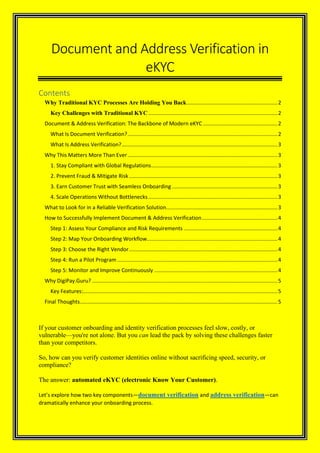
Document and AddressVerification in
eKYC
Contents
Why Traditional KYC Processes Are Holding You Back.............................................................2
Key Challenges with Traditional KYC .......................................................................................2
Document & Address Verification: The Backbone of Modern eKYC ..................................................2
What Is Document Verification?.....................................................................................................2
What Is Address Verification?.........................................................................................................3
Why This Matters More Than Ever.....................................................................................................3
1. Stay Compliant with Global Regulations.....................................................................................3
2. Prevent Fraud & Mitigate Risk....................................................................................................3
3. Earn Customer Trust with Seamless Onboarding .......................................................................3
4. Scale Operations Without Bottlenecks.......................................................................................3
What to Look for in a Reliable Verification Solution...........................................................................3
How to Successfully Implement Document & Address Verification...................................................4
Step 1: Assess Your Compliance and Risk Requirements ...............................................................4
Step 2: Map Your Onboarding Workflow........................................................................................4
Step 3: Choose the Right Vendor....................................................................................................4
Step 4: Run a Pilot Program ............................................................................................................4
Step 5: Monitor and Improve Continuously ...................................................................................4
Why DigiPay.Guru? .............................................................................................................................5
Key Features:...................................................................................................................................5
Final Thoughts.....................................................................................................................................5
If your customer onboarding and identity verification processes feel slow, costly, or
vulnerable—you're not alone. But you can lead the pack by solving these challenges faster
than your competitors.
So, how can you verify customer identities online without sacrificing speed, security, or
compliance?
The answer: automated eKYC (electronic Know Your Customer).
Let’s explore how two key components—document verification and address verification—can
dramatically enhance your onboarding process.
2.
Why Traditional KYCProcesses Are Holding You Back
Conventional KYC methods rely on manual document checks, in-person meetings, or postal
submissions. These methods are not only outdated—they’re inefficient and error-prone.
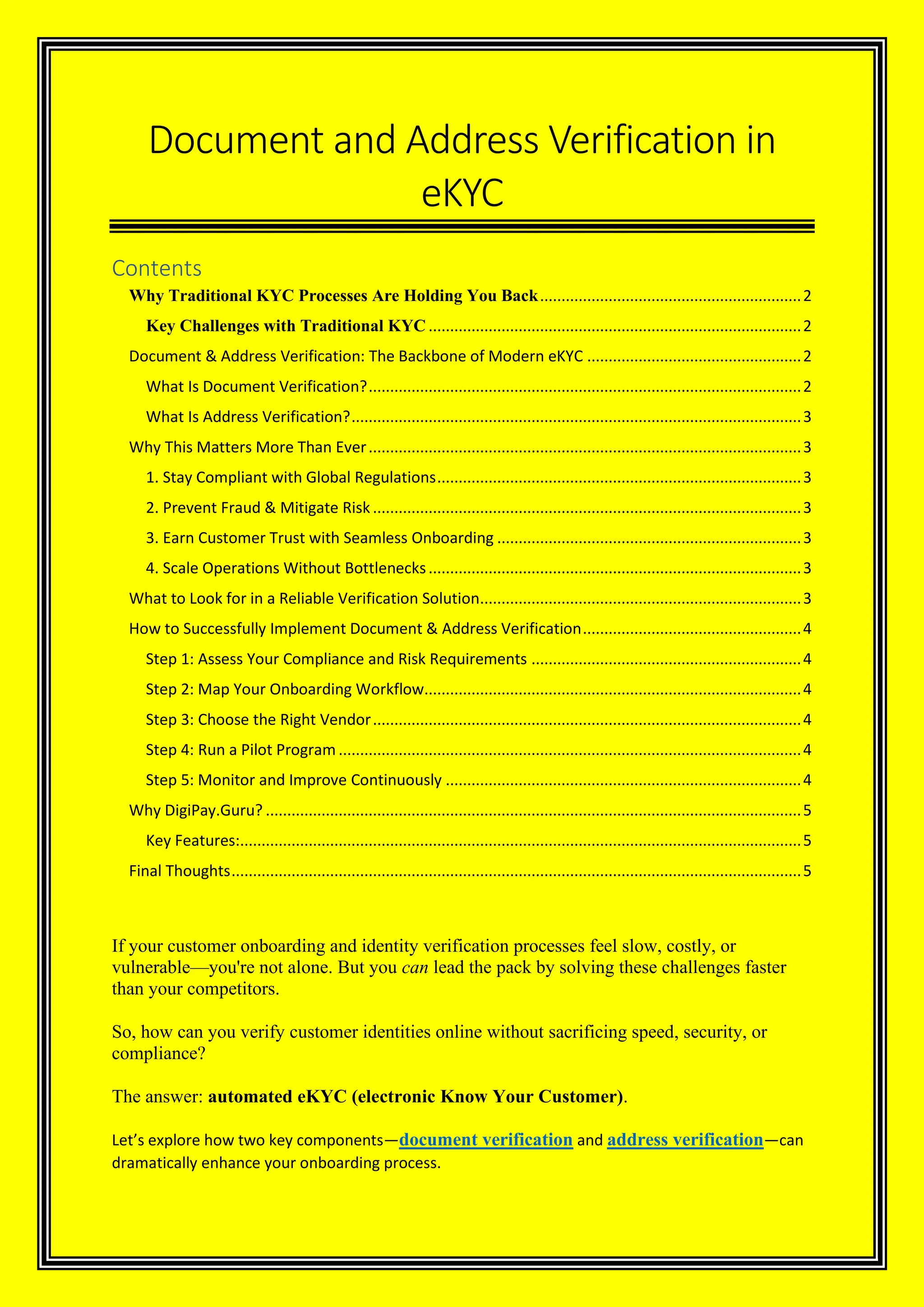
Key Challenges with Traditional KYC
Challenge Impact
High Operational Costs
Manual document reviews consume time and human
resources, driving up overheads.
Delayed Onboarding =
Lost Revenue
Every delay creates friction, causing potential
customers to drop off.
Greater Fraud Risk
Manual checks make it easier for fake IDs or
synthetic identities to slip through.
Compliance Struggles
Across Regions
Keeping up with international regulations manually is
nearly impossible.
Poor Customer
Experience
Clunky onboarding damages your digital reputation
and customer trust.
Document & Address Verification: The Backbone of
Modern eKYC
What Is Document Verification?
Document verification ensures that a customer’s submitted ID is valid, authentic, and matches
official records. It’s a foundational piece of secure, automated KYC processes.
How It Works:
1. User submits ID documents.
2. System extracts data using OCR (Optical Character Recognition).
3. AI checks the document’s type, structure, and data consistency.
4. Real-time feedback: approved or rejected.
Technologies Behind It:
• OCR: Extracts text data for analysis.
• AI & Machine Learning: Detects forgeries, fake documents, and inconsistencies.
3.
• Blockchain (Emerging):Being explored for tamper-proof record-keeping.
What Is Address Verification?
Address verification confirms that a customer’s stated address is valid and actually belongs to
them—crucial for risk mitigation and compliance.
How It Works:
1. User submits proof of address (e.g., utility bill).
2. System checks format, validity, and expiration.
3. A confidence score is calculated.
4. The document is approved or rejected.
Address Verification Methods:
• Document-Based: Bills, bank statements, tax letters.
• Video KYC: Live agents verify addresses via video calls.
• Geotagging & GPS: Cross-checks user’s location in real-time.
• IP & Metadata Analysis: Detects anomalies in location or behavior.
Why This Matters More Than Ever
Financial institutions today face intense pressure—from customers, regulators, and fraud threats.
Manual KYC checks can’t keep up.
Here’s why automated document and address verification is now essential:
1. Stay Compliant with Global Regulations
From FATF and GDPR to AML laws, requirements change constantly. eKYC tools help you stay ahead
without scrambling for every new rule.
2. Prevent Fraud & Mitigate Risk
Fake IDs and false addresses are common fraud tactics. Real-time verification filters out these
threats at the source.
3. Earn Customer Trust with Seamless Onboarding
Speed matters. Customers want smooth, secure onboarding—and they won’t wait around if it isn’t.
4. Scale Operations Without Bottlenecks
As you expand, automated verification ensures consistent compliance and speed across all regions
and markets.
What to Look for in a Reliable Verification Solution
4.
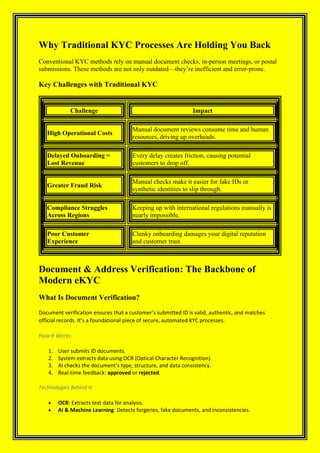
Not all verificationtools are created equal. Here’s what your business should prioritize:
Why It Matters
Accuracy & Fraud
Detection
Detects the smallest inconsistencies to protect your business
and users.
Speed & User Experience A fast, frictionless process boosts conversions and satisfaction.
Scalability
Must work seamlessly across markets with regional
customization.
Regulatory Compliance Should align with international and local KYC/AML laws.
Integration & Flexibility
Easy to plug into your existing systems with tailored
workflows.
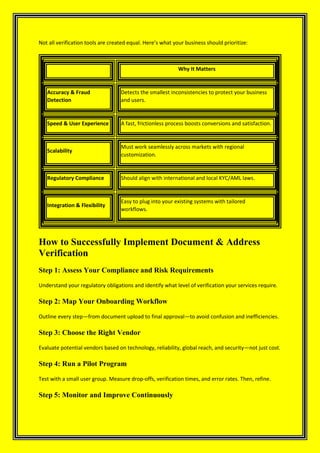
How to Successfully Implement Document & Address
Verification
Step 1: Assess Your Compliance and Risk Requirements
Understand your regulatory obligations and identify what level of verification your services require.
Step 2: Map Your Onboarding Workflow
Outline every step—from document upload to final approval—to avoid confusion and inefficiencies.
Step 3: Choose the Right Vendor
Evaluate potential vendors based on technology, reliability, global reach, and security—not just cost.
Step 4: Run a Pilot Program
Test with a small user group. Measure drop-offs, verification times, and error rates. Then, refine.
Step 5: Monitor and Improve Continuously
5.
Track performance metricsand make iterative improvements based on real-time data and user
feedback.
Why DigiPay.Guru?
DigiPay.Guru offers a complete eKYC solution designed for financial institutions that need secure,
scalable, and regulation-ready onboarding.
Key Features:
Document Verification
• Real-time OCR scanning
• Fraud detection using AI
• Format and expiry checks
• Instant validation
Address Verification
• Global address support
• Live geo-verification options
• OCR-based document parsing
• Customizable verification rules
With DigiPay.Guru, you’ll benefit from faster onboarding, reduced risk, and a fully compliant process
that your customers can trust.
Final Thoughts
Onboarding is no longer just a formality—it’s your first impression. And if your KYC process is clunky,
slow, or insecure, you risk losing both revenue and credibility.
Document and address verification are no longer optional add-ons—they’re critical pillars of a
modern, efficient, and compliant eKYC strategy.
Whether you're fighting fraud, expanding globally, or trying to win customer trust from the first
click—automated verification is how you do it.
Let DigiPay.Guru help you make that shift—with a solution that’s fast, secure, and built for scale.
Start onboarding smarter today.
Note – This blog was originally was posted on - Document & Address Verification in eKYC: Why It
Matters and How to Implement It
Connect With Us