5/8/2012
1
Digital Logic & Design
Dr. SajjadAhmed Nadeem
Department of Computer Science & IT
University of Azad Jammu & Kashmir
Muzaffarabad
Module-04
— Registers.
— Register Transfer.
— Binary Logic.
— Gates.
5/8/2012
2
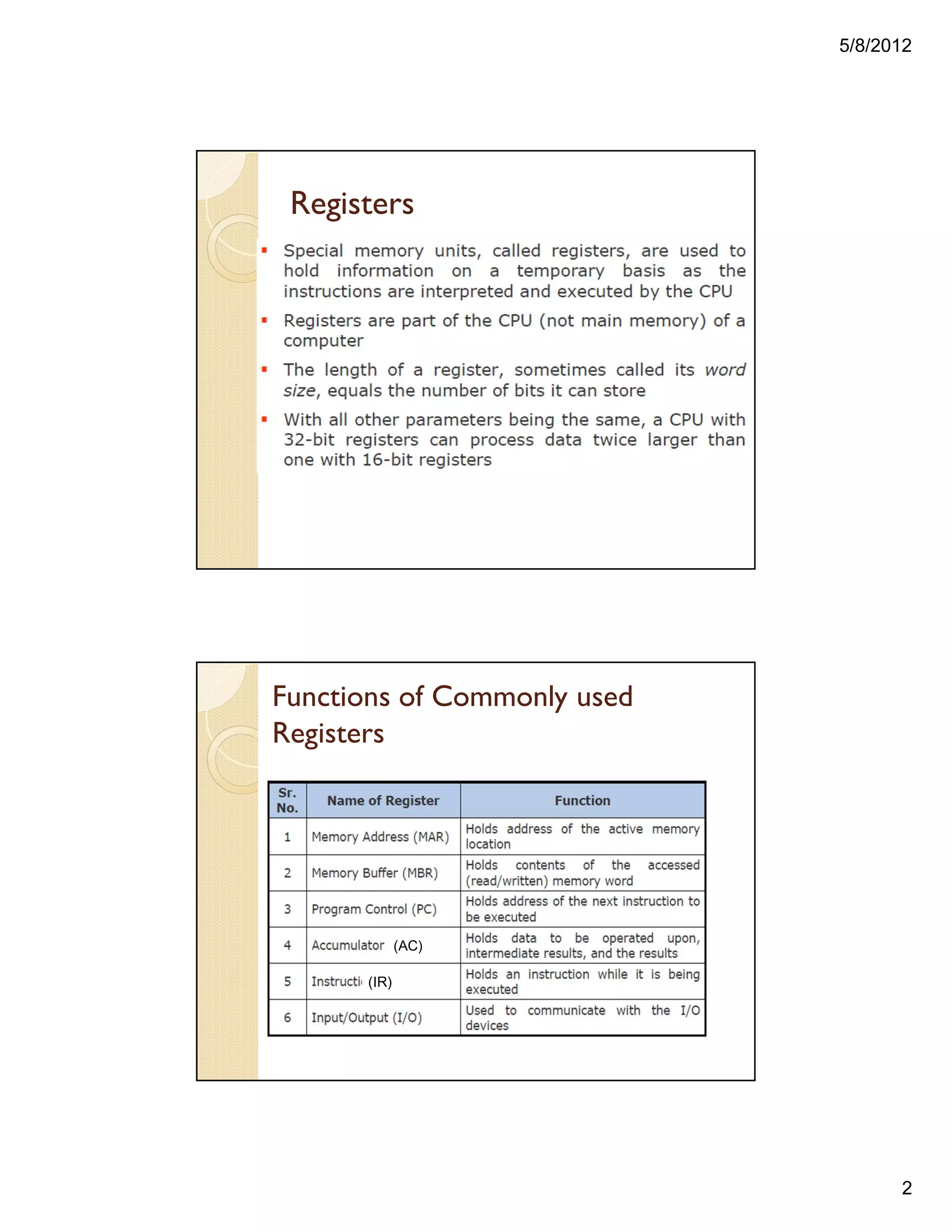
Registers
Functions of Commonly used
Registers
(IR)
(AC)
5/8/2012
3
RegisterTransfer
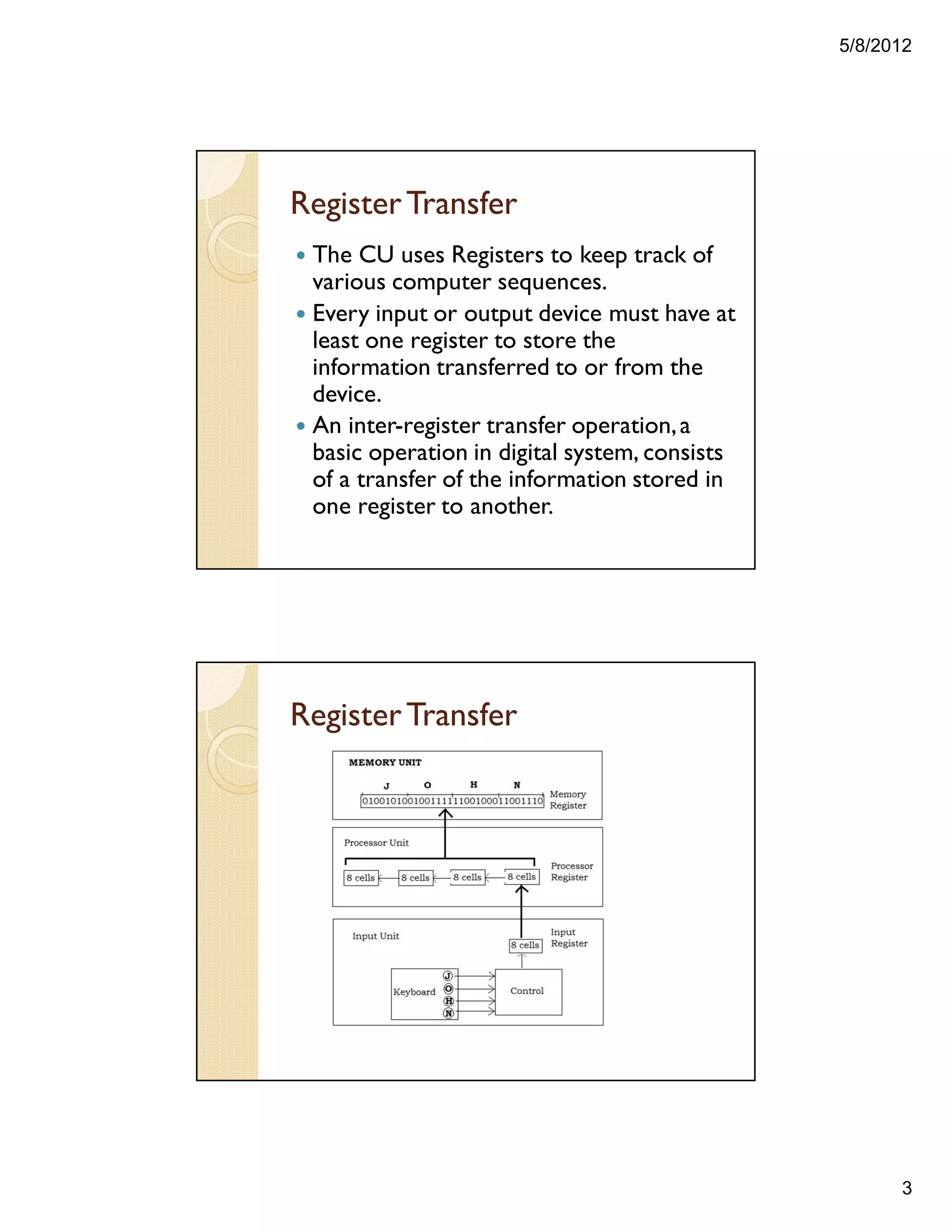
— The CU uses Registers to keep track of
various computer sequences.
— Every input or output device must have at
least one register to store the
information transferred to or from the
device.
— An inter-register transfer operation,a
basic operation in digital system, consists
of a transfer of the information stored in
one register to another.
RegisterTransfer
5/8/2012
4
RegisterTransfer
— The input unit is assumed to have a
keyboard,a control unit, and an input
register.
— Each time a key is struck, the control
enters into the input register an
equivalent 8 bit alphanumeric character
code (assume code is ASCII).
— The information from the input register is
transferred into the eight least significant
cells of a processor register.
RegisterTransfer
— After every transfer, the input register is cleared
to enable the control to insert a new 8 bit code
when the keyboard is struck again.
— Each 8 bit character transferred to the
processor register is preceded by a shift of the
previous character to the next 8 cells on its left.
— When the transfer of characters is completed,
the processor register is full, and its contents
are transferred into a memory register.
5/8/2012
5
RegisterTransfer
— To process discrete quantities of information in
binary form, a computer must be provided with,
i. Devices that hold the data to be processed.
ii. Circuit elements that manipulate individual
bits of information.
— The device most commonly used for holding
data is register.
— Manipulation of binary variables is done by
means of digital logic circuits.
RegisterTransfer
5/8/2012
6
RegisterTransfer
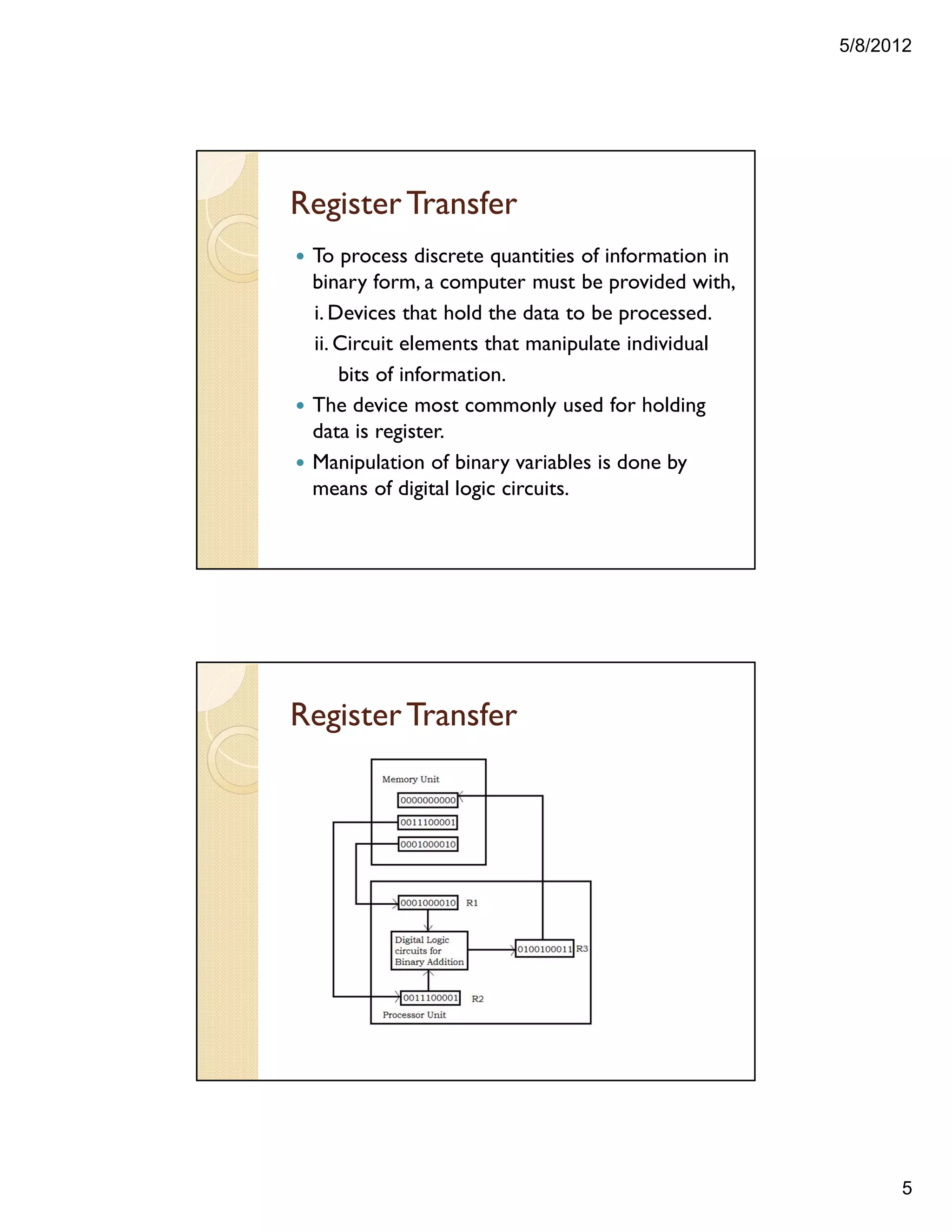
— Process of adding two 10 bit binary numbers.
— Memory unit, which normally consists of
thousands of registers, is shown with only 3 of
its registers.
— Processor is shown with 3 registers, R1,R2,R3,
together with Digital Logic Circuit that
manipulate the bits of R1 and R2 and transfer
into R3, their sum.
RegisterTransfer
— Information stored in memory can be
transferred to processor registers, and Results
obtained in processor registers can be
transferred back into a memory register for
storage.
— The registers of a system are the basic elements
for storing and holding the binary information.
— The Digital Logic Circuits process the
information.
5/8/2012
7
Binary Logic
— Binary Logic deals with variable that take
on two discrete values and with
operations that assume logical meaning.
— Binary logic is used to describe in a
mathematical way, the manipulation and
processing of binary information.
— It is particularly suited for the analysis and
design of digital systems.
— It is also termed as BooleanAlgebra.
Boolean Algebra
5/8/2012
8
Operator Precedence
Binary logic
— Binary logic deals with variables that take on two
discrete values and operations that assume logical
meaning.
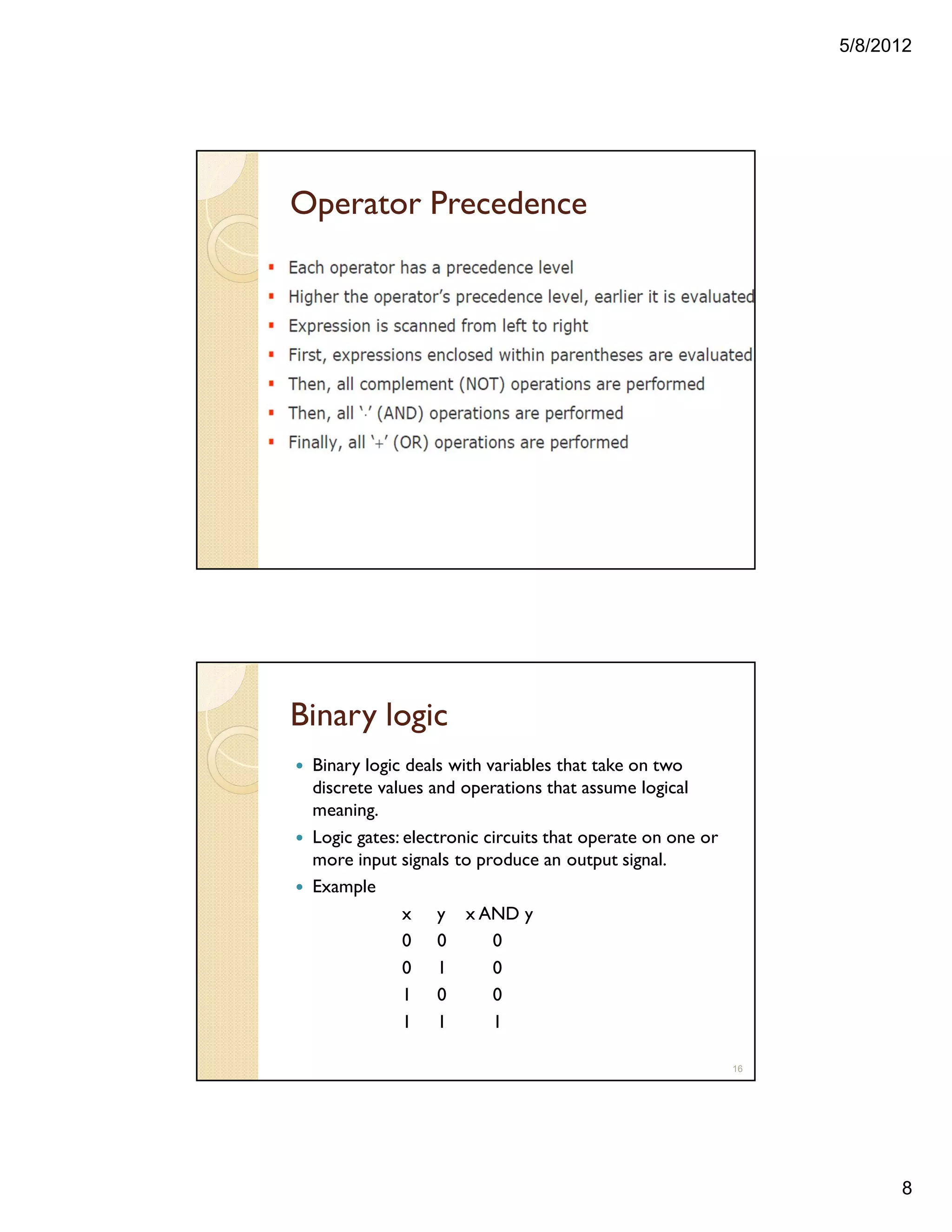
— Logic gates: electronic circuits that operate on one or
more input signals to produce an output signal.
— Example
x y x AND y
0 0 0
0 1 0
1 0 0
1 1 1
16
5/8/2012
9
17
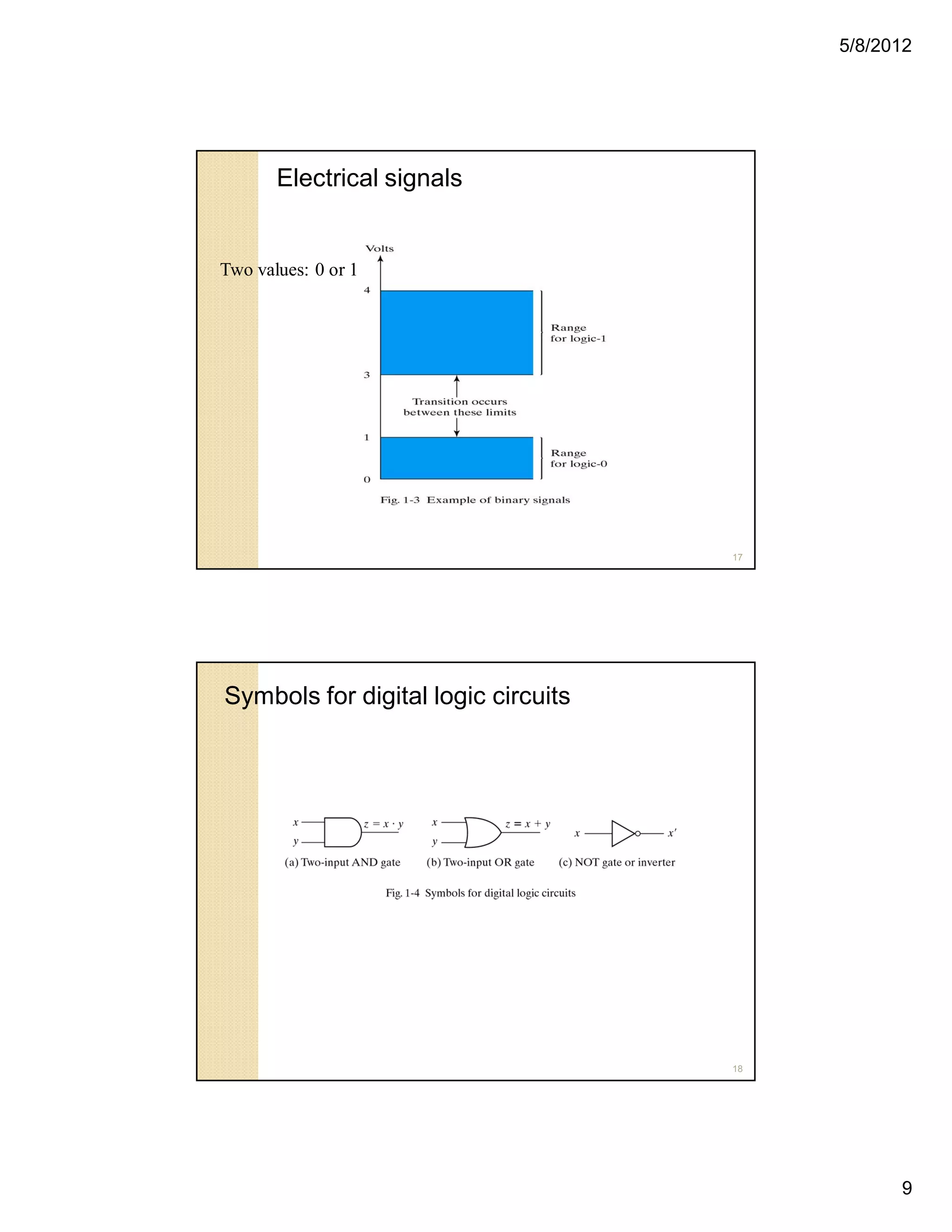
Electrical signals
Two values: 0 or 1
18
Symbols for digital logic circuits
5/8/2012
10
19
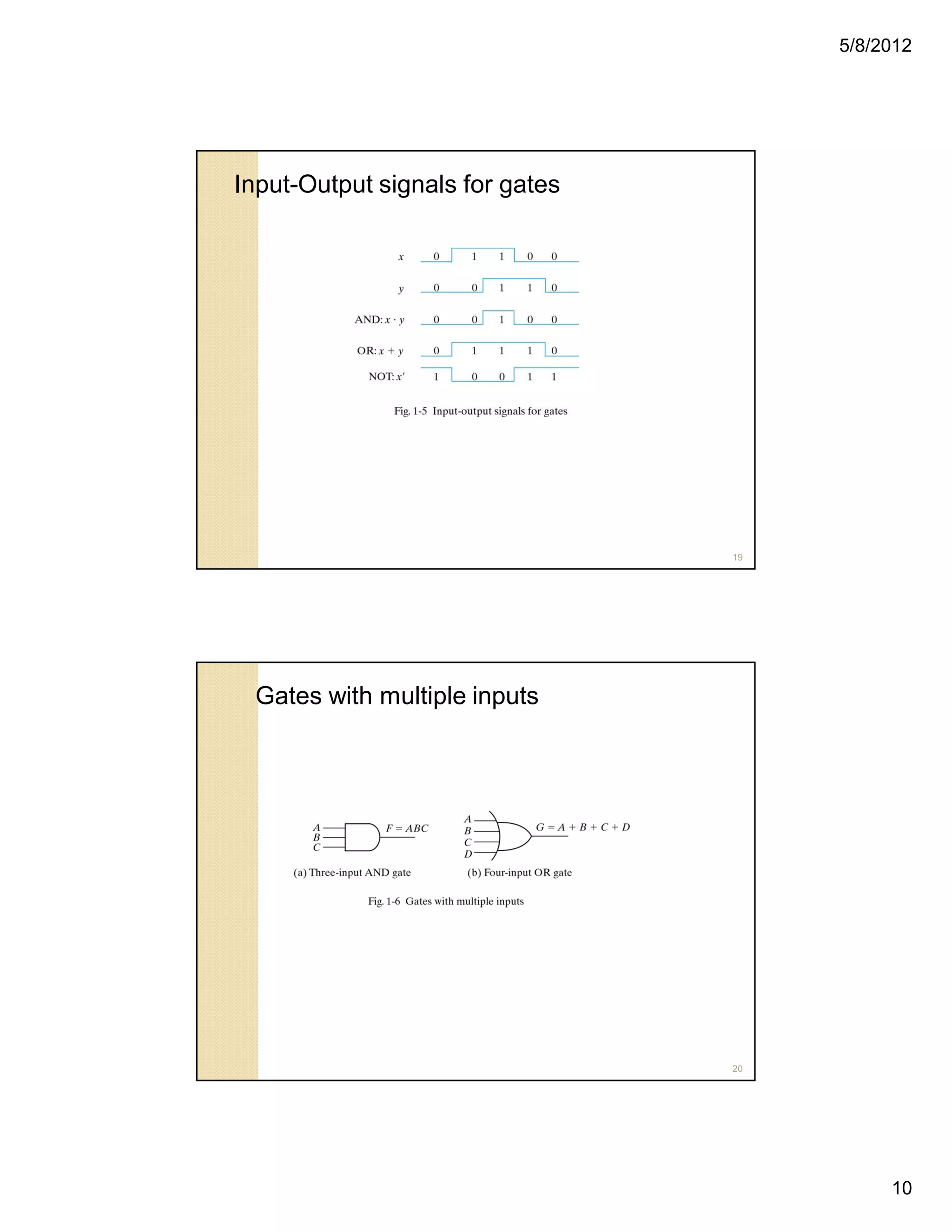
Input-Output signals for gates
20
Gates with multiple inputs

Dld lecture module 04 01

  • 1.
    5/8/2012 1 Digital Logic &Design Dr. SajjadAhmed Nadeem Department of Computer Science & IT University of Azad Jammu & Kashmir Muzaffarabad Module-04 — Registers. — Register Transfer. — Binary Logic. — Gates.
  • 2.
  • 3.
    5/8/2012 3 RegisterTransfer — The CUuses Registers to keep track of various computer sequences. — Every input or output device must have at least one register to store the information transferred to or from the device. — An inter-register transfer operation,a basic operation in digital system, consists of a transfer of the information stored in one register to another. RegisterTransfer
  • 4.
    5/8/2012 4 RegisterTransfer — The inputunit is assumed to have a keyboard,a control unit, and an input register. — Each time a key is struck, the control enters into the input register an equivalent 8 bit alphanumeric character code (assume code is ASCII). — The information from the input register is transferred into the eight least significant cells of a processor register. RegisterTransfer — After every transfer, the input register is cleared to enable the control to insert a new 8 bit code when the keyboard is struck again. — Each 8 bit character transferred to the processor register is preceded by a shift of the previous character to the next 8 cells on its left. — When the transfer of characters is completed, the processor register is full, and its contents are transferred into a memory register.
  • 5.
    5/8/2012 5 RegisterTransfer — To processdiscrete quantities of information in binary form, a computer must be provided with, i. Devices that hold the data to be processed. ii. Circuit elements that manipulate individual bits of information. — The device most commonly used for holding data is register. — Manipulation of binary variables is done by means of digital logic circuits. RegisterTransfer
  • 6.
    5/8/2012 6 RegisterTransfer — Process ofadding two 10 bit binary numbers. — Memory unit, which normally consists of thousands of registers, is shown with only 3 of its registers. — Processor is shown with 3 registers, R1,R2,R3, together with Digital Logic Circuit that manipulate the bits of R1 and R2 and transfer into R3, their sum. RegisterTransfer — Information stored in memory can be transferred to processor registers, and Results obtained in processor registers can be transferred back into a memory register for storage. — The registers of a system are the basic elements for storing and holding the binary information. — The Digital Logic Circuits process the information.
  • 7.
    5/8/2012 7 Binary Logic — BinaryLogic deals with variable that take on two discrete values and with operations that assume logical meaning. — Binary logic is used to describe in a mathematical way, the manipulation and processing of binary information. — It is particularly suited for the analysis and design of digital systems. — It is also termed as BooleanAlgebra. Boolean Algebra
  • 8.
    5/8/2012 8 Operator Precedence Binary logic —Binary logic deals with variables that take on two discrete values and operations that assume logical meaning. — Logic gates: electronic circuits that operate on one or more input signals to produce an output signal. — Example x y x AND y 0 0 0 0 1 0 1 0 0 1 1 1 16
  • 9.
    5/8/2012 9 17 Electrical signals Two values:0 or 1 18 Symbols for digital logic circuits
  • 10.
    5/8/2012 10 19 Input-Output signals forgates 20 Gates with multiple inputs