Easy Approach:
Numbering Systems
And Arithmetic Operations On Hex,
Binary, And Octal
Lecture-03
Teacher: Dr. Syed Ali Asgher
Email: alisyed5@duet.edu.pk
2
12
Department of Computer Science
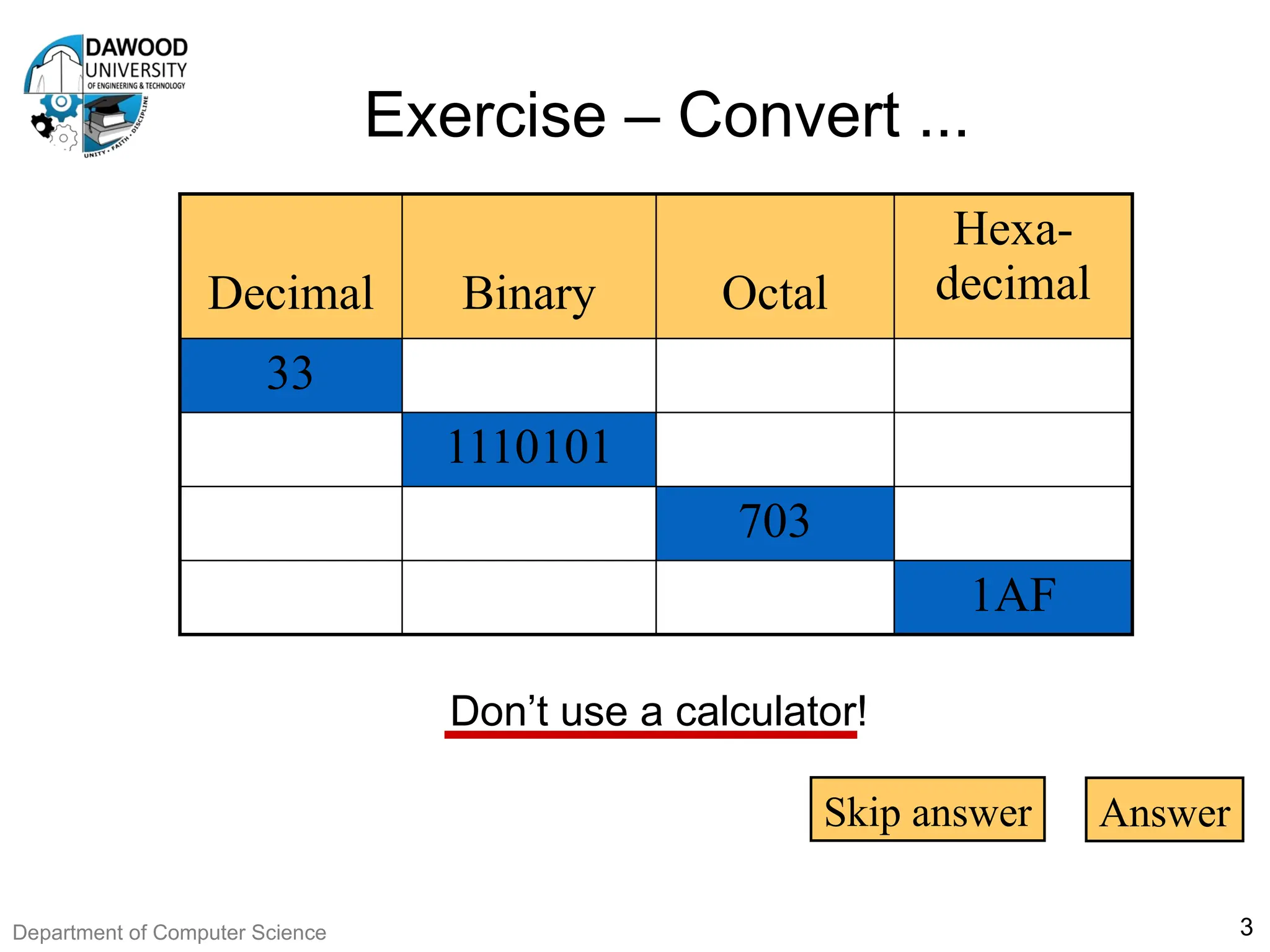
Exercise – Convert ...
3
Don’t use a calculator!
Decimal Binary Octal
Hexa-
decimal
33
1110101
703
1AF
Skip answer Answer
Department of Computer Science
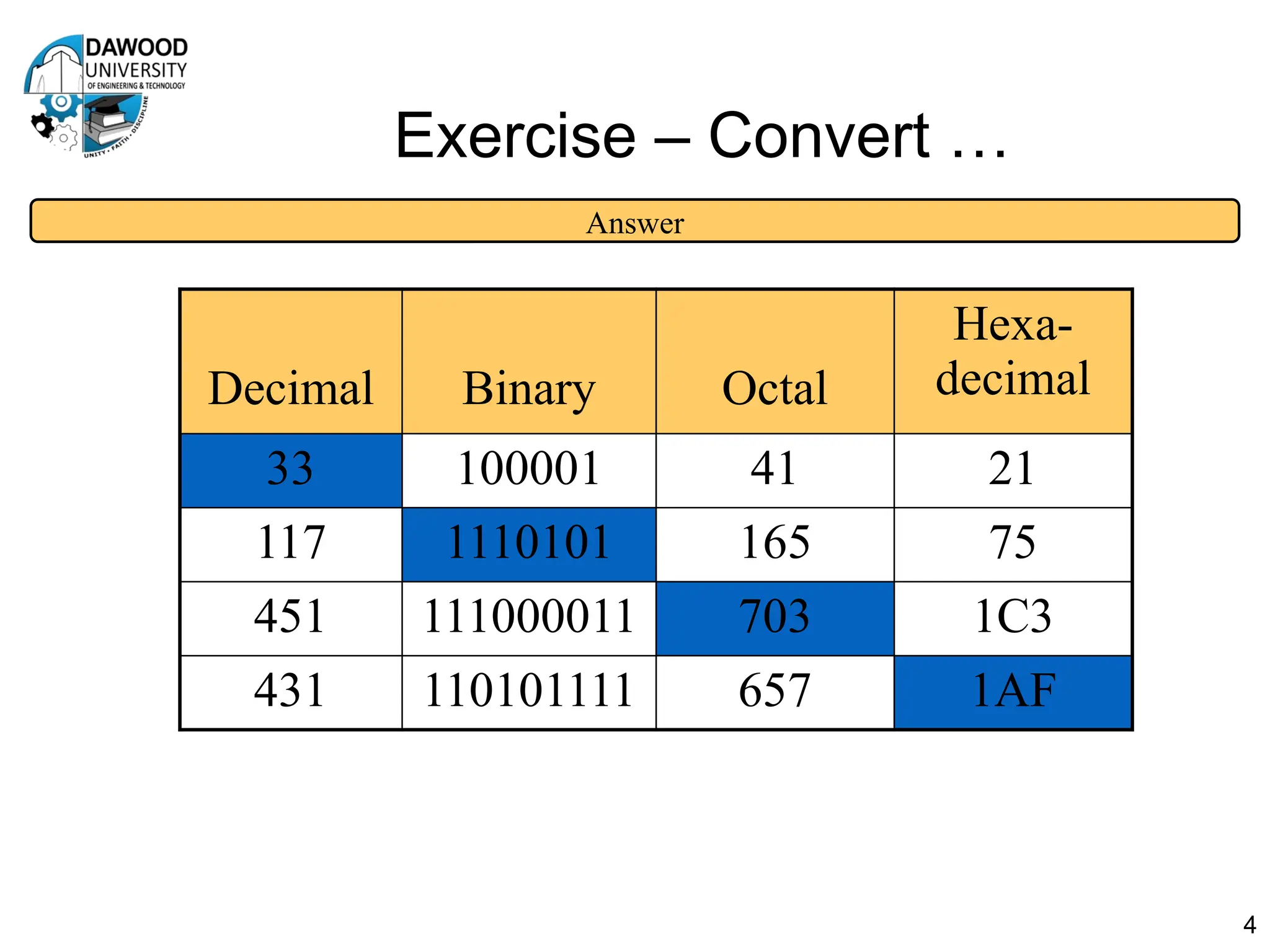
Exercise – Convert …
4
Decimal Binary Octal
Hexa-
decimal
33 100001 41 21
117 1110101 165 75
451 111000011 703 1C3
431 110101111 657 1AF
Answer
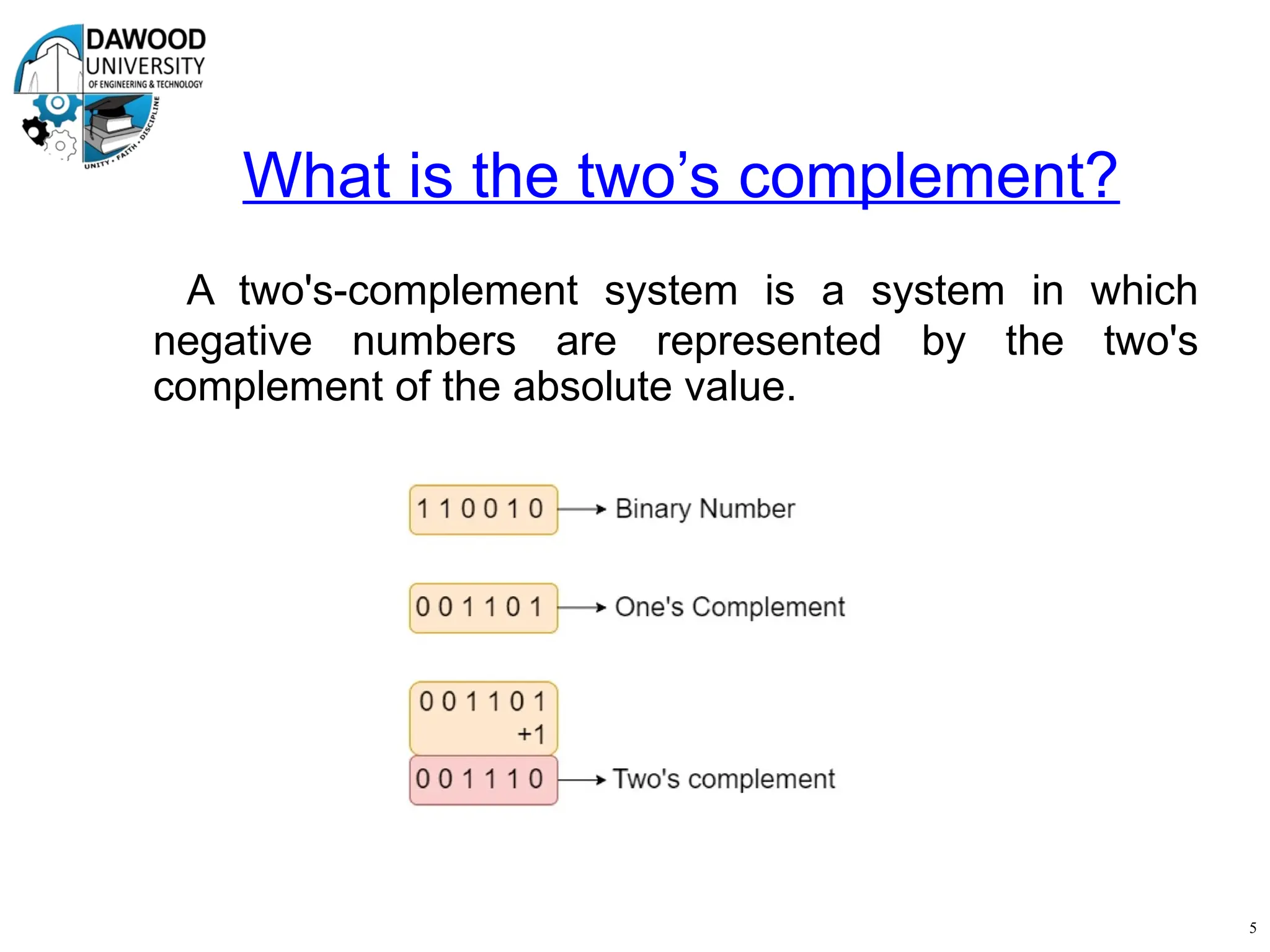
What is the two’s complement?
A two's-complement system is a system in which
negative numbers are represented by the two's
complement of the absolute value.
5
Example
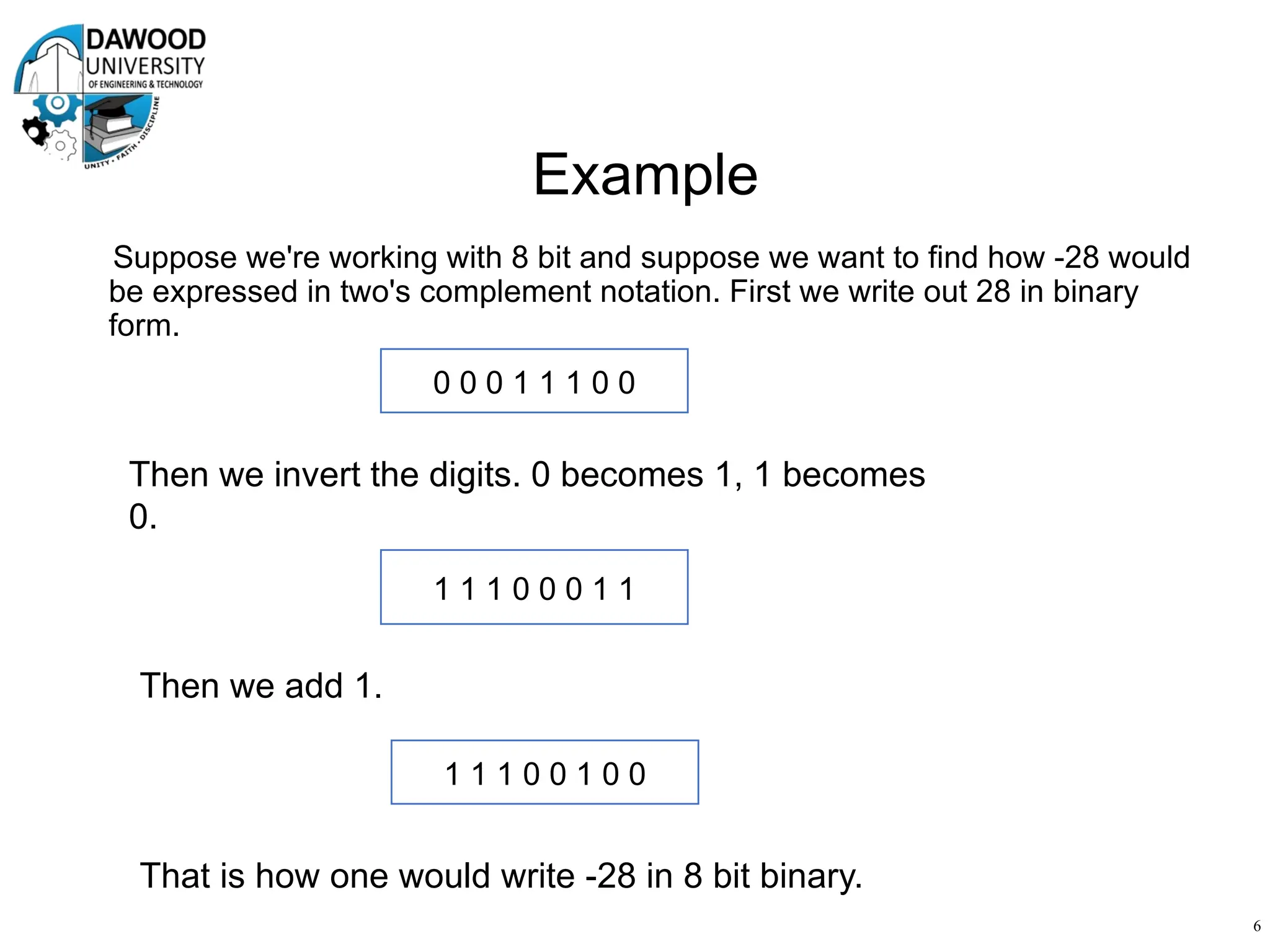
Suppose we're working with 8 bit and suppose we want to find how -28 would
be expressed in two's complement notation. First we write out 28 in binary
form.
0 0 0 1 1 1 0 0
1 1 1 0 0 1 0 0
1 1 1 0 0 0 1 1
Then we invert the digits. 0 becomes 1, 1 becomes
0.
Then we add 1.
That is how one would write -28 in 8 bit binary.
6
7
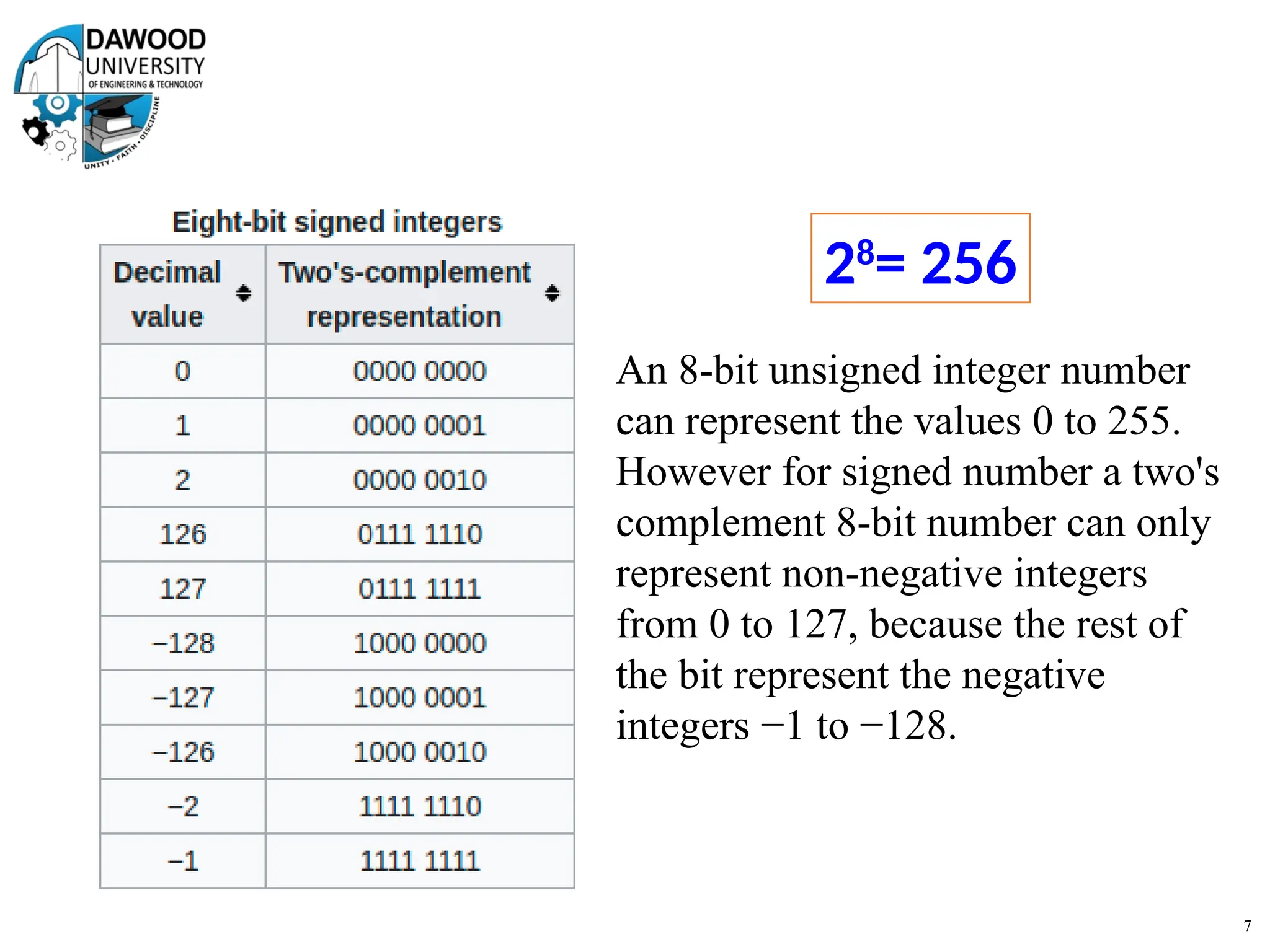
An 8-bit unsigned integer number
can represent the values 0 to 255.
However for signed number a two's
complement 8-bit number can only
represent non-negative integers
from 0 to 127, because the rest of
the bit represent the negative
integers −1 to −128.
28
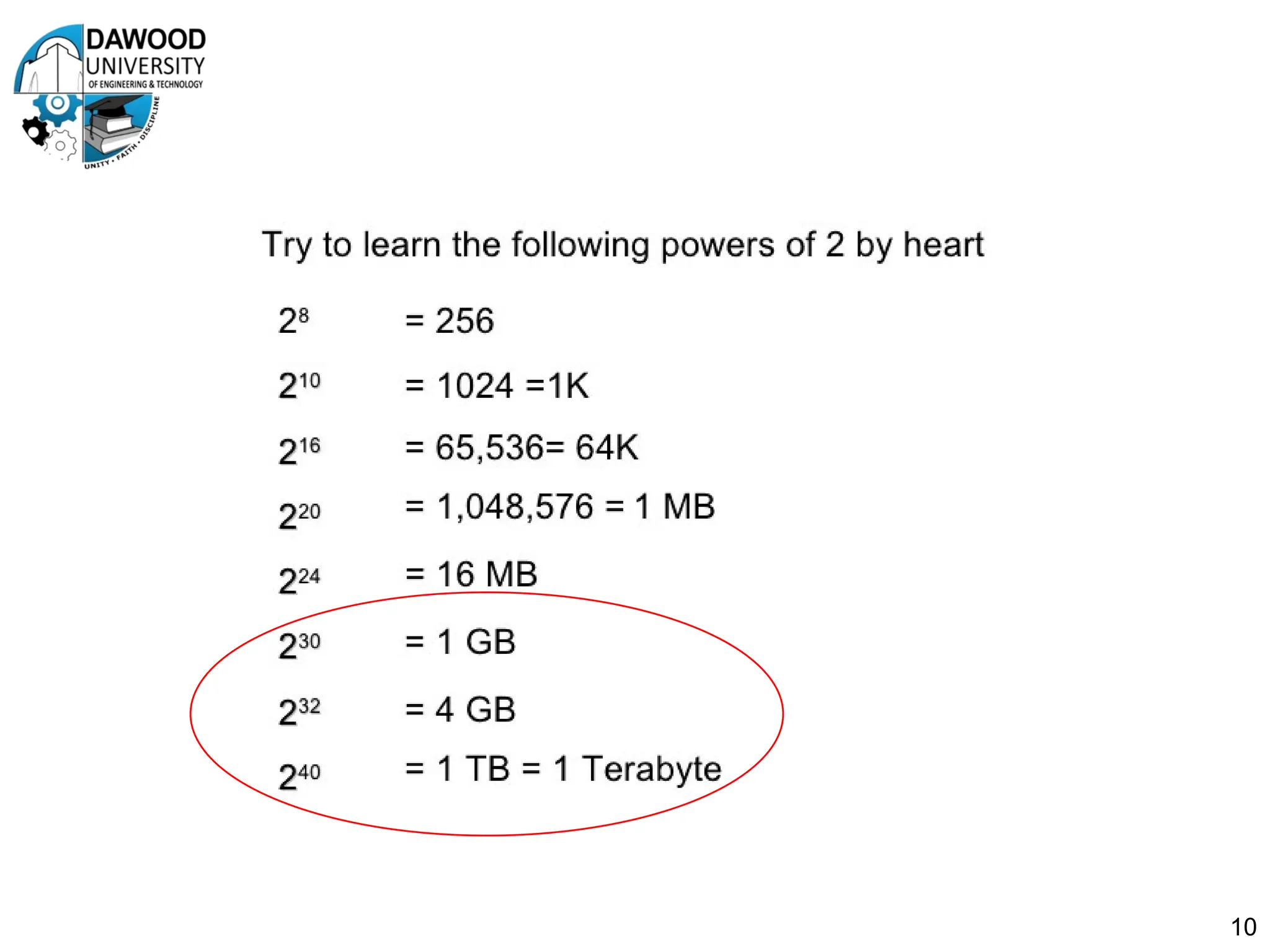
= 256
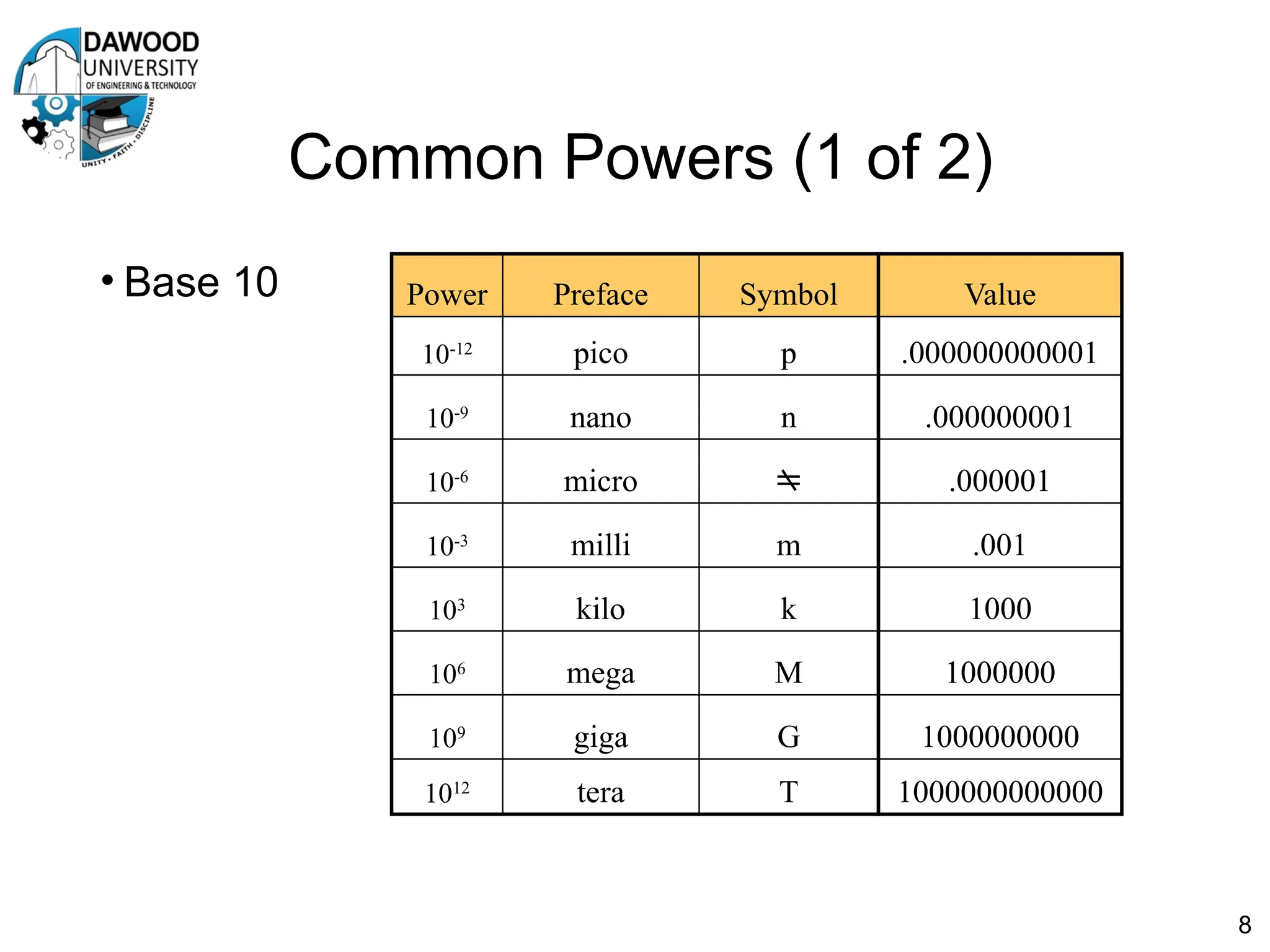
Common Powers (1 of 2)
• Base 10
8
Power Preface Symbol
10-12 pico p
10-9
nano n
10-6 micro 
10-3
milli m
103 kilo k
106 mega M
109 giga G
1012 tera T
Value
.000000000001
.000000001
.000001
.001
1000
1000000
1000000000
1000000000000
Common Powers (2 of 2)
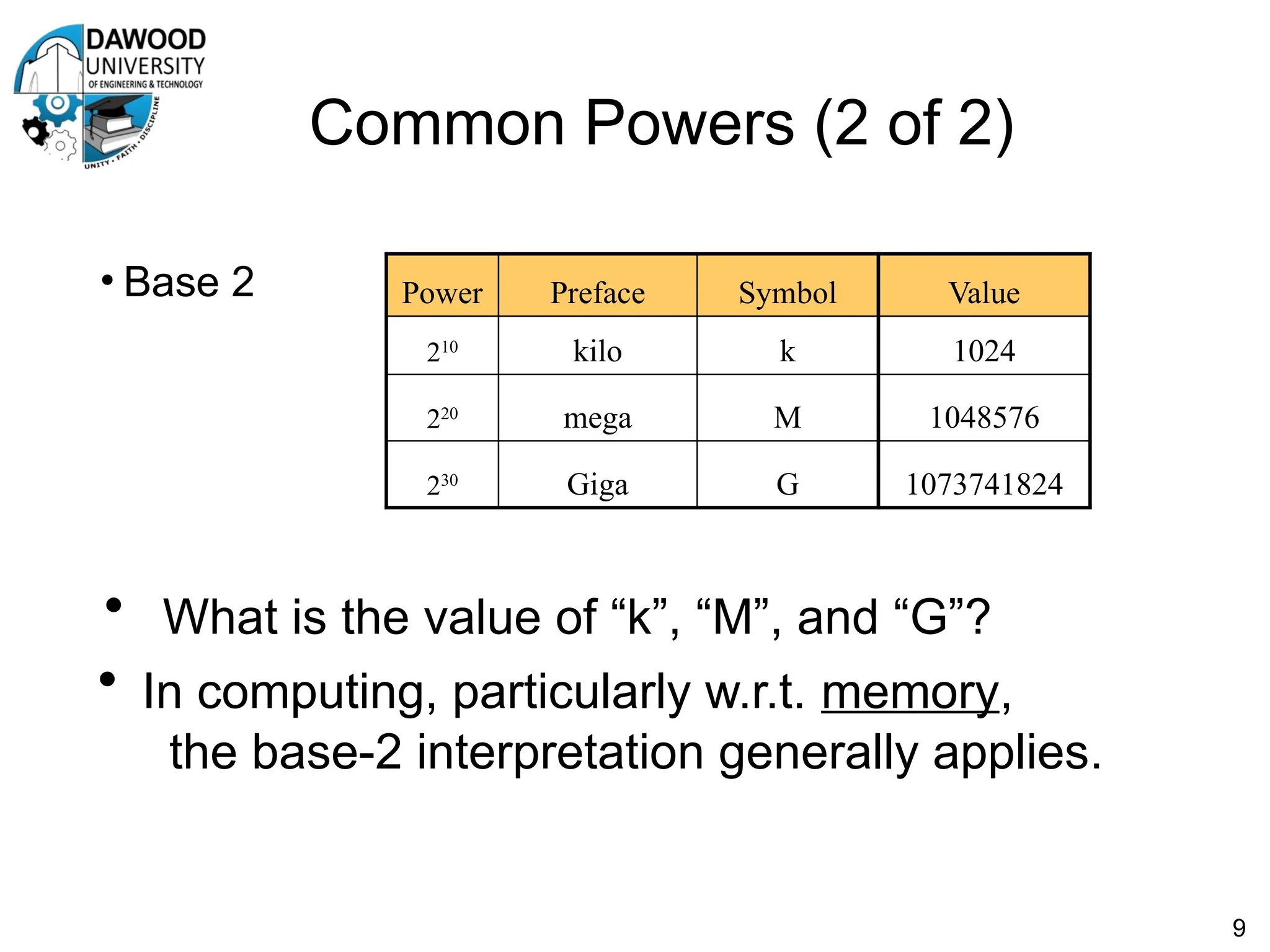
• Base 2
9
Power Preface Symbol
210
kilo k
220 mega M
230
Giga G
Value
1024
1048576
1073741824
• What is the value of “k”, “M”, and “G”?
• In computing, particularly w.r.t. memory,
the base-2 interpretation generally applies.
10
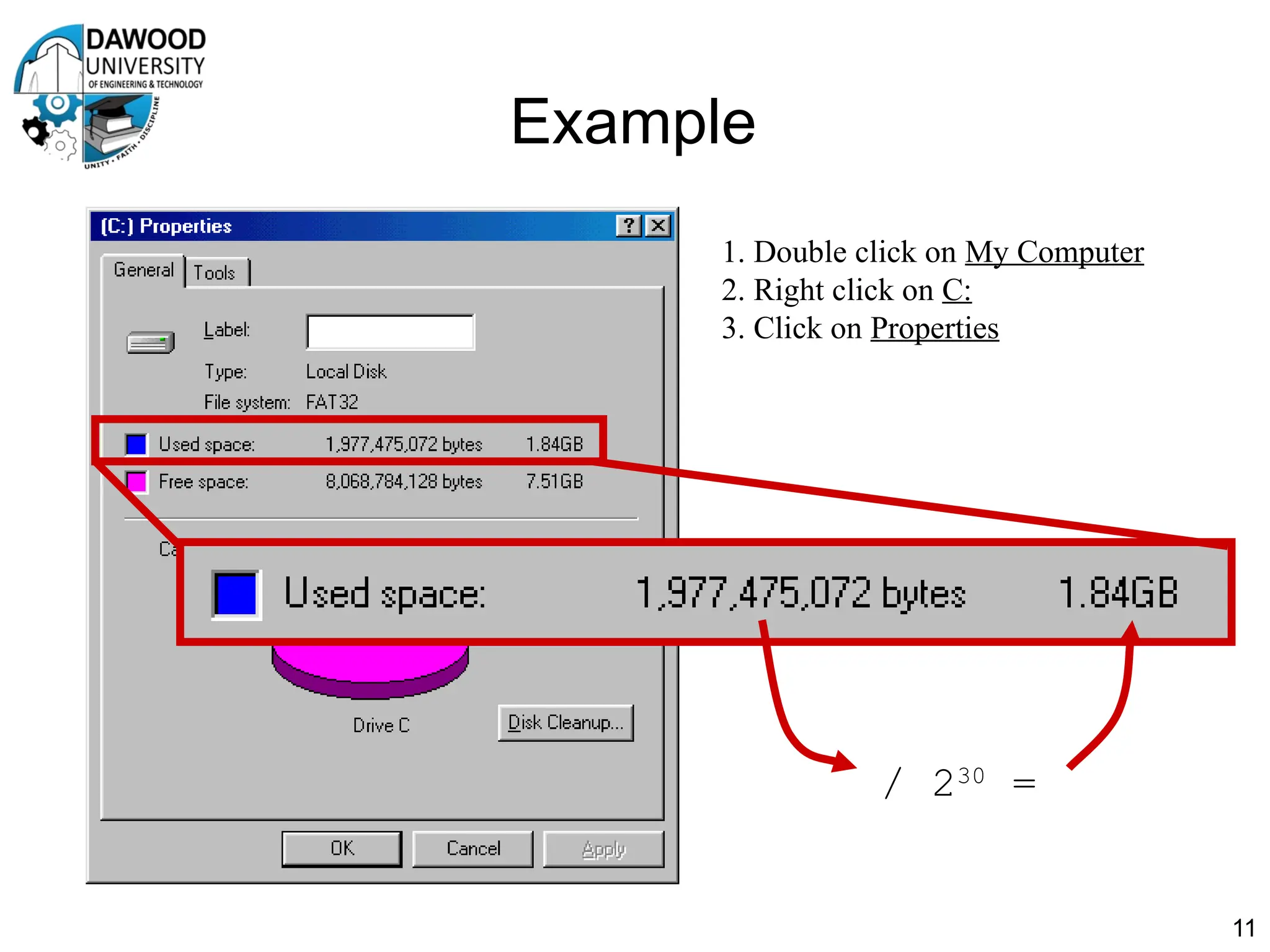
Example
11
/ 230
=
1. Double click on My Computer
2. Right click on C:
3. Click on Properties
Review – multiplying powers
• For common bases, add powers
12
26
 210
= 216
= 65,536
or…
26
 210
= 64  210
= 64k
ab
 ac
= ab+c
Arithmetic Operations on Hex,
Binary, Octal
13
Binary Addition
Rules:
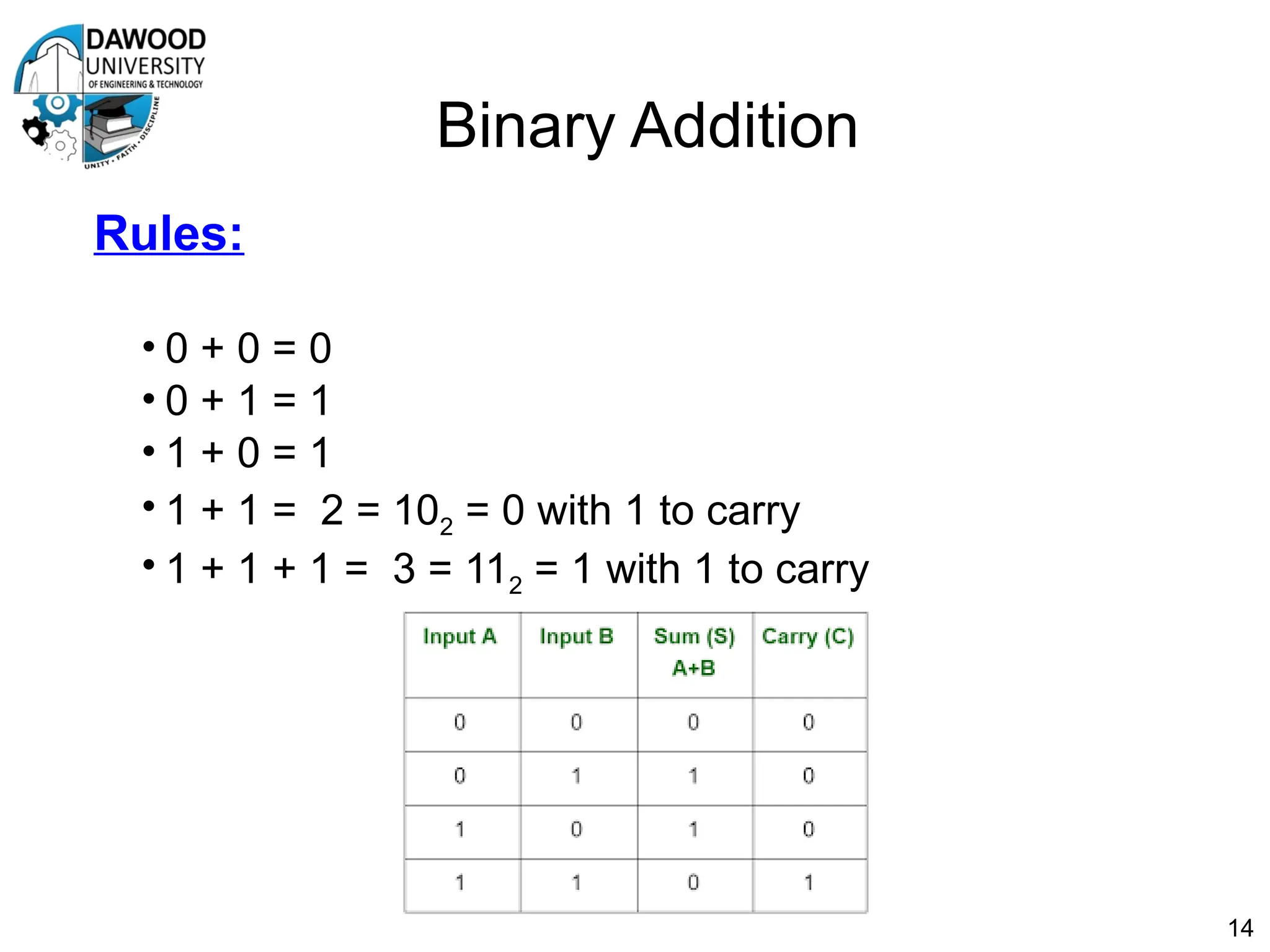
• 0 + 0 = 0
• 0 + 1 = 1
• 1 + 0 = 1
• 1 + 1 = 2 = 102 = 0 with 1 to carry
• 1 + 1 + 1 = 3 = 112 = 1 with 1 to carry
14
Binary Addition
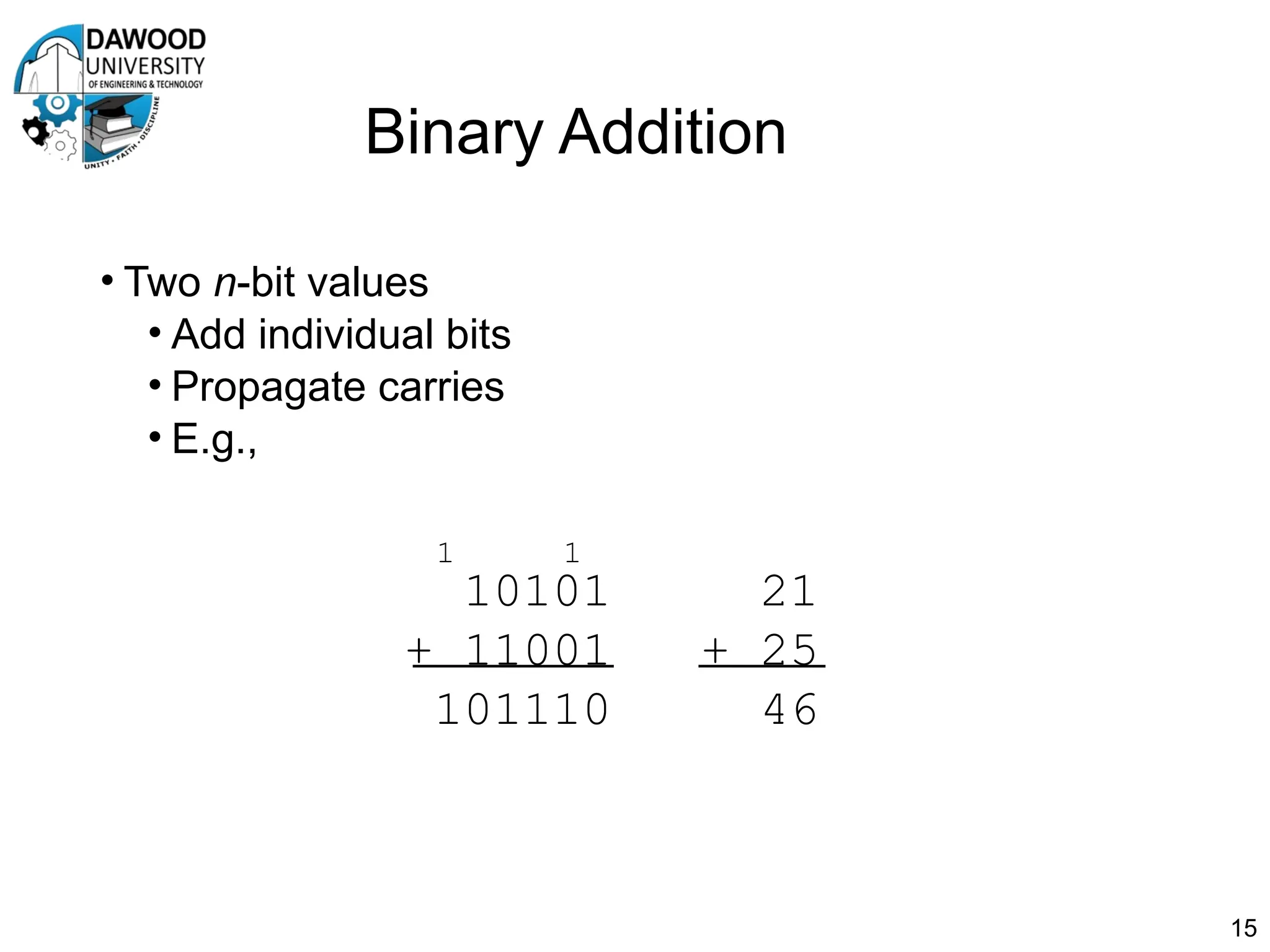
• Two n-bit values
• Add individual bits
• Propagate carries
• E.g.,
15
10101 21
+ 11001 + 25
101110 46
1
1
Binary Addition
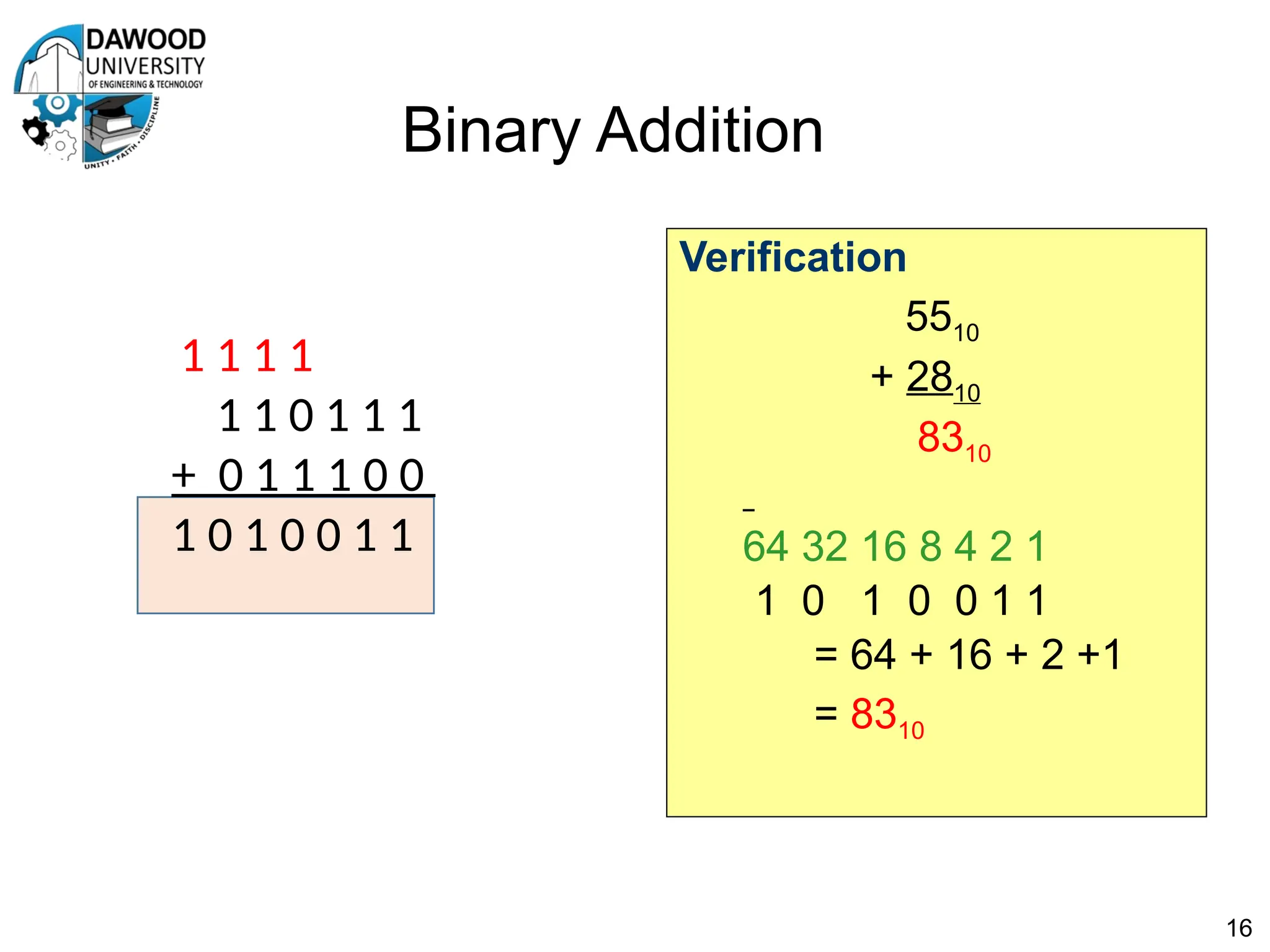
1 1 1 1
1 1 0 1 1 1
+ 0 1 1 1 0 0
1 0 1 0 0 1 1
16
Verification
5510
+ 2810
8310
64 32 16 8 4 2 1
1 0 1 0 0 1 1
= 64 + 16 + 2 +1
= 8310
Binary Addition
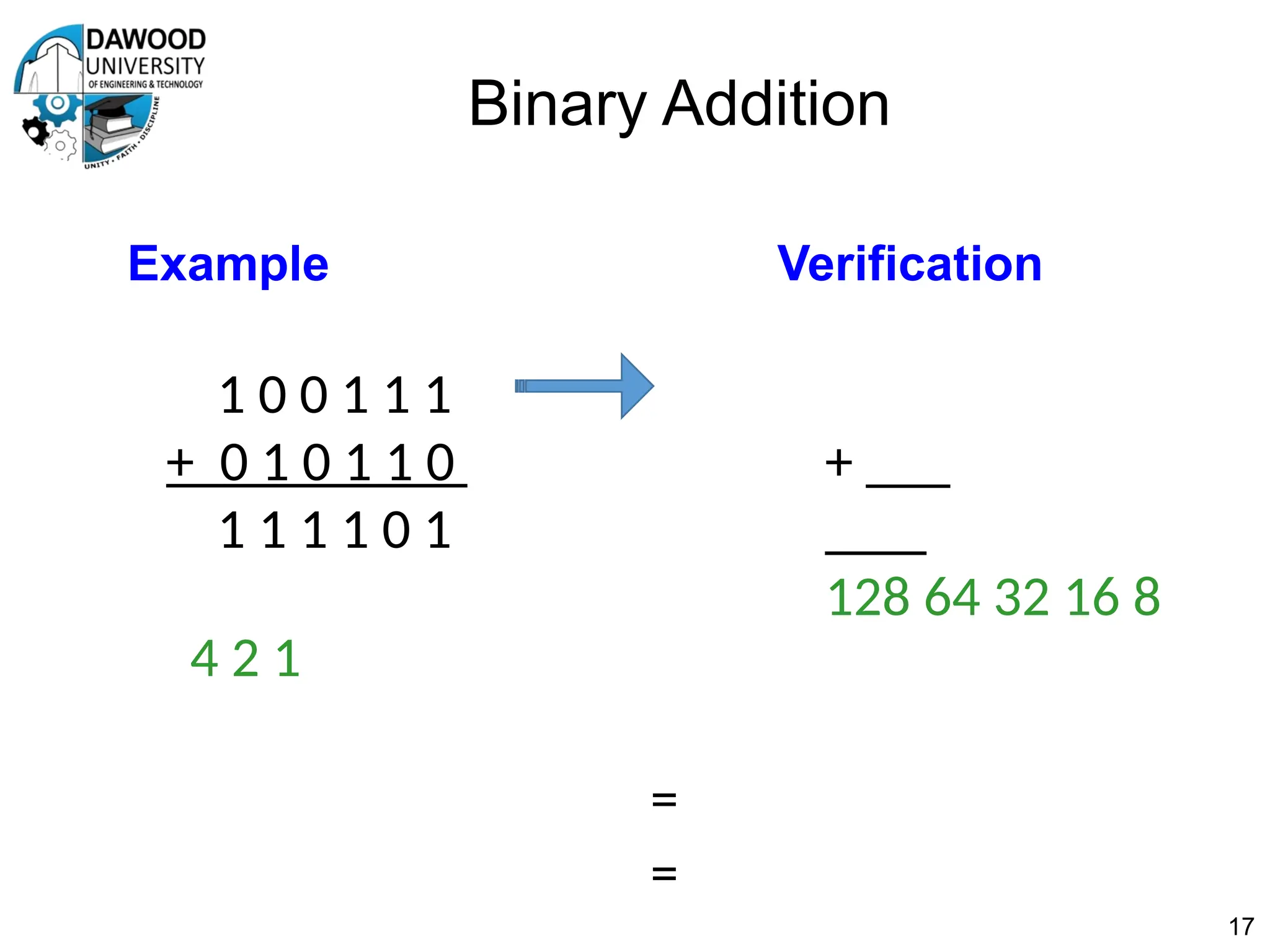
Example Verification
1 0 0 1 1 1
+ 0 1 0 1 1 0 + ___
1 1 1 1 0 1
128 64 32 16 8
4 2 1
=
=
17
Multiplication (1 of 3)
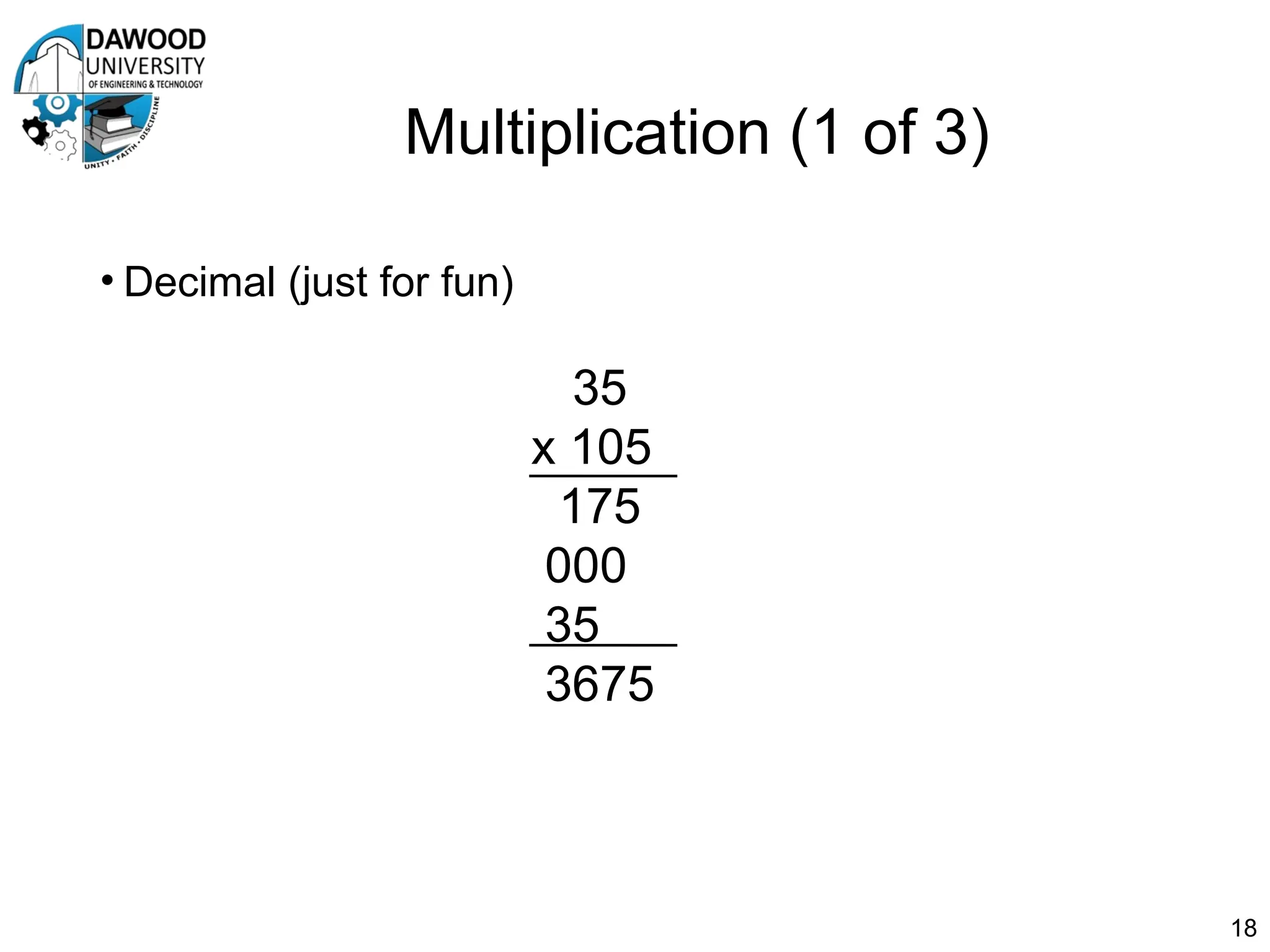
• Decimal (just for fun)
18
35
x 105
175
000
35
3675
Multiplication (2 of 3)
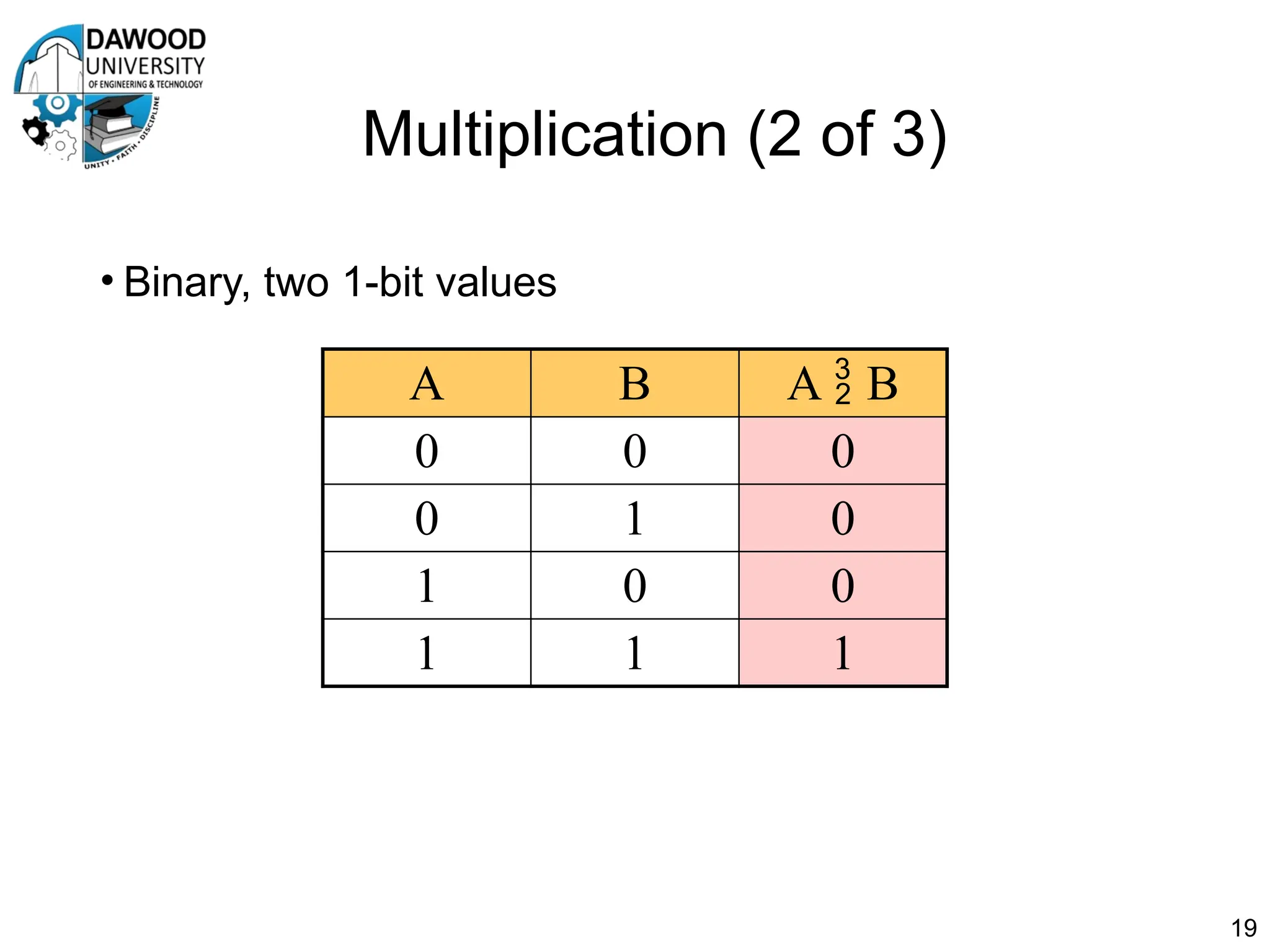
• Binary, two 1-bit values
19
A B A  B
0 0 0
0 1 0
1 0 0
1 1 1
Multiplication (3 of 3)
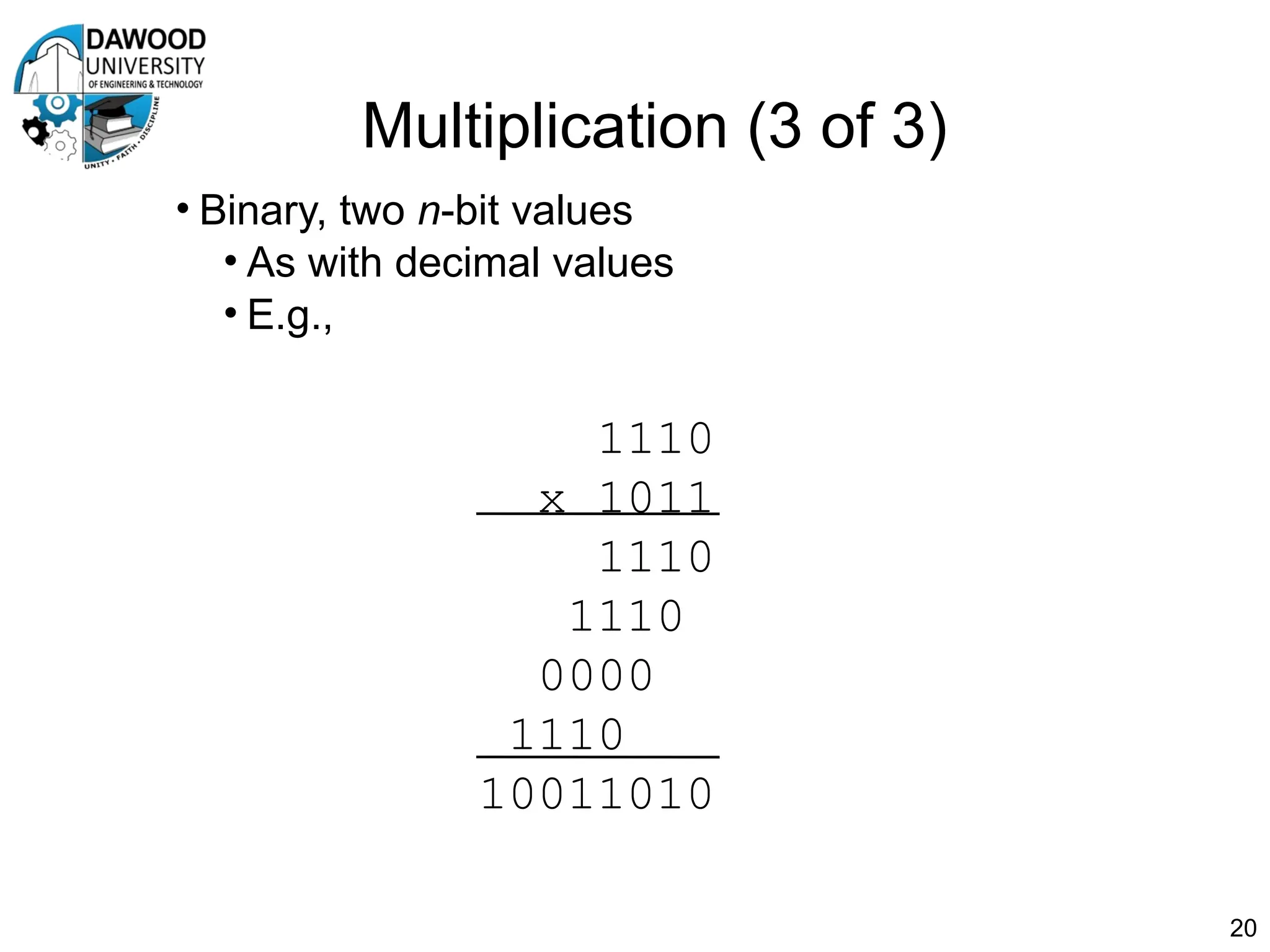
• Binary, two n-bit values
• As with decimal values
• E.g.,
20
1110
x 1011
1110
1110
0000
1110
10011010
Fractions
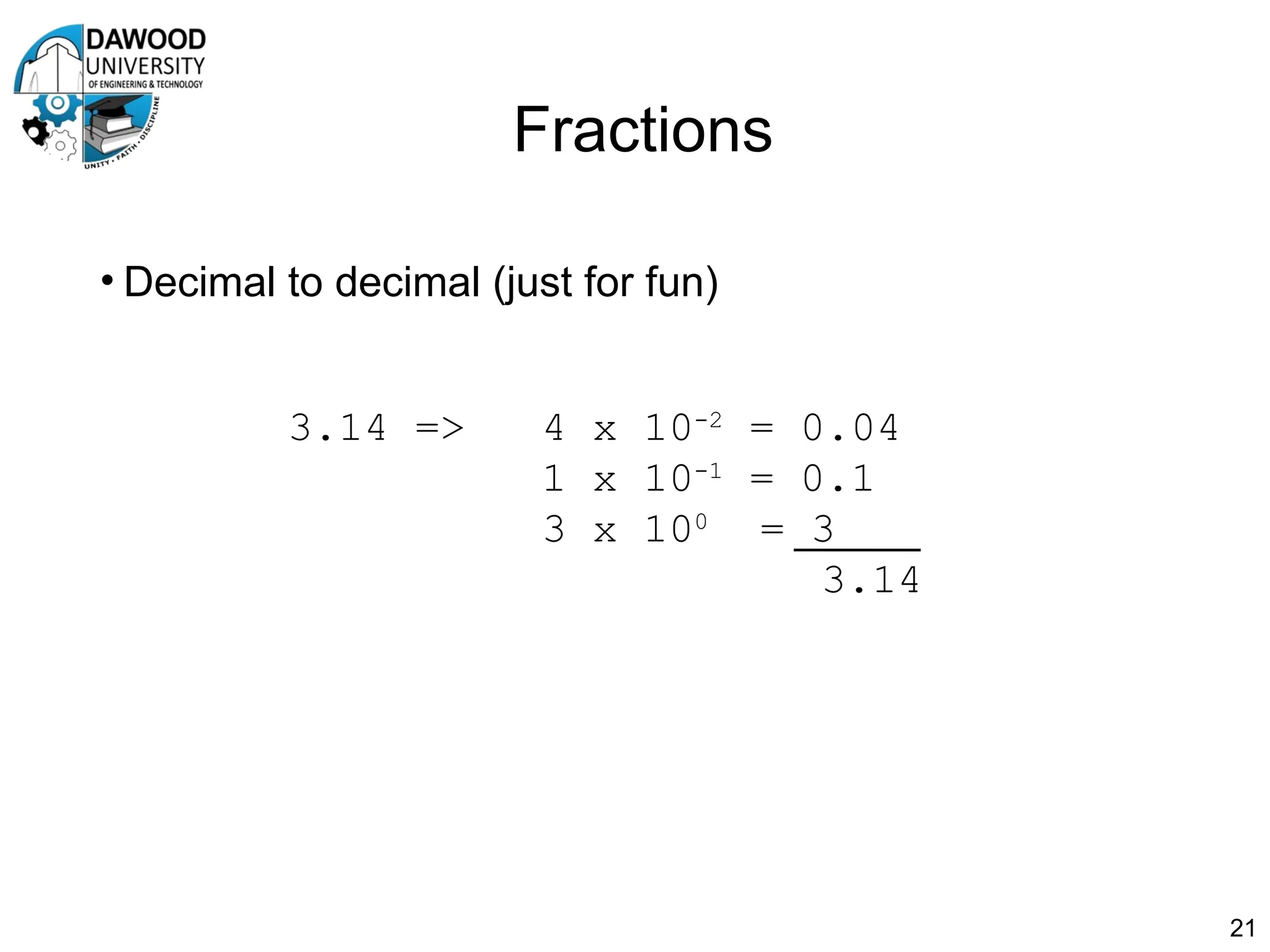
• Decimal to decimal (just for fun)
21
3.14 => 4 x 10-2
= 0.04
1 x 10-1
= 0.1
3 x 100
= 3
3.14
Fractions
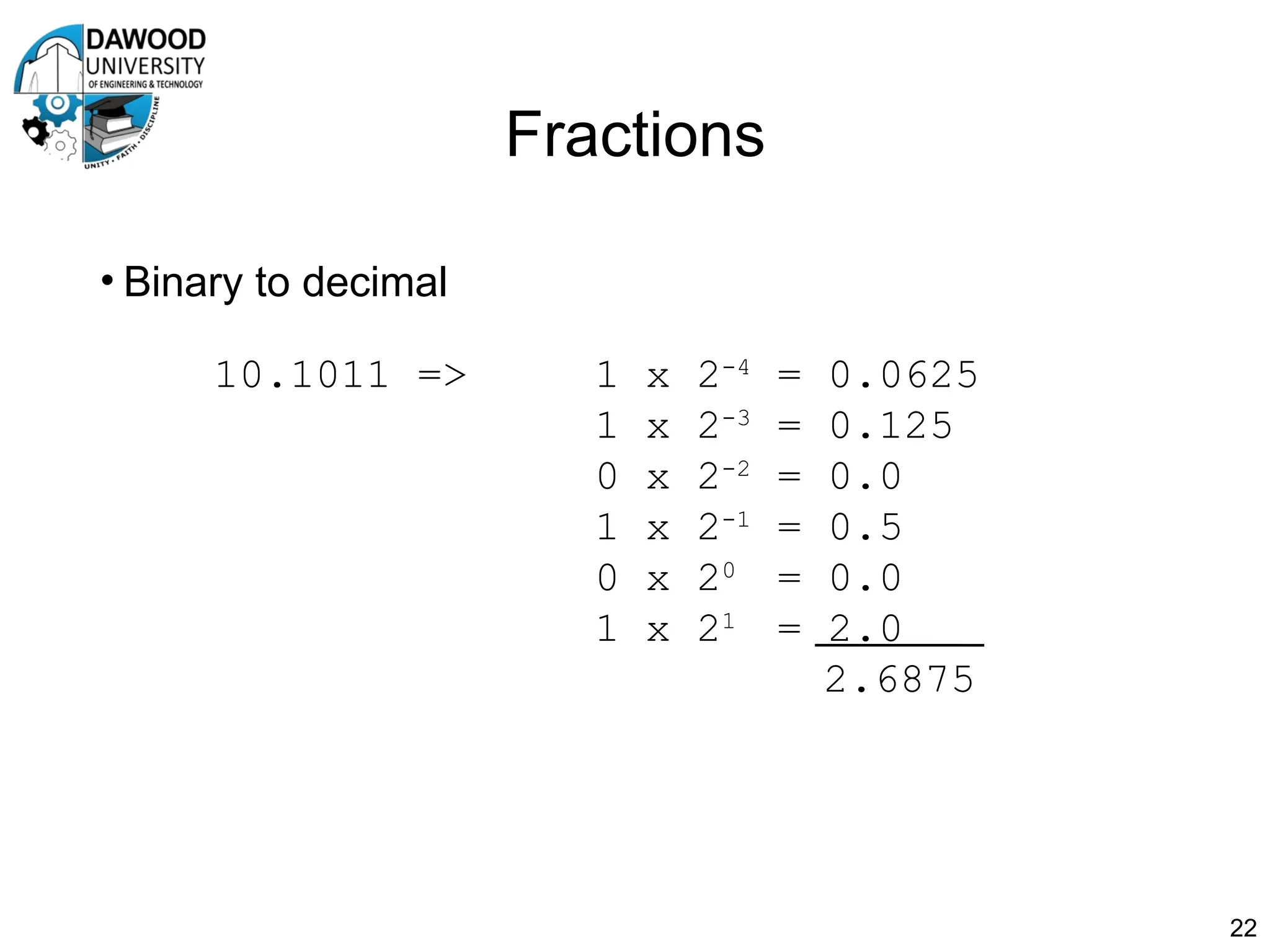
• Binary to decimal
22
10.1011 => 1 x 2-4
= 0.0625
1 x 2-3
= 0.125
0 x 2-2
= 0.0
1 x 2-1
= 0.5
0 x 20
= 0.0
1 x 21
= 2.0
2.6875
Fractions
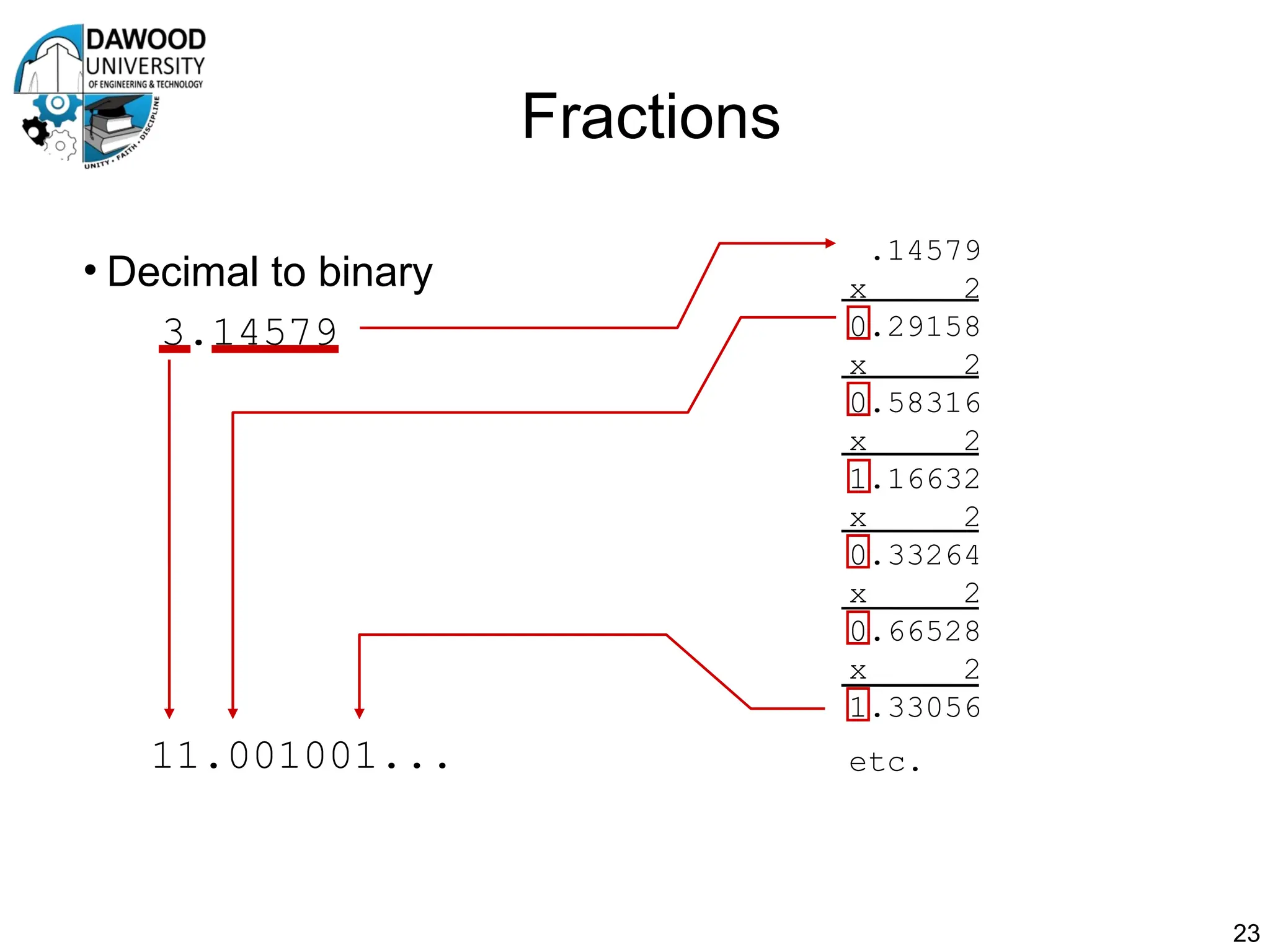
• Decimal to binary
23
3.14579
.14579
x 2
0.29158
x 2
0.58316
x 2
1.16632
x 2
0.33264
x 2
0.66528
x 2
1.33056
etc.
11.001001...
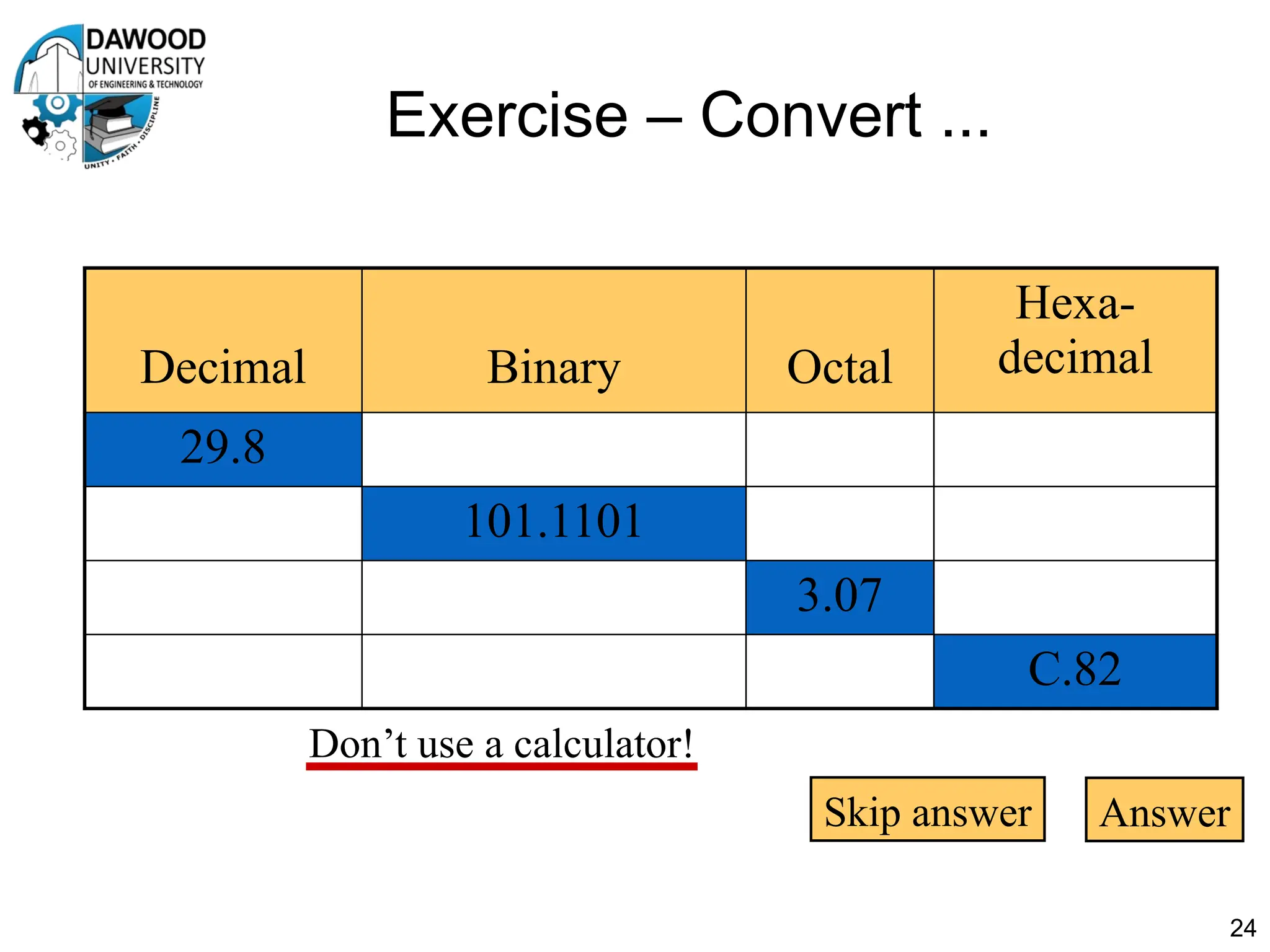
Exercise – Convert ...
24
Don’t use a calculator!
Decimal Binary Octal
Hexa-
decimal
29.8
101.1101
3.07
C.82
Skip answer Answer
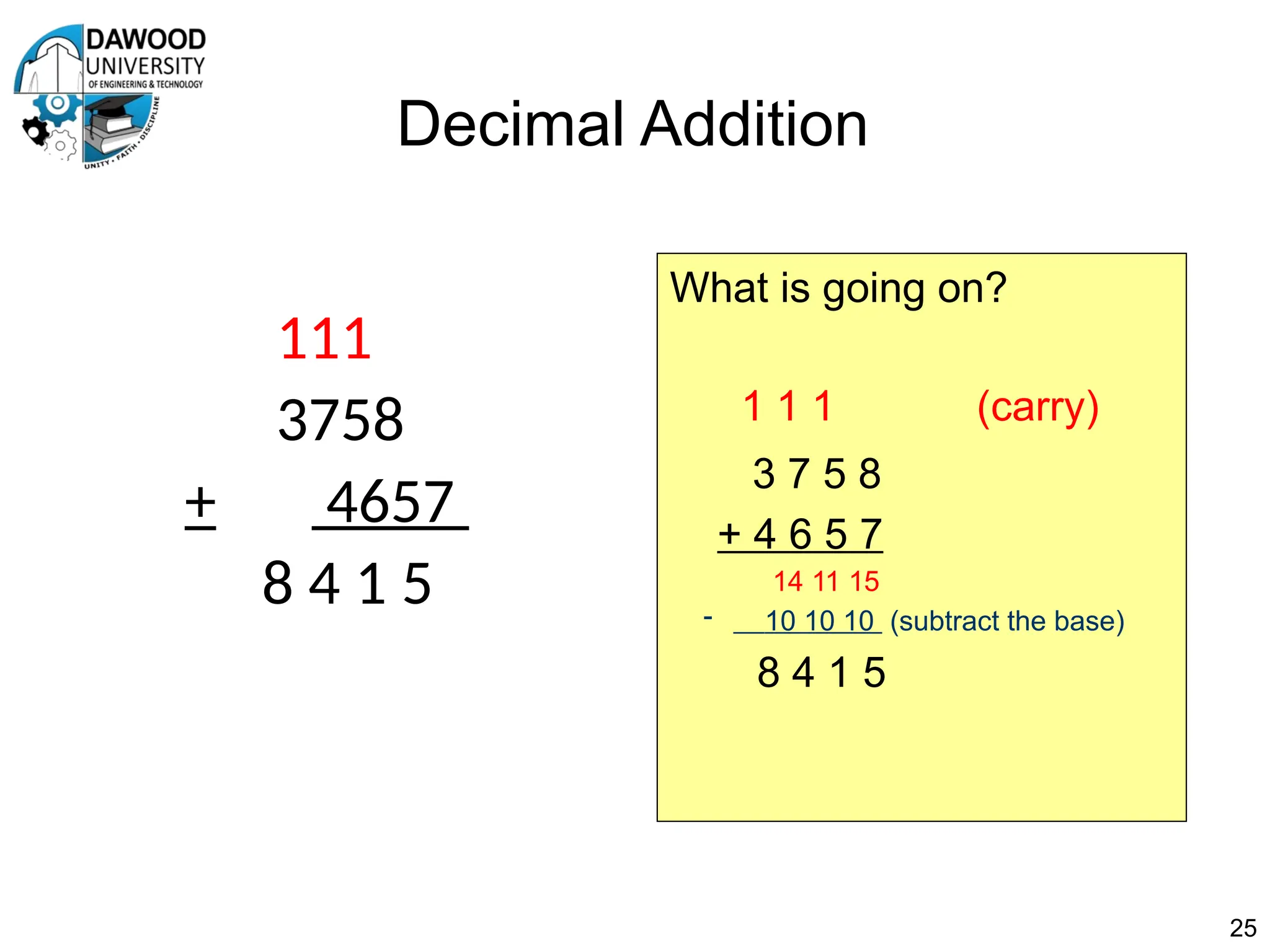
Decimal Addition
111
3758
+ 4657
8 4 1 5
25
What is going on?
1 1 1 (carry)
3 7 5 8
+ 4 6 5 7
14 11 15
- 10 10 10 (subtract the base)
8 4 1 5
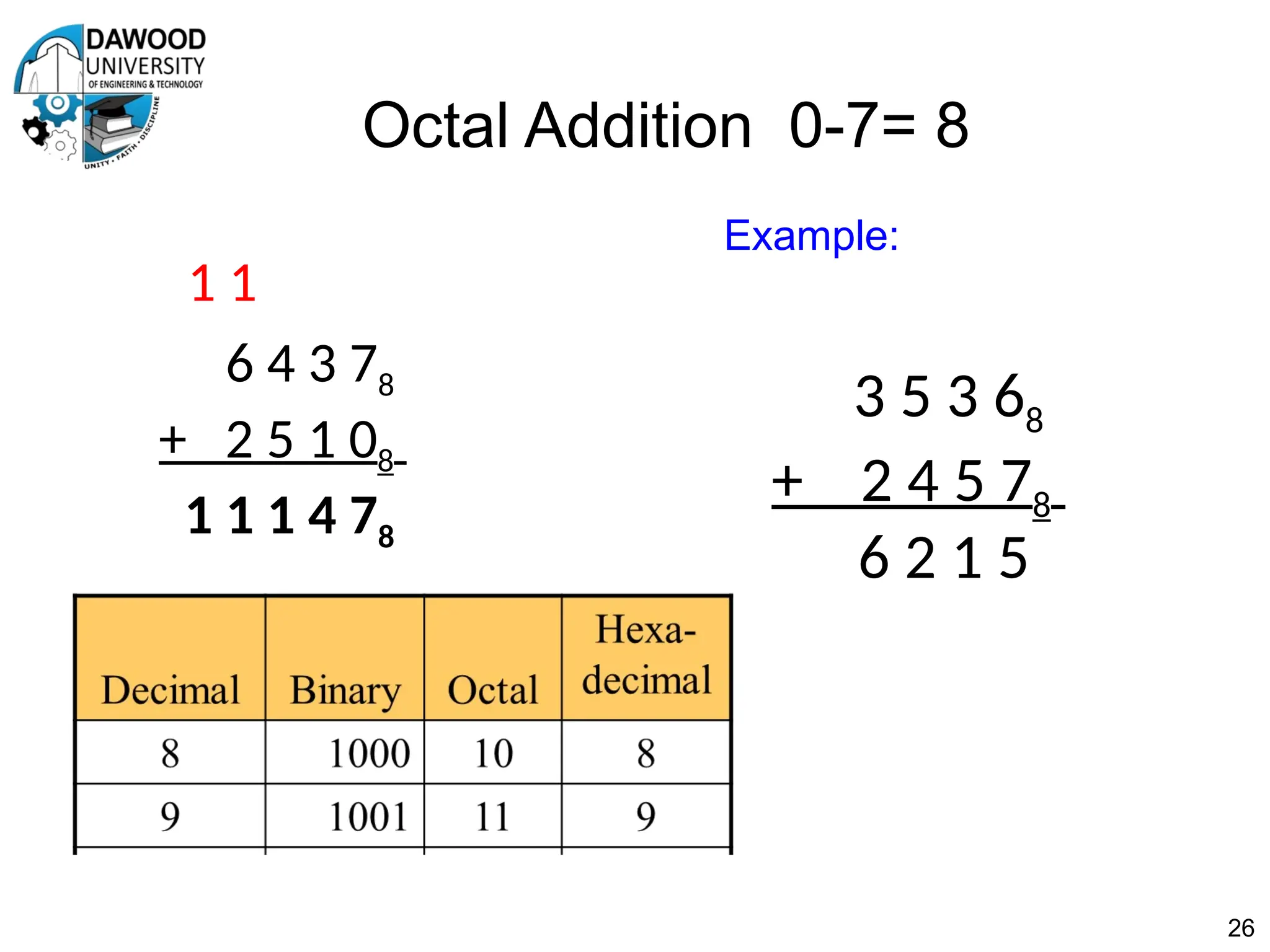
Octal Addition 0-7= 8
1 1
6 4 3 78
+ 2 5 1 08
1 1 1 4 78
26
Example:
3 5 3 68
+ 2 4 5 78
6 2 1 5
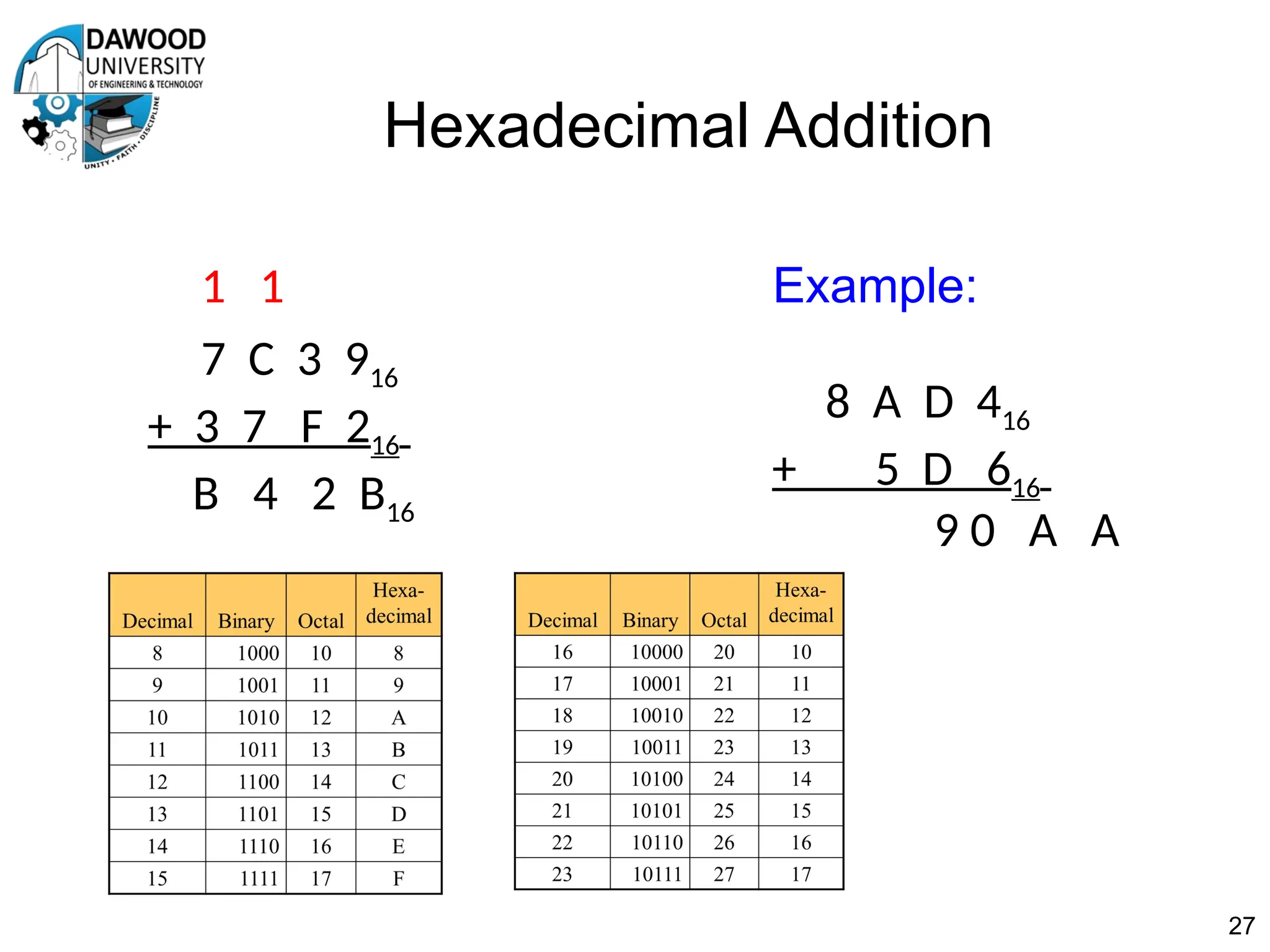
Hexadecimal Addition
1 1 Example:
7 C 3 916
+ 3 7 F 216
B 4 2 B16
27
8 A D 416
+ 5 D 616
9 0 A A
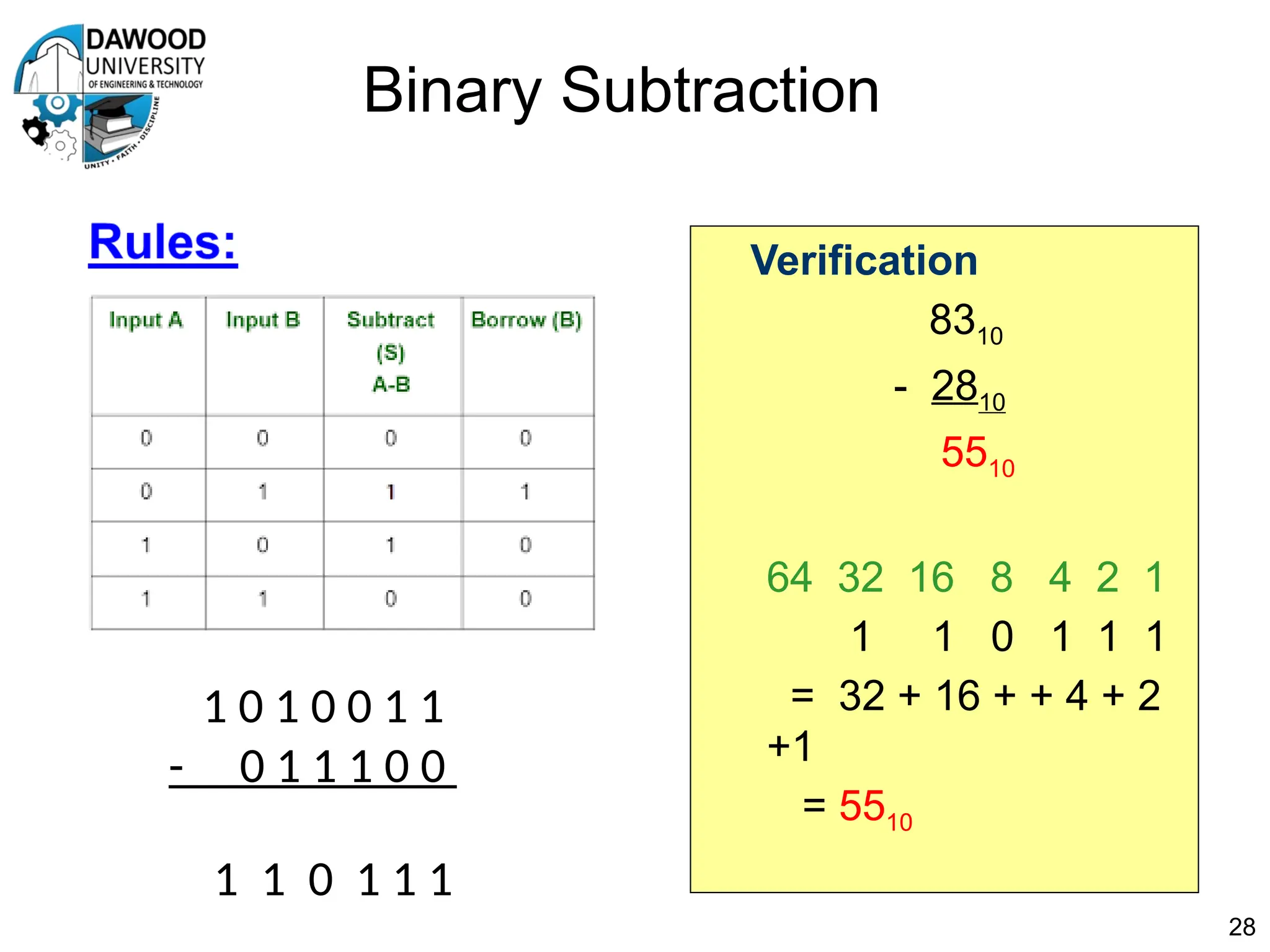
Binary Subtraction
1 0 1 0 0 1 1
- 0 1 1 1 0 0
1 1 0 1 1 1
28
Verification
8310
- 2810
5510
64 32 16 8 4 2 1
1 1 0 1 1 1
= 32 + 16 + + 4 + 2
+1
= 5510
Exercise
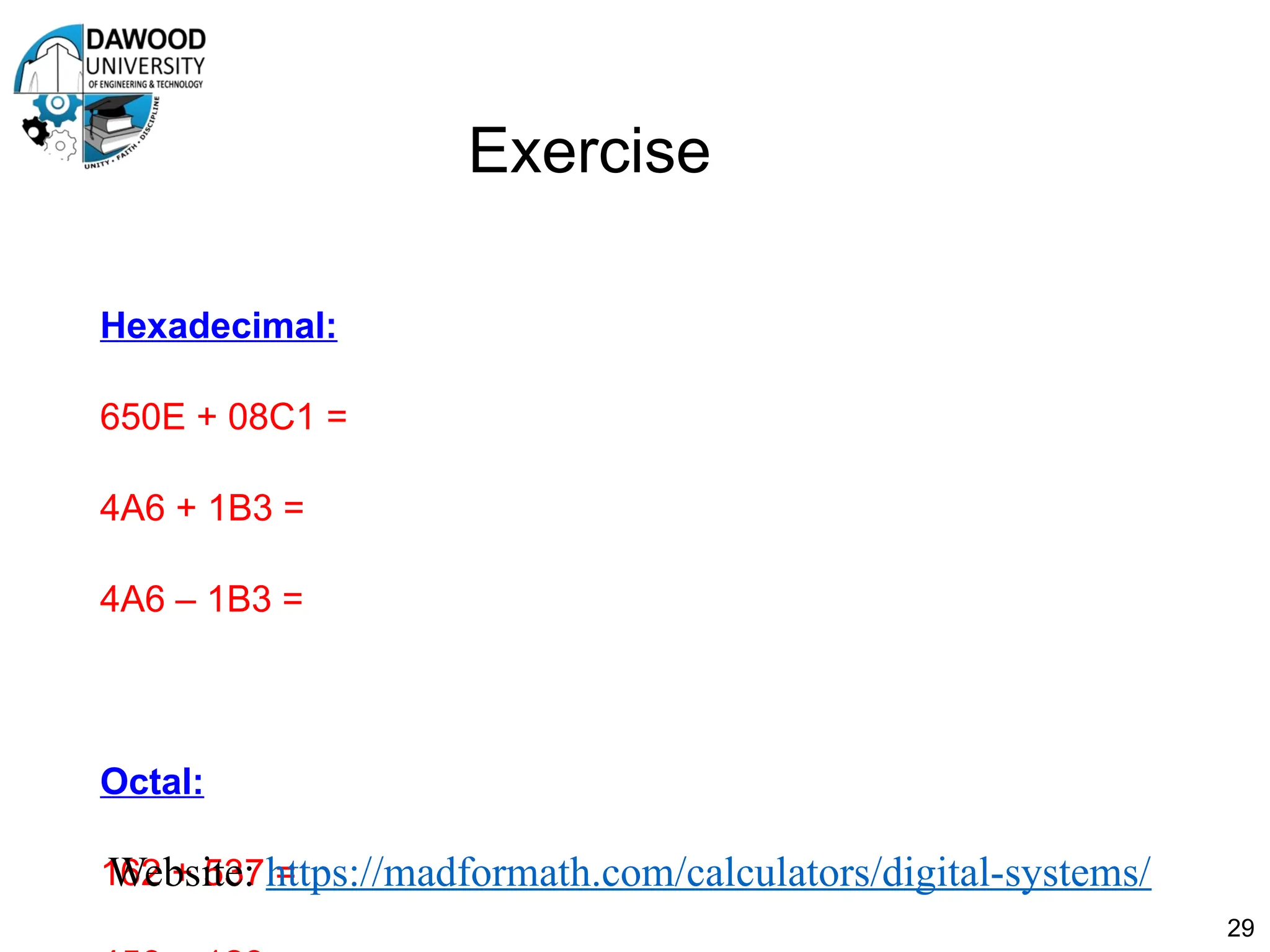
Hexadecimal:
650E + 08C1 =
4A6 + 1B3 =
4A6 – 1B3 =
Octal:
162 + 537 =
29
Website: https://madformath.com/calculators/digital-systems/
Solutions
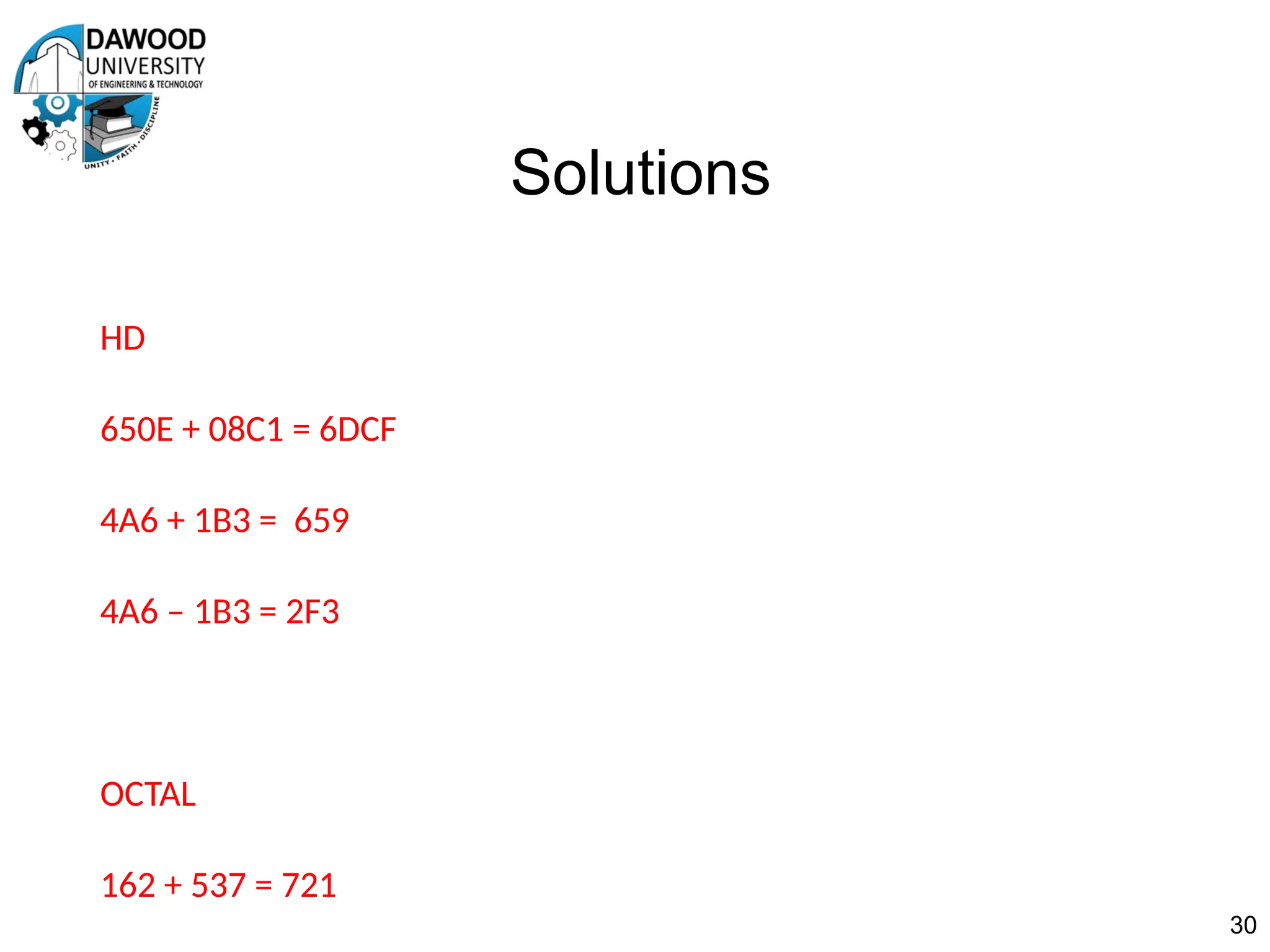
HD
650E + 08C1 = 6DCF
4A6 + 1B3 = 659
4A6 – 1B3 = 2F3
OCTAL
162 + 537 = 721
30

DLD Lecture 03(Number conversion & arithmetic).pptx

  • 1.
    Easy Approach: Numbering Systems AndArithmetic Operations On Hex, Binary, And Octal Lecture-03 Teacher: Dr. Syed Ali Asgher Email: alisyed5@duet.edu.pk
  • 2.
  • 3.
    Exercise – Convert... 3 Don’t use a calculator! Decimal Binary Octal Hexa- decimal 33 1110101 703 1AF Skip answer Answer Department of Computer Science
  • 4.
    Exercise – Convert… 4 Decimal Binary Octal Hexa- decimal 33 100001 41 21 117 1110101 165 75 451 111000011 703 1C3 431 110101111 657 1AF Answer
  • 5.
    What is thetwo’s complement? A two's-complement system is a system in which negative numbers are represented by the two's complement of the absolute value. 5
  • 6.
    Example Suppose we're workingwith 8 bit and suppose we want to find how -28 would be expressed in two's complement notation. First we write out 28 in binary form. 0 0 0 1 1 1 0 0 1 1 1 0 0 1 0 0 1 1 1 0 0 0 1 1 Then we invert the digits. 0 becomes 1, 1 becomes 0. Then we add 1. That is how one would write -28 in 8 bit binary. 6
  • 7.
    7 An 8-bit unsignedinteger number can represent the values 0 to 255. However for signed number a two's complement 8-bit number can only represent non-negative integers from 0 to 127, because the rest of the bit represent the negative integers −1 to −128. 28 = 256
  • 8.
    Common Powers (1of 2) • Base 10 8 Power Preface Symbol 10-12 pico p 10-9 nano n 10-6 micro  10-3 milli m 103 kilo k 106 mega M 109 giga G 1012 tera T Value .000000000001 .000000001 .000001 .001 1000 1000000 1000000000 1000000000000
  • 9.
    Common Powers (2of 2) • Base 2 9 Power Preface Symbol 210 kilo k 220 mega M 230 Giga G Value 1024 1048576 1073741824 • What is the value of “k”, “M”, and “G”? • In computing, particularly w.r.t. memory, the base-2 interpretation generally applies.
  • 10.
  • 11.
    Example 11 / 230 = 1. Doubleclick on My Computer 2. Right click on C: 3. Click on Properties
  • 12.
    Review – multiplyingpowers • For common bases, add powers 12 26  210 = 216 = 65,536 or… 26  210 = 64  210 = 64k ab  ac = ab+c
  • 13.
    Arithmetic Operations onHex, Binary, Octal 13
  • 14.
    Binary Addition Rules: • 0+ 0 = 0 • 0 + 1 = 1 • 1 + 0 = 1 • 1 + 1 = 2 = 102 = 0 with 1 to carry • 1 + 1 + 1 = 3 = 112 = 1 with 1 to carry 14
  • 15.
    Binary Addition • Twon-bit values • Add individual bits • Propagate carries • E.g., 15 10101 21 + 11001 + 25 101110 46 1 1
  • 16.
    Binary Addition 1 11 1 1 1 0 1 1 1 + 0 1 1 1 0 0 1 0 1 0 0 1 1 16 Verification 5510 + 2810 8310 64 32 16 8 4 2 1 1 0 1 0 0 1 1 = 64 + 16 + 2 +1 = 8310
  • 17.
    Binary Addition Example Verification 10 0 1 1 1 + 0 1 0 1 1 0 + ___ 1 1 1 1 0 1 128 64 32 16 8 4 2 1 = = 17
  • 18.
    Multiplication (1 of3) • Decimal (just for fun) 18 35 x 105 175 000 35 3675
  • 19.
    Multiplication (2 of3) • Binary, two 1-bit values 19 A B A  B 0 0 0 0 1 0 1 0 0 1 1 1
  • 20.
    Multiplication (3 of3) • Binary, two n-bit values • As with decimal values • E.g., 20 1110 x 1011 1110 1110 0000 1110 10011010
  • 21.
    Fractions • Decimal todecimal (just for fun) 21 3.14 => 4 x 10-2 = 0.04 1 x 10-1 = 0.1 3 x 100 = 3 3.14
  • 22.
    Fractions • Binary todecimal 22 10.1011 => 1 x 2-4 = 0.0625 1 x 2-3 = 0.125 0 x 2-2 = 0.0 1 x 2-1 = 0.5 0 x 20 = 0.0 1 x 21 = 2.0 2.6875
  • 23.
    Fractions • Decimal tobinary 23 3.14579 .14579 x 2 0.29158 x 2 0.58316 x 2 1.16632 x 2 0.33264 x 2 0.66528 x 2 1.33056 etc. 11.001001...
  • 24.
    Exercise – Convert... 24 Don’t use a calculator! Decimal Binary Octal Hexa- decimal 29.8 101.1101 3.07 C.82 Skip answer Answer
  • 25.
    Decimal Addition 111 3758 + 4657 84 1 5 25 What is going on? 1 1 1 (carry) 3 7 5 8 + 4 6 5 7 14 11 15 - 10 10 10 (subtract the base) 8 4 1 5
  • 26.
    Octal Addition 0-7=8 1 1 6 4 3 78 + 2 5 1 08 1 1 1 4 78 26 Example: 3 5 3 68 + 2 4 5 78 6 2 1 5
  • 27.
    Hexadecimal Addition 1 1Example: 7 C 3 916 + 3 7 F 216 B 4 2 B16 27 8 A D 416 + 5 D 616 9 0 A A
  • 28.
    Binary Subtraction 1 01 0 0 1 1 - 0 1 1 1 0 0 1 1 0 1 1 1 28 Verification 8310 - 2810 5510 64 32 16 8 4 2 1 1 1 0 1 1 1 = 32 + 16 + + 4 + 2 +1 = 5510
  • 29.
    Exercise Hexadecimal: 650E + 08C1= 4A6 + 1B3 = 4A6 – 1B3 = Octal: 162 + 537 = 29 Website: https://madformath.com/calculators/digital-systems/
  • 30.
    Solutions HD 650E + 08C1= 6DCF 4A6 + 1B3 = 659 4A6 – 1B3 = 2F3 OCTAL 162 + 537 = 721 30

Editor's Notes

  • #7 Difference between signed and unsigned integers? 2
  • #29 Website: https://madformath.com/calculators/digital-systems/