Django vs Ruby on Rails
Comparison: Web Frameworks
Performance and Popularity
What are Django?


Django is a Python-based web framework
best known for producing Python apps. It
was first released in 2005 as a free, open-
source, and universal framework.
Programmers praise Django’s features for
its functions. Its developments have
helped simplify the method of creating
sophisticated, database-driven websites.
Ruby on Rails is an open-source server-side
web app framework created under the MIT
License. Because Rails is a model-view-
controller framework, it comes with
excellent default structures for a database,
online services, and pages. Ruby on Rails
helps expand web solutions and provide
new features and modules.
What are Ruby on Rails?
Pros and Cons of
Django and Ruby on
Rails
Django Pros and Cons


Pros


Django is a scalable, mature
software and plug-in-wealthy
framework. It’s adaptable, has a
strong Admin Panel, and helps the
Representational State Transfer
(REST) foundation.Django uses a
battery-unfastened approach,
permits MVCdevelopment, and has
an exceptional database.
Cons


Django can’t handle multiple
requests simultaneously, which may
slow things down. It supports Django
ORM , which allows you to attach to
your database the same way as SQL.
Django can be overly monolithic. It
recommends that programmers
follow patterns within the
framework.
Pros


Ruby on Rails is straightforward to edit, easy
to migrate, with fast development. Rails have
default settings and an impactful test
environment. Ruby on Rails incorporates a
vibrant community to assist one in practice
and growth. The structure of the component
relies on plugins and gems, which provide
better functionality with less effort.
Ruby on Rails Pros
Ruby On Rails Cons
Developing APIs using Ruby
on Rails is difficult. Document
quality and standards are
inconsistent. The run-time
performance is often slow and
strict. There are ways to code
the identical problem that
numerous lines of coding can
become hard to know, even
more complicated, and needs
rewriting.
Summary


To summarise it let us check about their performance
and popularity factors.
Web Framework
Performance


Comparing the performance of Ruby on
Rails and Django, you’ll be able to see that
Rails is 0.7% faster. It is because Rails has
access to a library of great modules and
plugins that help improve the speed and
performance of the framework. Django, on
the contrary, supports rapid development
and is fair for web frameworks. The
authentication module and other features of
the Django framework are functional.
Web Framework
Popularity


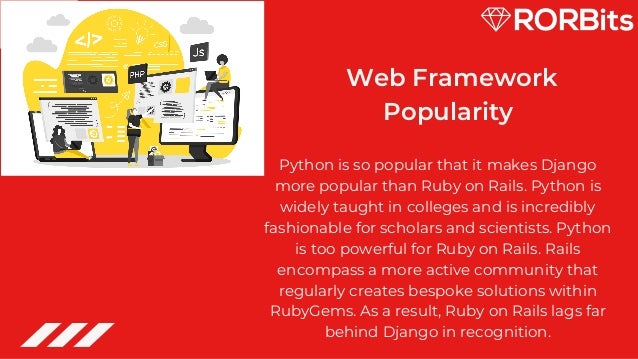
Python is so popular that it makes Django
more popular than Ruby on Rails. Python is
widely taught in colleges and is incredibly
fashionable for scholars and scientists. Python
is too powerful for Ruby on Rails. Rails
encompass a more active community that
regularly creates bespoke solutions within
RubyGems. As a result, Ruby on Rails lags far
behind Django in recognition.
Contact Us
https://www.rorbits.com/
Website
+91-9898119101
Phn No.
hello@rorbits.com
Email Id
Thank You!

Django vs. Ruby on Rails Comparison: Web Frameworks Performance and Popularity

  • 1.
    Django vs Rubyon Rails Comparison: Web Frameworks Performance and Popularity
  • 2.
    What are Django? Djangois a Python-based web framework best known for producing Python apps. It was first released in 2005 as a free, open- source, and universal framework. Programmers praise Django’s features for its functions. Its developments have helped simplify the method of creating sophisticated, database-driven websites.
  • 3.
    Ruby on Railsis an open-source server-side web app framework created under the MIT License. Because Rails is a model-view- controller framework, it comes with excellent default structures for a database, online services, and pages. Ruby on Rails helps expand web solutions and provide new features and modules. What are Ruby on Rails?
  • 4.
    Pros and Consof Django and Ruby on Rails
  • 5.
    Django Pros andCons Pros Django is a scalable, mature software and plug-in-wealthy framework. It’s adaptable, has a strong Admin Panel, and helps the Representational State Transfer (REST) foundation.Django uses a battery-unfastened approach, permits MVCdevelopment, and has an exceptional database. Cons Django can’t handle multiple requests simultaneously, which may slow things down. It supports Django ORM , which allows you to attach to your database the same way as SQL. Django can be overly monolithic. It recommends that programmers follow patterns within the framework.
  • 6.
    Pros Ruby on Railsis straightforward to edit, easy to migrate, with fast development. Rails have default settings and an impactful test environment. Ruby on Rails incorporates a vibrant community to assist one in practice and growth. The structure of the component relies on plugins and gems, which provide better functionality with less effort. Ruby on Rails Pros
  • 7.
    Ruby On RailsCons Developing APIs using Ruby on Rails is difficult. Document quality and standards are inconsistent. The run-time performance is often slow and strict. There are ways to code the identical problem that numerous lines of coding can become hard to know, even more complicated, and needs rewriting.
  • 8.
    Summary To summarise itlet us check about their performance and popularity factors.
  • 9.
    Web Framework Performance Comparing theperformance of Ruby on Rails and Django, you’ll be able to see that Rails is 0.7% faster. It is because Rails has access to a library of great modules and plugins that help improve the speed and performance of the framework. Django, on the contrary, supports rapid development and is fair for web frameworks. The authentication module and other features of the Django framework are functional.
  • 10.
    Web Framework Popularity Python isso popular that it makes Django more popular than Ruby on Rails. Python is widely taught in colleges and is incredibly fashionable for scholars and scientists. Python is too powerful for Ruby on Rails. Rails encompass a more active community that regularly creates bespoke solutions within RubyGems. As a result, Ruby on Rails lags far behind Django in recognition.
  • 11.
  • 12.