Bansal Institute of Engineering &
Technology
“PRESENTATION”
SUBMITTED TO :-
CSE DEPARTMENT
SUBMITTED BY :-
AKASH CHAUDHARY
1642210005
WEB DEVELOPMENT
WITH
DJANGO FRAMEWORK
❖ INTRODUCTION TO MADHESHIYA SOFTWARE PRIVATE LIMITED
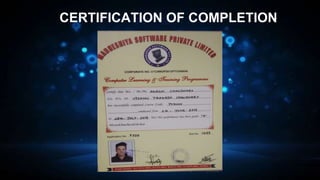
❖ CERTIFICATION OF COMPLETION
❖ INTRODUCTION TO PYTHON
❖ WHY WE USE PYTHON?
❖ INTRODUCTION TO WEB APPLICATION
★ INTERFACE
● SERVER SIDE
● CLIENT SIDE
★ STRUCTURE
★ DEVELOPMENT
★ APPLICATION
INDEX
INDEX
❖ INTRODUCTION TO DJANGO
★ HISTORY
★ FEATURES
★ EXTENSIBILITY PROPERTY OF DJANGO
★ SERVER ARRANGEMENTS
★ PORT TO OTHER LANGUAGE
❖ BIBLIOGRAPHY
❖ THANKYOU
INTRODUCTION TO MADHESHIYA SOFTWARE Pvt Ltd
Madhesiya Software Private Limited started in 2012 as a small Institute with a big
vision, is a dynamic new generation software solution as well as Networking Product
Development Institute. The Institute develop, markets, sells and supports software
products, ERPs, Web Based Projects, Networking Projects and offers turnkey
solutions to the customers.Madhesiya development team is built of motivated, young,
yet experienced professionals, all of whom have a higher degree. We have a strong
track record of innovation. Our solutions have been used by clients of different
background and size, from small companies to individuals and government
organizations.
Madhesiya Software Private Limited is master in programming services, Application
Development and Integration Services, Web Design and Development Services and
R&D. We offer customized and flexible IT solutions, with low costs for international
standards, without any reduction or loss in quality, technology and/or scalability for
the client. We treat our clients with courtesy, friendliness and intelligence.
CERTIFICATION OF COMPLETION
INTRODUCTION TO PYTHON
Python is a widely used general-
purpose, high level programming
language. It was initially designed by
Guido van Rossum in 1991 and
developed by Python Software
Foundation. It was mainly developed
for emphasis on code readability, and
its syntax allows programmers to
express concepts in fewer lines of
cod
1) Easy to Learn and Use
3) Interpreted Language
5) Free and Open Source
7) Extensible
9) GUI Programming Support
Why we use python?
2) Expressive Language
4) Cross-platform Language
6) Object-Oriented Language
8) Large Standard Library
10) Integrated
INTRODUCTION TO WEB APPLICATION
In computing, a web application or web app is a client–server
computer program that the client (including the user
interface and client-side logic) runs in a web browser.
Common web applications include webmail, online retail
sales, and online auction.
The general distinction between a dynamic web page of any
kind and a "web application" is unclear. Web sites most likely
to be referred to as "web applications" are those which have
similar functionality to a desktop software application, or to a
mobile app.
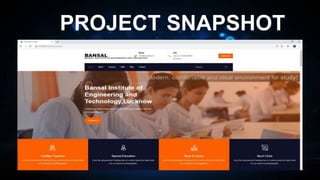
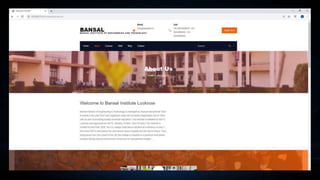
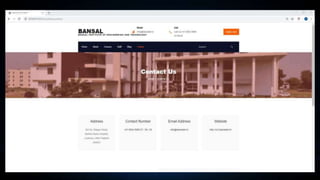
PROJECT SNAPSHOT
APPLICATION
INTRODUCTION TO DJANGO
Django is a web application framework written in Python programming
language. It is based on MVT (Model View Template) design pattern. The
Django is very demanding due to its rapid development feature. It takes
less time to build application after collecting client requirement.
HISTORY :- Django was design and developed by Lawrence journal
world in 2003 and publicly released under BSD license in July 2005.
Currently, DSF (Django Software Foundation) maintains its development and
release cycle.
Django was released on 21, July 2005. Its current stable version is 2.0.3
which was released on 6 March, 2018.
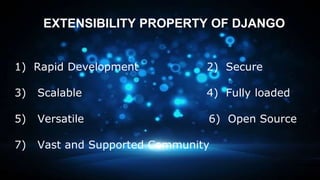
EXTENSIBILITY PROPERTY OF DJANGO
1) Rapid Development 2) Secure
3) Scalable 4) Fully loaded
5) Versatile 6) Open Source
7) Vast and Supported Community
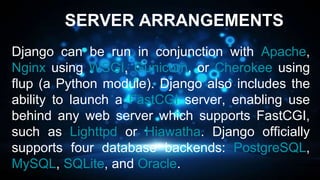
SERVER ARRANGEMENTS
Django can be run in conjunction with Apache,
Nginx using WSGI, Gunicorn, or Cherokee using
flup (a Python module). Django also includes the
ability to launch a FastCGI server, enabling use
behind any web server which supports FastCGI,
such as Lighttpd or Hiawatha. Django officially
supports four database backends: PostgreSQL,
MySQL, SQLite, and Oracle.
Programmers have ported Django's template design from Python
to other languages, providing decent cross-platform support.
Some of these options are more direct ports; others, though
inspired by Django and retaining its concepts, take the liberty to
deviate from Django's design:
❏ Liquid for Ruby
❏ Template:Swig for Perl
❏ Twig for PHP and JavaScript
❏ Jinja for Python
PORT TO OTHER LANGUAGE
BIBLIOGRAPHY
1) GOOGLE
2) YOU TUBE
3) Mr. SATISH SIR
THANKYOU

Django Frame Work

  • 2.
    Bansal Institute ofEngineering & Technology “PRESENTATION” SUBMITTED TO :- CSE DEPARTMENT SUBMITTED BY :- AKASH CHAUDHARY 1642210005
  • 3.
  • 4.
    ❖ INTRODUCTION TOMADHESHIYA SOFTWARE PRIVATE LIMITED ❖ CERTIFICATION OF COMPLETION ❖ INTRODUCTION TO PYTHON ❖ WHY WE USE PYTHON? ❖ INTRODUCTION TO WEB APPLICATION ★ INTERFACE ● SERVER SIDE ● CLIENT SIDE ★ STRUCTURE ★ DEVELOPMENT ★ APPLICATION INDEX
  • 5.
    INDEX ❖ INTRODUCTION TODJANGO ★ HISTORY ★ FEATURES ★ EXTENSIBILITY PROPERTY OF DJANGO ★ SERVER ARRANGEMENTS ★ PORT TO OTHER LANGUAGE ❖ BIBLIOGRAPHY ❖ THANKYOU
  • 6.
    INTRODUCTION TO MADHESHIYASOFTWARE Pvt Ltd Madhesiya Software Private Limited started in 2012 as a small Institute with a big vision, is a dynamic new generation software solution as well as Networking Product Development Institute. The Institute develop, markets, sells and supports software products, ERPs, Web Based Projects, Networking Projects and offers turnkey solutions to the customers.Madhesiya development team is built of motivated, young, yet experienced professionals, all of whom have a higher degree. We have a strong track record of innovation. Our solutions have been used by clients of different background and size, from small companies to individuals and government organizations. Madhesiya Software Private Limited is master in programming services, Application Development and Integration Services, Web Design and Development Services and R&D. We offer customized and flexible IT solutions, with low costs for international standards, without any reduction or loss in quality, technology and/or scalability for the client. We treat our clients with courtesy, friendliness and intelligence.
  • 7.
  • 8.
    INTRODUCTION TO PYTHON Pythonis a widely used general- purpose, high level programming language. It was initially designed by Guido van Rossum in 1991 and developed by Python Software Foundation. It was mainly developed for emphasis on code readability, and its syntax allows programmers to express concepts in fewer lines of cod
  • 9.
    1) Easy toLearn and Use 3) Interpreted Language 5) Free and Open Source 7) Extensible 9) GUI Programming Support Why we use python? 2) Expressive Language 4) Cross-platform Language 6) Object-Oriented Language 8) Large Standard Library 10) Integrated
  • 10.
    INTRODUCTION TO WEBAPPLICATION In computing, a web application or web app is a client–server computer program that the client (including the user interface and client-side logic) runs in a web browser. Common web applications include webmail, online retail sales, and online auction. The general distinction between a dynamic web page of any kind and a "web application" is unclear. Web sites most likely to be referred to as "web applications" are those which have similar functionality to a desktop software application, or to a mobile app.
  • 11.
  • 14.
  • 15.
    INTRODUCTION TO DJANGO Djangois a web application framework written in Python programming language. It is based on MVT (Model View Template) design pattern. The Django is very demanding due to its rapid development feature. It takes less time to build application after collecting client requirement. HISTORY :- Django was design and developed by Lawrence journal world in 2003 and publicly released under BSD license in July 2005. Currently, DSF (Django Software Foundation) maintains its development and release cycle. Django was released on 21, July 2005. Its current stable version is 2.0.3 which was released on 6 March, 2018.
  • 16.
    EXTENSIBILITY PROPERTY OFDJANGO 1) Rapid Development 2) Secure 3) Scalable 4) Fully loaded 5) Versatile 6) Open Source 7) Vast and Supported Community
  • 17.
    SERVER ARRANGEMENTS Django canbe run in conjunction with Apache, Nginx using WSGI, Gunicorn, or Cherokee using flup (a Python module). Django also includes the ability to launch a FastCGI server, enabling use behind any web server which supports FastCGI, such as Lighttpd or Hiawatha. Django officially supports four database backends: PostgreSQL, MySQL, SQLite, and Oracle.
  • 18.
    Programmers have portedDjango's template design from Python to other languages, providing decent cross-platform support. Some of these options are more direct ports; others, though inspired by Django and retaining its concepts, take the liberty to deviate from Django's design: ❏ Liquid for Ruby ❏ Template:Swig for Perl ❏ Twig for PHP and JavaScript ❏ Jinja for Python PORT TO OTHER LANGUAGE
  • 19.
    BIBLIOGRAPHY 1) GOOGLE 2) YOUTUBE 3) Mr. SATISH SIR
  • 20.