BY: IMTIAZ HUSSAIN 048 M. EHSAN ULLAH 012 HAFIZ ABUBAKAR 096(06) MUHAMMAD IDREES 027 DISTRIBUTING PROCESSING
OUTLINE Distributed Processing Distributed System Architecture  Form of D.P Techniques Challenges Advantage/Disadvantage
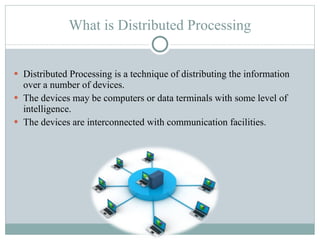
What is Distributed Processing Distributed Processing is a technique of distributing the information over a number of devices.  The devices may be computers or data terminals with some level of intelligence.  The devices are interconnected with communication facilities.
What is Distributed System A distributed system is one in which components located at  networked computers communicate  and  coordinate their actions only  by passing messages . Examples The internet An intranet which is a portion of the internet managed by an organization
Architecture Software layers System architectures Interfaces and objects Design requirements for distributed architectures
Software layers Applications, services Middleware Operating system Computer and network hardware
System architectures Client-server model Services provided by multiple servers Proxy srvers and caches Peer processes
Design requirements for distributed architectures Performance issues Use of caching and replication Dependability issues
Design requirements for distributed architectures Performance issues Responsiveness Balancing computer loads Quality of services Caching and replication The performance issues often appear to be major obstacles to the successful deployment of DS, but much progress has been made in the design of systems that overcome them by the use of data replication and caching. Dependability issues Correctness Security Fault tolerance
Form of Distributed Processing Distributed Applications Distributed Devices Network Management and Control Distributed Data
Distributed Applications One application splits up into components that are dispersed among a number of machines One application replicated on a number of machines A number of different applications distributed among a number of machines Can be characterized by vertical or horizontal partitioning
Distributed Devices Support a distributed set of devices that can be controlled by processors, e.g. ATMs or laboratory interface equipments  Distribution of processing technology to various locations of the manufacturing process in factory automation
Techniques of Distributed Processing Centralized Decentralized Parallel  Open Distributed Processing Clustering
Centralized Centralized Processing  is done at a central location, using terminals that are attached to a central computer The central computer performs the computing functions and controls the remote terminals. This type of system relies totally on the central computer.
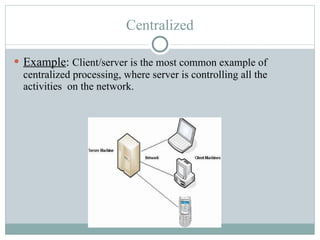
Centralized Example :  Client/server is the most common example of centralized processing, where server is controlling all the activities  on the network.
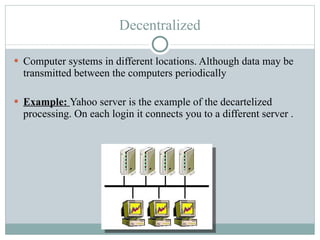
Decentralized Computer systems in different locations. Although data may be transmitted between the computers periodically Example:  Yahoo server is the example of the decartelized processing. On each login it connects you to a different server .
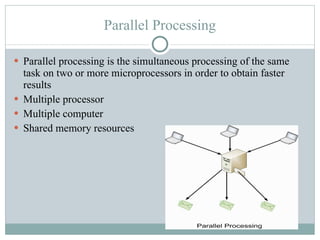
Parallel Processing Parallel processing is the simultaneous processing of the same task on two or more microprocessors in order to obtain faster results Multiple processor Multiple computer Shared memory resources
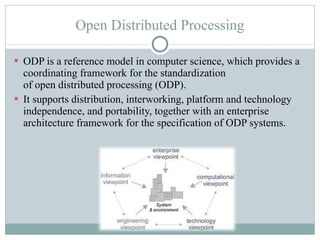
Open Distributed Processing ODP is a reference model in computer science, which provides a coordinating framework for the standardization of open distributed processing (ODP).  It supports distribution, interworking, platform and technology independence, and portability, together with an enterprise architecture framework for the specification of ODP systems.
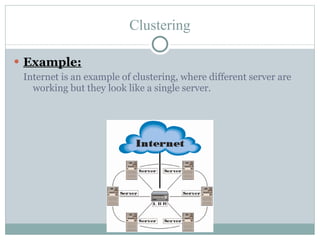
Clustering A cluster is a group of individual computer systems that can be made to appear as one computer system. Clustering is just one form of parallel computing.  key points that distinguishes clustering from other is the ability to view the cluster as either a single entity or a collection of stand-alone systems For example :  a cluster of web servers can appear as one large web server, but at the same time, individual systems within the cluster can be accessed as individual systems,
Clustering Example: Internet is an example of clustering, where different server are working but they look like a single server.
Challenges Heterogeneity Security Scalability Failure handling Concurrency
Advantages Quicker response time By locating processing power close to user, response time is typically improved. This means that the system responds rapidly to commands entered by users. Lower costs   Long-distance communication costs are declining at a slower rate than the cost of computer power Distributed processing can reduce the volume of data that must be transmitted over long-distances and thereby reduce long-distance costs. Improved data integrity High degrees of accuracy and correctness may be achieved by giving users control over data entry and storage.
Advantages Reduced host processor costs   The productive life of a costly mainframe can be extended by off-loading some its processing tasks to other, less expensive machines Resource sharing One of the main advantages of developing microcomputer networks is because they make it possible to share expensive resources such as high-speed, color laser printers, fast data storage devices, and high-priced software packages.
Disadvantage Complexities A lot of extra programming is required to set up a distributed system Network failure Since distributed system will be connected through network and in case of network failure non of the systems will work Security The information need to be passed between the network. And it can be tracked and can be used for illegal purpose. Costly software Not all situations are suitable for distributed computing
 

Distributed Processing

  • 1.
    BY: IMTIAZ HUSSAIN048 M. EHSAN ULLAH 012 HAFIZ ABUBAKAR 096(06) MUHAMMAD IDREES 027 DISTRIBUTING PROCESSING
  • 2.
    OUTLINE Distributed ProcessingDistributed System Architecture Form of D.P Techniques Challenges Advantage/Disadvantage
  • 3.
    What is DistributedProcessing Distributed Processing is a technique of distributing the information over a number of devices. The devices may be computers or data terminals with some level of intelligence. The devices are interconnected with communication facilities.
  • 4.
    What is DistributedSystem A distributed system is one in which components located at networked computers communicate and coordinate their actions only by passing messages . Examples The internet An intranet which is a portion of the internet managed by an organization
  • 5.
    Architecture Software layersSystem architectures Interfaces and objects Design requirements for distributed architectures
  • 6.
    Software layers Applications,services Middleware Operating system Computer and network hardware
  • 7.
    System architectures Client-servermodel Services provided by multiple servers Proxy srvers and caches Peer processes
  • 8.
    Design requirements fordistributed architectures Performance issues Use of caching and replication Dependability issues
  • 9.
    Design requirements fordistributed architectures Performance issues Responsiveness Balancing computer loads Quality of services Caching and replication The performance issues often appear to be major obstacles to the successful deployment of DS, but much progress has been made in the design of systems that overcome them by the use of data replication and caching. Dependability issues Correctness Security Fault tolerance
  • 10.
    Form of DistributedProcessing Distributed Applications Distributed Devices Network Management and Control Distributed Data
  • 11.
    Distributed Applications Oneapplication splits up into components that are dispersed among a number of machines One application replicated on a number of machines A number of different applications distributed among a number of machines Can be characterized by vertical or horizontal partitioning
  • 12.
    Distributed Devices Supporta distributed set of devices that can be controlled by processors, e.g. ATMs or laboratory interface equipments Distribution of processing technology to various locations of the manufacturing process in factory automation
  • 13.
    Techniques of DistributedProcessing Centralized Decentralized Parallel Open Distributed Processing Clustering
  • 14.
    Centralized Centralized Processing is done at a central location, using terminals that are attached to a central computer The central computer performs the computing functions and controls the remote terminals. This type of system relies totally on the central computer.
  • 15.
    Centralized Example : Client/server is the most common example of centralized processing, where server is controlling all the activities on the network.
  • 16.
    Decentralized Computer systemsin different locations. Although data may be transmitted between the computers periodically Example: Yahoo server is the example of the decartelized processing. On each login it connects you to a different server .
  • 17.
    Parallel Processing Parallel processing isthe simultaneous processing of the same task on two or more microprocessors in order to obtain faster results Multiple processor Multiple computer Shared memory resources
  • 18.
    Open Distributed ProcessingODP is a reference model in computer science, which provides a coordinating framework for the standardization of open distributed processing (ODP). It supports distribution, interworking, platform and technology independence, and portability, together with an enterprise architecture framework for the specification of ODP systems.
  • 19.
    Clustering A clusteris a group of individual computer systems that can be made to appear as one computer system. Clustering is just one form of parallel computing. key points that distinguishes clustering from other is the ability to view the cluster as either a single entity or a collection of stand-alone systems For example : a cluster of web servers can appear as one large web server, but at the same time, individual systems within the cluster can be accessed as individual systems,
  • 20.
    Clustering Example: Internetis an example of clustering, where different server are working but they look like a single server.
  • 21.
    Challenges Heterogeneity SecurityScalability Failure handling Concurrency
  • 22.
    Advantages Quicker responsetime By locating processing power close to user, response time is typically improved. This means that the system responds rapidly to commands entered by users. Lower costs   Long-distance communication costs are declining at a slower rate than the cost of computer power Distributed processing can reduce the volume of data that must be transmitted over long-distances and thereby reduce long-distance costs. Improved data integrity High degrees of accuracy and correctness may be achieved by giving users control over data entry and storage.
  • 23.
    Advantages Reduced hostprocessor costs   The productive life of a costly mainframe can be extended by off-loading some its processing tasks to other, less expensive machines Resource sharing One of the main advantages of developing microcomputer networks is because they make it possible to share expensive resources such as high-speed, color laser printers, fast data storage devices, and high-priced software packages.
  • 24.
    Disadvantage Complexities Alot of extra programming is required to set up a distributed system Network failure Since distributed system will be connected through network and in case of network failure non of the systems will work Security The information need to be passed between the network. And it can be tracked and can be used for illegal purpose. Costly software Not all situations are suitable for distributed computing
  • 25.

Editor's Notes

  • #2 Designed by: IMTIAZ HUSSAIN